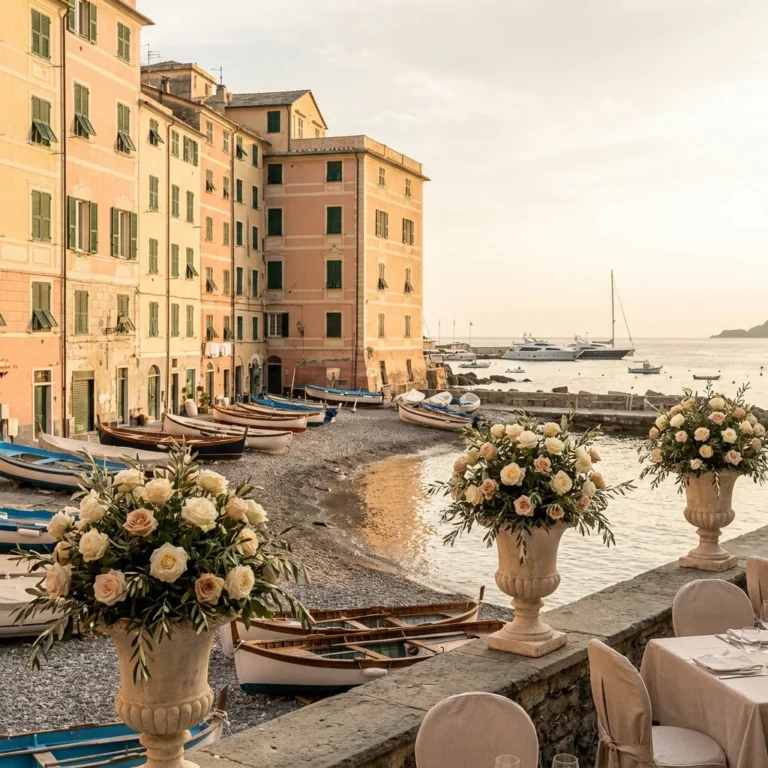
Lake Como Wedding Flowers
The villa you have chosen on the western shore — perhaps a sixteenth-century estate whose terraced gardens descend in stone tiers toward the water — almost certainly limits when a florist may arrive, how much weight a pier can bear, and how long an installation may remain before the evening light shifts. These are not aesthetic questions. They are the practical constraints that shape every floral decision on Lake Como, and most couples encounter them only after they have fallen in love with a single image of arches and roses.
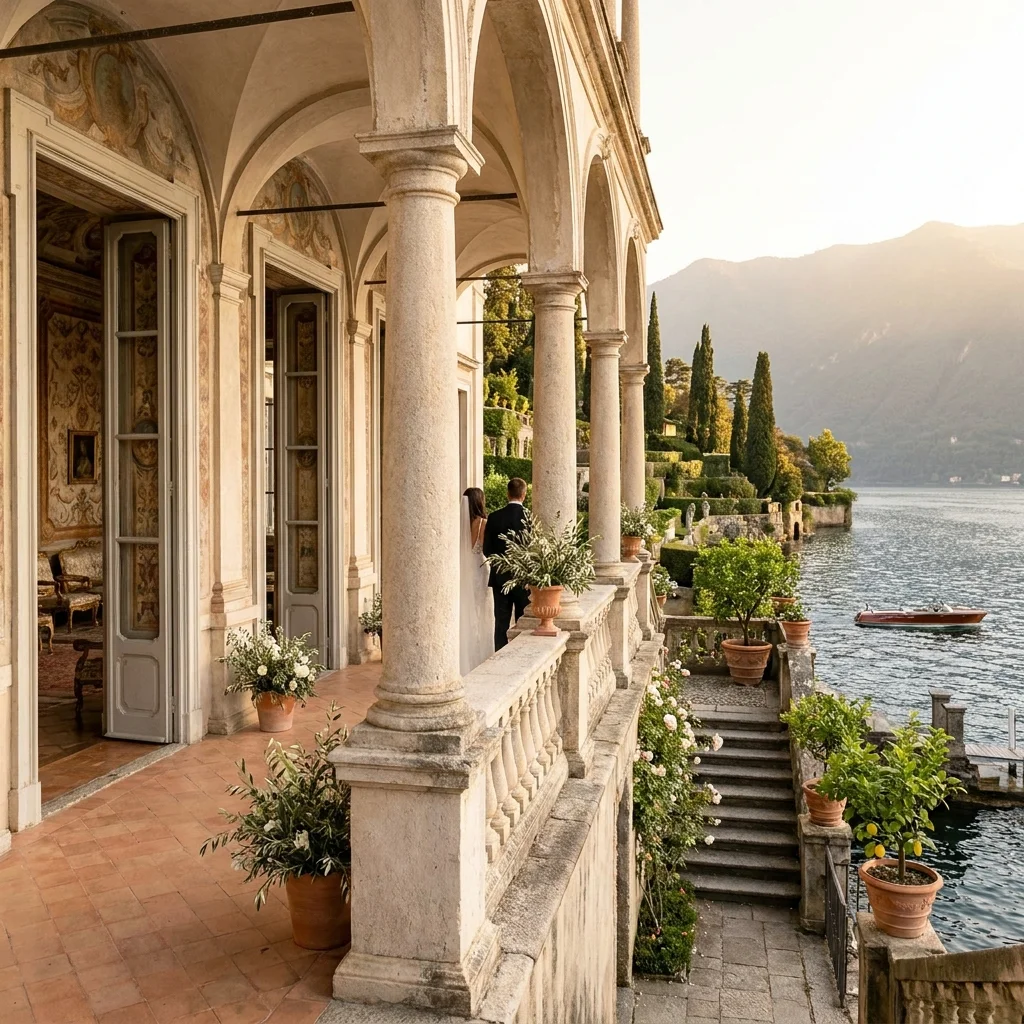
At Kiss Me Italy, we begin not with the bouquet but with the architecture, the boat schedule, and the lakefront microclimate. The flowers follow.
What Lake Como Wedding Flowers Typically Cost and What Shapes the Quote
Lake Como wedding flowers generally cost between €6,000 and €35,000 for a full celebration of 60 to 120 guests, depending on villa scale, installation complexity, and seasonal availability. A refined intimate design with ceremony arch, bridal flowers, and twelve centrepieces typically begins around €6,000–€9,000, while large architectural installations across multiple villa rooms and terraces can exceed €30,000. Travel, delivery to lakefront-access-only properties, permits where required, and Italian VAT at 22% are usually quoted as separate lines.
The figure moves with the venue. A villa reached only by boat carries a delivery premium that a road-accessible estate does not. We address this in the first consultation, before any concept is drawn.
Why Villa Architecture Decides the Floral Concept Before the Palette Does
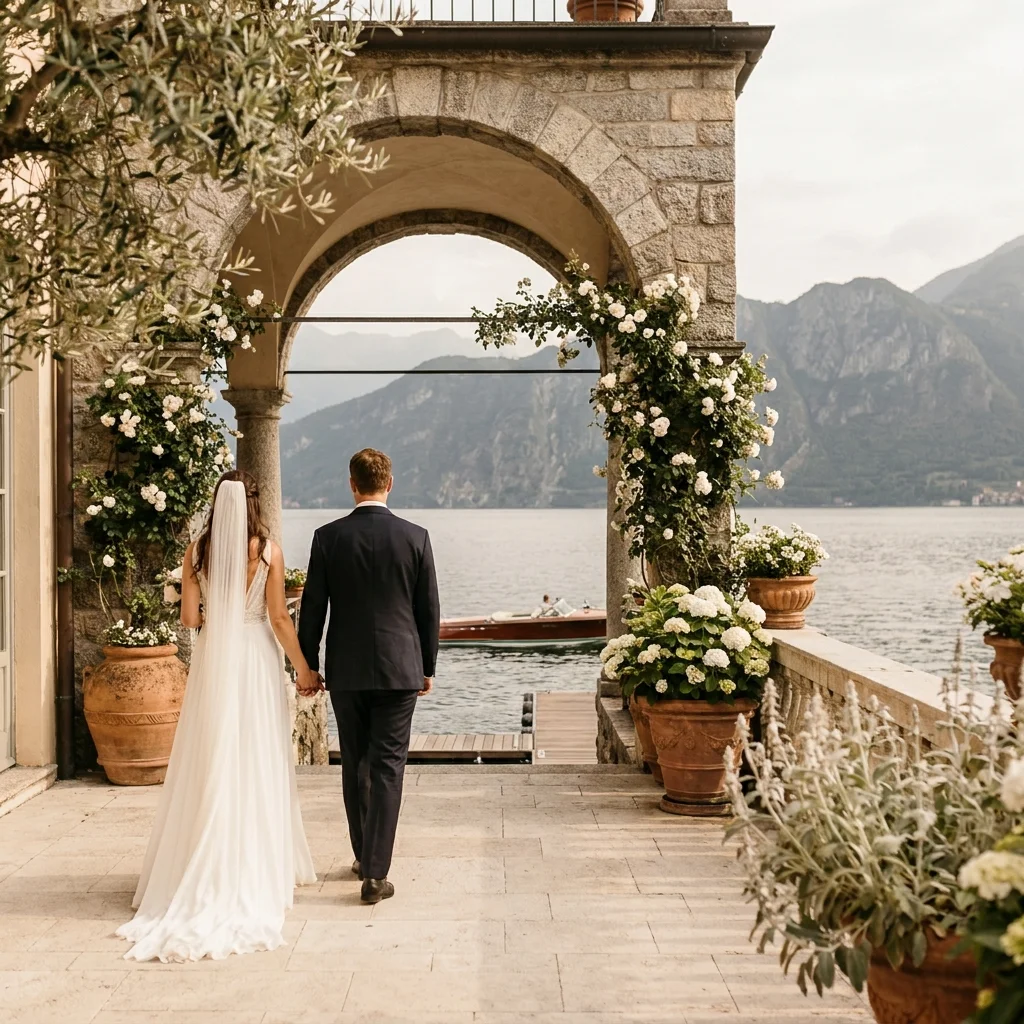
Lake Como’s wedding villas were not built as event spaces. They were commissioned, in most cases between the sixteenth and nineteenth centuries, as private noble residences — and their architectural grammar still governs what flowers can do inside them.
Consider the frescoed salons of a famous neoclassical property on the eastern shore. Ceilings rise four metres or more; the scale demands floral structures that read at a distance, not delicate posies that vanish against Baroque plasterwork. By contrast, a lesser-known private villa we often recommend — a terracotta-coloured residence with a loggia of slender columns and a garden of clipped box — asks for restraint, where a single trailing arrangement along a balustrade does more than a dozen tall arrangements ever could.
Villa Balbianello, with its arched loggia and dramatic promontory, is a study in how stone and water frame a ceremony; flowers here are punctuation, never wallpaper. Villa d’Este and Villa Erba, both grand in a more theatrical register, hold abundant Renaissance-scale design with ease. We read each room as a scenographer reads a stage. The set already exists. Our task is to dress it without competing with it.
This is why we never begin with a Pinterest palette. We begin with the proportions of the space, the colour of the existing stone and fresco, and the direction of afternoon light. The flowers are chosen last, and chosen to belong. Our team can review the venue’s architectural character and floral priorities in a private consultation — a conversation we welcome early.
How the Lake Microclimate Changes What Blooms Survive the Day
Lake Como sits in a pocket of unusual warmth. The water moderates temperature, but it also raises humidity, and in July and August the midday terraces grow hot enough to wilt soft-headed garden roses within hours of installation.
This is the seasonality that matters — not which flowers are fashionable, but which flowers hold. In late April through early June, peonies, ranunculus, and sweet pea arrive at their finest and tolerate the milder air. September and early October offer dahlias, late garden roses, and the first dried-grass textures, with cooler evenings that protect installations during the long reception. High summer favours hydrangea, lisianthus, and Mediterranean greenery — varieties bred to endure heat and direct sun.
We brief every florist on the specific microclimate of the chosen villa, because a north-facing courtyard and a south-facing lake terrace at the same property behave like two different climates. The Italian wedding flowers that flatter one will fail on the other. This is local knowledge no imported design deck can supply.
| Floral Scope | Indicative Range | Included | Quoted Separately |
|---|---|---|---|
| Intimate villa wedding (up to 40 guests) | €6,000–€9,000 | Bridal bouquet, ceremony focal piece, 6–10 centrepieces, design consultation | Delivery to boat-access villas, permits, VAT 22% |
| Mid-scale villa celebration (60–90 guests) | €10,000–€20,000 | Full bridal party flowers, ceremony arch, 12–18 centrepieces, aperitivo florals, strike | Travel/lodging for out-of-area crew, evening relighting of arrangements, VAT 22% |
| Large architectural installation (100+ guests) | €22,000–€35,000+ | Multi-room design, suspended/structural features, terrace and staircase work, full crew | Custom structures, rental hardware, permits, generator power, VAT 22% |
Indicative ranges. Contact Kiss Me Italy for a personalized proposal.
Floral Design as a System: Bouquet, Boat, Arrival, Aperitivo, Dinner
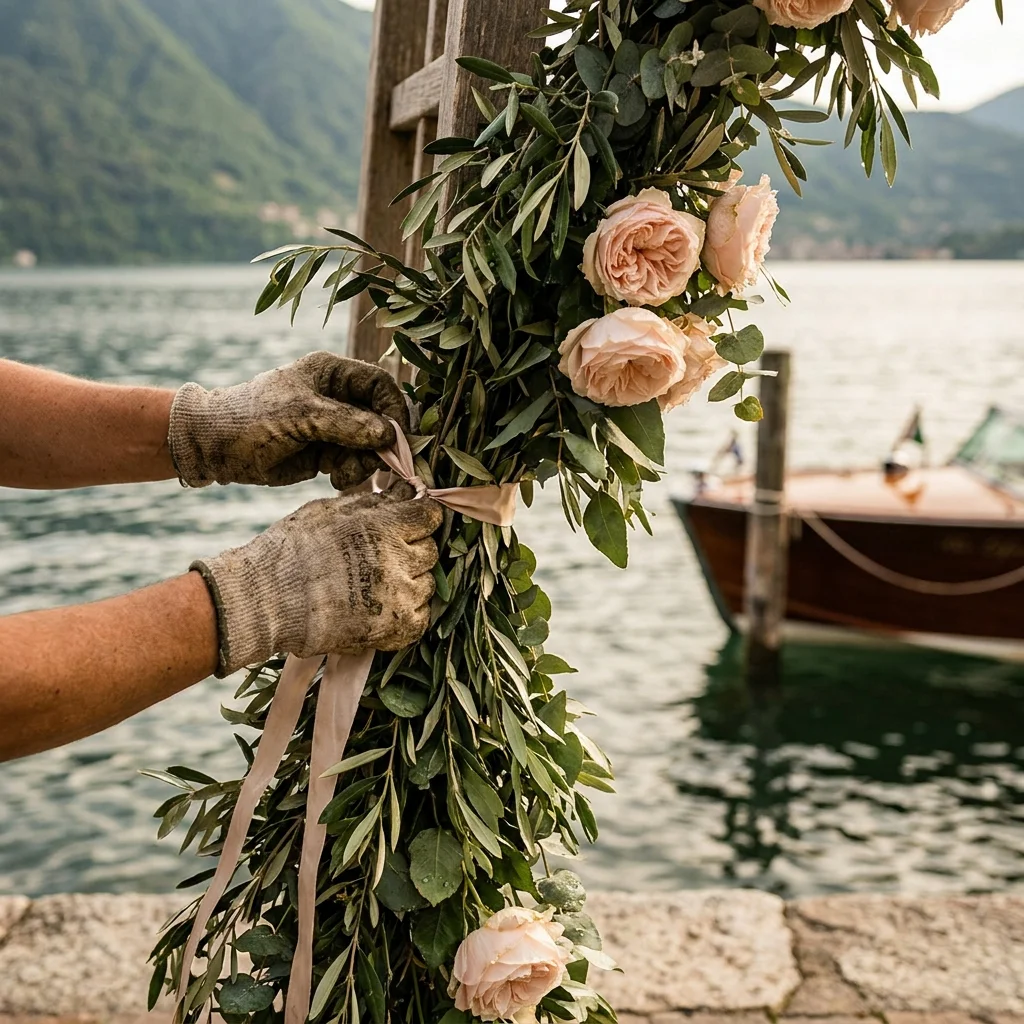
A wedding on Lake Como is rarely contained to one room. Guests arrive by boat, gather for aperitivo on a terrace, move to a ceremony lawn, then descend to a dining loggia as the light turns gold. The flowers must travel with them.
We design the floral story as a continuous sequence rather than a set of isolated arrangements. The bridal bouquet establishes the palette. The boat arrival — a moment increasingly central to lakeside weddings — may carry a single elegant garland at the prow, echoing the ceremony to come. The aperitivo zone receives lighter, lower work so guests can see one another across the tables.
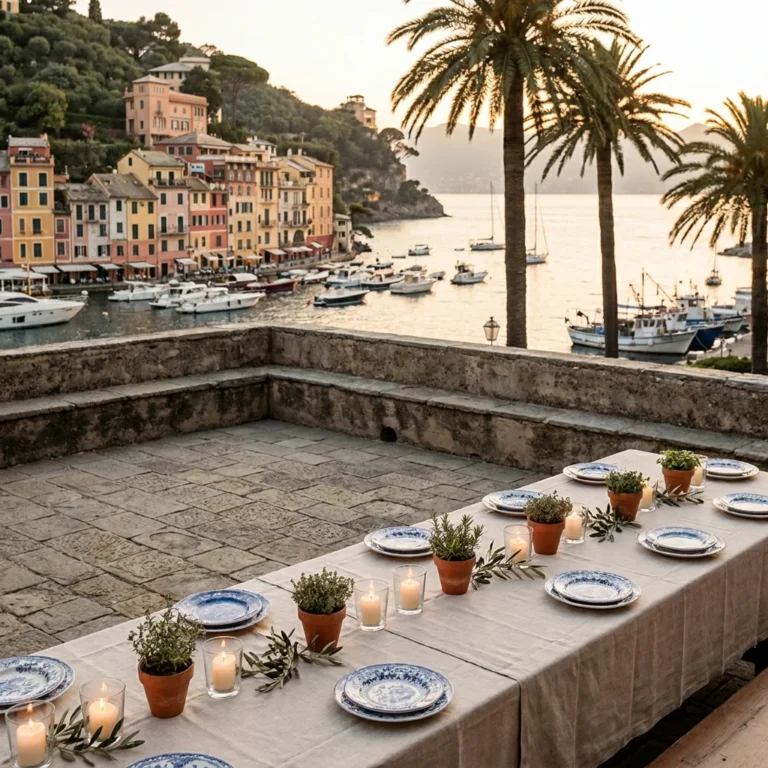
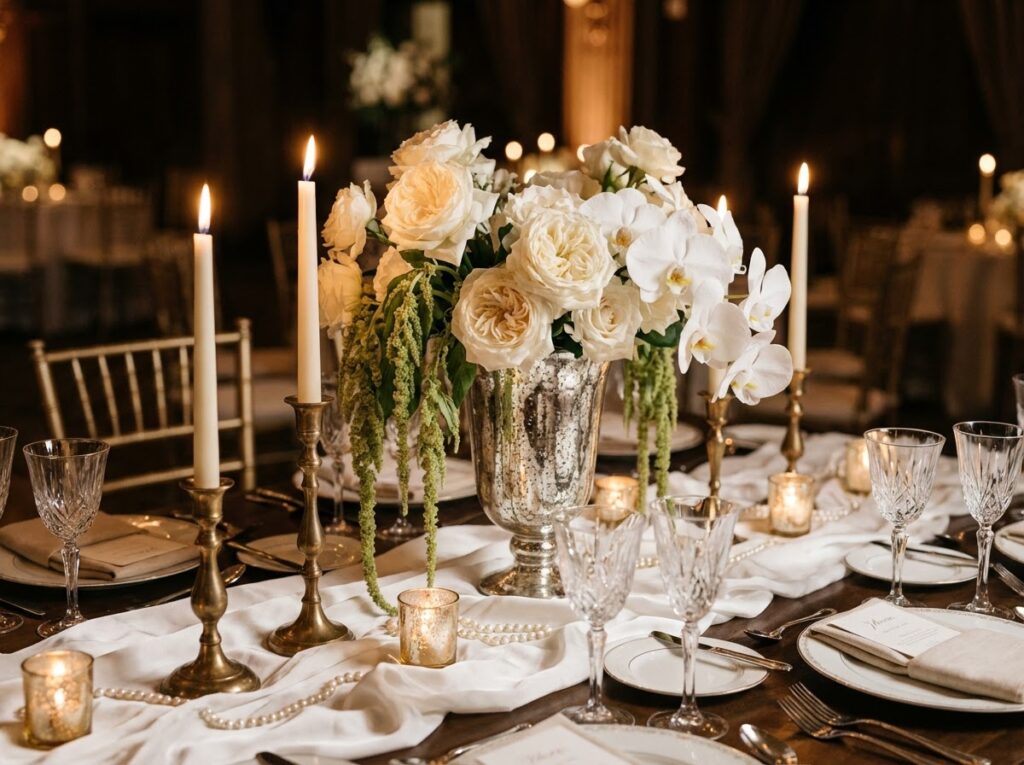
Then the dinner. Here the design either crescendos into serpentine-curved tables dressed with low running greenery and candlelight, or holds to round tables with taller, sculptural centrepieces. We coordinate this directly with the tablescape and lighting plan, because flowers that photograph beautifully at four in the afternoon can disappear entirely under warm evening light unless the relighting is planned in advance. The way these elements connect is something our work on Italian wedding tablescapes explores in depth, and the floral layer is integral to it.
This continuity is also what makes the photography sing. Editorial images depend on colour echoing through every frame — from the bouquet to the boat to the final toast — and we brief the florist and the wedding photographer together so the palette reads consistently across the entire day.
The Delivery, Installation, and Strike Windows That Govern Lakefront Flowers
This section is deliberately technical, because the logistics of Lake Como floral design are where most aesthetic ambitions either hold or quietly fall apart.
Many of the lake’s most beautiful villas have no road access. Flowers, structures, and crew arrive by boat — which means delivery is scheduled around water traffic, dock availability, and the villa’s own arrival window for the couple’s guests. A florist cannot simply park a van. We coordinate the floral barge to land and clear the pier before guest boats begin to dock.
Installation timing is dictated by heat and light. On a south-facing terrace in July, soft florals are installed in the final cool hours of the morning or, where possible, after the worst of the afternoon sun has passed — never staged at dawn to bake all day. Suspended and structural pieces require rigging time and, frequently, a permit from the villa for any fixing to historic surfaces. We secure these clearances in advance.
Strike — the removal of all floral material — is its own negotiation. Most historic villas require the property to be returned to its original state by a fixed hour, often early the following morning, with no marks on stone or fresco. We build the strike window into the contract from the outset so the celebration is never cut short to accommodate breakdown. The team handling this coordination is the same team described in our guide to choosing a luxury Lake Como wedding planner, and floral logistics are managed as part of that whole. Couples planning a destination celebration for the first time often find our overview of planning a Lake Como wedding a useful orientation before the floral conversation begins.
| Logistical Factor | Typical Window / Constraint | Cost Impact / Quote Driver | How We Manage It |
|---|---|---|---|
| Boat-only delivery | Floral barge cleared before guest arrivals | Delivery surcharge quoted separately; varies by distance and load | Scheduled with villa dock master and boat operator |
| Heat-sensitive installation | Soft florals set in final cool hours pre-event | Extended crew hours may apply for split-shift installation | Crew timing briefed to villa orientation and forecast |
| Structural rigging on historic surfaces | Villa permit often required | Permit fees and specialist rigging quoted as separate line items | Clearances secured in advance of contract sign-off |
| Strike / breakdown | Property restored by fixed morning hour | Overnight crew accommodation may be required and quoted separately | Window written into supplier contract from the start |
The factors above are operational quote drivers rather than fixed prices; each is itemised individually in your proposal. Contact Kiss Me Italy for a personalized quote.
What Lake Como Floral Quotes Include — and What They Don’t
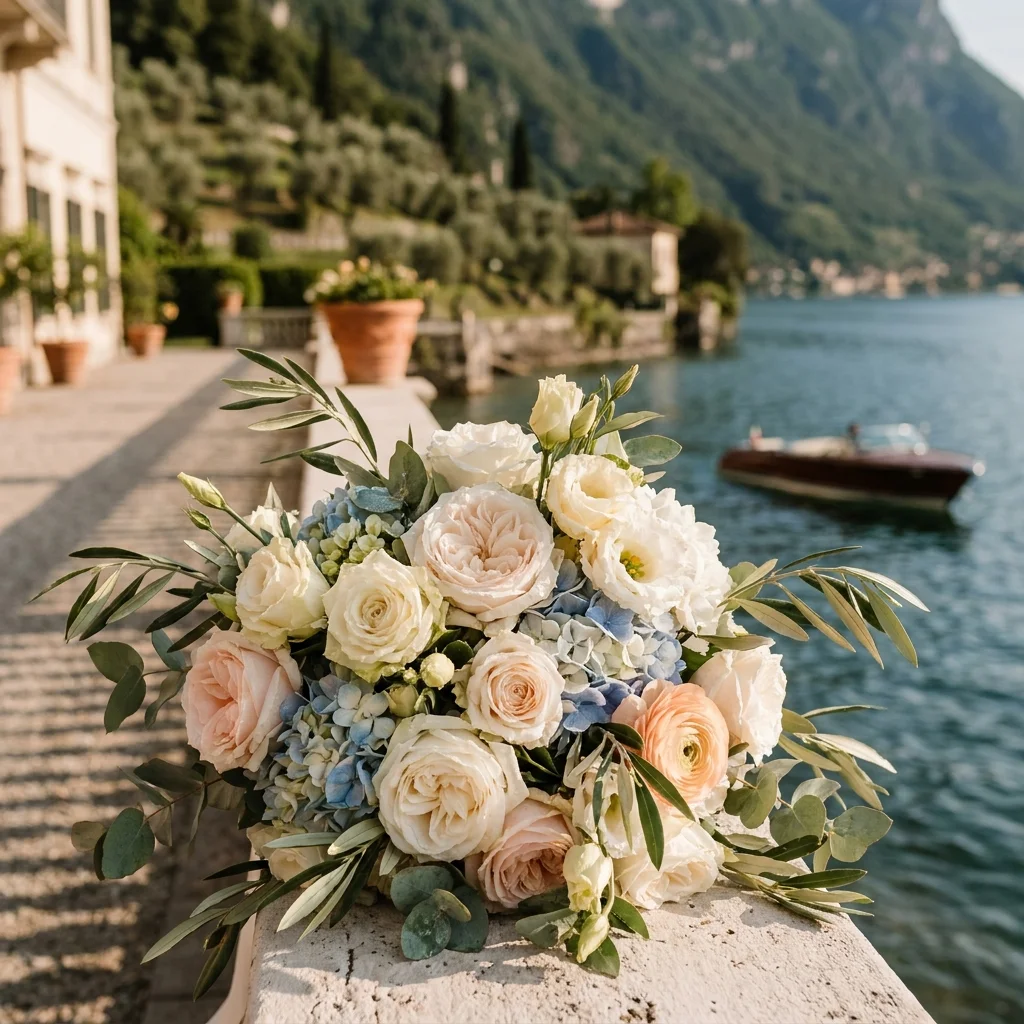
Floral quotes on Lake Como vary widely in what they bundle, and the difference between two superficially similar numbers is almost always in the exclusions. We read every quote line by line so the figure you approve is the figure you pay.
A complete Lake Como floral design quote ordinarily includes the design consultation, the bridal and bridal-party flowers, ceremony focal work, reception centrepieces, conditioning and preparation, and the installation crew for the day. It frequently does not include delivery surcharges for boat-access villas, accommodation for crew travelling from outside the lake region, rental hardware such as plinths and structures, generator power for suspended lighting within installations, or VAT at 22%.
Photography items such as second shooters, post-production, and albums should never appear inside a floral quote; if they do, we separate the supplier scopes before approval. What there can be, on the largest installations, is a design rendering or mock-up stage, where a sample centrepiece is built and reviewed before the full order is confirmed. We arrange this where the scale of investment warrants it. Couples weighing the broader picture often find our overview of planning a Lake Como wedding a useful frame for where flowers sit within the whole.
For the floral philosophy that underpins all of this, beyond the lake specifically, our wider perspective on Italian wedding colour palettes that photograph beautifully shapes how we choose and combine every stem.
An Afternoon on the Western Shore, From Bouquet to the Last Candle
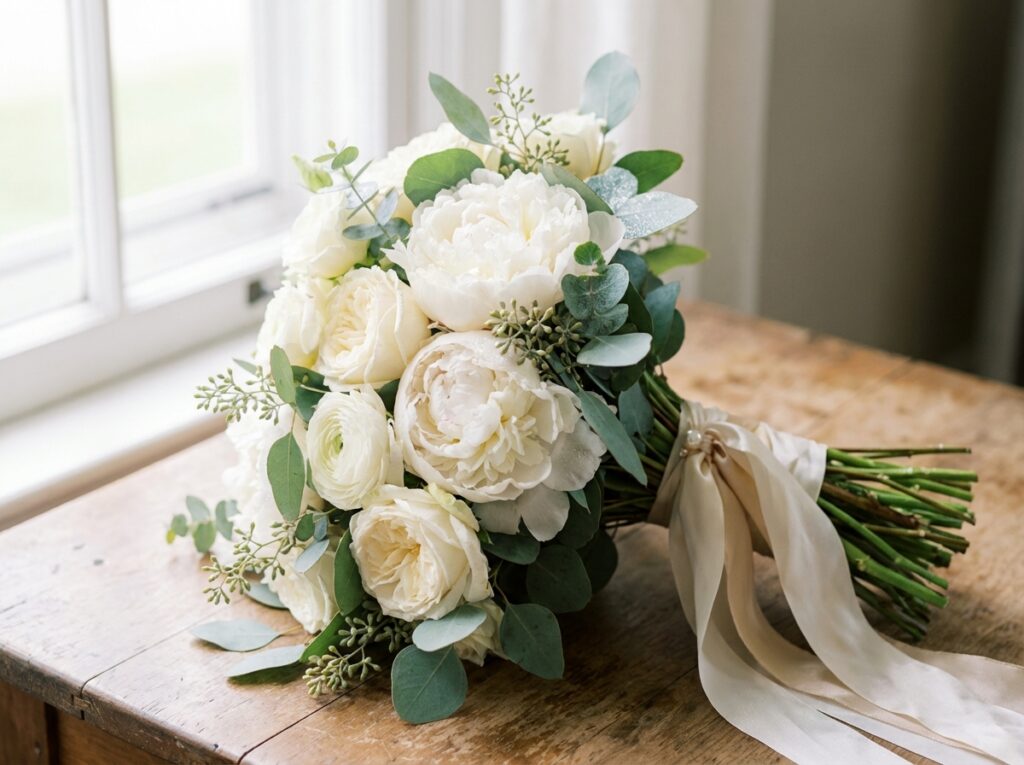
Picture it. A private villa, terraced toward the water, its garden walls warm with three centuries of sun. The bride’s bouquet is loose — garden roses the colour of old parchment, a single dark ranunculus at its heart, ribbon that moves in the lake breeze.
The guests arrive by boat. As each vessel rounds the point, the first thing they see is the loggia, dressed not in a wall of flowers but in two restrained columns of greenery and white that frame the lake beyond. The ceremony is brief. The light, by late afternoon, has gone honeyed.
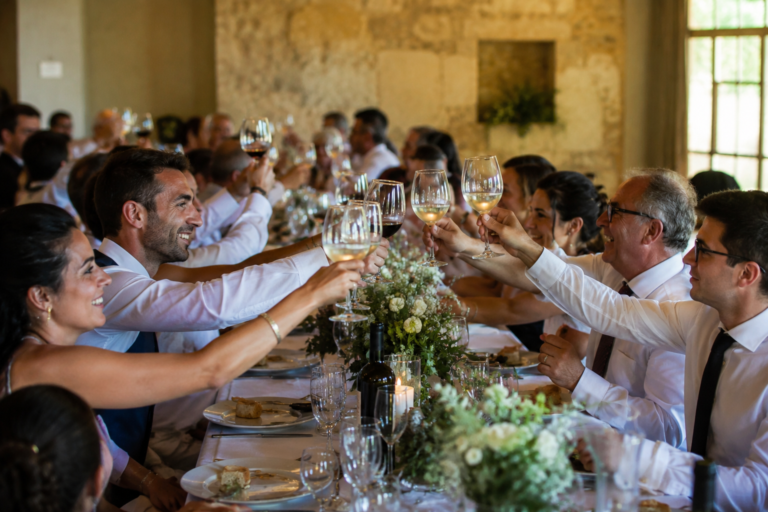
Then the descent to dinner. A long table follows the curve of the terrace, low running foliage threaded with the same parchment roses, candles every half-metre. As the sun drops behind the mountains opposite, the florals seem to deepen in colour — because we relit them an hour earlier, warm light angled to catch the petals, a detail no guest will notice and every photograph will hold. By the time of the last toast, the flowers are no longer decoration. They are the room.
That coherence does not happen by accident. It is curated, briefed, and protected from first sketch to final candle.
How We Curate the Florist Rather Than Hand You a List
We do not give couples a directory of florists and wish them luck. We select the right studio for the specific villa, season, and aesthetic, then manage the relationship on the couple’s behalf from concept to strike.
That means we brief the florist on the architecture and microclimate, we negotiate the inclusions and exclusions, we coordinate delivery with the boat operator and venue, and we align the floral palette with the table, the lighting, and the photography. Where a celebration draws on traditions from afar — as in a Chinese wedding in Italy with its own symbolic colours — we ensure the floral language honours them without losing the lake’s character.
For couples comparing regions, the same curated approach shapes our work on Lake Garda weddings and on the Amalfi Coast, each with its own floral logic. Lake Como simply has the most demanding access constraints of the three, and the most rewarding architecture once they are solved. The broader principles behind our floral work appear across our villa wedding planning and our bespoke luxury wedding service. Our team would gladly review your villa, season, and floral vision privately.
Frequently Asked Questions
What happens if a flower in our chosen palette isn’t available the week of the wedding?
Floral availability shifts with weather and market supply, so we confirm a primary palette and pre-approved substitutions during the design stage. If a specific variety falls short of quality on delivery week, the florist substitutes from the agreed alternates in the same tone and texture, with no change to the overall look you approved.
Does floral insurance exist, and who is responsible if an installation is damaged before the ceremony?
Professional florists working on Lake Como carry their own public liability cover, but this rarely extends to replacing finished installations damaged by weather, a third party, or an accident on site. We recommend confirming with your wedding insurer that your policy includes supplier failure and on-site damage to floral work, and we can advise on the scope of cover typically available in Italy.
Do historic villas restrict what florists can attach to walls or ceilings?
Yes. Most protected villas prohibit any fixing into stone, fresco, or historic plaster without explicit permission, which is why suspended and structural pieces require a villa permit. We secure these clearances before the design is finalized so no element is built that the property will not allow.
How does the choice between a symbolic and a religious ceremony affect the floral design?
A religious ceremony held in a chapel or church on the lake is governed by the institution’s own rules on decoration — many restrict the removal of flowers after the service, limit the use of non-white blooms at the altar, or prohibit certain structural pieces entirely. A symbolic ceremony on a villa terrace carries none of these constraints, giving the florist full creative latitude. We clarify the applicable rules for your ceremony type before any design is drawn.
If bad weather forces the ceremony indoors, do we lose the outdoor florals?
No. Our weather-plan coordination includes relocating or re-deploying floral elements to the indoor setting, and we brief the florist on both the primary and alternate layouts in advance. The crew is scheduled with enough margin to move installations without delaying the ceremony.
Are there fragrance considerations for flowers placed near the dining tables?
Highly fragrant varieties — gardenias, tuberose, stephanotis, and some lilies — can overwhelm guests seated close to centrepieces, particularly in an enclosed loggia or indoor salon where air movement is limited. We discuss fragrance intensity as part of the design brief, especially where guests include children or anyone with known sensitivities, and we can specify low-fragrance alternatives that hold the same visual weight.
How early should the floral design be locked relative to the wedding date?
The concept and palette are ideally confirmed eight to ten months out, with final quantities adjusted once the guest count and table plan are set. Securing the right florist for a peak-season Saturday on the lake often requires booking further ahead than that.
Who handles the floral breakdown so our celebration isn’t interrupted?
The florist’s crew handles strike, scheduled into a contracted window — usually early the following morning — so removal never intrudes on the reception. We write this timing into the supplier agreement at sign-off precisely so the evening runs to its natural end.
Can ceremony flowers be repurposed for the dinner to control cost?
Selected pieces — a ceremony arch reworked into a head-table feature, for example — can be carried through, and we plan this deliberately where it serves both budget and design. We confirm during the design stage which elements are built to move and which are fixed to a single moment.