
Wedding Planners Lake Como: How to Choose the Right Luxury Team for Your Destination Celebration
The best wedding planners on Lake Como combine full production authority — permits, boat logistics, vendor exclusivity, and curfew management — with the refined discretion that high-profile international couples require. Kiss Me Italy has coordinated luxury celebrations along the lake’s western and eastern shores for over three decades, translating Como’s singular beauty into events that run with precision, privacy, and a genuine sense of place.
The first question most couples ask us is not about flowers or colour palettes. It is about control. “If we hire you, do you actually run the day — or do we end up managing things ourselves from across the Atlantic?” After thirty years of producing Lake Como weddings, I can tell you that the answer to this question is the single most important criterion in choosing your planner. Everything else — the venue, the menu, the photographer — follows from it.
Lake Como is not a simple destination. The lake’s geography imposes constraints that most couples — and, frankly, many planners — discover too late. Venues are accessed by boat. Sound curfews are strict and enforced by the comune. Exclusive-use permits for the most coveted properties require negotiation twelve to eighteen months in advance. The couples we work with arrive at their wedding weekend feeling calm precisely because these realities have been resolved long before the first guest boards a water taxi.
This guide is not a gallery of pretty images. It is a decision framework: what level of planning authority you actually need, what a Lake Como wedding genuinely costs, and how to evaluate whether the planner you’re considering has the operational depth this lake demands.
What Separates a Lake Como Wedding Planner from a Generic Destination Coordinator
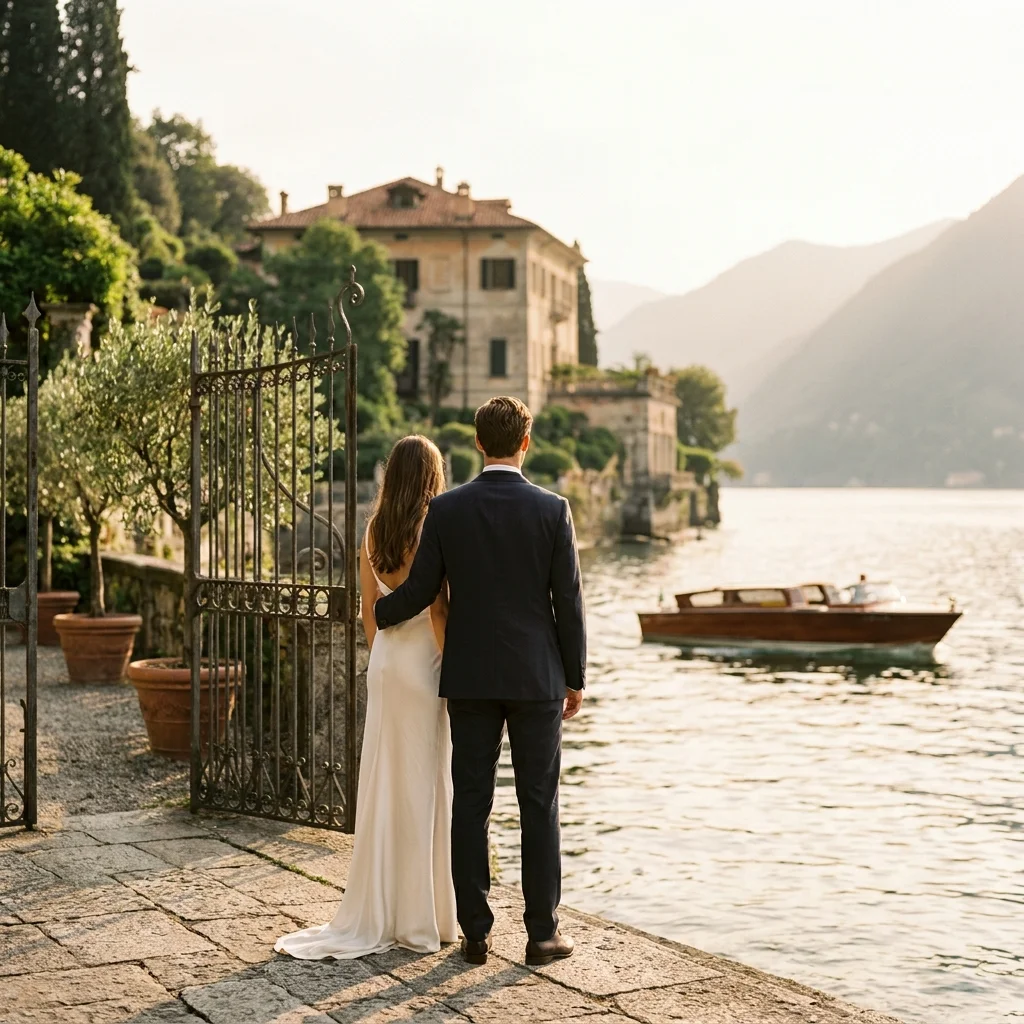
A destination wedding planner who works across all of Italy is not the same as one who has deep, ongoing relationships with Lake Como’s municipal offices, venue managers, and maritime transport operators. The distinction matters more here than in almost any other Italian region, because the lake functions as its own logistical ecosystem.
Consider a single example. A Saturday evening reception at one of the grand villas on the western shore must end amplified music by 11:00 PM — sometimes 10:30 PM, depending on the municipality. The couples we work with often want a celebration that extends past midnight. Our team manages this by structuring the evening in phases: amplified music during the reception window, then a carefully designed transition to an interior after-party space where acoustic parameters differ. This is not creativity. It is operational knowledge built over decades of working within these exact rules.
In our experience, the right Lake Como wedding planner should demonstrate three things before you sign any contract: direct venue access (not through a third-party booking platform), a documented permit timeline specific to your ceremony type, and a single point of coordination for all vendors — meaning you never negotiate separately with the florist, caterer, or lighting designer.
If you are still evaluating whether Italy is the right destination, our guide to choosing the best wedding planners in Italy outlines the broader criteria that apply across regions. But Lake Como adds layers that are specific to this lake alone.
Why Lake Como Wedding Costs Are Shaped by Boats, Access Windows, and Exclusivity Fees
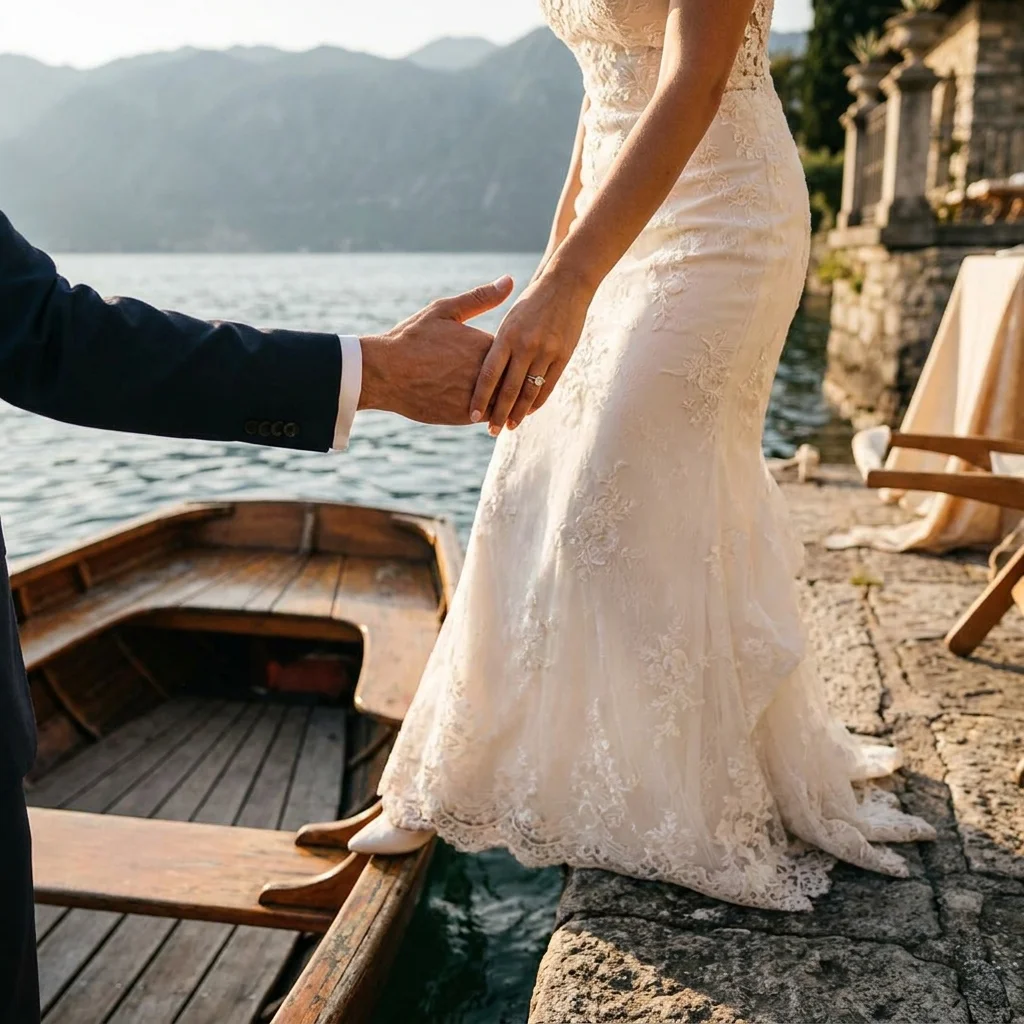
Budget conversations for Lake Como weddings tend to begin with the venue fee and end with surprise. The venue is only one component. What most planners miss — or fail to communicate early — is that logistics on Lake Como carry their own significant cost line.
Guest transfers by private boat from Bellagio to a western-shore villa can cost between €3,000 and €12,000 depending on fleet size, time of day, and whether you require a dedicated vessel for the couple. Evening return transfers after 11:00 PM carry premium rates because most operators limit late-night service. These are not optional extras; they are structural costs that must be budgeted from the start.
Exclusive-use fees at Lake Como’s most prestigious properties — Villa del Balbianello and Villa Balbiano among them — range significantly based on season, day of week, and whether the booking includes overnight accommodation for the couple or a full guest buyout. A hand-selected lesser-known villa on the eastern shore, with private gardens descending to the water and capacity for 80 guests, may offer comparable beauty at a meaningfully lower venue fee, but its access road may require shuttle coordination that adds a separate logistics cost.
Our complete Lake Como wedding planning guide details the cost architecture we use with every couple. Below is a summary of the investment ranges our clients typically encounter.
| Cost Category | Indicative Range (€) | What’s Included | Quoted Separately |
|---|---|---|---|
| Full-service wedding planning | 8,000 – 25,000 | Concept design, vendor sourcing, permit management, timeline production, on-site coordination (full weekend) | Planner travel and accommodation for multi-day events; VAT (IVA 22%) |
| Venue hire (exclusive use, high season) | 15,000 – 80,000+ | Venue access for ceremony and/or reception, basic furnishings, on-site venue coordinator | Catering, lighting, floral installations, overtime charges; VAT (IVA 22%) |
| Guest boat transfers (round trip, 60–100 guests) | 3,000 – 12,000 | Private fleet coordination, embarkation logistics, captain liaison | Late-night surcharges (after 11 PM); couple’s dedicated vessel; VAT (IVA 22%) |
| Catering & beverage (per person) | 180 – 450 | Multi-course seated dinner, welcome cocktail, open bar (4–5 hours), cake | Premium wine upgrades, after-party food stations, staff gratuities; VAT (IVA 22%) |
Indicative ranges based on Kiss Me Italy’s direct project experience. Contact Kiss Me Italy for a personalized proposal.
Iconic Venues You Can Name and Private Estates You’ll Only Discover Through Your Planner
Lake Como’s venue landscape divides into two categories, and understanding the difference shapes your entire planning timeline.
Villa del Balbianello, managed by FAI (Italy’s National Trust), is the lake’s most photographed ceremony location. Its terraced gardens on the Lavedo peninsula offer views that need no enhancement. But availability is limited, ceremonies must conclude by specific hours, and the site does not host receptions — meaning your planner must coordinate a seamless transition by boat to a separate reception venue. This is a logistical choreography, not a simple booking.
Villa Balbiano, on the western shore near Ossuccio, offers the grand-scale lakefront experience with capacity for larger celebrations. Its interiors have appeared in international film and editorial features. Exclusive-use bookings here require early commitment — typically fourteen to eighteen months in advance for peak-season Saturdays.
Then there are the properties that never appear on Instagram. A privately owned eighteenth-century estate above Varenna, with frescoed salons opening onto a walled garden. A restored silk-merchant’s residence in Torno with a private dock and views across to Bellagio. These venues are accessed through established relationships, not booking platforms. After thirty years, our network includes estates whose owners prefer discretion over publicity — and whose settings rival the famous names.
The couples we work with often begin with a famous venue in mind and, after our initial consultation, discover that a lesser-known property better suits their guest count, ceremony style, and privacy requirements. This is precisely why our curated approach to luxury wedding venues in Italy begins with your priorities, not a venue list.
For couples considering whether Lake Como or another Italian lake better fits their vision, our Lake Garda wedding guide offers a useful comparison of atmosphere, logistics, and investment levels.
Civil Ceremony, Symbolic Wedding, or Catholic Rite: What Each Requires on Lake Como
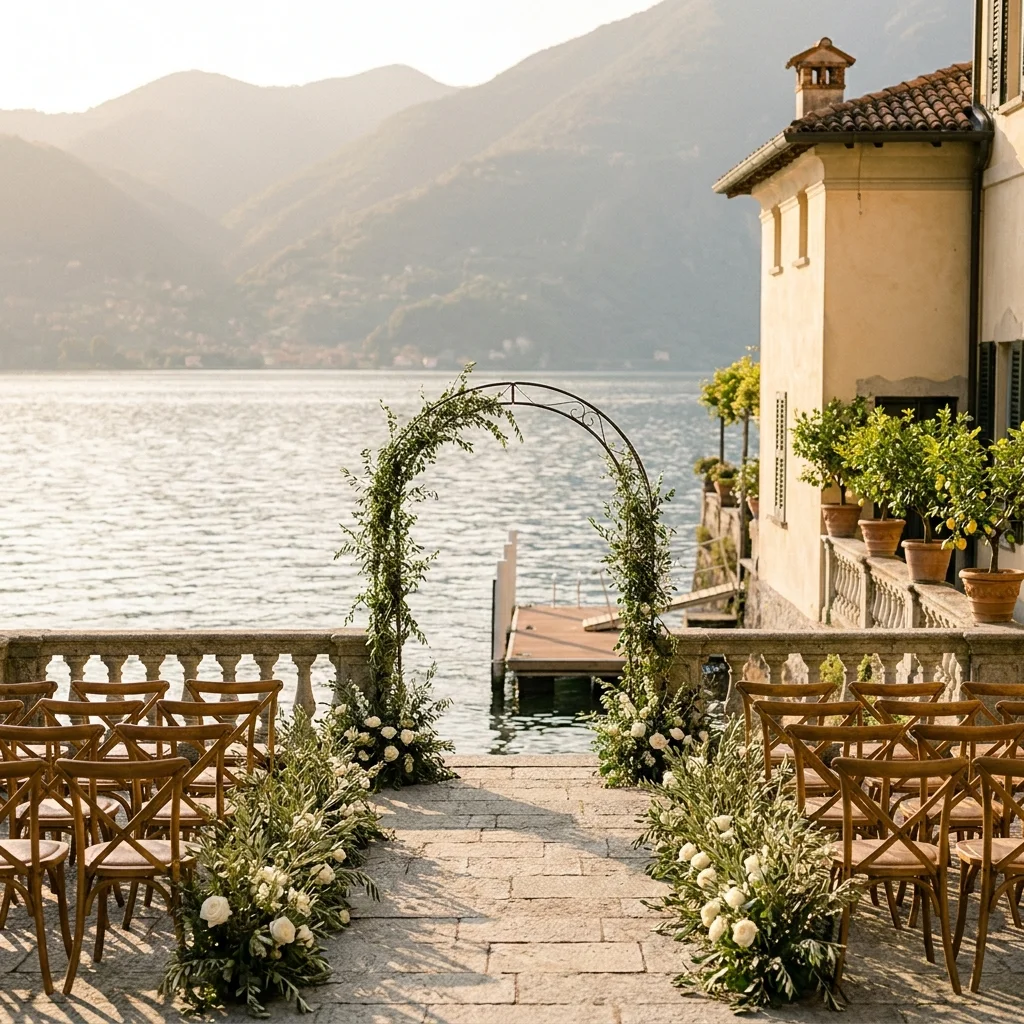
Ceremony type determines your permit timeline, your venue options, and — critically — your paperwork obligations as foreign nationals. This is not a detail to defer.
A civil ceremony on Lake Como is legally binding and must be officiated by the mayor or a delegated official of the comune where the ceremony takes place. Couples marrying in the Comune di Tremezzina (which includes Lenno, Tremezzo, and Griante) will work with that municipality’s civil registry. The paperwork process — including the Nulla Osta and Atto Notorio — typically requires three to four months of lead time for non-EU citizens. Our team manages every document, translation, and apostille so that the couple’s only task is to appear at the ceremony.
Our detailed guide to getting legally married in Italy as a foreigner covers the full documentation process. For Lake Como specifically, we coordinate directly with the local Ufficio di Stato Civile to confirm availability and ensure compliance.
A symbolic wedding on Lake Como carries no legal weight but offers complete creative freedom. The ceremony can take place anywhere — a private garden, a boat deck, a lakeside terrace — without municipal scheduling constraints. Many of our couples choose a symbolic ceremony in Italy and complete legal formalities in their home country before or after the celebration.
For couples seeking a Catholic marriage in Italy, the lake’s historic churches — including the Basilica di San Giacomo in Bellagio — offer extraordinary settings. Church availability, however, must be coordinated with the parish priest months in advance, and pre-marital preparation requirements (Pre-Cana or equivalent) must be fulfilled in the couple’s home diocese.
What a Lake Como Wedding Menu Actually Looks Like — and Why It Differs from Tuscany
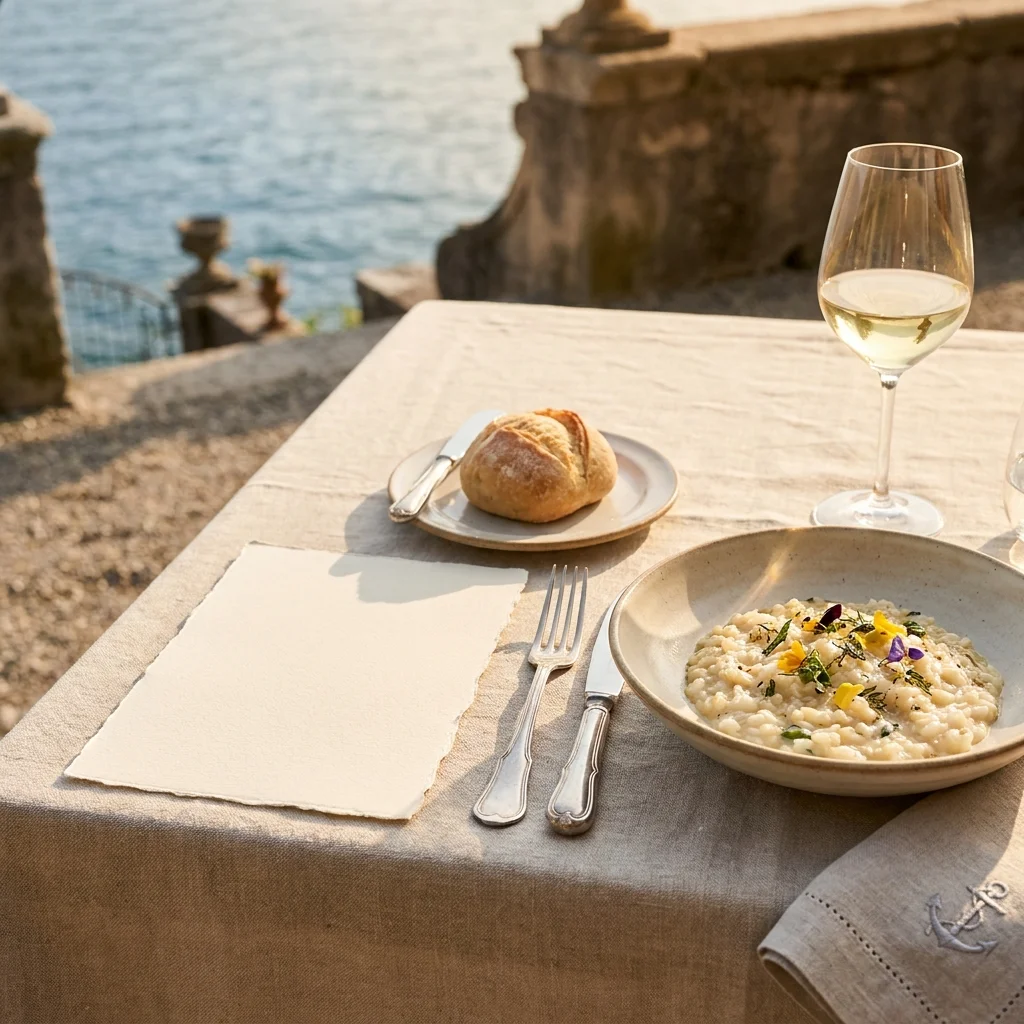
Lake Como sits in Lombardy, not Tuscany. The culinary tradition here is alpine-influenced, lake-centred, and distinct. Risotto — not pasta — anchors the primo course. Freshwater fish from the lake, particularly lavarello and missoltini, appear on menus that a Tuscan caterer would never compose. Butter and sage replace olive oil in many preparations.
This matters because the couples we work with want a genuine Italian dining experience, not a generic Mediterranean menu repackaged with a “Lake Como” label. Our hand-selected caterers source from the lake’s own fishermen and from suppliers in the Valtellina valley just to the north. A late-September wedding might feature a risotto with porcini gathered that morning from the forests above Menaggio.
Menu tastings typically occur three to four months before the wedding. We arrange these at the venue itself whenever possible, because plating, service flow, and kitchen logistics are venue-specific. A tasting at a Milan restaurant tells you almost nothing about how the food will perform in a villa kitchen with limited cold-storage capacity on a July evening.
For couples interested in the broader landscape of traditional Italian wedding food, our editorial covers the regional differences that define authentic celebrations. And our Italian wedding menu ideas guide offers inspiration across Italy’s diverse culinary traditions.
Why the Light on Lake Como Demands a Photographer Who Has Shot Here Before
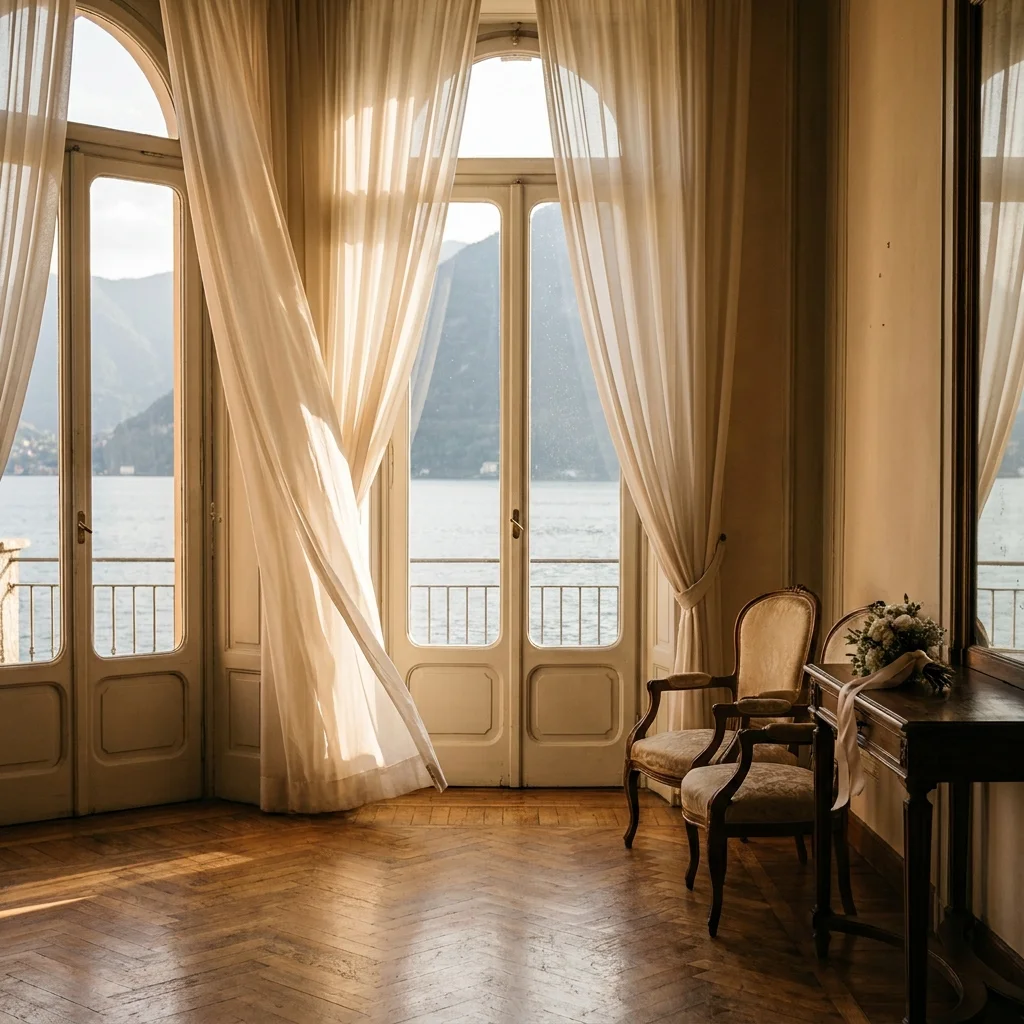
Lake Como’s geography creates a unique photographic environment. The mountains to the east mean direct morning sunlight arrives late — often not until 9:30 or 10:00 AM in autumn. By contrast, the western shore catches golden light from approximately 4:30 PM in summer, creating a two-hour window that experienced photographers plan their entire shot list around.
Reflections off the water add a secondary light source that can be extraordinary or, in the hands of someone unfamiliar with it, problematic. A photographer who has shot at your specific venue, in your specific season, will produce dramatically different results from one arriving for the first time — however talented they may be.
We maintain a curated roster of photographers and videographers who have worked Lake Como extensively. Each has shot at the major villas and many of the private estates in our network. Our guide to choosing a wedding photographer in Italy explains how we evaluate style, coverage approach, and logistical compatibility.
| Photography Service | Indicative Range (€) | What’s Included | Quoted Separately |
|---|---|---|---|
| Full-day coverage (10–12 hours), single photographer | 4,500 – 9,000 | Pre-ceremony through first dances, 500–800 edited images, online gallery, travel within Lombardy | Second shooter (+€1,200–€2,500), albums and prints, drone footage; VAT (IVA 22%) |
| Wedding weekend coverage (2–3 days) | 7,000 – 15,000 | Welcome dinner, ceremony day, day-after session; all edited images, online gallery | Photographer accommodation (arranged by our team), post-production rush delivery, albums; VAT (IVA 22%) |
| Cinematic film (highlight + full ceremony) | 5,000 – 14,000 | Two-person crew, 5–8 min highlight film, full ceremony edit, licensed music | Raw footage, extended reception edit, drone permits and equipment; VAT (IVA 22%) |
Indicative ranges. Contact Kiss Me Italy for a personalized proposal tailored to your venue and season.
Boat Schedules, Sound Curfews, and the Permit Gaps That Change Everything
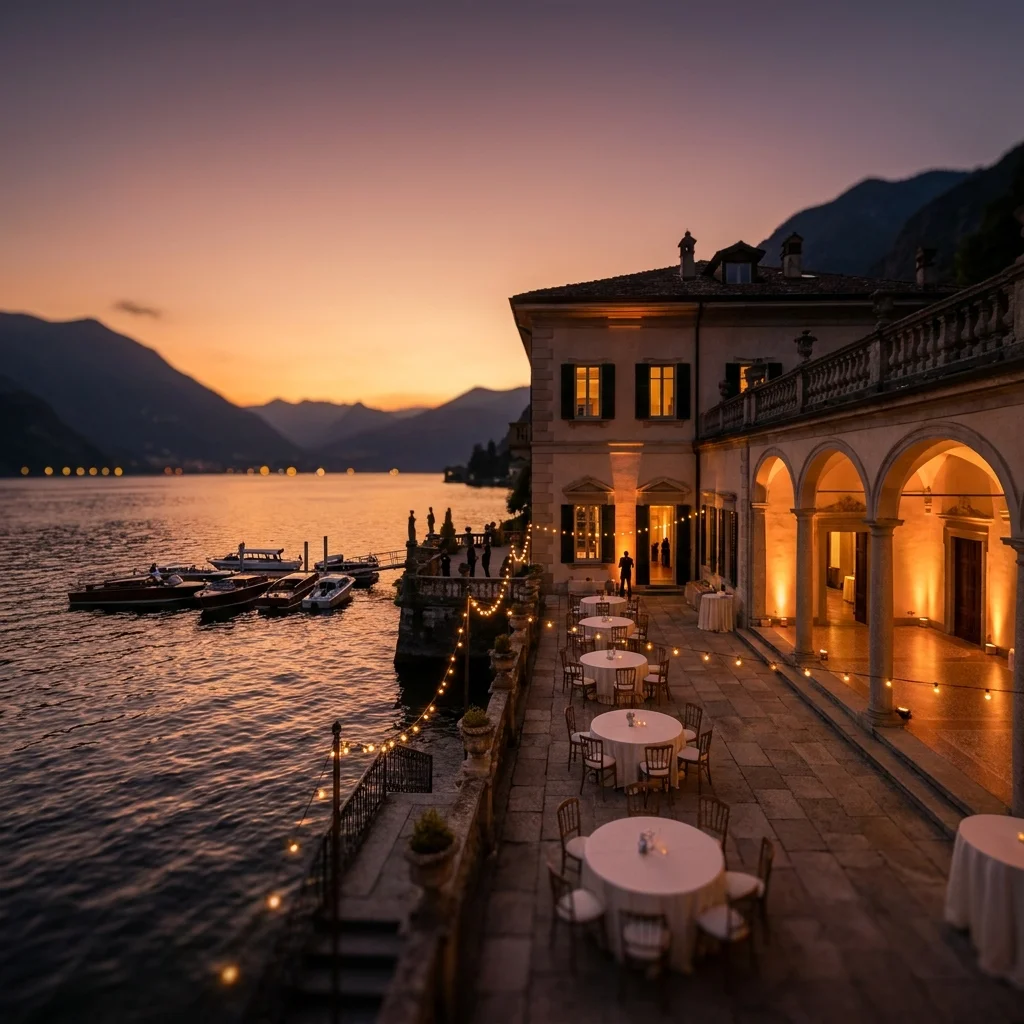
This section is technical by design. These are the operational realities that separate a well-produced Lake Como wedding from one that encounters friction on the day.
Boat logistics. Lake Como has no road connecting its eastern and western shores mid-lake. The car ferry between Bellagio, Varenna, Menaggio, and Cadenabbia operates on a fixed schedule that ends in the early evening. Private boat charters must be arranged separately, and the number of licensed operators is finite. For a Saturday wedding in July with 100+ guests, we begin securing boat contracts eight to ten months in advance.
Sound curfews. Each comune sets its own noise ordinance. Tremezzina, Bellagio, Cernobbio, and Laglio all have different rules. Amplified outdoor music typically must end between 10:30 PM and midnight depending on the specific municipality and the venue’s licence. We map the evening timeline to these parameters during the design phase — not as a last-minute adjustment.
Setup and teardown windows. Many lakefront villas allow vendor access beginning at 10:00 AM on the wedding day and require full clearance by 1:00 AM. For elaborate floral installations or lighting designs, this window is tight. Our production team coordinates staggered vendor arrivals — florists at 7:00 AM by special arrangement, lighting crew the evening before — to ensure the setup is complete well before the first guest arrives.
Parking and road access. The narrow lakeside roads between Cernobbio and Bellagio are not designed for coach traffic. Guest transport by minibus requires route planning and, in some cases, police coordination for temporary road closures near the venue entrance.
These details are invisible to the couple on the day. That is the point. They are visible in the planning — and they are precisely what distinguishes a luxury planner on Lake Como with genuine operational depth from one offering only aesthetic coordination.
Discretion as a Standard, Not a Marketing Claim
Many of the couples who come to us value privacy highly. Some are public figures. Others simply want their celebration to remain theirs — not content for a planner’s social media feed.
We treat discretion as an operational standard. This means vendor NDAs are part of our standard contracting process. Photographer and videographer social media usage is governed by written agreements that the couple reviews and approves. Guest lists are never shared with venue staff beyond what is operationally necessary. When a celebration takes place at a property accessible by public waterway, we coordinate timing so that the ceremony occurs during a window of reduced boat traffic — a detail that requires knowledge of the ferry schedule, the tourist boat routes, and the habits of the lake.
This is not a premium add-on. It is how we operate for every couple, whether the guest list is 30 or 300. Our bespoke luxury wedding approach is built on this principle.
A September Evening in Varenna: What the Day Actually Feels Like
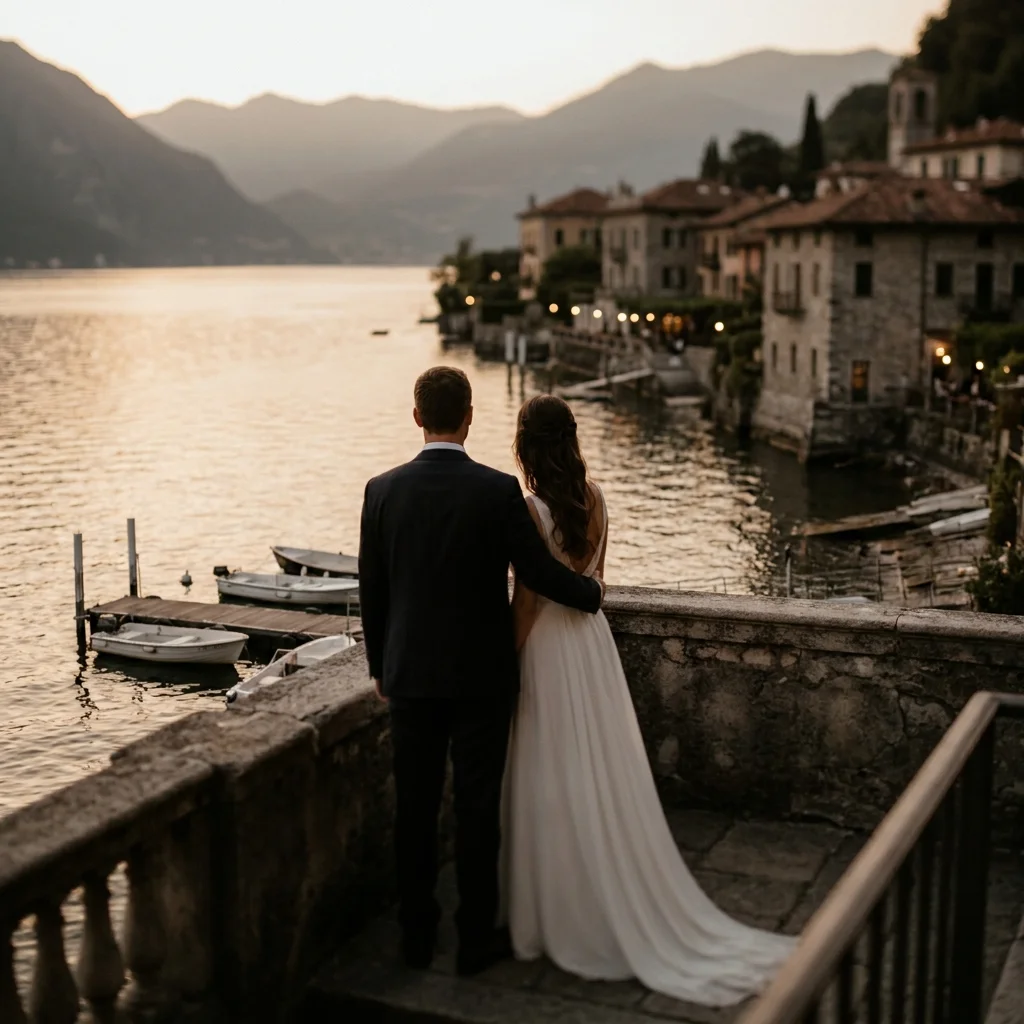
Let me describe a wedding we produced last September. Not to sell you an image, but to show you how the planning translates into experience.
The couple — she from New York, he from London — had chosen a privately owned villa above Varenna. Seventy-two guests. The ceremony was symbolic, held on a stone terrace overlooking the lake at 5:00 PM, when the September light turns the water a deep, shifting blue. The celebrant was a poet the couple admired, flown in from Edinburgh. Our team had rehearsed the microphone placement and acoustics the afternoon before, because the terrace sits in a natural amphitheatre that amplifies wind noise unpredictably.
Wind picked up. The dock went quiet. The boats held position. Our team moved the ceremony start by eight minutes — without an announcement. No one noticed.
Guests arrived by private boat from a grand hotel in Bellagio — a twelve-minute crossing. We had stationed a team member at the Bellagio dock and another at the villa’s private jetty to manage embarkation and arrival flow. The welcome cocktail began on the lower garden while the ceremony terrace was quietly reset for the reception — a transformation that took our floral and design team exactly forty-five minutes, a timing we had rehearsed twice.
Dinner was served at 8:15 PM. Risotto alla milanese with ossobuco as the primo. Lake fish — a delicate filetto di persico — as the secondo. Local wines from Valtellina. The cake was a traditional millefoglie, not fondant, because the couple wanted something their Italian guests would recognize as genuinely Lombard.
Music moved indoors at 10:30 PM per the municipal ordinance. The band transitioned seamlessly because we had briefed them on the exact minute. Dancing continued until 1:00 AM. The last boat departed at 1:20 AM. By 2:00 AM, the villa was restored to its original state.
No one noticed the logistics. That was the entire point.
How a Lake Como Wedding Weekend Is Structured — and What Each Element Costs
Most of our Lake Como celebrations are not single-day events. The couples we work with typically plan a two- to three-day wedding weekend that includes a welcome dinner, the ceremony and reception, and a farewell brunch.
The welcome dinner — often held at a lakeside restaurant in Bellagio, Varenna, or Cernobbio — sets the tone. It introduces guests to one another and to the lake itself. We typically arrange this as a seated dinner for 40–80, with informal toasts and local wines. Cost ranges from €120 to €280 per person depending on the venue and menu complexity.
The farewell brunch, usually hosted at the couple’s hotel or a nearby terrace, is lighter in production but important in hospitality. A late-morning gathering with pastries, fresh fruit, and espresso allows guests to say goodbye without the formality of the previous evening.
Our personalized wedding approach means that the weekend structure is designed around your guest profile — their ages, travel stamina, and how many are visiting Italy for the first time. For some couples, we add a guided boat excursion on the day before the wedding, visiting Bellagio and the gardens of a famous villa. For others, we arrange spa access at a grand hotel in Cernobbio.
| Weekend Element | Indicative Range (€) | What’s Included | Quoted Separately |
|---|---|---|---|
| Welcome dinner (60–80 guests) | 8,000 – 22,000 | Venue hire, 3-course seated dinner, wine pairing, basic floral centrepieces | Live music, custom lighting, printed menus; VAT (IVA 22%) |
| Farewell brunch (40–60 guests) | 2,500 – 7,000 | Hotel terrace or private venue, continental and Italian breakfast, coffee service | Photographer coverage, floral arrangements; VAT (IVA 22%) |
| Guest boat excursion (half-day, 40–60 guests) | 3,500 – 9,000 | Private fleet, guided stops at 2–3 lake towns, onboard aperitivo | Lunch reservations, guide gratuities; VAT (IVA 22%) |
Indicative ranges. Contact Kiss Me Italy for a personalized proposal.
Floral Design on Lake Como: What Grows Here, What Must Travel, and What That Means for Your Budget
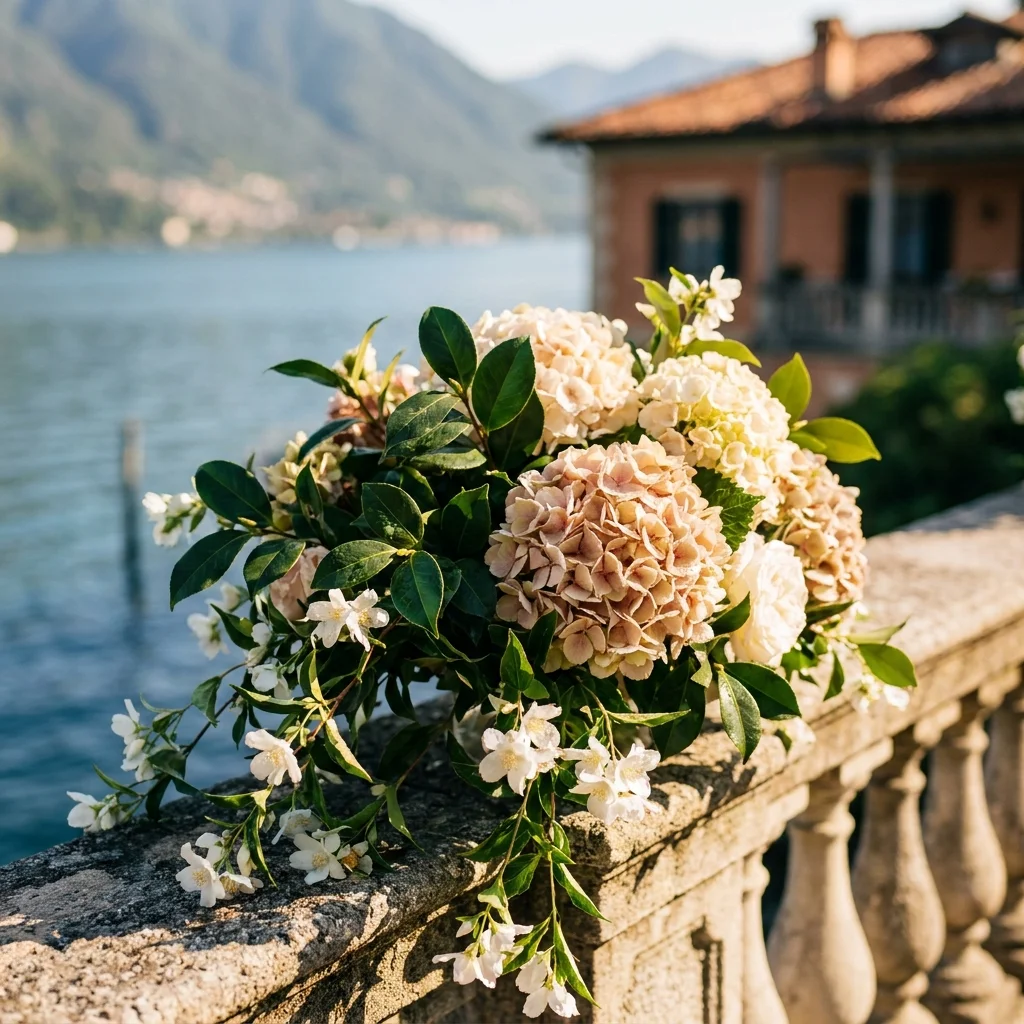
Lake Como’s microclimate — milder than its alpine latitude suggests — supports a surprising range of flora. Hydrangeas, oleanders, and camellias thrive along the shore. Olive and lemon trees line the villa gardens. In June and July, roses and jasmine are abundant locally.
However, the grand-scale floral installations that many couples envision — cascading orchid arches, peony-heavy tablescapes, or garden rose walls — require sourcing from the Dutch wholesale markets or from specialized growers in Liguria and Puglia. Transport adds cost, and temperature control during summer delivery is non-negotiable. A floral budget of €8,000 may produce a beautiful, locally sourced design; the same vision executed with imported peonies in July could exceed €25,000.
Our floral designers work within the season, not against it. A September wedding might feature dahlias, amaranth, and late-season garden roses in a palette that echoes the lake’s autumnal shift. This is not a compromise — it is a genuine expression of the place and the moment. Our Tuscany and Versilia wedding guide illustrates how we adapt floral philosophy to each region’s growing calendar.
What the Couples Who’ve Done This Before Would Tell You
We do not publish client testimonials with names attached — that would contradict the discretion we’ve described. But patterns emerge after thirty years.
The most common feedback we receive is not about the flowers or the food. It is about the absence of stress. Couples tell us that they were fully present at their own wedding — that they never once wondered whether the boats were running on time, whether the band knew when to lower the volume, or whether the cake would arrive intact despite the narrow lakeside road.
The second most common observation is about their guests’ experience. International guests — many visiting Italy for the first time — describe the weekend as the most thoughtfully organized event they have ever attended. This is not accidental. It is the result of a hospitality framework that extends beyond the couple to every person in attendance.
If you are beginning to envision your own Lake Como celebration, we welcome a private conversation about your vision, your guest list, and your priorities. Reach out to our team to begin.
How Our Initial Consultation Works — and What We Need from You Before It Begins
Our consultation process is designed to be efficient for time-poor couples. Before our first call, we ask you to complete a brief questionnaire covering: estimated guest count, preferred season, ceremony type (civil, symbolic, or religious), and any venues you’ve already researched. This allows us to arrive at the conversation with relevant options rather than generic overviews.
The initial consultation — typically 45 to 60 minutes by video call — covers three areas: your vision and non-negotiables, the logistical realities of your preferred dates and locations, and a preliminary investment framework. We do not present a fixed package. Every proposal is built from the ground up, reflecting your specific celebration.
Following the consultation, we prepare a detailed proposal within ten business days. This document includes venue recommendations (with availability status), a preliminary timeline, a vendor shortlist, and a transparent cost estimate with line-item detail. There is no obligation at this stage.
For couples exploring multiple Italian destinations simultaneously, our guides to Venice weddings, Amalfi Coast venues, and Florence celebrations offer region-specific context. And our comprehensive Italy wedding cost overview provides the broader financial picture.
The Decision That Matters Most Is Not the Venue — It’s the Team Behind It
After thirty years of producing weddings on Lake Como, I can tell you that the venue is never the variable that determines whether a celebration is extraordinary or merely beautiful. The variable is the team. The planner who understands that a July wedding at a Cernobbio villa requires a different production approach than an October ceremony in Varenna. The coordinator who knows that the Bellagio ferry schedule shifts in September. The designer who sources dahlias from a grower in Tremezzina rather than importing them from Amsterdam.
Como-based wedding production is not interchangeable. The right team will simplify your decisions, protect your privacy, and deliver a celebration that feels both effortless and deeply personal. The wrong one will leave you managing logistics from a different time zone.
We would be honoured to be part of your consideration. Contact Kiss Me Italy for a private consultation, and let us show you what thirty years of Lake Como expertise looks like in practice.
Frequently Asked Questions About Wedding Planners on Lake Como
Do we need a SIAE music licence for a live band or DJ at a Lake Como wedding, and who obtains it?
Yes. Any public performance of copyrighted music in Italy — including at a private venue hired for an event — requires a SIAE (Società Italiana degli Autori ed Editori) licence. The obligation falls on the event organiser, which in practice means your planner or the venue, depending on how the contract is structured. We obtain the SIAE licence as part of our standard production process, filing the programme declaration (bordereau) with the set list provided by the band or DJ at least 48 hours before the event. The cost is calculated on a per-event basis and varies with the duration of the performance and the number of guests. Couples who arrange their own entertainment without confirming SIAE compliance risk a fine issued to the venue — which can trigger penalty clauses in the venue contract. We verify coverage for every musical act we engage, and we require the same confirmation in writing from any musician a couple brings independently.
What insurance do Lake Como venues and vendors require, and what coverage should couples carry?
Most Lake Como venues require the event organiser to hold a public liability (responsabilità civile) policy covering a minimum of €1,000,000 — sometimes €2,000,000 for larger properties — for the duration of the event including setup and teardown. This policy must name the venue as an additional insured and be submitted before the contract is countersigned. Our planning fee includes arranging this coverage through our established broker network; the premium is quoted as a transparent line item. Separately, we strongly advise couples to carry wedding cancellation and curtailment insurance from their home country, covering supplier insolvency, extreme weather, and medical emergencies. Standard travel insurance rarely covers the full financial exposure of a destination wedding. For international couples, policies issued by UK or US specialist insurers (e.g., Dreamsaver, WedSafe) are accepted by Italian venues. Vendors — caterers, photographers, florists — are required under our contracts to carry their own professional indemnity and public liability coverage, and we collect certificates of insurance from every supplier before the event date.
How do you manage guest communications — dress code, boat boarding times, hotel logistics — without overwhelming them?
We produce a single, designed guest information document — typically a four- to six-page digital booklet — that consolidates every practical detail: dress code guidance with specific notes on cobblestones and dock surfaces (relevant for footwear choices), boat boarding times and embarkation points with map references, hotel check-in windows, and a day-of timeline written in plain language. This is distributed once, approximately three weeks before the wedding, via a private link. We do not send multiple reminder emails or create group messaging threads that generate noise. For guests requiring individual assistance — elderly travellers, those with mobility considerations, international guests unfamiliar with the lake — our team provides a direct WhatsApp contact number staffed from arrival day through departure. On the wedding day itself, our on-site coordinators manage all movement without broadcasting instructions over a microphone: guests are guided quietly and individually to the correct location at the correct time. The couple sees none of this operational layer.
What are typical vendor payment schedules, and how do you handle currency and international transfer fees for couples paying from abroad?
Italian vendors — venues, caterers, florists, musicians — typically ask for a deposit of 30–50% on contract signing and further instalments as the date approaches. With Kiss Me Italy, the full balance is always settled before the wedding day, following the payment calendar agreed in your proposal, and every payment is non-refundable once made, because suppliers are booked and paid in advance (see our Payment, Cancellation & Refund Policy). All payments are denominated in euros. For couples paying from the United States, United Kingdom, Australia, or Canada, we recommend using a specialist currency transfer service (Wise, OFX, or a private banking FX desk) rather than a standard bank wire, which typically carries a 2–4% spread on the exchange rate plus fixed transfer fees. On a total wedding budget of €120,000, the difference between a bank wire and a specialist transfer can exceed €3,000. We provide couples with a payment calendar at the proposal stage, mapping every due date across all vendors so that transfers can be planned in advance. We also hold all vendor contracts in our name where possible, consolidating payments through a single invoice to reduce the number of individual international transfers the couple must execute.
Can we host a rehearsal dinner on a private boat on Lake Como, and what are the safety and capacity constraints?
A boat dinner on Lake Como is entirely achievable and, for the right group, one of the most memorable elements of a wedding weekend. The practical constraints are specific. Licensed passenger vessels on the lake are governed by Capitaneria di Porto regulations, which set maximum capacity based on hull classification — typically 12 to 49 passengers for the private charter vessels most suitable for a dinner format. For groups larger than 49, multiple vessels must travel in convoy, which changes the dynamic considerably. Catering on board is limited to cold or ambient-temperature service unless the vessel has a fitted galley; most do not. This means the menu must be designed around what travels well — antipasti, charcuterie, composed salads, and desserts — rather than a plated hot dinner. We work with a small number of operators whose vessels are fitted for evening entertaining, with proper lighting, sound systems, and deck furniture. Departure and return times are subject to the same municipal noise ordinances that apply on land: amplified music on the water after 11:00 PM is not permitted in most zones. Life jacket provision and safety briefings are mandatory and are managed by the vessel captain.
How do you secure exclusivity and privacy when a venue sits adjacent to a public promenade or open waterway?
This is one of the more nuanced operational challenges on Lake Como, where many of the finest properties have lakefront boundaries that are technically accessible by water. Our approach operates on several levels simultaneously. First, we time the ceremony and key reception moments to coincide with periods of lower public boat traffic — typically mid-afternoon on weekdays, or early evening on Saturdays when tourist ferries have reduced their service. Second, for properties with open water frontage, we position a dedicated team member at the dock throughout the event with authority to politely redirect any approaching private craft. Third, where the venue permits, we use natural screening — temporary floral installations, fabric panels, or strategic lighting design — to reduce sightlines from the water without creating an obviously fortified perimeter. Fourth, for couples with significant privacy requirements, we negotiate a clause in the venue contract that restricts the property’s own social media posting during and immediately after the event. None of these measures are visible to guests. They are part of the production architecture that our Como-based wedding production team builds into every event from the design phase forward.
What accessibility options exist for elderly or mobility-impaired guests, and how do you plan around Lake Como’s physical terrain?
Lake Como’s terrain — stone staircases, sloped garden paths, floating docks, and narrow cobbled lanes — presents genuine challenges for guests with limited mobility, and it is a factor we assess at the venue selection stage. For every property we recommend, we document the number and height of steps between the arrival point and the ceremony and dining areas, the surface type of all guest pathways, and whether a level alternative route exists. Docks present a specific challenge: the step between a boat and a fixed jetty can be 30–60 cm depending on water level and vessel type, and this varies with the season. We arrange portable boarding ramps for any guest who requires them and brief boat captains accordingly. For guests who cannot manage stairs at all, we identify venues with lift access or single-level configurations as a priority. Where a beloved venue has unavoidable steps, we arrange a dedicated staff member to provide discreet physical assistance, and we communicate this privately with the relevant guests in advance through the couple. Wheelchair-accessible minibuses are available for road transfers and are booked as standard when the guest list includes elderly travellers.
What are the most common contract pitfalls in Lake Como venue agreements, and how do you protect couples from them?
After three decades of reviewing Lake Como venue contracts, the clauses that most frequently cause post-event disputes fall into four categories. First, overtime penalties: many contracts specify a per-hour charge — sometimes €1,500 to €3,000 — for any extension beyond the agreed end time, with the clock starting from the moment the last vendor vehicle leaves the property, not when the last guest departs. We negotiate a defined clearance window into every contract. Second, restoration deposits: venues routinely hold a deposit of €2,000 to €10,000 against damage, and the definition of “damage” in some contracts extends to normal wear on lawn surfaces or minor marks on stone floors. We photograph the entire property before setup begins and submit a timestamped record to the venue manager, creating an unambiguous baseline. Third, exclusivity limitations: some contracts describe “exclusive use” but retain the right for the venue owner or their family to access certain areas. We require a written definition of which spaces are fully exclusive and for which hours. Fourth, force majeure clauses: Italian venue contracts vary significantly in how they treat cancellation due to weather, government restriction, or supplier failure. We review these clauses against the couple’s insurance policy to ensure there are no gaps in coverage before any deposit is paid.
Boat operator contingency is built into our logistics plan from the contracting stage. We do not rely on a single operator for any wedding where boat transfers are critical to the event flow. For every primary charter, we maintain a confirmed secondary operator on standby — a separate company with a separate fleet — whose contract specifies a four-hour activation window. The standby fee is modest relative to the risk it mitigates. For weather advisories, we monitor Capitaneria di Porto bulletins and local wind forecasts (the Breva and Tivano winds on Lake Como follow predictable daily patterns, but can intensify unpredictably in spring and autumn) from 72 hours before the event. If conditions are forecast to exceed safe navigation thresholds — typically sustained winds above 30 km/h for smaller vessels — we activate the road transfer contingency, which uses pre-booked minibuses along the lakeside route. This adds travel time but ensures guest safety and event continuity. The couple is informed of the contingency activation as a matter of courtesy, not as a request for a decision: the operational call is ours to make, and we make it.
What is your approach to children at a Lake Como wedding — nannies, kids’ meals, transport, and keeping the event adult in atmosphere?
Children at a Lake Como wedding require their own parallel production track, and we treat it as such. For weddings with more than four or five children in attendance, we arrange a dedicated children’s coordinator — a qualified nanny or childcare professional, sourced through a vetted agency — who is present from the welcome cocktail through the end of dinner. This person manages a separate children’s activity space within the venue: typically a ground-floor room or shaded garden area equipped with age-appropriate activities, a dedicated children’s menu served at 6:30 PM (before the adult dinner begins), and a quiet rest area for younger children. The children’s menu is designed separately from the adult menu — familiar, simple, and served promptly — so that parents are not distracted by a hungry child during the ceremony or speeches. For boat transfers, children under 12 are required by Italian maritime regulation to wear life jackets, which we provide in the correct sizes and brief parents on in advance. The net effect is that children are genuinely cared for and entertained, parents are relaxed, and the adult atmosphere of the celebration is preserved without anyone feeling excluded.
When you are ready to plan it for real, explore our proposal packages.