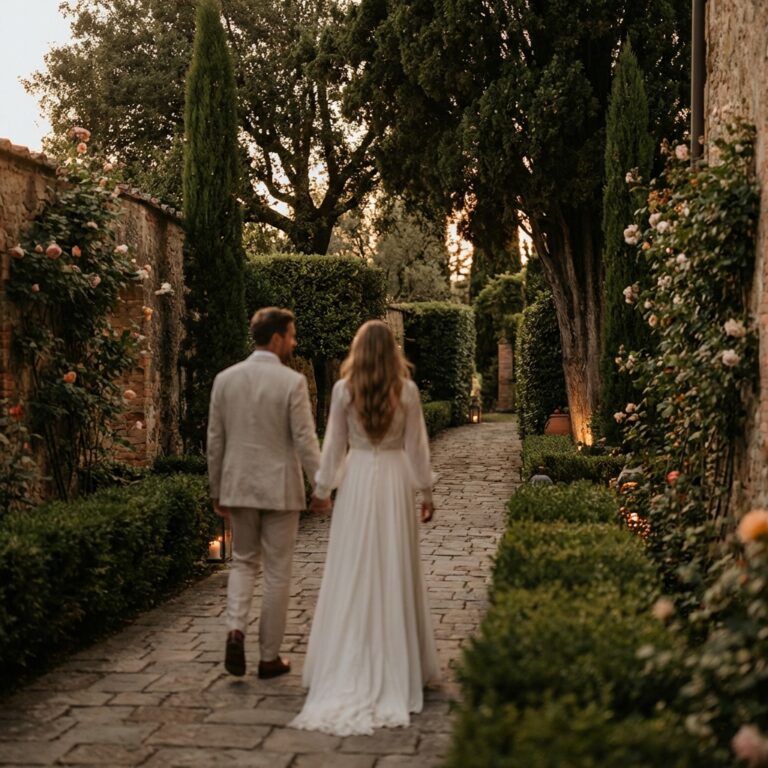
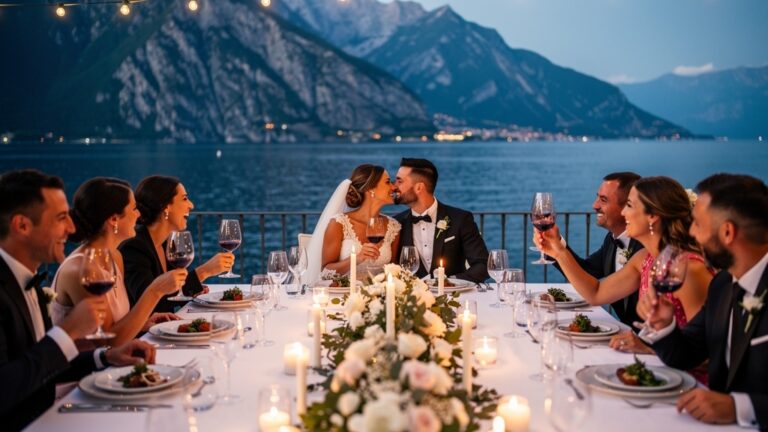
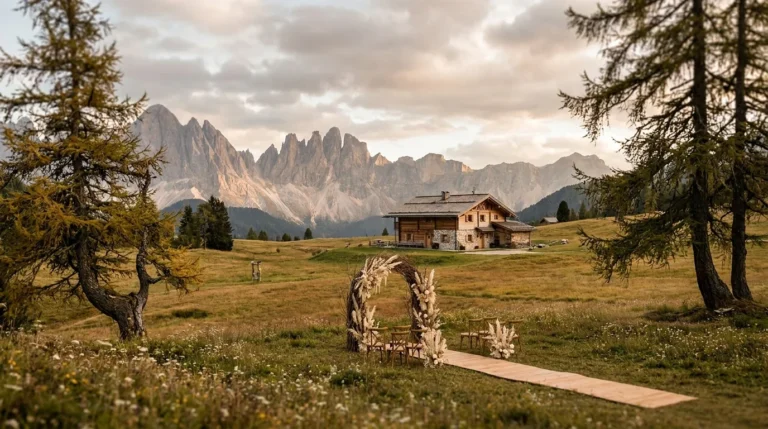
A tablescape wedding Italy project typically involves €8,000–€35,000 in styling investment for 80–120 guests, encompassing linens, florals, glassware, candlelight, and professional installation. The final figure depends on region, venue constraints, service style, and the degree of bespoke design. Kiss Me Italy manages every element of Italian wedding tablescape creation—from seasonal botanical sourcing to rental logistics and on-site styling—so that the reception you envision is the one your guests experience.
Wedding Tablescapes in Italy
“Will my table design actually work in the venue I’ve chosen?” That is the question couples ask us most often—usually after they discover a practical constraint: a terrace too narrow for rounds, a service corridor that cannot handle an imperial layout, or a catering partner whose service rhythm dictates centerpiece height and table width. An Italian wedding reception is not a blank canvas. It is a live operational environment with rules, measurements, and timing. Our work begins there: we translate your inspiration into a layout and specification that the venue and caterer can execute flawlessly, then we style it to an editorial standard.
Imperial Table vs. Round Tables: How Italian Venue Architecture Decides for You
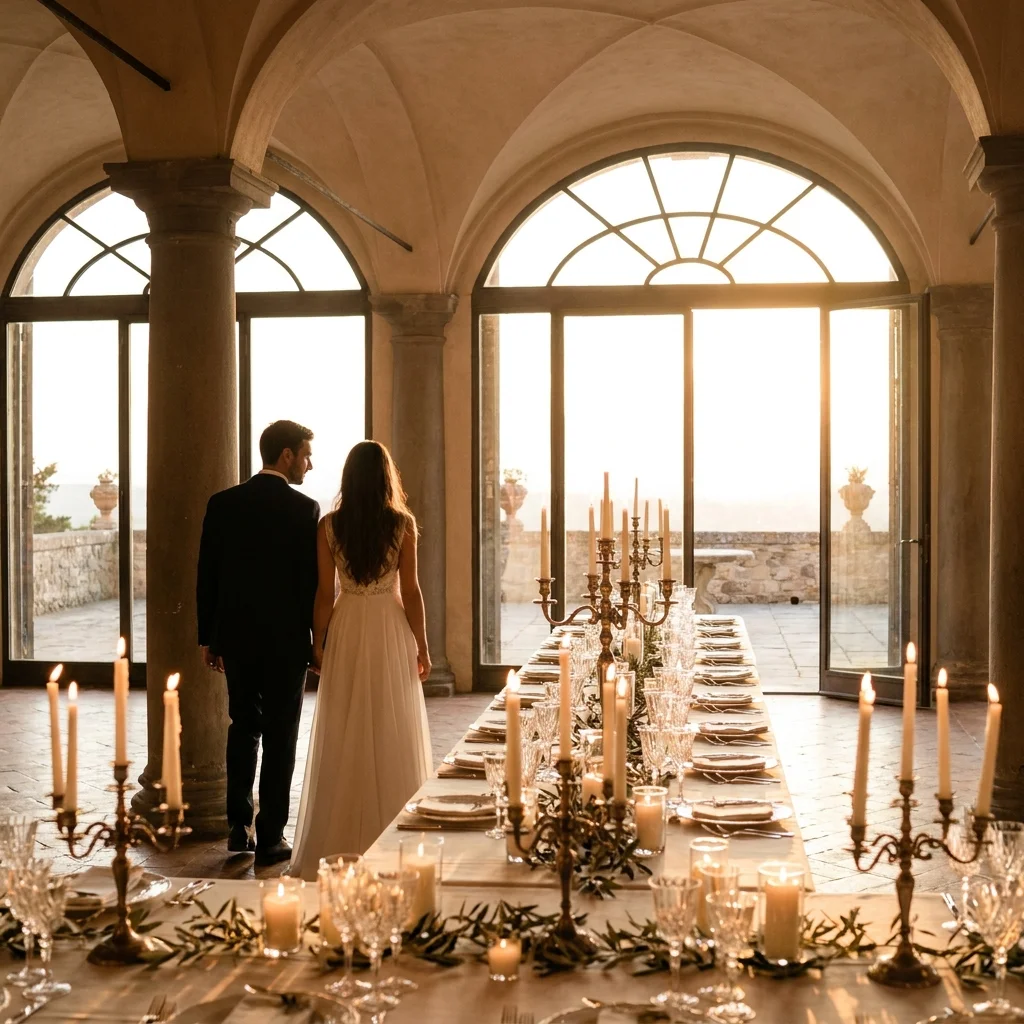
Before you choose a color palette or a single stem, you must choose a table format. This is the structural foundation of every Italy wedding table setting, and in Italian venues it is rarely a free choice.
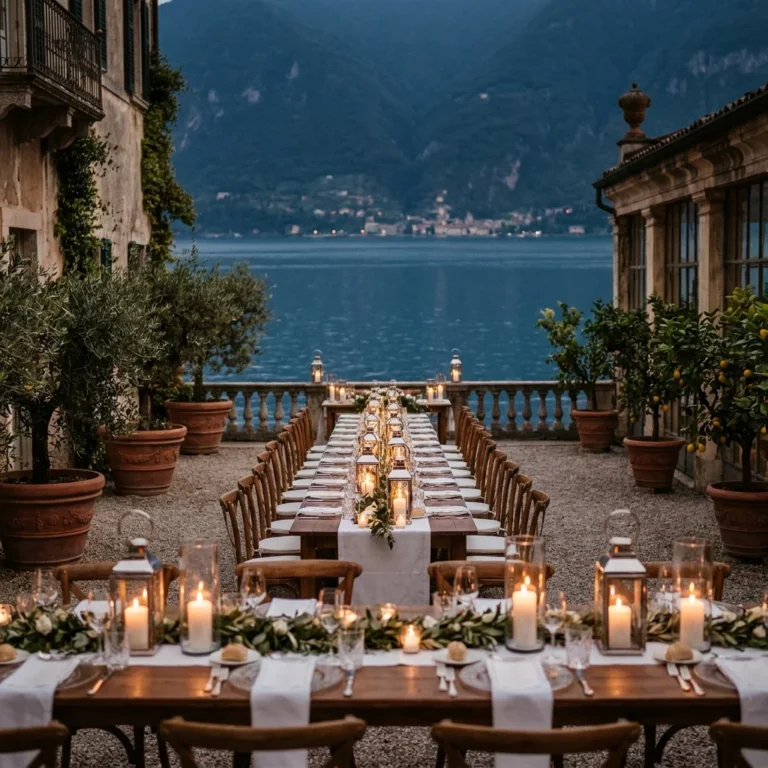
An imperial table—a single long surface seating 40 to 120 guests—creates dramatic sightlines and photographs with extraordinary editorial impact, especially beneath vaulted ceilings or along a loggia. But it demands at least 1.8 meters of width (with chairs) and uninterrupted length. Many historic Italian villas have dining rooms that taper, have columns, or include structural alcoves that interrupt the line. We survey every venue before proposing a layout, measuring clearance for service staff, wheelchair access, and the path from kitchen to table—because in a villa wedding in Italy, the kitchen may be on a different floor entirely.
Round tables of 8–10 guests suit venues with irregular footprints: a courtyard with a fountain at center, a terraced garden where levels change, a Venetian palazzo ballroom with multiple doorways. They encourage intimate conversation and allow more flexible floral design per table. But they multiply rental costs—each table needs its own centerpiece, its own set of candelabra, its own linen cut.
We guide this decision early. The table format shapes the entire Italy wedding table setting: the linen dimensions, the floral budget, the number of service staff, and even the menu structure, since plated courses move differently along an imperial table than across scattered rounds. When couples planning a Venice wedding envision a long candlelit table reflected in canal water, we confirm that the piano nobile can accommodate the length—and that the caterer’s team can navigate the service stairs with 120 plated dishes without a pause in pacing.
Plated Service vs. Family-Style: Why Your Table Design Must Match Your Catering Contract
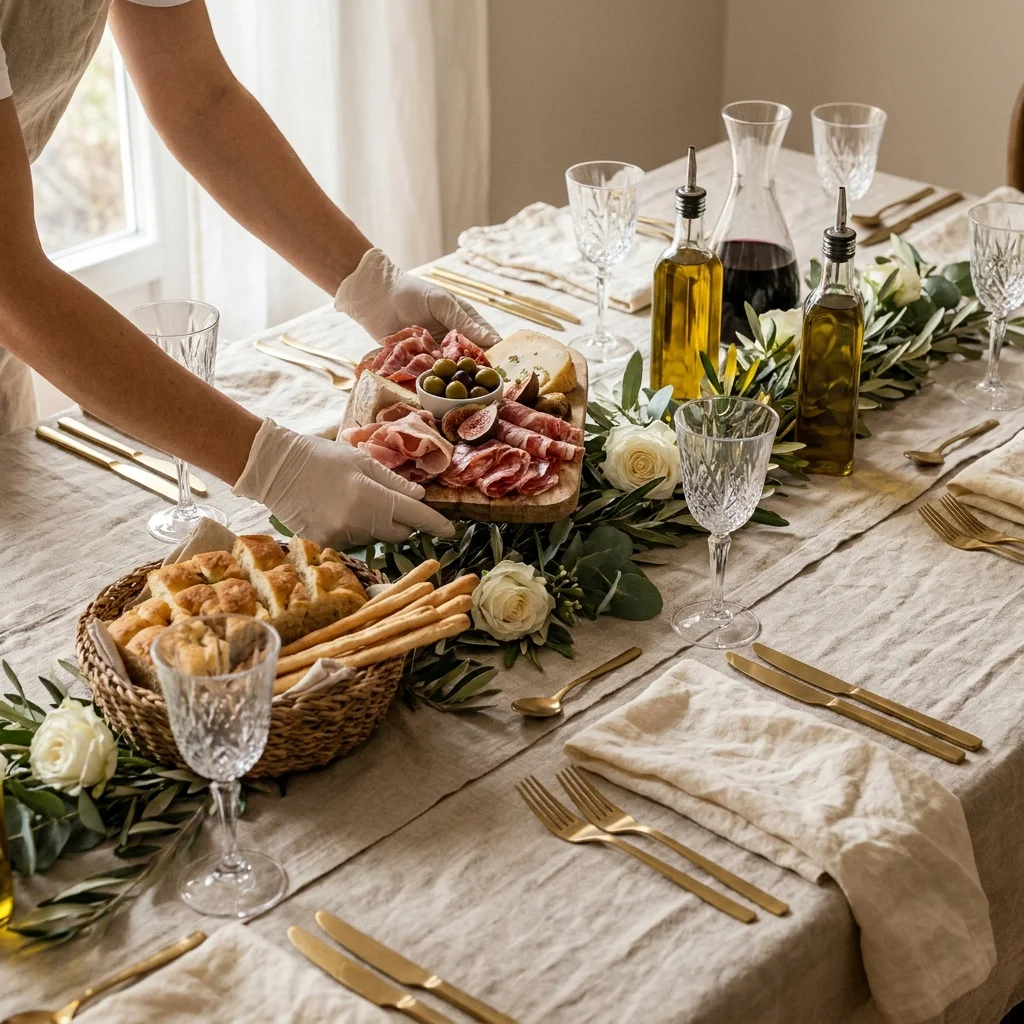
This is the tension most international couples overlook. The style of food service—plated vs. family-style—is not merely a hospitality preference. It physically reshapes your tablescape wedding Italy design.
Family-style service, deeply rooted in Italian dining culture, places shared platters, bread baskets, olive oil bottles, and sometimes wine carafes directly on the table surface. This means your floral arrangements must be lower, narrower, and positioned to leave clearance. A lush, overflowing garland running the length of an imperial table—the image that dominates Pinterest—may be incompatible with a family-style menu unless the table is wide enough (minimum 90 cm of surface between place settings) to hold both. We coordinate with the caterer before finalizing any centerpiece design, because the traditional Italian wedding food flow often includes four to six shared courses, each requiring table real estate.
Plated service gives you more design freedom. The table surface between courses is yours: tall candelabra, cascading florals, foraged branches, sculptural elements. But plated service in Italy requires more waitstaff, and the cost per head rises accordingly. In Tuscany and Liguria, where many caterers default to family-style, requesting full plated service may involve a staffing surcharge of 15–25%.
Neither is better. Both are beautiful. But the choice must be made before the tablescape design begins, not after. We manage this coordination so that the design brief your floral artist receives already accounts for every platter, every bread basket, every carafe that will share the surface with seasonal botanicals.
Why Seasonal Mediterranean Florals in June Look Nothing Like September—and Cost Differently
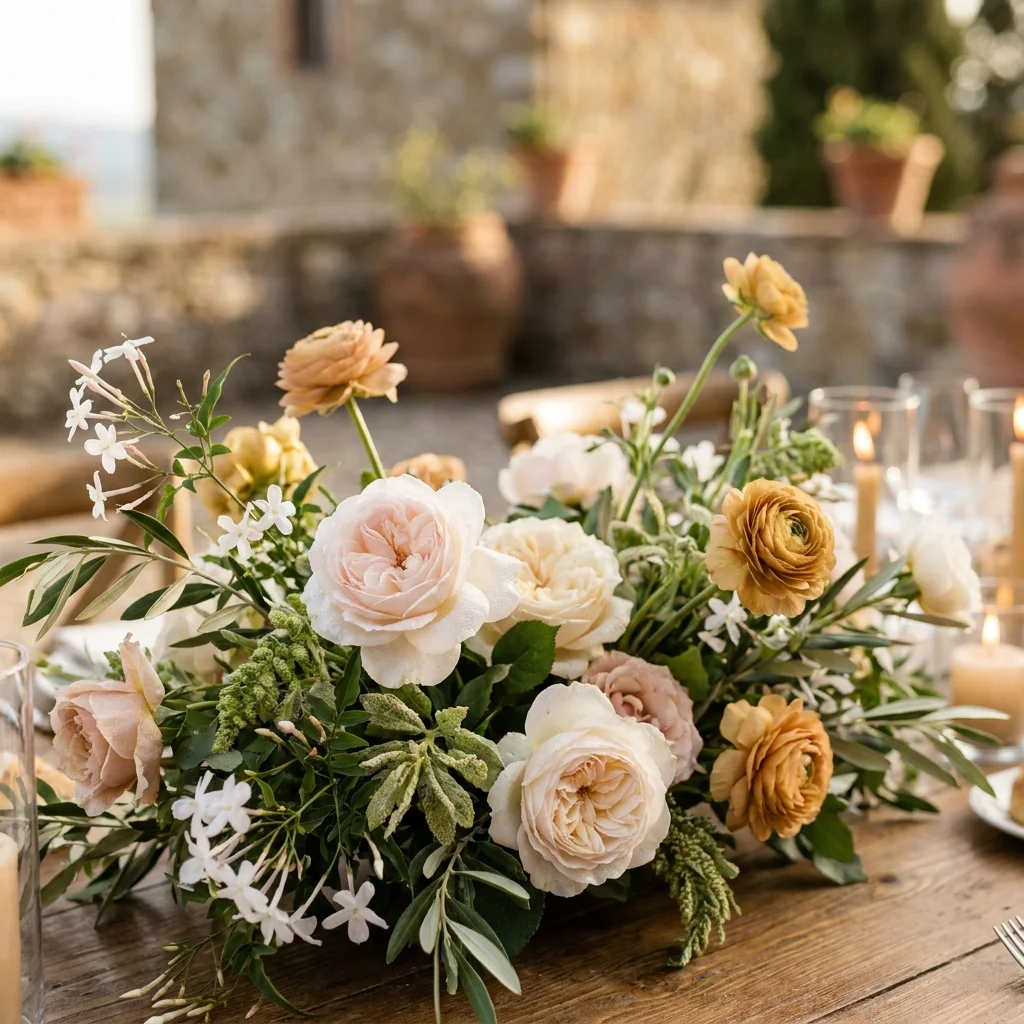
I design with what the land offers. This is our approach at Kiss Me Italy, and it is also the most practical approach to floral design for a tablescape wedding Italy project, because importing out-of-season stems into a remote Tuscan hilltop or an Amalfi Coast cliffside venue adds cost, fragility, and environmental strain.
In late May and June, the Mediterranean gives us garden roses at their most voluptuous, peonies in their final weeks, jasmine that perfumes an entire terrace, and the pale green of unripe olive clusters. The light at this time of year is long and warm, and it catches the translucency of white ranunculus and the blush of a particular shade of Juliet rose in a way that photographs with almost no editing. A June tablescape in Tuscany can be soft, abundant, romantic—and entirely foraged from local growers within a 60-kilometer radius.
By September, the botanical palette shifts dramatically. Dahlias dominate—burgundy, rust, terracotta. Figs appear, their dark skin splitting to reveal pink flesh. Pomegranates are still green but beginning to blush. Wild grasses dry to gold. The texture is earthier, more tactile, with a warmth that suits the amber light of early autumn evenings. A September tablescape in the same Tuscan venue will feel like a different world—and the floral cost may be 10–20% lower, because dahlias and seasonal foliage are abundant and local.
We never impose a season’s flowers onto a different season’s wedding. When a couple contacts us about an autumn celebration in Tuscany or Versilia, the botanical palette we propose is born from what will be blooming, fruiting, and drying at that exact moment. This is what gives a tablescape its authenticity—the atmosphere of a place and a time, not a catalog.
| Season | Key Botanicals Available | Floral Tablescape Range (80–120 guests) | Included | Quoted Separately |
|---|---|---|---|---|
| Late May–June | Garden roses, peonies, jasmine, olive branches, ranunculus | €6,000–€18,000 | Design concept, sourcing from local growers, on-site installation and breakdown, table garlands or centerpieces, accent foliage | Ceremony florals, bridal bouquet, arch/chuppah, delivery to remote venues (logistics surcharge), VAT (IVA 22%) |
| July–August | Hydrangeas, sunflowers, lavender, lemon branches, bougainvillea | €5,500–€16,000 | Same as above; heat-resistant conditioning included for summer installations | Same as above; refrigerated transport for coastal venues quoted separately |
| September–October | Dahlias, figs, pomegranates, wild grasses, dried seed pods | €5,000–€15,000 | Same as above; foraged and dried elements included in arrangement | Same as above |
Indicative ranges. Contact Kiss Me Italy for a personalized proposal.
The Fabric and Linen Choices That Shift the Entire Mood of an Italian Table Setting
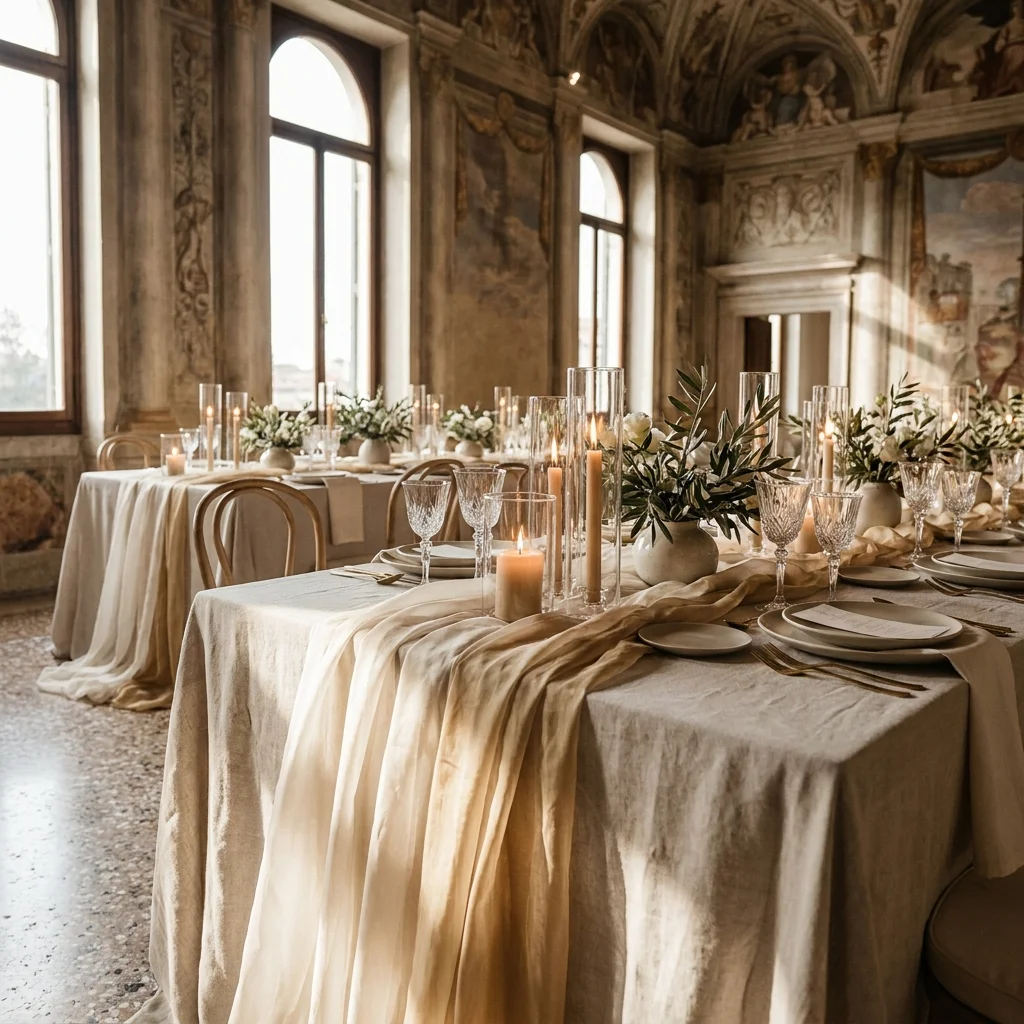
Linen is the first thing a guest touches. Before they notice the flowers, before they read the menu card, their hand meets the napkin, the tablecloth, the runner. This tactile first impression sets the emotional register of the entire evening, and it is one of the most underestimated elements of Italian wedding reception decor.
Stonewashed linen in natural tones—oatmeal, flax, pale sage—creates an effortless Mediterranean warmth. It drapes softly, catches candlelight with a gentle texture, and suits outdoor settings where the surrounding landscape is the dominant visual element. For a vineyard wedding in Italy, this is often the ideal choice: the fabric echoes the land.
Silk organza overlays add a layer of luminosity. When the light catches a sheer overlay at golden hour, the table surface seems to glow. This works beautifully in formal indoor settings—a frescoed hall, a palazzo ballroom—where the architecture demands a fabric that holds its own against gilded frames and marble floors.
Velvet runners in deep jewel tones—forest green, midnight blue, a particular shade of burgundy—anchor an autumn or winter tablescape with warmth and weight. They photograph with extraordinary richness in low light and candlelight, and they pair naturally with the darker botanical palettes of the cooler months.
We source linens from Italian textile houses and European rental partners, specifying exact dimensions for each table format. A 12-meter imperial table requires a single continuous cloth or precisely matched panels with invisible seams—details that rental companies manage differently depending on the region. Our team handles this coordination because a visible seam or a mismatched dye lot can undermine an otherwise flawless design.
Hiring a Professional Stylist Is a Distinct Decision—Here Is When It Matters Most
Many couples assume that their wedding planner or florist will also style the tables. In Italy, these are often separate roles, and understanding when to invest in a dedicated stylist is one of the most consequential decisions in reception design.
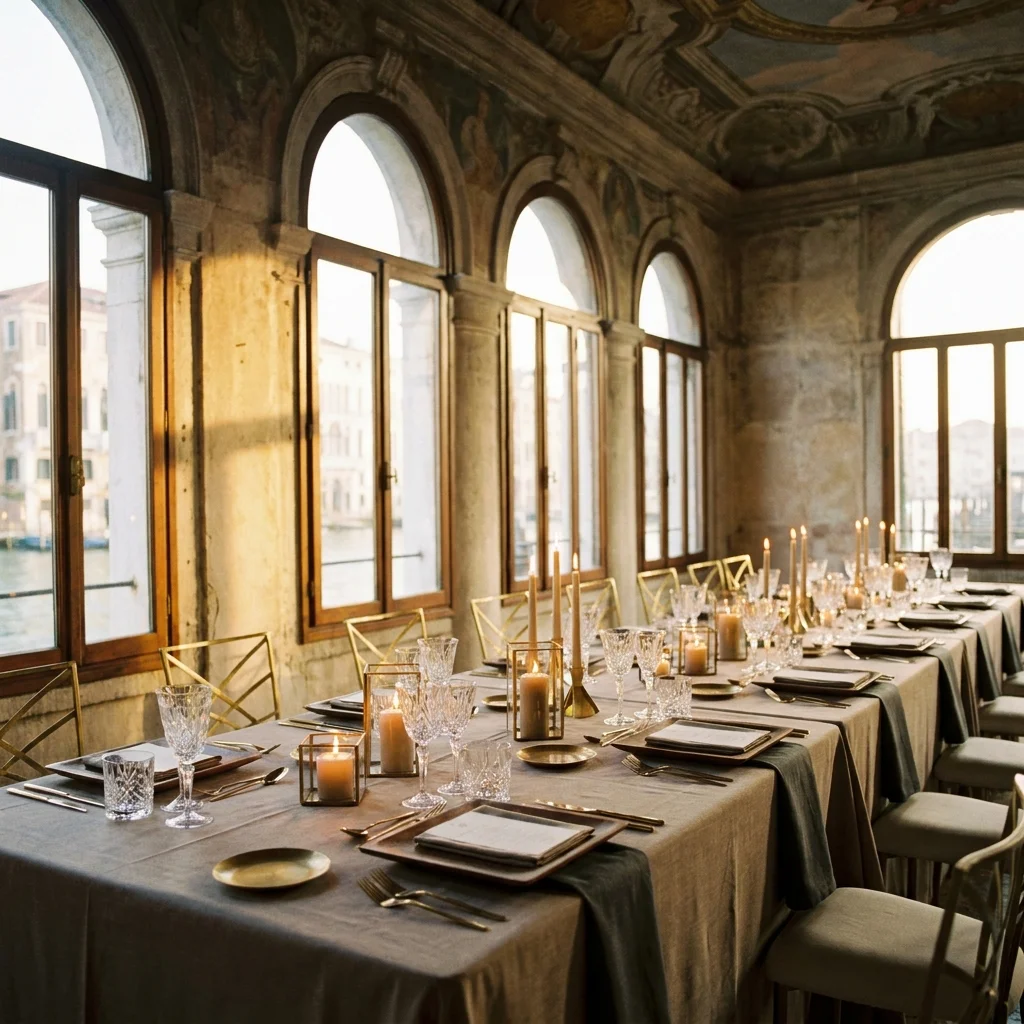
A professional stylist does not arrange flowers. They compose the entire visual field: the relationship between the height of the candelabra and the arch of the ceiling, the distance between the charger plate edge and the first wine glass, the color temperature of the candles relative to the ambient light at the hour dinner will be served. They think in proportions, sightlines, and photographic framing.
This role becomes essential when:
- The venue has strong architectural character (frescoes, columns, exposed stone) that the tablescape must complement rather than compete with
- The guest count exceeds 100 and multiple table groupings must feel cohesive across a large space
- The couple wants an editorial outcome—images that look like they belong in a design publication
- The reception transitions between spaces (aperitivo terrace to dinner hall to dance floor) and each zone requires its own visual identity within a unified aesthetic
At Kiss Me Italy’s bespoke luxury level, the stylist works alongside the floral designer, the lighting technician, and the wedding photographer to ensure that every element is positioned not only for the guest’s experience but for the camera’s eye. This is the difference between a beautiful table and an editorial tablescape.
What Italian Wedding Tablescape Design Actually Costs: Linens, Florals, Lighting, Rentals
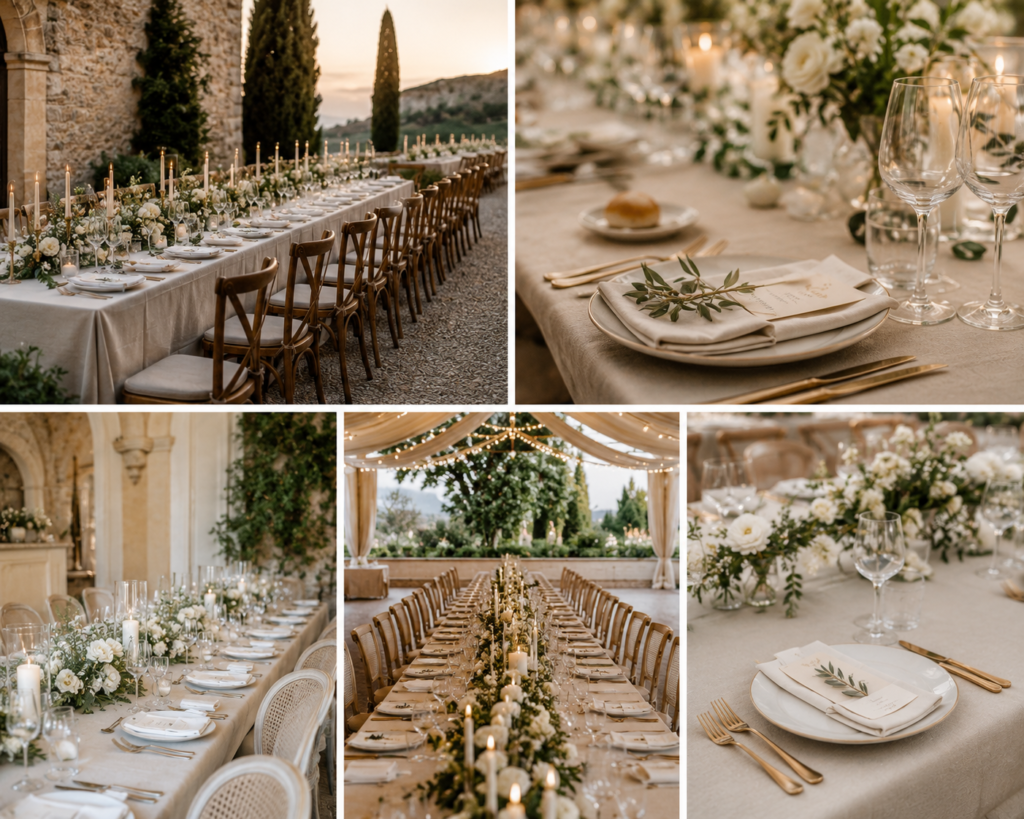
Transparency matters. Below are the component ranges we work within for Italian wedding tablescape projects, drawn from our experience across Tuscany, the Lakes, Liguria, the Amalfi Coast, and Venice. Every project is quoted individually because venue constraints, guest count, and design complexity vary enormously.
| Component | Range (80–120 guests) | Included | Quoted Separately |
|---|---|---|---|
| Linen & fabric (tablecloths, napkins, runners, overlays) | €1,500–€5,000 | Rental, pressing, delivery to venue, post-event collection | Custom-dyed or bespoke-woven fabrics; stain insurance; VAT (IVA 22%) |
| Tableware rentals (chargers, flatware, glassware) | €2,000–€7,000 | Delivery, setup, breakdown, washing; standard luxury-grade sets | Vintage or antique pieces; breakage deposit; gold-rimmed or hand-painted options; VAT |
| Candlelight & lighting design | €1,200–€6,000 | Candles, holders, installation, fire-safety compliance coordination with venue | Electrical lighting (string lights, uplighting); generator rental for outdoor venues; VAT |
| Professional styling (on-site) | €2,000–€5,500 | Full-day on-site presence, pre-event setup (typically 4–6 hours), coordination with florist and photographer | Travel and accommodation outside the venue’s region; multi-day installations; VAT |
| Stationery & paper goods (menus, place cards, table numbers) | €800–€3,000 | Design, printing, calligraphy (if selected), placement | Wax seals, handmade paper, custom illustration; VAT |
Indicative ranges. Contact Kiss Me Italy for a personalized proposal based on your venue, guest count, and design vision.
| Total Tablescape Investment | What This Level Typically Includes |
|---|---|
| €8,000–€15,000 | Refined seasonal florals, quality linen rental, standard glassware and flatware, candle installation, stationery. Suited to intimate weddings (40–70 guests) in venues with existing character. |
| €15,000–€25,000 | Bespoke floral design with foraged and imported elements, premium linen (silk, velvet, or stonewashed), upgraded glassware (colored stems, crystal), professional stylist, editorial lighting design. Suited to 80–120 guests. |
| €25,000–€35,000+ | Full editorial production: custom-dyed fabrics, sculptural floral installations, vintage or artisan tableware, multi-zone styling, dedicated lighting designer, on-site coordination with photographer for detail shots. Suited to 100–150+ guests or venues requiring extensive transformation. |
Indicative ranges. All figures exclude VAT (IVA 22%) unless noted. Floral costs listed separately in the seasonal table above. Explore our broader cost guide for context on total wedding investment in Italy.
Wind, Coastal Humidity, and Candle Restrictions: The Constraints That Shape Real Tablescapes
Reality check: what breaks first
If a tablescape fails on the day, it is rarely the flowers. It is the logistics: late rentals, missing quantities, candles that cannot be lit, or a layout that blocks service. This is why we treat tablescape design as production—measured, scheduled, and confirmed in writing with every supplier—before we ever discuss the final styling photograph.
This section is technical, and deliberately so. These are the operational realities that separate a styled photoshoot from a functioning reception.
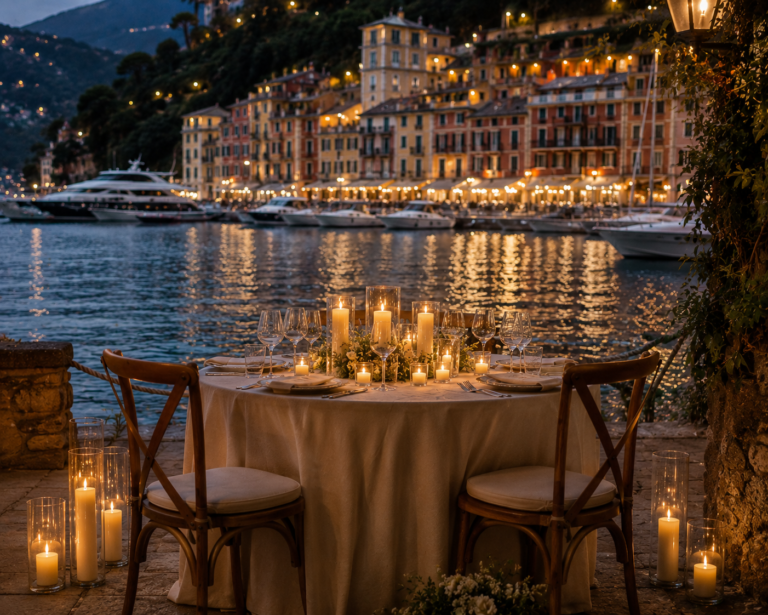
Wind. Open-air terraces on the Amalfi Coast and lakeside venues on Como and Garda are subject to afternoon and evening breezes that will extinguish unprotected flames, topple tall centerpieces, and lift lightweight napkins. We specify hurricane glass for every candle, weighted napkin folds or rings, and centerpiece structures anchored with floral foam or mechanical clips. For a Portofino wedding, where the Ligurian breeze is a near-certainty from May through September, we design low, dense arrangements that sit below the wind line.
Heat. July and August receptions that begin at sunset still contend with residual heat radiating from stone surfaces. Flowers wilt. Chocolate place-card holders soften. Butter curls on the bread plate. We time floral installation to begin no earlier than 90 minutes before guest arrival for summer outdoor weddings, and we use conditioning techniques—hydration tubes, misting, stem wrapping—that extend the life of cut stems by several hours.
Candle restrictions. Many historic Italian venues—particularly those classified as cultural heritage sites—prohibit open flames entirely, or restrict them to enclosed glass holders with specific clearance from walls and ceilings. We confirm fire regulations with every venue before including candles in the design. LED alternatives have improved dramatically; the best warm-tone flickering LEDs, placed inside frosted glass, are nearly indistinguishable from real flame in photographs. When the venue permits real candles, we manage fire-safety compliance documentation ourselves.
Humidity. Coastal and lakeside venues carry moisture in the evening air. Paper goods—menus, place cards, calligraphy escort cards—must be printed on stock that resists curling. We specify minimum 300gsm weight with coating for any stationery that will sit on an outdoor table for more than two hours. This is a small detail. It matters enormously.
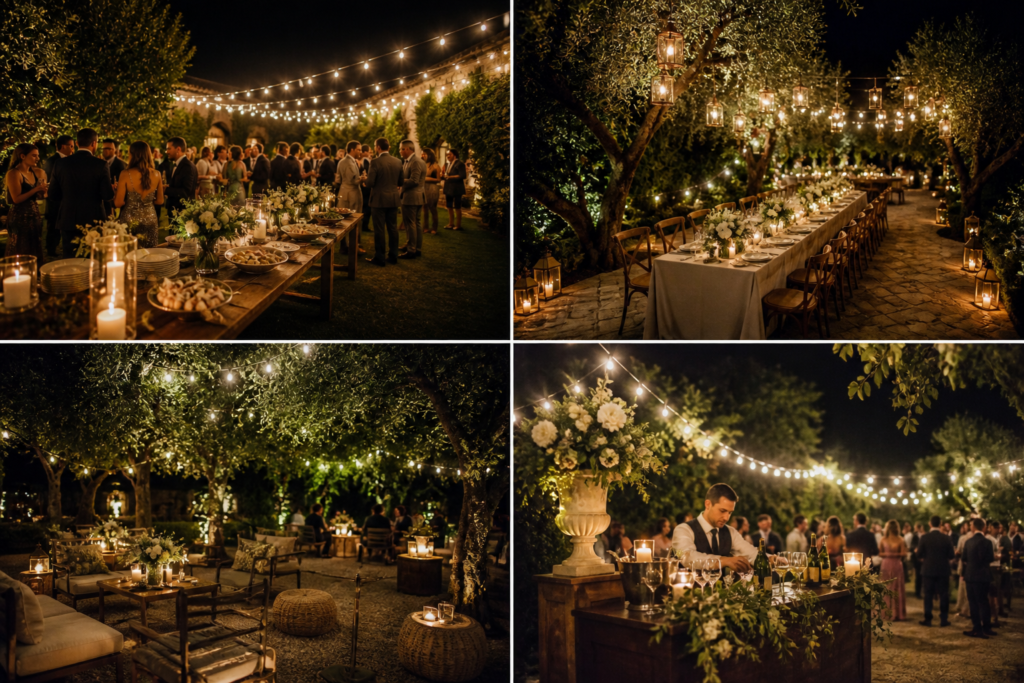
From Portofino to Venice: How Regional Light and Architecture Shape Your Table Design
I want to tell you about light, because it is the invisible material of every tablescape.
In Liguria—along the coast from Santa Margherita to the Cinque Terre—the light in late afternoon is golden and directional, filtered through maritime pines and reflected off the sea. It warms every surface it touches. A Ligurian wedding tablescape benefits from cool-toned linens (pale blue, seafoam, silver) that balance this warmth, and from glassware that catches and refracts the horizontal rays. The venues here are often compact: terraces carved into hillsides, gardens enclosed by stone walls. The tablescape must be proportioned to these intimate spaces—nothing oversized, nothing that overwhelms the natural frame.
In Tuscany, the light is broader, softer, diffused by the rolling landscape. A Tuscan venue’s stone and terracotta surfaces absorb light rather than reflecting it, creating a warm, matte backdrop. Here, richer textures work: velvet, raw linen, matte ceramic plates. The botanical palette can be bolder—deep reds, burnt orange, wild herbs like rosemary and sage laid directly on the table. The atmosphere of a Tuscan table at dusk, when candles take over from daylight, is one of the most photographed moments in Italian wedding design.
In Venice, everything changes. The light bounces off water and enters through tall windows at unpredictable angles, creating a shimmering, almost liquid quality inside the palazzi. A Venetian wedding tablescape can afford to be more dramatic: tall candelabra, reflective surfaces, crystal glassware, metallic accents. The architecture—soaring ceilings, Murano glass chandeliers, terrazzo floors—demands a design that rises to meet it. Simplicity here reads as emptiness. Considered opulence reads as belonging.
On the Amalfi Coast, the challenge is the transition from blazing afternoon sun to soft twilight within the span of a single reception. We design tablescapes that work in both extremes: light-colored linens that don’t absorb midday heat, flowers that hold in direct sun, and candlelight dense enough to carry the atmosphere once the sky darkens. A reception in Ravello or Positano unfolds against one of the most dramatic natural backdrops in the world—the tablescape must honor that view, not compete with it.
When Budget or Logistics Force Trade-Offs: What to Prioritize First
Every couple faces a moment when the vision exceeds the budget or the venue’s capacity. This is normal. It is not a failure of planning—it is the nature of designing within real constraints. Here is how we guide the prioritization.
Linens first. The tablecloth is the largest visual surface in any reception. A beautiful linen in the right tone transforms even simple tableware. Conversely, the most exquisite flowers cannot rescue a cloth that reads as generic or institutional. We always protect the linen budget.
Candlelight second. After linen, nothing shapes the atmosphere of an evening reception more powerfully than the quality and density of candlelight. A hundred candles at varying heights, in warm glass holders, create a sense of magic that no other element can replicate. This is where the light catches every surface—every glass, every petal, every guest’s face—and softens the entire scene.
Florals third. This may surprise you. Flowers are essential, but a restrained seasonal arrangement on a beautiful linen, surrounded by abundant candlelight, will always photograph more beautifully than an elaborate floral display on a plain cloth under flat lighting. When we must reduce floral volume, we concentrate impact: fewer but more sculptural arrangements, supplemented with foraged greenery—olive branches, trailing ivy, wild grasses—that add texture and movement at lower cost.
Tableware and glassware fourth. Rental upgrades (gold flatware, colored stems, artisan ceramics) add refinement, but they are the most flexible line item. A well-chosen standard set in a coherent palette serves beautifully.
This hierarchy is not rigid. For a micro wedding in Italy with 20 guests, the floral budget per table can be more generous because there are fewer tables. For a 150-guest celebration, candlelight and linen carry more weight because they unify the space. We calibrate every project individually.
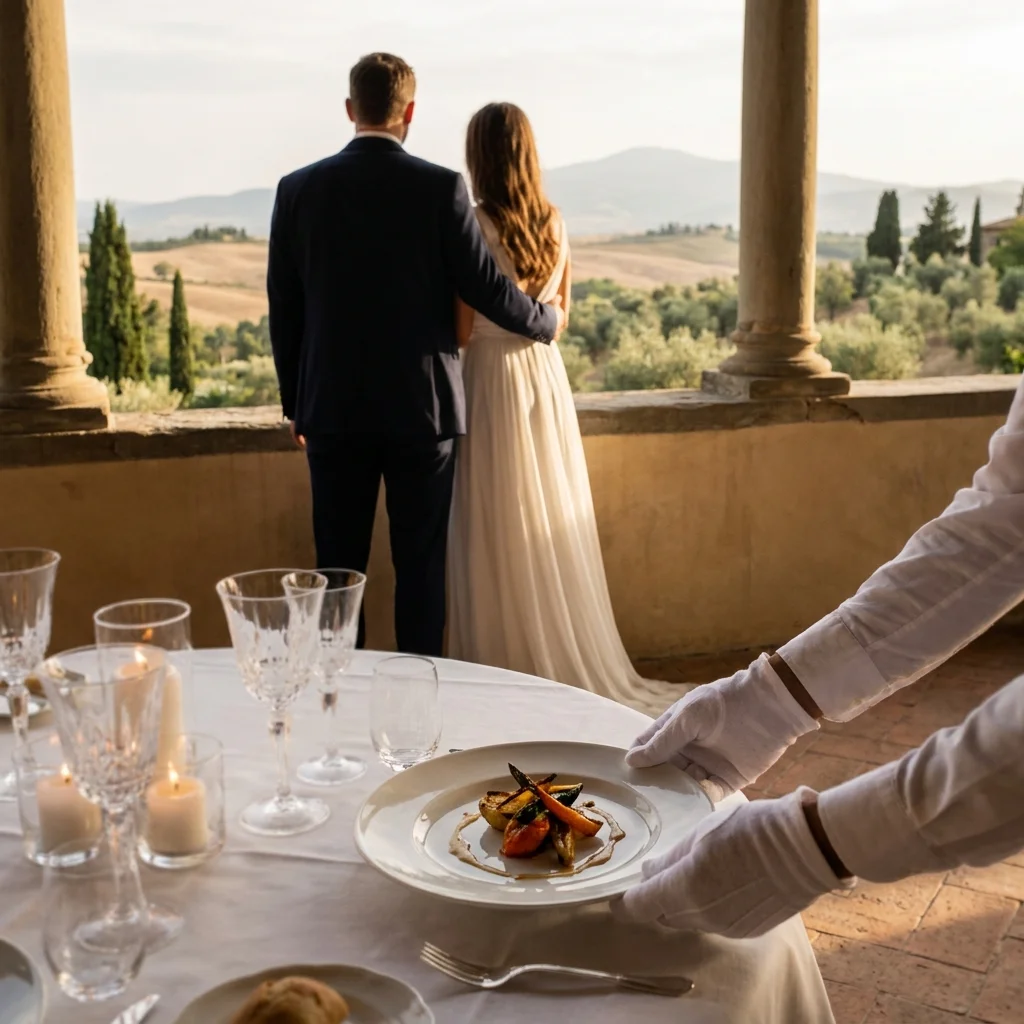
Conversation Flow, Sightlines, and Comfort: The Guest Experience Behind the Aesthetic
A tablescape is not only something to look at. It is something to sit within for three to four hours.
Sightlines matter more than most couples realize. A centerpiece taller than 35 cm at eye level blocks conversation across the table. Guests lean, crane, and eventually disengage. We design in two zones: below 30 cm (low, lush, accessible) or above 60 cm (elevated on slender stems or candelabra, clearing the line of sight entirely). The dead zone between 35 and 55 cm is where most amateur tablescape designs fail.
Seat spacing affects comfort and elegance equally. Italian venues often provide chairs that are wider or narrower than standard event chairs. We measure every chair and calculate place-setting width accordingly—minimum 65 cm per guest for comfort, 75 cm for luxury spacing. On an imperial table, this calculation determines the maximum guest count before a second table becomes necessary.
Conversation groupings are shaped by table format. Round tables of 8 create a single conversation circle. Round tables of 10–12 split into two or three sub-conversations. An imperial table creates natural clusters of 6–8 guests who interact primarily with their immediate neighbors. We advise on seating arrangements that honor these social dynamics, ensuring that no guest feels stranded at the far end of a 15-meter table.
The mise en place—the precise positioning of every glass, fork, knife, and napkin—is completed by our styling team on the day. We arrive four to six hours before guest arrival. Every element is placed, adjusted, and reviewed. Then the flowers go in. Then the candles. Then one final walk-through with the photographer to confirm that the detail shots are ready before a single guest enters the room.
How an Editorial Tablescape Photographs in Natural Italian Light—and Why That Matters at Design Stage
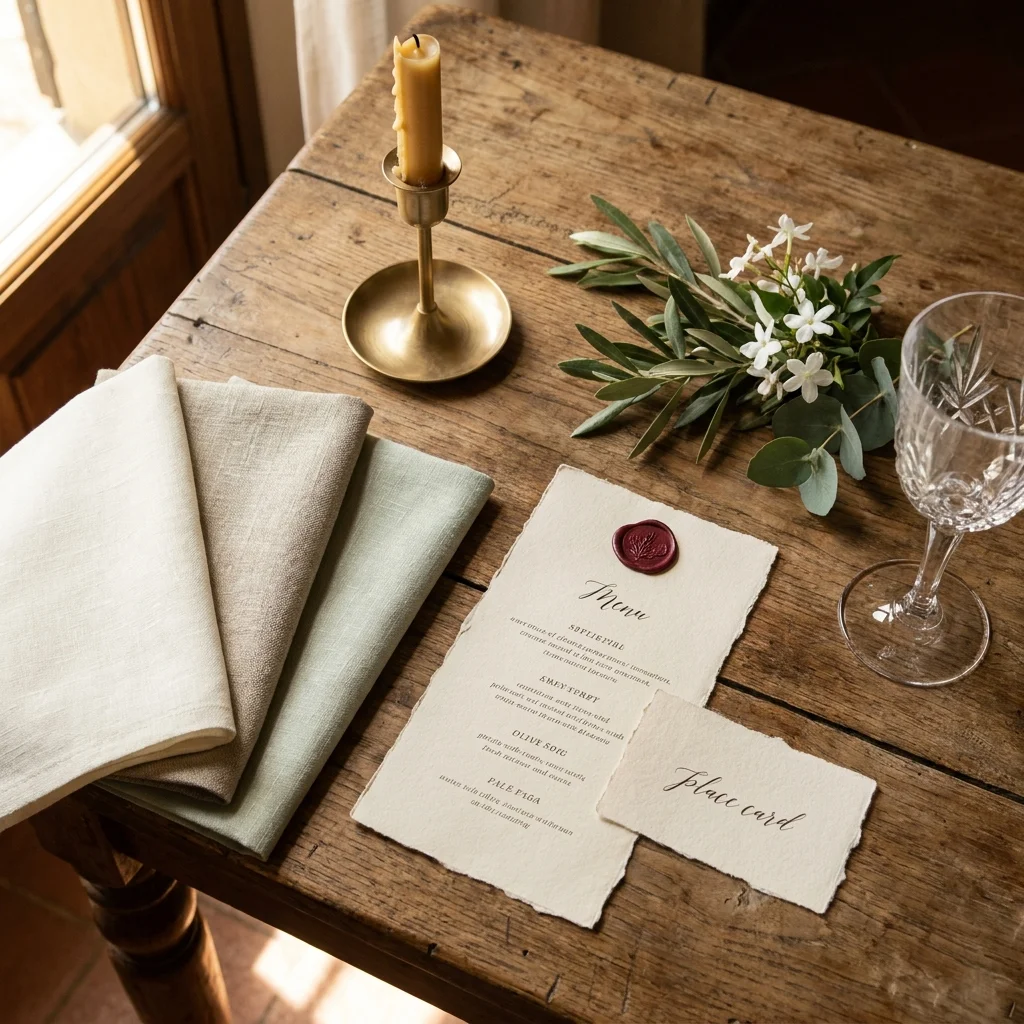
If you invest €15,000 or more in reception design, the images should be extraordinary. This means the tablescape must be designed with the camera in mind from the very first concept meeting.
We coordinate with the destination wedding photographer before finalizing the design. Key questions: What time will the detail-shot window occur? Where will the natural light enter the space at that hour? Will the photographer shoot from above (requiring a clear central line) or at table level (requiring depth and layered elements)? Does the videographer need a dolly path along the table that must remain unobstructed?
Metallic elements—gold flatware, brass candle holders, mercury glass votives—create beautiful highlights in natural light but can produce harsh reflections under flash. We specify finishes that are matte or brushed rather than polished for outdoor receptions where the afternoon sun is still strong during the detail-shot window.
Color matters photographically. A tablescape that reads as “warm white” in person may photograph as yellow if the linen has an ivory undertone. We select fabrics and florals with the photographic outcome in mind, often requesting test swatches from the linen supplier to review under natural light at the actual venue during a site visit. This level of precision is what produces images that feel effortless—because the effort happened months before the wedding day.
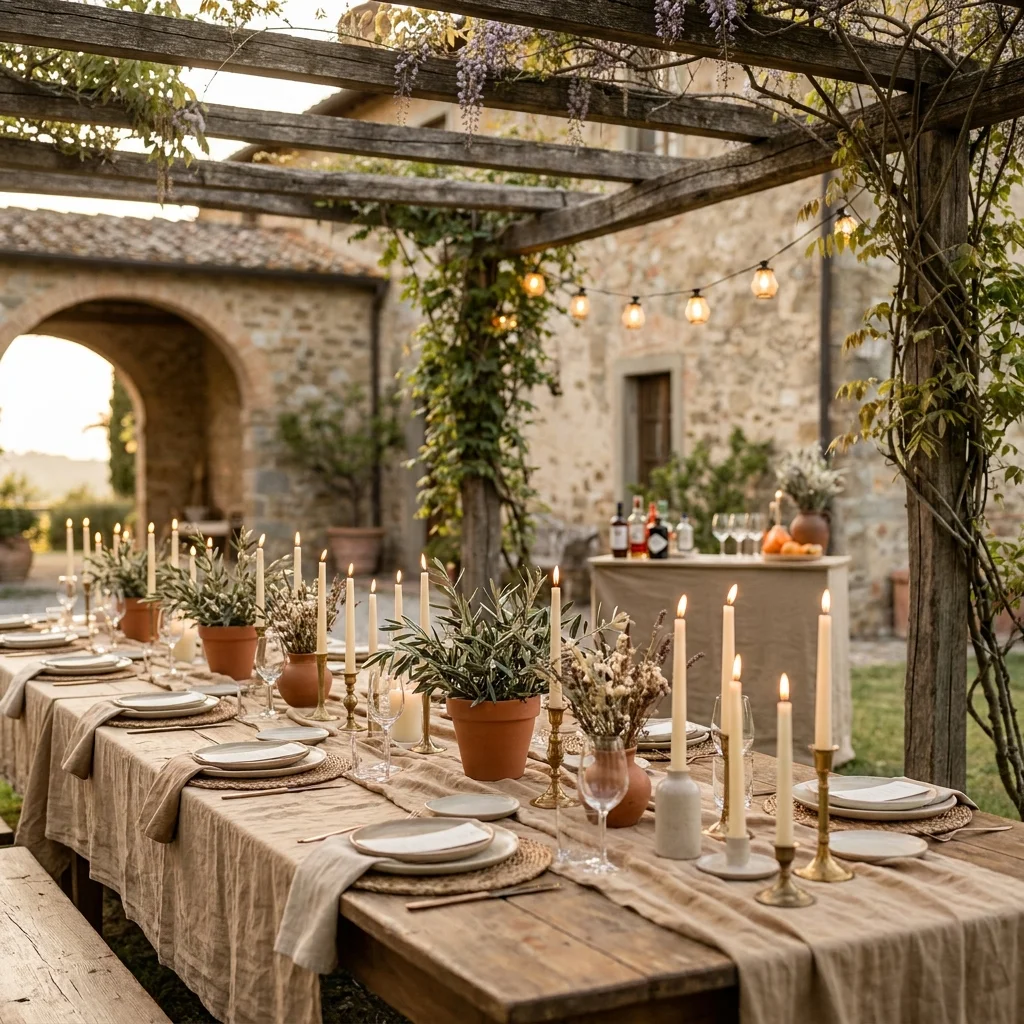
A Tablescape That Belongs to the Evening, Not Just the Photograph
The most beautiful Italian wedding tablescape I have ever designed was one that guests barely noticed—at first. They sat down, felt the weight of the linen napkin, caught the scent of jasmine woven through the garland, watched candlelight flicker across colored glass, and simply felt that the evening was perfect. They could not have told you why. That is the goal.
Every tablescape wedding Italy project we undertake at Kiss Me Italy begins with listening: to your story, your aesthetic instincts, your memories of meals that mattered. We translate that into a design that works with the venue, the season, the catering, the light, and the camera. Then we manage every vendor, every delivery, every last-minute adjustment, so that you experience the evening exactly as your guests do—from inside it, not behind it.
If you are beginning to imagine what your reception table might look like, reach out to our team. We will ask you the right questions first.
Frequently Asked Questions About Wedding Tablescapes in Italy
Do rental companies in Italy require a breakage deposit for glassware and tableware?
Often, yes—especially for crystal stems, vintage chargers, and hand-painted pieces. We confirm the deposit structure (hold vs. pre-authorized card vs. invoice), the replacement values, and the inspection process in advance, then manage reconciliation after the event so you are not negotiating damages during your honeymoon.
Is there a minimum spend for luxury tablescape rentals in Italy?
Many premium rental partners set minimum order values or delivery minimums, particularly in peak season and for remote venues. We structure the rental list to meet minimums intelligently—prioritizing the pieces that change the look most—rather than adding items that do not serve the design.
What is the rain-plan impact on an outdoor tablescape in Italy?
A credible Plan B affects table format, linen choices, candle strategy, and installation timing. We design the tablescape to translate into the indoor backup space without losing proportion or atmosphere, and we pre-approve both layouts with the venue and caterer so the switch can happen without compromising service.
Can we protect historic tables and surfaces from candle wax and staining?
Yes. Many venues require protective layers under linens and strict rules for wax containment. We specify appropriate underlays, drip-safe candle holders, and heat-resistant bases, and we coordinate venue approvals so the design remains compliant without looking utilitarian.
How do curfews and music restrictions affect dinner pacing and tablescape planning?
In some Italian locations, outdoor music has strict cut-off times. That changes the dinner timeline, the moment candles become essential, and when the room must transition to dancing. We align tablescape installation, lighting levels, and service rhythm with the venue’s regulations so the evening still feels seamless and elevated.
You may also enjoy reading What “Micro Wedding” Means in Italy (and How It Differs From an Elopement).