Wedding Celebrant Italy
The decision most couples are facing right now is not which villa, but which voice will stand in front of them — and whether that voice can legally marry them. In Italy it cannot, unless it belongs to a civil registrar of the comune or to a minister of a recognised faith: a wedding celebrant in Italy conducts a symbolic rite, written for you, delivered in your languages, in the garden or frescoed hall you actually chose. The legal act is signed separately — at home before departure, or in a municipal ceremony arranged around the same days. Our celebration collections, which include the venue, the ceremony and the celebrant who writes and performs it, run from €13,000 to €37,000. Everything beyond that — the second language, the rehearsal at golden hour, the microphone concealed inside a sixteenth-century balustrade — is the craft this article is about.
Legal, Religious, Symbolic: The Line Italian Law Draws Through Your Ceremony
This section is deliberately dry, because the distinction deserves precision. In the Italian system, a marriage acquires civil effect only through an ufficiale di stato civile — a registrar or delegated official of the comune — or through a minister of a religion whose confession holds a recognised agreement with the State. A symbolic celebrant, however gifted, does not register anything. That is not a limitation to be hidden; it is the reason the symbolic rite is free to be written entirely around the two people standing in it.
In practice, international couples work in one of three configurations. They complete the civil formalities in their home country and reserve the Italian day for the ceremony that matters emotionally. They pursue a full Italian civil rite, with the nulla osta, sworn translations and an interpreter present at the signing — a route we detail in our guide on what being legally married in Italy means for foreign couples. Or they hold the civil act in a municipal hall in the morning, then a symbolic ceremony in the afternoon, which is why the civil ceremony rules and real costs of an Italian courthouse wedding often sit alongside the celebrant conversation rather than replacing it. Our team handles the sequencing, so the two rites never compete for the same hour, the same light, or the same emotional weight. For couples weighing the three formats against one another, the broader comparison lives in our overview of civil, religious and symbolic ceremonies in Italy.
Lake Como: Where the Acoustic Is Water, Not Stone — and Ferries Have a Timetable
Villa Pizzo, laid out in the sixteenth century on the Cernobbio shore, presents a celebrant with a very particular problem: sound travels outward across the lake and never returns. There is no wall behind the guests to reflect the voice. A celebrant accustomed to enclosed rooms will be inaudible by the fourth row, which is why we place a discreet lapel transmitter and a single low-profile speaker angled inward, and why we schedule ceremonies against the public ferry timetable rather than against the wedding schedule alone. The Como–Bellagio boats pass with a wake and an engine note that lands, reliably, mid-vow.
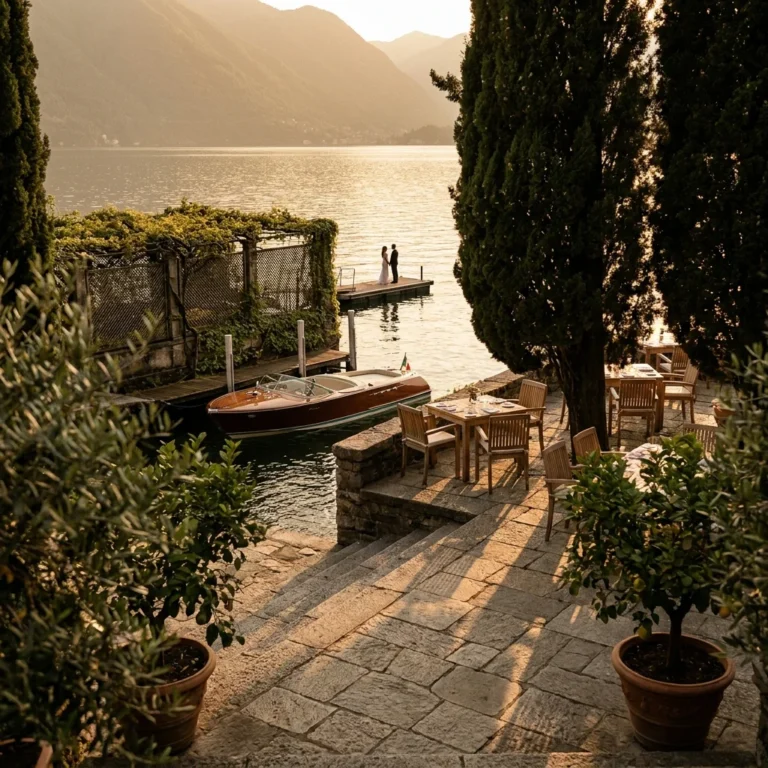
The Villa Pizzo micro wedding collection — three hours for ten guests or four hours for twenty, with the ceremony in the waterfront gardens and a celebration toast — is the setting where a written rite of roughly twenty-five minutes performs best. For a wholly private alternative, Villa Noseda taken in exclusive use for up to twelve guests, with its private dock and vintage Riva for the couple, allows the celebrant to work almost conversationally, at speaking volume, with the water as the only other sound. Couples still mapping the shoreline will find the full architectural picture in our guide to planning a Lake Como wedding.
Lake Garda: The Ora Wind Arrives at One O’Clock and Rewrites Your Script
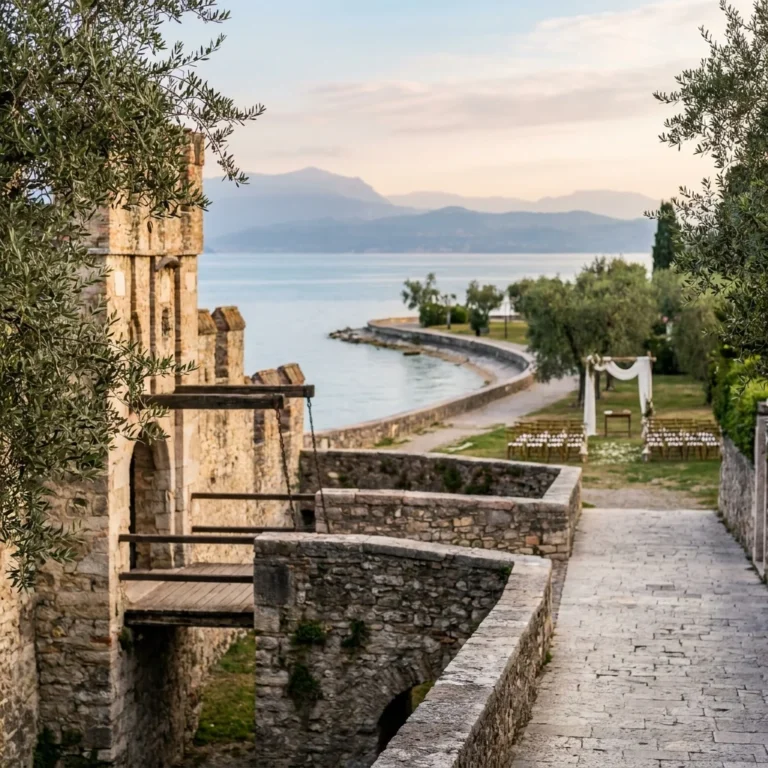
Garda has two winds and both are punctual. The Pelér descends from the north in the early morning; the Ora rises from the south around midday and holds until sunset. A celebrant working on the terraced gardens of Isola del Garda, on the island whose monastic settlement dates back to the thirteenth century, does not carry loose pages. We bind the script, weight it, and rehearse the delivery outdoors at the actual ceremony hour — never in the calm of a morning walkthrough that tells you nothing about two o’clock.
The island collection with its three private hours for up to twenty guests includes boat transfers, florals and photographer, and the rite is written to sit inside that window with room to breathe. Elsewhere on the lake, the Terrazza Koseritz at Villa Cortine Palace — the neoclassical villa whose terrace still carries the name of the Austrian count who commissioned it — offers panoramic views on three sides and a stone surface that returns the voice generously. The rooftop of Hotel Cristal Sirmione and the hillside gazebo of Villa Sostaga above Gargnano, for fifty guests, ask for different vocal registers entirely. The regional context sits in our guide to a wedding in Lake Garda, and couples returning to renew their promises often begin instead with our notes on a vow renewal on the Garda shoreline. When a date is already circled, our team will check the venue and celebrant availability together, since on this lake the two are rarely free on the same afternoon.
Tuscany: Castle Courtyards, Two Families, and a Rite Written for Both
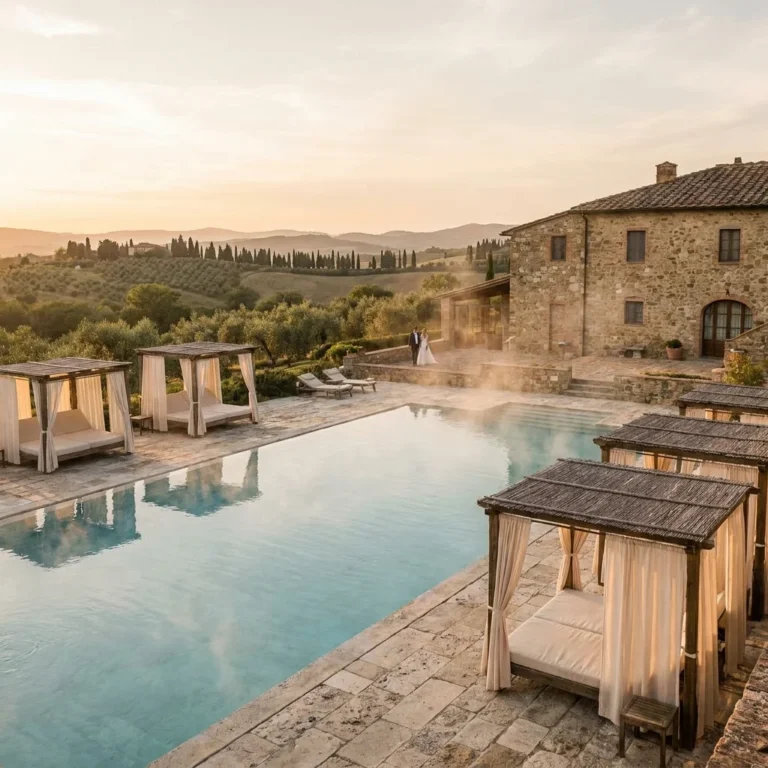
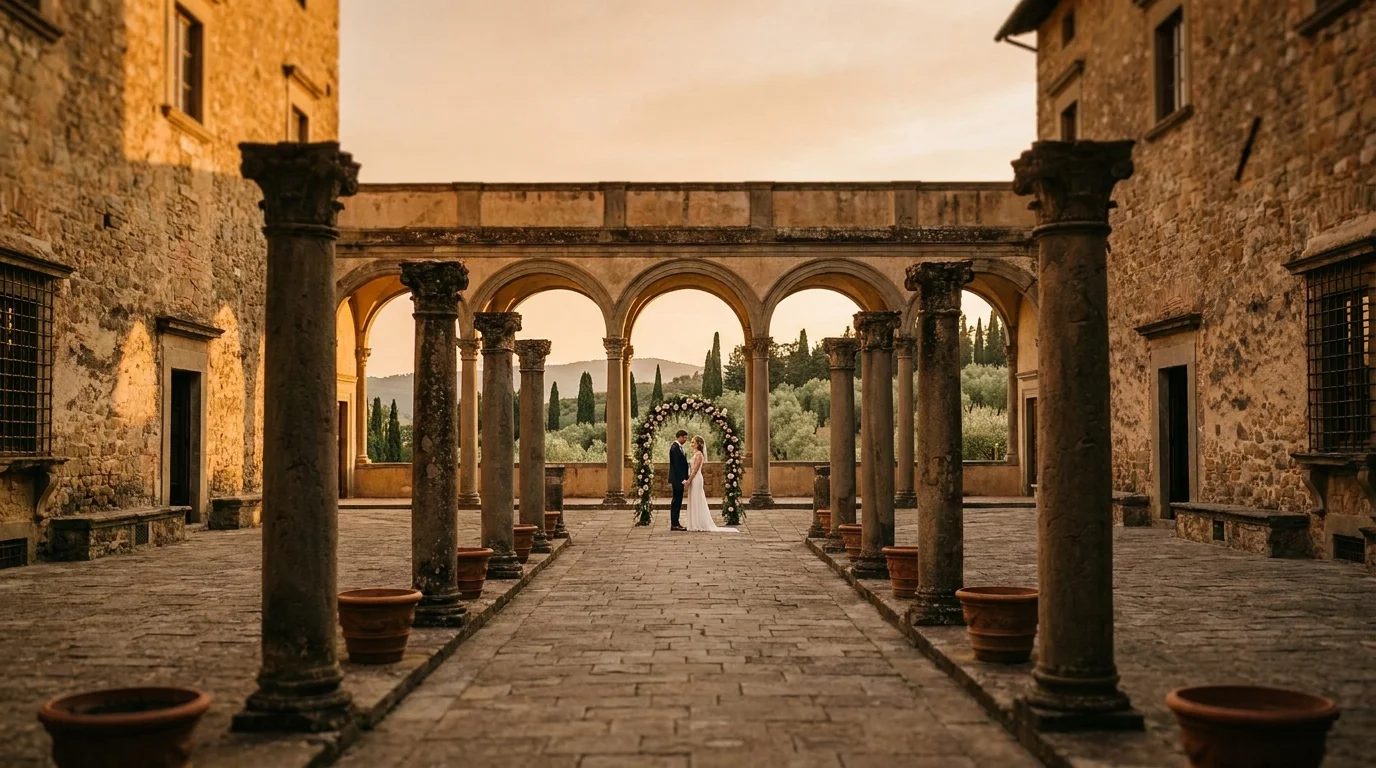
Inside a medieval courtyard in the hills south of Florence, stone does most of the acoustic work — and creates a different difficulty. Reverberation flatters a slow speaker and destroys a fast one. Our celebrants shorten their sentences and lengthen their pauses in these rooms; it is a scenographic decision as much as a vocal one, and it is rehearsed. The intimate Tuscan collection at Castello di Bibbione, with the stay at Villa il Poggio and its private pool, places the symbolic ceremony in the castle itself, which means the script is built for that architectural grammar and not transposed from a garden.
Tuscany also produces the most bicultural guest lists we handle: an Italian branch of the family, an American or British one, and a celebrant obliged to hold both without translating word for word into tedium. At Grotta Giusti Resort, where the garden ceremony precedes the reception and the nineteenth-century thermal grotto sits beneath the property, we favour an evening rite in late June — the sun does not leave the Tuscan hills until around nine, and the light at 19:30 is worth more than any lighting design. The venue landscape itself is mapped in our guide to wedding venues in Tuscany.
Venice: Frescoed Rooms Where Amplification Is Refused and the Voice Must Carry Alone
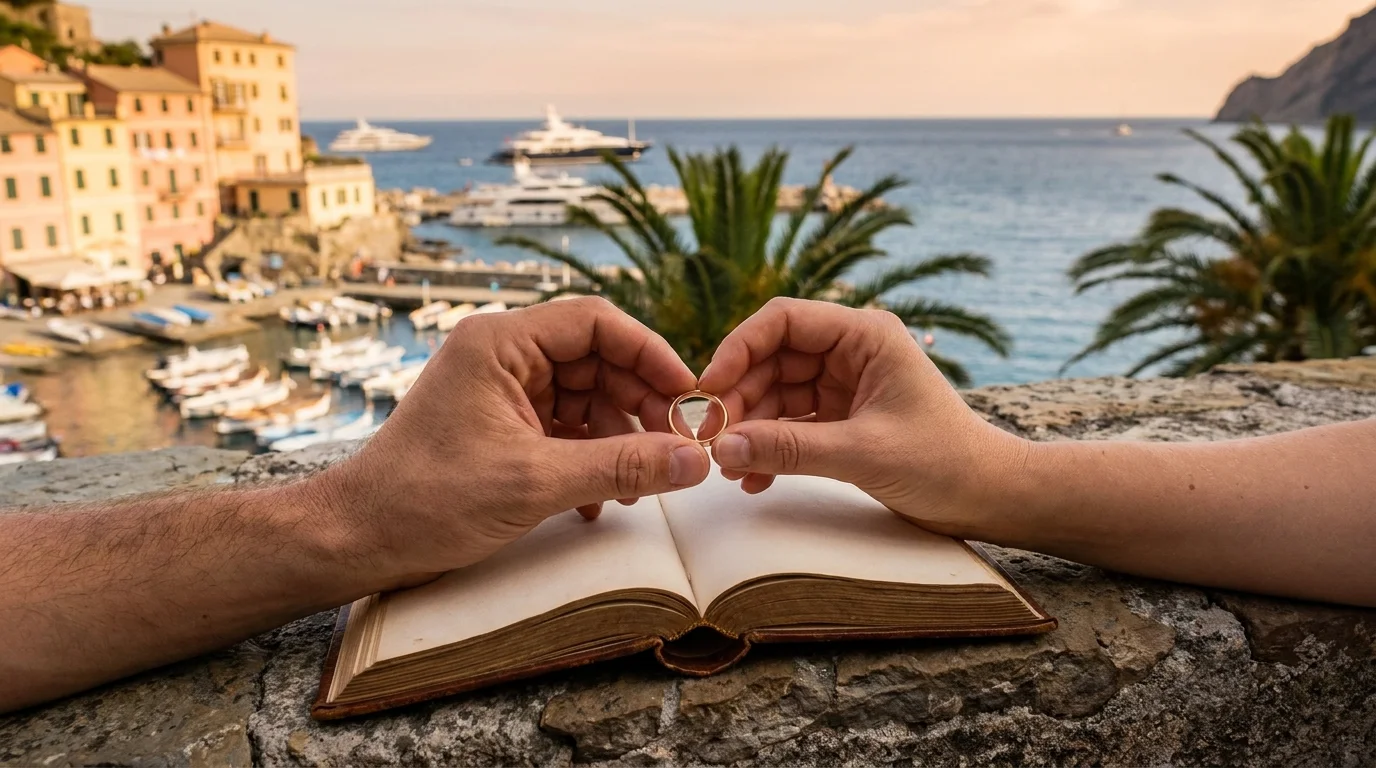
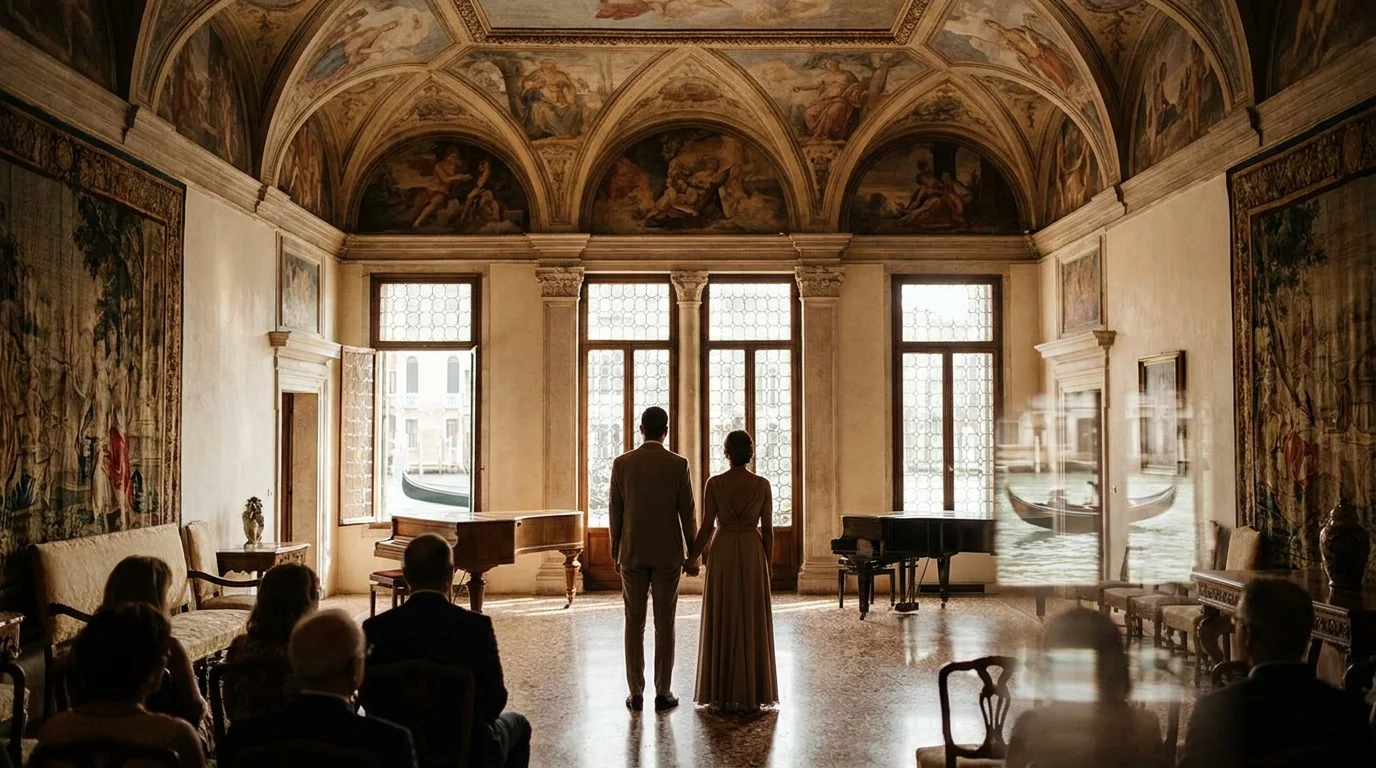
Several of the most beautiful licensed rooms in Venice — sixteenth-century piani nobili with original ceiling cycles overhead — do not permit amplification, or permit it only in a form so restricted it is not worth installing. That single constraint changes the entire selection criterion. In those rooms we do not propose a celebrant who reads; we propose one trained to project, because a frescoed hall of eighteen metres punishes an unsupported voice and rewards a stage-trained one. The celebrant is a performer here, in the honourable sense of the word.
Venetian ceremonies are also shorter by necessity: access is by water, guests arrive in staggered boats, and the room is often held for a defined slot. Thirty minutes, precisely built, outperforms fifty improvised. The architectural options are set out in our guide to wedding venues in Venice, and the budgetary structure of a Venetian celebration — including the water transfers that surround the rite — in our analysis of Venice wedding costs.
Liguria: A Sixteenth-Century Genoese Tower, a Six O’Clock Slot, and Salt in the Air
Torre Aurora stands on the sea cliff of Monterosso, a Genoese watchtower of the sixteenth century built against a threat that no longer exists. The exclusive-use collection there runs from 6 pm to midnight, with aperitivo, wedding dinner, cake and open bar — which means the ceremony has one hour, and one hour only, before the kitchen’s timeline begins. We write to that. Along the Gulf of Poets, the panoramic veranda of the Grand Hotel Portovenere, housed in a former monastic complex above the harbour, offers a sheltered rite with the sea below and the wind rising after sunset.
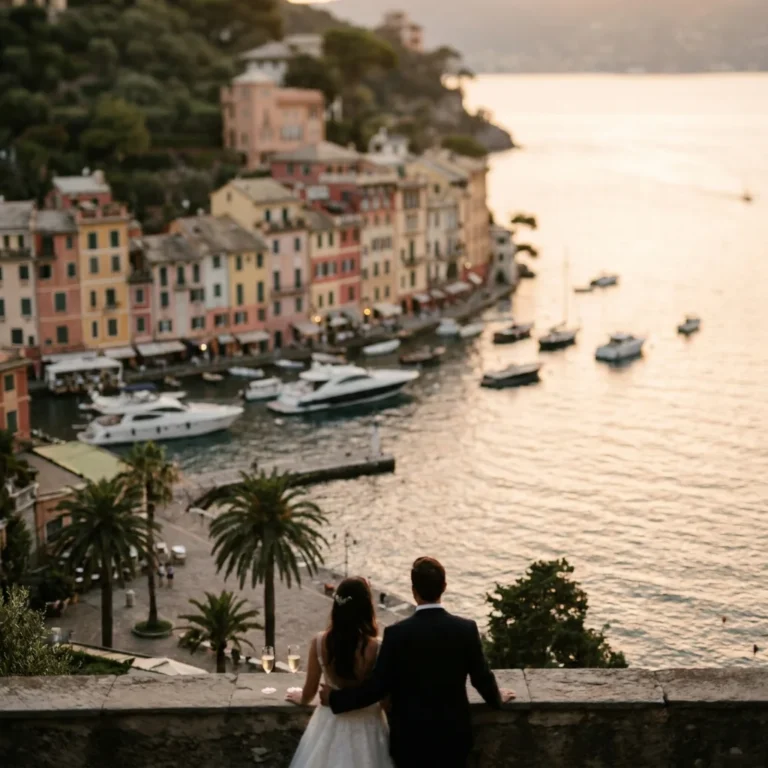
Salt air and evening humidity affect microphones, not romantically but electrically; our sound coordination includes a second transmitter kept dry and switched off until needed. The wider Ligurian picture appears in our guide to a wedding in Portovenere, and couples comparing this coast with the peninsula further west usually consult our breakdown of what a Portofino wedding costs.
Puglia: Two Days, Two Rites, One Celebrant
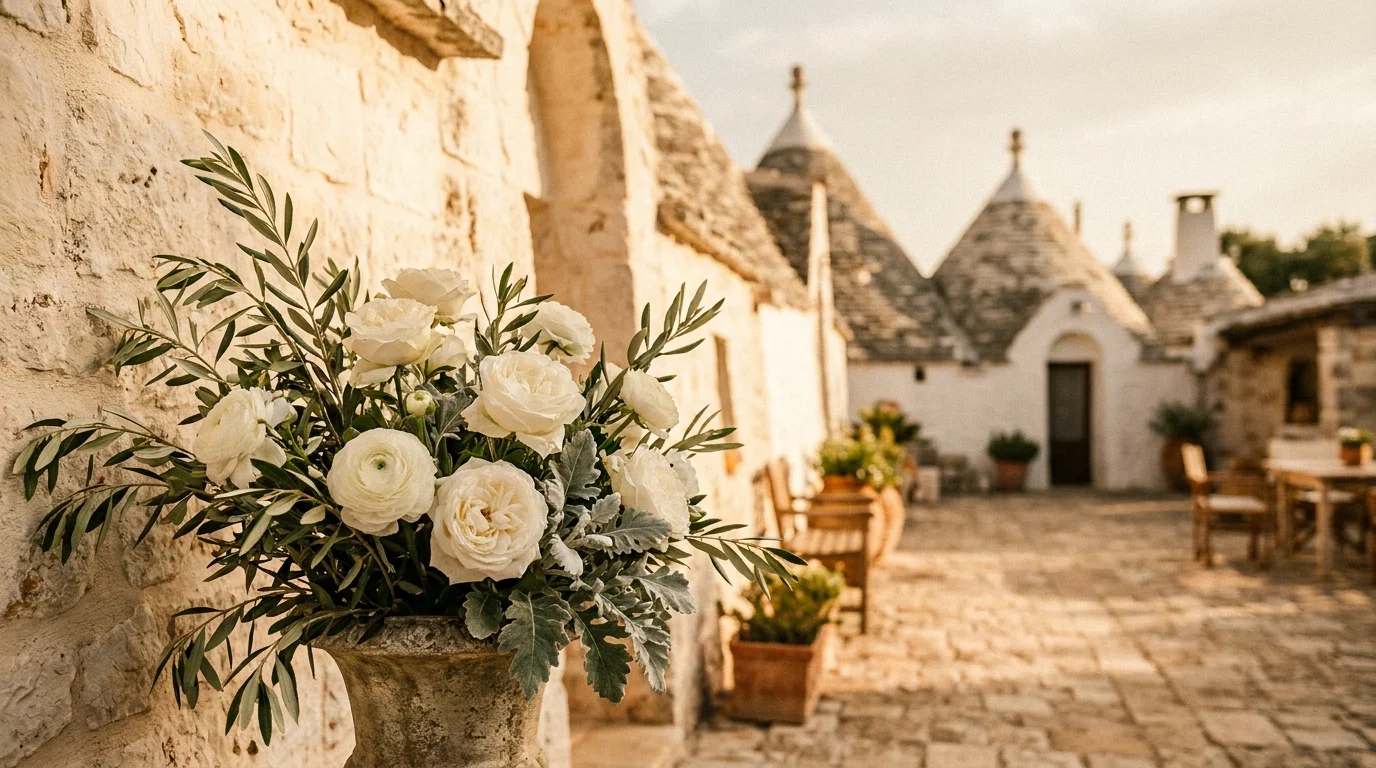
Puglia changes the celebrant’s job. The wedding is not an afternoon; it is two days. There is a welcome party the first evening and a ceremony the next. The Trulivo estate near Monopoli, taken in exclusive use with overnight accommodation for ten guests in restored trullo suites, allows the celebrant to meet every guest before speaking about them. Masseria Alchimia near Fasano does the same for twenty. That prior evening is not hospitality alone. It is research, and it shows in the script.
The Celebrant Who Lives Here Versus the One Who Flies In
Couples frequently arrive with a celebrant they love from home, and the question is legitimate. A professional travelling from London, New York or Sydney brings continuity of relationship and, occasionally, a voice the family already associates with meaningful moments. What they cannot bring is the venue rehearsal on the Thursday, the familiarity with a Ligurian sunset that falls twenty minutes earlier than the app predicts, or the ability to switch into Italian when a grandmother’s name is spoken. Travel and accommodation for an incoming officiant are quoted separately in every case, and typically add two nights plus flights to the ceremony line of the budget.
A resident wedding celebrant in Italy arrives the day before, walks the space at the ceremony hour, and knows which comune requires the symbolic rite to be visibly distinct from the civil one. Where a family carries its own liturgical expectations, the requirement becomes more specific still — a rite alongside a Greek Orthodox wedding in Italy demands a celebrant who knows precisely where the symbolic portion may begin and end.
The same discipline applies to cultural rituals with their own choreography. When a Chinese tea ceremony precedes the symbolic vows, the celebrant is not simply a speaker but the person who holds the transitions, so that neither tradition is compressed. We select for that. Our detailed criteria for choosing the right voice sit in the companion guide to the wedding officiant in Italy.
How Two Languages Are Distributed Across Forty Minutes Without Doubling the Length
The instinct is to translate everything. The result is a ceremony of eighty minutes in which every guest is bored for half of it. A bilingual wedding celebrant in Italy does something more architectural: the emotional passages are delivered in the couple’s first language, the structural passages alternate, and the culturally specific moments — the reading by an Italian uncle, the blessing from an English godmother — are left entirely in their own tongue with a single-sentence bridge before them.
| Language configuration | How the rite is constructed | Effect on ceremony length | Cost structure |
|---|---|---|---|
| English only | Full script in English; Italian used only for names, place names and the toast | 25–35 minutes | Included in our collections |
| English + Italian (bilingual celebrant) | Alternating structure; vows in the couple’s language, welcome and closing bilingual | 30–45 minutes | Included in our collections |
| English + Italian + third language | Third language handled by a second voice or by written translation in the ceremony booklet | 40–50 minutes | Second voice or interpreter quoted separately |
| Civil rite with legal interpretation | Sworn interpreter required by the comune at the signing; separate from the symbolic rite | 15–25 minutes (civil act only) | Municipal fees, sworn translations and interpreter quoted separately by the comune and appointed professionals |
Indicative ranges. Contact Kiss Me Italy for a personalized proposal.
Where guests will move directly from the rite to the table, the pacing of the ceremony is written against the kitchen’s own schedule — a coordination that also shapes the regional menu and its service rhythm. Nothing is left to be resolved on the day.
What the Celebrant Actually Costs Inside a Kiss Me Italy Collection
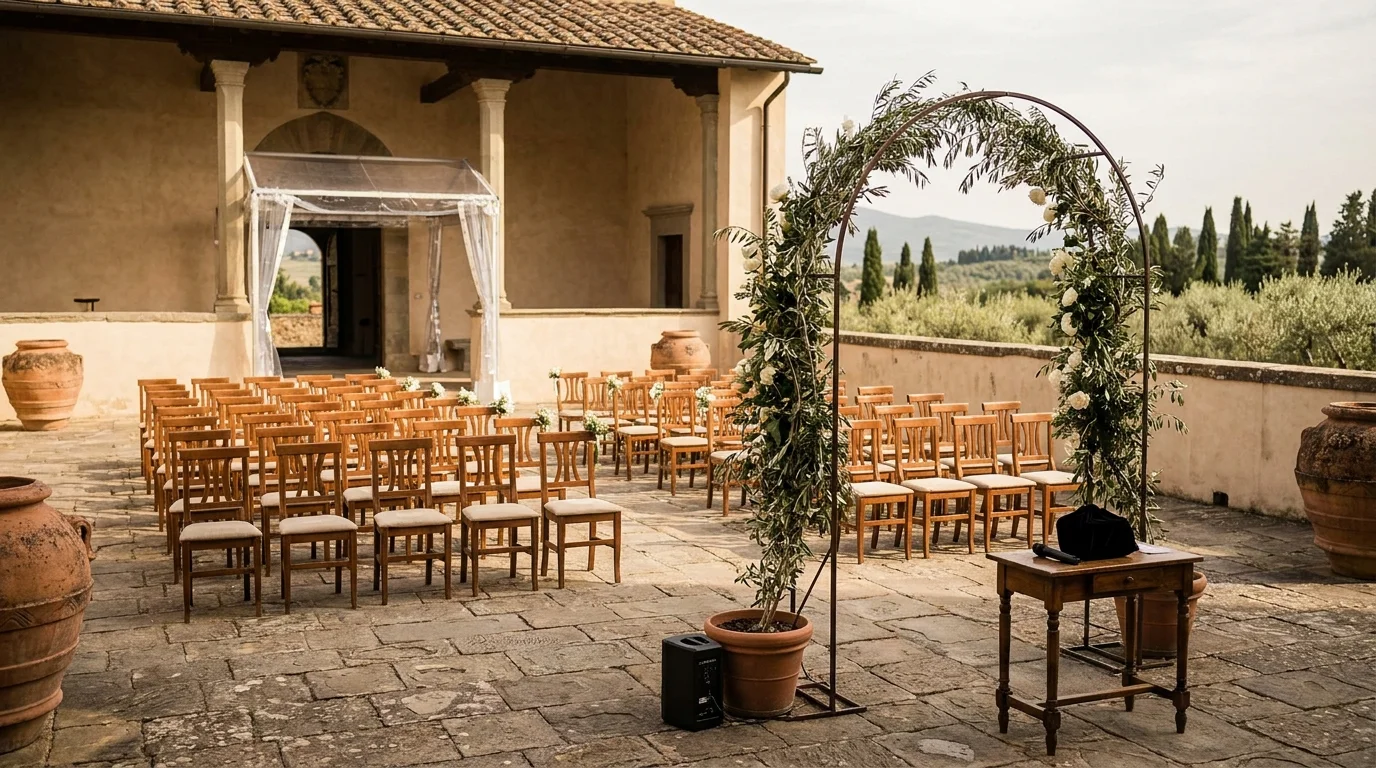
We do not sell the celebrant as a separate line item to be sourced, negotiated and briefed by the couple. The celebrant is curated, contracted and directed by us inside the collection, alongside the venue, the sound, the florals and the photographic timeline. Below are our real collections, at their real prices, each of which includes the symbolic ceremony conducted by a professional celebrant we have worked with directly.
| Collection | Price (for two) | What the collection includes |
|---|---|---|
| Intimate Lake Como Marriage — Villa Pizzo | €13,000 | Sixteenth-century Cernobbio estate; ceremony in the waterfront gardens; three hours for 10 guests or four for 20; celebration toast |
| Small Wedding on Lake Garda — Villa Sostaga | €19,000 | Outdoor gazebo ceremony above Gargnano for 50 guests; accommodation and live music not included |
| The Terraced Lakeview Wedding — Hotel Cristal Sirmione | €19,000 | Exclusive rooftop and sky bar overlooking Lake Garda |
| Micro Wedding — Villa Cortine Palace | €19,000 | Terrazza Koseritz in exclusive use, panoramic on three sides |
| Intimate Wedding — Castello di Bibbione & Villa il Poggio | €28,000 | Tuscan estate stay with private pool; symbolic ceremony at the castle |
| Intimate Island Wedding — Isola del Garda | €29,000 | Three private hours for up to 20 guests; terraced-garden ceremony, boat transfers, florals, photographer, toast |
| The Gulf of Poets Wedding — Grand Hotel Portovenere | €32,000 | Panoramic veranda in exclusive use; aperitivo, wedding lunch, cake, night at the hotel |
| The Intimate Villa Noseda Wedding — Lake Como | €33,000 | Private villa in exclusive use for up to 12 guests; private dock, vintage Riva for the couple |
| The Trulli Wedding Experience — Trulivo | €34,000 | Two days in exclusive use near Monopoli; welcome party, overnight for 10 guests in trullo suites |
| Boutique Countryside Hotel Wedding — Grotta Giusti | €35,000 | Garden ceremony and reception in Tuscany; overnight stay optional |
| The Puglia Countryside Wedding — Masseria Alchimia | €37,000 | Two days in exclusive use near Fasano; welcome party, overnight for 20 guests, breakfast, aperitivo and wedding dinner |
Indicative ranges. Contact Kiss Me Italy for a personalized proposal.
| Celebrant scope | Included in the collection | Quoted separately |
|---|---|---|
| Two pre-ceremony interviews with the couple (video call) | Included | — |
| Bespoke script writing, with two rounds of revision | Included | Further rewrites after the final approval date |
| Bilingual delivery (English + Italian) | Included | Third language, second voice or sworn interpreter |
| On-site rehearsal at the ceremony hour, day before | Included where the venue slot permits | Additional venue access hours |
| Celebrant travel within the venue’s region | Included | Travel and accommodation for a celebrant requested from another region or country |
| Ceremony sound: lapel transmitter, speaker, backup unit | Included | Live musicians, string ensembles, amplified performance |
| Ritual elements (handfasting, wine, sand, family blessing) | Included in the script design | Bespoke props, printed booklets, calligraphy |
| Civil registration, nulla osta handling, sworn translations, municipal fees | Not included — coordinated by us | Set by the comune and appointed professionals; confirmed in writing before booking |
| Italian VAT (IVA 22%) treatment | Itemised in the written proposal | — |
Indicative ranges. Contact Kiss Me Italy for a personalized proposal.
We publish no figure we have not verified. Municipal fees, sworn translations and interpreter costs vary by comune and are confirmed in writing, in your proposal, before anything is signed — and our team will build that itemised proposal around your date and guest count. Couples working at the smaller end of the scale often begin from our guide to the micro wedding in Italy, and those planning without guests at all from our overview of how to elope in Italy.
The Rehearsal, the Backup Voice, and the Ninety Minutes Before Guests Arrive
What distinguishes a directed ceremony from a booked speaker is everything the couple never witnesses. The day before, the celebrant walks the space with our production lead and the photographer: we fix the standing positions relative to the sun’s actual angle, agree the two cues at which the photographer moves, and mark the point in the script where the celebrant pauses for the wide frame. On the morning of the wedding, the sound is tested at the ceremony hour, not at nine.
We contract a second celebrant on standby for every ceremony — a colleague who has read the approved script and can perform it. It has rarely been needed. It is never negotiable. The venue receives a cue sheet with the arrival, processional and signing times to the minute, so the kitchen holds the aperitivo rather than guessing at it, and the florals for the ceremony point are re-set after the rehearsal rather than before it.
Rain does not cancel a rite; it relocates it, and the alternative interior is dressed, tested and scripted for in advance, because a frescoed hall requires a different vocal projection than an open terrace and the celebrant is briefed for both. This is the difference between commissioning a professional and directing a scenography. Couples renewing their promises after many years receive the same treatment, as set out in our guide to renewing your vows in Italy.
Choosing the Voice That Will Hold the Room
A ceremony lasts thirty-five minutes and is remembered for fifty years — which is a poor argument for treating the celebrant as the last supplier on the list. The right wedding celebrant in Italy is chosen the way a director casts: for timbre, for pacing, for the ability to speak two languages without sounding like a translator, and for the discipline to write a rite that belongs to one couple and no other. We audition, contract and direct that voice ourselves, inside a collection whose venue, timing and production are already aligned around it. When your date and destination are settled, we will propose the celebrants we believe are right for your ceremony, with recordings, and explain precisely why each one.
Questions Couples Ask Us Before They Book a Celebrant
Can we hear the celebrant speak before we commit?
Yes — we provide audio or video recordings of previous ceremonies, with the couples’ permission, so timbre and pacing can be judged rather than imagined. Where schedules allow, we also arrange a short introductory video call with the shortlisted celebrant. Most couples decide within one conversation.
What happens if the celebrant we want is already booked for our date?
We hold provisional dates with two or three celebrants during the venue negotiation, precisely because the best voices in Lake Como and Tuscany are committed nine to twelve months ahead for Saturdays between May and September. If the first choice is unavailable, we present alternatives matched on language and register, never simply on availability.
Can a family member or close friend perform the ceremony instead?
They can, and it is often beautiful — but the rite remains symbolic and carries no civil effect. In those cases we write the script with them, rehearse the delivery on site, and manage the sound and cueing so that the person speaking is free to be emotional rather than technical.
How long before the wedding is the final script approved?
We work to an approval date roughly three weeks before the ceremony, which leaves time for the printed booklets and the celebrant’s memorisation of names and pronunciation. Small additions after that date are always possible; structural rewrites are quoted separately.
Will the celebrant pronounce our families’ names correctly?
This is rehearsed explicitly. We collect a phonetic list of every name spoken during the rite — including surnames, hometowns and any word in a third language — and the celebrant confirms each one during the pre-ceremony call. It is a small thing that guests notice immediately.
Can the ceremony include a religious element without being a religious ceremony?
Yes. A blessing, reading or family prayer can be incorporated into a symbolic ceremony without presenting the rite as legally binding or as a formal religious service. We review the wording with the celebrant and position the element carefully so it respects both the family’s tradition and the ceremony’s intended character.