
Courthouse Wedding in Italy: Civil Ceremony Rules, Real Costs & a Seamless Experience
“Can we land on Friday and marry on Saturday?” It’s the most common—and most costly—assumption we hear about a courthouse wedding in Italy. The truth is practical: a civil ceremony is performed by a municipal officer at the Comune (town hall), typically lasts about twenty minutes, and it only becomes effortless when the document timeline, interpreter requirement, and Comune scheduling are handled with precision from the start.
Most couples who contact us about a civil ceremony in Italy have already searched “courthouse wedding Italy” and landed on a patchwork of contradictory advice. One forum says you need to arrive ten days early. Another insists the ceremony can be in English. A third claims you can marry at any venue you choose. After thirty years of coordinating legal weddings across Italian municipalities, I can tell you that every one of those statements is partly true—and partly misleading. The reality is more nuanced, it varies by Comune, and it is entirely manageable when an experienced team is working on your behalf.
Legal Civil Ceremony vs. Symbolic Ceremony: Which Decision Comes First
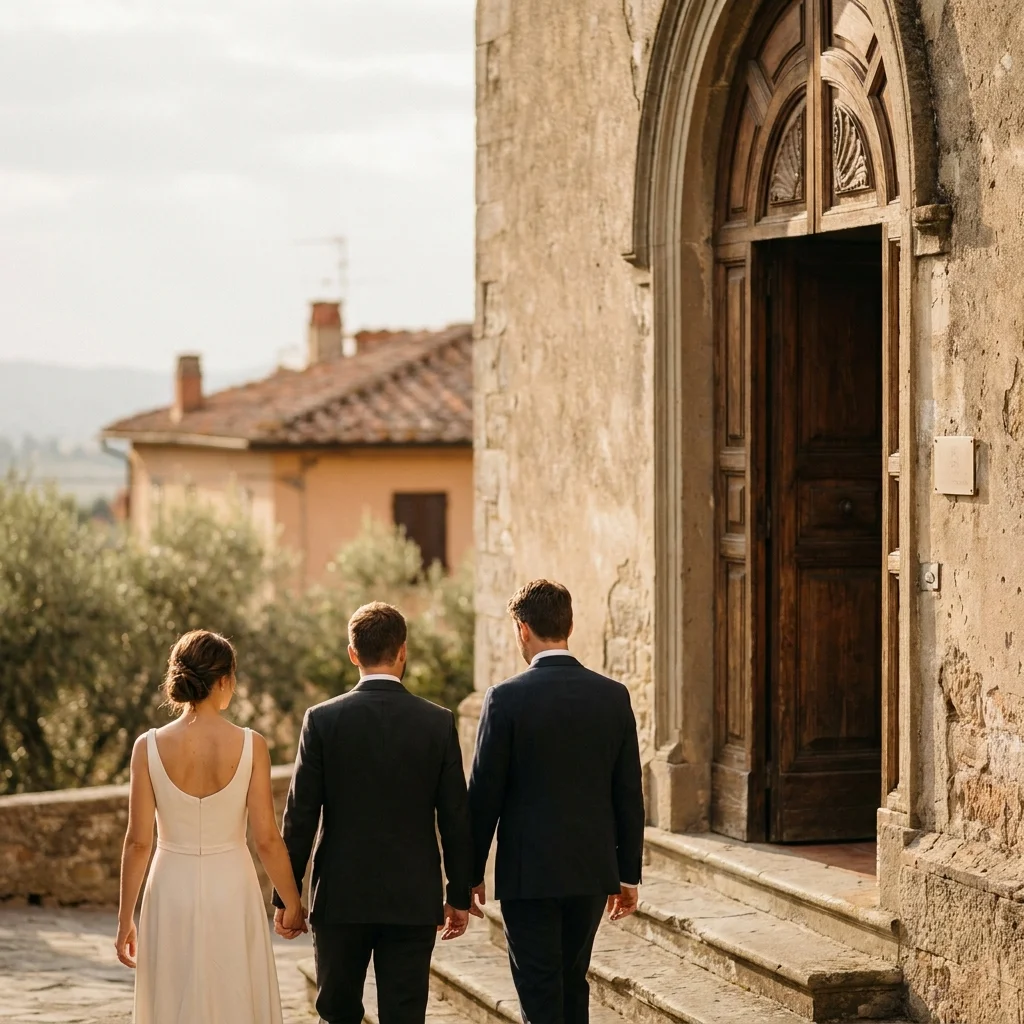
Before choosing a venue, a date, or a color palette, the couples we work with face a foundational question: do you want your Italian ceremony to be legally binding, or are you content with a symbolic celebration that carries personal but not legal weight?
A legal civil ceremony—what Italians call a matrimonio civile—requires specific documents, an appointed municipal officer, and compliance with the rules of the issuing Comune. It produces a marriage certificate recognized internationally. A symbolic ceremony, by contrast, can happen anywhere, be conducted by anyone you choose, and follow whatever structure you wish. Many couples who already hold a legal marriage certificate from their home country opt for a symbolic celebration in Italy, freeing them from paperwork entirely.
In our experience, roughly forty percent of our international clients choose the legal route. The rest prefer a symbolic elopement in Italy or a blessing. The decision shapes everything that follows: timeline, venue options, and the documentation we prepare on your behalf. Our team clarifies which path suits your situation during the very first consultation—Request your private consultation.
What “Courthouse” Actually Means in Italy—and Why the Comune Controls More Than You Expect
There is no direct equivalent of an American courthouse wedding in Italy. The closest parallel is the Comune civil ceremony, performed inside a town hall or at a Comune-designated external venue. This distinction matters.
Each Italian municipality maintains a list of approved locations for civil marriages. Some are grand: think the Sala Rossa in Florence’s Palazzo Vecchio or the ornate halls of Venice’s Ca’ Farsetti. Others are intimate rooms inside smaller town halls in Liguria or Piedmont. A few Comuni authorize ceremonies in external venues—historic villas, gardens, terraces overlooking the sea—but the municipality must formally designate the space, and the officiant is always a municipal officer, not a private celebrant.
The Comune also controls scheduling. Ceremony slots are assigned based on availability and guest count. In high-demand cities like Florence or Rome, summer Saturdays fill months in advance. We secure preferred slots early, often coordinating directly with the Ufficio di Stato Civile before our clients finalize travel dates. What most planners miss is that even confirming a date requires submitting preliminary documents—so the timeline begins well before you board a plane.
The Ceremony Is Conducted Entirely in Italian—Here’s What That Means on the Day
This surprises many couples. Every legal civil ceremony in Italy is conducted in Italian. No exceptions. If neither the bride nor the groom speaks Italian fluently, an official interpreter must be present and is legally required to translate the vows, the articles of the civil code read aloud by the officiant, and the couple’s responses.
The interpreter is not a casual bilingual friend. They must be a certified professional, and some Comuni require them to be sworn in before the ceremony or to present credentials in advance. In our experience, the interpreter’s role is far more than functional—it shapes the emotional rhythm of the ceremony. A skilled interpreter preserves the cadence of the Italian text while delivering a genuine, warm English rendition that lets you feel the gravity of the moment rather than simply decode it.
We hand-select interpreters we have worked with repeatedly, professionals who understand the pace of a twenty-minute civil ceremony and who know how to stand discreetly beside the officiant without disrupting the visual frame for your photographer. The difference between a generic translator and one who has done this dozens of times is audible and visible in the final images.
A Quick Reality Check Before You Choose a Date
Three facts decide whether your plan feels effortless—or rushed.
- The Comune’s calendar is not flexible in peak season.
- The interpreter is a legal requirement, not a preference.
- The paperwork clock starts months before you travel.
If you want the experience to feel calm, we build the timeline first, then we design the celebration around it.
The Document Timeline That Catches Most Foreign Couples Off Guard
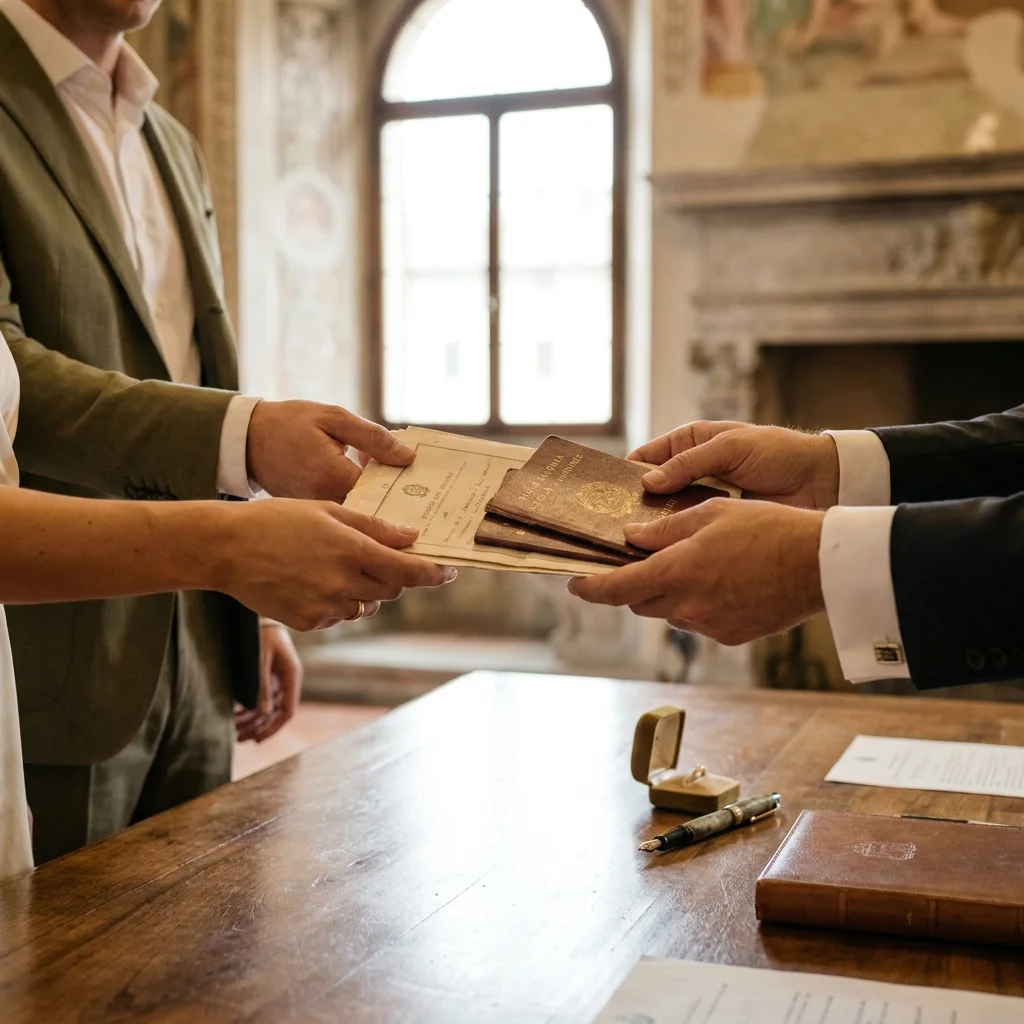
Paperwork is the invisible architecture of a courthouse wedding in Italy. It is not complicated when managed properly, but it operates on a timeline that punishes procrastination.
The Nulla Osta—a certificate confirming you are free to marry—must be obtained from your country’s embassy or consulate in Italy. For US citizens, this involves a sworn affidavit at the US Embassy in Rome or the Consulate in Florence, Milan, or Naples. British citizens follow a different path through the British Consulate. EU nationals may use documentation from their home civil registry. Requirements vary by Comune and nationality, which is precisely why we coordinate with the relevant offices on your behalf rather than handing you a checklist.
Once the Nulla Osta is in hand, it must be presented to the Comune along with other documents—birth certificates, passports, and sometimes divorce or death certificates if applicable—all translated, apostilled, and in some cases legalized. The Comune then posts the pubblicazioni (banns), a public notice of intent to marry. This posting period is typically two consecutive Sundays, meaning at least eleven days must pass before the ceremony can take place.
Some Comuni also require an in-person sworn declaration a few days before the wedding. This is a brief appointment at the town hall where both partners confirm their intent to marry before a municipal officer. Not every Comune enforces this, but when it applies, it means you cannot arrive the night before and marry the next morning.
Our team manages every step: we liaise with embassies, prepare translation packages, submit documents to the Comune weeks in advance, and confirm the sworn-declaration requirement so your travel dates are planned accordingly. If you are beginning to explore a legal marriage in Italy as a foreigner, we can outline the exact timeline for your nationality and chosen Comune during an initial consultation—Request your private consultation.
Two Witnesses Over Eighteen: A Simple Rule With Practical Implications
Italian civil law requires two witnesses present at the ceremony. They must be over eighteen and carry valid identification. They do not need to be Italian citizens or residents.
Most couples ask close friends or family members. But for elopements or very intimate celebrations where no guests are present, we provide professional witnesses from our team—discreet, well-dressed, and experienced in the ceremony flow. This is a small detail that matters more than it sounds: witnesses sign the register alongside you, and their composure contributes to the calm, unhurried atmosphere we create around every legal ceremony.
Twenty Minutes That Deserve More Thought Than Most Couples Give Them
A civil ceremony in Italy lasts approximately twenty minutes. The officiant reads selected articles from the Italian Civil Code, the interpreter translates, the couple exchanges consent, rings are offered (optional but customary), and the register is signed. It is brief. It is formal. And it is beautiful in its simplicity.
But brevity creates a particular challenge for photography and guest flow. There is no processional aisle in most town halls. No long musical interlude. The photographer has a narrow window to capture the exchange of vows, the signing, and the couple’s first moments as a married pair. This is why we coordinate closely with our photography team well before the day, reviewing the room’s natural light at the assigned time slot and planning angles that work within the space.
For couples who want a more expansive ceremonial experience—personal vows, readings, music—we often recommend pairing the legal Comune ceremony with a separate symbolic celebration later the same day or evening. The legal formality is handled in the morning; the emotional, personalized ceremony unfolds at a private villa, a terrace, or a garden where time is entirely yours. This approach gives you the best of both structures without compromising either.
Municipality Fees vs. Planning Fees vs. Celebration Costs: A Transparent Breakdown
Cost confusion around a courthouse wedding in Italy typically stems from conflating three separate categories. Here is how we present them to the couples we work with.
Municipal Fees (Paid Directly to the Comune)
| Fee Component | Indicative Range | What’s Included | What’s Separate |
|---|---|---|---|
| Standard ceremony fee (resident couple) | €250–€500 | Use of town hall ceremony room, municipal officiant | Interpreter, external venue surcharge |
| Non-resident couple surcharge | €400–€1,200 | Use of designated ceremony room, municipal officiant | Interpreter, Saturday/Sunday premium (some Comuni) |
| External venue authorization | €300–€900 | Officiant travel to Comune-approved external site | Venue hire fee (paid to venue owner), interpreter |
Indicative ranges. Fees vary by Comune and are confirmed during the planning process. Request your private consultation for a personalized proposal.
Planning & Coordination Fees (Kiss Me Italy)
| Service Tier | Indicative Range | Inclusions | Quoted Separately |
|---|---|---|---|
| Civil ceremony coordination only | Confirmed on proposal | Document preparation, embassy liaison, Comune scheduling, interpreter sourcing, witness arrangement, day-of coordination | Photography, florals, transport, celebration dinner |
| Civil ceremony + curated celebration | Confirmed on proposal | All coordination above plus venue scouting, menu curation, floral design, photographer/videographer management, guest logistics | Vendor fees invoiced directly by each supplier; VAT (IVA 22%) applied per Italian law |
Planning fees depend on scope, season, and destination. We provide a detailed, itemized proposal after an initial consultation. Request your private consultation.
Creative Celebration Costs (Vendor Services)
| Vendor Category | Indicative Range | Typically Includes | Quoted Separately |
|---|---|---|---|
| Photography (civil ceremony + portraits) | €2,500–€6,000 | 4–6 hours coverage, single shooter, edited gallery delivery within 8 weeks | Second shooter, albums/prints, travel outside region, VAT (IVA 22%) |
| Certified interpreter | €900–€1500 | Ceremony interpretation, pre-ceremony briefing | Travel outside municipality, post-ceremony translation of certificate |
| Celebration dinner (per guest) | €150–€600 | Multi-course seated dinner, house wines, service staff | Premium wine pairings, cake design, entertainment, venue hire |
| Permits & location fees (if required) | €200–€500+ | Comune/location-specific permissions for portraits or restricted areas (where applicable) | Varies by city/venue; accommodation for vendors (if needed), transport, and expedited requests |
| Post-production & delivery upgrades | €550–€1,500 | Rush editing, extended retouching, additional gallery curation | Albums, prints, second shooter, and travel/accommodation outside the base area |
Indicative ranges based on central and northern Italy. Southern Italy and island destinations may differ. For verified cost benchmarks, see our guides on Venice wedding costs and overall Italy wedding pricing.
Grand Town Halls vs. Comune-Approved External Venues: Atmosphere, Capacity, and Trade-Offs
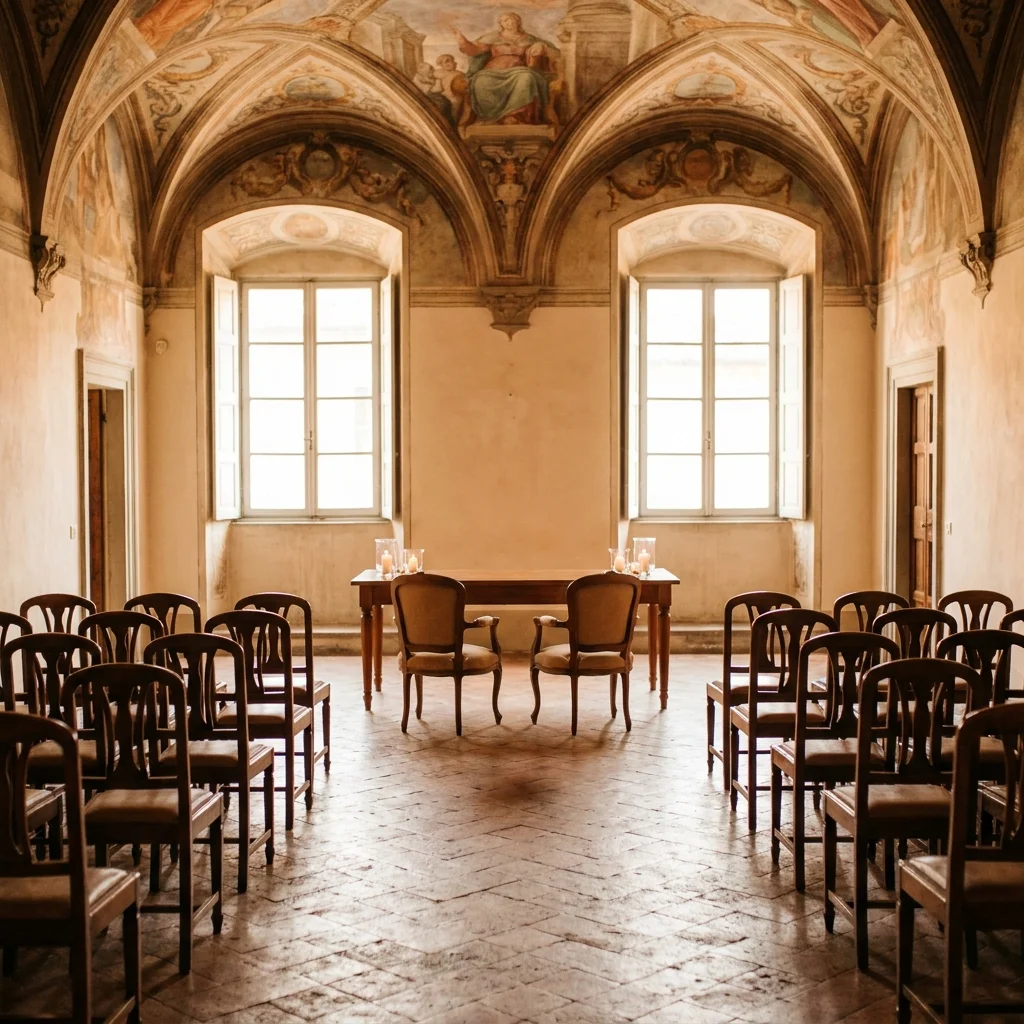
The choice between marrying inside a town hall and at an external Comune-approved venue involves more than aesthetics. Each option carries logistical realities worth understanding.
Historic town halls—Florence’s Palazzo Vecchio, Venice’s municipal halls, Rome’s Campidoglio—offer architectural grandeur that no private venue can replicate. Frescoed ceilings, centuries-old woodwork, marble floors. The trade-off: you share the building with other ceremonies scheduled that day, and you cannot customize the room with your own flowers, lighting, or music beyond what the Comune permits. Guest capacity is fixed, often at thirty to fifty.
External authorized venues offer more flexibility. A Comune in Tuscany might authorize a ceremony in a vineyard estate’s garden; a coastal municipality in Liguria might permit a terrace overlooking the harbor. You gain control over décor, timing, and guest count. The trade-off: the authorization process adds weeks to the timeline, the Comune charges an additional fee, and not every municipality offers this option.
In our experience, the couples we work with who prioritize intimacy and photographic beauty tend to prefer the external venue route, while those drawn to historical gravitas choose the town hall. We present both options with clear timelines and costs during the planning phase, always factoring in your guest count and the season. A micro wedding in Italy with fewer than fifteen guests, for instance, opens doors to smaller, more exclusive Comune-approved spaces that larger parties simply cannot access.
Why a Midweek Civil Ceremony in October Costs Less—and Often Feels Better—Than a Saturday in June
Timing shapes both cost and experience. Saturday slots in June, July, and September are the most competitive across major Italian Comuni. Fees are higher, availability is tighter, and the surrounding streets—especially in cities like Florence and Rome—are thick with tourists.
Shift to a Wednesday in mid-October, and the picture changes. Municipal fees are often lower for weekday ceremonies. The Comune’s schedule is less congested, giving you a better chance of securing a preferred morning or late-afternoon slot. The light in Tuscany and Umbria during October is warm and directional—ideal for portraits immediately after the ceremony. And restaurant availability for a celebratory dinner is dramatically easier to arrange.
Our Italy wedding calendar guide details seasonal nuances across regions. For a courthouse wedding in Italy specifically, the sweet spot we recommend most often is mid-September through late October or mid-April through late May: comfortable temperatures, manageable tourism, and Comuni that are responsive rather than overwhelmed.
Designing a Refined Celebration Around a Twenty-Minute Legal Ceremony
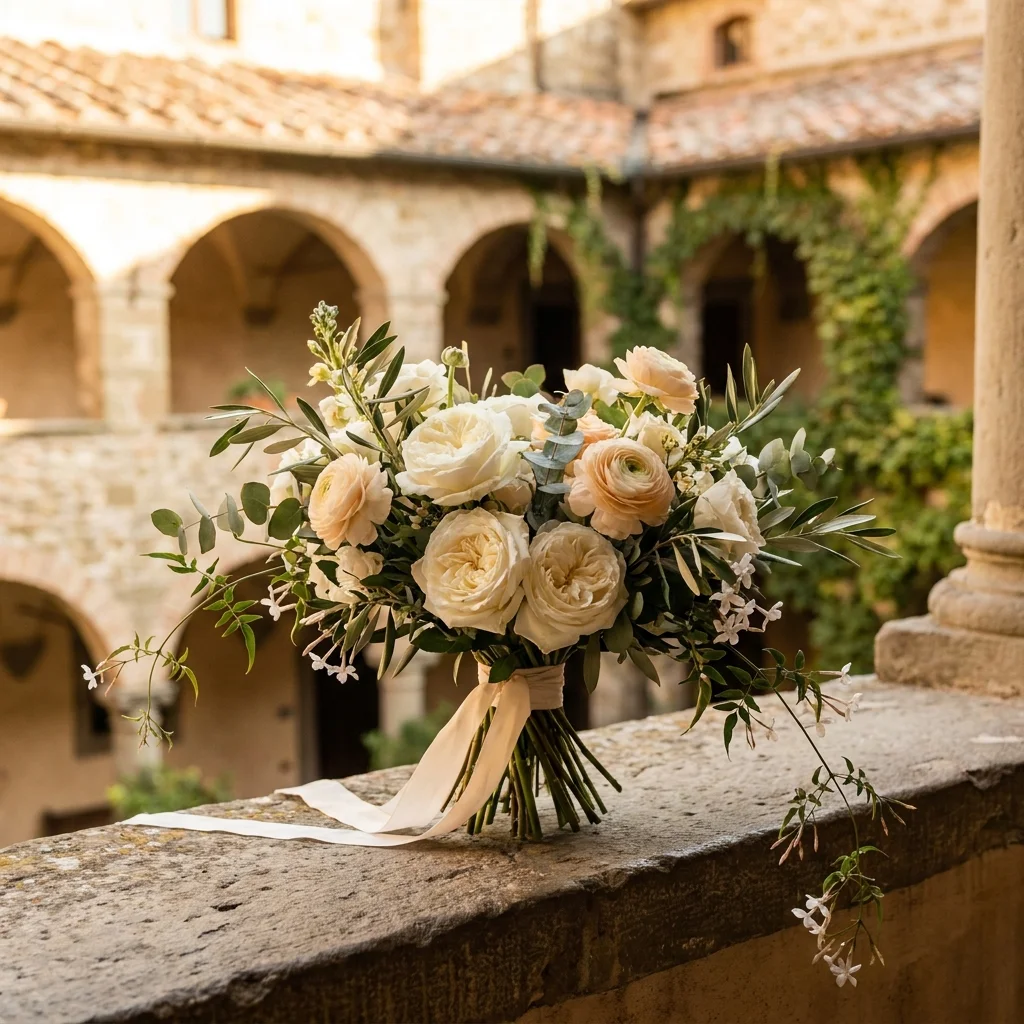
The brevity of a civil ceremony in Italy is not a limitation. It is a design opportunity.
We build the day around the ceremony rather than treating it as a formality to rush through. A typical arc might begin with a private getting-ready session at a boutique hotel, followed by the legal ceremony at the Comune mid-morning, editorial portraits in the surrounding streets or gardens during the golden hour between ceremonies, and a multi-course dinner at a hand-selected restaurant or private dining room in the evening.
For couples traveling with a small group, we often incorporate a welcome aperitivo the evening before and a leisurely Italian lunch the day after. The legal moment becomes the anchor of a broader celebration that unfolds across two or three days, each element curated to reflect the couple’s taste and the character of the destination.
Whether your celebration extends to a terrace on the Amalfi Coast or a private room in a Ligurian palazzo, our team handles vendor coordination, menu development, floral design, and transport logistics as a single integrated service. You experience the celebration. We manage everything behind it.
Let me be direct about what a courthouse wedding in Italy involves when managed by our team versus when attempted independently.
We prepare and review all documents before submission—Nulla Osta, birth certificates, apostilles, translations—ensuring they meet the specific requirements of your chosen Comune. We schedule and attend the sworn declaration if required. We source and brief the certified interpreter. We arrange witnesses if needed. We confirm the ceremony slot, coordinate arrival logistics, and ensure your photographer is positioned correctly in a room they have likely shot in before.
On the day itself, a member of our team is present at the Comune. Not visible, not intrusive, but there—confirming timing with the municipal officer, managing any last-minute adjustments, and ensuring the transition from ceremony to celebration is seamless.
After thirty years, we have relationships with Comuni across Italy. We know which offices respond within days and which require follow-up. We know which municipalities are flexible about external venues and which are not. This institutional knowledge is not something you can replicate with a checklist downloaded from a forum. It is built through decades of direct, repeated interaction—and it is the foundation of every legal ceremony we coordinate.
A Civil Ceremony in Italy—Without the Confusion
The term “courthouse wedding” carries a certain plainness in the American imagination—fluorescent lights, a clerk’s office, paperwork on a counter. The Italian equivalent could not be more different. A civil ceremony in Italy takes place in rooms designed centuries ago for civic ceremony, officiated by a sashed municipal officer reading articles of law that have governed Italian marriages for generations. It is formal, it is genuine, and it is yours.
What makes it seamless rather than stressful is the team behind it. Request your private consultation and let us show you exactly how we transform a legal formality into the opening act of a beautifully curated Italian celebration.
Frequently Asked Questions About a Courthouse Wedding in Italy
How do we obtain extra certified copies of the Italian marriage certificate after the ceremony?
After the ceremony, the Comune can issue certified copies (estratto/copia integrale) of your marriage record. The exact request method and turnaround time vary by municipality. We advise how many copies to request, coordinate the application with the civil registry office, and—when needed—arrange apostille and certified translation so the document is ready for use abroad.
What happens if our documents are rejected by the Comune?
Document issues typically arise from incorrect apostille formatting, missing translations, or outdated certificates. Because we review every document before submission and maintain direct communication with the Comune’s civil registry office, we resolve discrepancies well before your arrival in Italy.
Is our Italian civil marriage automatically recognized in the US or UK?
Yes, in most cases. Both the US and UK recognize civil marriages legally performed abroad. You will receive an Italian marriage certificate, which may need to be apostilled and translated for use in your home country. We advise confirming specific requirements with your local registrar or attorney.
Can we write our own vows for the civil ceremony?
The legal portion of the ceremony follows a prescribed format set by Italian civil law, and the officiant reads specific articles from the Civil Code. However, some Comuni allow a brief personal exchange after the legal declarations. For fully personalized vows, we recommend adding a symbolic ceremony to your day.
How far in advance should we start the paperwork process?
We recommend beginning at least four to six months before your intended ceremony date. Embassy appointments for the Nulla Osta, document apostille processing, and Comune submission timelines all require lead time that varies by nationality and season. Starting early gives us room to manage every step without pressure.
Do both partners need to be present in Italy for the entire document process?
Both partners must be present for the Nulla Osta appointment at the embassy or consulate and for any sworn declaration required by the Comune. However, much of the preparatory work—gathering, translating, and apostilling documents—can be handled remotely with our coordination before you travel.
Can we bring children to the ceremony at the town hall?
Yes. Children are welcome at Italian civil ceremonies, though the Comune’s ceremony room may have limited seating. We coordinate with the municipality to confirm capacity and can arrange childcare for the celebration portion of the day if parents prefer uninterrupted time during dinner or portraits.
What if we want to marry in a small village rather than a major city?
Smaller Comuni often offer a more personal experience—fewer competing ceremonies, a more intimate setting, and occasionally lower fees. The trade-off is that their administrative offices may have limited hours and slower response times. Our established relationships with municipalities across Italy allow us to navigate these nuances efficiently, whether you choose a hilltop village in Umbria or a coastal town in Liguria.
Is it possible to have a same-day symbolic ceremony and legal civil ceremony?
Absolutely. This is one of the most popular formats we design. The legal ceremony takes place at the Comune in the morning or early afternoon, and the symbolic celebration follows at a private venue later the same day. It gives couples both legal validity and the freedom to personalize every element of their vows and setting.
Do we need to tip the municipal officiant or interpreter?
Tipping the municipal officiant is not customary or expected in Italy. For the interpreter and other private vendors, a gratuity is appreciated but not obligatory. We provide our clients with a discreet tipping guide tailored to Italian customs so you feel confident on the day.
When you are ready to plan it for real, explore our proposal packages in Italy.