
Greek Orthodox Wedding in Italy: Churches, Canonical Requirements & Luxury Planning
Most couples who begin researching a Greek Orthodox wedding in Italy encounter the same uncertainty within the first hour: which churches in Italy are canonically recognized by the Ecumenical Patriarchate, and will the ceremony be legally binding under Italian civil law? The answer depends on the specific parish, the diocese’s current relationship with Italian civil authorities, and a sequence of ecclesiastical documents that must be assembled months before the ceremony date. This is not information that a venue brochure or a quick online search can reliably confirm.
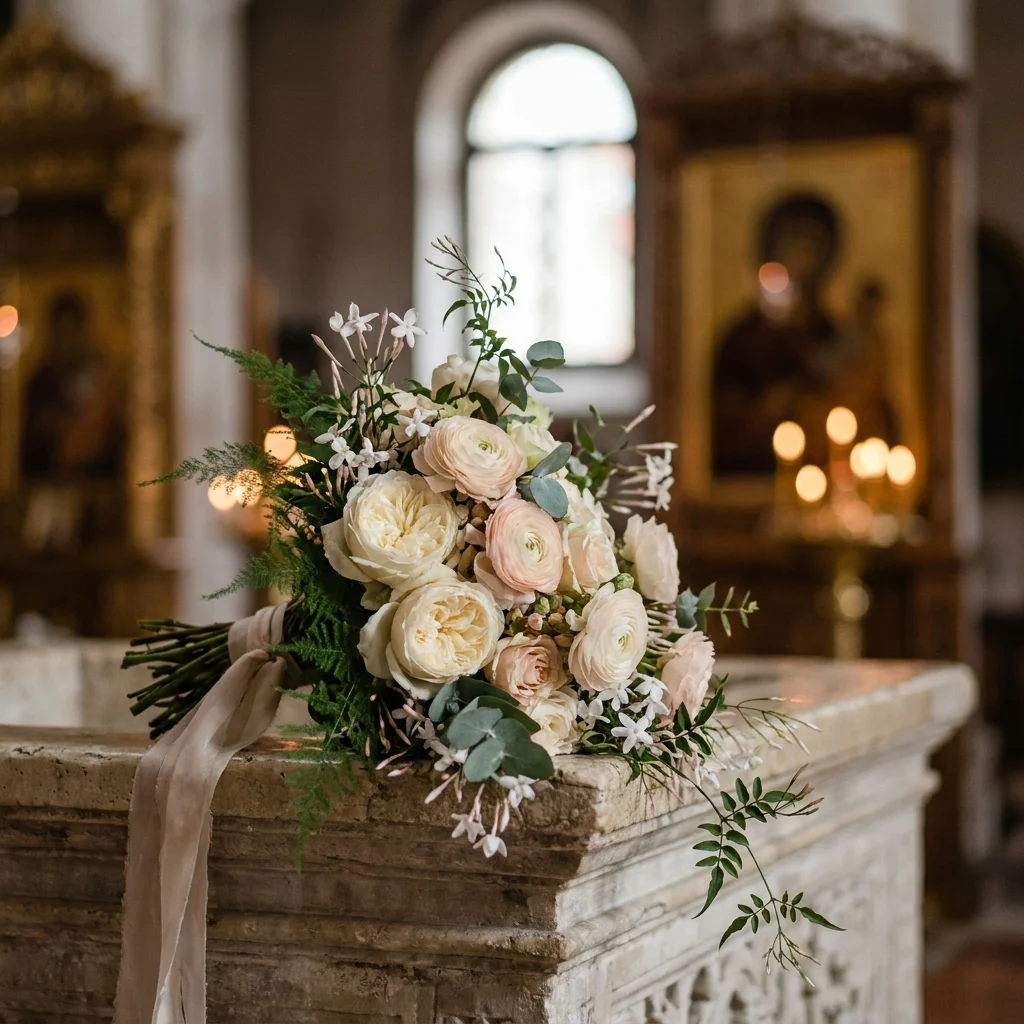
A Greek Orthodox wedding in Italy is both canonically and civilly possible, with recognized Orthodox churches operating in Venice, Rome, Naples, Milan, and several smaller cities. The ceremony requires coordination between the couple’s home parish, the Italian Orthodox parish priest, and the local Italian comune for civil registration. Kiss Me Italy manages the full ecclesiastical and legal pathway — from initial parish liaison to reception scenography — so that the sacred ceremony and the celebration that follows form one seamless, cinematic experience.
A Canonical Orthodox Ceremony vs. an Orthodox-Inspired Symbolic Blessing: Two Distinct Paths
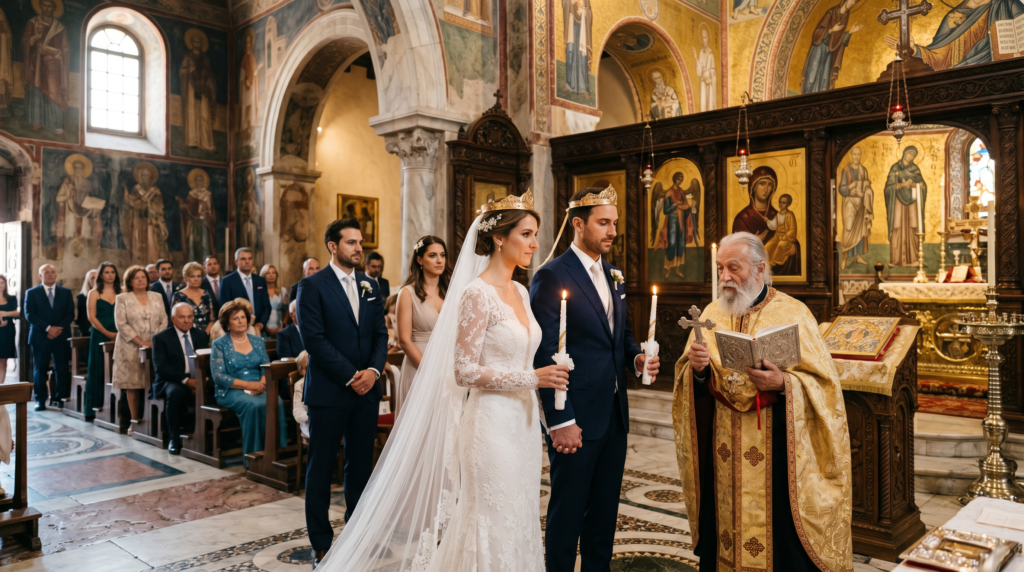
The first decision is structural. A canonical Greek Orthodox ceremony in Italy takes place inside a recognized Orthodox church, is officiated by an ordained Orthodox priest, and — when the correct civil paperwork has been filed with the Italian comune — carries full legal force under Italian law. This is the equivalent of what the couple would experience in a Greek cathedral at home. The crowning, the common cup, the circling of the altar table: every element follows the liturgical rite.
The alternative is a symbolic Orthodox-inspired blessing. Here, the couple marries civilly — either in Italy or in their home country — and then stages a blessing ceremony that echoes Orthodox liturgical structure without canonical standing. This path opens the door to non-church venues: a frescoed Renaissance hall, a lakeside terrace, a Baroque garden pavilion. The officiant may be an Orthodox deacon or a priest willing to offer a blessing outside the canonical framework, though availability varies and must be confirmed parish by parish.
Neither path is lesser. They serve different priorities. We guide couples through the implications of each — liturgical, legal, and aesthetic — during the initial consultation. If you are weighing these options now, our team can outline both timelines in detail; reach out to begin that conversation.
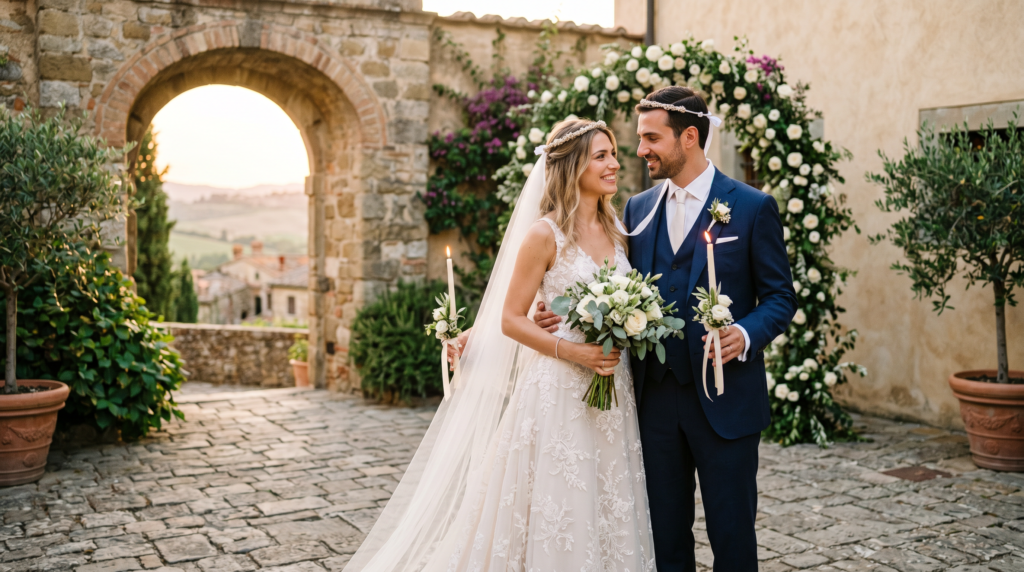
San Giorgio dei Greci, Venice: Why This Sixteenth-Century Church Dominates the Search Results
Built between 1536 and 1573 for the Greek confraternity of Venice, San Giorgio dei Greci is the most frequently cited venue for a Greek Orthodox ceremony in Italy — and for good reason. The church was originally built to serve the largest Greek community in the Western Mediterranean, and its interior retains an extraordinary iconostasis attributed to the Cretan school of painting. The bell tower, famously leaning, is visible from the Riva degli Schiavoni. It remains a functioning parish of the Ecumenical Patriarchate.
What the search results rarely mention is operational reality. San Giorgio dei Greci is an active parish church, not a private event space. Ceremony times are dictated by the liturgical calendar. Photography is permitted but governed by the parish priest’s discretion — flash is typically prohibited, and drone footage inside the church is out of the question. Guest capacity is limited by the nave’s proportions, and there is no adjacent piazza large enough for a receiving line of more than forty or fifty guests without encroaching on public pedestrian flow.
We have coordinated Orthodox wedding ceremonies in Venice and understand the specific timing windows, acoustic constraints, and floral restrictions that apply to sacred spaces in the city. Couples considering a Venice wedding with an Orthodox ceremony benefit from our direct familiarity with the parish’s administrative cadence, which operates on its own timeline — not the couple’s preferred planning schedule.
Orthodox Churches Beyond Venice: Rome, Naples, Milan, and What Each City Offers
Venice is the most romantic option. It is not the only one. Italy hosts several canonically recognized Orthodox parishes, each with distinct architectural character and logistical profiles.
Rome is home to a Greek Orthodox community that worships in a church near the historic center — a building whose frescoed interior and intimate proportions suit ceremonies of thirty to eighty guests. The advantage of Rome is the breadth of its reception infrastructure: Renaissance villas, Baroque palazzi, rooftop terraces overlooking the Forum. Couples planning a Greek Orthodox wedding in Italy often find that Rome offers the most versatile pairing of sacred ceremony and secular celebration. Our Rome venue portfolio reflects this range.
Naples has maintained a Greek Orthodox presence since the Byzantine period. The community is smaller, the church more modest in scale, but the surrounding Campanian landscape — Amalfi, Ravello, the islands — provides reception settings of extraordinary cinematic power. For couples drawn to the south, the Amalfi Coast’s venue landscape extends naturally from a Neapolitan ceremony.
Milan serves couples whose guest lists include many European travelers. The city’s Orthodox parish is modern in comparison to Venice or Rome, but the efficiency of Milanese infrastructure — airports, hotels, private dining rooms in historic palazzi — appeals to couples prioritizing guest comfort alongside liturgical authenticity.
In every case, we confirm current parish availability, officiant willingness, and civil-registration compatibility before presenting any option as viable. Online information about Orthodox churches in Italy is frequently outdated. We verify directly.
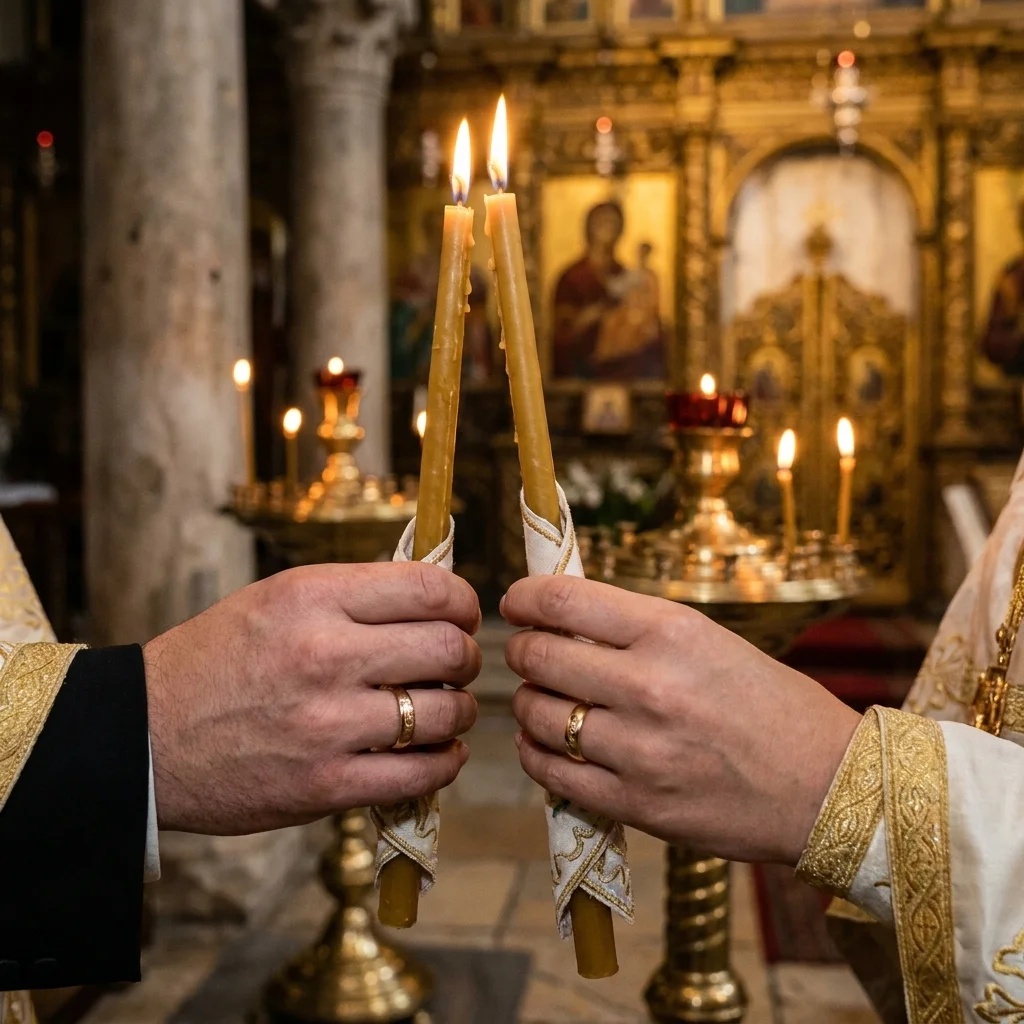
The Legal Sequence That Catches Most Foreign Couples Off Guard
Here is where a Greek Orthodox wedding in Italy diverges sharply from a Catholic one. Catholic marriages in Italy benefit from the Lateran Treaty’s automatic civil recognition. Orthodox marriages can achieve civil recognition, but the mechanism is different and requires an additional bureaucratic layer.
The couple must obtain a Nulla Osta — a declaration from their home country’s consulate in Italy confirming that no legal impediment to marriage exists. This document is then presented to the Italian comune where the ceremony will take place. The comune issues the marriage banns (pubblicazioni), which must be posted for a minimum period — typically eleven days, though this varies by municipality. Only after the banns have been posted and no objections raised can the Orthodox ceremony proceed with civil effect.
Simultaneously, the couple must satisfy the canonical requirements of the Orthodox Church: baptismal certificates, a letter of ecclesiastical freedom (celibacy certificate) from their home parish, and — if one partner is not Orthodox — a dispensation from the local bishop. The parish priest in Italy will not schedule the ceremony until these documents are in hand.
Our comprehensive guide to getting legally married in Italy as a foreigner covers the civil side in detail. For the ecclesiastical documents, our team liaises directly with the Italian parish and, where needed, with the couple’s home diocese to ensure that every certificate arrives in the correct format and within the required timeframe.
If the legal pathway feels daunting, that is precisely why we exist. Contact Kiss Me Italy and we will map the full document timeline specific to your nationalities, ceremony city, and preferred date.
Why Orthodox Ceremony Dates in Italy Are More Restricted Than You Expect
The Orthodox liturgical calendar imposes fasting periods during which the Mystery of Crowning (the wedding sacrament) cannot be celebrated. These include:
- Great Lent — roughly forty days before Orthodox Easter, which follows the Julian calendar and rarely aligns with Western Easter.
- The Dormition Fast — August 1 through August 14, eliminating a peak destination-wedding fortnight.
- The Nativity Fast — November 15 through December 24.
- The Apostles’ Fast — variable length, beginning the Monday after All Saints’ Sunday.
Wednesdays and Fridays are also traditionally excluded. So are certain feast days. The practical result: roughly 40–45% of the calendar year is unavailable for an Orthodox ceremony. Couples who arrive at planning with a fixed summer date often discover that their preferred Saturday falls within a restricted period.
We cross-reference the Orthodox liturgical calendar with Italian venue availability, local festival closures, and seasonal pricing tiers to identify the dates that are both canonically permitted and logistically optimal. Our Italian wedding calendar guide provides broader seasonal context, but for Orthodox-specific date mapping, a direct consultation is essential.
From Sacred Space to Secular Celebration: Designing the Reception as a Second Act
An Orthodox ceremony is deeply sensory. Incense, chanting, candlelight, gold leaf catching the glow of oil lamps. The architectural grammar of a sixteenth-century Orthodox church — the iconostasis as a vertical threshold between the earthly and the divine — creates a visual intensity that most reception venues cannot match. The scenographic challenge is not to replicate that intensity but to answer it with a different register.
In Venice, we have paired Orthodox ceremonies with receptions in Baroque palazzi along the Grand Canal, where the transition from church to celebration happens by private water taxi — guests stepping from sacred silence into the shimmer of the lagoon at dusk. In Rome, a ceremony near the Pantheon has led to a candlelit dinner in a Renaissance courtyard where the frescoed walls needed no additional decoration. In Tuscany, couples who marry in a small Orthodox chapel in Florence move to a hilltop villa where the reception unfolds across terraced gardens originally commissioned in the fifteenth century.
This is scenography in the theatrical sense: each space is a character, and the movement between them is the narrative arc of the day. Our curated venue portfolio includes properties selected specifically for their ability to sustain this kind of dramatic progression. For couples drawn to Florentine architecture, our Florence venue collection offers a focused shortlist.
What a Greek Orthodox Wedding in Italy Actually Costs: Verified Ranges and What Shapes the Quote
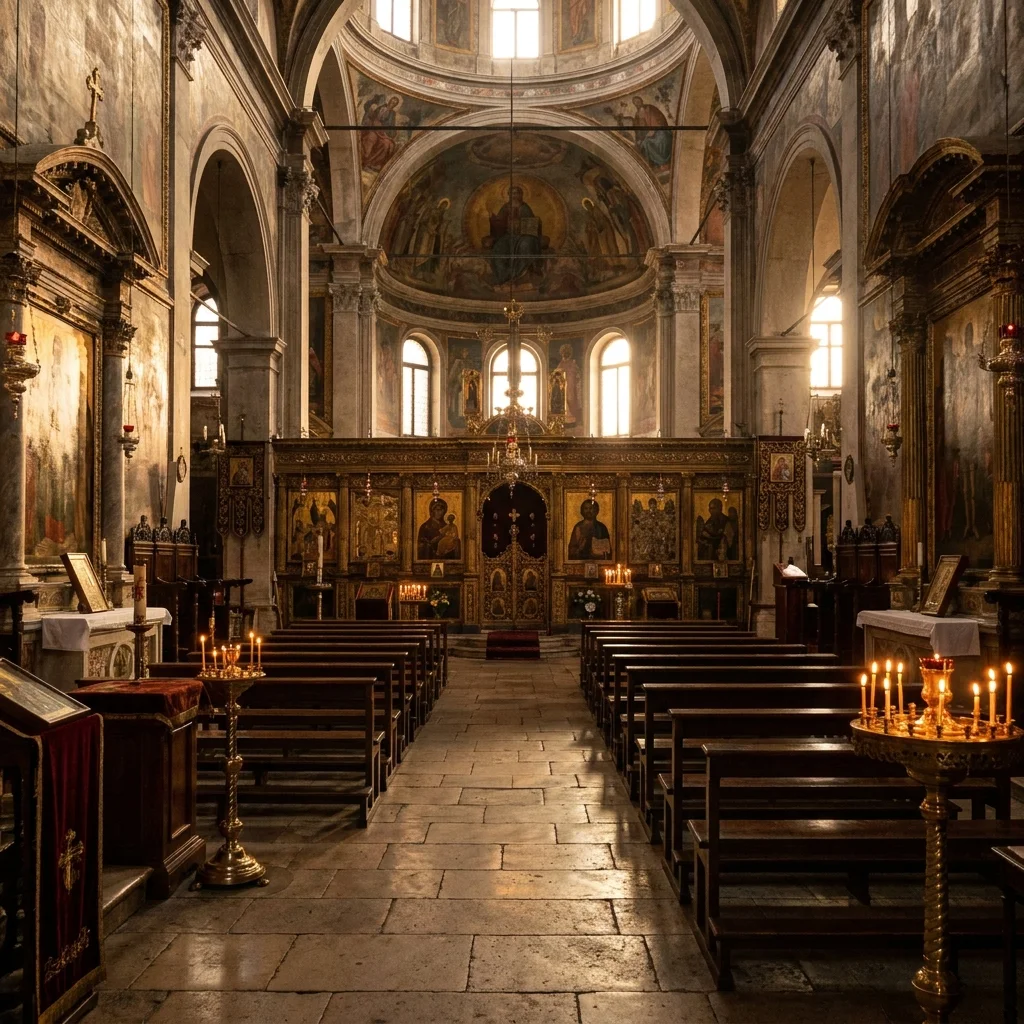
Pricing for a Greek Orthodox wedding in Italy is shaped by three independent variables: the ecclesiastical component (church fees, officiant, choir), the legal-administrative component (translations, apostilles, municipal fees), and the celebration itself (venue, catering, design, photography, entertainment). We separate these clearly because most competitors bundle them into a single opaque figure.
| Component | Indicative Range | Included | Quoted Separately |
|---|---|---|---|
| Church ceremony fee (parish donation + choir) | Confirmed via direct parish liaison | Use of church, officiant, liturgical choir (where available) | Floral decoration of the church interior; printed programs; additional musicians |
| Legal & document coordination | Confirmed via tailored proposal | Nulla Osta guidance, banns filing, interpreter for civil formalities | Apostille and translation fees (vary by home country); consular appointment scheduling |
| Full-day wedding planning & design | From €15,000 for intimate celebrations | End-to-end coordination, vendor curation, timeline management, on-site direction | Venue hire, catering, floral design, entertainment — each quoted per selection; VAT (IVA 22%) applied to all Italian-invoiced services |
Indicative ranges. Church fees are set by each parish and confirmed only through direct liaison. Contact Kiss Me Italy for a personalized proposal.
The celebration budget varies enormously by city and guest count. Venice commands a premium — our Venice wedding cost guide details the specific factors — while Tuscan and Roman celebrations offer broader pricing latitude. For a complete picture of Italian wedding investment, our comprehensive cost overview provides region-by-region context.
| Service | Range | Included | Quoted Separately |
|---|---|---|---|
| Wedding photography (full day, single shooter) | €4,000–€9,000 | Full-day coverage; travel within the ceremony region; digital gallery delivery | Second shooter; albums and fine-art prints; post-production rush delivery; photographer travel/accommodation outside the region; VAT (IVA 22%) |
| Wedding videography (cinematic edit) | €5,000–€12,000 | Full-day coverage; highlight film (3–5 min); travel within region | Feature-length edit; drone footage (requires ENAC permit); raw footage delivery; second videographer; VAT (IVA 22%) |
| Floral design (ceremony + reception) | €3,000–€15,000+ | Bridal bouquet, ceremony arrangements, reception centrepieces, consultation | Church-specific floral installations (subject to parish approval); delivery to multiple locations; breakdown and disposal; VAT (IVA 22%) |
Indicative ranges based on Kiss Me Italy project data. Final pricing confirmed after venue, guest count, and design brief are established. Contact Kiss Me Italy for a personalized proposal.
Photography and Music Inside an Orthodox Church: What the Priest Will and Won’t Allow
This section is deliberately direct. It addresses the constraints that shape creative decisions.
Photography: Most Orthodox priests permit a single photographer to move discreetly within the nave during the ceremony. Flash is almost universally prohibited. The iconostasis — the sacred screen separating the altar from the congregation — is a boundary that photographers may not cross. Some priests request that no photographs be taken during the crowning itself, reserving that moment for unmediated spiritual experience. We confirm these parameters with the officiant in advance and brief the photography team accordingly.
Videography: A single camera position, typically at the rear or side of the nave, is standard. Steadicam rigs and drone equipment are not permitted inside the church. Audio recording of the liturgical chanting may require separate consent.
Music: The Orthodox ceremony has its own musical structure — Byzantine chant performed by a cantor or small choir. Instrumental music (violin, organ, harp) is not part of the Orthodox liturgical tradition and is generally not permitted during the service. Couples who envision a string quartet or operatic soloist incorporate these elements into the reception or the transfer between church and venue.
Our photography curation process matches couples with shooters experienced in low-light, sacred-space conditions — professionals who know how to work within these constraints and still deliver editorial-quality imagery.
Two Orthodox Celebrations We Have Shaped: Visual Inspiration and Practical Lessons
A Greek-American couple married at San Giorgio dei Greci in Venice on a late-September afternoon. The ceremony began at 4:00 PM — the last light of the day entering through the south-facing windows, catching the gilt of the iconostasis. Sixty-two guests attended. The bride wore a cathedral-length veil that moved through the narrow nave like a scene from a Visconti film. The reception unfolded in a fifteenth-century palazzo on the Grand Canal, where the dining room’s original terrazzo floor and Murano chandeliers required no supplementary decoration beyond low arrangements of garden roses and trailing jasmine.
A second couple — she Greek, he Italian — chose Rome. The ceremony took place in a small Orthodox church near a medieval quarter, with thirty-eight guests. The intimacy of the space amplified the chanting. Afterward, guests walked through lamplit streets to a Renaissance courtyard where a seated dinner featured regional Roman cuisine: cacio e pepe served tableside, agnello scottadito, a tiered millefoglie in place of a traditional wedding cake. The Italian wedding menu was designed to honor both families’ culinary traditions.
These celebrations were not templates. They were responses to specific couples, specific buildings, specific light. That is what scenography means in practice.
Intimate Orthodox Weddings and Elopements: When the Guest List Is Under Twenty
Not every Greek Orthodox wedding in Italy requires a grand reception. Some couples seek the sacrament itself — the crowning, the common cup, the Dance of Isaiah — witnessed by a handful of loved ones, followed by a private dinner in a setting of quiet beauty.
For these celebrations, we curate an experience that honors the liturgical weight of the ceremony without the logistical apparatus of a large event. A canonical ceremony in a small Orthodox chapel, followed by a water-taxi transfer to a private dining room overlooking the lagoon. Or a blessing ceremony in a medieval Tuscan chapel, followed by lunch in a walled garden.
Our micro wedding planning approach is designed precisely for this scale, and couples considering an even more distilled experience may find our elopement framework a natural fit. The Orthodox liturgical structure, with its inherent drama and beauty, loses nothing in intimacy. If anything, it gains.
Why the Church, the Law, and the Celebration Must Be Planned as One Sequence
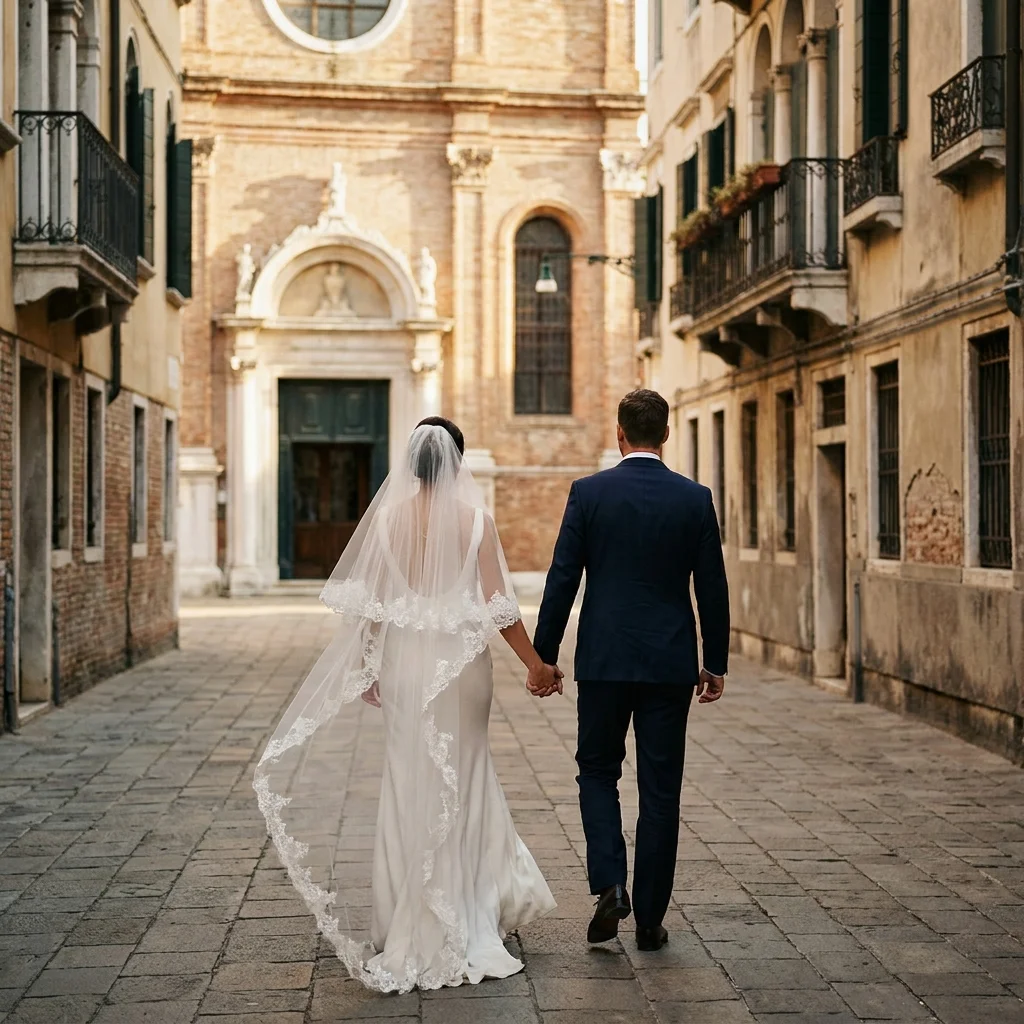
A Greek Orthodox wedding in Italy is not three separate projects — it is one narrative told in three acts. The ecclesiastical documents inform the legal timeline. The legal timeline determines the ceremony date. The ceremony date shapes the venue selection, the seasonal design palette, the quality of light in the photographs, the menu. Pull one thread and the entire fabric shifts.
This is why we manage the process as a single, integrated sequence. Our team handles the parish liaison, the consular coordination, the municipal paperwork, the venue negotiation, the vendor curation, and the on-site direction — all under one creative and logistical umbrella. The couple’s role is to make choices, not to manage logistics.
If you are considering a Greek Orthodox wedding in Italy and want clarity on what is genuinely possible for your specific situation, we welcome your inquiry. Every celebration begins with a conversation.
Frequently Asked Questions
Can a non-Orthodox partner participate in the crowning ceremony?
Yes, in most cases. The Orthodox Church permits marriages between an Orthodox Christian and a baptized non-Orthodox Christian, provided a bishop’s dispensation (oikonomia) is obtained in advance. The non-Orthodox partner participates fully in the crowning. We coordinate the dispensation request with the relevant diocese as part of our planning process.
How far in advance should we contact the Italian Orthodox parish?
We recommend initiating parish contact at least ten to twelve months before the desired ceremony date. Popular parishes — particularly in Venice — may have limited availability during the canonically permitted wedding periods. Early engagement also allows time for the ecclesiastical document exchange between your home parish and the Italian parish.
Is it possible to have the ceremony in Greek rather than Italian?
Most Orthodox parishes in Italy can conduct the ceremony in Greek, Italian, or a combination of both. The language depends on the officiant’s capabilities and the couple’s preference. We confirm language options during our initial parish liaison and can arrange for a bilingual printed program for guests who may not follow the liturgical language.
What happens if our preferred ceremony date falls within a fasting period we didn’t know about?
Our team cross-references the full Orthodox liturgical calendar — including moveable feasts calculated on the Julian calendar — before presenting any date as available. If your initial preference is restricted, we propose the nearest permitted dates and assess venue and vendor availability for each alternative before you commit.
Can we bring our own Orthodox priest from abroad to officiate in Italy?
A visiting priest may co-officiate or officiate only with the explicit written permission of the local Italian Orthodox bishop and the hosting parish priest. This permission is not automatic and must be requested well in advance. We manage this correspondence on the couple’s behalf, but couples should be prepared for the possibility that the local parish priest may be required to officiate or co-celebrate.
Are koumbaro (sponsor) roles recognized in the Italian legal paperwork?
The koumbaro and koumbara serve as canonical witnesses within the Orthodox ceremony and are recorded in the church’s sacramental register. For Italian civil purposes, two witnesses are required on the marriage certificate — these may be the same individuals, but the Italian comune does not use the term koumbaro. We ensure the roles align across both ecclesiastical and civil documentation.
Is it possible to hold the reception dinner on the same evening if the ceremony is late afternoon?
Yes, and this is the most common structure. Orthodox ceremonies typically last forty-five to sixty minutes. A late-afternoon ceremony at 4:00 or 5:00 PM allows for a cocktail reception beginning around 6:00 PM and a seated dinner by 8:00 PM. In Venice, the water-taxi transfer between church and palazzo adds approximately fifteen to twenty minutes, which we build into the timeline as a scenic interlude rather than dead time.
Do Italian Orthodox churches allow candles and incense brought by the couple’s family?
The church provides its own liturgical candles and incense as part of the sacramental rite. Decorative candles or personalized tapers for the processional may be permitted at the priest’s discretion, but they must meet fire-safety standards set by the local vigili del fuoco. We confirm these details during the church site visit, which we conduct on the couple’s behalf months before the ceremony.
What if we want a civil-only marriage in Italy and a separate Orthodox blessing back home?
This is a perfectly valid approach. A civil ceremony in Italy — held at the comune or an approved venue — provides full legal standing. The couple then arranges a canonical Orthodox blessing in their home country at a later date. We plan the Italian civil ceremony and celebration as a complete luxury experience, and the Orthodox blessing remains a separate, private matter between the couple and their home parish.