
Foreigners can marry legally in Italy with a civil ceremony at the town hall, a Catholic ceremony, or a civil ceremony followed by a religious or symbolic one. You need a valid passport, a birth certificate, a sworn statement of no impediment and an Atto Notorio, with every foreign document apostilled, translated and issued within six months of the wedding. Kiss Me Italy plans the ceremony and the day around it, with published packages from €1,600 for an elopement to €279,000 for a multi-day villa wedding.
Kiss Me Italy Packages for Foreign Couples
All prices are the live prices on each package page, in euros. The ceremony in these packages is symbolic. A civil ceremony at the town hall can be arranged separately, on request.
| Package | Where | Guests | Price from |
|---|---|---|---|
| The Little Dock Elopement — Private Dock, Lake Como | Lake Como | Couple | €1,600 |
| Your Love Story Ceremony in Tuscany — Celebrant-Led Elopement or Vow Renewal | Tuscany | Couple | €1,700 |
| The Secret Rooftop Wedding — Florence Rooftop Elopement | Florence | Couple | €1,900 |
| Intimate Lake Como Marriage — Villa Pizzo Micro Wedding | Lake Como | 10 / 20 | €13,000 |
| The Trulli Wedding Experience — Trulivo | Puglia | See package | €34,000 |
| The Lucca Villa Wedding for 50 Guests — Villa Grabau | Lucca, Tuscany | 50 | €44,000 |
| The Panoramic Coastal Terrace Wedding — Amalfi Coast | Amalfi Coast | See package | €49,000 |
| The Noble Palace Wedding — Venice | Venice | See package | €59,000 |
| The Grand Hotel Tremezzo Wedding for 100 Guests — Lake Como | Lake Como | 100 | €89,000 |
| Multi-Day Wedding on Lake Como — Villa Pliniana | Lake Como | See package | €279,000 |
Compare every option in our elopement packages in Italy and in our guide to how much a wedding in Italy costs.
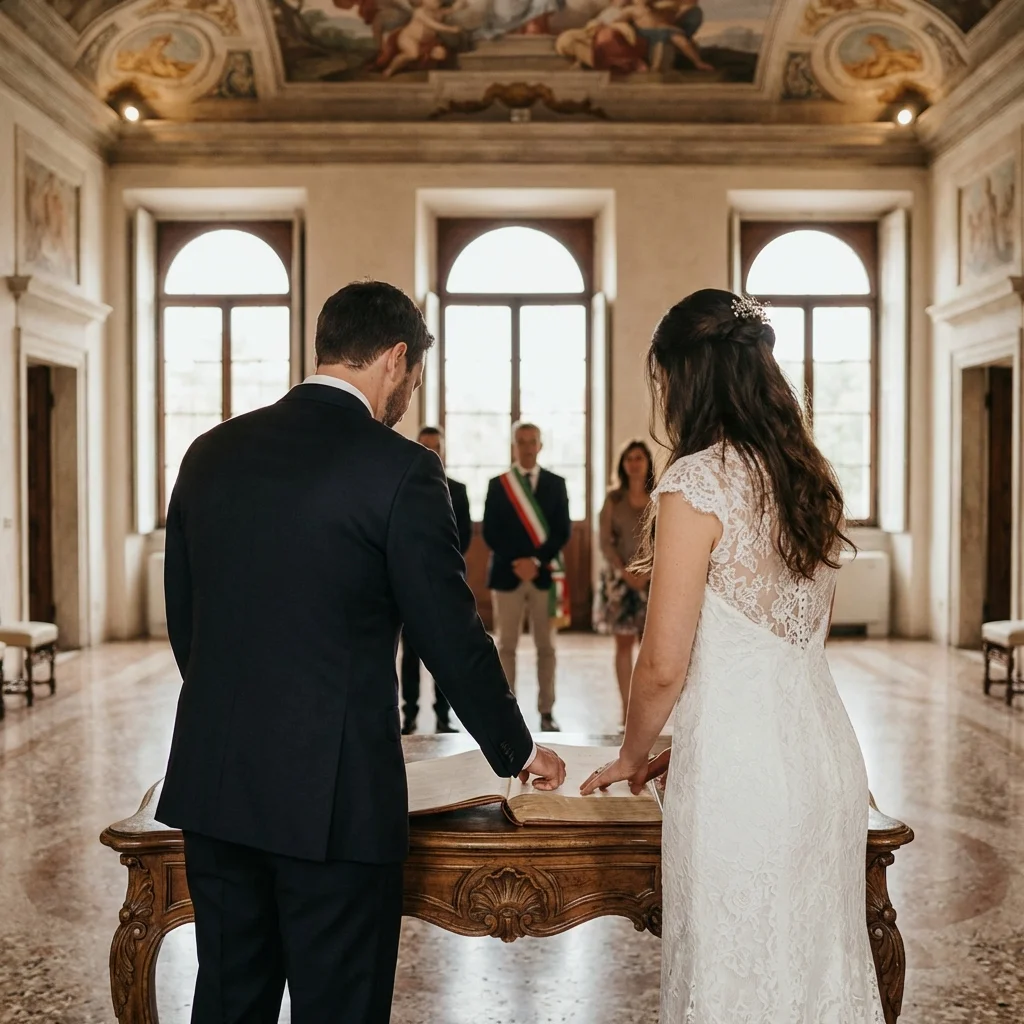
Can Foreigners Get Married in Italy?
Yes. Italian law does not require residence, and the same law applies across the whole country. Each town hall (Comune) may read the rules slightly differently and can waive some requirements, so its Registrar’s Office gives the final list of documents.
There are three types of ceremony:
- Civil ceremony. Performed at the town hall by the mayor or a deputy. It is legally binding.
- Catholic ceremony. Valid in civil law when performed by a Roman Catholic priest, who registers the marriage with the civil authorities. No separate civil ceremony is needed.
- Other religious ceremonies. When the officiant is not a Roman Catholic priest, a civil ceremony must take place first to make the marriage legal.
A fourth option is the symbolic ceremony, led by a celebrant in a villa, garden or terrace. It has no legal value, so some couples sign the legal papers at home and celebrate in Italy. Our guide to wedding ceremony types in Italy compares the three in detail.
Getting Married in Italy: Steps for a Civil Ceremony
These steps follow the guidance of the U.S. Embassy in Italy for American citizens. Other nationalities follow a similar path with their own documents, as explained further down.
Step 1: Contact the Town Hall
Write to the Ufficio Matrimoni of the town where you want to marry. Ask for the list of documents, how many days before the ceremony they must be submitted and the rental fee of the marriage hall.
Some town halls also ask for your birth certificate with apostille and translation. Ask early, because this changes what you bring to the consulate.
Step 2: Gather and Apostille Your Documents
Every document issued outside Italy must be legalized and translated into Italian. For U.S. documents, legalization means the Apostille stamp of the secretary of state in the state that issued the document.
Under Italian law, public documents from outside the EU are valid for six months from the date of issue. Order your certificates so that none is older than six months on the wedding day.
Step 3: Swear the Dichiarazione Giurata
This sworn statement says there is no legal impediment to your marriage under the laws of your U.S. state. You sign it in front of a U.S. consular officer in Italy, at the Embassy in Rome, a Consulate General in Milan, Florence or Naples, or a Consular Agency in Genoa, Venice or Palermo.
Then take it to the Legalization Office (Ufficio Legalizzazioni) of the local Prefettura, usually in the same consular district. Bring a €16 revenue stamp (marca da bollo), sold at any tobacco shop, for each document.
Step 4: Obtain the Atto Notorio
The Atto Notorio is a second declaration that nothing prevents the marriage. Two witnesses swear it with you. They must be over 18, carry photo ID and know you, and they cannot be family members.
You can obtain it at an Italian consulate before you travel, or at the court (tribunale) of the wedding town in Italy. The Italian Consulate in San Francisco states that its Atto Notorio is valid for 90 days and asks couples to get in touch no earlier than 90 days before the wedding.
In Italy, the court charges two €16 revenue stamps and one of €10.62, and the document is usually ready in four to ten days. An urgent same-day Atto Notorio costs two €16 stamps and one of €31.86. If you or a witness do not speak Italian, an interpreter is required.

Step 5: Make the Declaration of Intention to Marry
Bring all documents to the Ufficio Matrimoni and make the Dichiarazione di Matrimonio before the civil registrar. If you do not speak Italian, an interpreter should come with you. After this step you can set the date.
Italian residents must wait for the banns to be posted for two weeks. When neither partner is Italian or resident in Italy, the banns are waived or posted for a shorter period, from one day to a week depending on the town.
Step 6: The Civil Ceremony
The mayor or a deputy performs the ceremony. Two witnesses over 18 with photo ID must attend, plus an interpreter if needed. A witness cannot act as the interpreter.
You pay a rental fee for the marriage hall. According to the U.S. Embassy, it ranges from €500 to €9,200, depending on the location, the season and the day of the week.
Step 7: Legalize the Marriage Certificate
After the ceremony, ask the Comune for the marriage certificate and have it apostilled at the Legalization Office of the Prefettura for the area where you married. For U.S. citizens, the apostilled Italian certificate is enough to prove the marriage at home.
Documents Checklist
| Document | Where you get it | Notes |
|---|---|---|
| Valid passport | Your country | Active-duty U.S. service members can show a military ID |
| Birth certificate | Your country, with apostille and Italian translation | Required by some town halls; check first |
| Proof that a previous marriage ended | Divorce decree, annulment or death certificate, with apostille and translation | Only if you were married before |
| Dichiarazione Giurata (U.S. citizens) | U.S. Embassy or Consulate in Italy | Legalized at the Prefettura with a €16 stamp |
| Atto Notorio | Italian consulate abroad or court in Italy | Two witnesses each; valid 90 days at the San Francisco consulate |
| Nulla osta / CNI (British citizens) | British Embassy Rome, by post | Same document under a different name |
| Declaration of intention to marry | Ufficio Matrimoni of the town hall | With an interpreter if you do not speak Italian |
Rules for British and Other Nationalities
The UK government explains that a Nulla Osta is the same as a certificate of no impediment (CNI). British citizens apply by post to the British Embassy in Rome, with a notice of marriage and an affirmation signed in front of a notary.
For other nationalities, such as Canadian or Australian citizens, the documents depend on your own government and on the town hall. Ask your nearest Italian consulate and the Comune for the current list before you book flights.
If you are a U.S. citizen, our page on how to get married in Italy as a U.S. citizen covers the American route only.
If You Were Married Before
Bring the final divorce decree, annulment decree or death certificate of the former spouse, apostilled and translated. A woman whose previous marriage ended within the last 300 days needs a waiver from the Procura della Repubblica at the court of the wedding town. It is issued on medical evidence that she is not pregnant.

How Long Does It Take?
The paperwork takes a few months of preparation and several days in Italy. Waiting lists are common in popular towns, especially in May, June and September.
| When | What to do |
|---|---|
| 6 to 12 months before | Choose the town and venue; ask the Comune for its document list and hall fee |
| Within 6 months of the date | Order birth certificate and divorce papers, then apostille and translate them |
| Within 90 days of the date | Book the Atto Notorio at the Italian consulate (San Francisco rule) |
| A few days before | Swear the Dichiarazione Giurata, legalize it at the Prefettura, make the declaration at the town hall |
| Wedding day | Civil ceremony with two witnesses and an interpreter |
| After the wedding | Collect the marriage certificate and apostille it at the Prefettura |
Civil, Symbolic or Religious: Which One to Choose
A civil ceremony gives you a legal marriage in Italy, but it follows the town hall’s rooms, times and Italian wording. A symbolic ceremony can take place almost anywhere, at any hour, in English, with your own vows.
A common choice is to combine the two: a short legal signing at home, then a symbolic ceremony in Italy with a wedding officiant. Catholic couples can read our guide to a Catholic wedding in Italy, which lists the extra church documents.
For a legal ceremony at the town hall without a large wedding, see our page on a courthouse wedding in Italy.
Typical Costs of the Legal Part
Official fees come from the U.S. Embassy guidance. Service prices are the ranges already published on Kiss Me Italy.
| Item | Price |
|---|---|
| Marriage hall rental at the town hall | €500 to €9,200 |
| Revenue stamp for each document legalized at the Prefettura | €16 |
| Atto Notorio at an Italian court, standard | 2 × €16 + €10.62 in stamps |
| Atto Notorio at an Italian court, urgent | 2 × €16 + €31.86 in stamps |
| Celebrant for a symbolic ceremony | €800 to €2,500 |
| Planner, coordination of the day | €1,500 to €4,000 |
| Planning consultation with Kiss Me Italy | €720 |
| Organization of a civil ceremony by Kiss Me Italy | On request |
How Kiss Me Italy Helps
We plan the venue, the ceremony, the photographer and the day around it, in every region where we publish packages. For a civil ceremony, we can coordinate the town hall booking, the interpreter and the timing with the rest of the day.
The legal documents remain your responsibility, because they are issued by your country and by Italian offices. Always confirm the final list with the town hall.
Ready to compare places? Start with our guide to eloping in Italy or our intimate weddings in Italy.
Frequently Asked Questions
Can foreigners get married in Italy?
Yes. Foreigners can marry in Italy without being resident, with a civil ceremony at the town hall or a Catholic ceremony registered with the civil authorities. For non-residents the banns are waived or shortened. You need an apostilled set of documents, a declaration of no impediment and two witnesses at the ceremony.
What documents do I need to get married in Italy?
You need a valid passport, a birth certificate if the town hall asks for it, proof that any previous marriage ended, a declaration of no impediment and an Atto Notorio. U.S. citizens swear a Dichiarazione Giurata; British citizens obtain a Nulla Osta. Foreign documents need an apostille and an Italian translation.
How long does it take to get married in Italy?
Plan a few months of preparation and several days in Italy. Foreign documents must be issued within six months of the wedding, and some consulates issue the Atto Notorio only within 90 days of the date. In Italy, the declaration at the town hall comes a few days before the ceremony.
Is a marriage in Italy legally recognized in the US?
Yes. According to the U.S. Embassy in Italy, a foreign marriage that is valid where it was performed is automatically valid in the United States. The Italian marriage certificate proves it once it has an Apostille, which you obtain from the Prefettura for the area where you married.
Sources, checked on 4 November 2026: U.S. Embassy & Consulates in Italy, Getting Married in Italy; Consulate General of Italy in San Francisco, Foreign non-EU citizens marrying in Italy; GOV.UK, Italy: certificate of no impediment application documents. Rules can change: always confirm with the town hall and your consulate.