
“We’ve booked the villa—can we legally marry there?” It’s the question that most often changes an entire Italian wedding plan in a single call. In Italy, the ceremony type is not a styling choice; it determines whether your venue is legally usable, which offices must approve your date, and how early your documents must be in motion.
Italy recognizes three main wedding ceremony types: civil ceremonies (legally binding, performed by a municipal official), religious ceremonies (legally binding when conducted by a recognized faith, most commonly Catholic), and symbolic ceremonies (not legally binding, fully customizable in location and format). The ceremony type you choose determines your paperwork timeline, your venue options, and the scope of coordination your planning team manages on your behalf.
At Kiss Me Italy, we begin every planning conversation here—before design, before menus, before flowers—because this single decision cascades through every contract, every vendor brief, and every moment your guests will witness.
Civil Ceremony vs. Symbolic Ceremony: What Actually Changes in Your Venue Contract and Vendor Scope
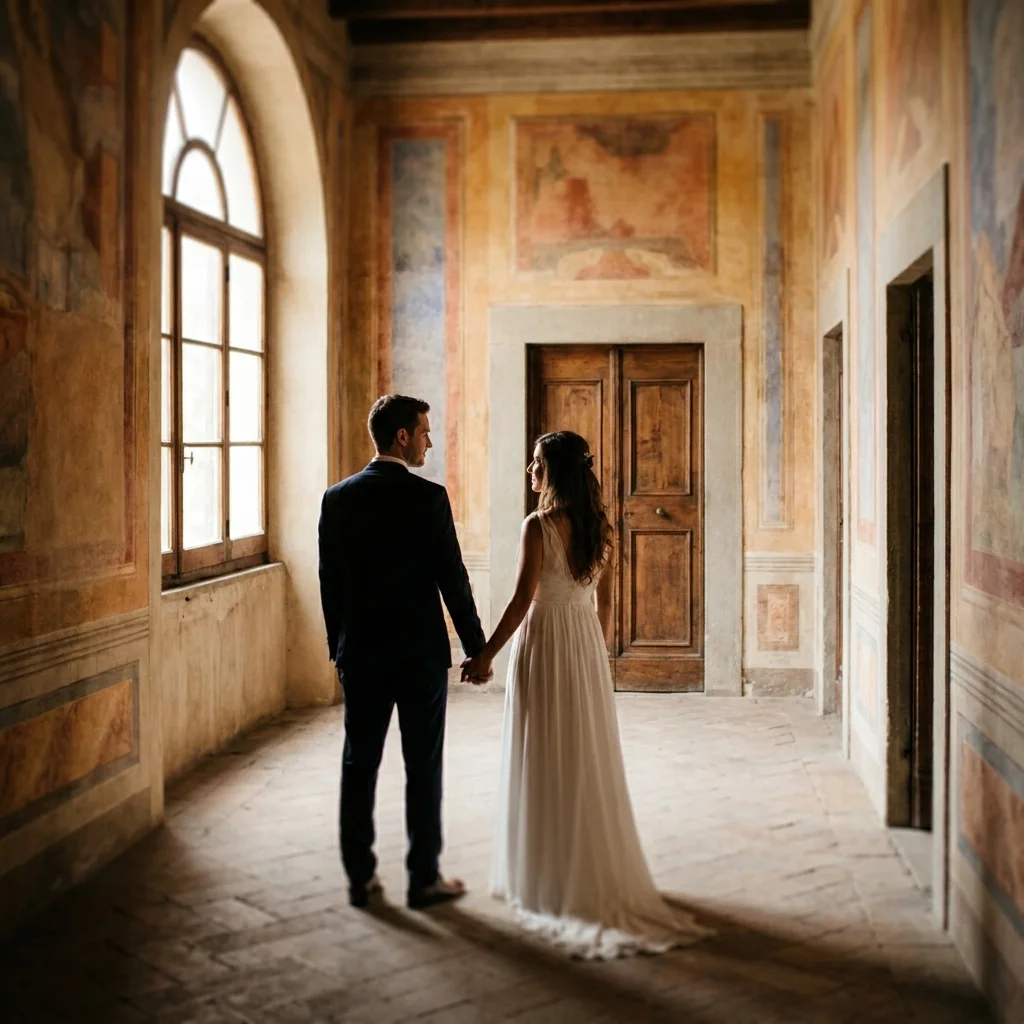
The difference between a civil and symbolic ceremony is not just about paperwork. It restructures your entire day.
A civil wedding ceremony in Italy must be performed by the sindaco (mayor) or a delegated municipal official, inside a space authorized by the local comune. In cities like Rome, Florence, and Venice, this means town halls, designated historic rooms, or — in some municipalities — approved outdoor locations within municipal jurisdiction. The ceremony language is Italian unless a translator is arranged. The time is assigned, not chosen. In high season, slots in popular comuni can be limited to weekday mornings. More in our guide: who can officiate your wedding in Italy.
A symbolic wedding ceremony in Italy, by contrast, carries no legal weight — which is precisely what gives it extraordinary freedom. You choose the hour. You choose the setting: a cliffside terrace, a private villa courtyard at golden hour, a lemon grove in Liguria where the scent of citrus and warm stone fills the air. You choose the words, the structure, the language. Our team writes the ceremony brief, coordinates the celebrant, and designs the sensory environment — from the texture of the aisle runner to the botanical arrangement framing the couple.
Here is the operational distinction most couples overlook: when you choose a civil ceremony, the venue contract must align with municipal scheduling, and your planning team coordinates with the comune’s office for date confirmation, document delivery, and interpreter logistics. When you choose symbolic, the venue contract is between you and the property — and your team controls the timeline entirely. Many couples who want a Tuscan venue with full-day exclusivity find that a symbolic ceremony paired with a separate legal marriage at home offers the most seamless experience.
Religious Ceremonies in Italy: Why Catholic, Jewish, and Other Faith Rites Each Require a Different Planning Timeline
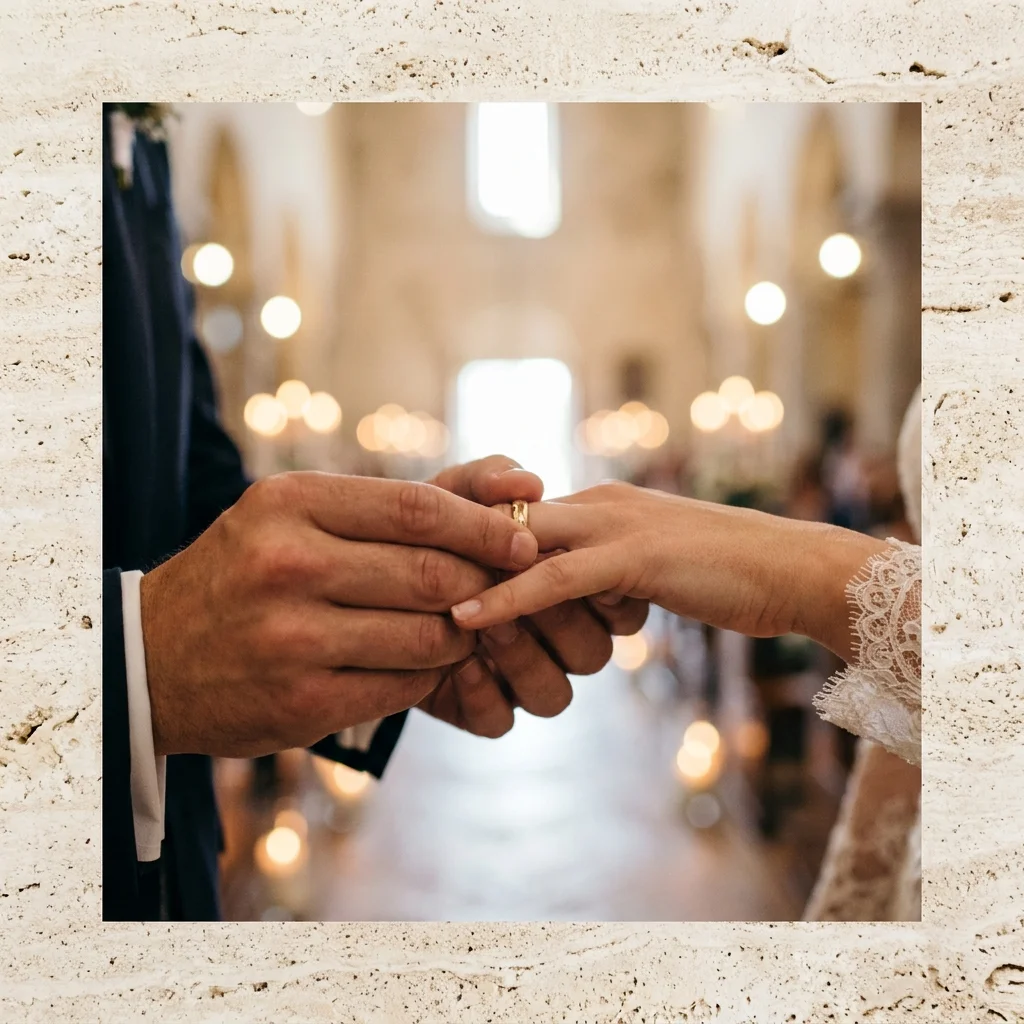
Italy’s Concordat with the Vatican means that a Catholic wedding in Italy for foreigners is both a sacrament and a legally binding civil act — provided the required Nulla Osta and diocesan permissions are in place. This dual nature is powerful but demanding. The paperwork begins six to eight months before the ceremony. Your home parish must issue a letter of freedom to marry; the Italian diocese must approve the church. Banns are published. A pre-Cana or equivalent marriage preparation course may be required, depending on your diocese of origin. More in our guide: Catholic church wedding in Italy.
The churches themselves carry a particular atmosphere that no secular venue can replicate. Morning light filtering through a Romanesque apse in Ravello. The coolness of travertine underfoot in a basilica near the Roman Forum. The echo. The incense. These are sensory experiences rooted in centuries of ritual, and our team at Kiss Me Italy coordinates every liturgical and logistical detail — from the parish priest’s requirements to the floral arrangements permitted on the altar, which vary church by church.
For couples planning a Jewish wedding in Italy, the ceremony is symbolic under Italian civil law — meaning a separate civil registration is necessary for legal recognition. The chuppah, the ketubah, the breaking of the glass: these are honored in full, but the legal marriage is handled independently, often at the local comune on a preceding day. We manage both threads so that the sacred ceremony remains uninterrupted by bureaucratic timing.
Other faith traditions — Anglican, Protestant, Orthodox — may or may not be recognized under Italian law depending on bilateral agreements between Italy and the specific religious body. Our legal coordination team verifies recognition status for each couple’s faith before any planning begins, because this single detail determines whether you need one ceremony or two.
What Each Ceremony Type Costs: Municipal Fees, Celebrant Fees, and What’s Quoted Separately
Pricing for wedding ceremony types in Italy varies not just by format but by municipality, season, and the level of coordination required. Below are indicative ranges based on our 2025–2026 planning experience across Tuscany, the Italian Lakes, the Amalfi Coast, Liguria, and Venice.
| Ceremony Type | Indicative Range | Included | Quoted Separately |
|---|---|---|---|
| Civil ceremony (comune fees) | €300–€1,600 | Municipal officiant, ceremony room, legal registration | Official translator (€250–€500), document apostille/legalization, travel to/from comune, VAT (IVA 22%) on translator services |
| Catholic religious ceremony | €500–€2,500 (church offering + diocesan fees) | Use of the church, parish priest, liturgical preparation meeting | Organist/choir (€300–€800), floral arrangements for altar, diocesan pre-Cana course fees, Nulla Osta processing, VAT on vendor services |
| Symbolic ceremony (celebrant) | €800–€3,000 | Professional celebrant, ceremony script development, 1–2 planning calls, on-site rehearsal | Travel and accommodation for celebrant outside local area, sound system rental, ceremony décor, VAT (IVA 22%) |
| Jewish ceremony (celebrant + coordination) | €1,500–€4,000 | Rabbi or officiant, ketubah preparation, chuppah coordination | Chuppah construction/rental, kosher catering coordination, civil ceremony fees (separate), VAT |
Indicative ranges. Request a tailored ceremony proposal
Note that these figures reflect ceremony-specific costs only. The full design of the ceremony environment — the botanical arrangements, the fabric draping, the aisle composition, the lighting — is part of the broader bespoke wedding design scope and quoted within the overall creative direction.
Planning and Legal Coordination: What a Full-Service Team Manages vs. What Couples Handle Alone
| Coordination Element | Full-Service (Kiss Me Italy) | Self-Managed |
|---|---|---|
| Nulla Osta procurement | Guided document checklist, consulate liaison, timeline tracking | Couple navigates consulate independently; average processing 4–8 weeks |
| Comune scheduling | Direct liaison with municipal office, date hold, interpreter booking | Couple contacts comune in Italian; limited English availability |
| Church/parish coordination | Diocese introduction, priest meeting arrangement, liturgical requirements brief | Couple contacts parish directly; response times vary widely |
| Symbolic celebrant sourcing | Curated shortlist matched to couple’s tone and language; script review | Couple searches online; no quality assurance or rehearsal coordination |
| Legal recognition at home | Post-ceremony document preparation, apostille guidance, certified translation coordination | Couple manages post-wedding; timelines vary by home country |
Indicative scope. Contact Kiss Me Italy to discuss your specific ceremony requirements.
For US citizens specifically, the process of getting legally married in Italy as a foreigner involves obtaining a Nulla Osta (affidavit of freedom to marry) from the US Consulate, which requires an appointment — often booked six to ten weeks in advance during peak season. Our team tracks consulate appointment availability and builds the document timeline into the overall planning calendar so that no ceremony date is at risk.
Why a Cliffside Symbolic Ceremony at Sunset Feels Different from a Town-Hall Morning: A Sensory Comparison
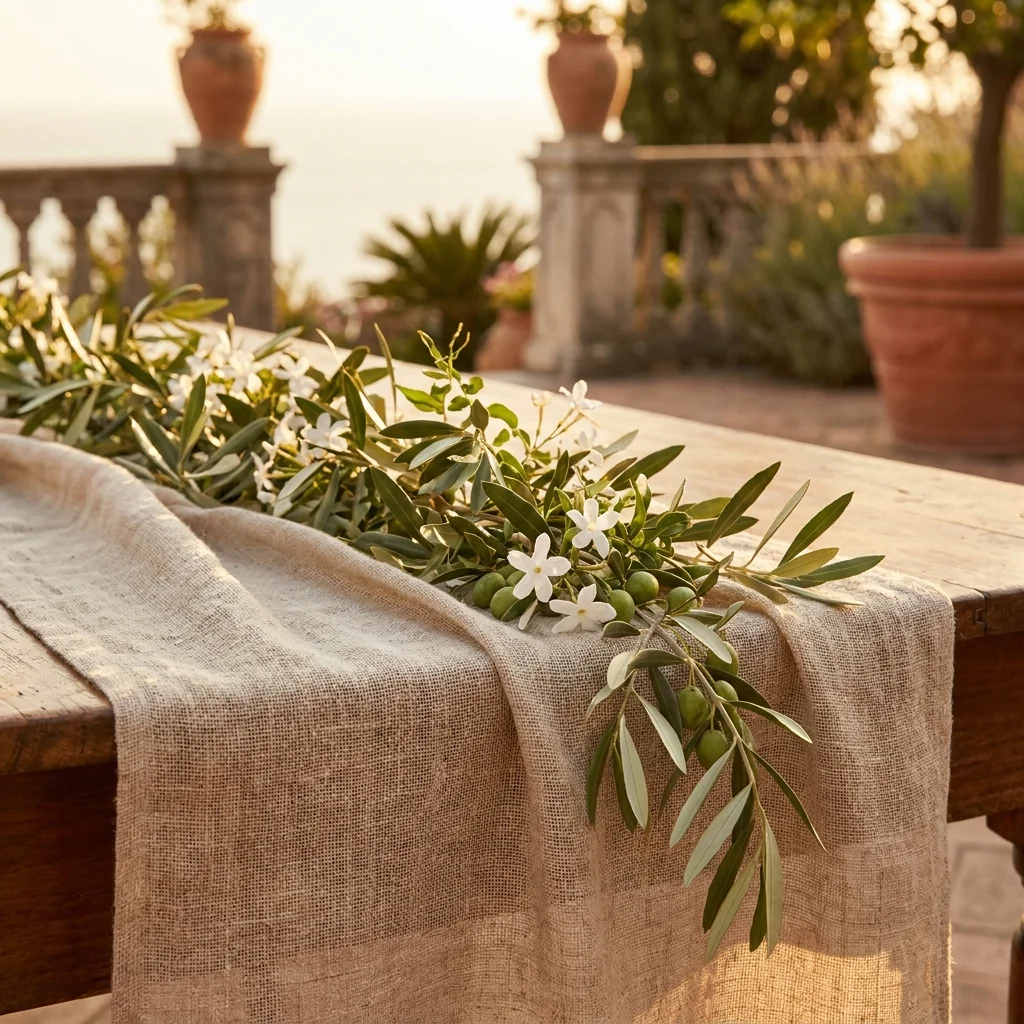
Two ceremonies we’ve designed illustrate the difference more clearly than any checklist—because the format changes not only legality, but the entire sensory rhythm of the day.
The first: a civil ceremony in a medieval town hall in southern Tuscany, mid-morning in October. The room was small — frescoed walls, a particular shade of ochre that only exists in buildings that have absorbed five centuries of Mediterranean light. The sindaco wore a tricolor sash. The couple’s vows were translated, sentence by sentence, from English into Italian. There was a formality to it — a gravity — that surprised everyone. The groom later said it felt like the town itself was witnessing their marriage. The atmosphere of that room, with its cool stone and its silence, was unreproducible.
The second: a symbolic ceremony on a private terrace overlooking the sea near Ravello, late May, just before seven in the evening. The light was amber and horizontal, catching the edges of the olive-leaf garlands we’d foraged that morning from the property’s own grove. The linen runner had a raw, tactile weight — undyed, with a visible weave. The celebrant spoke in English, then the bride’s mother read a passage in French. There was no translator. No municipal schedule. The couple had written every word. When the wind shifted, you could smell jasmine from the garden below, and salt from the coast.
Both were beautiful. Both were real. But they were entirely different experiences, shaped by the ceremony type chosen months earlier. This is why we begin the conversation here.
How Seasonal Availability and Mediterranean Light Shape Which Ceremony Type Works Best
The ceremony type you choose interacts directly with the season. Civil ceremonies in Italian comuni follow municipal office hours — typically morning or early afternoon. In July and August, this means your ceremony occurs during the most intense heat and the harshest overhead light. For couples dreaming of a ceremony along the Amalfi Coast, a symbolic format allows us to schedule the vows for early evening, when the coastal light softens and the stone terraces release the warmth they’ve absorbed all day.
In autumn — late September through November — the situation reverses. Daylight shortens. A morning civil ceremony in Florence or Venice can capture the low, golden light that makes these cities extraordinary in the cooler months. The botanical palette shifts too: from the white jasmine and gardenias of summer to the deeper textures of seasonal arrangements — burgundy dahlias, dried grasses, persimmon branches, seed pods with a matte, tactile surface that photographs beautifully in diffused autumn light.
For Lake Como weddings, the interplay between ceremony type and season is particularly pronounced. Catholic ceremonies in lakeside churches are available year-round, but the light inside a Romanesque nave at 11 a.m. in December is profoundly different from the same space in June. We advise on this — not as a preference, but as a design parameter that affects floral selection, fabric choices, and photographic direction.
Handfasting, Pagan, and Interfaith Ceremonies: Where Italian Law Draws the Line and Where Design Takes Over
A handfasting wedding in Italy is classified as symbolic. It carries no legal recognition. The same is true for pagan ceremonies, Wiccan rituals, and most interfaith formats that blend elements from two or more traditions. This is not a limitation — it is a creative opening. Read next: pagan wedding.
Because these ceremonies exist outside the legal framework, they can take place anywhere the venue permits: a forest clearing in the Dolomites, a private garden in Umbria, a candlelit courtyard in a Ligurian borgo. The design possibilities are extraordinary. For a handfasting ceremony we coordinated last spring, we sourced hand-dyed silk ribbons in shades drawn from the surrounding landscape — sage green, dusty lavender, the warm ivory of local limestone. The cords were braided with dried rosemary from the property’s herb garden. Every material was seasonal, foraged, and specific to the place. More in our guide: handfasting ceremony.
For couples whose celebration bridges two faith traditions — say, a Catholic and Hindu ceremony, or a Jewish and secular format — the legal question must be answered first. Which ceremony, if any, will carry legal weight? Once that is resolved, the design of each ritual element can proceed with clarity. Our team coordinates with officiants, rabbis, priests, and celebrants across traditions to ensure that the spiritual and aesthetic integrity of each rite is preserved. Related guide: Chinese wedding ceremony in Italy.
Vow Renewals in Italy: No Paperwork, Full Design Freedom, and a Different Emotional Register
A vow renewal in Italy is always symbolic. There is no legal component, no municipal involvement, no document timeline. This makes it the most design-forward ceremony type we offer — and, for many couples, the most emotionally resonant.
Without the constraints of legal scheduling, we design vow renewals around the setting and the season with complete freedom. A lakeside renewal on Lake Garda in early October, when the water reflects the changing foliage and the air carries the first coolness of autumn. A terrace ceremony above the Ligurian coast in late June, with the scent of wild thyme and the sound of cicadas as the only accompaniment.
The emotional register is different too. Couples renewing vows are not beginning — they are deepening. The ceremony language tends to be more personal, more specific, more rooted in shared history. Our celebrants understand this distinction, and the design — from the botanical palette to the music selection — reflects it.
Getting Married in Italy as a US Citizen: The Consulate Step That Shapes Your Entire Timeline
For American couples, the critical bottleneck is the Nulla Osta appointment at the US Consulate — available in Rome, Florence, Milan, and Naples. This sworn statement that you are legally free to marry must be obtained in person, and appointment slots during peak wedding season (May through September) fill rapidly. We recommend securing your consulate appointment at least ten weeks before the wedding date.
After the Nulla Osta is issued, it must be taken to the local Prefettura for validation, then delivered to the comune where the civil ceremony will take place. The entire chain — consulate, Prefettura, comune — operates on Italian administrative timelines, which do not accelerate for wedding deadlines. Our legal coordination team manages each handoff, tracking document status and maintaining direct communication with municipal offices.
Couples who prefer a symbolic ceremony in Italy and a legal marriage at home bypass this process entirely. Many of our American clients choose this path — a deeply personal symbolic ceremony at their Italian venue, followed by a brief civil ceremony at their county clerk’s office upon return. The full legal guide for foreign couples marrying in Italy outlines both pathways in detail.
Italian Wedding Traditions That Shape the Ceremony Atmosphere — Even When You Don’t Plan Them
Regardless of which ceremony type you choose, certain Italian traditions may surface — sometimes by design, sometimes spontaneously. The confetti (sugar-coated almonds, not paper) are offered in odd numbers, traditionally five, symbolizing health, wealth, happiness, fertility, and longevity. They appear at nearly every Italian wedding, tucked into small fabric pouches or arranged in glass vessels on the reception tables.
In southern Italy, the serenata — a serenade performed by the groom beneath the bride’s window on the eve of the wedding — remains a living tradition. While most international couples don’t incorporate it literally, the spirit of it — music, surprise, a gesture of devotion — can be woven into the ceremony design. We’ve arranged a solo violinist playing from a balcony as the bride approached a courtyard ceremony, echoing the serenata tradition without replicating it.
These cultural textures are part of what makes wedding ceremony types in Italy feel different from the same formats elsewhere. The traditional Italian wedding food sequence carries similar depth — each course has a rhythm and a meaning that our team integrates into the overall flow of the celebration.
Three Questions That Determine Your Ceremony Type Before Any Design Begins
After coordinating hundreds of ceremonies across Italy, we’ve distilled the ceremony-type decision into three questions:
1. Do you need your Italian ceremony to be legally binding? If yes, you choose between civil and religious (for recognized faiths). If no, symbolic opens every venue and every hour to you.
2. Is your faith tradition recognized under Italian law? Catholic, certain Protestant denominations, and Jewish ceremonies conducted by recognized communities can carry legal weight — but each requires specific documentation. Other traditions default to symbolic, with a separate civil ceremony for legal recognition.
3. What sensory experience do you want your guests to remember? The formality of a municipal room with frescoed walls. The sacred echo of a basilica. The open air, the scent of Mediterranean herbs, the freedom of a ceremony written entirely in your own words. This is where the choice becomes personal — and where the design begins.
We guide every couple through this framework in our initial consultation. If you’re beginning to consider your options, reach out to our team to start the conversation.
How Ceremony Type Affects Photography Coverage, Permits, and Editorial Direction
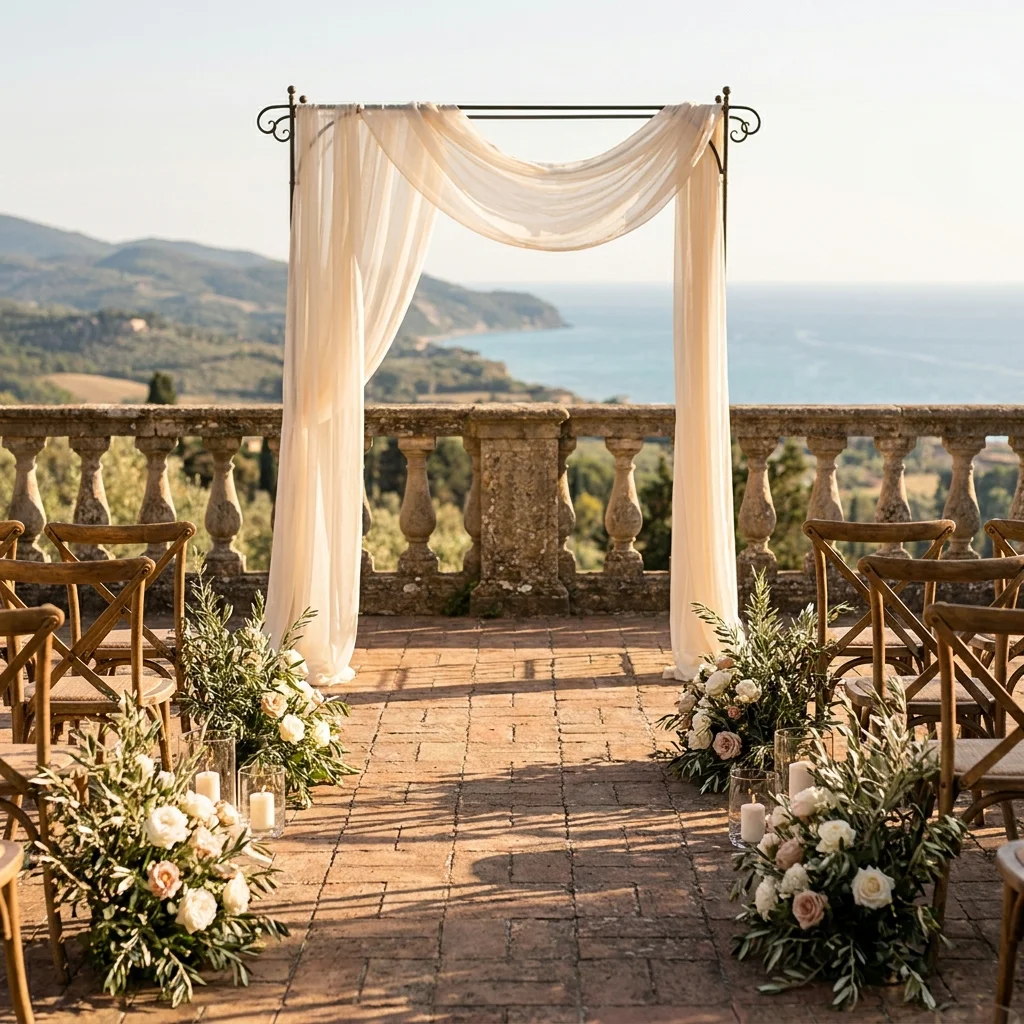
The ceremony format directly shapes your photographer’s brief. A civil ceremony in a town hall may last fifteen to twenty minutes, in a room with fixed lighting and limited movement. A symbolic ceremony outdoors can last forty-five minutes, with natural light shifting throughout and multiple angles available. A Catholic mass may extend to an hour, with restrictions on flash photography and movement within the nave.
| Photography Element | Civil Ceremony | Religious Ceremony | Symbolic Ceremony |
|---|---|---|---|
| Typical ceremony duration | 15–25 minutes | 45–75 minutes | 20–45 minutes |
| Flash/lighting restrictions | Rare | Common (varies by church) | None (outdoor) / Flexible (indoor) |
| Photographer positioning | Fixed, limited space | Restricted zones (altar, aisle) | Full freedom |
| Permit requirements | Municipal photo permit occasionally required | Parish permission; some churches charge a photography fee (€100–€300) | Venue-dependent; typically included in venue contract |
| Editorial direction impact | Documentary, intimate | Architectural, reverent | Full editorial control; styled vignettes possible |
Photography fees are separate from ceremony costs. Full-day editorial coverage typically ranges from €4,500–€9,000 (single shooter; travel within region included; second shooter, albums, post-production, and VAT quoted separately). Contact Kiss Me Italy for photographer recommendations matched to your ceremony type.
The Ceremony Is the Foundation — Everything Else Is Built Upon It
Every floral arrangement, every fabric choice, every timing decision in an Italian wedding flows from the ceremony type. The legal structure determines the schedule. The spiritual format determines the emotional tone. The setting — indoor or outdoor, sacred or secular, municipal or private — determines the sensory world your guests enter.
At Kiss Me Italy, we don’t treat the ceremony as one item on a checklist. It is the foundation of the entire design. The seasonal botanicals we select, the tactile materials we source, the way we choreograph the light — all of it begins with this choice. Whether you’re drawn to the gravitas of a Catholic ceremony in an ancient Italian church, the creative freedom of a symbolic celebration on a private villa terrace, or the elegant simplicity of a civil union in a Renaissance town hall, our team manages every layer of complexity so that what you experience is only beauty.
Begin a conversation with Kiss Me Italy — and let us help you choose the ceremony that feels like yours.
Frequently Asked Questions About Wedding Ceremony Types in Italy
Do we need witnesses for a civil wedding in Italy, and can they be non-EU citizens?
Yes. Civil ceremonies require witnesses, and they can be non-EU citizens. Requirements vary by comune (ID type, age, and whether an interpreter is needed). We confirm witness rules with the municipality before you finalize travel plans.
What documents typically need translation, and does the comune require sworn translations?
Many comuni require certified or sworn translations for specific documents (often birth certificates and divorce decrees, if applicable). The exact standard depends on the municipality and your nationality. Our legal coordination team confirms the translation format and arranges certified translators when required.
Can we legally marry in one comune and hold the celebration in a different region?
Yes. Many couples complete the legal civil ceremony where scheduling is straightforward, then host the symbolic ceremony at their chosen venue elsewhere. The key is building realistic travel buffers and aligning document delivery with the comune’s timelines—both of which we plan in advance.
If one partner was previously married, does that change the timeline for Italy?
It can. Divorce documentation often requires additional legalization and translation steps, and some consulates/comuni request extra supporting paperwork. We review your specific circumstances early and build the document schedule accordingly so your ceremony date is protected.
Are there days when civil ceremonies are harder to schedule in Italy?
Yes. Municipal ceremonies follow office hours and local calendars, so weekends, public holidays, and peak-season dates can be limited or priced differently. We advise on realistic date options before you commit to venue contracts and guest travel.