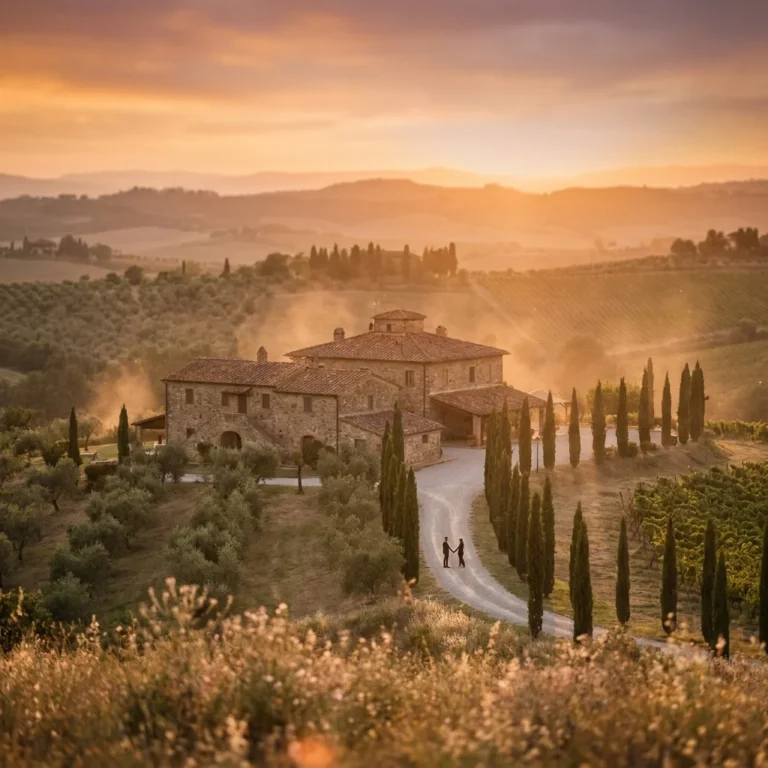
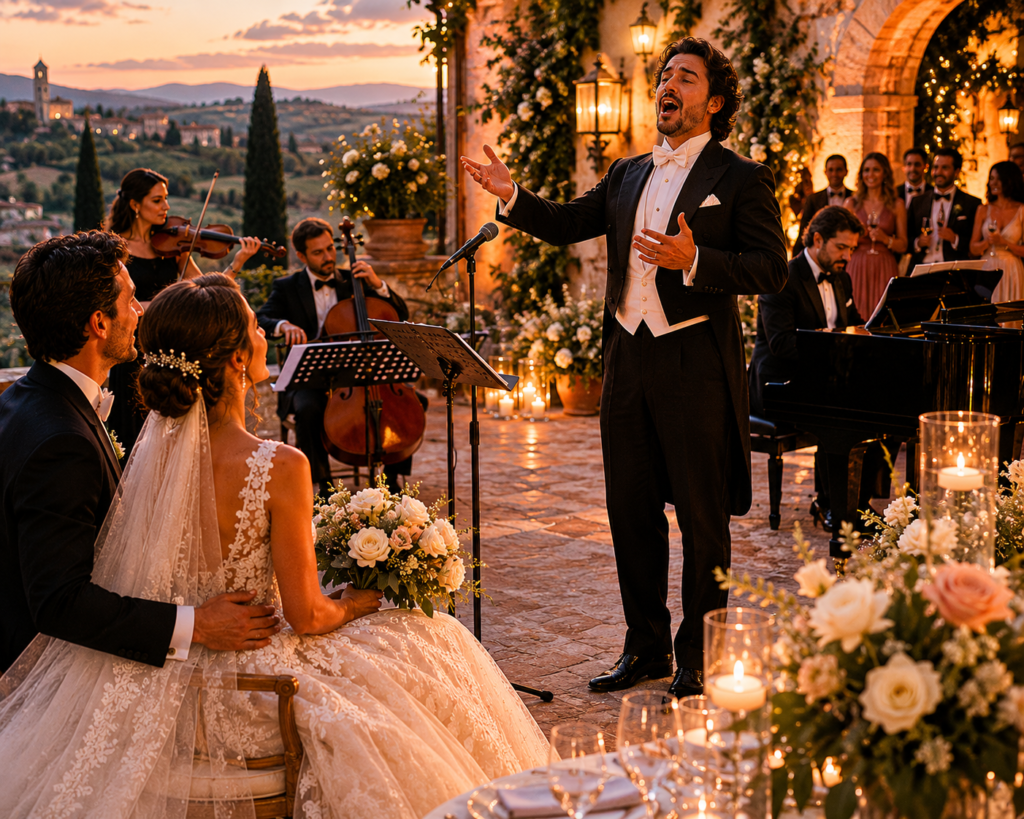
An opera singer for a wedding in Italy costs €1,200 to €6,500 per performance, depending on the program, the accompaniment and the travel. A singer can cover the processional, the signing and the recessional, or a single aria at dinner. Churches, villas and town halls all work, and the season runs from spring to early autumn.
Packages With Live Music Included
These live Kiss Me Italy packages already include a singer or a live musician. Prices are in euros, as published, for two people.
| Package | Location | Live music | Price |
|---|---|---|---|
| The Gondola Serenade Proposal — Venice | Private gondola, Venice | Live serenade by a professional singer, photographer | €2,100 |
| The Grand Canal Serenade & Dinner Proposal — Venice | Grand Canal, Venice | Live serenade by a professional singer, dinner, photographer | €2,500 |
| The Lake-View Gazebo Proposal with Fireworks & Live Music | Casa degli Spiriti, Lake Garda | Live harp or piano, fireworks, photographer | €4,200 |
| The Lake-View Garden Elopement with Photographer & Fireworks | Casa degli Spiriti, Lake Garda | Live harp or piano, celebrant, fireworks | €5,300 |
| The Lake-View Garden Vow Renewal with Photographer & Fireworks | Casa degli Spiriti, Lake Garda | Live harp or piano, celebrant, fireworks | €5,300 |
An opera singer can be added to any wedding, elopement or vow renewal. On some proposal packages, live music is a listed add-on: on Garda Sunset Dream, a violinist or an acoustic set costs €500. Full weddings are in our Italy wedding packages.
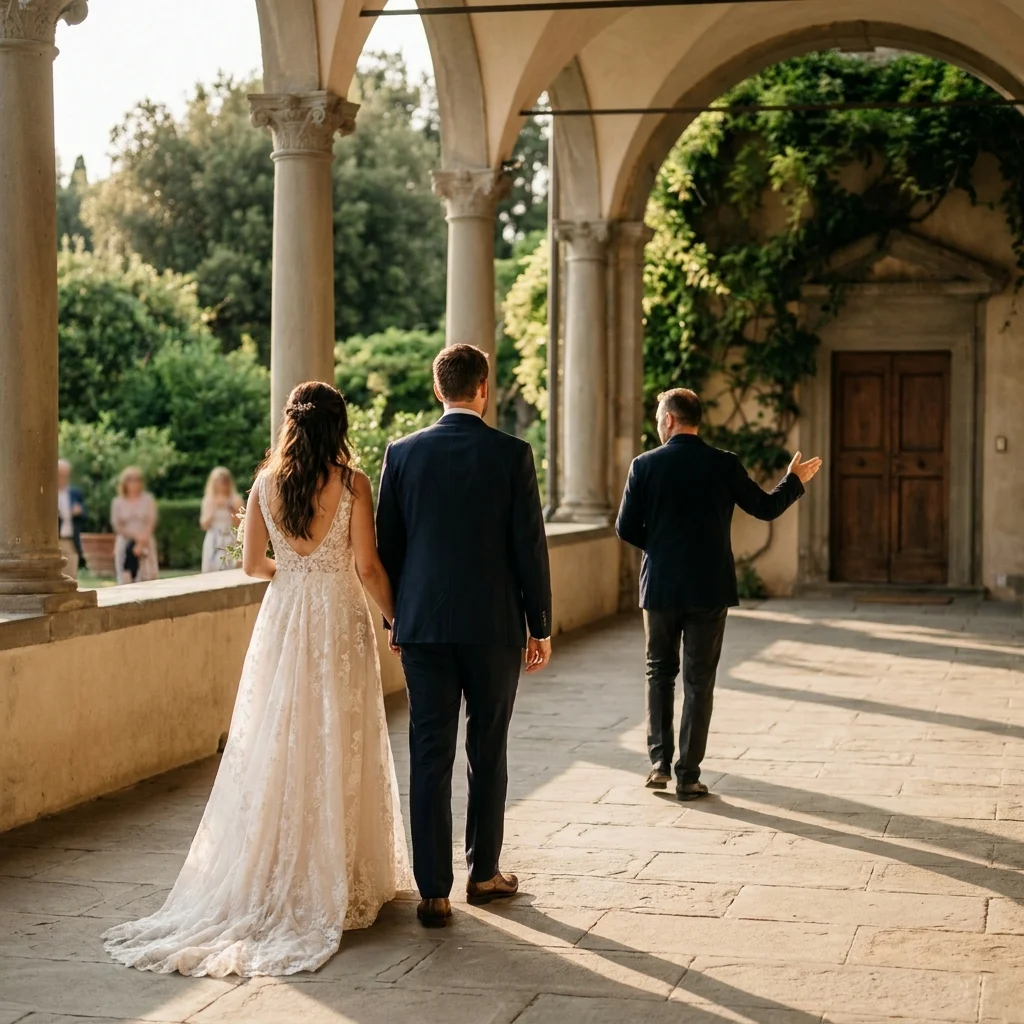
How Much an Opera Singer Costs for a Wedding in Italy
The range below is the one published on Kiss Me Italy guides. The final quote depends on how many pieces, how many moments of the day and who accompanies the voice.
| Music for the wedding | Price range |
|---|---|
| Opera singer, one performance | €1,200–€6,500 |
| String quartet, ceremony | €2,000–€3,500 |
| String quartet, full day | €3,500–€5,000+ |
| Ceremony musicians | €800–€1,500 |
| Classical guitarist, solo | €500–€1,000 |
| Pianist or organist to accompany the singer | On request |
What moves the price
- Program length: three pieces at the ceremony cost less than a ceremony plus an aperitivo set.
- Accompaniment: piano, organ, guitar or a string quartet each add a musician.
- Rehearsal: a rehearsal at the venue adds time on site.
- Travel: islands, mountain venues and long transfers add travel and sometimes a night’s stay.
- Sound: outdoor venues may need a small amplification system.
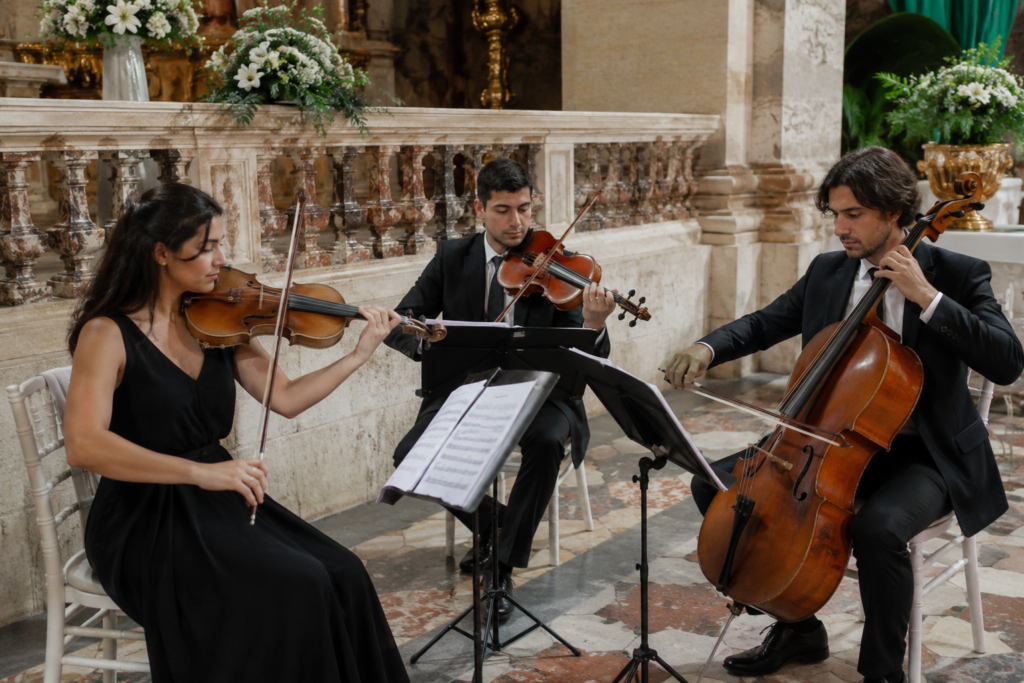
Wedding Arias for Each Moment of the Ceremony
Choose one piece for each moment, not one for every minute. A ceremony usually has room for three to five pieces. The table lists well-known choices with their composer and source.
| Moment | Aria or piece | Composer and work | Why it fits |
|---|---|---|---|
| Guests arriving | “Caro mio ben” | Attributed to Tommaso Giordani | Short, gentle, in Italian |
| Processional | “Ave Maria” | Franz Schubert | Slow and solemn, suits church and garden |
| Processional | “Ave Maria” | Bach–Gounod | Bright melody over a Bach prelude |
| Readings or a ritual | “Panis angelicus” | César Franck | Sacred, works with organ or strings |
| Signing of the register | “O mio babbino caro” | Giacomo Puccini, Gianni Schicchi | Famous, short, ideal for a soprano |
| Signing of the register | “Ombra mai fu” | George Frideric Handel, Serse | Calm and lyrical, good for any voice |
| Signing of the register | “Laudate Dominum” | W. A. Mozart, Vesperae solennes de confessore | Sacred, for church ceremonies |
| Recessional | “Libiamo ne’ lieti calici” | Giuseppe Verdi, La traviata | The drinking song: festive, best as a duet |
| Recessional or toast | “Il bacio” | Luigi Arditi | Light waltz song about a kiss |
| Dinner | “Nessun dorma” | Giacomo Puccini, Turandot | A tenor showpiece for a big moment |
| Dinner | “’O sole mio” | Neapolitan song | Guests know it and sing along |
Processional
The entrance needs a steady, slow tempo. An “Ave Maria” is the classic choice in church. In a garden, pair the voice with strings or a guitar, so the entrance can start softly and grow.
Signing of the register
Signing takes a few minutes, which suits one complete aria. A soprano with “O mio babbino caro” or any voice with “Ombra mai fu” fills the gap without rushing the officiant.
Recessional
The exit should lift the mood. The brindisi from La traviata is a duet for tenor and soprano, so it is a good reason to book two singers. A single voice can close with an upbeat Neapolitan song.
Dinner
One or two pieces between courses work better than a full set. Agree the timing with the kitchen, so the performance does not clash with service. For the evening, see our guide to the wedding band in Italy.
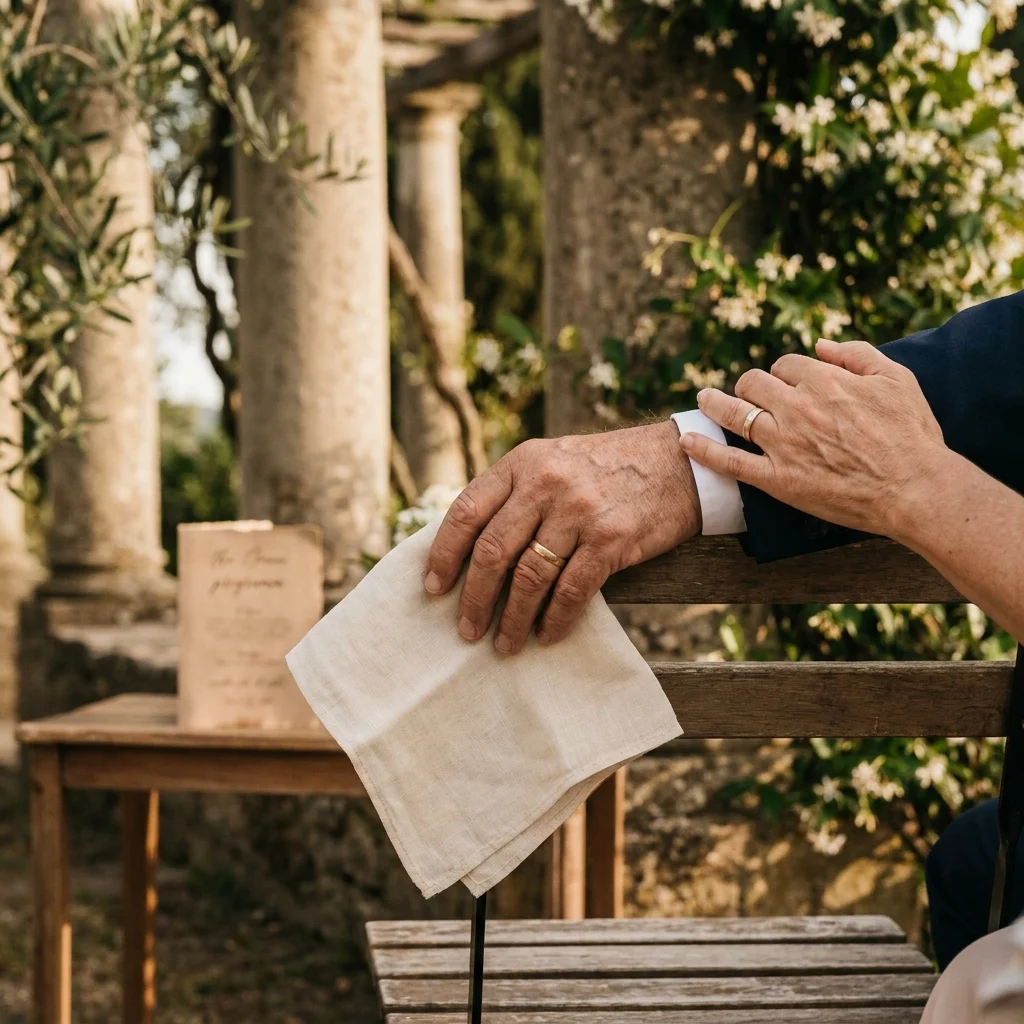
Church, Civil or Symbolic: Where the Singer Can Perform
Catholic church
Sacred pieces such as “Ave Maria” and “Panis angelicus” are the safe choice in church. Some parishes do not allow opera arias or secular songs during Mass, so send the program to the parish early and get it approved. See our guide to the Catholic wedding in Italy and Florence wedding venues.
Civil ceremony at the town hall
Each Comune sets its own rules for civil wedding rooms. Some allow music, with limits. In Cuneo, for example, the civil wedding rules allow musical instruments without amplification, as background to the ceremony (Comune di Cuneo, art. 7). Ask your Comune before you book a singer, and plan for an unamplified voice. Legal steps are in how to get married in Italy as a foreigner.
Symbolic ceremony
A symbolic ceremony in a villa, garden or on a terrace gives the most freedom: any aria, any order, any language. The limits come from the venue, such as sound curfews. Our wedding officiant guide explains who can lead a symbolic ceremony.
Combining the Singer With a String Quartet
A voice alone sounds bare outdoors. The accompaniment shapes the sound, and the budget.
| Accompaniment | Best for | Notes |
|---|---|---|
| Organ | Church ceremonies | Use the church organ and organist, if the parish allows |
| Piano | Villas, palazzi, dinner | Needs a tuned piano or a digital stage piano |
| Classical guitar | Gardens, terraces, small ceremonies | Light and easy to move; €500–€1,000 for the guitarist |
| String quartet | Ceremony and aperitivo | Fullest sound; €2,000–€3,500 for the ceremony |
| Recorded backing track | Remote venues | Cheapest, but loses the live feel |
With a quartet, the musicians can play the entrance of the guests and the aperitivo, and the singer joins for two or three key pieces. Read more in our guide to the string quartet for a wedding in Italy.
Venue Acoustics: Indoors, Outdoors and Heritage Rooms
- Stone churches and chapels: natural reverb carries the voice without a microphone. Slow pieces work best.
- Villa halls and palazzi: good sound, but low ceilings can make a big voice feel loud. A lighter voice often suits these rooms.
- Gardens and terraces: sound disappears into open air. Place the singer with a wall or a building behind, facing the guests, and plan for light amplification.
- Lakeside and seaside: wind and boat traffic compete with the voice. A ceremony late in the day is usually calmer.
- Heritage venues: some restrict amplification or performance hours. Ask the venue for its rules in writing.
If you are still choosing the place, compare villa weddings in Italy and Venice wedding venues.
Opera by Region
| Region | Typical setting | Planning tip |
|---|---|---|
| Tuscany | Villa courtyards, chapels, vineyards | Courtyards carry sound well; evening ceremonies are cooler. See Tuscany weddings. |
| Venice | Palazzi, churches, gondolas | Indoor rooms dominate; check amplification rules. See Venice wedding costs. |
| Lake Como | Villa gardens and terraces | Place the singer with the villa behind. See Lake Como weddings. |
| Lake Garda | Lakeside gardens, gazebos | Live harp or piano is included in the Casa degli Spiriti fireworks packages. See Lake Garda weddings. |
| Amalfi Coast | Cliff terraces, churches | Outdoor terraces may need amplification; allow for travel. See Amalfi Coast wedding costs. |
How to Book an Opera Singer in Italy
- Listen first. Ask for recent recordings, ideally live and in a similar setting.
- Agree the program. List each piece, the moment and the length, and the backup piece if the timing changes.
- Confirm the accompaniment. Who plays, what instrument, and who provides it.
- Plan a rehearsal. Even a short sound check at the venue avoids surprises.
- Check sound and power. For outdoor venues, confirm amplification and a power point.
- Put it in writing. Fee, travel, timings, attire, what happens in rain, and a replacement if the singer is ill.
- Brief the photographer and videographer. Share the timing so they are in place. See our wedding photographer in Italy and videographer guides.
For summer dates, book as early as possible: good singers also have concert and festival seasons. Kiss Me Italy can find the voice, plan the program and coordinate the day as part of your wedding. Contact Kiss Me Italy with your date and venue.
More ideas for the day are in our guides to wedding entertainment in Italy, Italian wedding traditions, vow renewals in Italy and what a wedding in Italy costs.
Frequently Asked Questions
How much does an opera singer cost for a wedding?
In Italy, an opera singer costs €1,200 to €6,500 per performance. A short ceremony program sits at the lower end. Two singers, several moments of the day, an accompanist and travel push the price up. A pianist or organist is quoted on request, and a string quartet for the ceremony is €2,000 to €3,500.
What are the best opera arias for a wedding ceremony?
Popular choices are Schubert’s or Bach–Gounod’s “Ave Maria” for the entrance. For the signing, try Puccini’s “O mio babbino caro” or Handel’s “Ombra mai fu”, and close with Verdi’s brindisi from La traviata for the exit. In church, keep to sacred pieces such as Franck’s “Panis angelicus”.
Can an opera singer perform at a civil ceremony in Italy?
Often yes, but each Comune decides. Some town halls allow music with limits: in Cuneo, for example, only instruments without amplification, as background. Ask the Comune when you book the room, and plan an unamplified voice with piano or strings. A symbolic ceremony gives full freedom.