Cinque Terre Elopement
The first question couples ask us is almost never about flowers. It is this: if four of the five villages have no drivable access, how do two people actually get married there? The answer is architectural and administrative at once. The five villages fall under only three municipalities — Monterosso al Mare, Vernazza (which administers Corniglia) and Riomaggiore (which administers Manarola) — so a legally binding civil ceremony is celebrated in one of three town halls, while the terraces, harbours and dry-stone vineyard walls that couples actually came for host the symbolic celebration. Kiss Me Italy builds the day around that distinction, and around the railway timetable that quietly governs everything else.
A Cinque Terre elopement is an intimate coastal wedding for two, staged across one or more of the five Ligurian villages, with either a civil ceremony at a municipal venue or a symbolic ceremony on a private terrace, vineyard or boat. In the current Kiss Me Italy catalogue, verified Ligurian examples include Columbus Dream Genoa at €2,200 for two and Into The Blue Portofino at €7,900 for two. A Cinque Terre version is built as a destination-specific proposal, with transfers, boat, access, permits and supplier logistics confirmed separately for the selected route. Most couples marry symbolically on the coast and complete legal formalities either at home or at a Ligurian town hall in the days before.
Three Comuni, Five Villages: Where a Ceremony Can Legally Take Place
The villages were fortified by the Republic of Genoa against Saracen raids, and the sixteenth-century towers that survive above Monterosso al Mare and Vernazza still define the skyline. What they do not contain is a large civic apparatus. Each of the three comuni maintains a small number of rooms authorised for civil marriage, and slots are limited — frequently weekday mornings, with restricted or surcharged availability on Saturdays and none on public holidays. We confirm the calendar in writing with the relevant comune before any date is proposed to you, because a Saturday afternoon that exists in Rome does not necessarily exist in a village of nine hundred residents.
For international couples, the paperwork sits upstream of the day itself: the documents, translations, legalisation and interpreter arrangements required by the relevant authorities for your nationality and chosen comune. Our team handles the sequence, the appointments and the correspondence. If the distinction between binding and symbolic is still unclear, our guide to the different wedding ceremony types in Italy sets out the legal architecture, while the practical requirements for foreign nationals are detailed in our overview of how to get married in Italy as a foreigner.
Many couples we work with choose the second path deliberately. They register legally at home, then elope symbolically on the Ligurian coast with a celebrant whose voice, language and register we select with them — a decision we treat as casting, not booking, and one we discuss in our notes on choosing a wedding officiant in Italy. Where a binding Italian civil ceremony is the priority, our guide to a courthouse wedding in Italy explains what happens inside the municipal room itself. Both routes can be designed with the same visual ambition, although the ceremony setting and legal documentation differ.
Choosing Between the Five Villages Is an Access Decision, Not a Beauty Contest
You have almost certainly already fallen for one of them. Our work begins after that, because each village imposes a different physical grammar on the day. Monterosso al Mare has the only genuine beach, level ground behind the promenade and a station that opens directly onto the seafront — which makes it the least strenuous of the five for a bride in a long gown and the only one where a car can realistically deposit you close to your ceremony point.
Vernazza offers the coast’s most cinematic natural harbour, a piazza open to the water and the ruined Doria tower above it, but the final approach is pedestrian and steeply cobbled. Corniglia sits roughly a hundred metres above the sea on a rocky spur; its railway station lies below the village, connected by the Lardarina staircase of some three hundred and eighty steps, with a municipal shuttle as the alternative. We do not send couples up that staircase in ceremony dress. When Corniglia is the chosen setting, we schedule vehicle access from the inland road and time the arrival to the shuttle, not to hope. Shuttle timing is reconfirmed with the local operator ahead of the date.
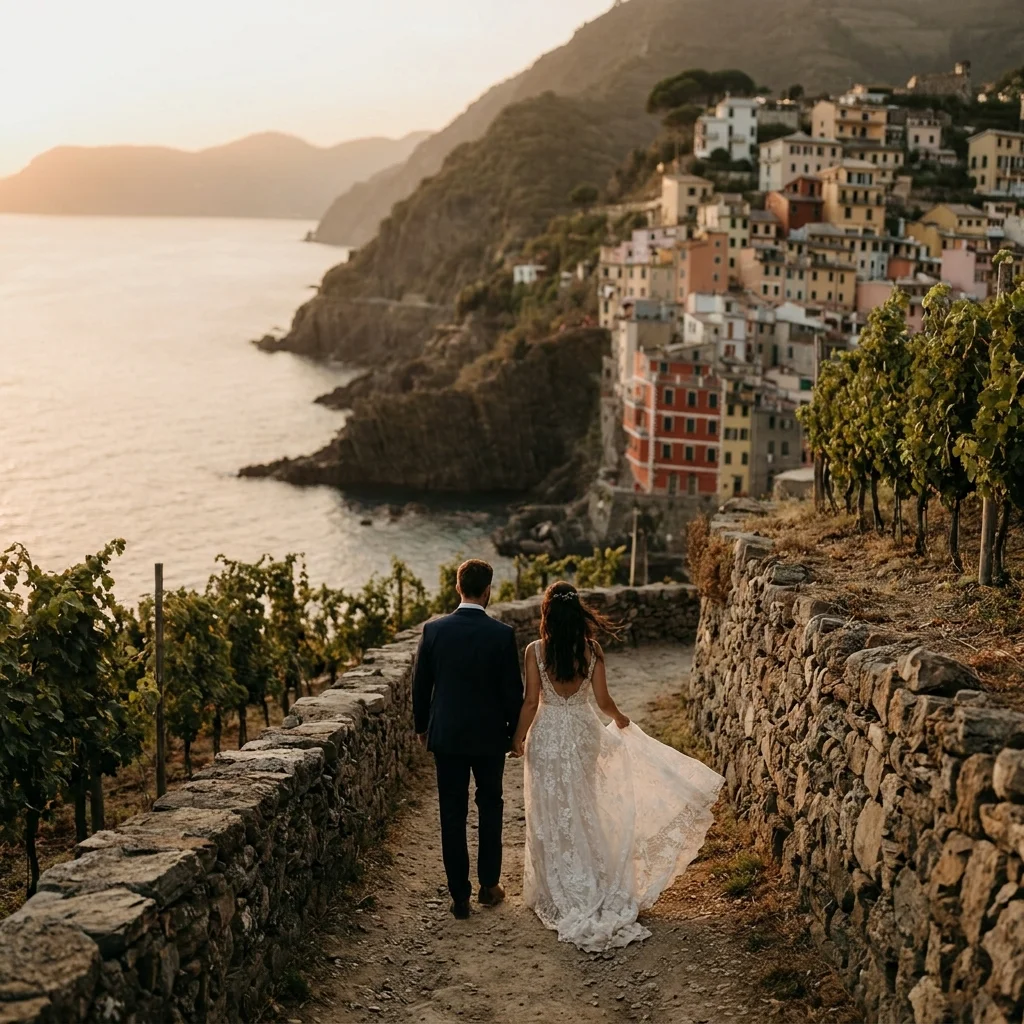
Manarola gives us the terraced vineyards whose dry-stone walls were first cut for viticulture in the medieval period, and the western headland that turns to gold in the final forty minutes before sunset. Riomaggiore, the easternmost, has the tightest ravine and the most compressed evening light. Our recommendation is usually a pairing, not a single village: one for the ceremony, one for portraits, connected by a train ride of four to nine minutes. Couples who want the full destination overview before narrowing down will find it in our Cinque Terre wedding guide, which covers the villages as a whole rather than the mechanics of eloping in two.
Why We Often Add Portovenere — and Why It Is Not the Sixth Village
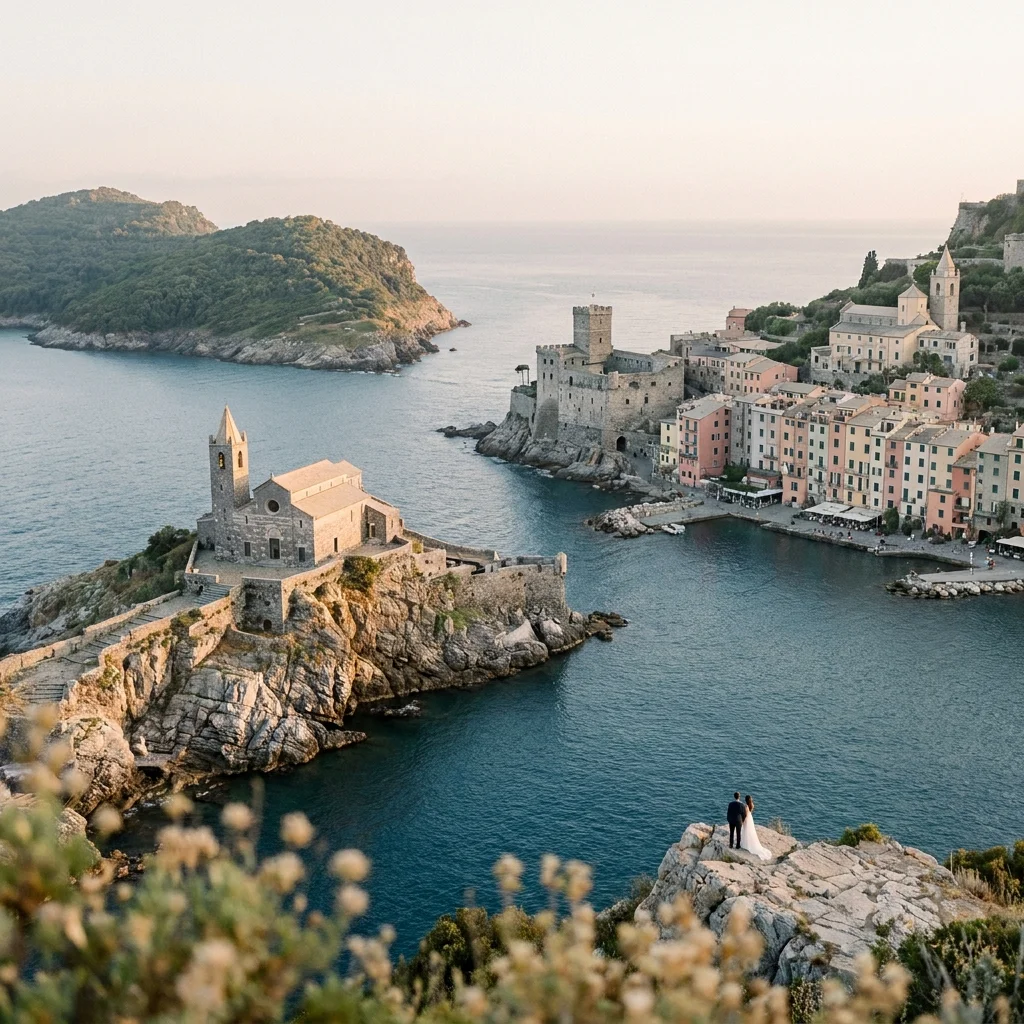
Portovenere is not one of the Cinque Terre. It lies south, across the Gulf of La Spezia, in a separate comune, and it shares only a UNESCO listing with the five villages. It also holds one of the most theatrical scenographies on this coast: the medieval church of San Pietro on a promontory struck on three sides by open sea, with the Doria fortress rising behind the palazzata of narrow tower-houses.
For a Portovenere elopement, the practical advantages are real. Road access is generally direct, though we reconfirm current restrictions with local authorities for your date, the harbour is deep enough for a private boat to embark and disembark comfortably in most sea states, and the comune has its own civil marriage capacity. We frequently propose it as either the legal anchor of the day or the closing act — a boat departing Riomaggiore at the end of the afternoon, running south along the cliffs, arriving with the light behind the island of Palmaria. Presented honestly, it broadens the day; presented as a Cinque Terre village, it would simply be wrong. Our team maps both options in the first consultation, and you are welcome to write to us with your dates before deciding which coastline anchors your ceremony.
What a Cinque Terre Elopement Costs, Line by Line
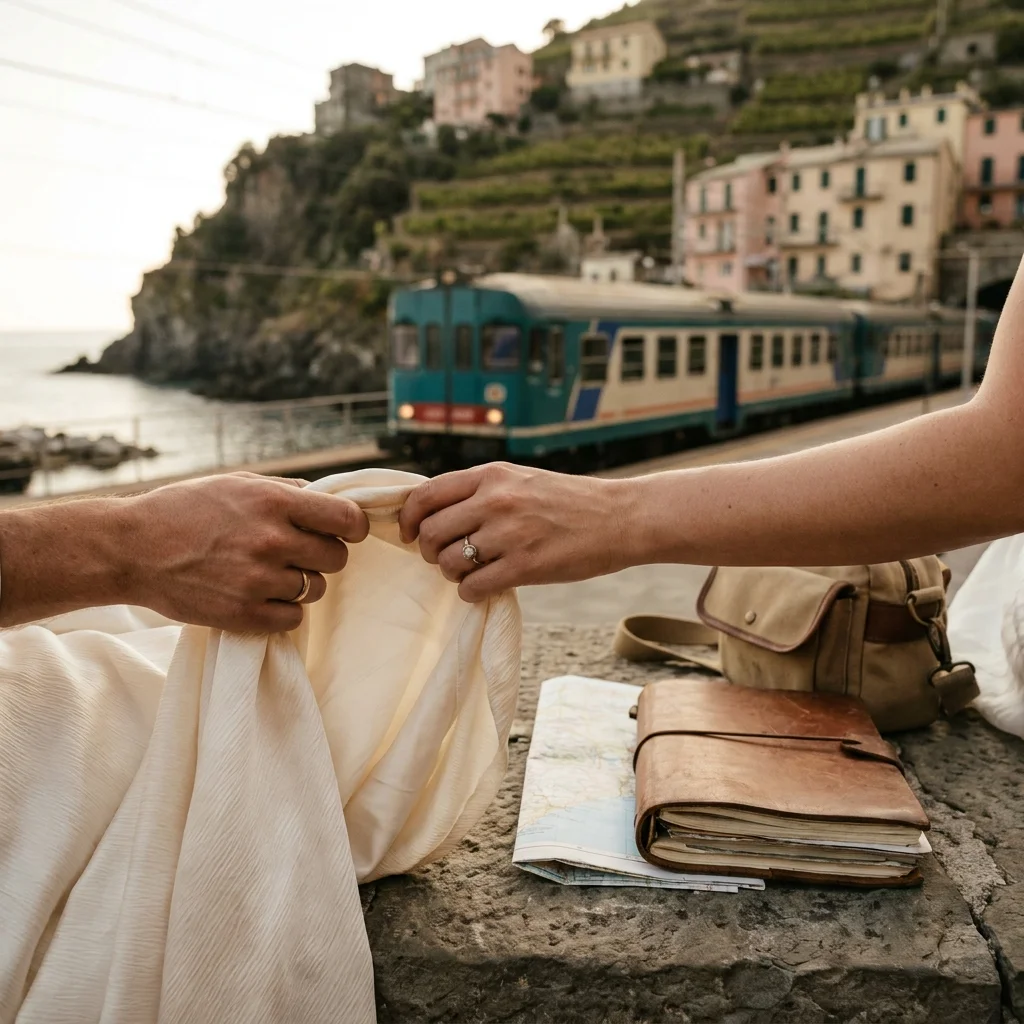
We publish real prices for two people. For this guide, we use only Ligurian elopement products whose current Kiss Me Italy catalogue price can be verified directly. These products were designed around Genoa and the Portofino–San Fruttuoso coast; a Cinque Terre version is not assumed to cost the same.
The linked collections retain their published price and core creative scope. Any Cinque Terre adaptation is issued as a destination-specific proposal after transport, boat access, permits, ceremony setting and supplier availability are confirmed.
| Current Kiss Me Italy Ligurian elopement benchmark (for two) | Published price | Published core scope | Cinque Terre adaptation |
|---|---|---|---|
| Columbus Dream Genoa | €2,200 | Genoa elopement at Terrazza Colombo above the historic port, with symbolic ceremony, Red Ribbon Ritual, artisan florals, professional photography and a seafront lunch | Transfers to the Cinque Terre, ceremony-setting access, permits, boat or rail logistics, legal formalities and any additional coverage are confirmed separately in the destination-specific proposal |
| Into The Blue Portofino — San Fruttuoso Abbey | €7,900 | Private-boat arrival to San Fruttuoso, symbolic ceremony on a sea-facing terrace with three rituals, photography around the abbey and gardens, lunch by the abbey, return to Portofino for Castello Brown and aperitivo | A Cinque Terre version is a different route and is therefore re-quoted for vessel, embarkation points, access, permits, supplier logistics and any additional services |
Published Kiss Me Italy product prices checked against the current live elopement catalogue. These are prices for the linked products, not fixed Cinque Terre quotations. A Cinque Terre adaptation is confirmed in a separate written proposal.
Italian VAT is confirmed line by line in the written proposal, because it applies differently to municipal fees, boat charters and creative services. Third-party costs sit outside our collections entirely, and we quote them transparently rather than folding them into a single figure. Couples comparing coastlines often read our breakdown of what a Portofino wedding costs alongside these figures; those weighing a very different setting sometimes look at Venice wedding cost for context. The wider national picture is set out in our guide to how much a wedding in Italy costs.
| Third-party item | Indicative range | Notes on inclusion |
|---|---|---|
| Civil ceremony fee, Ligurian comune (non-residents) | €400–€1,500 | Set by each municipality; Saturday and out-of-hours surcharges common. Not included in any collection; we obtain written confirmation before booking. |
| Sworn translation per document | €80–€150 | Excludes court legalisation stamps, quoted at cost. |
| Qualified ceremony interpreter | €250–€450 | Requirements and eligibility are confirmed in writing with the chosen comune. Travel within Liguria included; overnight stay separate. |
| Private boat, half day, two passengers | €600–€1,600 | Skipper and fuel included; aperitivo service, floral installation on board and mooring fees separate. |
| Private car with driver, La Spezia or Levanto to a village access point | €120–€280 | One-way, luggage included; waiting time beyond one hour billed separately. |
| Terrace or private-property use fee | €300–€1,200 | Where a privately owned setting is used for the symbolic ceremony; furniture hire and power supply quoted separately. |
Indicative ranges. Contact Kiss Me Italy for a personalized proposal.
Trains, Stairs and Swell: The Timetable That Governs the Day
This section is deliberately technical. The five villages sit on a single railway line between Levanto and La Spezia. In high season, regional services typically run at intervals of roughly fifteen to thirty minutes, though we reconfirm exact schedules for your selected date directly with the rail operator. Journey times between adjacent villages are four to nine minutes. That line is not a scenic option. It is infrastructure.
Consequences we plan around, precisely:
- Village lanes are pedestrian. Vehicles stop at designated points above or outside the historic centres. The final approach is always on foot, and we measure it in minutes and gradient before we propose it.
- Corniglia’s station lies below the village. Access is by staircase or municipal shuttle. We use inland vehicle access for ceremony arrivals.
- Public ferries serve four villages; Corniglia has no landing. Ferry and private-boat operations along this stretch are suspended when swell exceeds safe transfer conditions, most often in spring and late autumn. We reconfirm ferry schedules and seasonal suspensions with the relevant operators for your specific date.
- Coastal footpaths open and close by decision of the national park authority. We verify status the week of the elopement and again the day before.
- Between 11:00 and 16:00 in July and August, the villages carry dense pedestrian traffic. For symbolic celebrations, we generally avoid that window; where a civil appointment dictates otherwise, we redesign the route and portrait schedule around pedestrian density.
- Luggage, gowns and lighting equipment move by hand or by boat. Our coordinator carries them; you do not.
None of this is an obstacle once it is scheduled. It simply cannot be improvised on the morning. Couples drawn to the shoreline more broadly may also find our reflections on a beach wedding in Italy useful, since Monterosso al Mare is the only Cinque Terre village where sand genuinely enters the equation.
A Managed Sequence, From First Light to the Last Boat
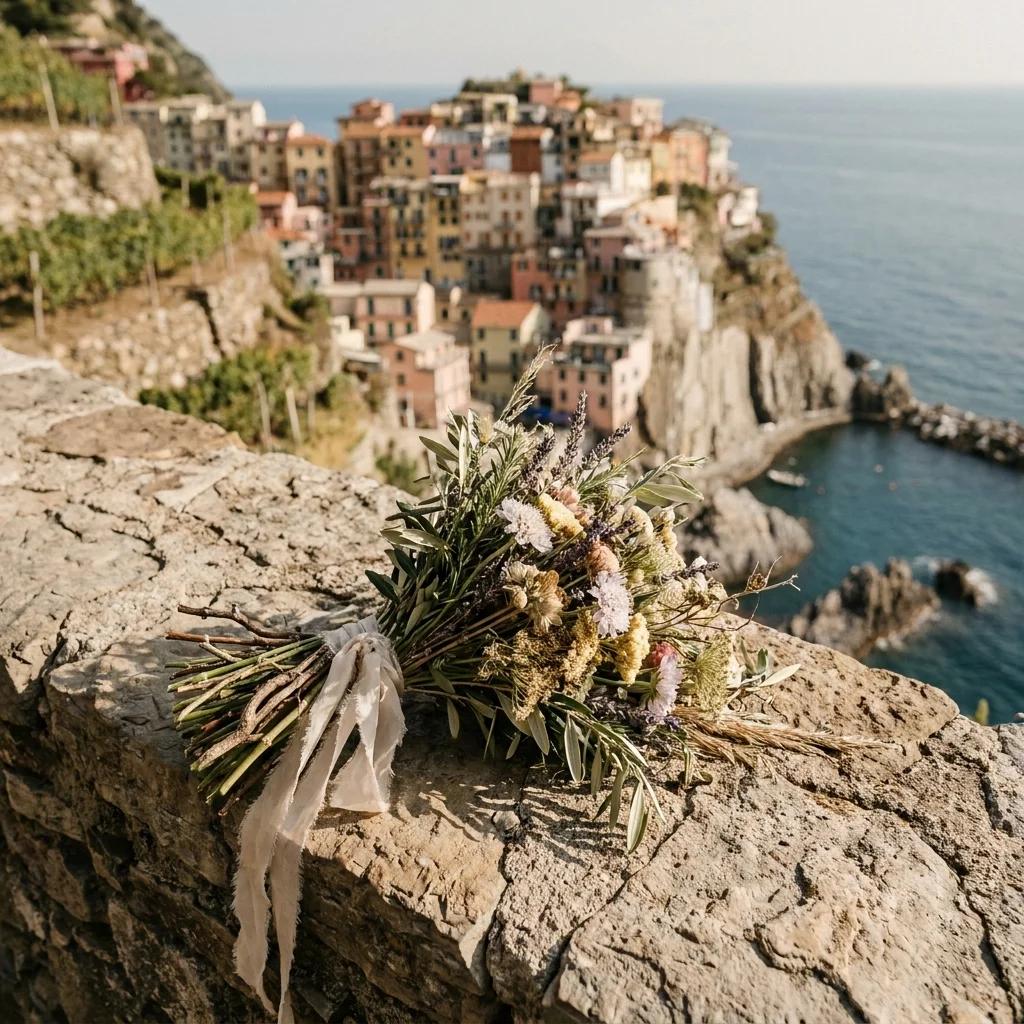
The elopements we are proudest of are built around two quiet windows: the ninety minutes after sunrise, and the two hours before dusk. Between them, the day slows deliberately.
A typical structure begins with hair and make-up in your accommodation, then a private car to the ceremony access point while the villages are still waking. The symbolic ceremony runs thirty to forty minutes — vows, a ritual chosen with you, a witness or two if you have brought them. Then portraits on the terraces while the lanes are still empty, a long lunch of anchovies and Sciacchetrà somewhere with a sea view, several unhurried hours of rest, and a return to the water for the final light. The day ends with dinner for two, not with a schedule.
Our coordinator is present throughout and invisible in every frame. She holds the train times, the celebrant, the florist’s delivery slot, the boat’s departure and the restaurant’s table in one hand. This is what distinguishes a curated Cinque Terre elopement from a self-navigated one: the transitions are governed, so the hours in between feel entirely yours. If you would like us to sketch a sequence around your own arrival dates, our team will prepare an itinerary proposal before any supplier is engaged. Couples wanting a slightly larger version of the same choreography, with a handful of guests, will find the framework in our guide to a micro wedding in Italy.
Photography and Film When Every Piece of Equipment Travels by Train and on Foot
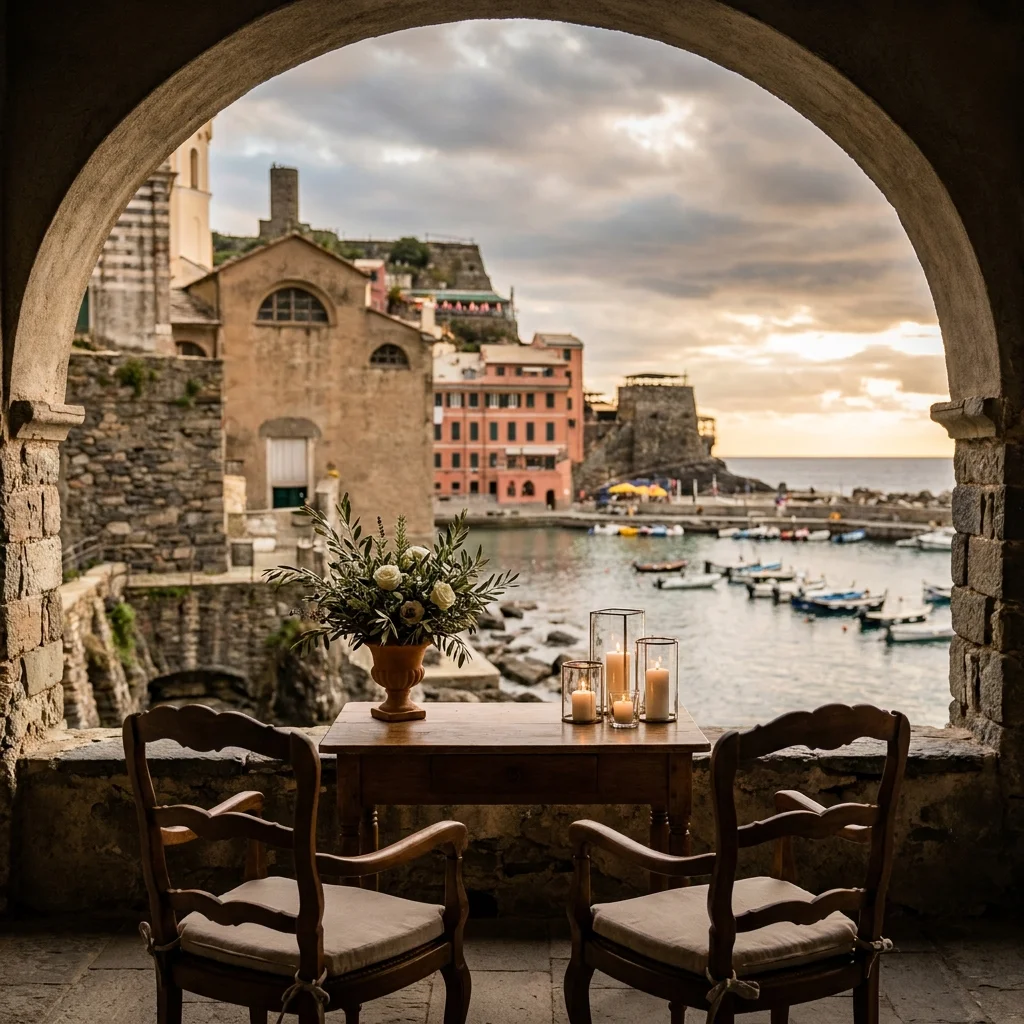
Here the terrain dictates the crew size. A photographer working the Cinque Terre carries only what can be moved comfortably on foot: two bodies, three primes, no lighting stands on a cobbled ravine. We brief accordingly and we build backup locations into the shot list, because a closed footpath or a crowded harbour front cannot be argued with on the day.
Light behaves specifically here. Monterosso and Vernazza face broadly north-west and hold warm evening light on the buildings; Manarola’s western headland delivers the celebrated final glow; Riomaggiore loses direct sun earlier because of its ravine. We schedule the village, not merely the hour. Our standards for imagery on this coast are set out in our guide to working with a wedding photographer in Italy, and the broader coastal approach in our notes on Italian Riviera wedding flowers feeds directly into how bouquets are built to photograph in salt wind.
| Creative service | Indicative range | Included | Quoted separately |
|---|---|---|---|
| Photography, elopement coverage | €1,800–€4,800 | Three to six hours, single photographer, travel within Liguria, colour-graded gallery delivered in four to six weeks | Second shooter, printed album, drone operation, additional hours, overnight accommodation for early sunrise starts |
| Film, short-form edit | €2,200–€5,500 | Single operator, ceremony and portrait coverage, three to five minute edited film, licensed music | Second operator, drone, full-length documentary edit, same-day teaser, travel outside Liguria |
| Floral design for two | €350–€1,200 | Bridal bouquet and buttonhole in seasonal Ligurian stems, delivery to your accommodation or ceremony point | Ceremony arch or installation, boat styling, table flowers, porterage on stepped access routes |
| Private dinner for two | €120–€280 per person | Set menu, table with sea view, service | Wine pairing beyond the house selection, private room supplement, chef at a private villa, table styling |
Indicative ranges. Contact Kiss Me Italy for a personalized proposal.
Sciacchetrà, Anchovies and a Table Set for Two People Only
The culinary identity of this coast is narrow and superb. Salted anchovies from Monterosso al Mare, basil grown on the terraces for pesto, lemon-cured fish, and Sciacchetrà — the passito made from grapes dried on these same vineyard walls, a prized passito rooted in the terraces of the Cinque Terre.
For a table of two, we build menus around what the boats brought in that morning. We book the table, agree the menu in advance and confirm the wine the week before, so that nothing about dinner requires a decision from you on your wedding day. Where accommodation cannot host a private dinner, we arrange a chef or a reserved terrace elsewhere. Ideas across the regional repertoire are gathered in our collection of Italian wedding menu ideas, and the design language of a small coastal table is explored in our guide to the Italian Riviera tablescape.
What Happens When the Sea Turns: Our Contingency Architecture
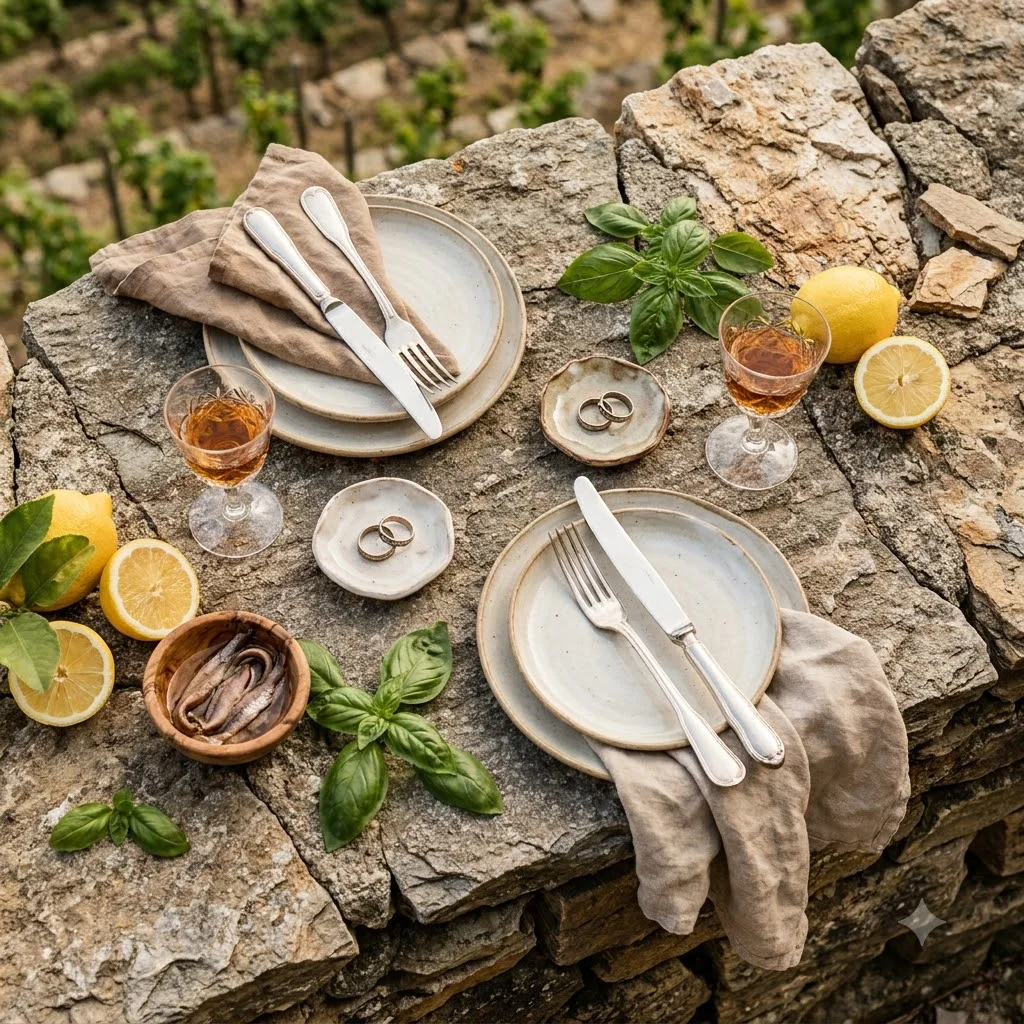
Weather on this coast changes with the afternoon. Our proposals therefore contain two locations for every outdoor moment, not one, and a defined decision point — usually the evening before, reviewed again three hours ahead. You are informed of the decision; you are never asked to make it.
If a boat transfer cannot operate safely, the ceremony moves to a sheltered terrace or an interior of comparable character, with the same celebrant and the same floral design already on site. If a footpath is closed, portraits relocate to a pre-scouted alternative in the same light. If a train service is disrupted, our coordinator switches to road transfer through the inland route, which adds distance but restores control. Should a legal ceremony slot be affected by a municipal closure, the symbolic celebration proceeds on the day and the civil formality is rescheduled within your stay. This is the discipline behind every Cinque Terre elopement we produce, and it is the reason couples engage a luxury wedding planner in Italy rather than assembling suppliers individually.
Extending the Day Into a Wider Ligurian Stay
Two people who have travelled from Boston or San Francisco rarely want a single afternoon. We frequently frame the elopement as the centre of a five- to seven-night arc along the coast, moving west with the light. The bay of the Abbazia di San Fruttuoso, a tenth-century Benedictine foundation reachable only by boat or footpath, makes an extraordinary second act, described in detail in our guide to a San Fruttuoso wedding.
Further west, the promontory offers the sixteenth-century Genoese fortress of Castello Brown above the harbour of a village whose architectural grammar has barely altered since the Republic; our overview of a wedding in Portofino covers that setting fully. The bay of Camogli offers a quieter register, while Santa Margherita Ligure provides the most comfortable hotel base for couples who want level ground and a short boat ride to everything else. Arrivals through the port city itself are addressed in our guide to a Genoa wedding, and the full regional picture in our Wedding Liguria collection. For couples who prefer one address for the entire stay, our notes on a wedding in Italy with accommodation explain how exclusive-use properties work along this coast.
How Our Team Takes This On
A Cinque Terre elopement looks spontaneous and is not. It is a small production with a large number of dependencies — a comune calendar, a railway timetable, a sea state, a celebrant, a florist’s delivery route and a photographer walking with everything he owns. Our role is to hold all of it so that the two of you hold nothing.
We begin with a conversation about dates, then confirm what is genuinely available before showing you a single image. From there we design the sequence, engage the suppliers, obtain the permissions and travel with you on the day. Our wider elopement philosophy is set out in our guide to eloping in Italy, and if the Cinque Terre is where you have already decided to marry, we would be glad to hear from you and start building the day around your arrival.
Frequently Asked Questions
Can we bring a photographer or videographer from our home country while Kiss Me Italy coordinates the local team?
Yes, and it happens regularly. We brief your travelling photographer on access routes, permit conditions, train timings and the light windows for each village, and we position our local team around their working method rather than in competition with him. Any additional shooting permissions required for a non-resident professional are obtained by our office.
In what language is the ceremony conducted, and can it be adapted for our guests?
A symbolic ceremony can be conducted in English, Italian or bilingually, with the celebrant’s script written specifically for the two of you. A civil ceremony is conducted in Italian by law, and interpretation is arranged according to the requirements confirmed with the chosen comune. Either way, we agree the language and register of the ceremony with you well before the day itself.
What happens to the bouquet and floral pieces after the ceremony?
We can arrange for the bouquet to travel with you for evening portraits, then have it delivered back to your accommodation or preserved through a specialist florist if you would like to keep it. Buttonholes and any ceremony floral pieces are collected by our team so nothing is left behind on a terrace or in a boat.
How do you protect our privacy during the busier summer months?
We schedule the ceremony and key portrait moments around the villages’ quieter hours, choose vantage points away from the main pedestrian flow, and brief our suppliers to work discreetly. Where a setting cannot guarantee privacy at a given time, we propose an alternative location or a different part of the day instead.
How long does it take to receive our legal marriage certificate after the ceremony?
Timelines depend on the comune and on whether documents require further legalisation for use in your home country. We confirm the expected issuing and delivery schedule with the relevant registry office as part of your written proposal, so you know when to expect the certificate before you travel.
How is our accommodation check-in coordinated with the wedding-day schedule?
Our coordinator liaises directly with your accommodation on arrival timing, luggage handling and any early access needed for hair, make-up or dressing before the ceremony. Where check-in falls close to the ceremony window, we sequence the day so that neither the property nor your own preparation time is compressed.
How are deposits and cancellation terms handled when several local suppliers are involved?
Your proposal identifies the contracting and payment structure clearly, with Kiss Me Italy remaining your central point of coordination and accountability throughout. Each supplier’s own cancellation window is disclosed in the proposal, and we time the payment calendar so that the least flexible commitments are confirmed last wherever possible.
Can children attend an elopement planned around steep paths and boat transfers?
Children are welcome, and their presence changes the routing rather than the plan. We favour Monterosso al Mare or Portovenere for families, keep walking distances short, and arrange a car to wait at the access point rather than asking anyone to manage staircases in ceremony dress. Life jackets for minors are confirmed with the skipper in advance.
Can we include a religious blessing in addition to a legally binding ceremony?
In most cases yes, though it depends on the parish and on your own denomination and documentation. We approach the relevant church directly, establish what certificates are required from your home parish, and schedule the blessing separately from the civil formality so that neither compresses the other.
Do we need witnesses if nobody is travelling with us?
A civil ceremony in Italy requires two witnesses over eighteen; a symbolic ceremony does not. When couples travel alone, our team can arrange two suitable adult witnesses and submit their details according to the chosen comune’s current requirements.