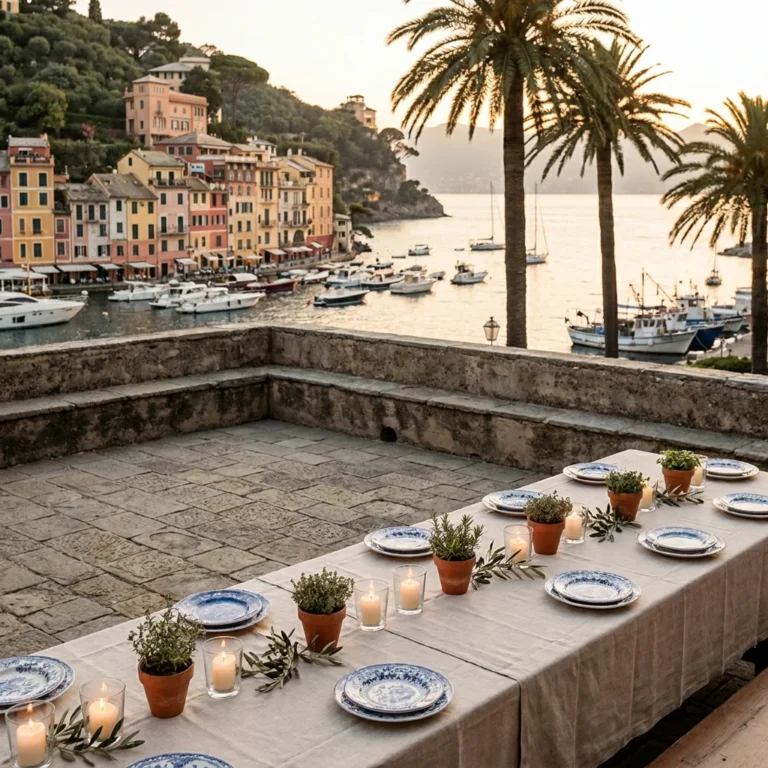
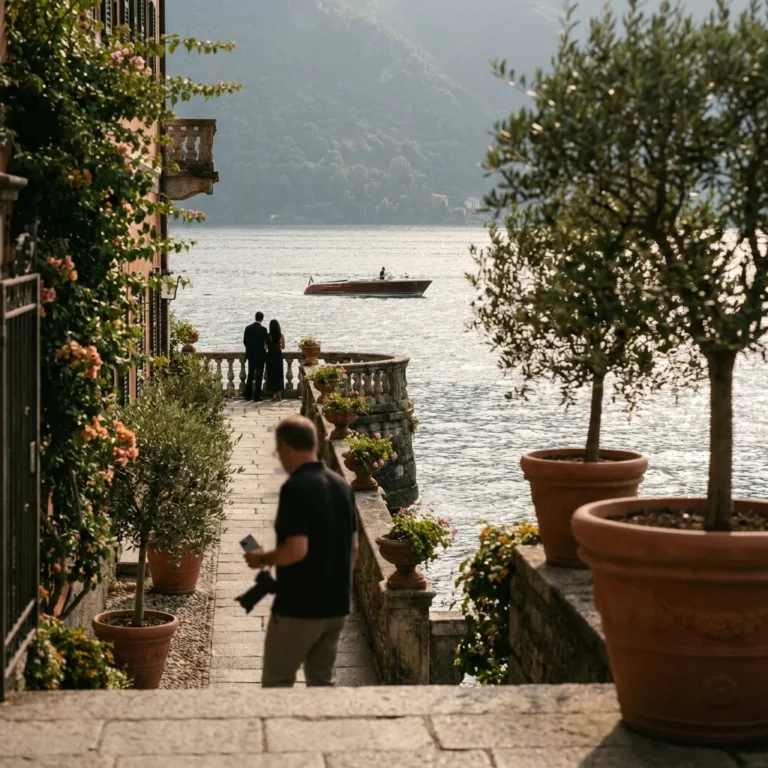
Lake Garda Wedding Season
Nine times out of ten, the first question a couple asks me is not about venues. It is about the date. And on Lake Garda the date is not a matter of taste — it decides which shore works, what hour the ceremony can start, whether the boat transfer is realistic, and how much of the lake belongs to your guests rather than to the summer holiday traffic from Munich and Innsbruck. Over the past thirty years I have watched couples fall in love with a terrace in a photograph taken in late September and then request the second week of August, which is an entirely different lake.
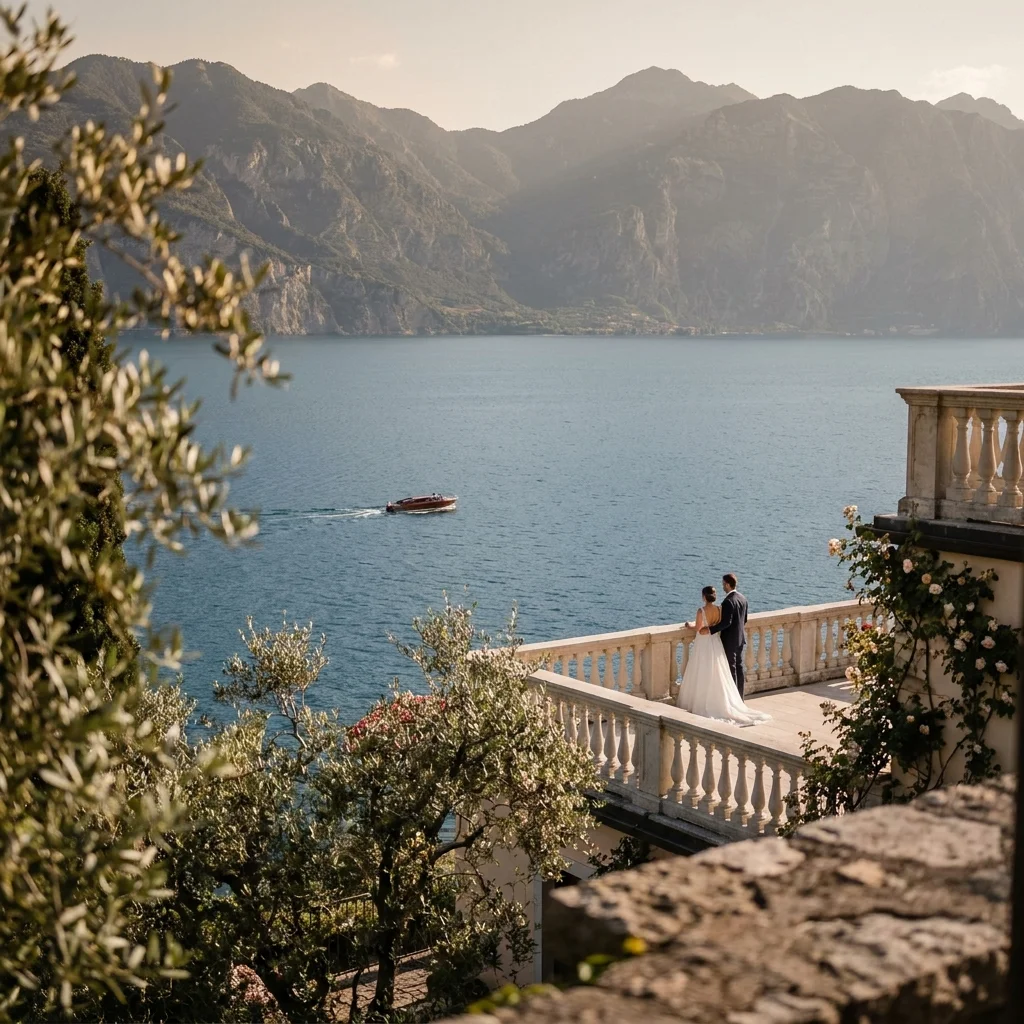
The Lake Garda wedding season runs from late April to mid-October, with mid-May to mid-June and the second half of September offering the most reliable balance of stable weather, comfortable temperatures and manageable crowds. July and August are the warmest and busiest months, shaped by German, Austrian and Dutch school holidays that fill the shoreline hotels and ferries. Late September typically delivers daytime highs of 24–26°C, softer light, and considerably less pressure on accommodation and private boat availability.
What follows is not a calendar of Italy. It is the calendar of one lake, with its own winds, its own microclimate and its own high season. For the wider picture of venues, legal routes and costs on the lake, our full overview of a wedding in Lake Garda, Italy sits alongside this guide, and Kiss Me Italy coordinates every one of the seasonal variables described below. See also: what a Lake Garda wedding costs.
The Recommendation I Give First: Mid-May to Mid-June, or the Second Half of September
I prefer to open with the answer rather than build up to it. If a couple gives me no constraints beyond “the best possible day”, I propose the window between roughly 15 May and 15 June, or the fortnight after 15 September. Those weeks give us long evenings, water temperatures that make boat arrivals pleasant rather than bracing, olive groves and vineyards in full leaf, and — critically — venues that are still willing to negotiate exclusive use rather than defending their peak-season occupancy.
May and early June are the greener months. The Bardolino hills are still bright, the wisteria on the older lakeside properties is at its height in the first half of May, and the northern basin has not yet reached its summer wind pattern. Late September is the warmer, quieter, more golden option. The lake holds heat well into autumn, and after the third week of September the shoreline towns exhale.
The difference matters less than the couple’s own priorities. Guests travelling with small children usually do better in June. Couples who want a long outdoor dinner without artificial cooling do better in September. In our experience the best month for a Lake Garda wedding is the one that protects the specific thing you are least willing to compromise — and identifying that thing is the first conversation we have, not the last. If you would like to test your preferred window against real availability, our team is happy to review it with you through a direct enquiry.
North, South, East, West: Four Lakes Pretending to Be One
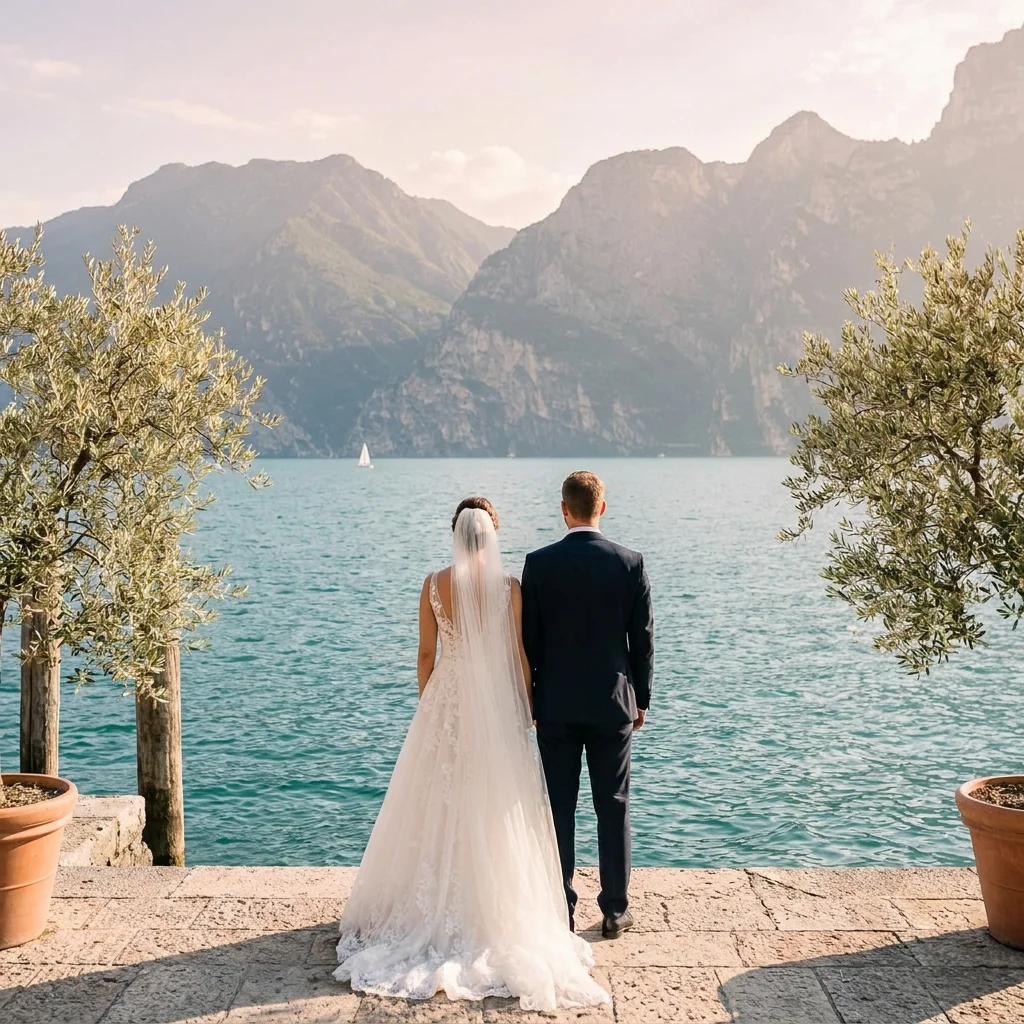
Lake Garda is 51 kilometres long. Treating it as a single climate is the most common error I see in generic destination advice, and it leads couples to book the wrong shore for the wrong month.
The northern basin — Riva del Garda, Torbole, Limone — is a narrow fjord walled by cliffs. It is cooler, dramatically beautiful, and windy by design; it is the reason the lake is a world capital of sailing and windsurfing. Ceremonies there in May can be several degrees cooler than in the south, and afternoon gusts are a working constraint, not an occasional inconvenience.
The southern basin — Sirmione, Desenzano, Peschiera, and the moraine hills behind them — is broad, open and Mediterranean in feel. It warms first in spring and holds humidity in July and August. This is where the season starts earliest and where midday heat is most noticeable.
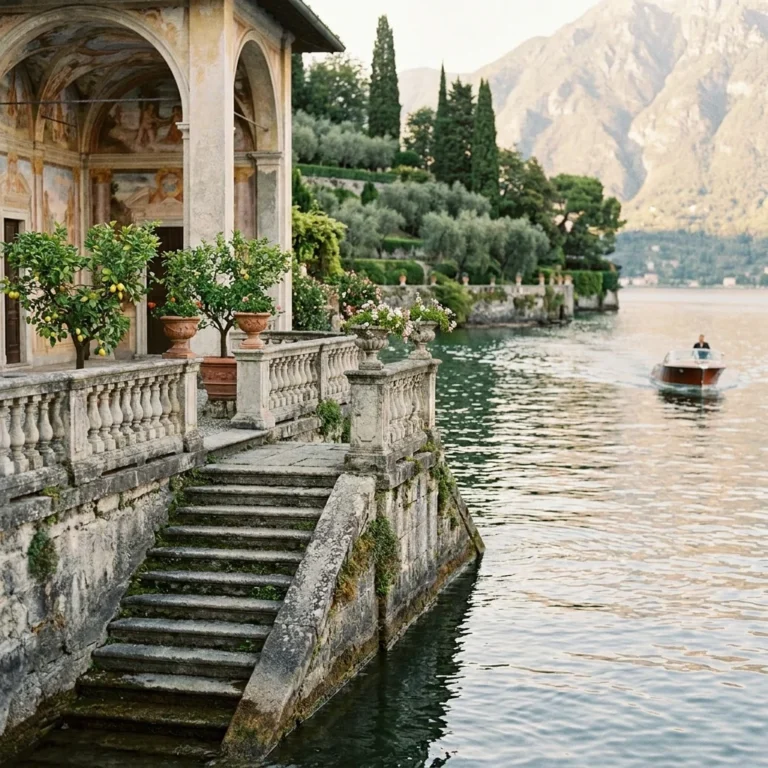
The eastern shore, on the Verona side, faces west across the water. Sunset happens over the lake, which is why so many of the most photographed dinners on Garda are staged there. Monte Baldo rises behind, so morning sun arrives later. The western shore, the Riviera dei Limoni, faces east: exquisite morning light, sunrise over the mountain ridge — and terraces that fall into shadow noticeably before the official sunset time, sometimes forty minutes before it in late September.
We map the shore to the month, not the other way around. A late-September dinner on a west-facing eastern-shore terrace and a June ceremony in the shaded hills above Garda are two completely different production plans, and our team handles the timing of each accordingly.
The Ora and the Peler: The Two Winds That Set Your Ceremony Hour
This is the part of the Lake Garda wedding season that almost no international guide explains, and it is the part that most affects how a day actually feels.
The Peler (also called the Vento or the Sover) is the northerly. It blows down the lake from the small hours until mid-morning, strongest in the northern basin, and it is the reason a 10am boat crossing in the north can be lively while an 11.30am crossing is calm. The Ora del Garda is the southerly. It rises in the early afternoon, usually somewhere between one and three o’clock, and blows until close to sunset. It is remarkably regular from spring through to September, and it strengthens as it travels north.
What this means in practice: a 2.30pm outdoor ceremony in the northern half of the lake in June is a ceremony held in wind. Veils, orders of service, lightweight table runners, unweighted floral structures — all of them respond to it. We therefore build the ceremony hour around the Ora rather than around a photograph someone saw online. In peak season we favour ceremonies from 4.30pm onward, when the southerly begins to soften, or late-morning ceremonies followed by a long lunch. In October the Ora is weaker and less predictable, which changes the calculation again.
What most planners miss is that the wind pattern also governs private navigation. Skippers on the lake cancel for wind, not for rain, and the operational decision is usually taken on the morning of the transfer. We contract boats with a written wind protocol and a land-based alternative already timed to the minute.
What the Averages Say — and What We Never Promise
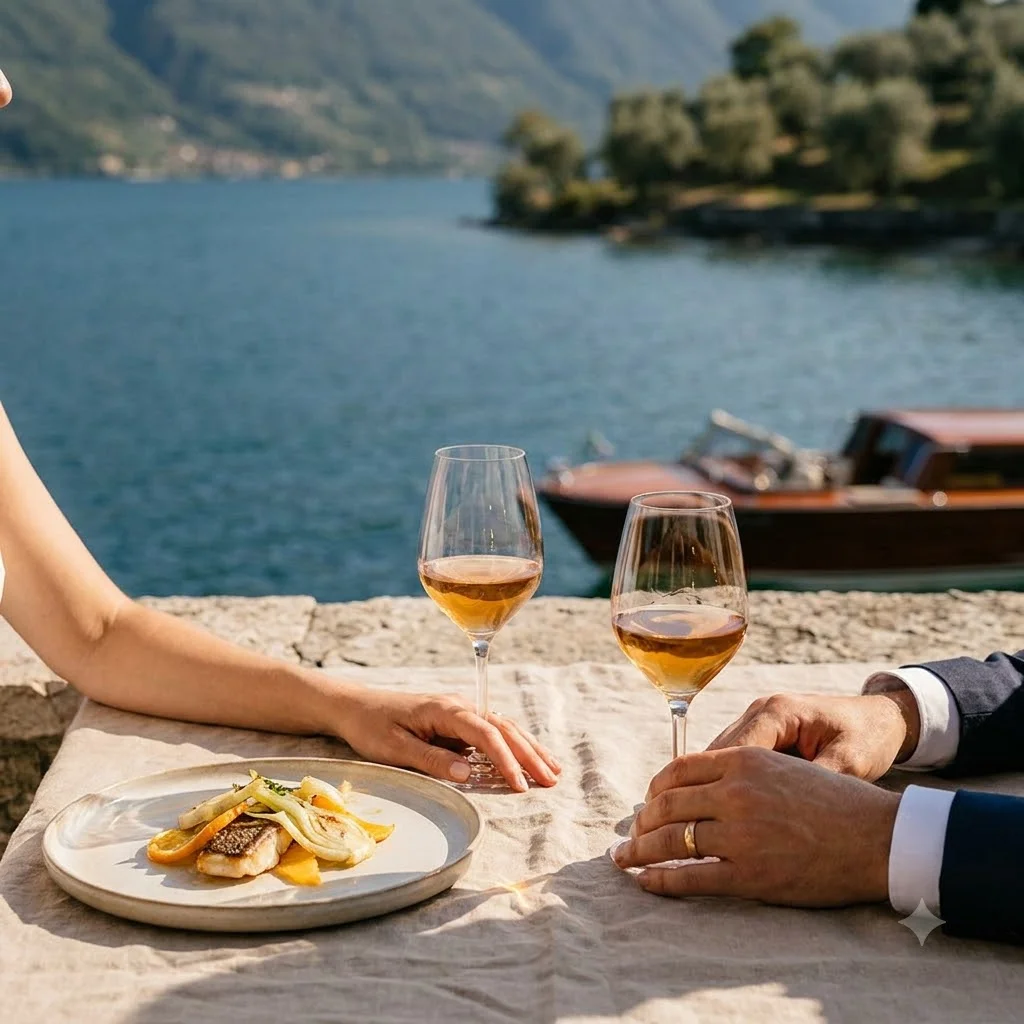
Historical averages are useful. They are not forecasts, and I have never in thirty years offered a couple a guarantee about a single day’s weather.
Typical daytime highs around the lake sit near 21–24°C in May, 26–28°C in June, 29–32°C in July and August with real humidity in the southern basin, 24–26°C in early September, around 20–22°C by early October. Spring brings the highest probability of short, sharp afternoon thunderstorms, particularly in late May and early June; these often clear within an hour, which is precisely why our timelines are built with an hour of elasticity rather than a rigid minute-by-minute plan. Autumn rain, when it comes, tends to be more persistent and less theatrical.
We treat every published climate figure as historical context and every venue’s outdoor-season claim as something to be verified in writing. Before a contract is signed, our team confirms three things directly with the property: the covered alternative and its true seated capacity, the point in the day at which the decision to move indoors is taken, and whether that decision carries a cost. Those three answers are worth more than any average temperature table.
August on Garda Is Not the Same as August Elsewhere in Italy
Couples arriving from the United States or the United Kingdom often assume that August in Italy means empty cities and closed businesses. On Lake Garda the opposite is true, and it catches people out.
Garda is the most visited lake in Italy and its dominant international market is German-speaking. Bavarian and Austrian school holidays, together with the Pentecost break in late May or early June, produce genuine occupancy spikes that have nothing to do with the Italian calendar. Add Ferragosto in mid-August, and the shoreline roads between Garda and Malcesine can move slowly at exactly the hours you want guests arriving. Ferry timetables are at their fullest but also at their busiest, and the better hotels apply minimum-stay requirements.
None of this makes August impossible. It makes August expensive and logistically dense. When couples are committed to those weeks — usually because of professional calendars — we move the entire structure of the day: ceremonies after 5pm, guest accommodation blocked in the quieter hill properties behind the shoreline rather than on it, private transfers instead of public navigation, and dinner service that begins as the heat leaves the terrace. Managing a Lake Garda wedding season in high summer is entirely feasible. It is simply a different discipline. More in our guide: summer weddings in Italy.
Venue Operations Change Month by Month, and So Does What “Exclusive Use” Really Buys
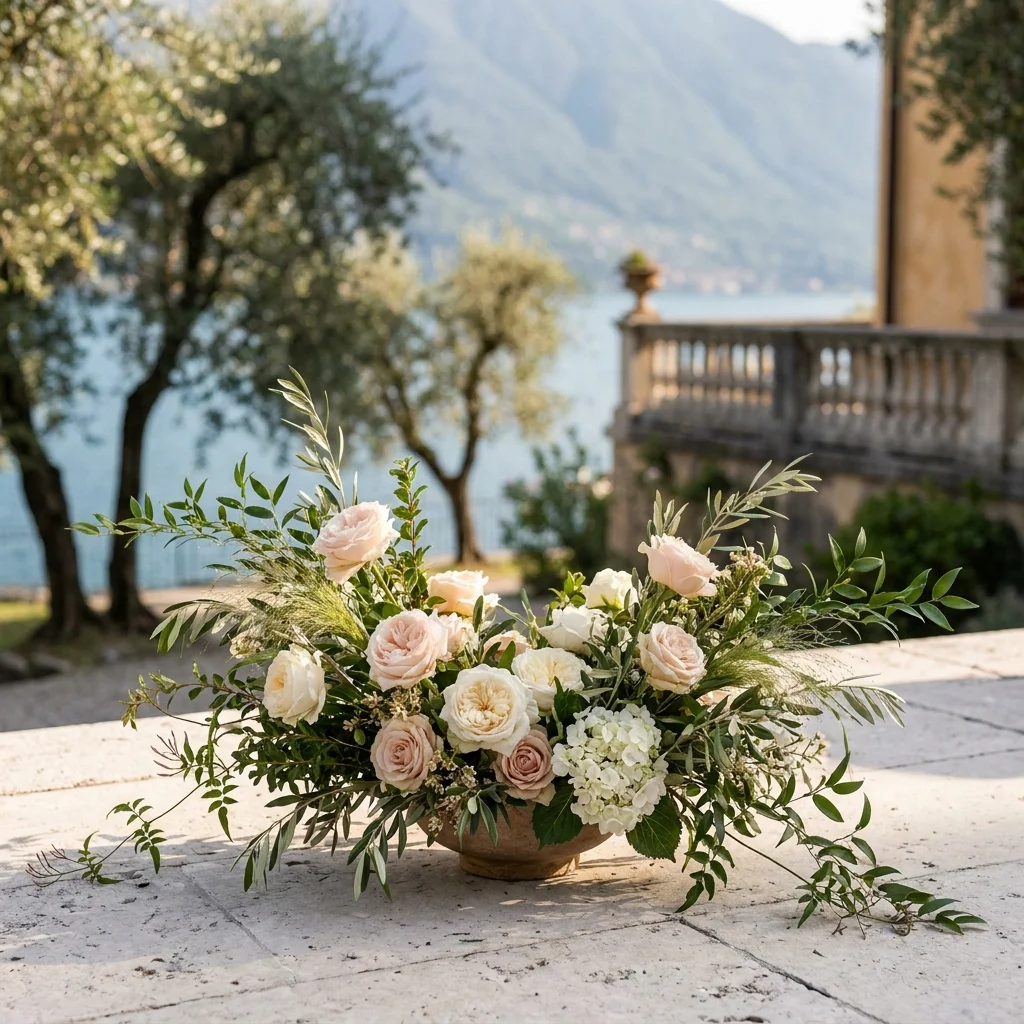
Season determines availability, but it also determines what a venue is actually able to give you.
Between late April and early October, most of the significant properties on the lake operate their full outdoor programme. Outside that window, terraces close, kitchens reduce, and exclusive use becomes cheaper but less complete. Historic municipal settings behave differently again: several lakeside comuni authorise civil ceremonies in their scenic locations only within a defined seasonal calendar, which is why a spring ceremony inside a castle courtyard on the eastern shore and a February one are not the same request at all.
Private estates give the most freedom. A private vineyard estate in the Bardolino hills, a short drive inland from the eastern shore, is the property we return to most often for two-day celebrations, precisely because its forty-one rooms allow the guest experience to be contained rather than scattered across five hotels. The island estate in the western bay and the great terraced hotel gardens above Sirmione are equally seasonal in their operation, and each publishes its own outdoor-season dates.
Booking rhythm follows the same logic. For May, June and September dates, we secure the leading properties twelve to eighteen months ahead; for October and April, six to nine months is often sufficient. Couples who want their guests sleeping where they celebrate will find our guidance on a wedding in Italy with accommodation a useful companion to this section, and those weighing estate options more broadly can review how we approach a villa wedding in Italy. Our team verifies outdoor-season dates, curfew hours and covered capacity in writing before any deposit is discussed.
The Menu Follows the Lake’s Calendar: Lavarello in June, Truffle and Radicchio in October
Garda cooking is genuinely its own thing — neither Venetian nor Milanese — and the season shows on the plate more honestly here than in many Italian regions.
In late spring we work with lake fish: coregone and lavarello from the deep water, carpione, pike served the local way with polenta. Asparagus from the moraine flats and the first courgette flowers appear in May. June brings peaches and apricots from the eastern hills. By September the emphasis shifts entirely — Bardolino and Valpolicella grapes are being picked, the new olive oil from the Riviera dei Limoni presses in late October, and radicchio, pumpkin and porcini arrive. A May menu and a September menu at the same estate should not read alike, and when they do, someone has stopped paying attention.
Season also affects service format. In July and August we lean toward extended aperitivi in the shade and later, lighter dinners; in late September a long seated dinner with heavier plates and a local red is a pleasure rather than an endurance test. Couples exploring regional direction will find our thinking in Italian wedding menu ideas and in our wider piece on Italian wedding food genuinely useful before the tasting.
Two practical notes on guest experience. Language support is particularly important on Garda because many local suppliers work in German as well as Italian and English — a good share of local suppliers work fluently in German as well as English, and we place bilingual staff at reception and at the ceremony when the guest list requires it. And favours travel: in autumn we send guests home with new-pressed oil from an eastern-shore mill or a bottle from the harvest they watched being picked, which is a more honest souvenir than anything bought in a shop.
Floral Design and the Growing Calendar Nobody Prints in a Catalogue
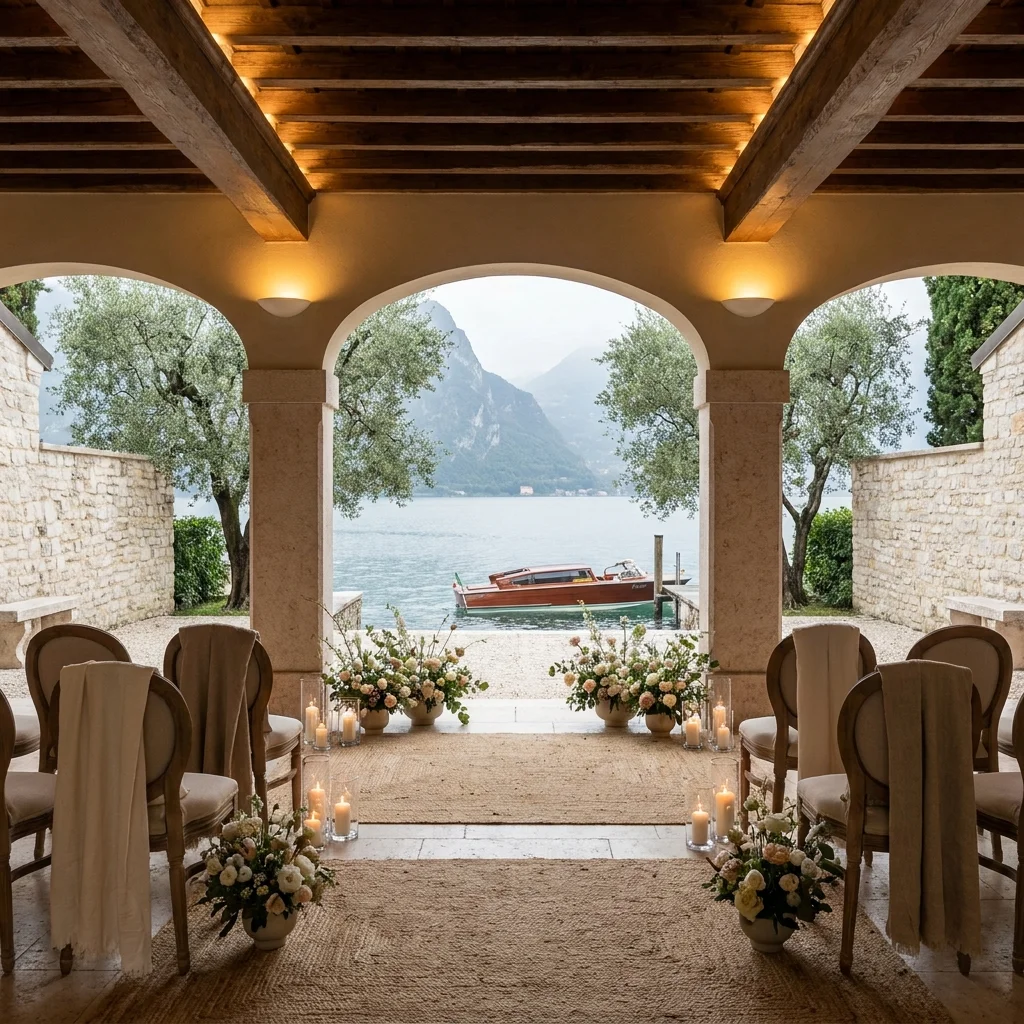
The lake’s Mediterranean microclimate — olives, cypress, citrus and oleander at forty-five degrees north — is a gift to floral design and a trap for couples working from an inspiration board built in another hemisphere.
Peonies are a May and very early June flower here, and by the third week of June they are imported at a premium with a shorter vase life in warm rooms. Garden roses perform beautifully from late May through September. In high summer we design with structure and foliage — olive, myrtle, ruscus, jasmine — because delicate blooms are working against both the heat and the afternoon Ora. September and October give dahlias, hydrangea in its aged tones, grasses and vine.
Wind is the second design constraint, and it is seasonal. Elevated arrangements and free-standing installations on an exposed terrace in June are engineered differently from the same scheme in October. We specify weighted bases and low-profile arrangements for wind-exposed months, and we hold installation to the latest workable hour so that nothing sits in the sun for four hours before guests see it.
A 9pm June Sunset and a 7.20pm September One Are Two Different Wedding Timelines
This is where the Lake Garda wedding season stops being a matter of comfort and becomes a matter of hours on a schedule.
Around the summer solstice the sun sets close to 9pm local time; by mid-September it is near 7.30pm, and by the end of the month closer to 7.05pm. Subtract the mountain effect: on the western shore, direct sun leaves the shoreline well before the published sunset, and on the eastern shore the last light lingers on the water while the terrace itself is already in soft shade. A June couple can hold their portraits until 8pm and still eat at a civilised hour. A late-September couple cannot.
So the timeline inverts. In September we frequently place the ceremony at 4pm and the aperitivo immediately after, stealing the couple away for twenty-five minutes at 6.45pm while guests are still occupied. In June the same twenty-five minutes lands at 8.15pm. Blue hour — that period of even, cool light over the water that photographs so well from a boat — arrives roughly forty minutes after sunset in both cases, and it is the single most-requested image we deliver on this lake.
We brief the photographic team on shore orientation, sunset time and the wind forecast the day before, every time. Couples selecting coverage may find our overview of working with a wedding photographer in Italy helpful, and those planning social-first content will recognise the coordination described in our piece on the role of a wedding content creator during a compressed autumn timeline.
The Legal Calendar Is Not Seasonal — But the Town Hall Is
A short, direct section, because this part rewards precision rather than atmosphere.
Civil ceremony documentation for foreign nationals follows the same national procedure whatever the month. What changes seasonally is capacity. Lakeside town halls handle a heavy volume of foreign files between May and September, and appointment slots for the sworn declaration are finite. August staffing is reduced. We open municipal files six to eight months before the date and we confirm the appointment before the guest list is printed.
Three points worth knowing. Some scenic municipal locations are licensed only within a stated seasonal window. Saturday afternoon slots in the most requested comuni are the first to close. And a religious or symbolic route removes the town-hall constraint entirely, which occasionally makes an October date feasible where a civil one is not.
Our team manages the file end to end. The framework is set out in our guides to getting legally married in Italy as a foreigner, to the different wedding ceremony types in Italy, and to what a courthouse wedding in Italy actually involves. For symbolic ceremonies we also curate the voice that leads them, as described in our approach to selecting a wedding officiant in Italy.
Where the Season Actually Moves the Number — and Where It Does Not
Couples often assume that choosing September over June cuts the budget substantially. It does not, and I would rather say so plainly.
Season moves accommodation, boat charter and, to a degree, venue hire. It does not move catering, floral labour, photography or production. The real saving in a shoulder-season date is negotiating room: a property with an unsold October weekend will discuss exclusive use in terms it would never entertain for the second Saturday in June. That is where the value sits — in leverage, not in list prices.
| Collection | Investment (EUR) | Included | Quoted separately |
|---|---|---|---|
| A Private Vineyard Estate Wedding — Lake Garda | €109,000 | Two-day celebration with the estate in exclusive use; 41 rooms for two nights with breakfast; pre-wedding day with dinner; wedding day ceremony, aperitivo and reception dinner; full planning, design direction and on-site coordination by our team, according to the published collection specification | Only items outside the published collection specification, together with bespoke programme extensions and third-party municipal or legal charges where applicable. The linked product page and written proposal confirm the final inclusions, exclusions and IVA treatment before booking. |
Published collection price. The linked product page and written proposal confirm the current guest configuration and inclusions. Contact Kiss Me Italy for a personalized proposal.
Third-party items sit outside any collection and vary by comune, by supplier and, in the case of navigation, by season. The figures below reflect written supplier quotations held by our office and are reviewed each season.
| Item | Indicative range (EUR) | What is included | What is quoted separately |
|---|---|---|---|
| Civil ceremony fee, lakeside comune (non-residents, external scenic location) | €600–€2,500 | Municipal room or location fee; registrar attendance | Stamp duties, certificate copies, Saturday and public-holiday surcharges; not subject to VAT |
| Sworn translation and legalisation of documents | €90–€250 per document | Certified translation and court sworn statement | Apostille and consular fees; courier; VAT 22% where applicable |
| Ceremony interpreter (English / German / Italian) | €250–€600 | Up to two hours on site; travel within the Verona and Brescia provinces | Rehearsal attendance, full-day guest support, VAT 22% |
| Symbolic ceremony celebrant | €600–€1,500 | Script development, one consultation, ceremony delivery | Travel beyond the lake, rehearsal, VAT 22% |
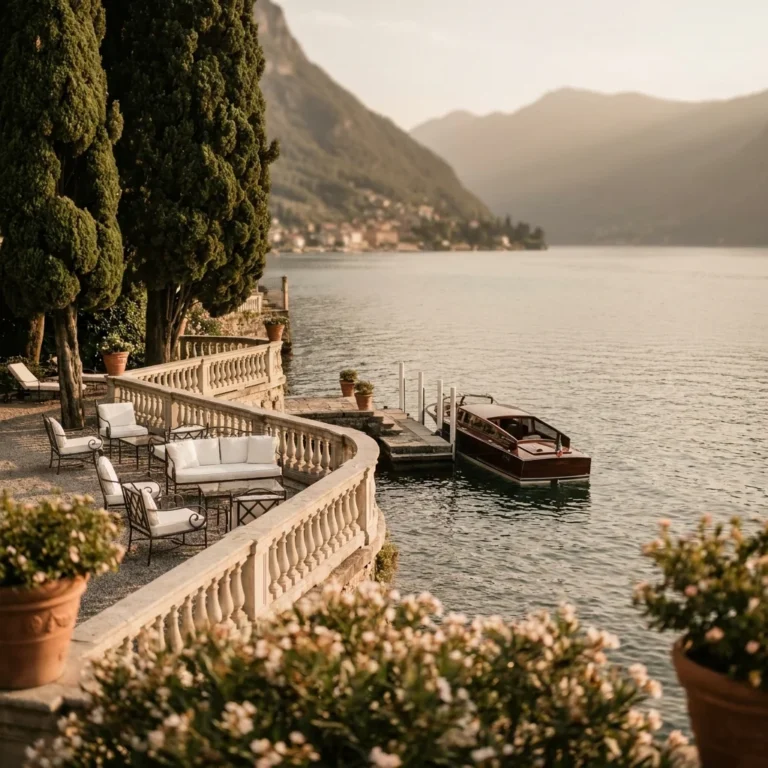
| Private classic wooden launch, 2–3 hours | €900–€2,500 | Skipper, fuel, mooring at agreed pontoons | Additional guest-transfer runs, onboard service, wind-cancellation rebooking, VAT 22% |
| Guest coach transfer, 50 seats (airport or hotel movement) | €700–€1,400 per movement | Driver, fuel, tolls | Waiting time beyond one hour, night surcharge after 00:30, VAT 10% |
| Photography, full-day single shooter | €4,500–€8,500 | Full-day coverage; travel within northern Italy; edited gallery delivered within 6–10 weeks | Second shooter €1,200–€2,000; albums €600–€2,500; rush delivery; accommodation for multi-day coverage; VAT 22% |
| Videography | €4,000–€9,000 | Full-day coverage, highlight film, standard grade | Feature-length edit, drone permits, second operator, VAT 22% |
| Outdoor climate management (misting fans, heaters, treated perimeter) | €600–€2,500 | Equipment, delivery, installation and removal | Generator power where the venue supply is insufficient, VAT 22% |
Indicative ranges only, based on written supplier quotations held by our office. Request a season-specific proposal from our team.
Couples benchmarking across regions before they commit often look at what a wedding in Italy really costs, and some compare the lake against the coast using our analysis of Portofino wedding costs or of Venice wedding costs. The seasonal logic differs in each place. On Garda, the variable that moves most is the room block. We would be glad to build a costed seasonal comparison for your specific guest count.
A Seasonal Decision Matrix for Lake Garda
| Period | Typical daytime high | Wind, light and water | Crowd and price pressure | Best suited to |
|---|---|---|---|---|
| Late April – early May | 18–22°C | Wind still irregular; sunset near 20:20; lake water cold | Low | Intimate celebrations, indoor-leaning plans, strong negotiating position |
| Mid-May – mid-June | 21–28°C | Ora establishes in the afternoon; sunset 20:40–21:00; greenest landscape; occasional sharp thunderstorms | Medium, with a Pentecost spike | Long evenings, garden ceremonies, families with children |
| Late June – July | 28–32°C | Reliable afternoon Ora; sunset near 21:00; warm water, ideal for boats | High | Later ceremonies from 17:00, shaded aperitivi, waterfront dinners |
| August | 29–32°C, humid in the south | Ora strong in the north; sunset 20:40 falling to 20:00 | Peak: German and Austrian holidays, Ferragosto, minimum-stay rules | Couples fixed to these dates, with private transfers and hill accommodation |
| Early September | 24–27°C | Wind softening; sunset near 19:50; warmest water of the year | Medium-high | Boat arrivals, outdoor dinners, harvest-adjacent menus |
| Mid – late September | 22–26°C | Golden low light; sunset 19:30 falling to 19:05; shoreline shade arrives early on the western shore | Medium, easing weekly | Photography-led days, seated dinners, quieter shoreline towns |
| October | 18–22°C | Ora weak and irregular; sunset near 18:40; rain more persistent when it comes | Low | Vineyard settings, new olive oil, indoor-outdoor plans with a strong covered alternative |
Historical typical conditions compiled from our own operational records across the lake. Not a weather guarantee. Our team can prepare a tailored comparison for your dates.
The Contingency We Build Into Every Month, Including August
A backup plan that is announced on the morning of the wedding is not a plan. It is an improvisation, and guests can always tell.
Our contingency is designed at the same time as the primary plan and costed into the same budget line. That means the covered alternative is styled, lit and floral-dressed regardless of whether it is used; that the decision point is written into the schedule — typically four hours before the ceremony for a covered move, and the morning of for a boat transfer; and that the transport substitution is pre-contracted rather than found on the day. Guests never see the switch happen. They see a room that was always meant to look exactly like this, a boat that was always going to be the way they crossed the lake, and a timeline that never once betrays the decision that was quietly made behind it. That, more than any single date on a calendar, is what thirty years on this lake has taught us to protect: not the weather, which nobody controls, but the experience of the day, which we do.
If there is a single principle behind everything in this guide, it is that the Lake Garda wedding season is not one season at all. It is a sequence of overlapping micro-seasons — light, wind, temperature, menu, municipal calendar, guest availability — and the couples who feel most at ease on their wedding day are almost always the ones whose date was chosen to match those variables deliberately, rather than in spite of them. We would be glad to walk through your own priorities and match them to the right weeks on the lake through a direct enquiry with our team.
Frequently Asked Questions
If we hold a date eighteen months out, is the venue price locked?
A courtesy hold does not by itself guarantee a price. The venue fee is governed by the signed contract and the deposit terms agreed for your date. Supplier categories that can vary with the market — such as catering per head, floral stems or boat charter fuel — are adjusted only according to the terms stated in the relevant supplier agreement, with any variance presented in writing before it is confirmed.
Who decides if the Ora is too strong on the day, and when?
The call sits with our on-site producer, made at the morning briefing with the venue’s own operations lead. The threshold is agreed in advance and written into the plan, so nobody is negotiating in the moment: below it the lakeside ceremony proceeds, above it we move to the covered position that has been held in reserve since the contract stage.
Can we hold dates in two different months while we decide?
Most Garda venues allow a courtesy hold on one date at a time, occasionally two for a limited window. We negotiate the second hold where the relationship allows it and tell you plainly when a venue will not — pretending otherwise costs you the date that mattered.
Will our overseas guests struggle with flights outside high season?
Verona, Bergamo and Milan Malpensa all serve the lake and all three run year-round, with reduced frequency rather than closure between November and March. The practical constraint in low season is not the flight but the last connection of the evening, which is why we build guest transfers around arrival times rather than the other way round.
Do the cross-lake ferries run all year?
The main Desenzano–Sirmione–Gardone service operates year-round; the routes serving the northern shore reduce sharply from November and some stop entirely. If your plan depends on guests crossing the lake, we confirm the published timetable for your exact date before it enters the schedule, and we hold road transfers as the alternative.
If we choose March or November, which suppliers are simply closed?
A number of lakeside venues close for maintenance between early November and mid-March, and some restaurants used for welcome dinners close with them. Photographers, florists, celebrants and musicians all work year-round. We give you the confirmed open list for your date rather than a general seasonal impression.
Is wedding weather insurance worth taking on Lake Garda?
It is worth taking when a material part of the budget is exposed to a single outdoor position with no covered equivalent. Where the venue already offers an indoor alternative of comparable quality, the premium usually buys less than the same money spent on a proper covered structure.
How late can we set the ceremony hour relative to sunset?
As a working rule the ceremony should begin two hours and fifteen minutes before sunset, which protects the vows, the portraits and the aperitivo in usable light. Because sunset shifts by nearly ninety minutes between June and late September, the hour is set once your date is fixed, not before.