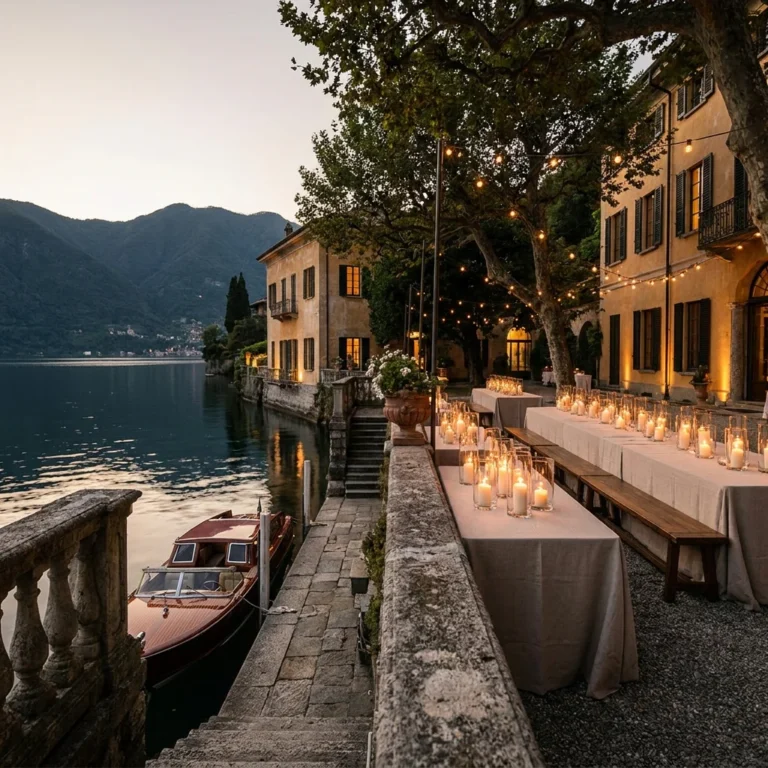
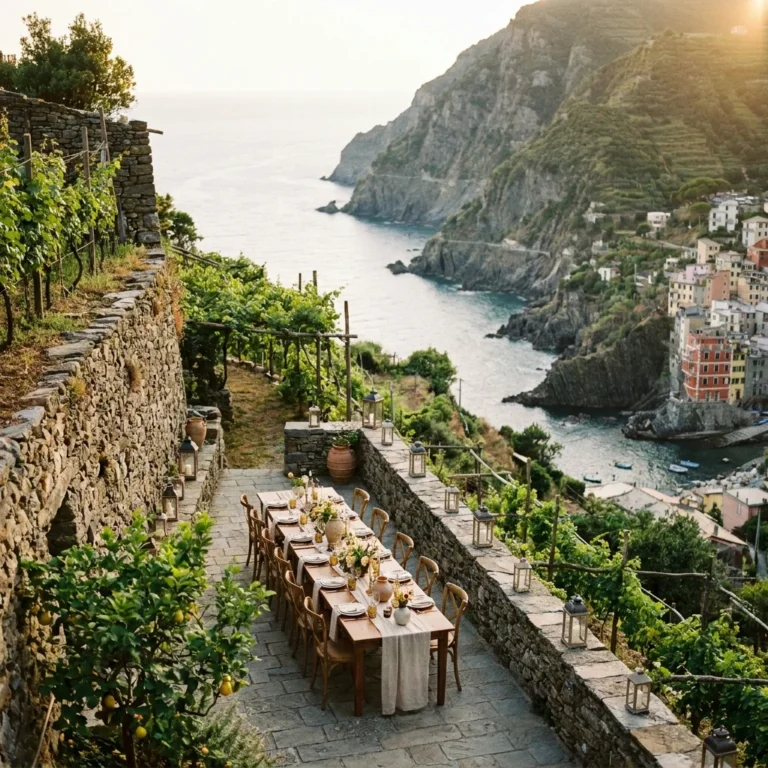
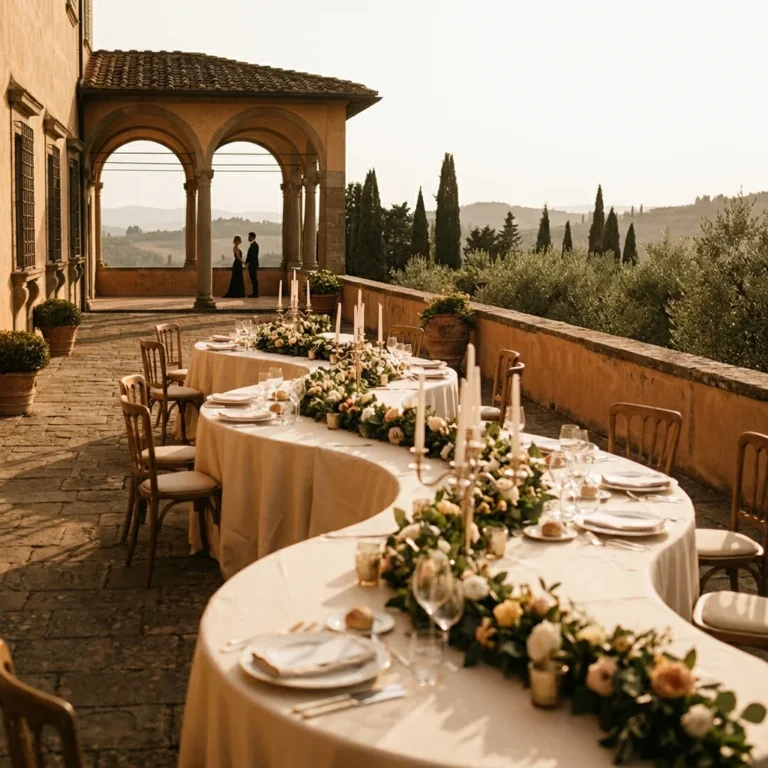
Italy wedding RSVP etiquette requires bilingual invitation wording, a two-phase response timeline (soft RSVP eight to ten weeks before the wedding, final confirmation four to six weeks out), and precise guest list protocols that account for dietary needs, children policies, and plus-one clarity. For destination weddings in Italy, where catering contracts lock final headcounts 21–30 days before the event and transport manifests require confirmed names for private transfers, an accurate RSVP system is not a social formality — it is the mechanism that protects your budget, your venue contract, and every guest’s experience. Read next: how many guests for a destination wedding.
Italy Wedding RSVP Etiquette
Most international couples discover the complexity of Italy wedding RSVP etiquette only after their stationer asks a question they hadn’t considered: should the response card be in English, Italian, or both? At Kiss Me Italy, we manage this process from first draft to final headcount — quietly, precisely, and with the discretion that high-profile celebrations require. The RSVP is not a card. It is a data-collection instrument, a privacy gate, and a guest-experience signal, all at once.
Why RSVP Protocols for Italy Destination Weddings Differ from Domestic Events
A domestic wedding in the United States or United Kingdom operates within a single postal system, a shared language, and a familiar social contract around response timing. An Italy destination wedding does not. Guests are crossing borders. Some hold passports that require Schengen visas with confirmed accommodation addresses. Others need to arrange childcare weeks in advance because the invitation specifies an adults-only reception.
The timeline is compressed on the vendor side and extended on the guest side. Italian caterers typically require a final headcount — not an estimate, a contractual number — between 21 and 30 days before the event. Yet international guests need more time to confirm, not less, because they are booking flights, coordinating travel companions, and often adjusting work schedules across time zones. This tension between early guest confirmation and late vendor deadlines is the central challenge of Italy wedding RSVP etiquette.
We resolve it with a two-track system. A soft RSVP collected eight to ten weeks out establishes intent. A final confirmation, requested four to six weeks before the celebration, locks the number. The interval between the two allows our team to follow up privately with guests who haven’t responded — a task that, when handled by the couple or their families, creates social discomfort. When handled by a planning team, it remains professional and protected.
Couples planning a celebration at an exclusive-use venue in Italy will find that this two-phase approach also protects the venue contract, which often includes minimum-spend clauses tied to confirmed guest numbers.
È Gradita Gentile Conferma, S.V.P., and RSVP: What Italian Invitation Phrases Actually Mean
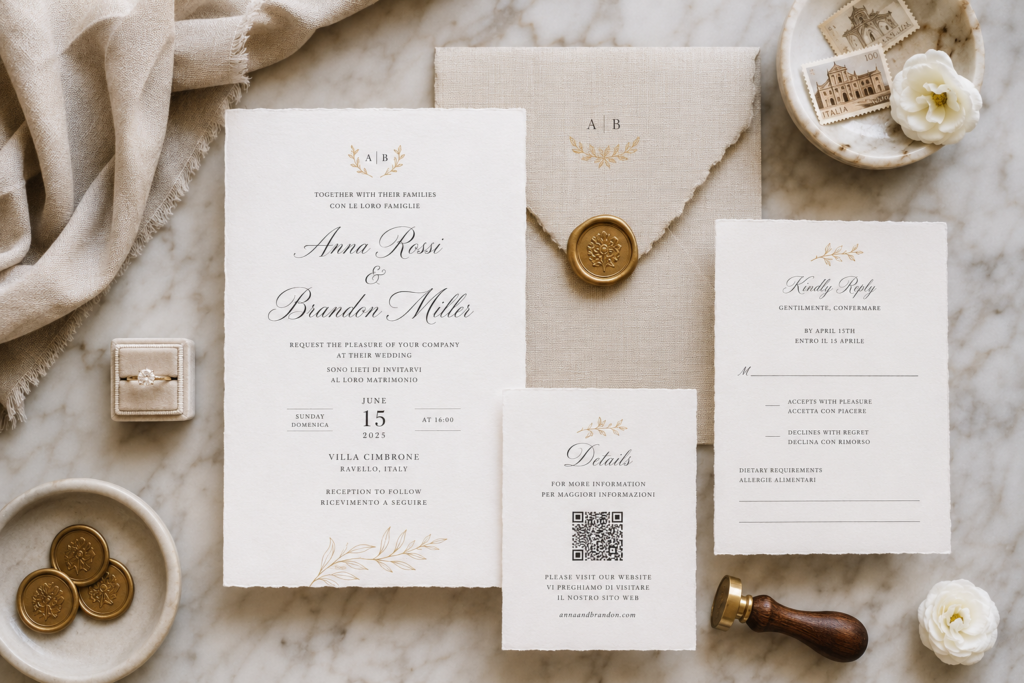
Italian wedding invitations rarely use the English abbreviation “RSVP.” Instead, you will encounter phrases rooted in Italian social convention. Understanding them matters — not because your guests will receive an Italian-language card (most destination wedding invitations are bilingual), but because your Italian vendors, your stationer, and your ceremony officiant may reference them.
“È gradita gentile conferma” translates loosely as “a kind confirmation is appreciated.” It is the standard Italian RSVP phrase, softer in tone than the French-origin “Répondez s’il vous plaît.” It implies expectation without command. For a luxury celebration, this phrasing sets the right register: polished, warm, never transactional.
“S.V.P.” — sometimes written “VSPP” in older Italian stationery — stands for “Si Vuole Prego di Partecipare” or, more commonly in modern usage, simply mirrors the French “S’il Vous Plaît.” In practice, VSPP vs RSVP is a stylistic choice, not a functional one. Both request a response. Our team advises using “RSVP” on the English side of a bilingual card and “È gradita gentile conferma” on the Italian side, ensuring clarity for every recipient.
A note on tone: Italian wedding invitation wording tends toward formality. Where an American invitation might read “Please let us know by June 15,” an Italian equivalent would frame the same request as a gracious wish. We draft and review all invitation language before it goes to print — not to impose a template, but to ensure the wording reflects the couple’s personality while respecting the conventions their Italian and international guests will recognize.
For couples navigating the legal requirements of marrying in Italy as foreigners, the invitation wording may also need to reference the ceremony type, which affects guest expectations around timing and dress code.
The Two-Track RSVP Timeline: Italy-Based Vendors vs. International Guest Lists
Below is the timeline framework we use for destination weddings in Italy. It accounts for the reality that Italian vendor contracts operate on different deadlines than international guest travel planning.
| Milestone | Timing (Before Wedding Day) | What It Triggers |
|---|---|---|
| Save-the-date sent | 10–12 months | Guests begin booking flights and accommodation; no formal RSVP requested yet |
| Formal invitation sent | 12–14 weeks | Includes RSVP card or QR code link; dietary and attendance details requested |
| Soft RSVP deadline | 8–10 weeks | Initial headcount for venue and catering estimates; transport planning begins |
| Follow-up by planning team | 6–8 weeks | Private outreach to non-respondents; dietary confirmations collected |
| Final RSVP deadline | 4–6 weeks | Locked headcount submitted to caterer, florist (table count), and transport provider |
| Vendor contract lock | 21–30 days | Caterer finalizes menu quantities; seating chart confirmed; name-based transport manifest submitted |
Indicative framework. Contact Kiss Me Italy for a personalized timeline based on your venue, season, and guest geography.
The gap between the final RSVP deadline and the vendor contract lock is intentional. It gives our team a buffer to manage last-minute changes — a guest who must cancel due to a visa issue, a couple who adds a companion — without triggering penalty clauses in the catering or venue agreement.
For celebrations on the Amalfi Coast, where road access is limited and private boat transfers require advance booking with named passenger lists, this buffer is not a luxury. It is a necessity.
The “Soft RSVP” Concept and Why It Protects Both Budget and Relationships
A soft RSVP is an informal indication of attendance — a “yes, we plan to come” or “unfortunately, we cannot” — collected before the formal deadline. It is not binding. It is not contractual. But it is enormously useful.
Here is why. Italian catering contracts for luxury weddings typically include a minimum-spend clause based on a guaranteed guest count. If your soft RSVP suggests 120 guests and your final count drops to 85, the financial difference is significant — often €8,000–€15,000 in catering alone, depending on the menu tier. The soft RSVP allows our team to flag potential shortfalls early, giving the couple time to adjust the menu structure, the table layout, or the entertainment format without rushing decisions in the final weeks.
From a relationship perspective, the soft RSVP also removes the awkwardness of chasing responses. When a guest hasn’t replied, it is our team — not the bride’s mother — who sends a courteous, confidential follow-up. The couple’s social relationships remain untouched. This is a small detail that high-profile clients quietly prioritize, and it is one of the reasons planner-led RSVP operations exist.

QR Code Wedding RSVP Etiquette: When Digital Response Systems Serve Discretion
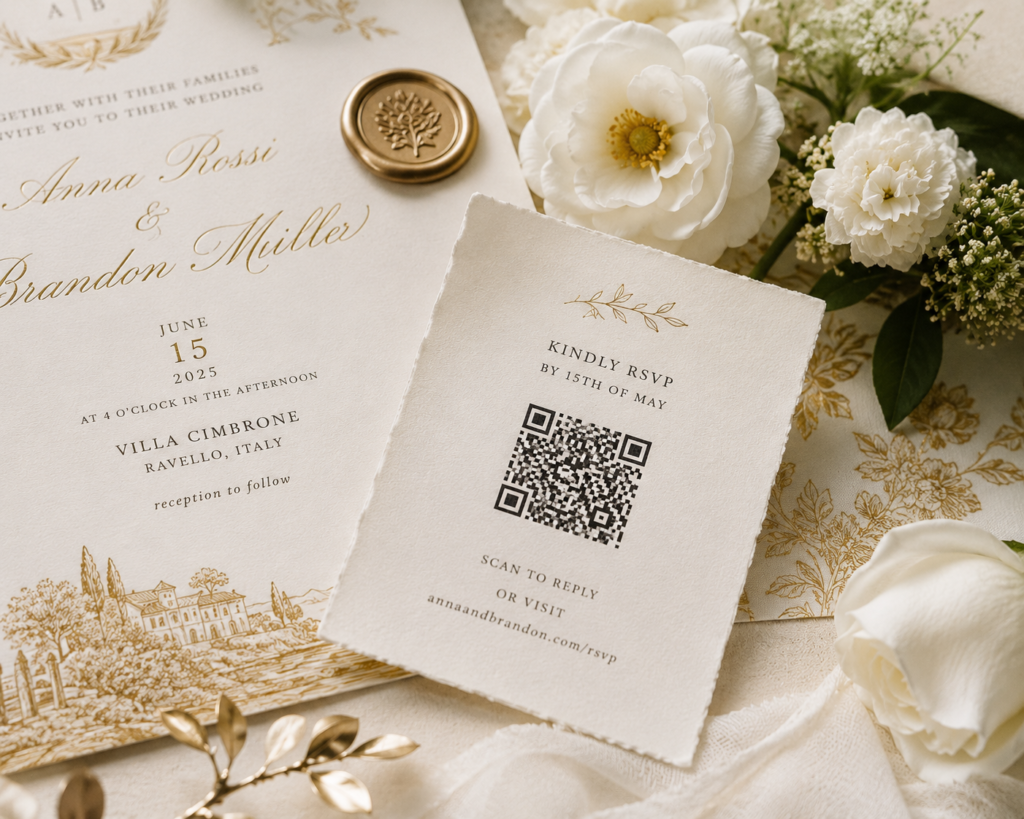
A printed response card, mailed back in an enclosed envelope, remains the most traditional RSVP method. It is also the slowest. For destination weddings in Italy, where guests are spread across multiple countries and postal systems, a QR code linked to a secure digital response form offers speed without sacrificing elegance.
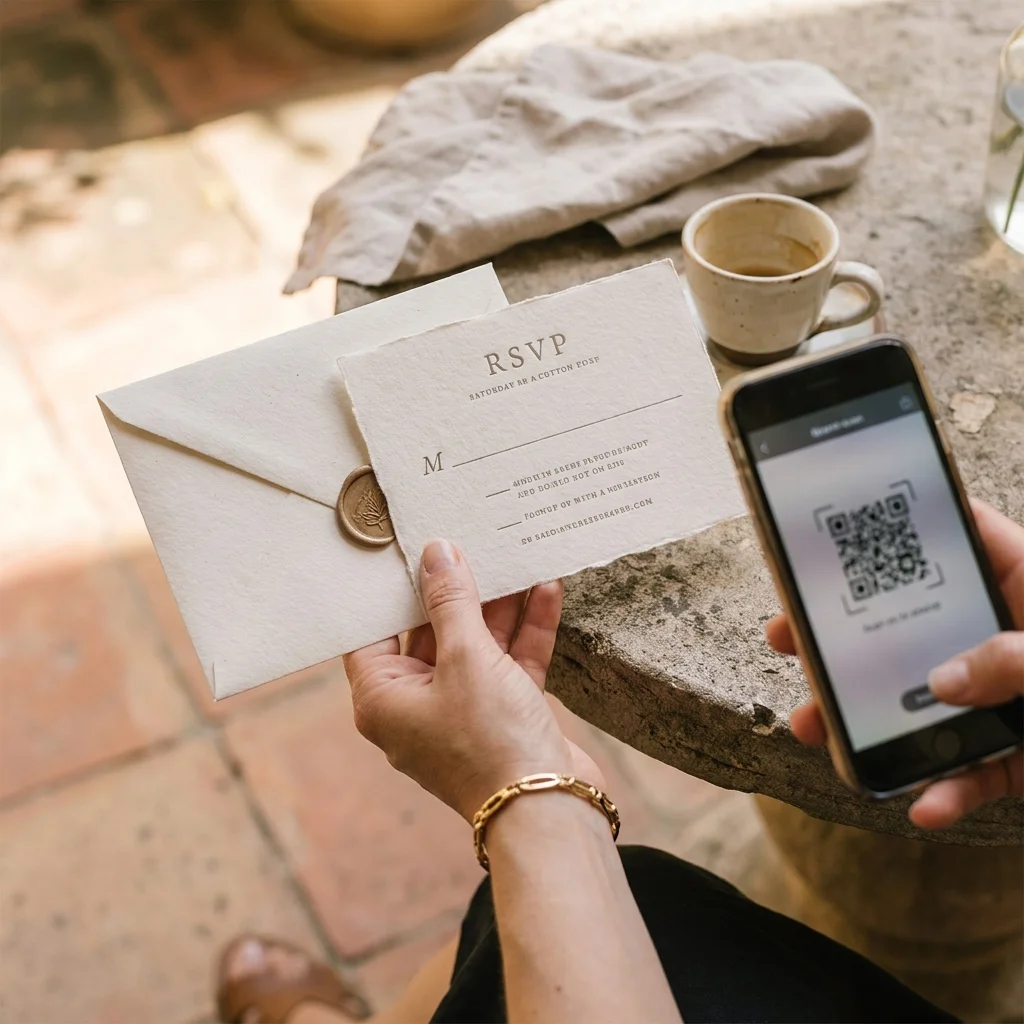
The QR code is printed on the invitation suite — typically on a separate enclosure card, not on the invitation itself. Scanning it opens a private, password-protected form where the guest confirms attendance, indicates dietary restrictions, notes plus-one details, and selects from multi-day event options (welcome dinner, ceremony, reception, post-wedding brunch).
For high-profile weddings, the digital form also serves as a privacy gate. Access is password-protected. Responses are stored in a system managed by our team, not on a social platform or shared spreadsheet. Guest names, dietary information, and contact details remain confidential — a consideration that matters enormously when the guest list includes public figures, executives, or individuals who require discretion about their travel plans.
We always recommend offering both options: the QR code for convenience and a traditional reply card for guests who prefer it. The data flows into the same tracking system regardless of method.
Children, Plus-Ones, and Partial Attendance: The Micro-Decisions That Create Friction
Three scenarios generate more confusion — and more private messages to the couple — than any other aspect of Italy wedding RSVP etiquette.
Children on Italian Wedding Invitations
If children are not invited, the invitation is addressed only to the adults by name. No additional note is needed. If children are welcome, the inner envelope (or digital form) lists them by first name. The ambiguity arises when the invitation is silent. In Italian convention, if a child’s name does not appear, they are not invited. In American convention, the same silence is sometimes interpreted as an oversight.
We resolve this by including a clear, warm line on the details card: “We have arranged an adults-only evening” or “We joyfully welcome your children — a supervised play area will be available during the reception.” Both options are gracious. Neither leaves room for misinterpretation.
For families traveling to Italy with young children who are not attending the reception, we can coordinate vetted childcare providers at the guest’s hotel — a service that transforms a potential inconvenience into a thoughtful gesture.
Plus-One Etiquette for Italy Weddings
Plus-one etiquette Italy wedding conventions follow a simple principle: the invitation names the invited guests. “Mr. James Clarke and Guest” explicitly offers a plus-one. “Mr. James Clarke” does not. For destination weddings, where the cost per guest — including transfers, welcome events, and multi-course dinners — can reach €250–€450 per person, plus-one clarity is a financial decision as much as a social one.
Our team manages plus-one requests that arrive after the invitation has been sent. These are handled privately, with the couple’s approval, and the response is always communicated warmly — whether affirmative or not.
Partial Attendance at Multi-Day Celebrations
Destination weddings in Italy often span two or three days: a welcome dinner, the ceremony and reception, and a farewell brunch. Some guests can attend only one event. The RSVP system must capture this. A single “yes” or “no” is insufficient. More in our guide: wedding welcome bag ideas.
We structure the response form — whether physical or digital — to allow guests to confirm attendance for each event individually. This data feeds directly into catering counts, transport scheduling, and seating arrangements for each occasion. Couples who are planning their Italian wedding menu will appreciate that per-event headcounts allow the chef to adjust quantities with precision, reducing waste and ensuring every course is served at its best.
Dietary Restrictions on the Wedding RSVP: What Italian Caterers Need and When
Italian wedding cuisine is built on seasonal ingredients, regional tradition, and a multi-course structure that can span four to six hours. Accommodating dietary restrictions within this framework is entirely possible — but the information must arrive early enough for the chef to design alternatives that feel intentional, not improvised.
The RSVP form should collect dietary information at the soft-RSVP stage, not the final confirmation. This gives the caterer six to eight weeks to source specialty ingredients, test alternative preparations, and integrate them into the menu flow. Common requests include gluten-free pasta (readily available in Italy), vegan courses, kosher-style preparation, and allergen-specific exclusions.
For celebrations where the menu is a centerpiece of the guest experience, we coordinate a tasting session that includes the alternative dishes, ensuring they meet the same standard as the primary menu. The cost of dietary accommodations is typically absorbed within the per-person catering rate for standard requests; specialized requirements (full kosher preparation, rare allergen substitutions) may incur a supplement of €30–€80 per guest.
| Dietary Request Type | Caterer Lead Time Needed | Typical Cost Impact |
|---|---|---|
| Vegetarian / vegan | 3–4 weeks minimum | Usually included in per-person rate |
| Gluten-free | 3–4 weeks minimum | Usually included; artisan GF pasta sourced separately |
| Kosher-style (not certified) | 6–8 weeks | €30–€60 per guest supplement (ingredient sourcing) |
| Severe allergen (e.g., nut-free kitchen protocol) | 6–8 weeks | €50–€80 per guest supplement (dedicated preparation area) |
| Halal | 6–8 weeks | €40–€70 per guest supplement (certified meat sourcing) |
Indicative ranges based on Tuscany and Lake Como catering partnerships. Contact Kiss Me Italy for a personalized proposal.

Where RSVP Inaccuracies Become Expensive: Catering, Permits, and Transport Contracts
An inaccurate headcount is not a social inconvenience. It is a contract liability. Here is where the numbers matter most.
Catering. Most luxury Italian caterers charge per person with a guaranteed minimum. If your confirmed count is 100 and only 82 attend, you pay for 100. If 108 attend and you confirmed 100, the caterer may accommodate — but at a rush surcharge of 15–25% on the additional covers, plus the risk that the kitchen cannot maintain quality at an unplanned volume.
Venue permits. Certain Italian municipalities require an event permit that specifies the maximum number of guests. Exceeding it can trigger fines or, in extreme cases, a request to reduce attendance on the day. For weddings in Venice, where venue capacities are strictly enforced due to building codes, this is not theoretical.
Transport. Private boat transfers on Lake Como, minibus convoys on the Amalfi Coast, and vintage car fleets in Tuscany all require named manifests submitted days in advance. A guest who RSVPs “no” and then appears — or one who confirms and doesn’t arrive — disrupts the logistics chain. The financial impact is modest per individual (€80–€200 for a missed transfer seat), but the cumulative effect across 10–15 discrepancies can reach €1,500–€3,000.
| Contract Area | Headcount Locked | Cost of ±10 Guest Discrepancy | What’s Included in Base Contract |
|---|---|---|---|
| Catering (luxury tier, 5-course) | 21–30 days before event | €2,500–€4,500 overpayment or rush surcharge | Menu, service staff, tableware rental; beverages and VAT (22%) quoted separately |
| Floral / tablescape | 14–21 days before event | €800–€2,000 (additional or wasted centerpieces) | Design, installation, breakdown; candles and linens often quoted separately |
| Private transport (boats, minibuses) | 7–14 days before event | €1,500–€3,000 (unused seats or emergency additions) | Vehicle hire, driver, fuel; gratuities and tolls quoted separately |
| Venue permit adjustment | 30–60 days before event (municipality-dependent) | €500–€1,200 (re-filing fees, potential fines) | Permit application, liaison with comune; VAT included |
Indicative ranges. Contact Kiss Me Italy for a personalized assessment based on your venue and region.
Guest List Protocols That Prevent Unwanted Attention at High-Profile Celebrations
This is the section most planning guides omit entirely, and it is the one our high-profile clients ask about first.
When a guest list includes names that are recognizable — whether in entertainment, finance, politics, or sport — the RSVP process becomes a privacy operation. Every confirmation is a data point. Every dietary note is personal information. Every transport manifest is a location schedule. In the wrong hands, this information becomes a liability.
Our guest list protocol operates on three principles:
Access control at the data level. RSVP responses are collected through encrypted forms, stored in a system accessible only to the lead planner and the security coordinator. Guest names are never shared with vendors in full; caterers receive a count and dietary matrix, not a name list. Transport providers receive first names and pickup locations, never surnames.
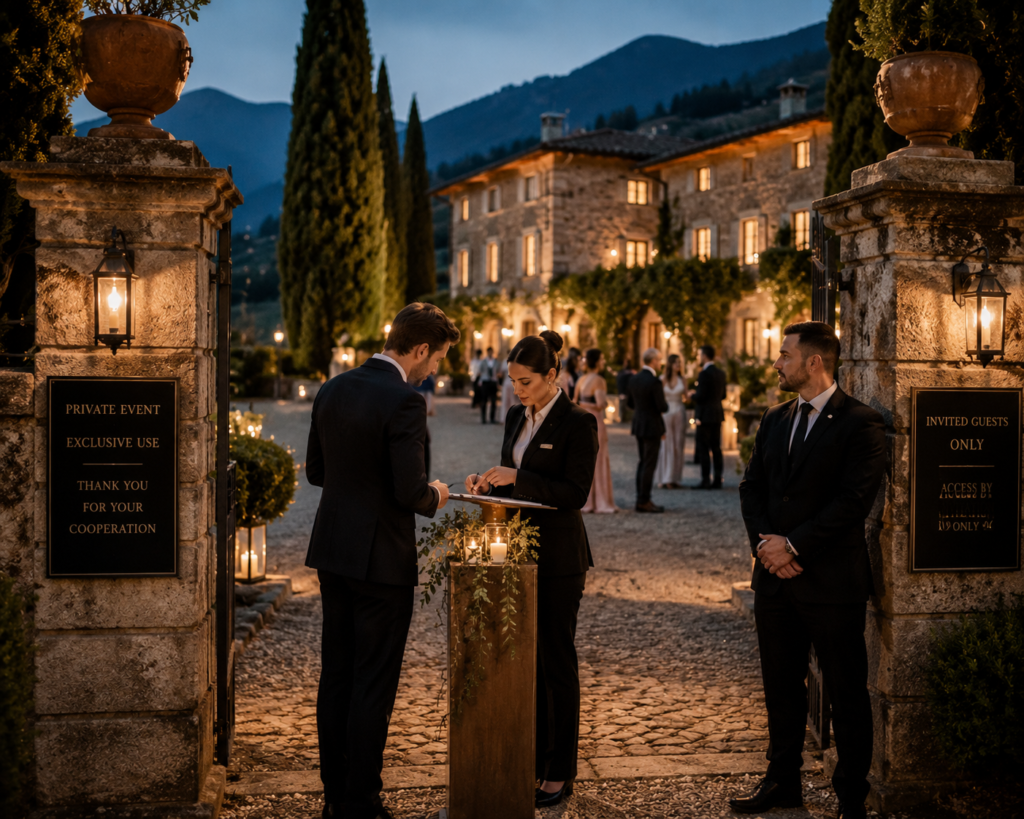
Access control at the venue. For exclusive-use venues — the only type we recommend for high-profile celebrations — we manage a single point of entry with a confirmed guest register. This is not a velvet rope. It is a discreet checkpoint, staffed by our team, where each arriving guest is welcomed by name. No one who is not on the list enters. No one who is on the list is questioned visibly.
Post-event privacy. Photographer and videographer contracts include confidentiality clauses that restrict image distribution. Social media guidelines — communicated to guests via the invitation suite, not announced at the event — establish whether photography is welcome, restricted to certain moments, or entirely private. We have managed celebrations where no image has ever appeared online. That level of protection is irreplaceable.
Couples exploring exclusive-use villa weddings in Italy will find that the villa format naturally supports these protocols, with controlled perimeters and private grounds that eliminate the possibility of external observation.
Why Planner-Led RSVP Tracking Protects Relationships and Timelines Simultaneously
Following up with a guest who hasn’t responded is, in theory, simple. In practice, it is one of the most socially delicate tasks in wedding planning. The bride’s college friend who hasn’t replied may be dealing with a personal situation. The groom’s business associate may have misplaced the invitation. The couple’s elderly relative may not have understood the QR code.
When our team handles follow-ups, the couple is removed from the awkwardness entirely. We send a warm, professionally worded message — by email, by phone, or through a family liaison — that treats the non-response as a simple logistical matter. There is no guilt. There is no pressure. There is a clear deadline and a gracious tone.
This service also ensures that the data is centralized. When three family members are each “helping” with RSVPs — one tracking a spreadsheet, another collecting verbal confirmations at a dinner party, a third forwarding emails — information fragments. Numbers conflict. Dietary details get lost. Our centralized tracking system eliminates this entirely, producing a single, verified headcount that flows to every vendor simultaneously.
For couples who are coordinating a micro wedding in Italy, where every seat matters and the margin for headcount error is zero, planner-led RSVP management is not an upgrade — it is the foundation of the entire event.

IBAN and Bank Details on Italian Wedding Invitations: The Gifting Signal Most International Couples Miss
In Italian wedding tradition, monetary gifts are standard. Guests contribute cash — often in an envelope presented at the reception — rather than purchasing items from a registry. For international destination weddings, this convention creates a question: how do you communicate gifting preferences without being direct?
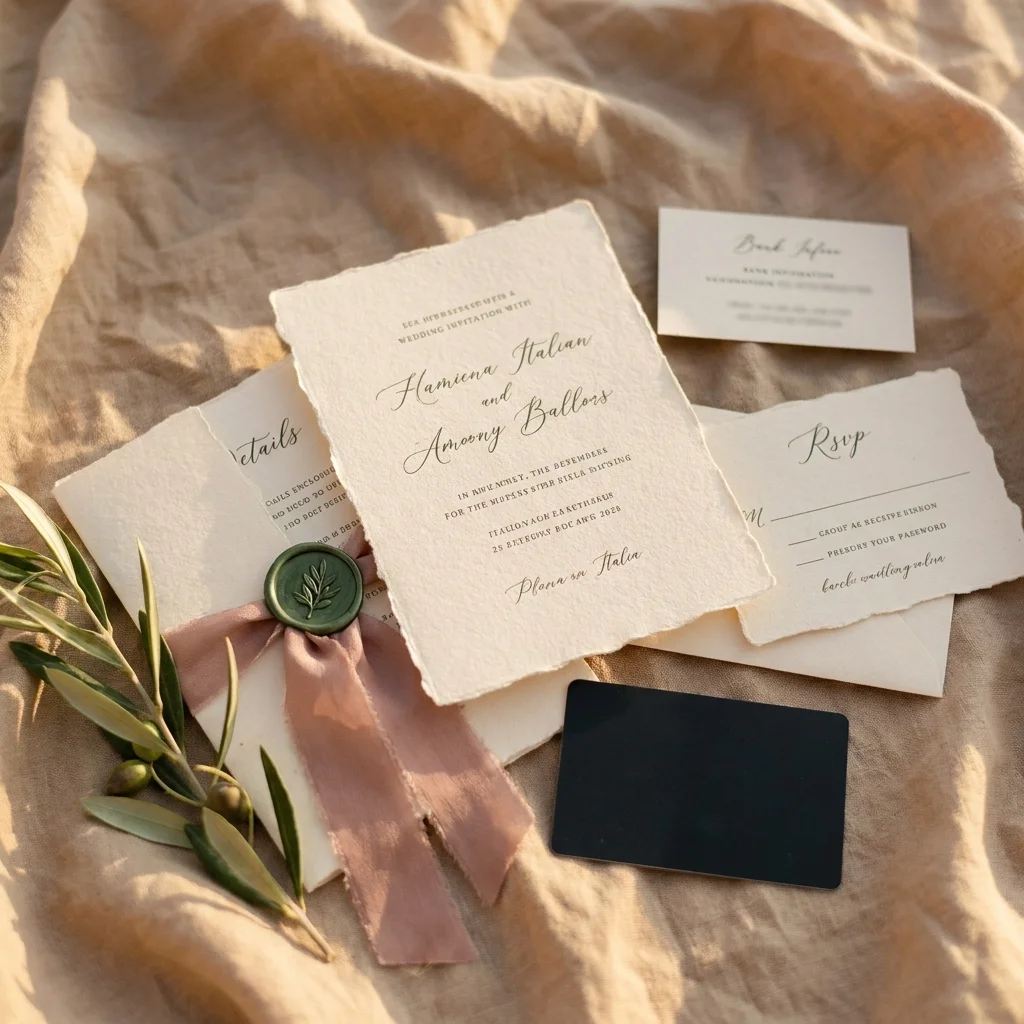
The Italian approach is to include a small card within the invitation suite — never on the invitation itself — with the couple’s bank details (IBAN) and a brief, gracious note: “La vostra presenza è il regalo più bello. Per chi desiderasse contribuire al nostro viaggio di nozze…” (“Your presence is the most beautiful gift. For those who wish to contribute to our honeymoon…”). This is not considered gauche in Italian culture. It is expected.
For international guests unfamiliar with this convention, we recommend a bilingual version of this card, or a discreet link to a digital fund. The key is placement: it accompanies the invitation suite but is never the focal point. Our stationery partners design these enclosures to match the invitation aesthetic, ensuring the gifting information feels integrated rather than transactional.
This is a detail that couples planning their overall Italy wedding budget sometimes overlook — but for guests, it removes uncertainty and allows them to participate in the Italian tradition with confidence.

Refined Wording for Accept, Decline, Dietary, and Special Requests
The tone of an RSVP response reflects the tone of the celebration. For a luxury wedding in Italy, the language should be warm, specific, and free of ambiguity. Below are wording frameworks our team provides to couples for their invitation suites and digital response forms. These are starting points — every set is refined to match the couple’s voice and the event’s register.
Acceptance (formal): “We are delighted to accept your kind invitation and look forward to celebrating with you in [region/city]. We will attend [list of events: welcome dinner, ceremony, reception].”
Decline (gracious): “It is with sincere regret that we are unable to join you for your celebration in Italy. Please know that you will be in our thoughts on your wedding day, and we send our warmest congratulations.”
Dietary notification: “We would be grateful if the kitchen could accommodate [specific requirement]. Please do not hesitate to contact us if further detail would be helpful.” This phrasing positions the request as collaborative, not demanding — a small distinction that Italian chefs genuinely appreciate.
Plus-one inquiry (when not explicitly offered): “We wanted to ask, with complete understanding if it is not possible, whether [name] might be welcome to join us for the celebration.” This framing respects the couple’s guest list decisions while allowing the question to be asked without presumption.
Couples planning celebrations in Florence or Rome may also wish to include a brief note about the ceremony venue’s dress code or access requirements — information that, when included on the RSVP details card, reduces last-minute guest inquiries by roughly 60%, based on our experience across seasons.
The RSVP as a Quiet System That Shapes the Entire Celebration
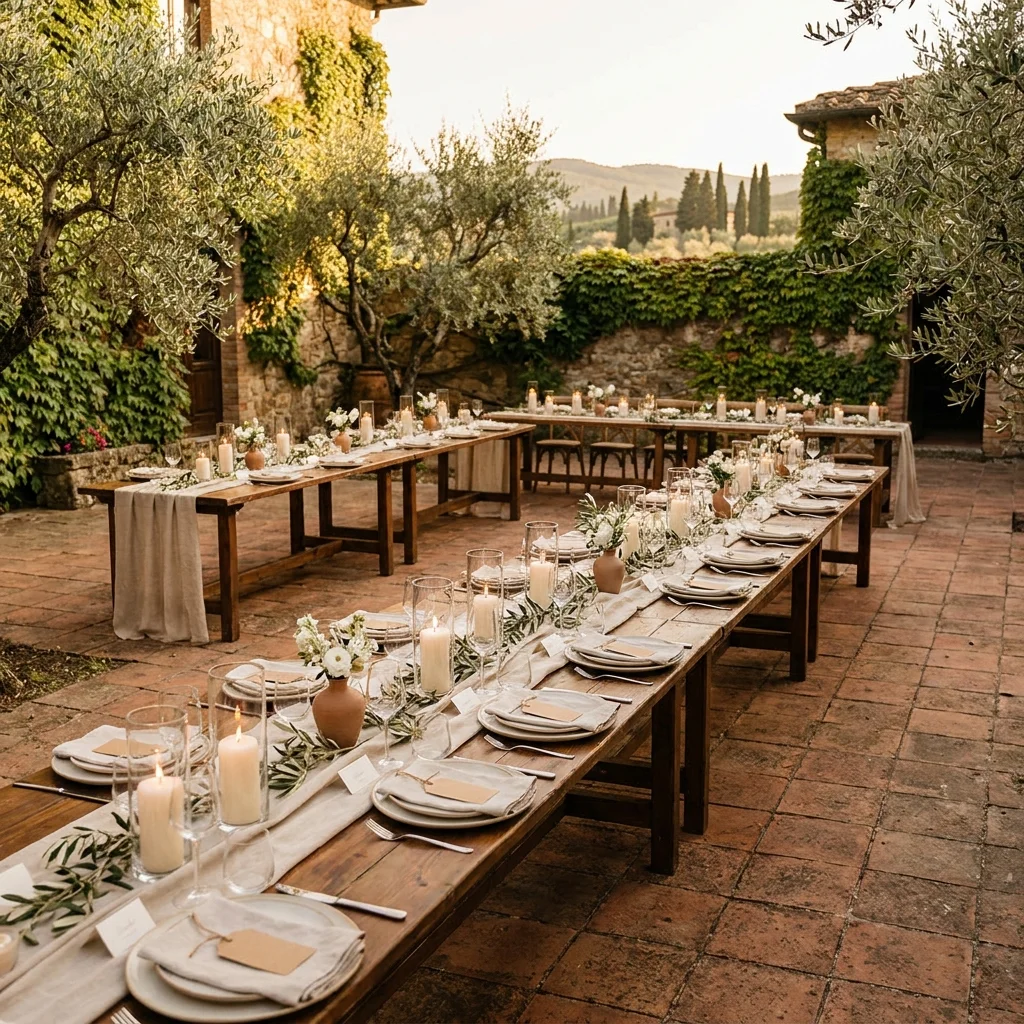
Italy wedding RSVP etiquette is, at its core, a communication system. It determines who attends, what they eat, how they arrive, and — for high-profile celebrations — who knows they were there at all. When managed with discretion and precision, it is invisible to the guest. They receive a beautiful invitation, respond with ease, and arrive to a celebration where every detail reflects their confirmed preferences.
That invisibility is the point. The best RSVP systems are the ones no one notices — because the couple never had to chase a response, the caterer never received a wrong number, and the transport coordinator never scrambled for an extra seat. At Kiss Me Italy, this is the standard we maintain for every celebration we manage. Quietly. Without compromise.
If you are beginning to plan a wedding in Italy and want your guest list managed with the same care as the flowers, the music, and the venue, we welcome your inquiry. Reach out to our team to begin a confidential conversation.

Frequently Asked Questions: Italy Wedding RSVP Etiquette
What happens if a confirmed guest cancels after the caterer has locked the headcount?
Once the caterer has locked the headcount (typically 21–30 days before the event), the couple is contractually committed to pay for that number of covers. A late cancellation does not reduce the catering bill. Our team builds a small buffer — usually 3–5% — into the confirmed count to absorb last-minute changes without financial impact, a practice we calibrate based on the guest geography and historical response patterns for destination celebrations.
Should we send a physical invitation or is a digital-only RSVP acceptable for a luxury Italian wedding?
For luxury celebrations, a physical invitation suite remains the standard — it signals the caliber of the event and creates a tangible keepsake. However, the response mechanism can be digital (QR code or private link) without diminishing the formality. We recommend pairing a printed suite with a digital response option, which accelerates data collection while preserving the elegance of the invitation itself.
How do we handle RSVPs for guests who need a Schengen visa to attend?
Guests requiring a Schengen visa should be sent save-the-dates and formal invitations earlier than the standard timeline — ideally 16–18 weeks before the wedding. The invitation itself, along with a formal letter from the couple confirming the event details and venue address, can support the visa application. Our team provides template support letters and coordinates with the couple to ensure the documentation is accurate and timely.
Can guests RSVP to individual events within a multi-day wedding weekend, or must they commit to all?
Guests should be able to confirm attendance for each event individually. Our digital response forms include checkboxes for each occasion — welcome dinner, ceremony and reception, farewell brunch — so that partial attendance is captured cleanly. This data is essential for per-event catering orders, transport scheduling, and seating arrangements at each gathering.
Is it appropriate to include a wedding website URL on an Italian wedding invitation?
Yes, provided it is presented on a separate details card rather than on the invitation itself. The website can host travel information, accommodation suggestions, event schedules, and the RSVP form. For high-profile couples, we recommend password-protecting the site and using a custom domain that does not include the couple’s full names, adding a layer of discretion to the guest-facing experience.
How do Italian vendors react if the final headcount changes by more than 10% after confirmation?
A reduction of more than 10% typically does not lower the bill — the guaranteed minimum applies. An increase of more than 10% may be accommodated at a rush surcharge (15–25%) or may exceed the venue’s permitted capacity. Our two-phase RSVP system is specifically designed to prevent swings of this magnitude by identifying trends early and allowing course corrections before contracts lock.
What language should the RSVP card be written in if most guests are American but the wedding is in Italy?
If the majority of guests are English-speaking, the RSVP card should be primarily in English with key Italian phrases included for cultural warmth — for example, using “È gradita gentile conferma” alongside the English response instructions. Fully bilingual cards are appropriate when a significant portion of the guest list is Italian. Our stationery review process ensures the balance is correct for each couple’s specific audience.
Do we need to provide accommodation details on the RSVP card, or is that handled separately?
Accommodation details belong on the details card or the wedding website, not on the RSVP card itself. However, if the couple has arranged a room block at a specific hotel, a brief reference — “Accommodations have been reserved at [hotel name]; details enclosed” — can appear on the details enclosure. Our team coordinates room blocks and can include booking links within the digital RSVP system for seamless guest access.
How do we handle a guest who brings an uninvited plus-one to the wedding day?
At events we manage, the guest register at the venue entrance ensures that only confirmed attendees are welcomed. If an uninvited companion arrives, our on-site team handles the situation discreetly — typically by welcoming the individual warmly and seating them if capacity allows, or by explaining the situation privately without causing embarrassment. The couple is never involved in this conversation. It is resolved quietly, in real time, by our team.
Can Kiss Me Italy manage RSVPs for a wedding planned by another agency?
Our RSVP and guest list management services are offered as part of our full-service and partial planning packages. We do not typically manage RSVPs as a standalone service, because the data collected through the RSVP process feeds directly into catering, transport, floral, and seating decisions that require integrated coordination. For couples already working with another planner, we recommend discussing the possibility of a collaborative arrangement — our team is happy to explore the options.
Planning something special in Italy? Read also our guide: Luxury Forest Wedding in Italy: A High-End Guide to Woodland Celebrations.