
Amalfi Coast Elopement
The first question our high-profile couples ask is not about the view. It is: who else will be there? On this coastline the answer is a matter of hours and metres — a clifftop terrace that belongs to you alone at 9:30 in the morning can hold forty strangers with cameras by noon. Our entry collection for two on this coast is €2,900, ceremony included, and the single most valuable thing it buys is not the setting. It is control over who sees you say the words.
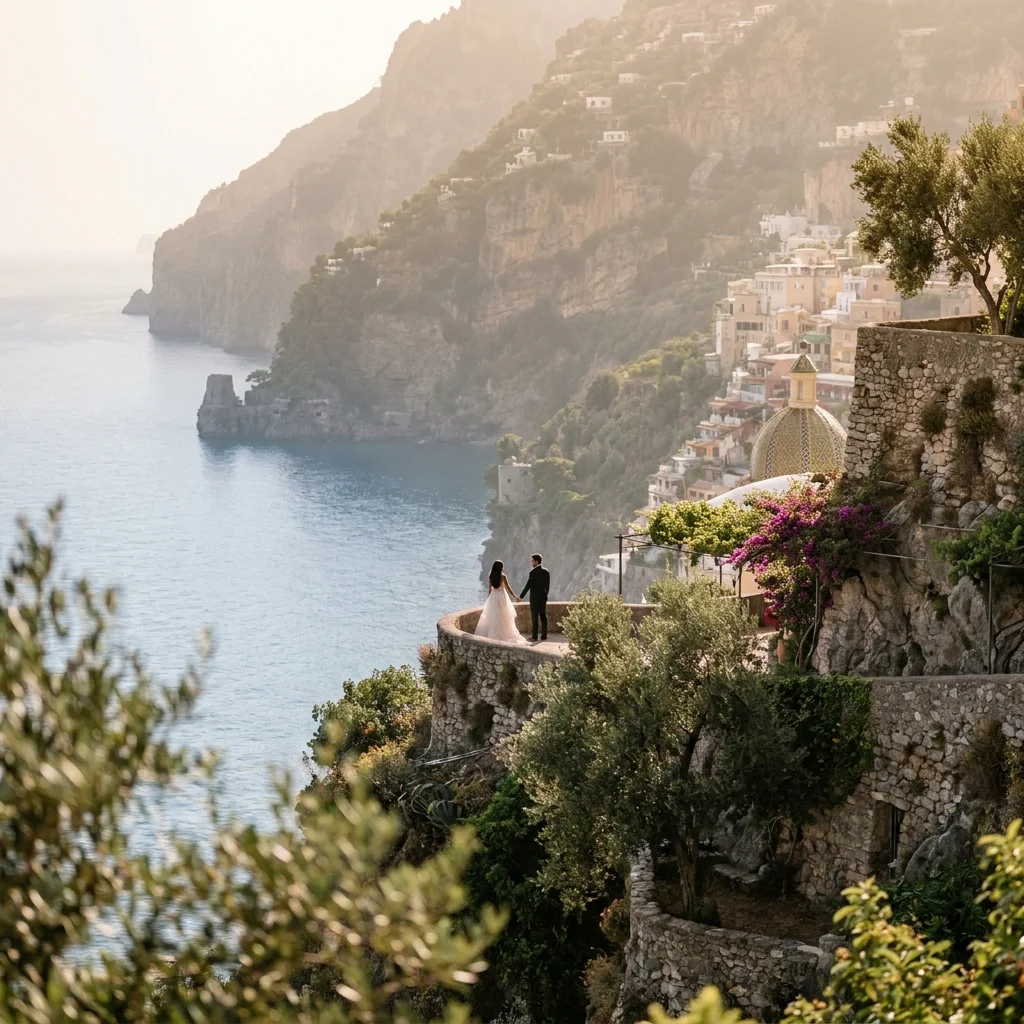
An Amalfi Coast elopement is an intimate ceremony for two — or for a very small protected group — held in Positano, Ravello, Amalfi, Sorrento or on Capri, usually lasting 20 to 40 minutes and followed by portraits and a private toast. Curated collections for two begin at €2,900 with Kiss Me Italy, with photography, floral design, transfers, private dining and legal formalities quoted separately. Symbolic ceremonies can be held in clifftop and seafront settings; legally binding civil ceremonies follow municipal procedures and separate documentation timelines.
What follows is organised as a series of choices, because that is how this coast actually works. Positano or Ravello. Legally binding or symbolic. Boat access or road access. May or September. Two of you, or twelve. Each choice changes the level of discretion we can guarantee, and each one is reversible only up to a point in the calendar.
Positano Versus Ravello: Two Different Kinds of Privacy, Two Different Arrivals
They are forty minutes apart by car and they behave nothing alike.
Positano is vertical. Everything happens on steps, and the town’s most photographed church sits at the bottom of the funnel where every visitor eventually passes. Our couples who choose Positano for an Amalfi Coast elopement are choosing the image — the domed majolica roof, the pastel amphitheatre of houses, the water below — and accepting that the image comes with footfall. That is entirely manageable, but it is managed by timing rather than by walls. We schedule Positano ceremonies early: arrival between 9:00 and 10:00, ceremony concluded before the first ferries release their day-trip flows, portraits on the stepped alleys while the light is still lateral and the streets belong mostly to delivery carts.
Ravello is horizontal, and 350 metres higher. Access is gated, gardens are enclosed, and the famous belvederes of the Villa Rufolo and Villa Cimbrone gardens sit behind a ticket line rather than on a thoroughfare. For a couple who genuinely cannot be observed — a recognisable face, a family under scrutiny, a client who simply refuses to be photographed by strangers — Ravello is the more protected proposition, and we generally recommend it. The trade-off is atmosphere: Ravello is monastic and green, Positano is theatrical and blue. Our team walks couples through both on a call, with reference imagery and a frank assessment of exposure at each hour of the day. If a broader picture of the coastline’s formal wedding settings is useful before that conversation, our overview of wedding venues on the Amalfi Coast covers the larger-scale properties that sit outside the elopement format entirely.
Amalfi town itself offers a third register: a cathedral of extraordinary presence, a small harbour, and a level walk — the only genuinely level walk on this coast, which matters more than couples expect. Sorrento sits at the practical end, twenty minutes from the motorway and closest to Naples airport. Capri is its own decision, and we treat it separately below.
Legally Binding Versus Symbolic: What Actually Changes for a Couple of Two
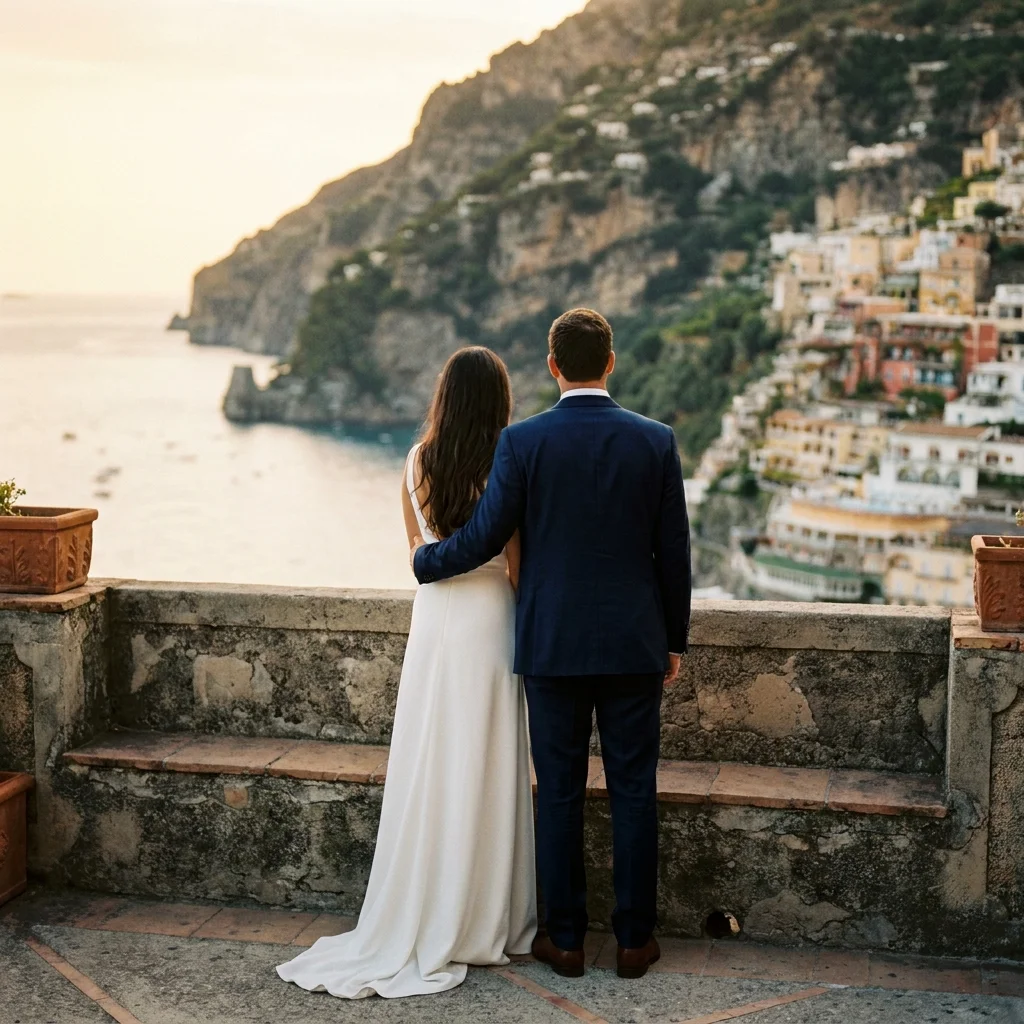
This section is deliberately technical. The distinction is procedural, not emotional, and couples deserve it stated plainly.
A symbolic ceremony carries no civil effect in Italy or in the couple’s home jurisdiction. It has no documentary prerequisites, no municipal calendar, and generally no statutory interpreter requirement — though bilingual officiation or interpretation can still be curated for the couple and their guests where it is wanted — and, critically for our purposes, no obligation to hold it in a designated municipal room. This is why the majority of Amalfi Coast elopements we curate are symbolic: the officiant, the wording, the readings and the location are entirely ours to compose, and a clifftop terrace at 18:30 is available in a way that a civil registry office simply is not. Many couples pair a symbolic ceremony in Italy with a civil registration completed at home, before or after travel. Our guide to wedding ceremony types in Italy sets out the three formats side by side, and the way we shape the voice, language and script of the ceremony itself is described in our overview of choosing a wedding officiant in Italy.
A legally binding civil ceremony follows municipal procedure. Requirements vary by comune and by the couple’s nationality, and they typically involve a declaration made before the couple’s own consular authority, sworn translations of civil-status documents, an interpreter present at the ceremony where neither party speaks Italian, and a ceremony held on a date and in a room or authorised outdoor location approved by that municipality. Documentation windows and ceremony-room availability are set by each comune and change; we verify both in writing before any date is confirmed. The general framework for foreign nationals is set out in our guide to getting married in Italy as a foreigner, and the procedural detail of the civil route in our page on the civil ceremony in Italy.
One practical consequence for privacy: a civil ceremony is recorded in municipal registers and takes place on a municipal schedule. A symbolic ceremony generally leaves no equivalent municipal record, though our team reviews and confirms the confidentiality implications of each format for every couple’s specific circumstances before recommending one. For clients whose primary concern is confidentiality, that difference is often decisive, and we say so early rather than late.
What the Numbers Look Like: Our Collection Versus Third-Party Fees
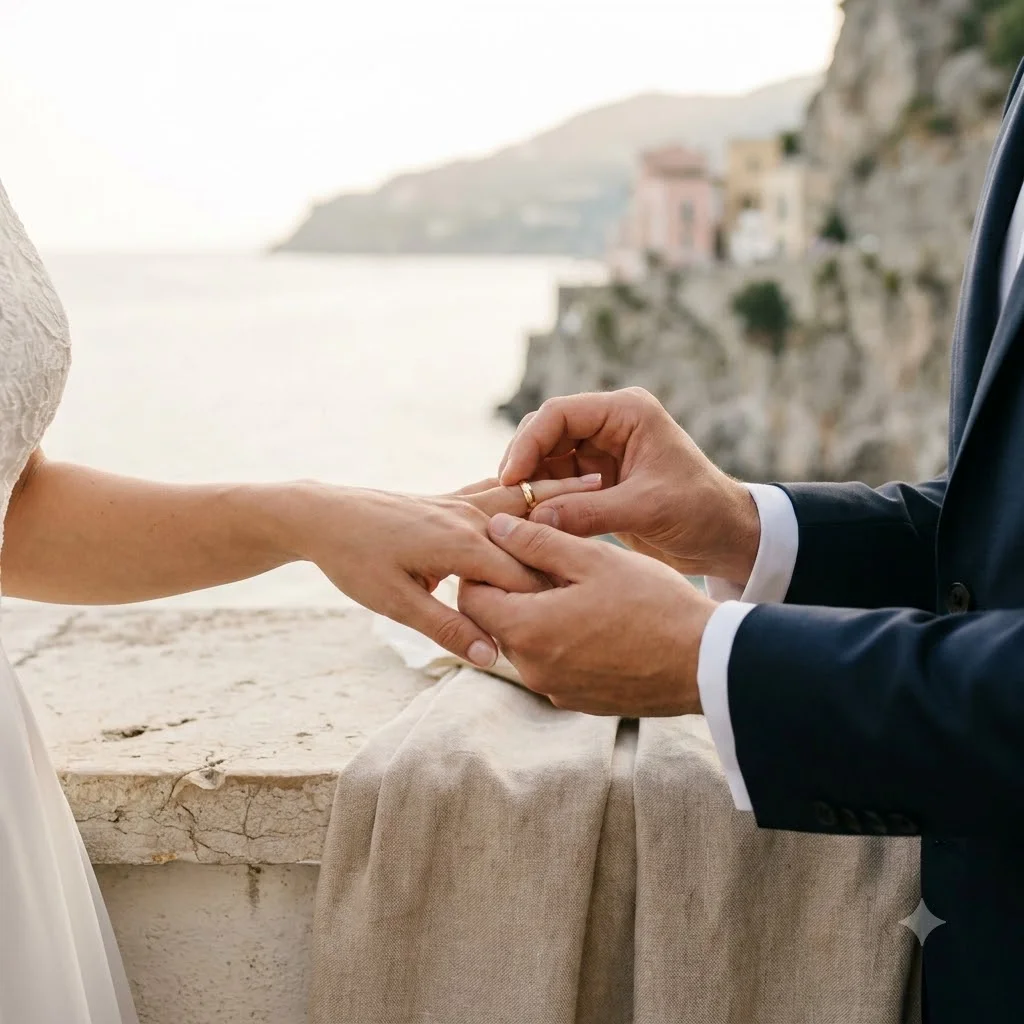
Two categories of cost exist here, and conflating them is how couples lose confidence in a quotation. The first is our curated collection, which is a fixed, contracted figure. The second is third-party expenditure — municipal fees, translations, boats, dining, accommodation — which we source, negotiate and coordinate, but which is billed on supplier terms.
| Collection / item | Price (EUR) | Included | Quoted separately |
|---|---|---|---|
| Positano Dream — elopement for two | €2,900 (fixed, two people) | Intimate symbolic ceremony for two in a thousand-year-old clifftop basilica setting above the Mediterranean; officiant; ceremony coordination and on-the-day direction; celebratory toast; single point of contact throughout planning | Photography and film, floral design beyond the ceremony, hair and makeup, transfers and private boat, dining, accommodation, any legally binding civil-ceremony fees. VAT treatment stated in the written proposal. |
| Municipal civil ceremony fee (indicative third-party) | €400–€1,800 | Comune ceremony fee where a legally binding civil ceremony is requested; varies by municipality, day of week and location category | Sworn translations, consular declarations, interpreter, document couriers. Set by each authority and confirmed in writing before booking. |
| Sworn translations and interpreter (indicative third-party) | €250–€700 | Translation of civil-status documents and interpreter attendance at a civil ceremony | Apostille or legalisation obtained in the couple’s home country. Excluded from all collections. |
| Private car transfer, Naples airport to Positano or Ravello (indicative third-party) | €180–€320 each way | Executive sedan, English-speaking driver, meet-and-greet, luggage | Waiting time beyond 60 minutes, additional stops, minivan upgrade for small groups, night surcharge. |
| Private boat, half-day charter for portraits or arrival (indicative third-party) | €700–€1,900 | Skippered gozzo or motor launch, fuel within coastal range, 3–4 hours | Capri crossings, extended charters, onboard catering, mooring fees at private jetties. |
Indicative ranges for third-party items; our collection price is fixed and contracted. Verified against current Kiss Me Italy commercial records and supplier quotations for the current catalogue season. Contact Kiss Me Italy for a personalized proposal.
Couples comparing coastlines sometimes find it useful to see how a different Italian destination structures the same expenditure — our breakdown of Portofino wedding costs and our guide to Venice wedding costs both separate fixed collection pricing from supplier billing in the same way. For the widest view, our analysis of what a wedding in Italy actually costs explains why the same guest count produces different figures in different regions. A written proposal for your own dates is a short conversation away — our team responds to direct enquiries within one working day.
Photography for Two Versus Photography for Twelve: Where the Cost Actually Moves
Imagery is one of the most valued elements of an Amalfi Coast elopement, and unlike almost everything else in the day, it cannot be revisited once the moment has passed. Every detail of the celebration — the flowers, the setting, the ceremony itself — is composed with the same care, but photography deserves particular attention, since it is the record that carries the day forward for a lifetime. This is the line item where our experienced team encourages couples to invest thoughtfully rather than economise.
Coverage cost on this coast is driven less by guest count than by movement. A ceremony for two, portraits within 300 metres, done in two hours: simple. The same ceremony followed by a boat transfer to a second location and a dinner in a third town: three logistical scenarios for one photographer, and the pricing reflects it.
| Coverage | Indicative range (EUR) | Included | Quoted separately |
|---|---|---|---|
| Ceremony and portraits, 2 hours, single photographer | €1,100–€2,200 | Ceremony plus portraits in one town, single shooter, edited high-resolution gallery delivered within 4–6 weeks, travel within the Amalfi Coast | Second shooter, film, albums and prints, drone, RAW files, accommodation where a pre-dawn call time is required. VAT (IVA 22%) applies unless the proposal states otherwise. |
| Half-day, single photographer plus preparation coverage | €2,200–€3,600 | Bridal preparation, ceremony, portraits, toast; 5–6 hours; edited gallery within 6 weeks; travel within the coast | Second shooter, videographer, album, boat charter used for portraits, extension beyond contracted hours, prints. |
| Full-day photography with film (photographer plus videographer) | €4,500–€8,500 | Full-day coverage, two professionals, edited gallery plus 3–5 minute film, post-production within 8–10 weeks, travel within Campania | Second stills shooter, drone permissions where restricted, feature-length edit, albums, printed products, supplier accommodation for multi-day schedules. |
| Fine-art album and prints | €600–€1,800 | Designed album, hand-bound, 30–60 spreads, one revision round | Duplicate parent copies, framed prints, shipping outside the EU, additional revision rounds. |
| Short-form social content (discreet second operator) | €900–€2,000 | Vertical clips and reels captured alongside the main coverage, delivered within 7 days | Same-day edits, additional operator days, licensed music beyond standard catalogue. |
Indicative supplier ranges verified against current photographer and film quotations for the current catalogue season; not part of the fixed collection price. Contact Kiss Me Italy for a personalized proposal.
We select the photographer against the location and the hour, not from a generic roster — a shooter who works beautifully in Ravello’s enclosed gardens at midday is not necessarily the right choice for backlit Positano at 9:00. Our approach to selection and direction is set out in our guide to wedding photography in Italy, and where couples want reels alongside the formal gallery, we brief a wedding content creator whose presence remains unobtrusive throughout. One rule we apply without exception: no imagery from a confidential celebration is published without written consent, and for high-profile clients we contract that restriction directly with every supplier.
Access Control: The Guest List Protocols That Keep an Elopement Unobserved
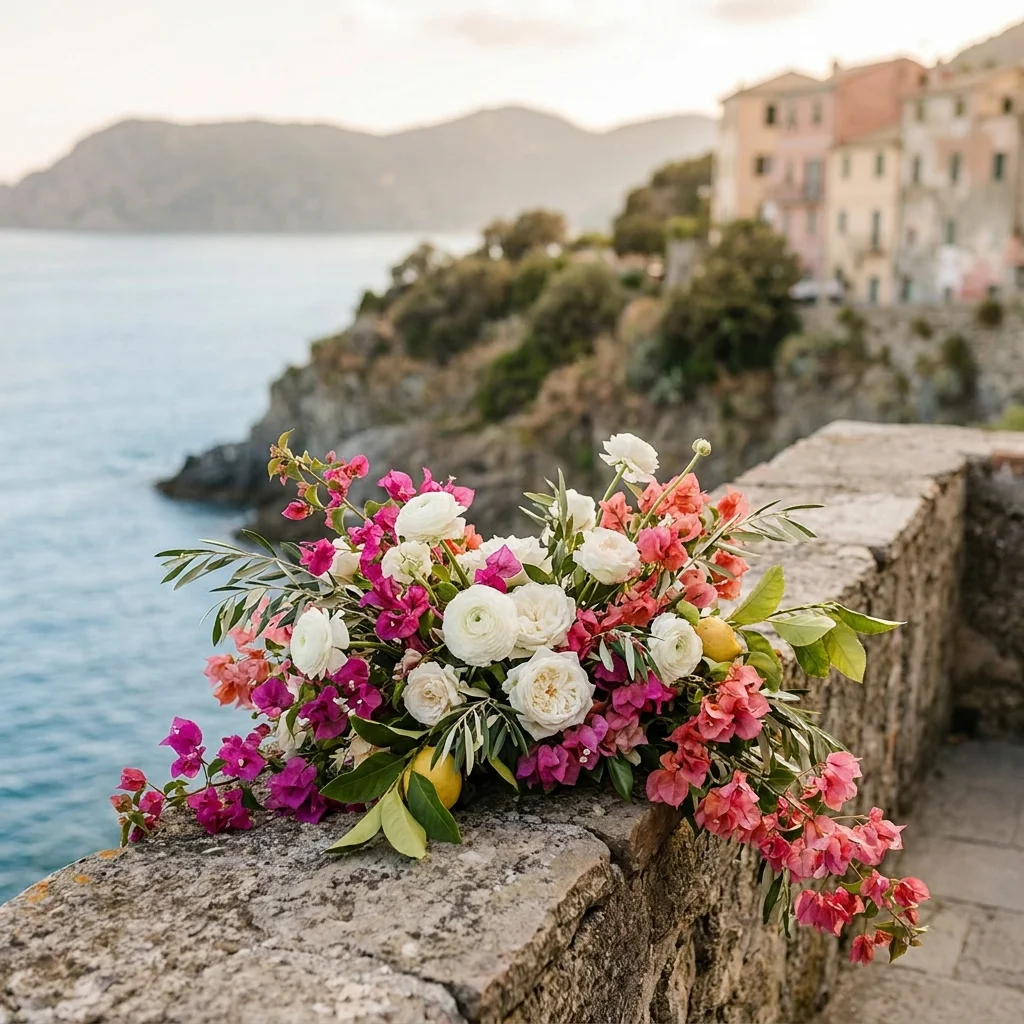
Most planners treat privacy as a location problem. It is a procedure problem.
A ceremony for two on a gated terrace can be photographed from a hotel window above it. A ceremony for ten in a closed garden can be described on social media by a supplier’s assistant before the toast is poured. The location matters; what matters more is who holds the address, when they receive it, and what they have signed. Our standard guest list protocol for a high-profile Amalfi Coast elopement works like this: the exact ceremony location is released to guests 24 to 48 hours before, through a single channel, with transfer times attached; suppliers receive a call sheet identifying the town but not the couple’s surname until 72 hours out; and every contracted professional — officiant, photographer, florist, driver, restaurant manager — signs a confidentiality undertaking before deposit.
Where a client’s recognisability demands it, we arrange exclusive-use windows rather than shared access. On this coast that generally means one of three things: a private clifftop garden closed to all other visitors for a contracted period, a chartered vessel where the ceremony takes place offshore, or a terrace within a single-property estate where the only people present are the ones on our list. These arrangements are secured 6 to 12 months ahead for high-season dates. They are not available at short notice, and we would rather say that plainly than promise a window we cannot hold.
Couples who want to understand how these protocols scale to a slightly larger celebration will find our page on the micro wedding in Italy useful, and the broader philosophy behind our confidential commissions is described in bespoke luxury weddings in Italy. If discretion is your governing requirement, that is the conversation to open with — you can write to us in confidence and no details are shared internally beyond the team assigned to your file.
Boat Access Versus Road Access: Amalfi, Sorrento and Capri Compared
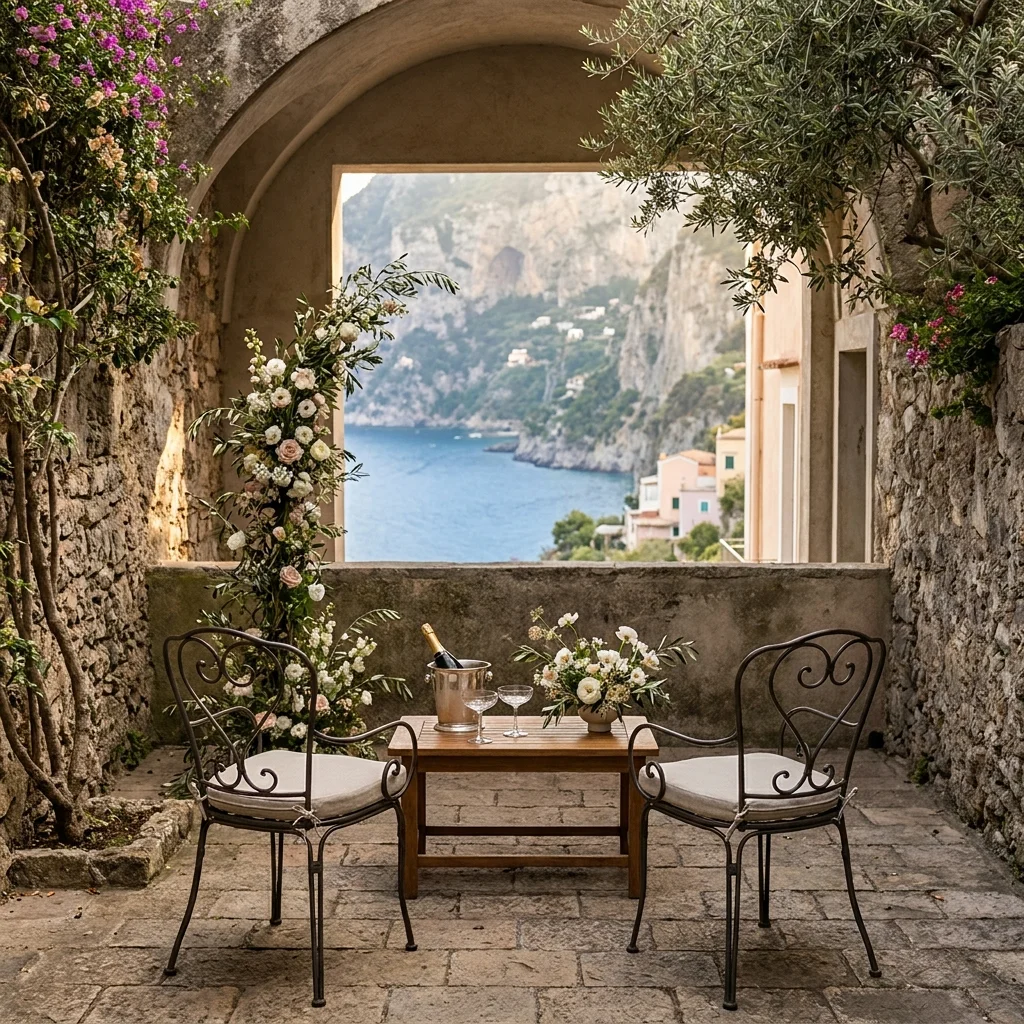
The coast road is a single lane in each direction with hairpin bends and, between July and mid-September, a rhythm entirely outside anyone’s control. That is a scheduling fact, and it shapes every itinerary we build.
Road access suits Ravello and Sorrento. Ravello sits above the coast road on a spur, so the final approach is short, and our team assesses and confirms the extent of any exposure along that route for each specific commission before we recommend it. Sorrento connects to the motorway and to Naples in under an hour. Both are the sensible choice when a couple lands the morning of the ceremony, which we discourage but occasionally accommodate.
Boat access transforms Positano and Amalfi. A private launch from Sorrento or Salerno delivers the couple to a jetty rather than to a bend in a road, cuts a 90-minute drive to 35 minutes, and — the reason we recommend it most often — is assessed by our team, case by case, as substantially reducing the arrival’s visibility, in many instances removing it from view almost entirely. The couple steps onto stone, walks up a private stair, and is at the ceremony, with far less of the exposure that a car door, a pavement or a crossed piazza would otherwise involve.
Capri is a different calculation. It offers strong privacy on paper — an island with limited vehicle access and hotels accustomed to protecting recognisable guests — and the weakest reliability, because everything depends on a crossing. Sea conditions cancel private tenders more often than couples expect, particularly in April and October. For an Amalfi Coast elopement that includes Capri, we build the ceremony on the mainland and treat the island as the following day’s portrait session, so that weather never touches the ceremony itself. Couples drawn to the water more broadly may also want to read our thoughts on a seaside wedding in Italy, which addresses shoreline settings across several regions.
Late May Versus Mid-September: How Season, Light and Visibility Move Together
These are the two windows we recommend most, and they are not interchangeable.
Late May gives long evenings, bougainvillea at its peak, sea temperatures still cool, and a coastline that has not yet reached its summer density. Ceremony light at 18:00 is warm and generous; a 19:30 dinner ends in dusk rather than darkness. Availability, however, closes early — the desirable May and early-June dates on this coast are typically committed 9 to 14 months ahead.
Mid-September inverts almost everything. The sea is at its warmest, the light is shorter and more golden, evening arrives faster, and by the third week the day-trip volume has dropped noticeably. Restaurants regain their tables. Boats regain their flexibility. For couples whose priority is being quietly alone in Positano at 10:00, the second half of September is the finest fortnight of the year, and our own preference for confidential commissions.
July and August are workable but require discipline: ceremonies before 10:00 or after 18:30, no midday exteriors, and boat transfers instead of road wherever possible. Between late June and mid-August, an outdoor toast at 14:00 on an unshaded terrace is a decision nobody enjoys. October and April both offer beautiful, emptier days and require a contracted indoor alternative for every outdoor element. November through March we plan only for couples who want the coast bare and grey and entirely theirs — which some do, and which can be extraordinary. Our overview of eloping in Italy compares these seasonal windows across every region we cover, for couples still weighing coast against lake against city.
Two of You Versus Twelve: How Guest Count Rewrites Transport, Dining and Contingency
The word elopement stretches. In our records, roughly half of these celebrations involve nobody but the couple and the officiant; the rest include between two and twelve people. That range looks small. Operationally it is not.
At two, everything is agile. One car. One table. A ceremony that can move by an hour on the morning itself if the light or the weather asks for it. Photography is simpler, the toast can happen anywhere, and the contingency plan is essentially a second location and an umbrella.
At eight to twelve, four things change simultaneously. Transport becomes a convoy, which on the coast road means staggered departures and a minivan rather than sedans. Ceremony access becomes a capacity question — several of the most beautiful clifftop settings hold six people comfortably and fourteen not at all. Dining moves from a table to a private room, with a set menu confirmed 10 to 14 days ahead and dietary requirements consolidated in advance; our page on Italian wedding menu ideas covers the regional composition of those menus. And contingency planning acquires a second layer, because relocating two people takes four minutes and relocating twelve takes thirty-five.
None of this is a deterrent. It is simply why we ask for the final number early and why our proposals are structured around headcount bands rather than a single figure. Couples who suspect their guest list may grow beyond twelve are, in truth, planning something else — and we are glad to shape that instead, drawing on the approach described in our personalized wedding planning pages.
Full Coordination Versus Partial Assistance: Where the Real Risk Sits
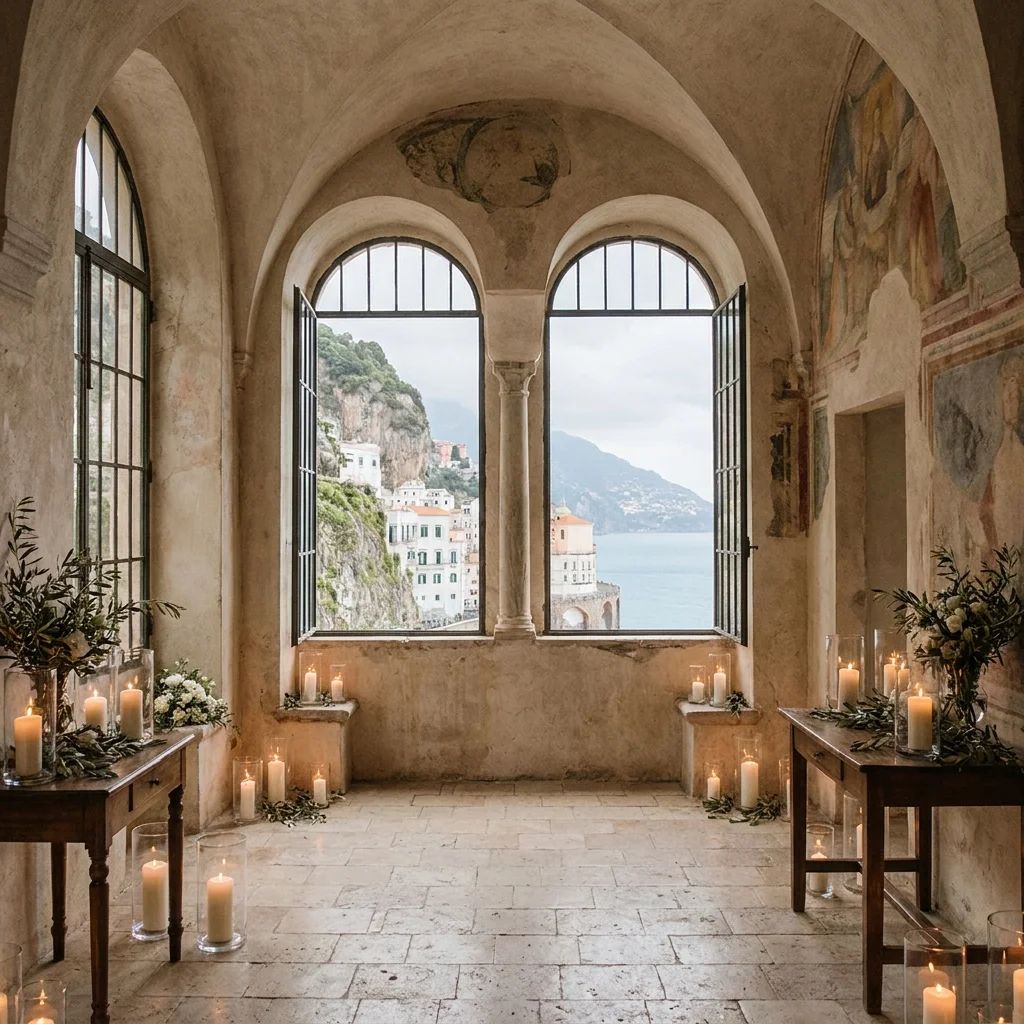
Every element of an Amalfi Coast elopement can be sourced individually. Photographers publish rates. Restaurants take reservations. Boats can be chartered online. What cannot be sourced individually is the connective tissue — the sequence in which those bookings depend on one another, and the person who holds the whole sequence when one element moves.
| Production element | Indicative range (EUR) | Included | Quoted separately |
|---|---|---|---|
| Floral design for two (bouquet and boutonnière) | €250–€650 | Seasonal design, delivery to the preparation location before 9:00, boutonnière pinning | Ceremony arch or aisle design, table florals, second bouquet for throwing, imported blooms out of season. |
| Ceremony floral installation, clifftop or garden | €900–€3,200 | Arch or altar design, installation and removal within contracted access window, seasonal Mediterranean palette | Candles and lighting, structural rental, permit surcharges for protected sites, second-location duplication. |
| Hair and makeup, bride, on location | €350–€750 | Trial by video consultation, on-location service, touch-up kit | In-person trial the previous day, second stylist, groom grooming, additional guests, early-call surcharge before 7:00. |
| Private dining for two to twelve | €120–€350 per person | Set multi-course menu, wine pairing, service, reserved terrace or private room | Exclusive-use supplements, cake, musicians, extended service beyond three hours, VAT and cover charges where applied by the venue. |
| On-the-day direction and privacy management | Included in the collection for two; from €900 for group elopements | Coordinator present from preparation to toast, supplier call sheet, access control at the ceremony point, confidentiality undertakings signed by all suppliers | Additional coordinator for multi-location days, second-day itinerary management, dedicated close-protection personnel where a client’s profile requires it. |
Indicative supplier ranges verified against current quotations for the current catalogue season; collection pricing is fixed and contracted separately. Contact Kiss Me Italy for a personalized proposal.
What we manage, concretely: the ceremony access window and its contracted duration; the officiant’s script in the couple’s language; the florist’s delivery slot against the photographer’s call time; the driver’s departure against coast-road conditions on that specific weekday; the restaurant’s confirmation of the private room; the alternative indoor setting held on standby; and the release schedule of the address to everyone who needs it. Our team’s composition and the way files are assigned is described on our team page, and the criteria we would apply if we were the ones hiring are set out in our guide to choosing a luxury wedding planner in Italy.
The Second Plan Nobody Sees
Rain on this coast arrives sideways and leaves in forty minutes.
Every itinerary we contract carries a held alternative. Not a suggestion — a held one, with a decision point set at a specific hour and a named person authorised to call it. For a Positano morning, that decision is made at 7:30. For a Ravello evening, at 15:00. The couple is told once, calmly, and never asked to choose between two uncertainties on their own wedding morning.
This is the least glamorous paragraph in this article. It is also the reason our couples describe the day as effortless.
Beginning the Conversation
An Amalfi Coast elopement is a small event with a large number of dependencies, and the couples who enjoy it most are the ones who hand those dependencies to someone else. Our collection for two begins at €2,900. What sits around it — imagery, flowers, boats, dining, a second day on Capri, a vow renewal instead of a first ceremony, as described in our page on renewing your vows in Italy — is composed for each couple individually, in writing, with every included and separately quoted item named.
Couples still weighing destinations sometimes read this alongside our guide to eloping in Venice before deciding between water and cliff, and our curated experiences pages show how a ceremony extends into the days around it. When you are ready, tell us your dates and your requirements — including any concern about visibility, which we treat as a planning parameter rather than an inconvenience. Every enquiry is answered by a named member of our team, and nothing leaves that team.
Questions Our Couples Ask Before They Commit
What happens if our preferred Amalfi Coast photographer is already booked?
We hold a shortlist of three photographers matched to your specific location and hour, so a first-choice unavailability is answered the same day with alternatives of equivalent standard. Where a couple is committed to one particular name, we occasionally shift the ceremony date by 24 to 48 hours rather than change the photographer — imagery is the one element that cannot be recreated.
Can we bring a photographer or videographer from our home country?
Yes, and a number of our couples do. We brief them on access windows, permit restrictions at protected sites, and the local timing realities they cannot know from abroad, and we include them in the supplier call sheet and confidentiality undertakings exactly as we would a local professional. Their travel, accommodation and any additional access fees are quoted separately.
How quickly do you provide a written proposal once we enquire?
Most couples receive an itemised written proposal within two to three working days of a first call, with every collection component, third-party estimate and payment milestone set out individually rather than bundled into a single figure. Where a date is time-sensitive — a weekend already under enquiry from another couple — we can turn a first proposal around within 24 hours on request.
Can the Positano Dream or another collection be adjusted to our own preferences?
Yes. The published collections are a starting point rather than a fixed menu. Couples regularly ask us to adjust the officiant’s script, add a second location for portraits, or remove an element they don’t need, and every such change is reflected in a revised written proposal before anything is confirmed, so the figure you agree to always matches what is actually included.
We’re planning from a different time zone — how do you manage supplier communication around that?
One coordinator holds every supplier relationship on your behalf, so you are not required to correspond directly with florists, drivers or venues across time zones yourself. Supplier calls and confirmations are scheduled within Central European working hours, and decisions are relayed to you in a single update at a time that suits your own calendar, rather than in a stream of separate messages.
Can we host a welcome dinner even if the ceremony is only for two?
Frequently, yes: a ceremony for two followed the next evening by a private dinner for family who arrive afterwards is one of the most graceful formats on this coast. We reserve a private room or terrace, agree the menu ten to fourteen days ahead, and manage arrivals so that nobody is present at the ceremony itself unless you wish them to be.
How are deposits and postponements handled across multiple suppliers?
Each supplier holds its own deposit and cancellation terms, and we consolidate them into a single written schedule so that you see every date and figure in one place before committing. Where a postponement becomes necessary, our team renegotiates transfers of deposit with each supplier individually — a task that is considerably easier when one party holds all the contracts.
Can we arrange a ceremony that respects two different faiths or cultures?
A symbolic ceremony is the most accommodating format for this, because its structure, language and rituals are composed rather than prescribed. We work with officiants who can hold two traditions in one sequence without either feeling secondary, and we prepare a bilingual script in advance so both families follow every word.
How is confidentiality reflected in our contracts, not just in conversation?
Every supplier engaged on a high-profile file signs a written confidentiality undertaking before deposit, and our own agreement with you sets out how images, names and locations may or may not be used or shared afterwards. Where a client’s profile warrants it, we add specific non-disclosure clauses and image-release restrictions directly into supplier contracts, so the commitment sits in writing rather than as a verbal understanding alone.
Can we arrange a ceremony in more than one language for our guests?
Yes — this is one of the most common adjustments couples request. Our officiants can conduct a ceremony bilingually, alternate between languages for different sections, or have key passages read by a guest in a second language, and the full script is prepared and reviewed in writing well before the day so nothing is left to on-the-spot translation.