
“Where will our guests sleep?” is, without exception, the first logistical question every international couple asks us — often before they have confirmed a date, a menu, or even a ceremony style. Wedding guest accommodation Italy requires a curated lodging strategy that balances on-site villa stays (typically sleeping 12–40 guests), overflow clusters at nearby hotels or agriturismi, coordinated transport, and clear guest-payment etiquette. At Kiss Me Italy, we design and manage this accommodation architecture as a hospitality program — not a spreadsheet — so the celebration feels seamless from the first airport transfer to the farewell morning coffee.
Wedding Guest Accommodation Italy
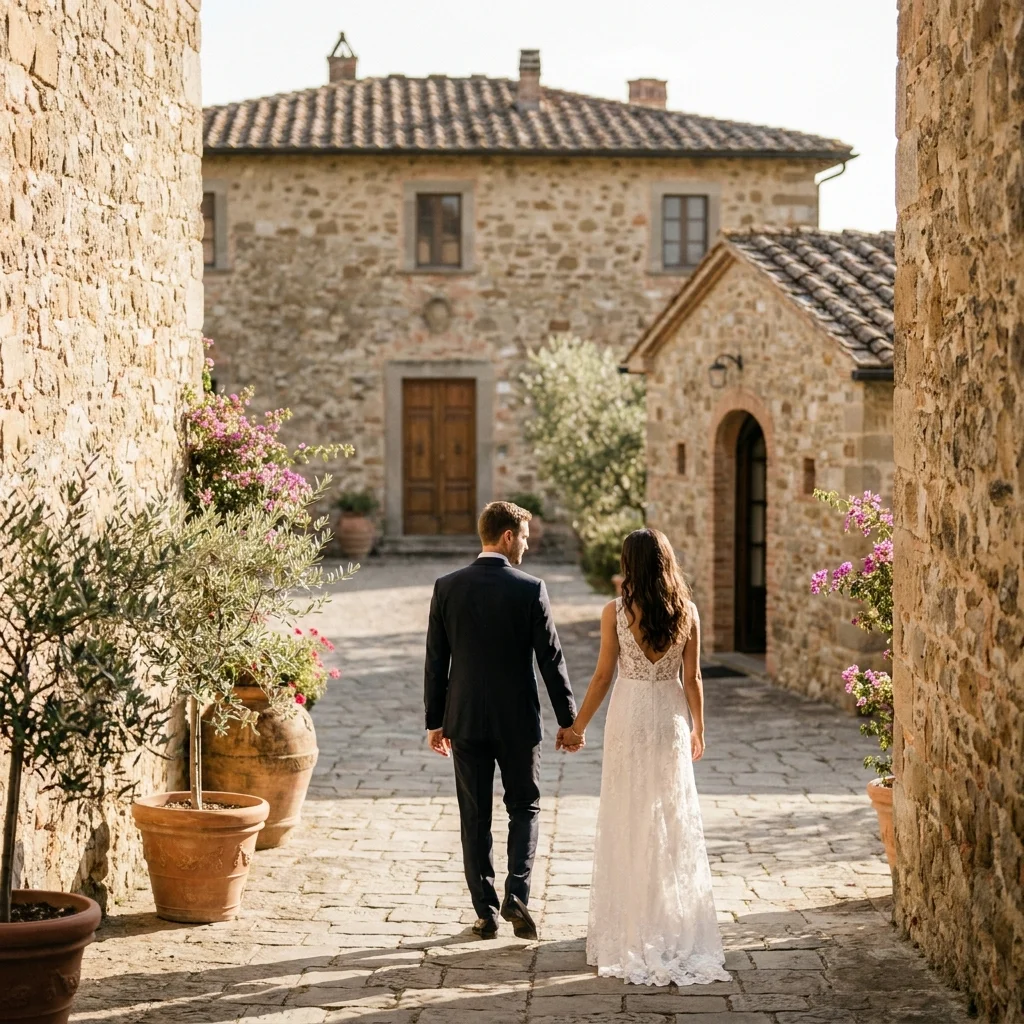
What “Sleeps 20” Actually Means — and Why Capacity Is the First Filter at Inquiry Stage
Most Italian wedding estates advertise a sleep count. A Tuscan villa might say “sleeps 24.” A Lake Como property might list “14 bedrooms.” These numbers deserve scrutiny. Sleep counts often include pull-out sofas, children’s beds, or annexed cottages that sit a five-minute walk from the main house. For a luxury celebration, the usable capacity is usually 60–75% of the advertised maximum, because your guests are not backpackers — they expect a private bathroom, a proper bed, and proximity to the event spaces.
During the initial inquiry phase, we filter properties by three dimensions simultaneously: guest count, bedroom quality, and the ratio of on-site to overflow beds needed. A couple planning a villa wedding in Italy for 80 guests, for instance, might house 30 on-site and need a nearby cluster for the remaining 50. That ratio shapes everything — transport logistics, breakfast service, the timing of the welcome evening, and even the ceremony start time.
We map these variables before the first venue visit. The result is a lodging brief that accompanies every shortlist, so no couple falls in love with a property only to discover it cannot comfortably host their guest profile.
The Real Cost Architecture of a Villa Buyout vs. a Room Block — and Who Pays for What
Here is where wedding guest accommodation in Italy becomes genuinely complex. Italian venue contracts distinguish between two revenue streams: the venue hire fee (for exclusive use of event spaces) and the accommodation revenue (room nights). Some estates bundle both. Others separate them entirely. Understanding this split is essential before signing anything.
A full buyout means you rent the entire property — event spaces, bedrooms, gardens, pool — for a fixed period, typically three to five nights. Guests stay on-site, and the couple either absorbs the room cost or asks guests to contribute. A room block, by contrast, is a pre-negotiated allocation at a nearby hotel, held under a group rate with a release date (usually 60–90 days before the wedding).
| Accommodation Model | Indicative Cost Range | What Is Typically Included | What Is Quoted Separately |
|---|---|---|---|
| Full villa buyout (Tuscany, sleeps 20–30) | €15,000–€45,000 for 3-night minimum | Exclusive use of all spaces, bedrooms, gardens, pool; daily housekeeping; welcome setup | Catering, floral design, transport, VAT (IVA 22%), tourist tax, extra cleaning for events |
| Full villa buyout (Lake Como, sleeps 12–20) | €20,000–€60,000 for 3-night minimum | Exclusive use, bedrooms, private dock or garden access; concierge during stay | Catering, permits, floral, VAT (IVA 22%), boat transfers, tourist tax |
| Room block at 4-star hotel (Amalfi Coast, 20 rooms) | €180–€450 per room per night | Room, breakfast, group rate guarantee, hold until release date | Transfer to venue, welcome bags, tourist tax (€1–€5/person/night), VAT included in rate |
| Agriturismo cluster (Umbria/Tuscany, 8–15 rooms) | €120–€280 per room per night | Room, breakfast, parking, garden access | Transport to venue, additional meals, tourist tax, VAT included in rate |
Indicative ranges based on 2024–2025 season. Contact Kiss Me Italy for a personalized proposal.
The question of who pays is one we navigate with particular care. In many Anglo-American traditions, guests cover their own hotel rooms. In Italian culture, hosting guests on-site at your villa is an act of generosity — the couple absorbs the cost. For destination weddings, the most elegant approach often sits between: the couple hosts the wedding night and perhaps one additional night, while guests cover remaining nights at the overflow properties. We draft the wording for this communication so it reads as hospitality, never as an invoice.
Minimum-Stay Clauses and Cancellation Windows: The Contract Details That Protect Your Budget
Italian wedding venues — particularly private estates — almost universally require a minimum stay of two to four nights during peak season (May through October). This is not negotiable. It is how these properties sustain their business model, and it is also, frankly, what makes a destination wedding feel like a destination rather than a day trip.
What catches couples off guard is the interaction between the minimum stay and the guest payment structure. If the villa requires a three-night buyout at €12,000 per night, that €36,000 is committed regardless of how many guests actually stay all three nights. Some guests will arrive the day before and leave the morning after. Others will stay the full duration. We model these scenarios early, building a realistic occupancy forecast so the couple understands their true per-guest cost.
Cancellation policies vary. Most estates require a 50% deposit at booking, with the balance due 60–90 days before arrival. Room blocks at hotels typically carry a penalty-free release date, after which unbooked rooms revert to the hotel’s general inventory. We negotiate these terms as part of the accommodation plan, ensuring the couple has flexibility without financial exposure. Understanding how to get married in Italy as a foreigner involves navigating precisely these contractual layers — and we handle each one.
Why Guest Profile — Not Just Guest Count — Determines the Right Lodging Mix
A guest list of 60 can require wildly different accommodation strategies depending on who those 60 people are. This is the dimension most venue-search platforms ignore entirely. We do not.
Consider the variables. Elderly relatives need ground-floor rooms, proximity to the event, and reliable air conditioning — a charming but steep hillside agriturismo is not appropriate. Families with young children benefit from self-contained apartments with kitchenettes, ideally a short walk (not a shuttle ride) from the main property. International guests arriving from different time zones need early check-in flexibility, which not every property grants without negotiation.
We build a guest accommodation matrix during the planning phase. Each guest or family unit is assigned a lodging tier — on-site, near-site, or overflow — based on their relationship to the couple, their mobility, their travel itinerary, and their likely participation in multi-day programming. The result is a lodging plan that feels personal, not algorithmic. It is the difference between a guest finding a handwritten welcome note and a particular shade of seasonal flowers in their room, and a guest receiving a generic booking confirmation.
For couples considering a more intimate celebration, our approach to micro weddings in Italy often simplifies this matrix dramatically — but the same care applies.
The Week-Of Choreography: Check-In Timing, Luggage Flow, and Room Assignment Logistics
This section is deliberately technical, because this is where the invisible work happens.
Check-in and check-out timing at Italian properties follows a standard rhythm: check-in at 15:00, check-out by 10:00. On a wedding weekend, these windows create friction. Guests arriving for a Friday welcome dinner may land at Milan Malpensa at 11:00 and reach the villa by 13:30 — ninety minutes before their room is ready. Meanwhile, the floral team is installing the ceremony arch, the caterer is receiving deliveries, and the couple is doing a final walkthrough.
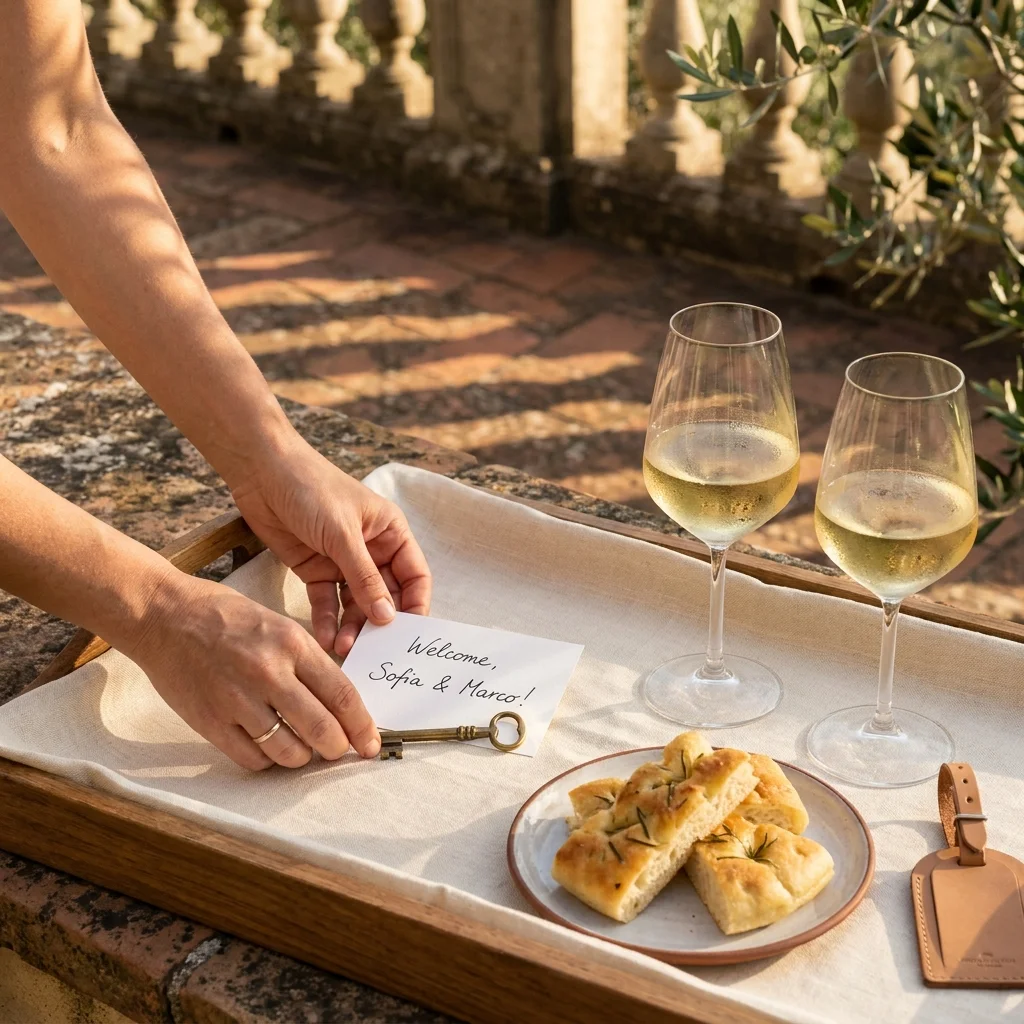
We solve this by negotiating early check-in for priority guests, designating a luggage-drop area with a member of our team present, and scheduling a light welcome refreshment (perhaps chilled Vermentino and focaccia on the terrace) that occupies guests gracefully while rooms are finalized. The atmosphere of arrival matters enormously. It sets the emotional register for the entire weekend.
On checkout day — typically the morning after the wedding — we coordinate a staggered departure schedule. Guests with early flights receive wake-up calls and pre-arranged transfers. Those staying an additional night at overflow properties have their luggage moved seamlessly. The couple, ideally, is still asleep.
Transport choreography between the venue and overflow lodging is a subject we address in depth in our approach to luxury wedding venues in Italy, where the distance between sleeping and celebrating is always a design consideration.
How On-Site Accommodation Transforms Ceremony-Day Timing and Atmosphere
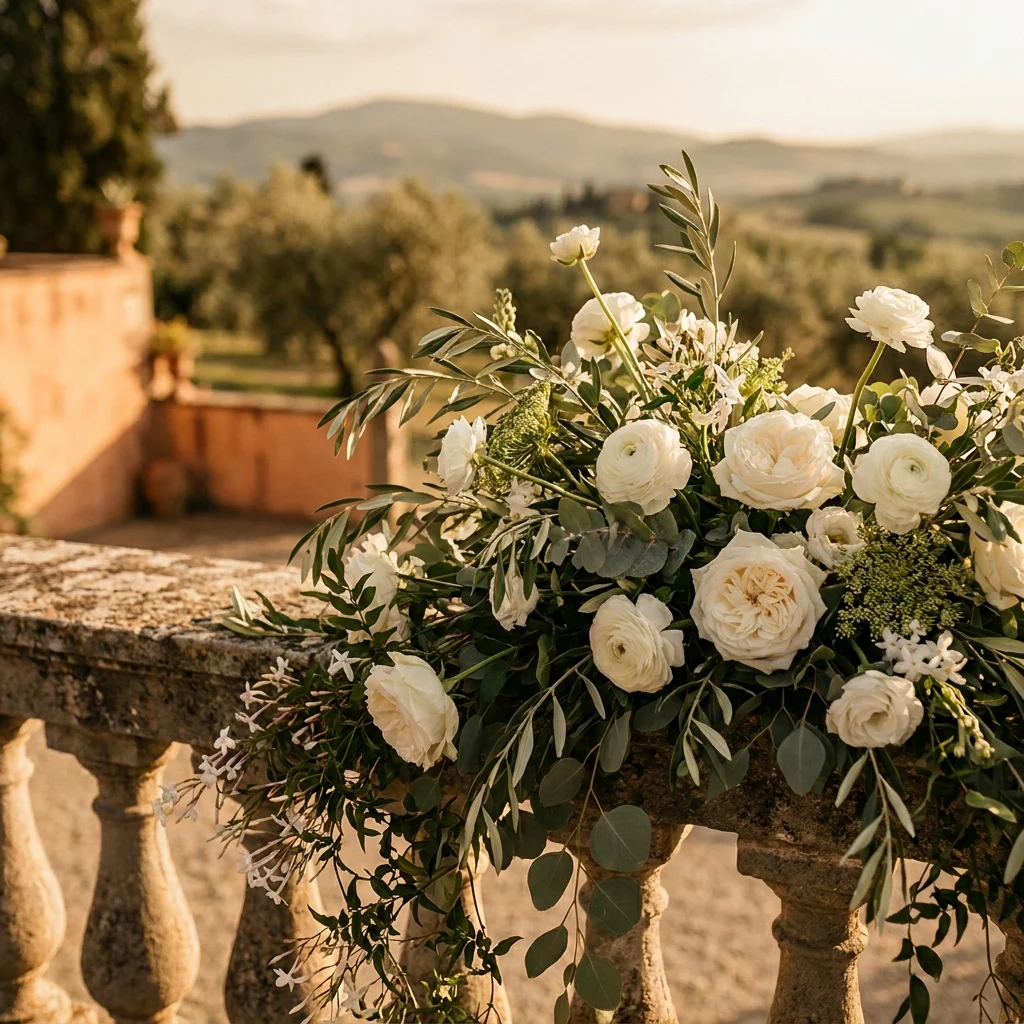
The texture of linen curtains catching late-afternoon Tuscan light. The particular scent of terracotta tiles cooled by evening air. The sound of gravel under a guest’s shoes as they walk from their room to the welcome aperitivo without once checking a map. These are the sensory details that distinguish a well-planned accommodation experience from a merely functional one. I think of guest lodging the way I think of a botanical arrangement: every element has a position, a reason, and a relationship to the whole. When we manage wedding guest accommodation in Italy, we are designing the atmosphere of arrival, rest, and reunion — the invisible scaffolding that holds the celebration together.
When guests sleep where they celebrate, the day unfolds differently. There is no bus to catch. No GPS to consult. No anxiety about parking. The morning has a particular quality — barefoot on warm stone, the smell of espresso drifting from the kitchen, the sound of a garden being prepared. I have watched guests drift toward the ceremony space an hour early simply because the light was beautiful and there was nowhere else they needed to be.
This proximity changes the ceremony start time. Instead of scheduling around guest transport (which on the Amalfi Coast can mean narrow roads and 40-minute transfers), we can place the ceremony at the golden hour — 17:30 in June, 16:00 in late October — knowing every guest is already on-site. The seasonal light becomes a design material, not a logistical constraint.
On-site stays also enable the multi-day programming that distinguishes a destination wedding from a one-evening event. A traditional Italian wedding food experience might begin with a casual Friday-evening pizza party by the pool, continue with the formal Saturday celebration, and close with a Sunday-morning brunch under the pergola. Each meal, each gathering, is a layer in the composition — and all of it is possible only because guests are there, rested, and together.
Lake, Coast, Countryside: How Italian Geography Shapes Your Accommodation Strategy
Not all Italian regions present the same accommodation landscape. The constraints are real, and they are actually planning advantages when understood early.
Lake Como and Lake Garda: Waterfront villas tend to be intimate — sleeping 12 to 20 — with limited overflow options within walking distance. Hotel clusters exist in the lakeside towns (Bellagio, Varenna, Sirmione), but they fill quickly during summer. A Lake Como wedding with 80 guests typically requires booking overflow hotels 10–12 months in advance. Boat transfers between lodging and venue add a romantic but weather-dependent variable. For Lake Garda celebrations, the eastern shore offers more hotel inventory than the western, which matters when building a room block.
Tuscany and Umbria: The countryside estate model is ideal for wedding guest accommodation in Italy. Properties here tend to be larger — sleeping 25 to 40 — and surrounded by agriturismi and boutique hotels within a 10–15 minute drive. The landscape itself is the overflow strategy: rolling hills dotted with small properties, each with its own character. A Tuscan wedding venue with a strong accommodation plan can house an entire guest list within a five-kilometer radius.
Amalfi Coast and coastal villages: Accommodation is the most constrained here. Hotels are terraced into cliffs. Rooms are smaller. Availability is fiercely competitive from June through September. The Amalfi Coast wedding cost often reflects this scarcity — room rates in Positano and Ravello can exceed €500 per night in peak season. We often recommend shoulder-season dates (late April, early October) where the Mediterranean light is equally extraordinary and room inventory opens significantly.
Venice: A city without cars, where luggage must travel by water taxi. The Venice wedding cost includes a transport layer that mainland destinations simply do not. We coordinate water-taxi arrivals, negotiate palazzo room blocks, and time guest movements to avoid the midday tourist congestion on the canals.
What Overflow Lodging Actually Costs — and How We Structure the Financial Architecture
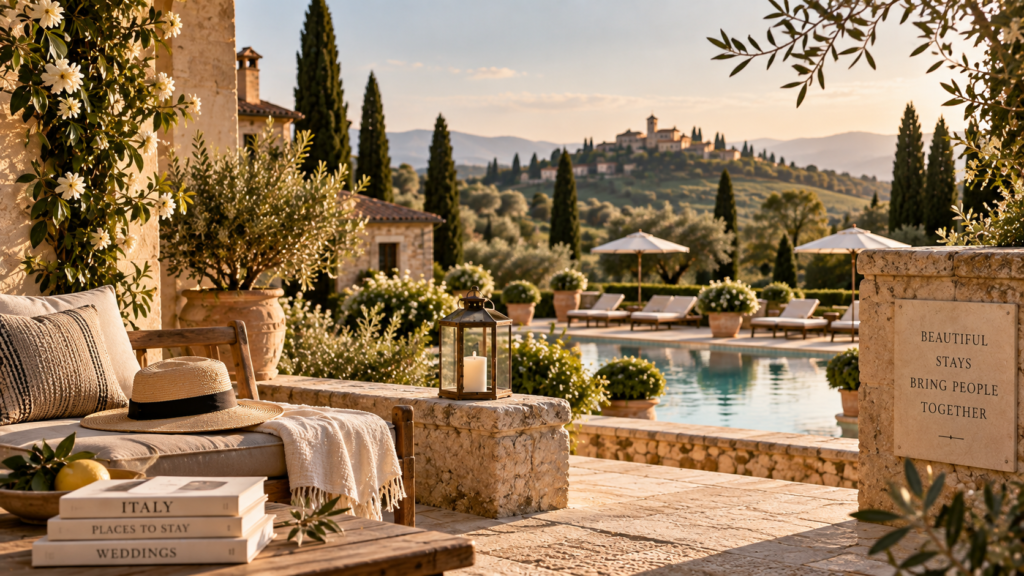
The term “overflow” sounds secondary. It should not. For many guests, the overflow property is their primary experience of the destination. We select these properties with the same sensory criteria we apply to the main venue: the quality of the bed linens, the scent of the garden at night, the view from the breakfast terrace.
| Region | Overflow Property Type | Cost per Room per Night | Included | Quoted Separately |
|---|---|---|---|---|
| Tuscany | Boutique agriturismo (4–10 rooms) | €150–€320 | Room, breakfast, parking, pool access | Dinner, transport to venue, tourist tax (€1–€3/person/night) |
| Lake Como | 4-star lakeside hotel (room block) | €220–€500 | Room, breakfast, group rate, lake-view upgrade (subject to availability) | Boat transfer, minibar, tourist tax (€2–€5/person/night) |
| Amalfi Coast | Boutique hotel Ravello/Praiano | €280–€600 | Room, breakfast, terrace access | Private car/boat to venue, tourist tax, VAT included in rate |
| Liguria (Portofino area) | 3- to 4-star hotel Santa Margherita | €160–€380 | Room, breakfast, central location | Boat or car to venue, tourist tax |
Indicative ranges for 2024–2025 high season. Contact Kiss Me Italy for a personalized accommodation plan.
We also clarify the tourist tax — tassa di soggiorno — which guests pay directly to the property, typically €1–€5 per person per night depending on the municipality and hotel star rating. It is a small amount, but mentioning it in the guest information booklet prevents confusion at checkout.
Guest Payment Etiquette: The Wording That Makes Financial Clarity Feel Gracious
This is the section couples find most uncomfortable to discuss — and the one where our guidance matters most.
When the couple hosts all accommodation (full buyout, costs absorbed), the guest communication is straightforward: “Your room at the villa has been arranged for Friday through Sunday. A welcome package will be waiting.” Elegant. Simple.
When guests are expected to book and pay for their own overflow rooms, the language must be equally clear but warmer: “We have reserved a selection of rooms at [Property Name] at a preferred rate for our wedding weekend. You may book directly using the link below by [release date].” We draft this language, embed it in the wedding website, and manage the booking link logistics.
The hybrid model — couple hosts one or two nights, guests cover the rest — requires the most delicate communication. We typically structure it as: “Friday and Saturday nights at the villa are our gift to you. For those wishing to extend their stay, [nearby property] offers a lovely option at a group rate.” The tactile detail of a welcome bag in the guest’s room — perhaps seasonal fruit, a hand-drawn map, a small bottle of local olive oil — reinforces that this is hospitality, not a transaction.
For couples navigating guest-list dynamics alongside accommodation decisions, our perspective on personalized wedding planning in Italy addresses how we balance intimacy with logistics.
The Transport Layer Between Lodging and Celebration — Timed to the Minute
| Transport Type | Indicative Cost | Included | Quoted Separately |
|---|---|---|---|
| Luxury minivan shuttle (8-seater, round trip, up to 30 km) | €350–€600 per vehicle per round trip | Driver, fuel, insurance, scheduled pickup/return | Waiting time beyond 6 hours, tolls, VAT (IVA 22%) if not in rate |
| Private boat transfer (Lake Como, one way, up to 8 guests) | €400–€900 per trip | Captain, fuel, dock fees at origin | Dock fees at destination, gratuity, VAT (IVA 22%) |
| Vintage car for couple (ceremony to reception, up to 2 hours) | €800–€1,800 | Driver, vehicle, fuel, insurance | Additional hours, decoration, VAT (IVA 22%) |
Indicative ranges. Contact Kiss Me Italy for transport coordination tailored to your venue and guest count.
We build a transport schedule that accounts for the last guest leaving the overflow hotel, the first guest needing to return (parents with young children, elderly relatives), and the end-of-evening departure. Every shuttle is timed to the wedding timeline — not the other way around. The couple never sees a logistics spreadsheet. They see guests arriving on time, relaxed, with a glass already in hand.
When Guest Accommodation Becomes Part of the Design — Not a Problem to Solve
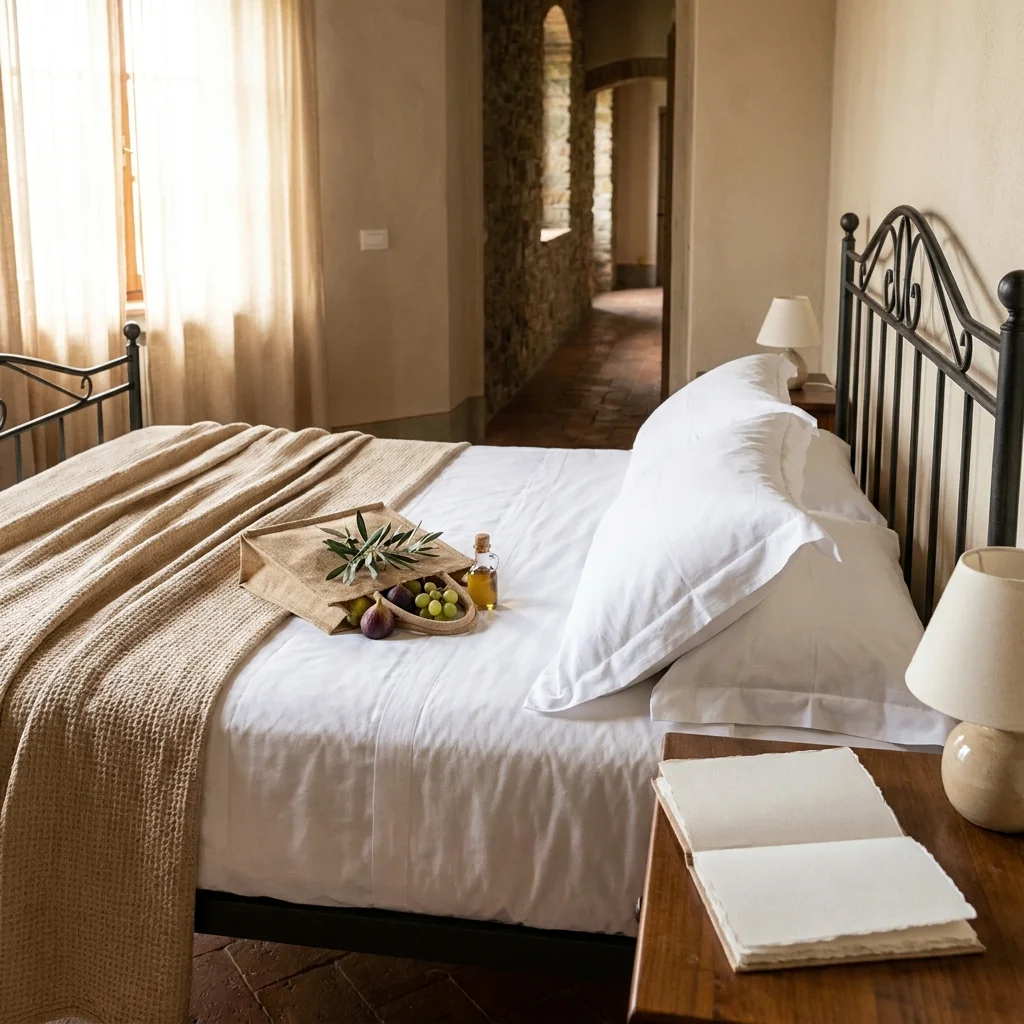
I return, always, to the sensory. The way a foraged rosemary sprig on a guest’s pillow connects them to the landscape before they have even seen the ceremony space. The texture of hand-pressed stationery in a welcome envelope. The particular Mediterranean warmth of a stone corridor at dusk, leading from a bedroom to a candlelit courtyard. Wedding guest accommodation in Italy, when managed with intention, is not logistics. It is the first and last impression of the celebration.
At Kiss Me Italy, we design accommodation plans that are as considered as the floral installations, as precise as the ceremony timeline, and as personal as the vows. Every room assignment, every transfer, every welcome detail is part of a larger composition — one that your guests will remember not as “the hotel was nice” but as “the entire weekend felt like it was made for us.”
If you are beginning to imagine how your guests will experience Italy — not just your wedding day but the mornings before and the mornings after — we would welcome the conversation. Reach out to our team and let us begin shaping the accommodation architecture that holds your celebration together.
Frequently Asked Questions About Wedding Guest Accommodation in Italy
Should we create a single booking page for guests, or let each property manage reservations?
For multi-property lodging plans, a single, brand-consistent booking page prevents confusion and reduces guest emails. We typically present curated options by tier (on-site, near-site, overflow), list what is included (breakfast, parking, views), and provide the correct booking method for each property (code, dedicated contact, or link), so guests feel guided rather than “sent to search.”
How do we handle guests who book outside the room block and still expect shuttle service?
We define “official” pickup points tied to the curated lodging cluster and communicate them clearly. Guests who choose alternative hotels are welcome to join the celebration, but transport is routed to the planned stops to protect timing, comfort, and budget. When needed, we can arrange private transfers for out-of-cluster guests as an add-on.
What is the most discreet way to prioritize the best on-site rooms for family and VIP guests?
We build a private rooming list with the couple and share only what each guest needs to know: their room name/number, check-in details, and who to contact on arrival. The “why” behind assignments is never discussed publicly. This preserves elegance and avoids the social friction that can arise when room categories vary.
Can we offer different accommodation price tiers without making the weekend feel fragmented?
Yes—when the tiers are curated, not random. We select overflow properties that share a coherent aesthetic and service standard, then unify the experience with consistent welcome materials, clear transport, and a shared “home base” schedule (welcome aperitivo, ceremony timing, brunch). Guests remember the flow, not the price differences.
What information should be in the guest accommodation booklet to reduce last-minute messages?
The essentials: exact addresses and pin links, check-in/out times, luggage instructions, breakfast hours, dress codes for each event, shuttle pickup points and times, local taxi numbers, and a single on-the-ground contact for the weekend. We write this in a hospitality tone—clear, calm, and concise—so guests feel looked after.
How do you prevent the couple from becoming the “front desk” during the wedding weekend?
We assign a dedicated accommodation lead who manages arrivals, keys, luggage flow, and guest questions, and we coordinate directly with each property’s reception or concierge. Guests receive one point of contact for the weekend, so the couple stays fully present—never troubleshooting room logistics between photos and dinner.