A wedding welcome bag in Italy typically costs between €25 and €250 per guest, depending on the level of curation, regional sourcing, and whether hotel room-drop coordination is included. Kiss Me Italy designs and delivers these welcome packages as a fully managed guest-experience touchpoint — from artisan sourcing and multilingual insert cards to timed delivery across multiple hotels — so that every guest’s first impression of your Italian wedding weekend begins before the ceremony itself.
Italian Wedding Welcome Bags
Most couples planning a destination wedding in Italy underestimate one detail that shapes the entire guest experience: what happens between airport arrival and the welcome dinner. Your guests have traveled six, eight, twelve hours. They’re jet-lagged, possibly disoriented, and often checking into a hotel where no one at reception speaks their language. The wedding welcome bag is not a gift basket. It is the first managed moment of your celebration — and in our experience, it sets the emotional register for everything that follows. After thirty years of coordinating destination weddings across Tuscany, the Amalfi Coast, Venice, Lake Como, and Liguria, I can tell you that the couples we work with remember the welcome bag long after the confetti has been swept away.
Why the Welcome Bag Conversation Starts Eight Months Before the Wedding
A genuine Italian wedding welcome bag is not assembled the week before. It is sourced, tested, designed, and coordinated across a timeline that begins at least eight months before the event. Here is why: the best artisan producers in Tuscany and Campania — the ones whose olive oil, biscotti, or limoncello you actually want in a welcome bag — require minimum orders placed months in advance, especially during peak wedding season from May through October.
When couples reach out to us through our contact page, the welcome bag is one of the earliest conversations we initiate. Not because it is the most complex element of the wedding, but because it intersects with so many others: guest count confirmation, hotel selection, dietary restrictions, and the overall design language of the celebration. A welcome bag that feels disconnected from the wedding’s aesthetic — wrong color palette, generic products, a tone that clashes with the invitation suite — undermines the very cohesion it is supposed to create.
What most planners miss is that Italy’s artisan supply chain operates on its own calendar. A hand-selected ceramicist near Ravello may need twelve weeks for custom-painted tiles. A small-batch torrone producer in Piedmont shuts production entirely in August. We know these rhythms because we have navigated them for three decades.
The Restraint Principle: Why We Remove Items More Often Than We Add Them
There is a persistent instinct among couples to overfill welcome bags. More items, more generosity — the logic seems sound. But after thirty years, I have learned the opposite is true. Luxury is restraint. Your guests are arriving with suitcases already at capacity. A bulky, overloaded tote creates a storage problem in a boutique hotel room, not a warm feeling.
Our curation philosophy is simple. Every item must pass three tests: Is it useful within the first 24 hours? Does it reflect the region where the wedding takes place? Would a guest be disappointed if it were missing? If an item fails any one of these, it does not make the cut.
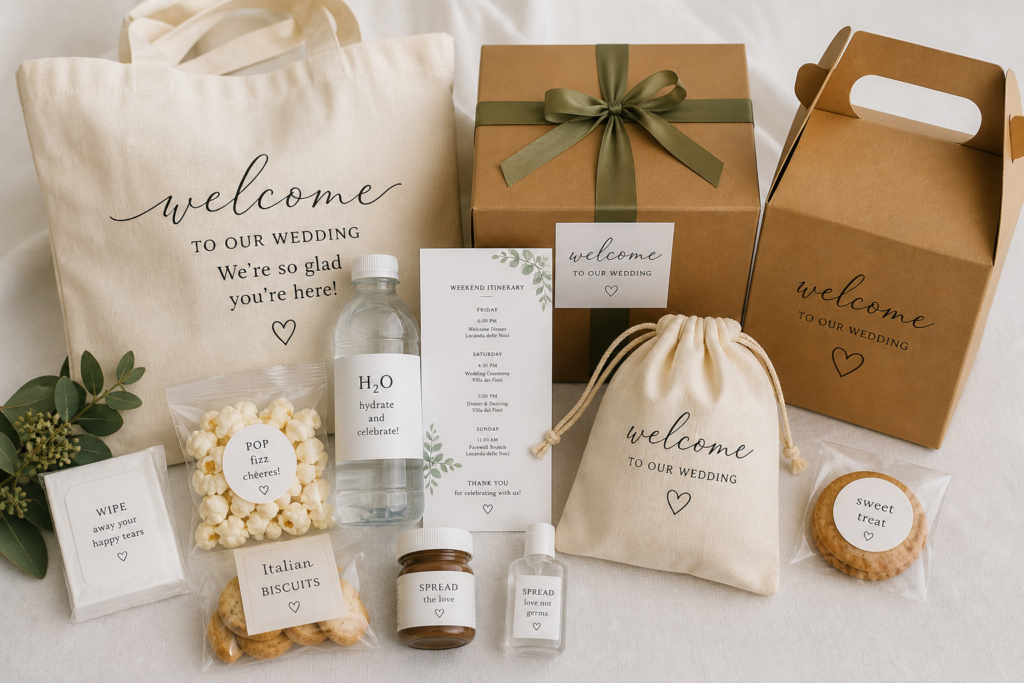
This means we often remove the third variety of biscotti, the oversized candle, the decorative item that photographs well but serves no purpose. What remains is a tight, elegant selection — typically five to seven items — that feels intentional rather than abundant. The couples we work with are often surprised by how much more refined the final bag looks once we’ve edited it down. If you are exploring broader approaches to personalized wedding planning in Italy, this same restraint philosophy runs through every element we design.
What Belongs in an Italian Wedding Welcome Gift — Region by Region
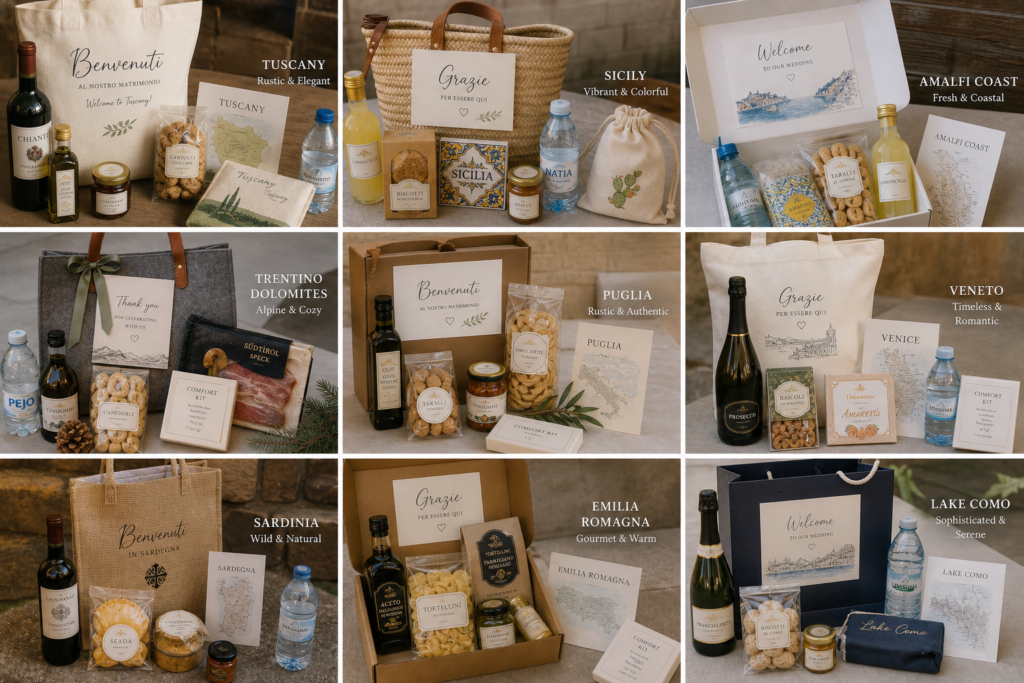
A destination wedding welcome bag should feel native to the place. A welcome bag for a Tuscany wedding and one for a Venice wedding should not contain the same products. Here is how we approach regional curation:
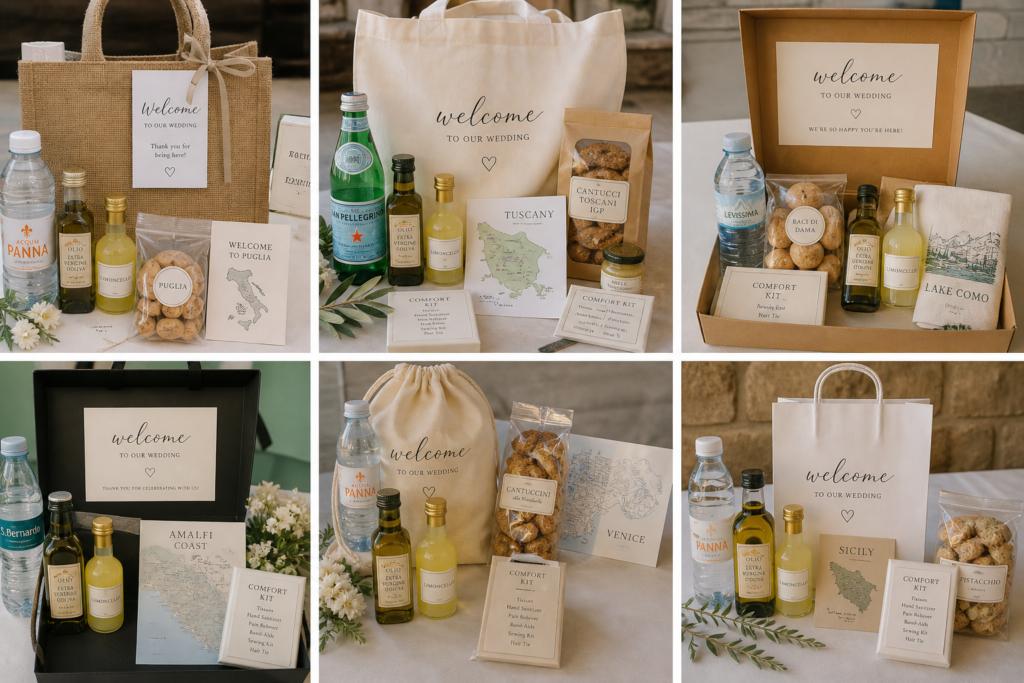
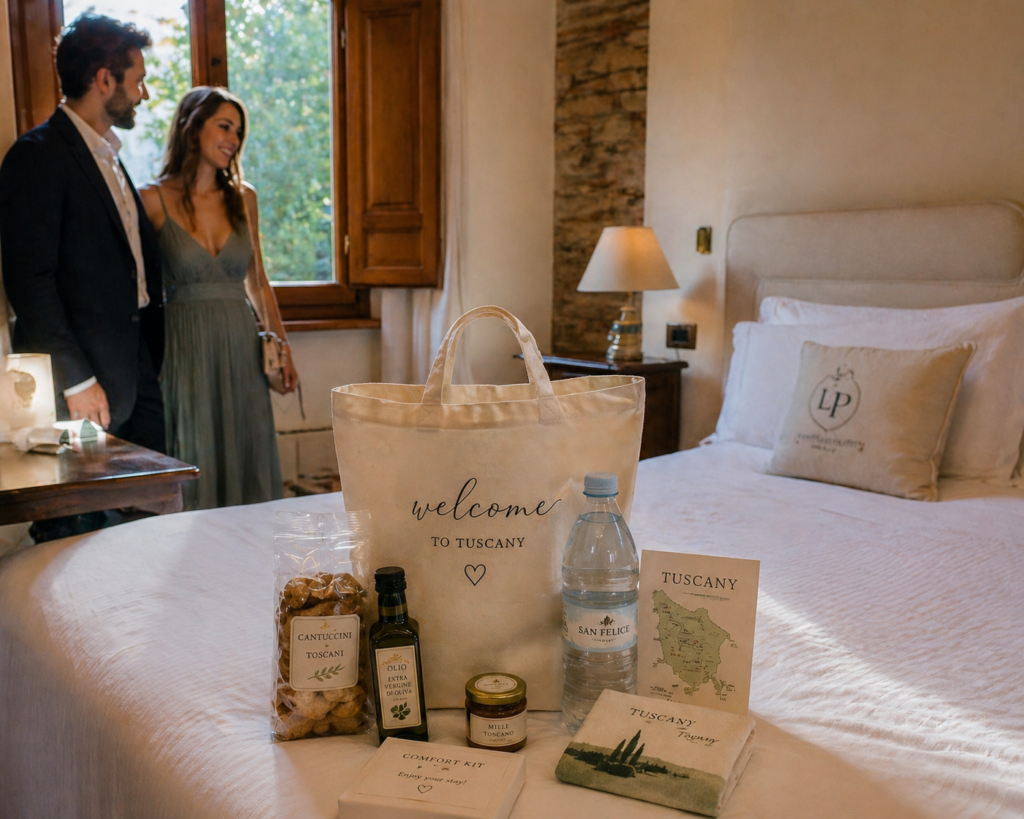
Tuscany and Umbria: Cold-pressed olive oil in a hand-labeled bottle (100–250 ml), cantucci from a family bakery, a linen pouch of dried lavender, a small bottle of still water, and a printed itinerary card on textured stock. For autumn weddings, we sometimes include a miniature jar of chestnut honey — a product that surprises guests who associate Italy only with citrus.
Amalfi Coast and Campania: Limoncello in a ceramic bottle (a functional keepsake), sfogliatella or lemon-almond biscuits, SPF lip balm (essential for outdoor ceremonies along the coast between June and September), a folding fan in the wedding’s color palette, and a waterproof pouch for boat transfers. Couples planning celebrations in this region often find our guide to Amalfi Coast wedding costs helpful for understanding how regional sourcing affects overall budgets.
Lake Como and the Italian Lakes: Locally produced grappa or herbal digestif, artisan chocolate from a lakeside pasticceria, a silk-blend scarf or pocket square (evenings on the lake drop to 15°C even in July), and a printed map of the lake with marked points of interest for guest downtime.
Venice: A miniature bottle of prosecco from the Veneto hills, handmade baicoli biscuits, a Murano glass token (small enough to slip into a carry-on), and a vaporetto route card with marked stops relevant to the wedding weekend. For couples considering a Venice wedding, the welcome bag often doubles as a practical navigation tool for guests unfamiliar with water-based transport.
Travel Accessories and Recovery Items: The Category Most Couples Overlook
Regional delicacies make a welcome bag feel Italian. But the items guests reach for first are almost always practical. After a long-haul flight, your guests want hydration, orientation, and comfort — in that order.
We include a curated set of travel-comfort essentials in every bag we design: a high-quality reusable water bottle or a pair of glass-bottled still waters, a packet of electrolyte powder (discreetly branded to match the wedding aesthetic), blister plasters for cobblestone walking, and a small tube of hand cream. These are not glamorous. They are used within the first hour.
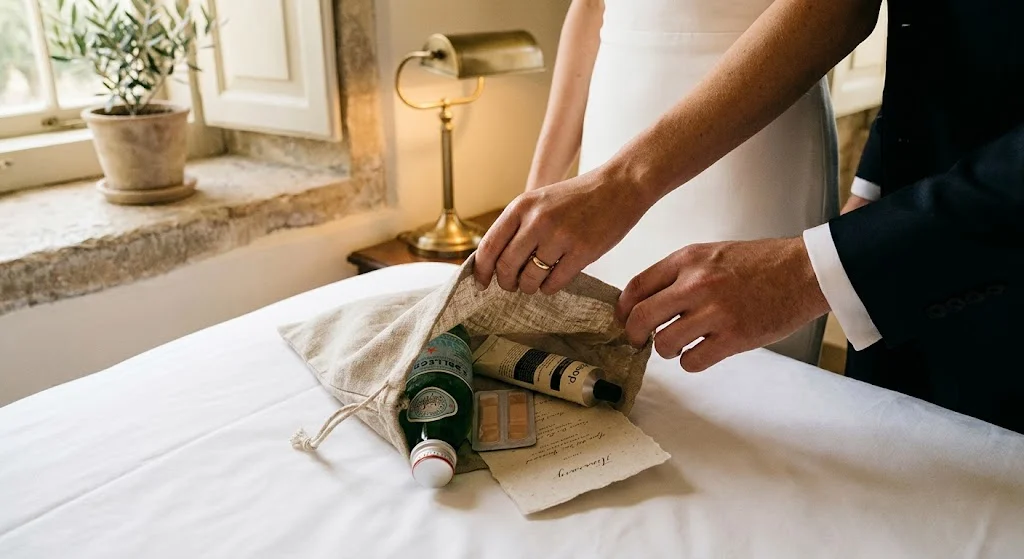
For weddings with a post-ceremony brunch the following day, we also prepare a next-morning recovery pouch — a separate, smaller package left in rooms during the reception. It contains sparkling water, a citrus-infused face mist, paracetamol, and a handwritten card from the couple thanking guests for celebrating with them. This second touchpoint is something we developed over years of observing what guests actually need, and it has become one of the most appreciated details in the weddings we coordinate.
Real Cost Ranges for Italian Wedding Welcome Bags — With Full Inclusions

Pricing a wedding welcome bag in Italy depends on three variables: the number of guests, the level of artisan sourcing, and the complexity of hotel distribution. Below are the ranges we work within, drawn from our direct experience coordinating destination weddings across Italy.
| Tier | Per-Guest Cost | Included | Quoted Separately |
|---|---|---|---|
| Essential | €25–€70 | 4–5 regional food items, printed itinerary card, branded tote or linen bag, single-hotel room drop | Multi-hotel distribution, custom packaging design, recovery pouch, VAT (IVA 22%) |
| Curated | €60–€120 | 5–7 artisan items (food + 1 keepsake), multilingual insert, custom-printed packaging, room drop across up to 2 hotels | Third hotel or villa distribution, ceramic or glass keepsakes, recovery pouch, VAT (IVA 22%) |
| Bespoke | €120–€250+ | 6–8 hand-selected items including keepsake, fully custom packaging and ribbon, multilingual welcome booklet, room drop across up to 3 hotels, next-morning recovery pouch | Additional hotels beyond 3, monogrammed items requiring 12+ week lead time, VAT (IVA 22%) |
Indicative ranges. For a tailored welcome-bag concept and logistics plan, request a proposal.
For context, a 60-guest wedding at the Curated tier typically totals €3,000–€4,800 before VAT. This includes all sourcing, assembly, quality control, labeling, and coordinated delivery. What it does not include — and what we always clarify upfront — is the cost of any bespoke monogramming, custom ceramic production, or distribution to more than two separate hotel properties.
| Distribution Model | Cost Range | What’s Covered |
|---|---|---|
| Single hotel room drop | Included in all tiers | Coordination with hotel concierge, labeled bags delivered to each room 2–4 hours before guest check-in |
| Multi-hotel (2–3 properties) | €190–€450 total | Separate delivery runs, hotel-specific labeling, timing coordination across properties; driver and logistics team included |
| Villa or private estate delivery | €190–€500 total | On-site placement in guest rooms or communal welcome area; coordination with villa staff; VAT quoted separately |
Indicative ranges. For a tailored welcome-bag concept and logistics plan, request a proposal.
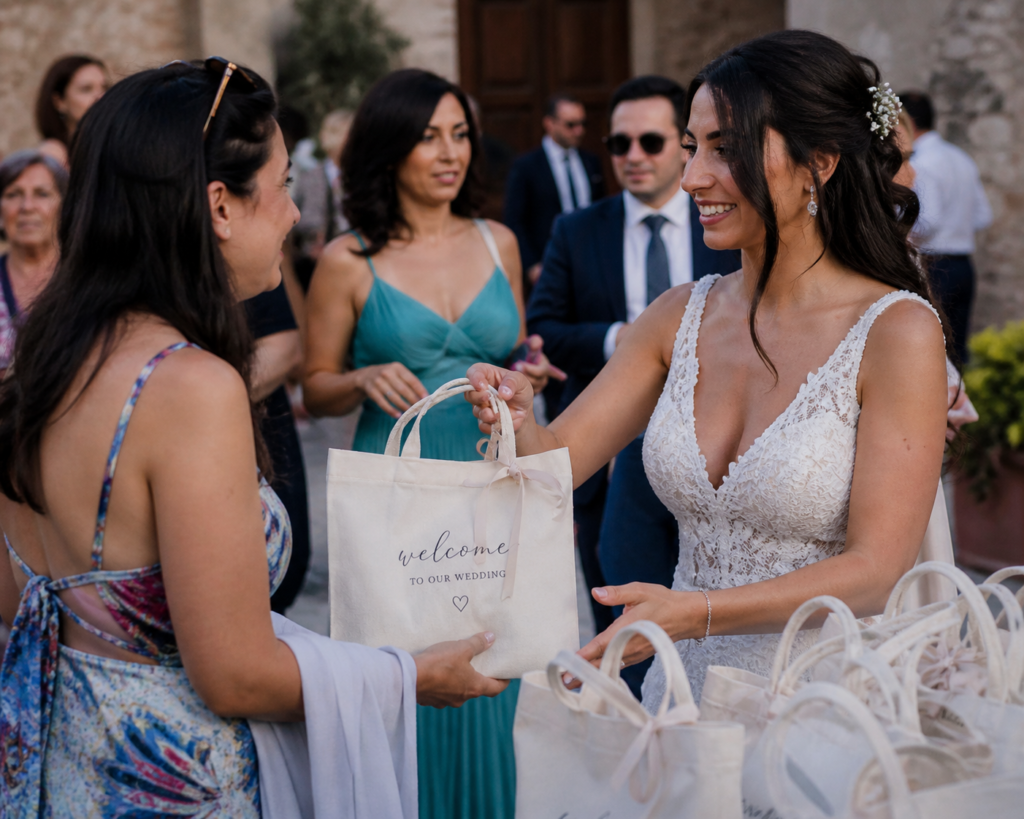
Hotel Room Drops, Staff Handoffs, and the Logistics That Protect Your Timeline
This is the section where the tone shifts, because this is where most welcome bag plans quietly fall apart. Distribution is not romantic. It is operational. And it is the difference between a guest finding a beautifully arranged bag on their bed and finding a pile of totes stacked behind a reception desk.
Here is how we manage it. Every bag is labeled with the guest’s name and room number. We confirm room assignments with the hotel 48 hours before check-in, then again the morning of delivery. Our logistics coordinator arrives at the property two to four hours before the first guest is expected, working directly with housekeeping staff to place bags in rooms after cleaning but before arrival. In high-season months — June through September — we build a 90-minute buffer into the schedule because hotel turnover can delay room readiness.
When guests are spread across multiple hotels, the coordination multiplies. We assign a dedicated driver for each delivery run, with bags sorted and loaded in labeled crates. Each hotel receives a printed manifest listing guest names, room numbers, and any special notes (dietary restrictions flagged on specific bags, for example). The hotel concierge signs off on receipt. We photograph the placement in at least two rooms as confirmation for the couple.
For couples hosting guests at a private villa in Italy, the process differs slightly — bags are placed in individual guest suites by our own team, often alongside a handwritten room card that orients guests to the property’s layout, Wi-Fi credentials, and the weekend schedule. This is the level of managed detail that transforms a welcome bag from a nice gesture into a genuine hospitality system.
Why Multilingual Insert Cards Matter More Than the Products Inside
In our experience, the single most-read item in any Italian wedding welcome bag is not the food. It is the printed insert. This card — or in the case of larger weddings, a small booklet — tells guests everything they need to know: the weekend timeline, transport details, emergency contacts, dress code reminders, and local recommendations for their free hours.
For international weddings, we produce these inserts in two or three languages. A recent wedding near Florence required English, Mandarin, and Italian. Another on the Amalfi Coast needed English, Hebrew, and French. We work with professional translators — never automated tools — because a mistranslated dress code or an unclear shuttle time creates real confusion for guests in an unfamiliar country.
The design of the insert matches the wedding’s visual identity: the same paper stock, the same typeface family, the same color references. It is a small production in itself, and we treat it as such. Couples who are navigating the legal requirements of marrying in Italy as foreigners often appreciate that we handle guest-facing communications with the same precision we bring to permit documentation.
How the Welcome Bag Connects to Your Wedding’s Design Language
A welcome bag is the first physical object your guests associate with your wedding. Its texture, color, and typography establish expectations. If your reception features a carefully considered Italian wedding menu with hand-lettered place cards and linen runners, but your welcome bag arrives in a generic kraft tote with a printed sticker, the disconnect is immediate.
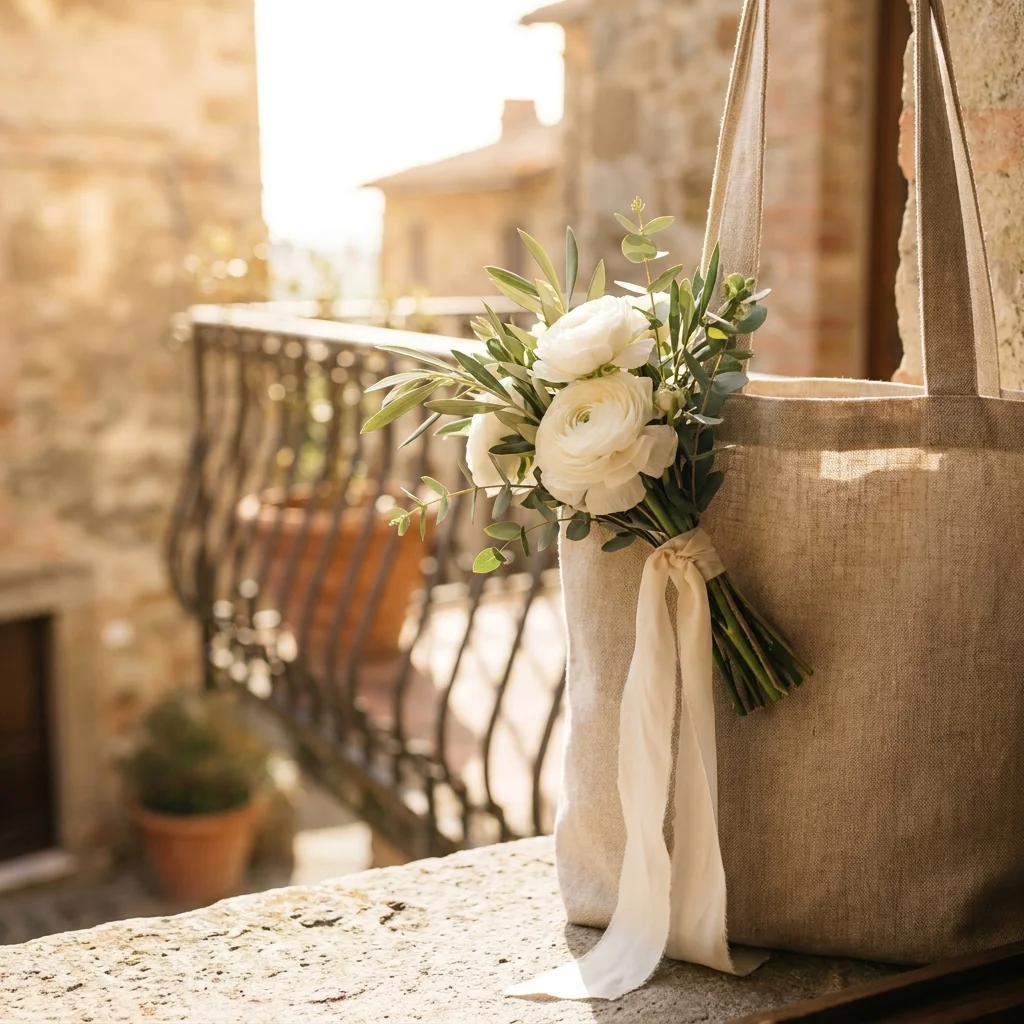
We design welcome bag packaging as part of the broader stationery suite. The bag itself — whether linen, cotton canvas, or a rigid box — is selected to complement the invitation design. Ribbon colors reference the floral palette. Labels are printed on the same stock as the ceremony programs. This is not decorative excess. It is visual coherence, and it signals to guests that every element of the weekend has been considered.
For couples working with us on a bespoke luxury wedding, the welcome bag design is typically finalized during the same creative session where we confirm table linens, menu card formats, and signage — usually four to five months before the wedding date.
The Week-of Assembly: Where Quality Control Happens Behind the Scenes
Five to seven days before the wedding, all welcome bag components arrive at our assembly location. Every item is inspected. Olive oil bottles are checked for leaks. Biscuits are confirmed fresh — we reject any batch with a best-before date less than three weeks out. Ceramic items are examined for chips. Printed materials are proofread one final time.
Assembly takes our team approximately four to six hours for a 60-guest wedding. Each bag is built to a precise layout: heavier items at the bottom, fragile items cushioned, the printed insert on top so it is the first thing a guest sees. Bags are then sealed, labeled, and organized into delivery crates by hotel.
This process is invisible to the couple. That is the point. By the time guests open their welcome bags, the sourcing, testing, assembly, and delivery have been managed across months — and the couple has spent zero hours on logistics. If you are beginning to plan your Italian destination wedding and want this level of coordination from the start, we invite you to reach out to our team.
The Post-Wedding Touchpoint: Next-Day Essentials That Close the Weekend
The wedding welcome bag opens the celebration. But the most thoughtful hosts also close it. We offer a next-morning recovery package as an optional add-on, delivered to guest rooms during the reception — typically between 10 PM and midnight, coordinated with hotel night staff.
Contents are simple and purposeful: two bottles of sparkling mineral water, a citrus face mist, a small packet of Italian espresso (for rooms with a coffee maker), paracetamol, and a thank-you card from the couple. The card often includes a gentle reminder about the traditional Italian wedding food they enjoyed and a note about any post-wedding gathering the following day.
This second delivery costs between €15 and €30 per guest, depending on contents, and follows the same hotel-coordination protocol as the initial room drop. It is a small investment with outsized emotional impact — guests wake up feeling cared for, not abandoned after the party ends.
| Recovery Package Option | Per-Guest Cost | Contents | Delivery Timing |
|---|---|---|---|
| Standard | €15–€39 | Sparkling water (x2), paracetamol, thank-you card | During reception (10 PM–midnight) |
| Enhanced | €25–€69 | Sparkling water (x2), citrus face mist, espresso packet, paracetamol, hand cream, thank-you card | During reception (10 PM–midnight) |
Indicative ranges. VAT (IVA 22%) quoted separately. Contact Kiss Me Italy for a personalized proposal.
A Managed Welcome Is the First Chapter of Your Italian Wedding Story
After thirty years of designing destination weddings in Italy, I have seen welcome bags evolve from an afterthought into one of the most meaningful guest touchpoints of the entire weekend. Done well — sourced with care, assembled with precision, delivered with hotel-ready coordination — a wedding welcome bag in Italy becomes the opening line of your celebration’s narrative. It tells your guests: you are in good hands, and every detail has been considered.
At Kiss Me Italy, we manage this process from first sourcing conversation to final room-drop photograph, so that the couple’s only role is to approve the design. Whether your wedding is a lakeside gathering for thirty guests at Lake Como or a 150-person celebration at a luxury venue in Tuscany, the welcome bag is where hospitality begins. We would be glad to design yours — let us start the conversation.
Frequently Asked Questions About Wedding Welcome Bags in Italy
Do welcome bags trigger customs or airline restrictions for guests flying home?
We curate with departure logistics in mind. Liquids are kept in travel-friendly sizes, fragile keepsakes are packed to survive carry-on handling, and we advise couples when a product is better reserved for an in-room moment rather than a take-home item. If your guest list includes multiple long-haul departures, we can tailor contents to minimize airport friction while preserving the Italian character of the welcome.
Can you coordinate welcome bags alongside shuttle schedules and late arrivals?
Yes. We align delivery windows with your arrival plan—flight clusters, shuttle departures, and concierge staffing—so guests who check in late still receive a polished welcome. When arrivals are staggered across a full day, we can stage a second placement window or arrange a controlled handoff protocol with the hotel to protect presentation.
What information do you need from us to begin (and when)?
To start, we request your venue area, hotel list (even provisional), guest count range, and any known dietary or cultural considerations. Once your rooming list is available, we move into labeling and manifests. This is why we recommend beginning the welcome-bag conversation early: it allows artisan sourcing and print production to run on a calm, controlled timeline.
Can the welcome bag design match our stationery and wedding crest exactly?
Absolutely. We can match paper stock, typography, and color references, and we can integrate a crest or monogram across labels, ribbons, and inserts. Where a design element requires specialty print methods or longer lead times, we will advise early so the result feels intentional—never rushed.
Do you offer a child-friendly welcome bag for families traveling with kids?
Yes. For family-heavy guest lists, we create a discreet children’s variant that feels consistent with the main design while being genuinely useful—think Italian snack options appropriate for children, a small activity card for travel downtime, and practical items parents appreciate at check-in. It’s a refined solution that avoids novelty items and keeps the overall presentation cohesive.
What happens if a supplier delivers late or an item arrives imperfect?
We build contingency into sourcing: vetted alternates, buffer time for re-orders, and quality control at intake. If an item fails inspection—leaks, chips, compromised packaging—we replace it before assembly. The goal is simple: your guests never see the problem, and your timeline stays intact.
Planning something special in Italy? Read also our guide: Handfasting Wedding in Italy: How to Plan a Meaningful Symbolic Ceremony.