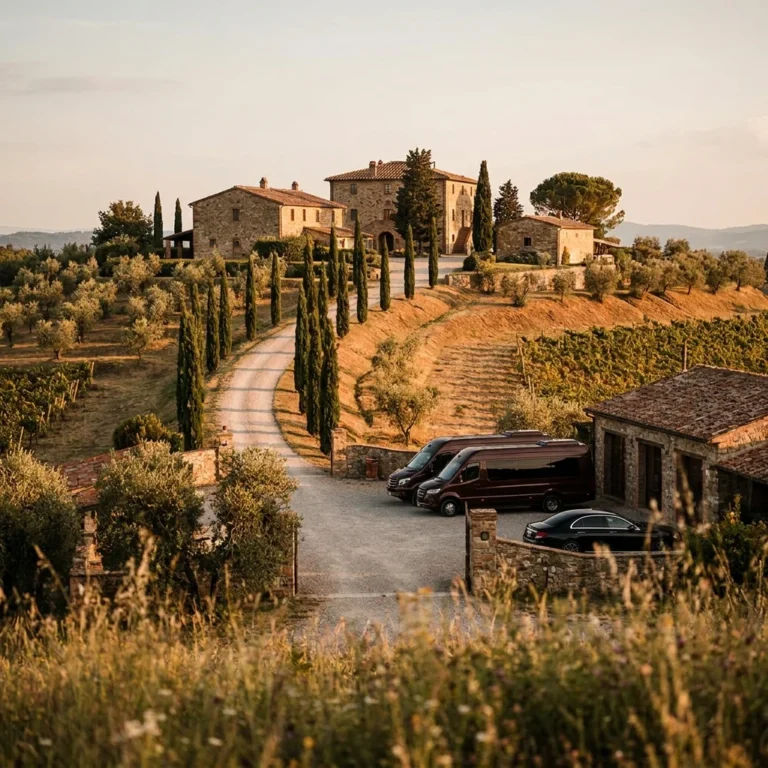
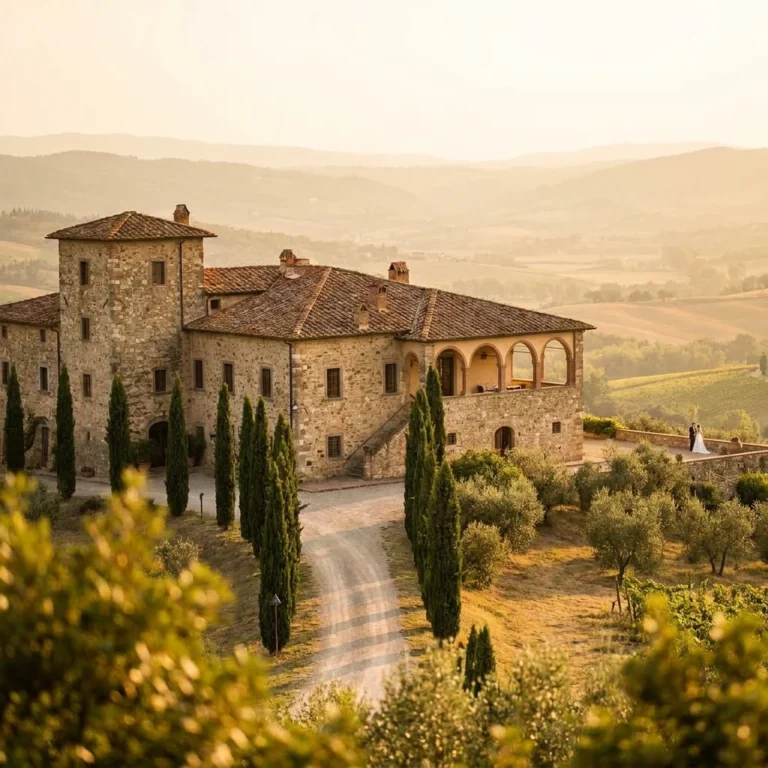
Most couples start with a guest list—then discover their venue contract, room inventory, and transport plan quietly set the real limit. In Italy, headcount is not a preference; it is the number that determines whether you can secure exclusivity, meet catering minimums, and move guests between events without delays or added fees.
Italy Wedding Guest Count
An Italy destination wedding guest list size typically ranges from 20 to 150 guests, with most luxury celebrations falling between 50 and 100. The ideal number depends on venue exclusivity clauses, regional transportation constraints, minimum catering spends, and the multi-day hospitality structure that defines a true Italian destination wedding. At Kiss Me Italy, we treat guest count as a design decision — one that shapes floral scale, seating rhythm, and the sensory experience of every room your guests enter.
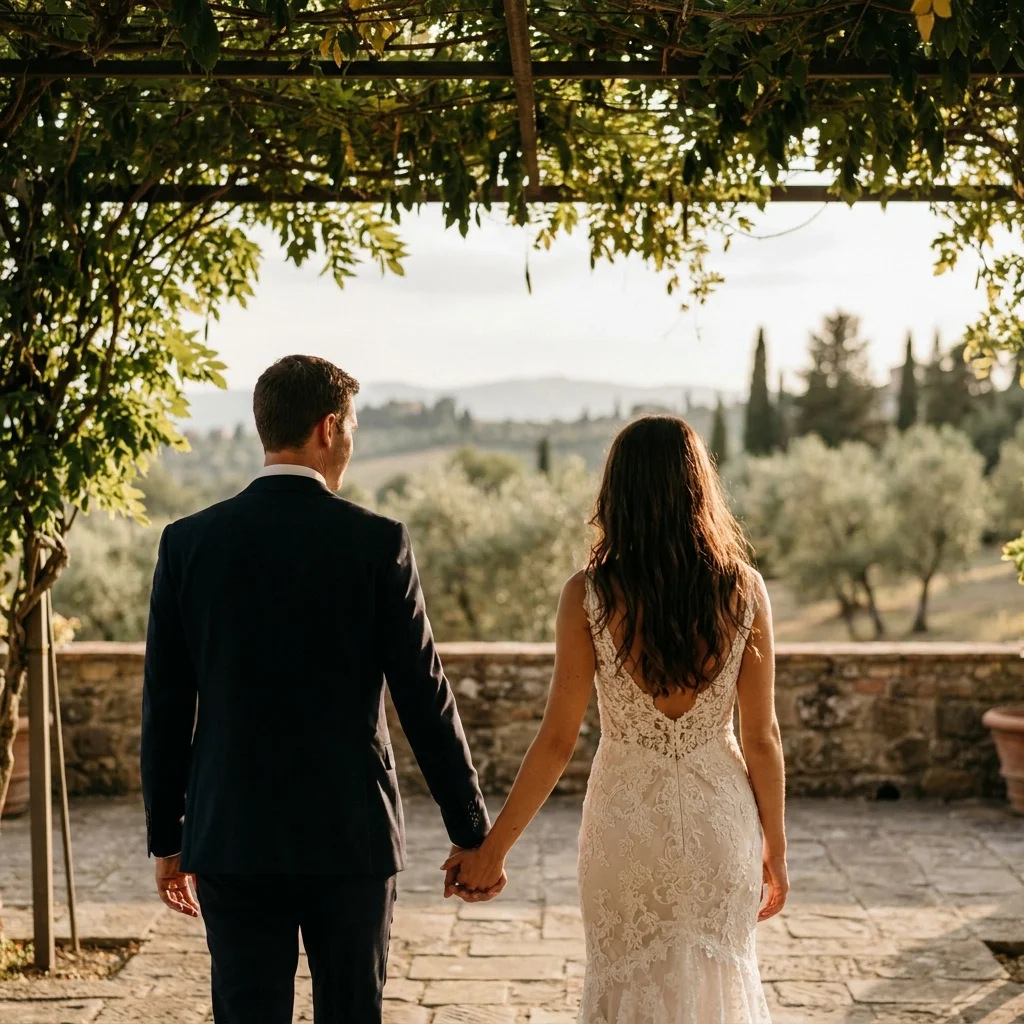
Why Guest Count in Italy Is a Hospitality Decision, Not a Spreadsheet Exercise
There is a particular shade of frustration I see in couples who arrive at our first consultation with a spreadsheet of 180 names and a Tuscan villa that holds 90 for dinner. The tension is real. It is also the wrong starting point.
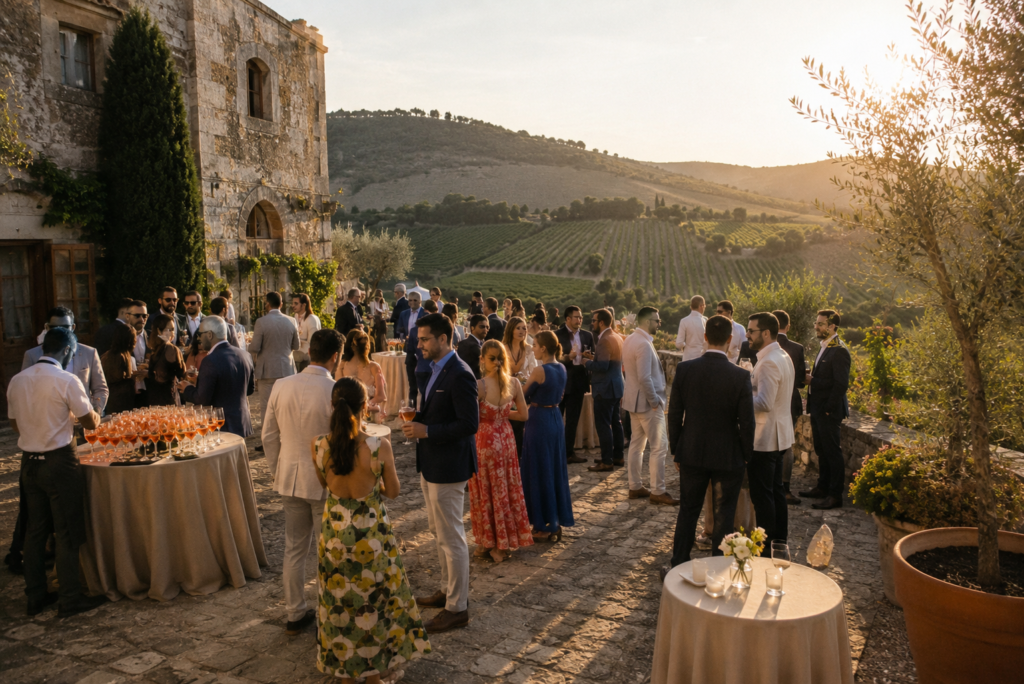
Guest count in Italy is not about trimming a list until it fits a room. It is about designing the right scale of experience — the atmosphere of a long table under pergola vines versus the energy of twelve round tables in a frescoed ballroom. Forty guests at a lakeside villa create a different texture of celebration than forty guests in a Venetian palazzo. The botanical arrangements shift. The light catches differently. The sound of laughter carries in ways that change the entire evening.
When we guide couples through this decision, we begin with three questions: How many days will your guests spend in Italy? What level of personal attention do you want each guest to feel? And what does your venue’s exclusivity clause actually require? These questions matter more than the raw number. A couple hosting 60 guests across a three-day villa buyout will invest more per person — and create a more immersive experience — than a couple hosting 120 for a single evening in a hotel ballroom.
This is why we frame the number of guests as a hospitality strategy. The headcount you choose determines whether your celebration feels like a private gathering or a curated event. Both are beautiful. They are simply different compositions.
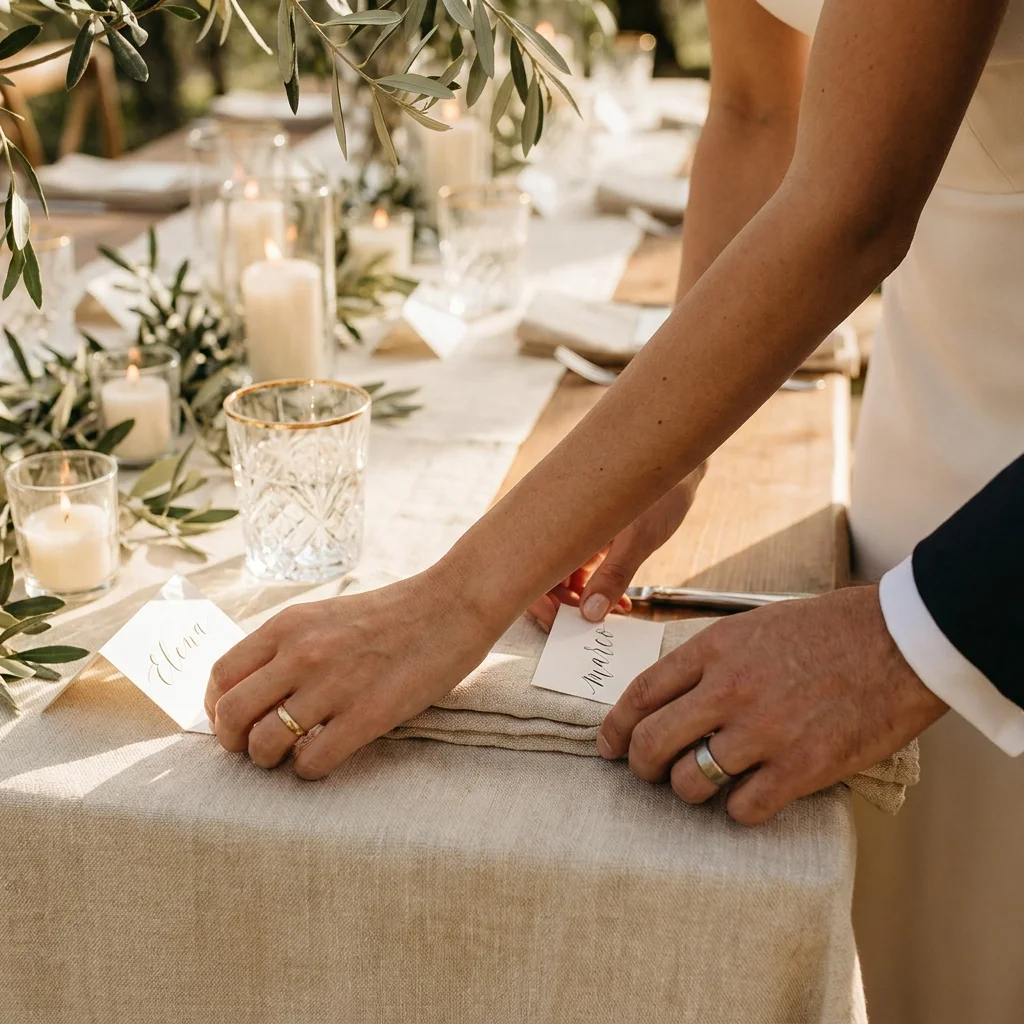
30 Guests vs. 80 Guests vs. 150 Guests: What Each Scale Actually Requires in Italy
The difference between these three numbers is not just arithmetic. It is logistical, contractual, and sensory.
At 30 guests, you are in the territory of what Italy does with extraordinary grace: the intimate celebration. A single long table. Foraged seasonal arrangements — olive branches, garden roses, wild herbs — that feel gathered rather than constructed. A ceremony in a private chapel or a lemon-scented terrace. Transportation is a single vintage bus or a few private cars. Accommodation fits within one estate. The atmosphere is familial, unhurried. Couples considering this scale often find that our micro wedding framework clarifies what is possible.
At 80 guests, you enter the most common range for luxury destination weddings in Italy. This is where logistics become genuinely complex. You need multiple accommodation properties coordinated within a 15-minute radius. Catering moves from a single service team to a full brigade. Floral installations scale from tabletop to architectural — entrance arches, ceremony backdrops, staircase garlands. Transportation requires a shuttle schedule, and in regions like the Amalfi Coast, that means accounting for narrow roads, one-way traffic windows, and boat transfers that depend on sea conditions.
At 150 guests, Italy’s infrastructure becomes the deciding factor. Only certain venues accommodate this attendance for a seated dinner. Historic centers with pedestrian-only access create loading challenges for catering and décor teams. Curfew ordinances — 11 PM in many Tuscan comuni, midnight in parts of Lake Como — compress the reception timeline. We manage these constraints daily, but couples should understand that a headcount of 150 in Italy is not the same as 150 in a suburban hotel. It requires earlier planning, larger vendor teams, and a venue with genuine capacity — not just theoretical floor space.
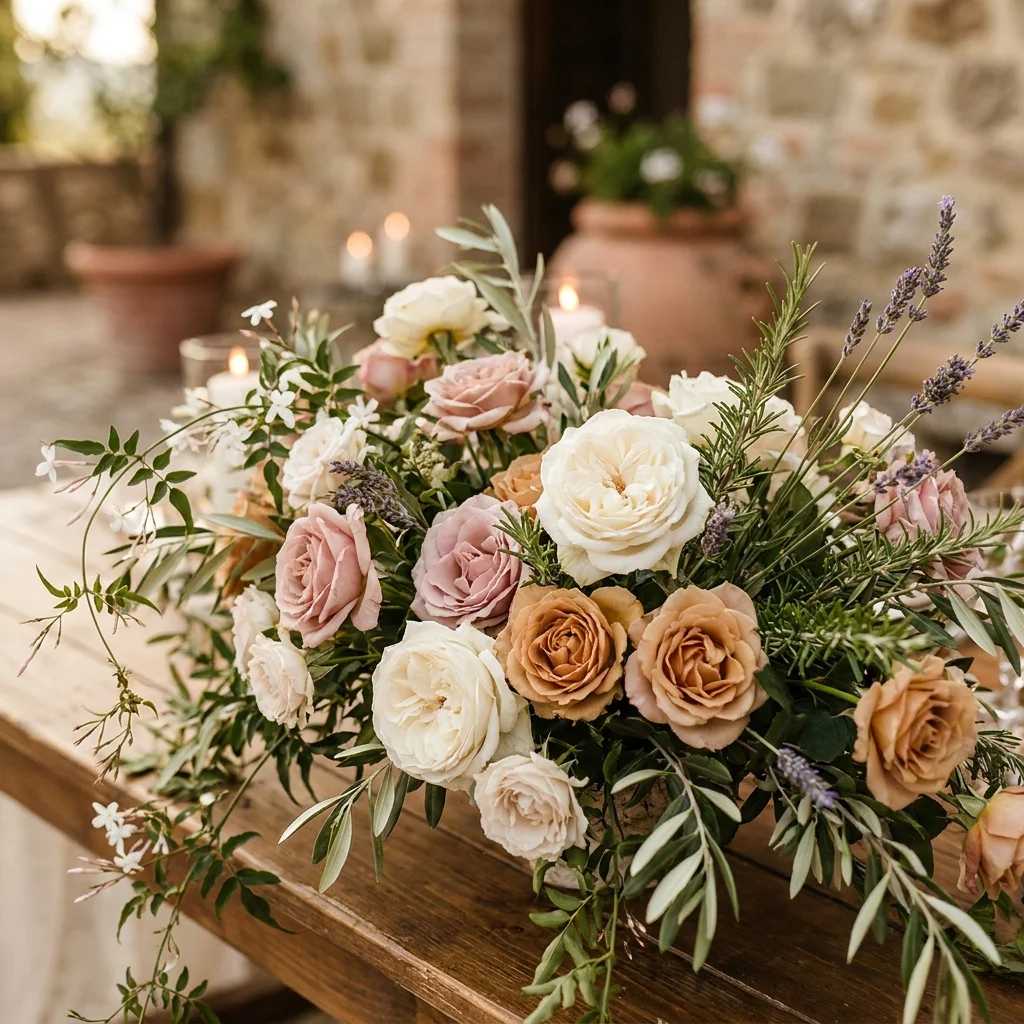
How Guest Count Changes Your Italy Wedding Budget: Real Ranges by Scale
The relationship between attendance and total investment is not linear. Certain costs are fixed regardless of headcount — permits, planning fees, ceremony musicians. Others scale sharply: catering, floral volume, printed materials, transportation. The tables below reflect ranges we see across regions, based on the luxury tier of celebration our clients typically design.
| Guest Count | Estimated Total Range (excl. VAT) | Included in Range | Quoted Separately |
|---|---|---|---|
| 20–40 | €35,000–€90,000 | Venue hire (single day or weekend buyout); seasonal floral design for ceremony + reception; catering with open bar; planning and coordination; ceremony officiant; single-day photography | Videography; musician fees; guest accommodation; transportation; photographer travel outside region; albums and post-production; legal/permit fees; IVA 22% |
| 50–80 | €70,000–€180,000 | Venue hire (typically weekend exclusivity); full floral scenography including ceremony, reception, and welcome dinner; catering with premium wine pairing; planning and on-site coordination across all events; full-day photography with second shooter | Videography; entertainment; guest accommodation block; multi-day shuttle service; printed stationery; post-production and albums; legal fees; IVA 22% |
| 100–150 | €150,000–€350,000+ | Venue hire (multi-day exclusivity); large-scale floral and lighting design; catering for all events (welcome dinner, ceremony, reception, brunch); senior planner + assistant coordination; full-day photography with two shooters | Videography; live entertainment (band, performers); full guest accommodation management; transportation fleet; printed materials; post-production, albums, and prints; legal fees; IVA 22% |
Indicative ranges. Request a tailored guest-count feasibility review for a personalized proposal.
Notice that the jump from 40 to 80 guests does not simply double the budget. Venue fees often remain similar — the real increase comes from catering minimums, floral volume, and the staffing required for multi-location coordination. For couples exploring what shapes Italy wedding costs, guest count is the single most powerful lever.
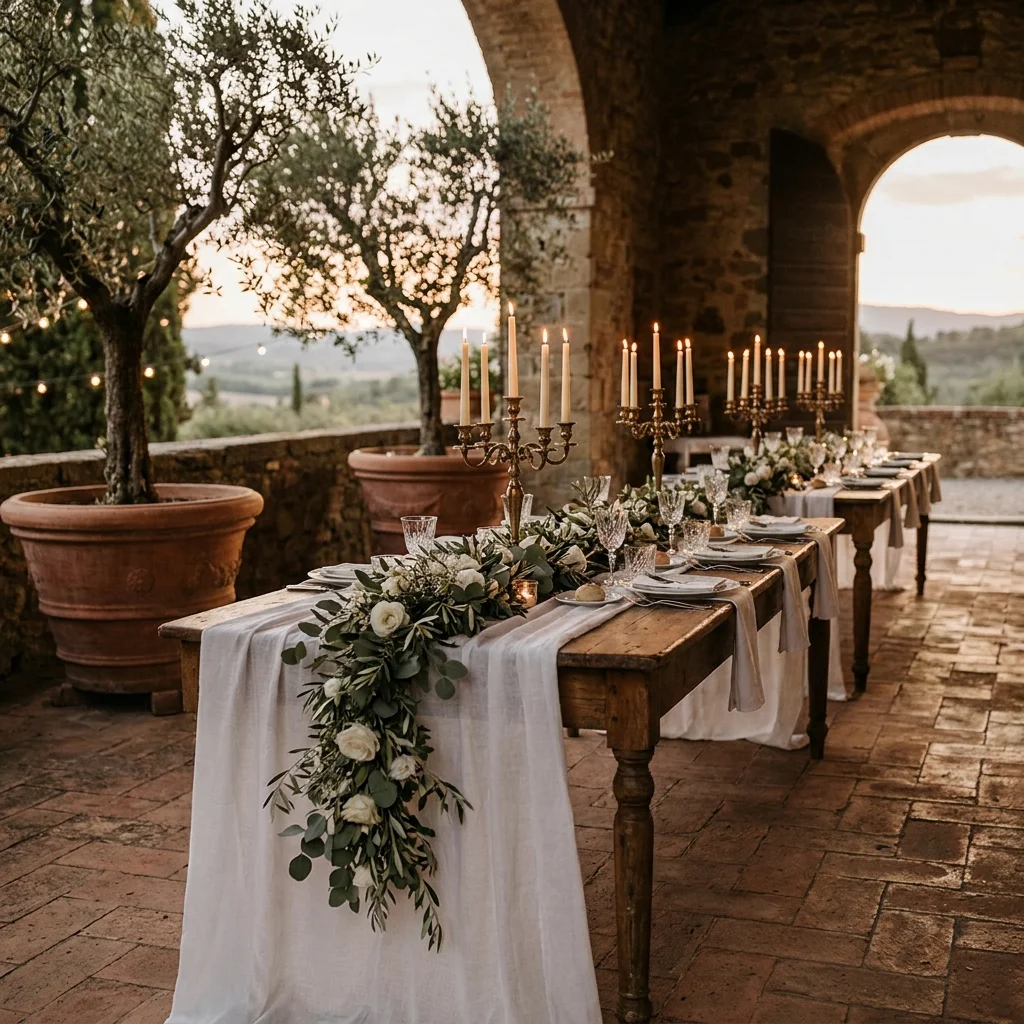
Venue Capacity on Paper vs. What the Space Holds Gracefully
A venue that lists capacity for 120 seated guests may technically fit that number. Whether it feels graceful at 120 is another question entirely.
Italian historic venues — frescoed salons, terraced gardens, cloistered courtyards — were not designed for modern event logistics. A room that seats 120 at round tables may leave no space for a band, a dessert station, or the floral installation that gives the evening its visual identity. We walk every venue with a surveyor’s eye, measuring not just floor area but flow: how guests move between aperitivo and dinner, where the light falls at 8 PM in July versus October, how sound behaves under a vaulted stone ceiling.
In Florence, Renaissance-era rooms with soaring ceilings feel spacious but often have narrow doorways that limit service flow. On Venice’s canals, palazzo capacity is constrained by water-entrance logistics — how many guests can disembark from boats simultaneously without crowding a fondamenta. In the Dolomites, alpine venues may offer breathtaking outdoor ceremony space but limited indoor alternatives if weather shifts.
This is why we never recommend a venue based on listed capacity alone. We assess the number that allows your celebration to breathe — that gives each guest enough space to feel enveloped by the atmosphere rather than pressed against it.
RSVP Uncertainty in Destination Weddings: Planning for the Number That Actually Arrives
Here is the tension no one discusses openly enough: when you host a destination wedding in Italy, the gap between your invitation list and your confirmed headcount can be significant. Domestic weddings might see a decline rate of 10–15%. For international destination celebrations, the variance is wider and far less predictable.
We do not treat this as a problem. We treat it as a planning variable — one we manage through contract structure and timing.
Save-the-date timing is the first lever. For Italy destination weddings, we recommend sending save-the-dates 10 to 12 months before the wedding date, with formal invitations following at 6 months. This cadence gives guests time to arrange travel while giving us enough lead time to adjust room blocks and catering guarantees. The Italy wedding calendar also matters: a September wedding competes with back-to-school logistics for guests with children, while a June wedding may conflict with other peak-season travel plans.
On the contract side, we negotiate flexibility into every agreement we manage. Catering guarantees typically lock 10 to 14 days before the event — we structure our RSVP deadline to precede that lock by at least a week, giving us a buffer to adjust. Hotel room blocks are held with graduated release clauses rather than all-or-nothing commitments. Transportation is contracted with scalable vehicle options: a 50-seat coach that can be swapped for two 25-seat shuttles if attendance drops.
For couples whose confirmed attendance falls in the 80–120 range, we typically plan logistics for three scenarios: confirmed count, confirmed minus 15%, and confirmed plus 10% (accounting for last-minute plus-ones or family additions). This is not anxiety management. It is simply how professional destination hospitality works.
Save-the-Date and RSVP Timeline: When Each Step Protects Your Guest Count
| Timeline Milestone | Months Before Wedding | What It Affects |
|---|---|---|
| Save-the-date sent | 10–12 months | Guest travel planning; early flight/hotel bookings; initial headcount estimate for venue shortlisting |
| Formal invitation sent | 5–6 months | Confirmed guest list for accommodation blocking and transport planning |
| RSVP deadline | 8–10 weeks | Firm headcount for catering, rental orders, seating chart, escort card printing |
| Final catering guarantee | 10–14 days | Locked per-person cost; final menu quantities; staffing confirmation |
| Seating chart finalized | 5–7 days | Escort cards printed; table florals confirmed to exact count; place settings ordered |
Indicative timeline. Ask for a venue shortlist built around your headcount to discuss your specific schedule.
Each of these milestones is a contractual checkpoint. Miss the RSVP deadline by two weeks and you may lose the ability to reduce a catering guarantee — which means paying for plates that sit empty. We manage this entire cadence, sending reminders, tracking responses, and communicating with every vendor so that your final number is confirmed cleanly.
Tuscany vs. Lake Como vs. the Amalfi Coast: Which Region Fits Your Headcount Best
Each Italian region imposes its own constraints on the number of guests you can host — not because of beauty, but because of access, infrastructure, and seasonal rhythm.
Tuscany is the most flexible for larger guest counts. Rolling estates with multiple buildings can accommodate 100+ guests on-site. Roads are wide enough for coach access. The seasonal window extends comfortably from late April through mid-October, and Tuscan wedding costs scale predictably with headcount. For weddings of 80–150, Tuscany offers the most forgiving logistics.
Lake Como rewards intimacy. Many lakeside villas cap at 80 for a seated dinner. Boat transfers are charming but weather-dependent and time-consuming for large groups. The Como planning framework we use accounts for these realities — scheduling boat arrivals in waves, coordinating with local maritime authorities, and ensuring that the guest experience feels seamless rather than rushed. Attendance above 100 is possible but requires villas on the western shore with road access, which narrows the selection considerably.
The Amalfi Coast is the most logistically demanding. Positano’s vertical geography means guests walk steep paths or ride small local vehicles. Amalfi Coast wedding costs reflect this: transportation alone can represent 8–12% of the total budget for groups above 60. Ravello offers more accessible venues, but parking and coach access remain constrained. For this region, we find that 40–70 guests creates the most tactile, Mediterranean experience — one where the landscape feels like a gift rather than a logistical challenge.
Couples drawn to Portofino or the Ligurian Riviera encounter similar access constraints: narrow coastal roads, limited parking, and venues that shine brightest at intimate scale. Rome, by contrast, handles larger numbers with urban infrastructure — but the atmosphere shifts from estate intimacy to architectural grandeur.
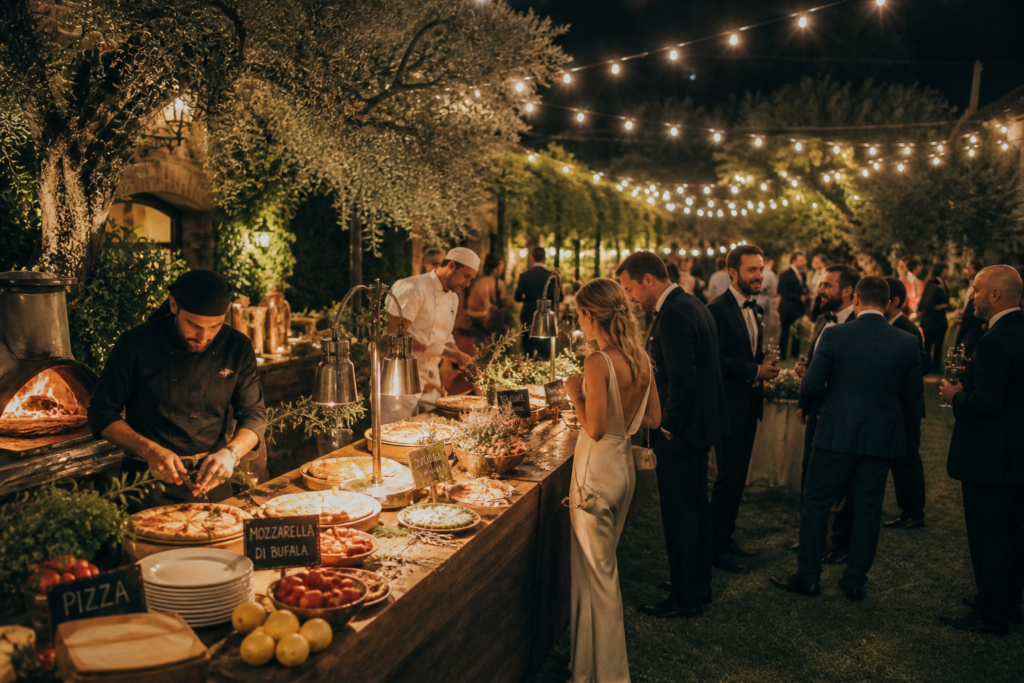
Welcome Dinner, Day-After Brunch, Villa Buyout: How Guest Count Multiplies Across a Multi-Day Italian Wedding
A destination wedding in Italy is rarely a single evening. It is typically a two- or three-day arc: a welcome dinner the night before, the ceremony and reception, and a farewell brunch the morning after. Each event requires its own venue arrangement, catering, staffing, and floral design.
This is where your headcount compounds. Eighty guests across three events means 240 guest-meals, each with its own menu, its own service team, its own table arrangement. The welcome dinner might be a long-table affair under a pergola draped in jasmine — seasonal, foraged, Mediterranean in every detail. The brunch might be a relaxed buffet in a garden with lavender hedges and linen-covered stations. Each setting requires its own botanical composition, its own lighting design, its own sensory identity.
Villa buyouts simplify this beautifully for groups of 30–60. When the entire property is yours for the weekend, the atmosphere becomes continuous — guests drift from pool to garden to terrace, and every space feels curated. For larger groups requiring hotel accommodation, we coordinate welcome bags, shuttle schedules, and dietary information across properties, ensuring that the experience feels unified even when guests are distributed across multiple locations.
Our Italian wedding food philosophy adapts to each event’s scale and mood — a five-course seated dinner for the reception, a family-style arrangement for the welcome evening, a lighter Mediterranean spread for the morning after. The number of guests determines not just quantity but format, and format determines atmosphere.
Minimum Spends, Exclusivity Clauses, and Curfews: The Contract Lines That Your Guest Count Triggers
This section is deliberately more technical. It needs to be.
Minimum catering spend. Most Italian venues with in-house catering impose a minimum food-and-beverage commitment, typically ranging from €8,000 to €25,000 depending on the property. If your confirmed headcount drops below a certain threshold, you still pay the minimum. We negotiate these clauses to include flexibility — a per-person rate with a guaranteed floor rather than a flat minimum — but couples should understand that a group of 40 at a venue designed for 100 may trigger a surcharge or require supplementary spending on wine or entertainment to meet the contractual floor.
Exclusivity clauses. A full buyout means no other events on the property during your celebration. For villas, this is standard. For hotels and larger estates, exclusivity may apply only to specific hours or spaces. Attendance affects this: a hotel that grants exclusivity for 80+ guests may not offer it for 40, meaning another event could share the property. We clarify these terms before any commitment is made.
Curfew and noise ordinances. Italian comuni enforce noise regulations that vary by municipality. A villa outside Siena may allow music until midnight; a property within Florence’s historic center may require amplified sound to stop at 10:30 PM. Larger groups generate more ambient noise, which means stricter enforcement risk. We assess each venue’s relationship with local authorities and, where possible, arrange sound-dampening measures — directional speakers, indoor dance spaces, strategic placement of the DJ or band — to extend your evening without conflict.
VAT (IVA) at 22%. Every cost quoted in Italy is subject to IVA unless explicitly stated otherwise. On a €150,000 celebration, that is €33,000 in tax alone. We ensure every proposal we present separates net and gross figures so there are no surprises.
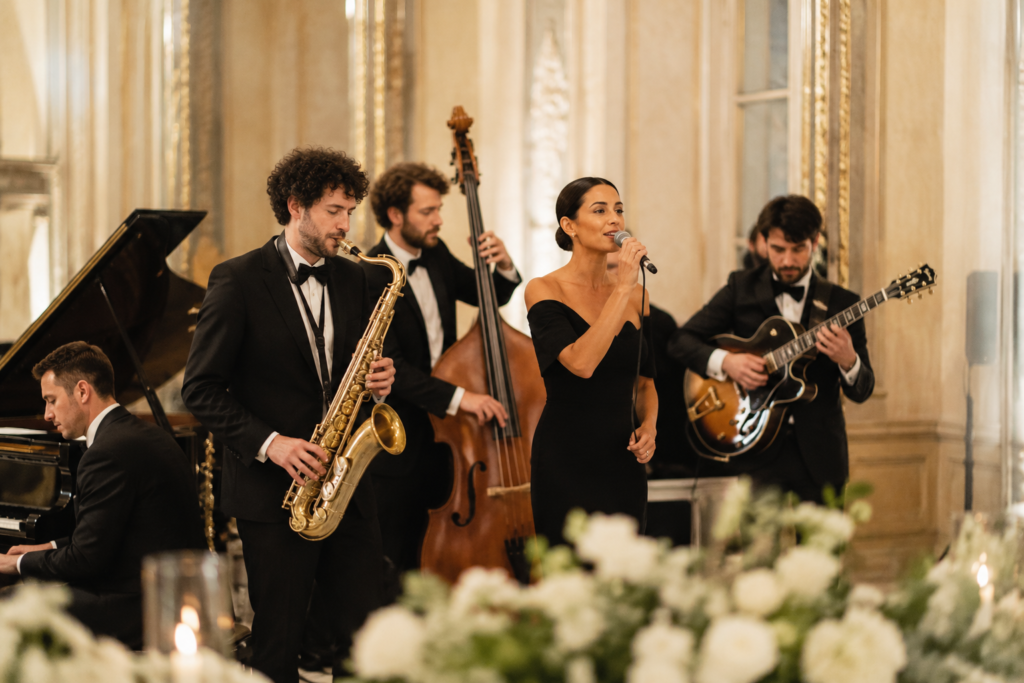
When Guests Cannot Travel: Livestreaming and Remote Inclusion That Feels Considered, Not Compromised
Not every name on your list will make the journey. Elderly grandparents, guests with health constraints, family members whose visa timelines do not align — these are realities of destination celebrations. The question is not whether to accommodate them, but how to do so with grace.
We arrange discreet livestreaming for the ceremony — a single fixed camera with high-quality audio, accessible via a private link. This is not a production; it is a window. The camera is positioned to be invisible to in-person guests, and the stream is available for 48 hours afterward. For couples who want more, we coordinate with the videography team to create a short highlight film delivered within two weeks, shareable with anyone who could not attend.
The cost is typically €800–€1,500 for a single-camera ceremony stream with private link access, excluding the videographer’s main coverage. It is quoted separately from the primary photography and videography investment. It is a discreet, high-standard solution that allows key family members to be present in real time—without changing the atmosphere for guests on-site.
Guest Accommodation and Transportation Costs by Region: What the Numbers Look Like
| Region | Accommodation (per room/night, 4-star+) | Guest Shuttle (per event transfer) | Notes |
|---|---|---|---|
| Tuscany (rural estate) | €180–€450 | €600–€1,800 (coach, depending on distance) | On-site accommodation often available at villa buyout properties; shuttle needed only if guests stay off-site |
| Lake Como | €250–€700 | €1,200–€3,500 (combination of boat + minibus) | Boat transfers weather-dependent; backup road transport always arranged; peak season (June–Sept) commands premium |
| Amalfi Coast | €300–€800 | €1,500–€4,000 (minibus fleet + possible boat) | Narrow roads limit vehicle size; transfers take longer than distance suggests; advance booking essential May–Oct |
| Venice | €220–€600 | €2,000–€5,000 (water taxi fleet for 50+ guests) | All transport by water; coordination with ACTV schedules; private dock access varies by venue |
| Rome | €200–€500 | €500–€1,500 (coach or minibus) | Urban infrastructure simplifies logistics; ZTL (restricted traffic zone) permits required for historic center venues |
Indicative ranges; VAT (IVA 22%) quoted separately. Discuss your guest-count range with our planners for region-specific proposals.
These figures illustrate why the number of guests you invite is inseparable from budget. Adding 20 guests to a Lake Como celebration does not just add 20 dinner plates — it may add an entire second boat transfer, an additional hotel block, and a larger welcome-dinner venue. We map these cascading costs in our initial planning phase so that the headcount you choose is one you can host with generosity, not compromise.
The Number That Lets You Host Beautifully
Every guest count carries its own beauty and its own demands. Thirty guests and a lemon-scented terrace. Eighty guests and a frescoed ballroom filled with candlelight and the scent of garden roses. One hundred and fifty guests and a Tuscan estate transformed across three days into something that feels like a private village.
The right number is not the biggest one you can afford or the smallest one that avoids complexity. It is the number that allows you to host every person with the attention, the comfort, and the sensory richness that an Italian celebration deserves. It is the number that lets the seasonal botanicals breathe, the tables feel generous, the evening unfold without rush.
At Kiss Me Italy, we help you find that number — and then we manage every contract, every transfer, every floral stem, and every room block that makes it real. Request a region-specific budget and logistics proposal, and we will design a celebration scaled precisely to your vision.
Frequently Asked Questions About Italy Wedding Guest List Size
Do Italian venues count vendors (band, photographer, planner) toward capacity limits?
Often, yes—especially for indoor spaces governed by fire-safety limits. We confirm whether staff are included in the stated capacity and, if needed, redesign the layout (service corridors, band footprint, dessert placement) so your guest experience remains comfortable.
Can we host a standing aperitivo for 150 if the seated dinner limit is 110?
Sometimes. Many venues allow a higher “standing reception” number than a seated dinner number, but only if circulation, restrooms, and service access remain compliant. We verify the venue’s permitted event formats and build a timeline that avoids bottlenecks at arrivals, bars, and transitions.
How do we handle guest list politics without compromising the venue we want?
We recommend setting a non-negotiable capacity ceiling tied to your preferred venue category, then allocating invitations by priority tiers (immediate family, closest friends, extended family, colleagues). This keeps decisions principled and prevents last-minute pressure from forcing a venue change.
What is the most common guest-count mistake couples make for Italy?
Choosing a venue first based on photos, then discovering the “comfortable” capacity is 15–25% lower than the advertised maximum once you add a band, dance floor, and proper service flow. Our venue shortlisting is built around real, livable capacity—not theoretical numbers.
Do we need a full wedding website if we’re keeping the guest count small?
Not always. For intimate celebrations, a well-structured digital itinerary (travel guidance, dress codes, transfer times, RSVP link) can be more elegant than a large website. We advise the format that best matches your scale and privacy preferences.
How do dietary requirements affect planning at higher guest counts?
At 80+ guests, dietary tracking becomes a service operation: separate prep, labeled place cards, and a clear kitchen brief. We collect requirements early, confirm them with catering, and ensure the service team can execute discreetly—without making guests feel “managed.”
Is it better to cap plus-ones for a destination wedding in Italy?
Often, yes—especially when venue capacity is tight or accommodation is limited. We help you set a consistent rule (married/long-term partners only, or plus-ones for guests traveling alone) so the policy feels fair and avoids last-minute headcount inflation.
How do we plan children’s attendance without losing the adult atmosphere?
We can design a parallel children’s experience—early dinner, supervised activities, and a quiet room—so parents can stay present for the evening. This is particularly effective for guest counts above 60, where a few families can change the rhythm of the reception.
What’s the cleanest way to communicate a firm capacity limit to family?
We suggest framing it as a venue and hospitality constraint, not a personal choice: “The venue comfortably hosts X for dinner, and we’re committed to hosting everyone well.” When needed, we provide wording that is gracious, consistent, and difficult to argue with.
Keep exploring: How Much Does It Cost to Elope in Italy? Real Ranges, Inclusions, and What Shapes the Quote.