Lake Garda Wedding Tablescape
Most couples arrive at the tablescape conversation with a photograph and a question: will these colours survive the light? On Lake Garda that question is not decorative. The lake acts as a reflector, and between 6pm and 8pm in September it pushes a cool blue-grey wash across every pale surface within twenty metres of the water — which is precisely why a linen that reads ivory in a London showroom can read grey on a Garda terrace. Our first design decision is never a colour. It is a room, an hour, and an orientation.
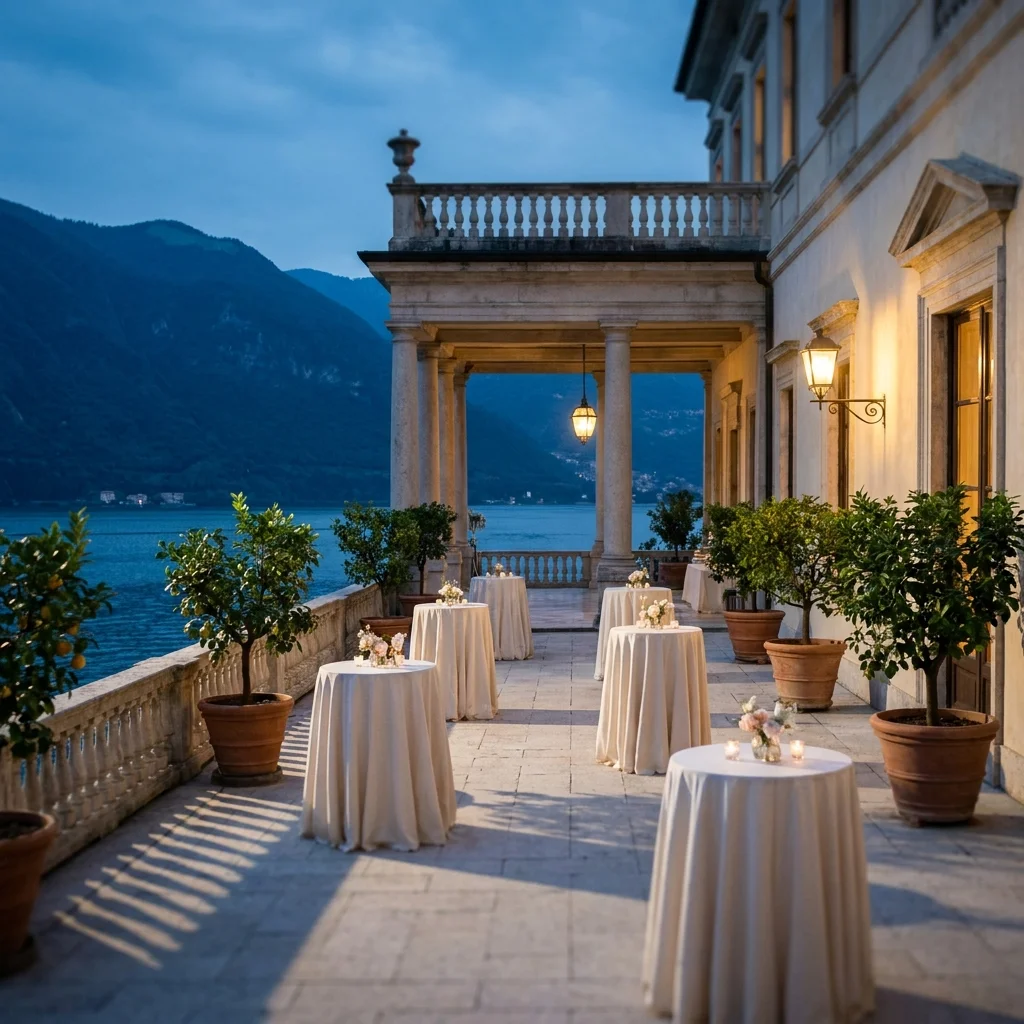
A Lake Garda wedding tablescape is a coordinated design of linen, tableware, glassware, candlelight, florals and stationery, built around the specific venue, its orientation to the lake and the hour of service. On Lake Garda, verified full-service celebrations with exclusive-use estates begin at €109,000 for the complete two-day collection, with tabletop design typically representing €180–€450 per guest depending on materials, floral density and rental sourcing. Kiss Me Italy curates the creative brief, verifies feasibility against wind, heat and open-flame constraints, and manages every supplier through installation.
Why the Same Tablescape Reads Differently at 6pm and at 8pm on the Eastern Shore
There is a moment on the Veronese shore — Torri, Garda, Bardolino — when the sun drops behind Monte Baldo’s western counterpart and the light stops arriving from the sky. It arrives from the water. Horizontal, silvered, cool. Ivory linen turns faintly blue. Warm brass looks green. Anything terracotta suddenly sings.
Then, twenty-five minutes later, the candles take over and the entire palette inverts. Wax light is amber. It flatters cream, coral, apricot, honey, unglazed ceramic, aged silver. It flattens icy white and does something unkind to lilac.
We design for both hours, not one. The aperitivo palette and the dinner palette are frequently not identical — a shift of napkin, a change in floral vessel between courses, a second candle height introduced after dessert. On the western shore, in the coves below Salò and Gardone, the reverse holds true: the sun stays longer on the stone, the warmth persists, and a cooler palette earns its place. This is scenography, and it obeys the same rules a lighting designer obeys in a theatre. Couples who want the wider picture of when and where those hours fall across the year will find our overview of a wedding in Lake Garda a useful companion to this piece.
Frescoed Sala vs Waterside Terrace: Two Architectural Grammars, One Guest List
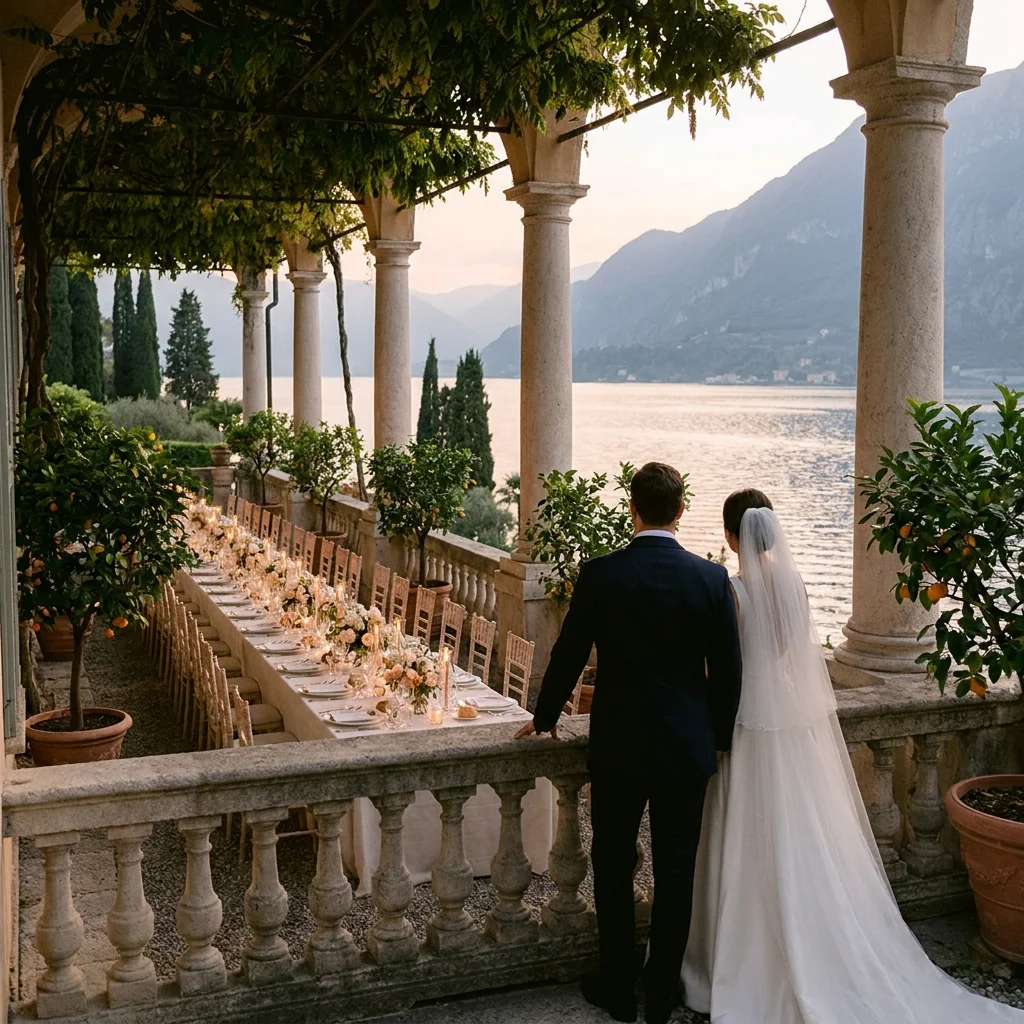
An eighteenth-century patrician villa in the hills behind the eastern shore, set among vineyards above Cavaion Veronese, offers a formal interior architecture: stucco cornices, frescoed panels, symmetrical proportions inherited from a noble family that built for processional dining, not for lake views. The room already speaks. A dense, maximalist tablescape competes with it and loses.
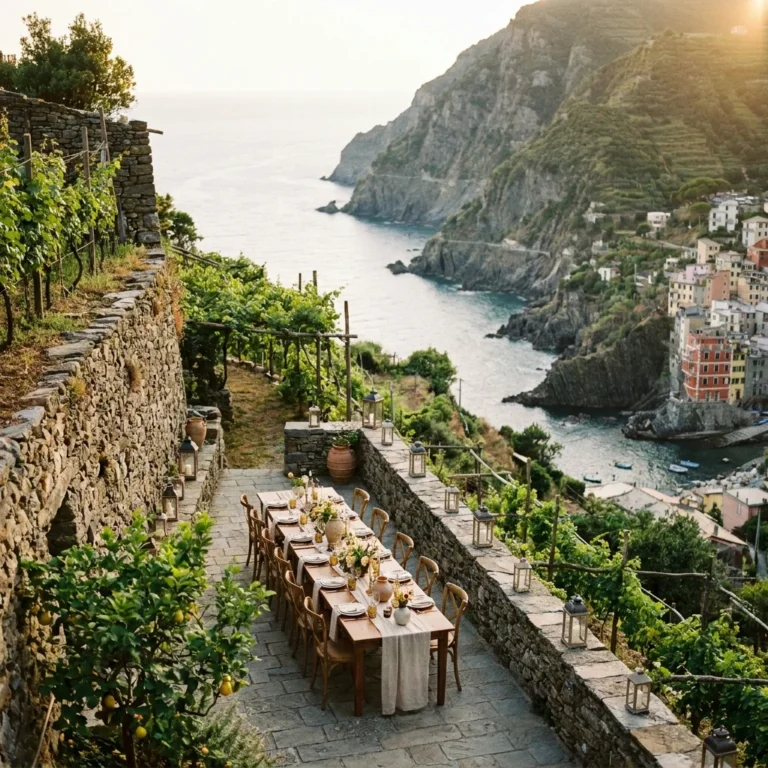
The waterside terrace is the opposite condition. Open sky, no ceiling to contain the eye, a horizon line that pulls attention outward. Here the table must build its own architecture: taller candle registers, a longer continuous runner of foliage, greater vertical contrast to hold guests inside the composition after dark.
Between these two extremes sit the intermediate rooms, and they are the most interesting. A limonaia — one of the tall, glazed citrus houses historically associated with Garda’s western shore — gives filtered north light, cool humidity and an existing structure of stone piers. A loggia gives shade with reflected warmth. A formal parterre garden gives geometry that a serpentine table can either echo or deliberately contradict. We match the geometry of the table to the geometry of the room, not to a trend. If you are also weighing exclusive-use accommodation for two nights, our guidance on a wedding in Italy with accommodation explains how guest housing shapes the dinner timeline.
Gardesana Ceramics and Citrus vs Imported Porcelain: What We Source Within Forty Minutes of the Shore
Lake Garda has a material vocabulary of its own, and it is not the same vocabulary as the Riviera or the Venetian lagoon. Hand-glazed ceramics from the Veronese and Brescian workshops — matte olive, chalk white, a particular pale cobalt that appears on eighteenth-century pharmacy jars. Lemons and citrons, cultivated commercially on the western shore since the thirteenth century and still grown in the surviving limonaie. Undyed and stone-washed linen from Lombard mills. Local white marble and river-worn limestone for chargers and plinths.
Imported porcelain has its place, particularly for very formal frescoed interiors where an antique-pattern service holds the register of the room. But a Lake Garda wedding tablescape built on locally fired ceramic reads as belonging to the place — and photographs with a texture that flat glaze cannot produce. We maintain relationships with two ceramic workshops and one linen atelier within a forty-minute drive of the shoreline, which means replacement pieces and additional covers can be collected the same week rather than shipped.
The material logic differs by region, deliberately. A Venice wedding tablescape built around Murano glass operates on transparency and colour saturation; a tablescape on the Italian Riviera works with sea-bleached tones and painted majolica; the Tuscan wedding table setting leans on terracotta, olive wood and wrought iron. Garda sits between mountain and Mediterranean, and its tabletop should say so.
The Peler and the Ora: Two Winds That Decide Whether Your Candles Stand
This section is technical, and deliberately so.
Lake Garda has two reliable daily winds. The Peler descends from the north in the early morning hours and drops by mid-morning. The Ora del Garda rises from the south in the early afternoon and typically strengthens between 2pm and 6pm before easing at dusk. Sailors plan regattas around them. We plan tablescapes around them.
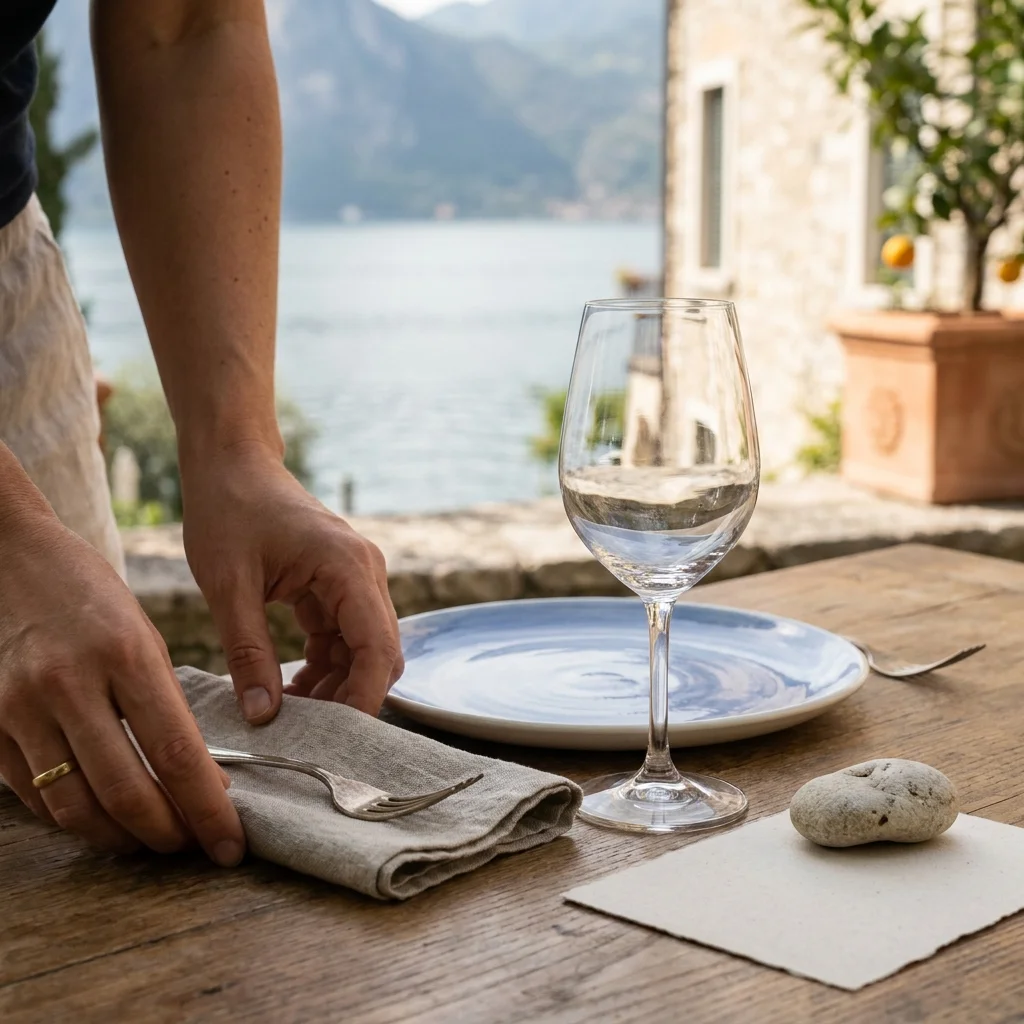
The practical consequences are specific. Unprotected tapers on an exposed terrace before 7pm are not viable in high season. Loose petals, unweighted place cards, lightweight menu paper and tall single-stem arrangements all require engineering rather than optimism. Our specification uses wind-rated glass hurricanes of a minimum height above the flame, weighted vessel bases, and stationery on 600gsm stock or set under stone or ceramic weights.
Open flame is a second, separate matter. Historic properties with frescoed ceilings, timber structures or protected interiors apply their own restrictions, and some permit candlelight only in fully enclosed glass, only after a stated hour, or only under the supervision of a fire-safety attendant. We confirm each venue’s written candle policy at contract stage — not at the final walkthrough — and we design two lighting registers in parallel so the atmosphere is never contingent on a single answer. For couples whose entire vision rests on wax light, the dedicated planning behind a candlelit evening on the lake deserves its own conversation, and our team is glad to open it.
Heat and moisture complete the set. July and August afternoons on the southern basin around Sirmione reach the point where butter softens and delicate blooms collapse within ninety minutes of installation. Our floral holding for those dates is cold-chain, installation moves to the final possible window before service, and the linen selection shifts toward looser weaves that do not show humidity.
What a Lake Garda Tablescape Costs — and What Sits Outside the Quotation
Our verified Lake Garda collection is a full two-day celebration with the estate in exclusive use. Tabletop design is curated within it, with material upgrades quoted transparently against the brief.
| Collection | Price (basis) | Included | Quoted separately |
|---|---|---|---|
| The Cordevigo Estate Wedding — Lake Garda | €109,000 (two-day celebration, base price as published for two people) | Exclusive use of Villa Cordevigo; 41 rooms for guests over two nights with breakfast; pre-wedding day with dinner; wedding-day reception and aperitivo; planning, scenographic direction and on-site coordination as detailed on the collection page | Guest flights and airport transfers; photography and videography; municipal and permit fees; sworn translations and interpreters; specialist tabletop upgrades in antique or commissioned materials; VAT (IVA 22%) where applicable by line item |
Collection price is current and verified against our internal records. Third-party items outside the collection are quoted individually. Indicative ranges. Contact Kiss Me Italy for a personalized proposal.
Where a couple engages us for design and supplier management on a venue outside the collection, tabletop components are priced by cover or by table. The ranges below reflect documented supplier proposals for Lake Garda dates.
| Tablescape component | Indicative range and basis | Included in the range | Excluded / separate |
|---|---|---|---|
| Scenographic direction and design brief | €2,800–€6,500 per event | Concept development, palette and material research, venue light study, supplier briefing, one physical mock-up table | Travel for a second mock-up outside Veneto/Lombardy; VAT 22% |
| Linen (long-drop cloths, napkins, underlays) | €90–€260 per table | Rental, pressing, on-site dressing | Bespoke dyeing to a matched Pantone; laundering surcharge for wine damage; VAT 22% |
| Hand-glazed gardesana ceramic or porcelain service | €28–€75 per cover | Charger, plates, rental logistics within 40 km of the shoreline | Breakage deposit (typically 10–15% of rental value, refundable); transport to island venues; VAT 22% |
| Glassware and flatware | €22–€60 per cover | Three-glass setting, full flatware, polishing on site | Antique or commissioned patterns; additional stemware for a fourth pour; VAT 22% |
| Candlelight (wind-rated hurricanes, tapers, vessels) | €60–€190 per table | Vessels, wax, wind protection, relighting service during dinner | Fire-safety attendant where the venue requires one; venue open-flame authorisation; VAT 22% |
| Table florals and foliage runners | €120–€480 per running metre | Design, conditioning, installation, removal | Imported out-of-season stems; cold-chain holding for July–August dates; VAT 22% |
| Stationery and calligraphy | €14–€48 per guest | Menu, place card, calligraphed name, Italian printing | Letterpress or foil dies; shipping of foreign-printed suites; VAT 22% |
Indicative ranges based on documented supplier proposals for Lake Garda dates. Contact Kiss Me Italy for a personalized proposal.
| Constraint-driven item | Indicative range | Included | Excluded / not applicable |
|---|---|---|---|
| Venue open-flame authorisation / municipal permit | €0–€600 per event (indicative; venue and comune dependent) | Application handled by our team | Fees are pass-through at cost; VAT per issuing authority |
| Parallel weather scheme (loggia or covered room dressed in reserve) | €1,400–€4,800 | Second linen and candle set, standby crew, decision protocol at T-6 hours | Marquee or sailcloth structure hire; flooring; VAT 22% |
| Décor transfer by tender to island or shoreline-access venues | €700–€2,600 | Two crossings, crated handling, crew | Guest boat transfers; harbour fees; VAT 22% |
| Editorial tabletop documentation (still imagery of the set table before service) | €900–€2,200 as an add-on to full-day coverage | 45–60 minutes of dedicated coverage before guest entry, colour-accurate editing | Photographer travel and accommodation; second shooter; albums and prints; post-production delivery beyond the agreed 6–8 week window — all quoted separately |
Indicative ranges. Contact Kiss Me Italy for a personalized proposal.
For couples calibrating expectations across destinations, our transparent breakdown of what a wedding in Italy costs sets the wider frame, while the comparative figures in our Venice wedding cost guide and our Portofino wedding cost analysis show how venue typology moves the tabletop budget.
36 Guests vs 120: How Headcount Rewrites Table Geometry, Not Just Table Size
Guest count is not a quantity problem. It is a geometry problem.
At 30 to 40 guests, a single continuous table is almost always the correct answer, and the design can afford one uninterrupted floral gesture running its full length, with candle heights varied along a single axis. Every guest sees every other guest. Nobody sits behind an arrangement. On a Garda terrace of that scale we frequently use a curved run rather than a straight one, so the lake stays in the sightline of both sides.
At 70 to 90, the composition breaks into multiple tables and a new discipline appears: repetition with controlled variation. Identical tables read as banqueting. Wildly different tables read as chaos. We build a rule — the same three vessel types, the same two candle heights, a floral density that shifts by ten per cent between tables — so the room feels composed rather than duplicated.
Above 100, service flow governs everything. Aisle widths of at least 1.4 metres for plated service, centrepiece heights either below 30cm or above 65cm so conversation lines pass beneath, and a seating plan that keeps the kitchen route invisible from the principal table. Intimate celebrations follow a different logic entirely, which our guidance on a micro wedding in Italy addresses directly.
Pastel Blue and Citron Yellow: One Direction Among Several, Not a House Rule
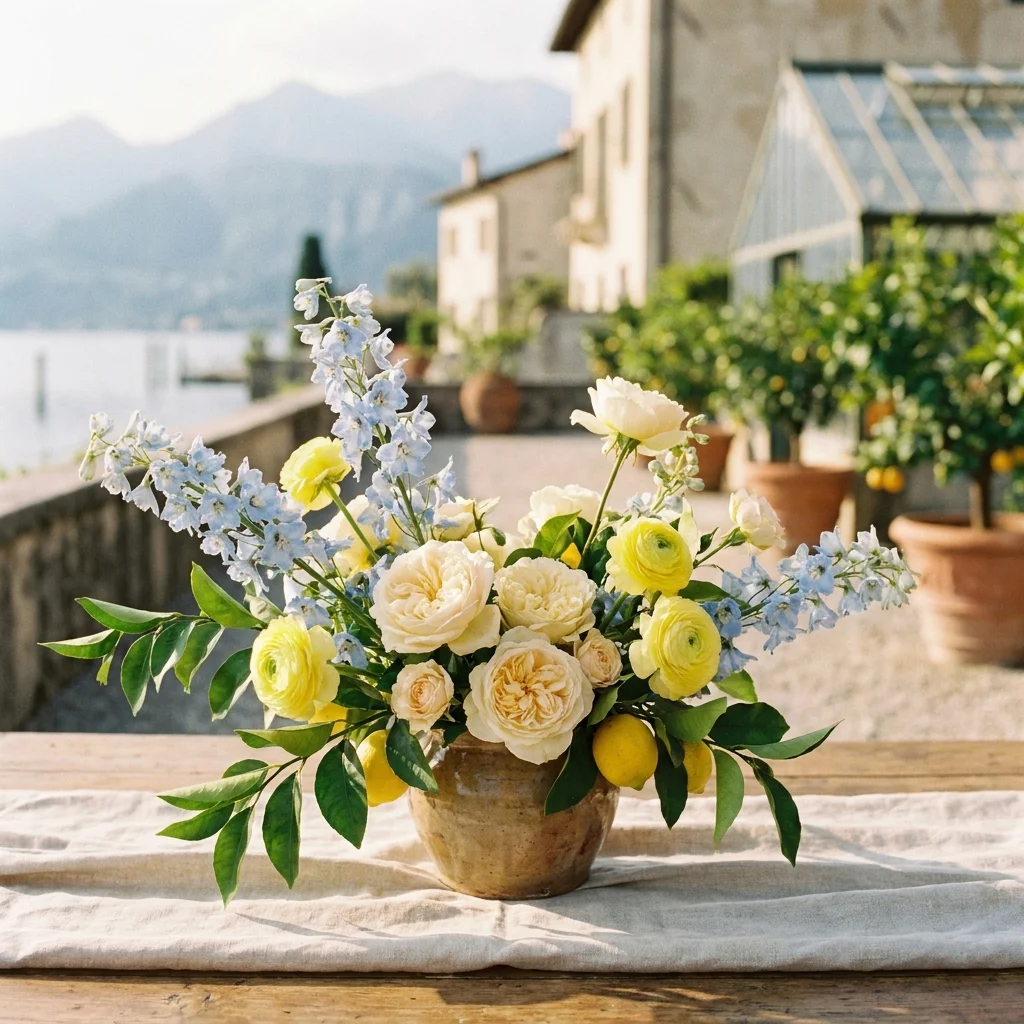
A pale blue and citron palette circulates widely as the Garda signature, and it can be genuinely beautiful — the blue borrowed from the water, the yellow from the limonaia harvest, both held together by undyed linen. We have executed it on a west-facing terrace in late May with excellent results.
It is one direction. Not the direction.
Two others deserve equal consideration. The first is a monochrome scheme in chalk, bone and unglazed stone, appropriate for a frescoed Renaissance interior where the walls supply all the colour a room can hold; here contrast comes entirely from texture and candle height. The second is a deeper autumn register — fig, bronze, oxblood, aged brass — which suits October dinners in a vaulted cellar or a stone loggia and photographs with remarkable depth under wax light. Seasonal availability governs which flowers can carry each direction, a subject treated properly in our work on seasonal wedding flower design and in our notes on expertly managed floral sourcing.
The menu belongs in this conversation too. Lake fish, Lugana, Bardolino and Garda olive oil each carry a colour and a vessel logic, and a tabletop designed without reference to the plate is a tabletop that fights the food. Our thinking on Italian wedding menu construction and on why Italian wedding food is remembered feeds directly into the material brief.
How We Build the Brief Before a Single Piece Is Ordered
Our sequence is fixed, and it is deliberately front-loaded. We begin with a light and orientation study of the specific room or terrace at the exact hour of your service, conducted on site. We then establish the venue’s written position on open flame, installation access and setup hours — some historic properties release the dining space only four hours before service, which determines how much can realistically be installed and in what order.
Only then do we develop the palette and material direction, and only then do we brief suppliers. A physical mock-up table is set and photographed before any full order is confirmed — with your actual linen, your actual ceramic, your actual candle height, under the correct light. Couples review it remotely or in person. Adjustments happen there, calmly, rather than on the wedding morning.
Installation is managed by our own crew alongside the venue’s service team, with a documented running order. Our approach to bespoke luxury weddings in Italy and the philosophy behind our personalized planning method explain why we refuse to work from a catalogue. If the venue itself is still open, our guidance on choosing a villa wedding in Italy is the sensible starting point, and our criteria for selecting a luxury wedding planner in Italy will tell you what to expect from any team you interview, including ours.
The Parallel Scheme We Design and Hope Never to Use
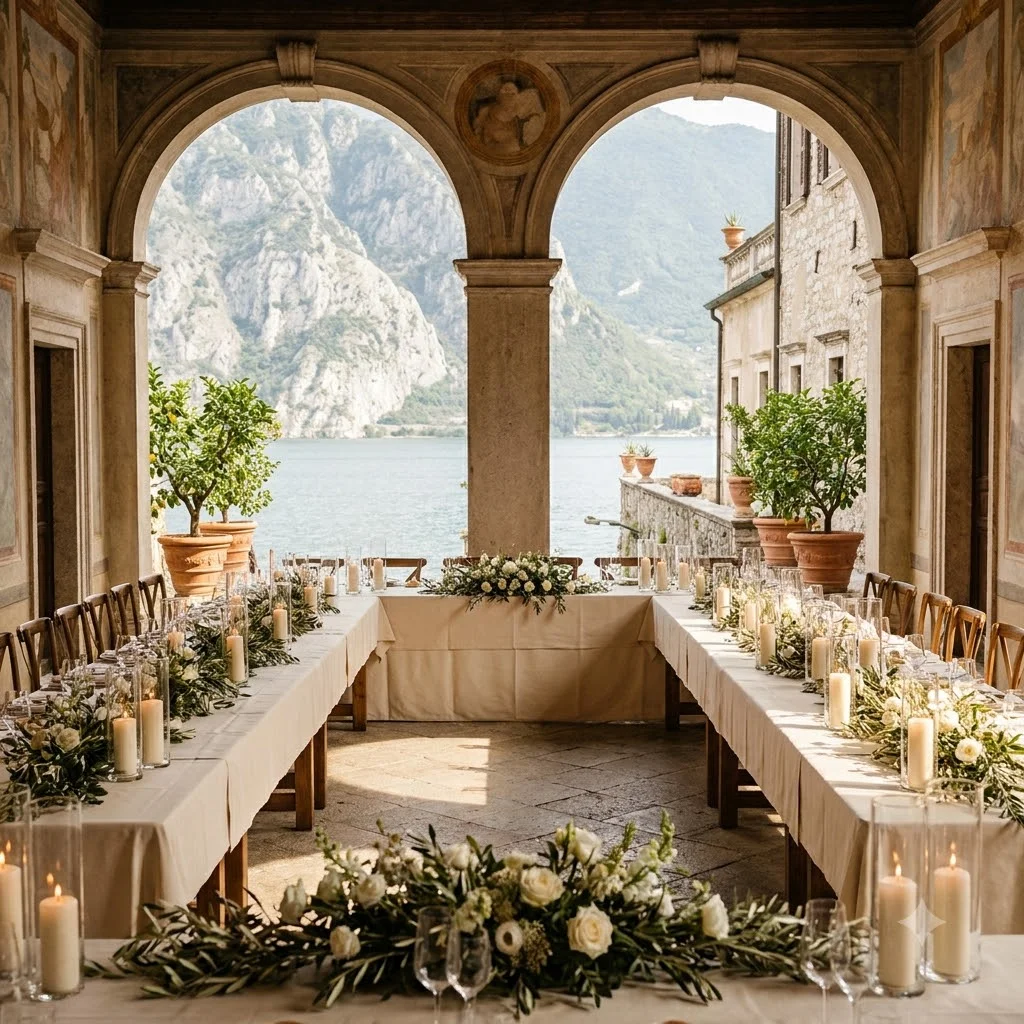
Every outdoor Garda reception we manage carries a second, fully designed scheme for a covered space — not a fallback, but an alternative composition. Different linen drop, different candle strategy, different floral distribution, because a loggia at 25 metres is not a terrace at 40 and the same design does not transfer.
The decision point is fixed at six hours before service, taken by our team against the local forecast, with the venue and every supplier already briefed on both versions. Guests never see a change of plan; they see a room that looks intended. Couples renewing their commitment on the lake benefit from the same parallel thinking, as described in our guide to a vow renewal on Lake Garda.
Why Tabletop Scale and Contrast Decide How the Room Photographs
A table that pleases the eye at 1.5 metres can disappear in an image. The reason is contrast range: at dusk, a camera reading candlelight will hold detail in warm mid-tones and lose both the deepest shadows and the palest whites. Which means a tablescape composed entirely of white on white photographs as a flat plane, however exquisite it looks in person.
Our specification therefore builds at least three tonal registers into every table — a dark note, a mid note, a highlight — and one reflective element, whether glass, brass or glazed ceramic, to catch flame. Vertical variation matters equally: three candle heights read as depth, one reads as a line. The technical side of that collaboration is set out in our guidance on working with a wedding photographer in Italy, and the broader standard we hold across every celebration is described under our luxury weddings.
Where to Begin
A Lake Garda wedding tablescape that works is never chosen from images. It is derived — from a room’s proportions, a shoreline’s orientation, an hour of light, a wind that arrives at two in the afternoon, and a guest list whose sightlines matter more than any trend. That derivation is our work, and we do it before you commit to a single material.
Send us the date, the venue if you have one, and the hour you imagine sitting down to dinner. We will tell you what the light will be doing, what the wind is likely to do, and what the table can become. Write to us here to begin the design conversation, or read more about the team at Kiss Me Italy who will be standing behind that table on the day.
What Couples Ask Before Confirming a Tablescape Design
Can we ship our own china or heirloom pieces to Italy for the tablescape?
Yes, and we regularly integrate a few personal pieces — a grandmother’s candlesticks, a set of monogrammed napkins. We arrange bonded storage near the venue, condition-check on arrival, and handle the return shipment; customs documentation for non-EU shipments is prepared by our office roughly six weeks ahead.
Can the tablescape accommodate guests with visual or mobility requirements?
Yes. We review contrast, type size, place-card legibility, table-edge clearance and service routes as part of the room plan. These decisions are coordinated with the venue before the mock-up so accessibility is integrated elegantly rather than added after the design is complete.
We recommend related rather than identical. The welcome dinner typically uses the same material family in a looser register — shorter linen, fewer candle heights, garden-cut foliage — so the wedding-day table reads as an elevation rather than a repetition.
How far in advance is the rental order confirmed for a September date?
Linen and specialist ceramic are reserved eight to ten months ahead for September and early October, which are the most contested weeks on the lake. Glassware and flatware volumes can be adjusted up to about three weeks before service as final guest numbers settle.
Our contracts require suppliers to hold a documented reserve of at least ten per cent above the confirmed count, and we specify an approved alternative for every hand-made item at the mock-up stage. The substitution is pre-agreed in writing, so any swap is invisible in the finished room.
How is breakage on hand-painted or antique pieces charged?
A refundable deposit of typically ten to fifteen per cent of the rental value is held, and losses are reconciled against a per-item replacement schedule attached to the rental contract. We provide that schedule before you approve the design so there are no unquantified figures.
Can we bring a stylist or designer from our own country to work alongside your team?
Frequently, yes. We act as the local production authority — venue liaison, permits, access windows, installation crew, supplier contracts — while your designer holds the creative direction, and we agree the division of responsibility in writing before suppliers are engaged.
Do guests take anything from the table home?
Purchased elements such as ceramic favours, calligraphed place cards or small potted citrus can be designed to leave with guests; rented linen, glassware and vessels cannot. We separate the two categories clearly in the quotation so nothing is ambiguous on the night.
Can different table shapes be combined within one reception?
Yes, when the architecture supports it. We may use a curved principal table with smaller rounds or ovals elsewhere, but proportion, linen fall and repeated material details are controlled so the room reads as one composition rather than several unrelated settings.
What happens to the table between the ceremony and dinner if both use the same terrace?
We build a turnaround plan with a defined crew size and duration — typically 55 to 80 minutes — while guests are held at an aperitivo location out of sightline. The reveal is staged deliberately, and guests re-enter to a completed room they have not yet seen.
To discuss a Lake Garda wedding tablescape for your own date, reach our design office directly.