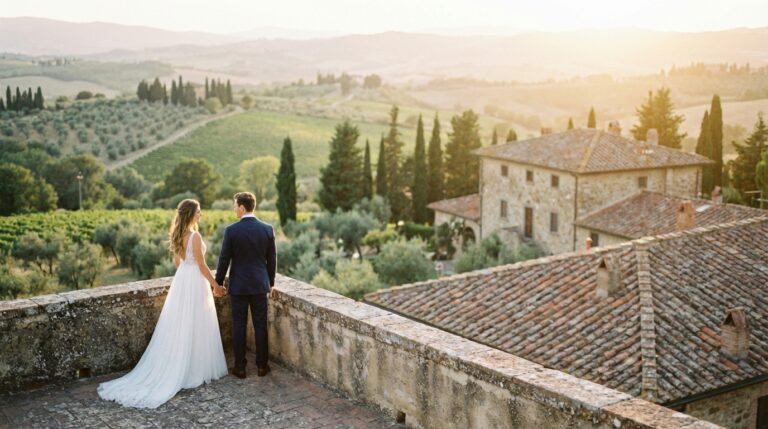
Tuscany Wedding Flowers: Seasonal Luxury Design Curated by Kiss Me Italy
The first decision most couples don’t realize they’re making is one of timing. A May wedding in the Florentine hills and a September wedding on the Versilia coast call for entirely different botanicals — and the venue you’ve chosen may forbid the very arrangement you’ve pinned. Before a single stem is sourced, we are already mapping season, microclimate, and the written rules of your chosen estate, because in Tuscany flowers are never a finishing touch added at the end. They are a structural decision made early.
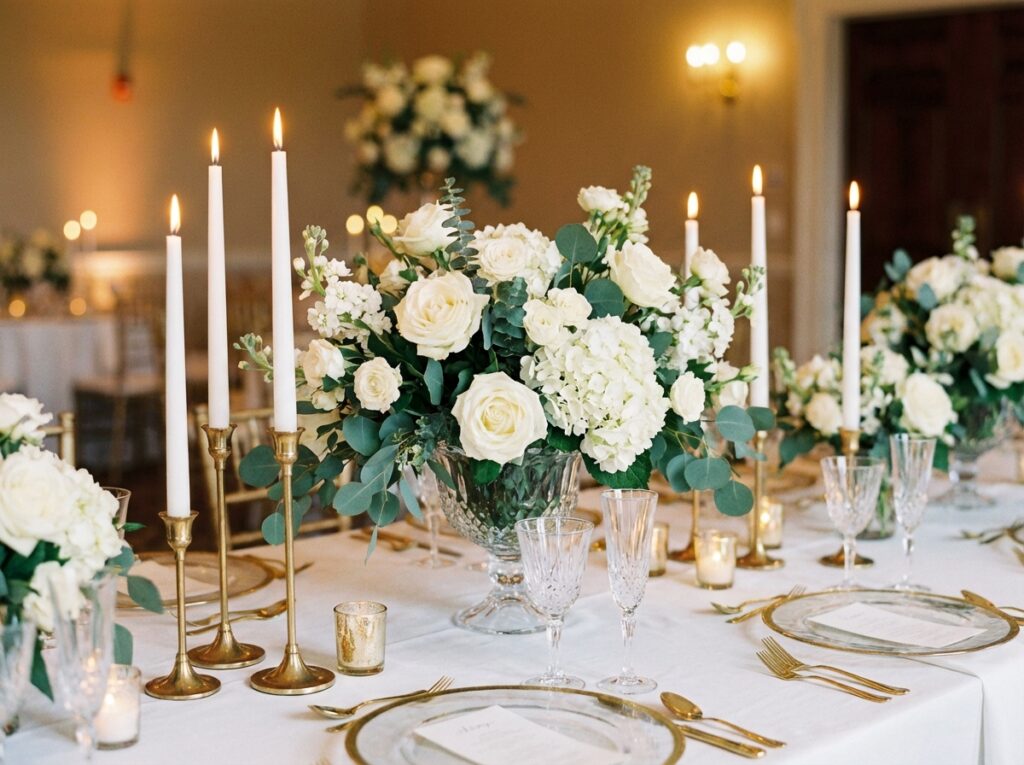
At Kiss Me Italy, we approach floral design as a complete composition rather than a shopping list.
What Tuscany Wedding Flowers Actually Cost — and What Drives the Range
Tuscany wedding flowers typically range from €6,000 to €35,000 or more, depending on season, guest count, venue restrictions, and the scale of installation. Locally grown seasonal botanicals — peonies in late spring, dahlias and cosmos in early autumn, ranunculus in March — keep both cost and carbon footprint lower, while imported blooms and large suspended structures move a budget into its upper ranges. The figure covers design, sourcing, installation, and strike when managed end-to-end.
That number surprises some couples. It reassures others. The variation comes down to a handful of decisions, and we walk through each of them before we ever quote. A ceremony arch reading from twelve metres away in open countryside requires a different volume of material than an intimate cloister where guests sit within touching distance of every petal.
The First Conversation: Reading Your Season Before Your Palette
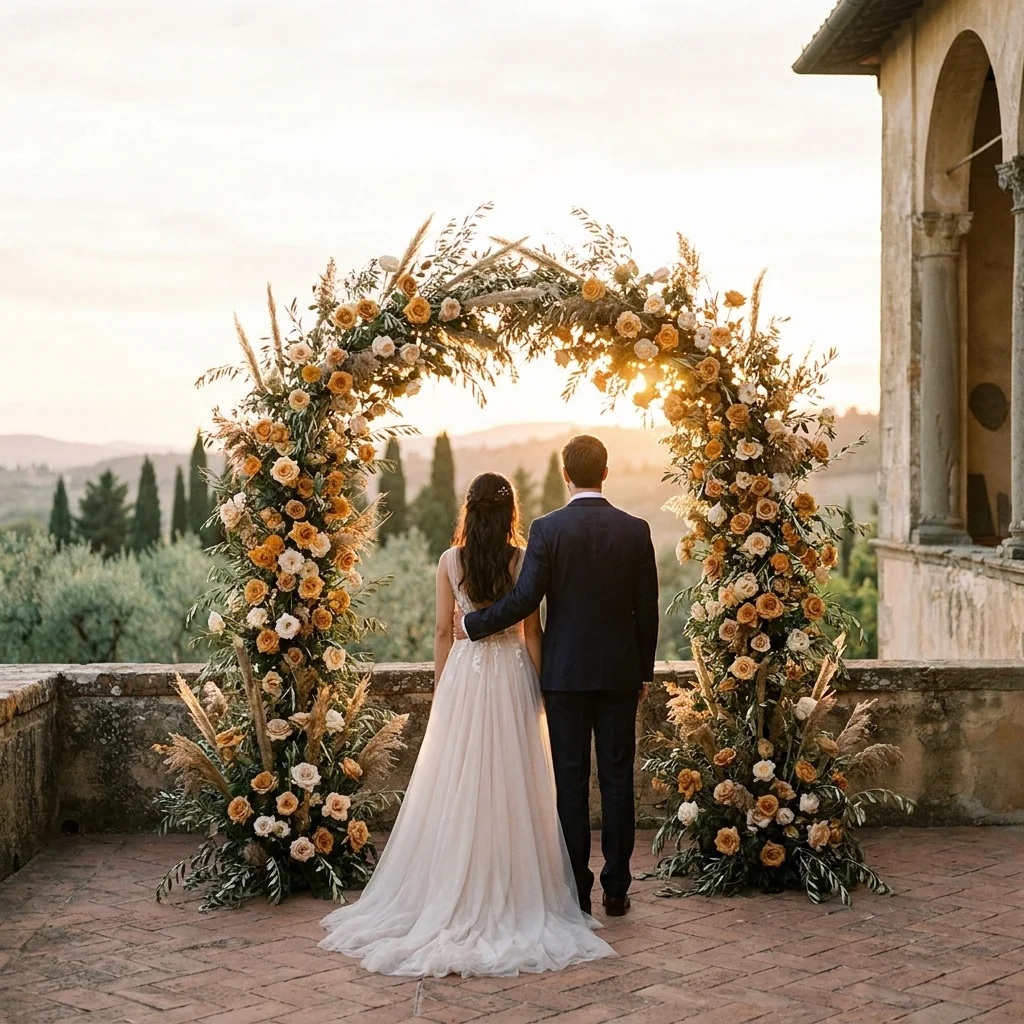
When a couple first contacts us about wedding flowers in Tuscany, we resist the urge to talk colour straight away. We ask the date first. The date governs everything that follows.
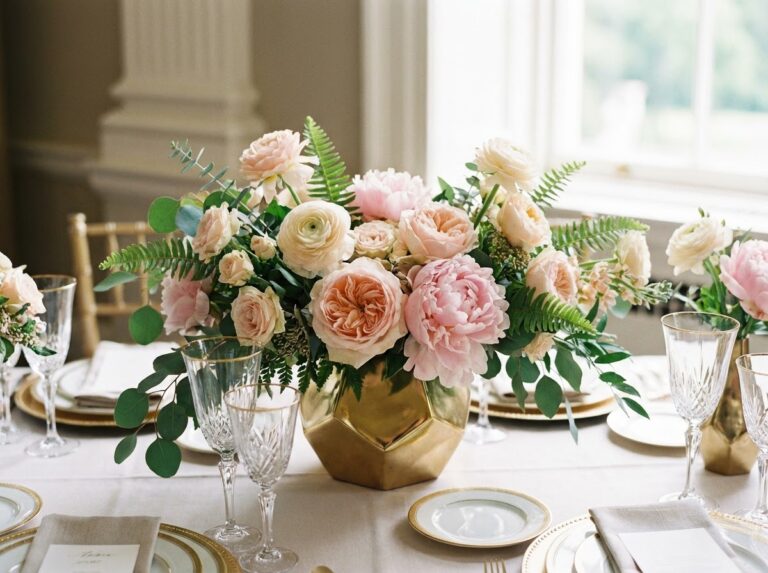
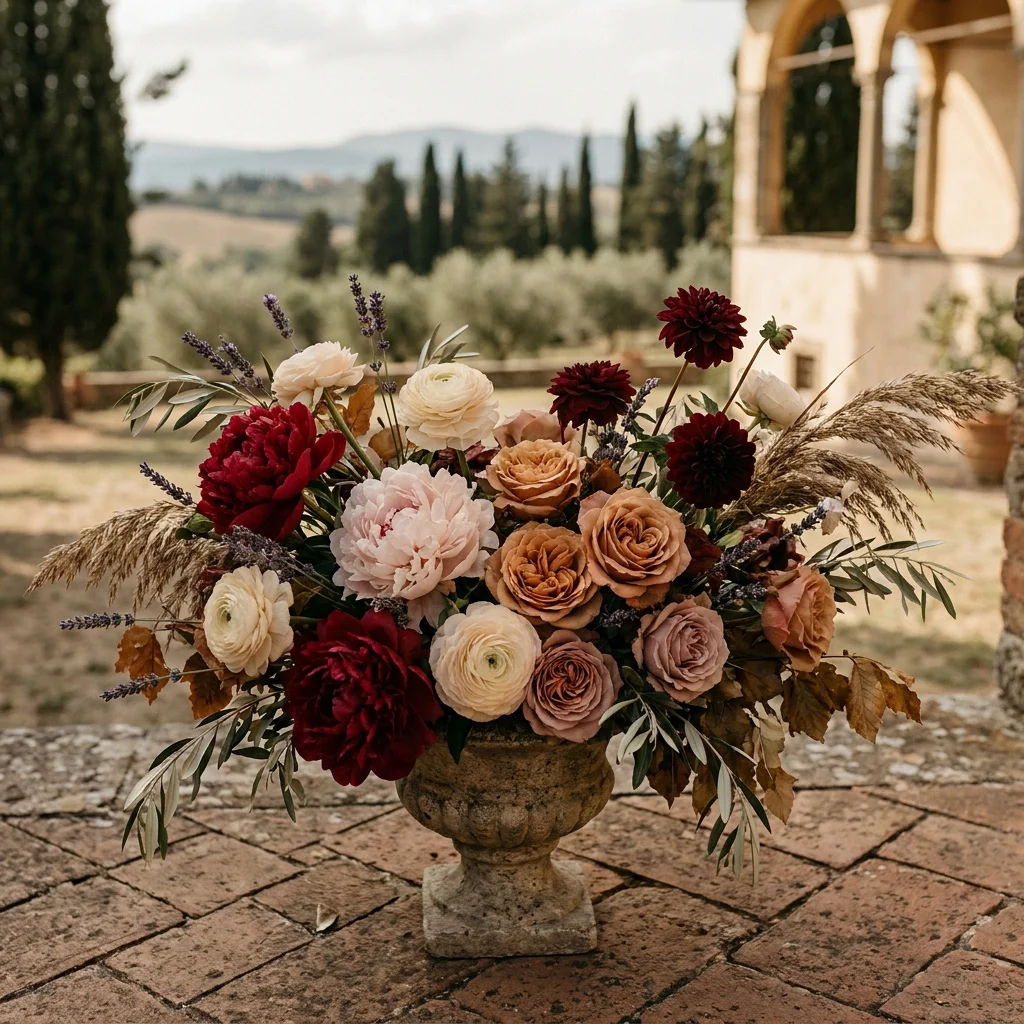
Tuscany has a generous floral calendar, but it is not infinite. Peonies — the flower most requested by international brides — have a true local window that closes by mid-June. Lavender peaks across the inland hills from late June into July. By September, the palette shifts toward dahlias, amaranth, late roses, and the foraged grasses and olive foliage that give an autumn Tuscan composition its particular weight and texture.
We tell couples this honestly. A July request for fresh local peonies means importing at a premium, with a shorter vase life in the heat. We would rather guide you toward what the land is offering that week — the atmosphere of a season captured in its own materials always photographs more truthfully than a flower fighting its climate. If you are still choosing between regions, our overview of wedding venues in Tuscany is the place to understand how setting shapes the floral brief.
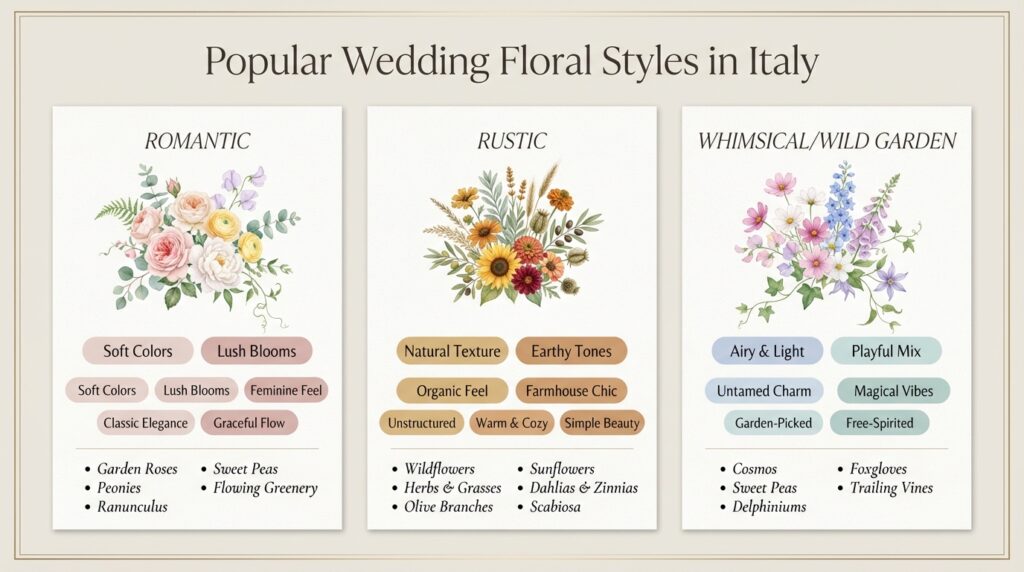
This first conversation is also where we listen for the tactile language a couple uses without realising it. Some want softness — loose, foraged, gardenesque. Others want architecture and clean line. That instinct, more than any Pinterest board, shapes the design.
The Venue Rules That Quietly Decide Your Floral Design
Every Tuscan venue carries its own grammar of what is permitted, and these rules rarely appear in the brochure. A historic chapel may forbid fixings to stone, open flame near drapery, or any installation above a certain height. A protected garden estate may restrict where vehicles can unload and how late an installation crew may remain.
We hold these details because we work inside these venues repeatedly. A deconsecrated countryside chapel we use often allows freestanding arrangements but nothing affixed to its frescoed walls — so we design weighted urns rather than mounted garlands. A renowned Florentine cloister limits load-in to a two-hour morning window before the site opens to other access.
These constraints are not obstacles. They are the frame. Understanding them early is what lets a Tuscan villa wedding flowers brief feel effortless on the day, because nothing is improvised at the last hour. Couples drawn specifically to a villa setting will find the relationship between architecture and arrangement explored further in our guide to a villa wedding in Italy.
We are always glad to discuss your chosen venue’s floral rules before you commit to a design direction.
How Floral Design Changes Across Tuscany’s Five Settings
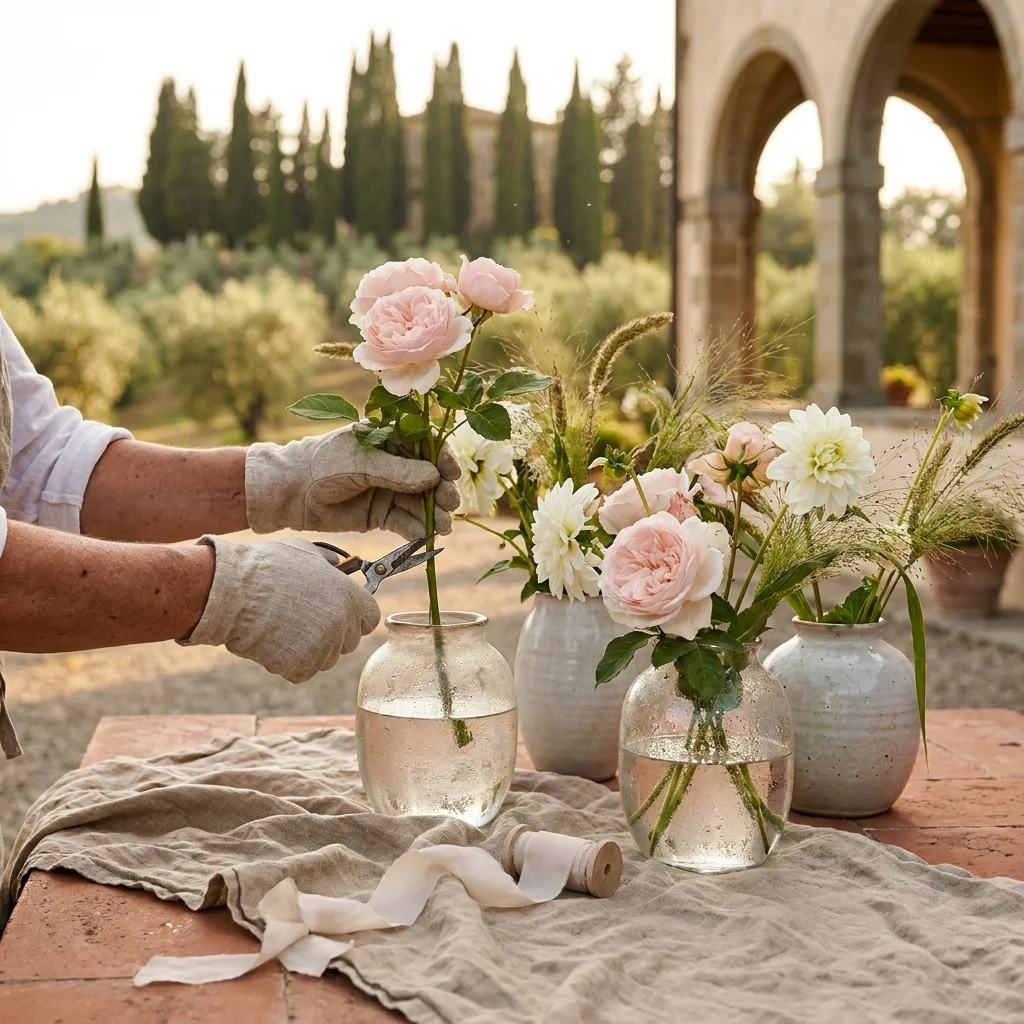
There is no single Tuscan look. The land offers at least five distinct stages, and each rewards a different botanical approach.
The countryside estate — rolling vineyard and cypress — wants generosity and movement. Loose arrangements of garden roses, foraged grasses, and trailing greenery read beautifully against open distance and warm stone. The formal villa garden asks for more structure: symmetry, clipped foliage, a palette that answers the architecture rather than competing with it.
Florence itself, with its Renaissance interiors, calls for restraint and proportion — deep tones, sculptural single varieties, nothing fussy. Coastal Tuscany along Versilia introduces a Mediterranean lightness: paler blooms, sea-resistant foliage, arrangements built to hold their shape in salt air and afternoon breeze. And the intimate ceremony — a small terrace, a private cloister — concentrates everything into a few perfect, close-range details where light catches every fold of a petal.
For couples weighing the broader Versilia coastline, our luxury wedding Tuscany and Versilia guide sets out how the coast differs from the inland hills. Those set on the city itself will find the Florence wedding venues overview useful, while a Florence wedding carries its own particular demands of scale and tone.
Flowers as a Thread Through the Whole Day, Not a Single Centrepiece
This is where floral design becomes most consequential. A wedding’s floral design fails when it lives only on the tables. It succeeds when it carries the guest from one moment to the next without anyone noticing the seams.
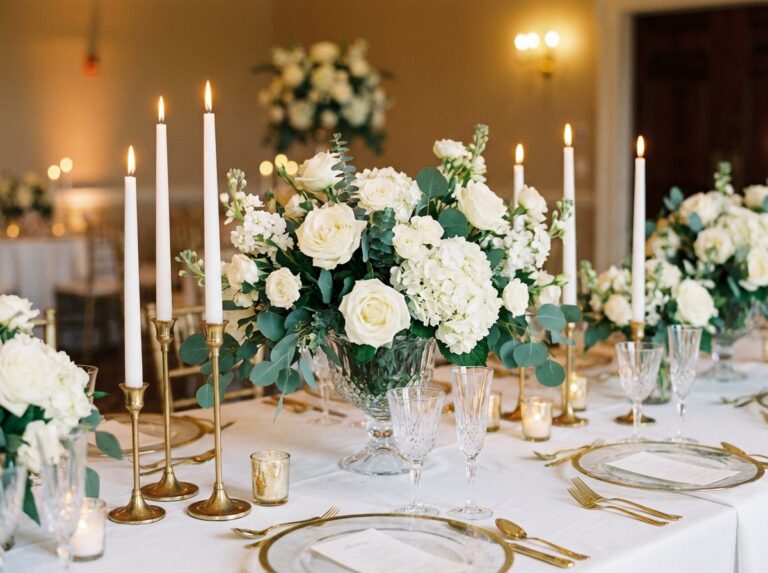
We design in chapters. The ceremony sets the key — the arch or the aisle the eye reads first. The aperitivo softens it, smaller arrangements at standing height where guests linger with a glass in hand; our thinking here aligns closely with the rhythm of an Italian wedding cocktail hour. Then the tablescape, where height, scent, and candle interact across a long evening — a discipline we treat with the same care found in our work on wedding tablescapes in Italy.
Scent matters more than most plans account for. A heavily perfumed centrepiece competes with the food. We keep the most fragrant botanicals away from the dining table and let them work at the ceremony and entrance instead, where their Mediterranean sweetness belongs.
The cake moment, the lighting, the final dance — each carries a deliberate floral note. By the close of the evening, the flowers have travelled with the guests rather than simply decorated a room. For a sense of how this floral thread sits within a full reception, our perspective on all-inclusive destination wedding planning shows how the pieces lock together.
The Load-In, the Heat, and the Strike: What Happens Behind the Petals
This part is unglamorous, and it is precisely where most floral plans quietly come undone. Allow me to be direct here, because the technical reality deserves plain language.
Summer heat is the first adversary. Between late June and mid-August, inland Tuscany regularly exceeds 35°C by midday, and cut flowers wilt fast. We schedule delicate installations for early morning or hold them in cold storage until the last possible window, building the most heat-sensitive arrangements — hydrangea, peony, sweet pea — closest to guest arrival rather than at dawn.
Load-in is the second. Many estates sit at the end of a single narrow unpaved approach; a refrigerated van and a hard ceremony start time leave a fixed window, often three to four hours. We confirm vehicle access, turning space, and power for cold storage during the site visit, not on the day.
Then the strike. Most venues require full floral removal the same night or by an early-morning deadline, and a protected garden will specify exactly what may touch its lawns. Our crew handles dismantling and clearance so the couple never thinks about it. The arrangements that can be repurposed for a post-wedding brunch the following morning, we set aside deliberately.
None of this reaches the guest. That is the point.
Indicative Floral Investment by Wedding Scale
The tables below reflect documented ranges for fully managed floral design across typical Tuscan settings. They assume seasonal sourcing where possible; imported or out-of-season blooms sit at the upper end.
| Wedding Scale | Floral Design Range | What’s Included |
|---|---|---|
| Intimate (up to 30 guests) | €6,000–€11,000 | Ceremony focal piece, bridal bouquet, buttonholes, up to 4 tables, design and consultation, installation and strike. Excludes imported blooms, suspended structures, and VAT (IVA 22%). |
| Mid-scale villa (50–90 guests) | €12,000–€22,000 | Ceremony arch or aisle, aperitivo arrangements, full tablescape florals, bridal party flowers, cake florals, installation and strike. Excludes lighting design, large suspended installations, and VAT. |
| Large estate (100+ guests) | €22,000–€35,000+ | Multi-zone design across ceremony, aperitivo, dining and dance, statement installations, full crew, cold-storage logistics. Excludes rare imported varieties and VAT. |
Indicative ranges for floral design only. Includes design, sourcing, installation, and strike as listed. Excludes VAT unless stated, venue permits where required, extraordinary travel/accommodation for remote islands or multi-day crews, and non-floral services. Photography items such as post-production, second shooter, and albums are not applicable to floral design. Contact Kiss Me Italy for a personalized proposal.
| Seasonal Sourcing Note | Peak Window | Cost Effect |
|---|---|---|
| Peonies (local) | Late April–mid June | Best value in window; premium import outside it |
| Ranunculus, anemone | March–May | Moderate, strong local availability |
| Lavender, local herbs | June–July | Low; often foraged within the estate |
| Dahlias, amaranth, late roses | September–October | Moderate; excellent autumn texture |
Indicative ranges for floral design only. Includes design, sourcing, installation, and strike as listed. Excludes VAT unless stated, venue permits where required, extraordinary travel/accommodation for remote islands or multi-day crews, and non-floral services. Photography items such as post-production, second shooter, and albums are not applicable to floral design. Contact Kiss Me Italy for a personalized proposal.
If a clear sense of overall budget would help frame these figures, our breakdown of what a Tuscany wedding typically costs places floral design within the full picture, and the broader Italy wedding cost guide sets it in national context.
Why a Curated Florist Beats a Self-Managed Supplier Search
A couple sourcing their own Tuscany wedding florist from abroad faces three layers of friction: language, distance, and the impossibility of judging quality from a website. We remove all three.
As your Tuscan wedding floral design curators, we hold the relationships with growers who supply us through the season, the knowledge of which venue forbids what, and the crew who installs and strikes to deadline. Our work on luxury wedding flowers Tuscany projects sits inside a single managed plan — flowers, light, table, and timing answering one another rather than arriving as separate deliveries. The same discipline shapes our approach to Florence wedding flowers within the city’s more formal interiors.
This is the heart of the Kiss Me Italy approach: complexity absorbed entirely behind the scenes. Our design signature — seasonal Mediterranean botanicals, foraged texture, arrangements built for the light they will live in — runs through every composition.
We would be delighted to begin a conversation about your floral vision whenever you are ready.
Bringing the Composition Together
A wedding’s flowers are remembered as a feeling, not a list. The cool of stone under a morning arrangement. The scent that met guests at the entrance. The way candlelight found the petals at the long table after dark. These are the things no photograph fully holds — they are lived.
Our role is to make all of it appear effortless while managing, behind every petal, the season, the sourcing, the venue’s rules, the heat, and the timing. That is what curated seasonal wedding flowers Italy design truly means. When you are ready to shape yours, we are here to listen first.
Frequently Asked Questions
How far in advance should we confirm our floral design?
For peak-season dates (May, June, September), we recommend confirming the floral direction 10 to 12 months ahead, primarily to secure preferred growers and installation crew rather than the flowers themselves. Final variety choices can be adjusted closer to the date as the season reveals what is at its best.
Do you offer a mock-up or trial arrangement before the wedding?
For larger commissions we can arrange a design preview — a composed sample of key elements such as a table centrepiece or ceremony focal piece — so you can assess scale, palette, and texture in person or via detailed photography before the final order is confirmed. This is particularly valuable when a couple is working remotely and cannot visit Tuscany ahead of the date.
Can you accommodate guests with allergies or young children when selecting flowers?
Yes — we ask about known sensitivities during the design brief. Certain high-pollen varieties, heavily scented blooms, and plants with toxic properties if ingested can be avoided or repositioned away from areas where children will be present. We flag any relevant considerations and propose alternatives that preserve the aesthetic without the risk.
How are last-minute seasonal substitutions approved if a variety becomes unavailable?
We build a substitution protocol into every contract. If a confirmed variety falls short of quality at the market in the days before the wedding, we contact you with a proposed alternative of equivalent character and cost before making any change. You retain approval over substitutions that affect the visible design; logistical adjustments within the same colour and form family are handled at our discretion to protect timing.
What happens to floral arrangements if rain forces the ceremony indoors?
Our rain plan includes pre-agreed indoor positions for all ceremony florals, so relocation is a rehearsed procedure rather than an improvisation. Arrangements designed for outdoor settings are scaled and structured to read equally well inside; where a piece genuinely only works outdoors, we have an indoor alternative ready. The couple is never asked to make decisions about this on the day.
Is it possible to preserve the bridal bouquet after the wedding?
We can advise on preservation methods — freeze-drying, pressing, and resin encapsulation are the most reliable for Tuscan summer conditions — and we work with specialist preservationists we trust. We prepare the bouquet for handover in the condition best suited to the chosen method. This is arranged in advance so the process begins immediately after the ceremony.
Do you work with flowers we bring or specify from our home country?
We can incorporate a meaningful flower or family tradition into the design, sourcing the closest equivalent locally where importing isn’t practical. We’ll always be transparent about whether a specific variety travels well to Tuscany and how it behaves once it arrives.
Can the same florist coordinate flowers across multiple wedding-weekend events?
Yes — and we recommend it. Designing the welcome dinner, ceremony, reception, and farewell brunch as one continuous palette is far more cohesive than separate suppliers, and it lets us repurpose materials economically across the weekend.
Will the floral team be present during the wedding itself, or only for setup?
For larger weddings we keep a member of the floral crew on site through key transitions, particularly any that involve moving arrangements from ceremony to reception or refreshing pieces in heat. For smaller events, the design is set to hold for the full day without intervention.
Do your floral prices include the venue’s required cleanup and removal?
Yes — strike and full removal to the venue’s deadline are included in our managed floral pricing, including any specific rules a protected garden imposes on its lawns and surfaces. You won’t receive a separate cleanup charge for the florals we install.