
Wedding Planner Rome Italy: Permits, Documents, and the Timeline Behind a Curated Celebration
Planning a wedding in Rome brings together a remarkable setting and practical decisions: the ceremony you want, the spaces you will use, the people joining you and the time each arrangement needs. A wedding planner in Rome, Italy, helps connect those decisions so the celebration feels considered from beginning to end. Municipal bookings, personal documents, venue conditions and supplier schedules each follow their own process. Our Rome collections offer different ways to celebrate, from a castle reception to an intimate hotel stay or a villa overlooking the city. Their inclusions should be read alongside your chosen programme, with any additions clearly agreed. At Kiss Me Italy, we bring the planning and creative detail into one conversation, giving you a clear view of what comes next while keeping the experience you imagine at the heart of each decision.
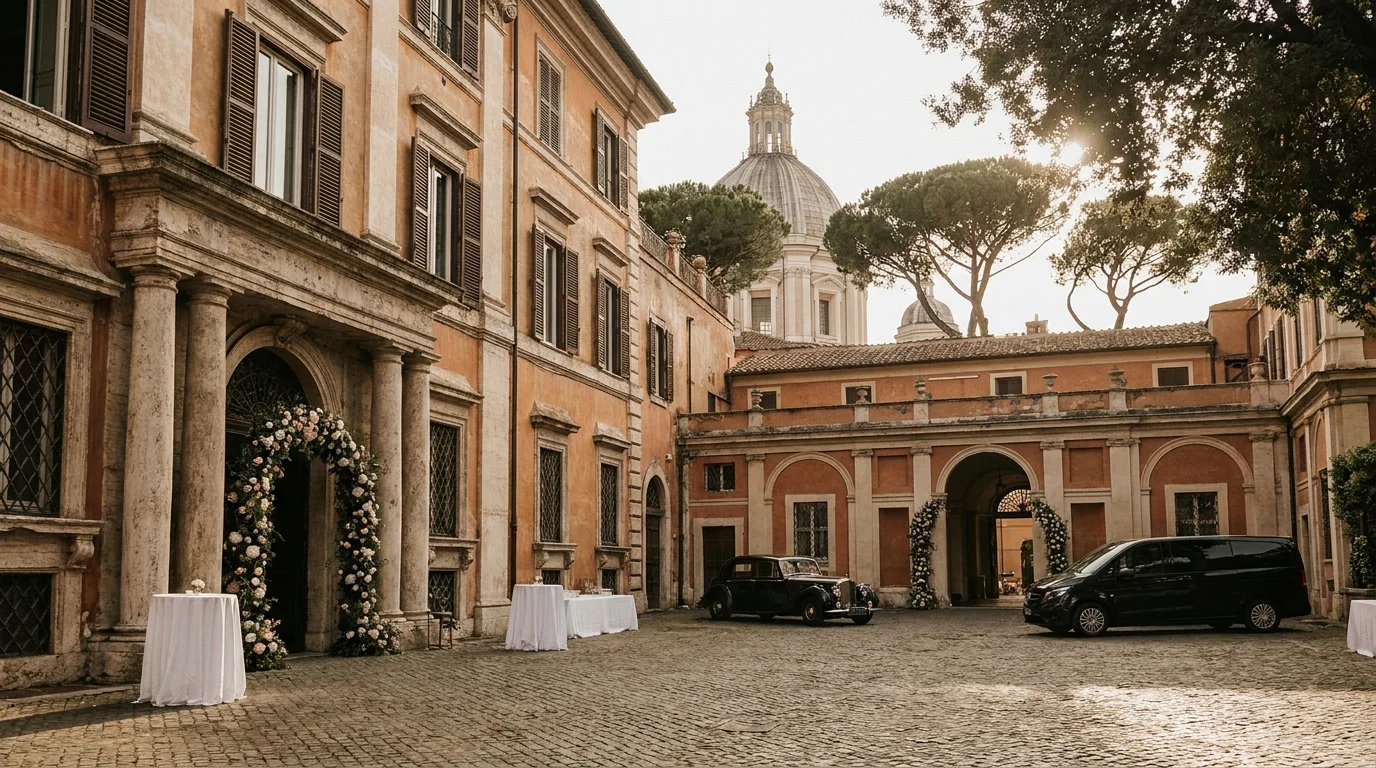
A planner can help organise the process, but the scope of that support should be clear. Personal declarations and official documents remain subject to the requirements of the issuing authority. Some steps require your attendance or signature; any permitted representation must be checked in advance. Venue arrangements, catering, flowers, music, transport and photography can be coordinated within the agreed planning brief. That does not automatically mean the planner signs every supplier contract or receives every payment on your behalf.
Before confirming, establish who contracts with each supplier, who receives payment and which terms apply if plans change. A single planning contact can keep those relationships organised without replacing the obligations in individual agreements. Cancellation conditions and access arrangements need to be understood and agreed, rather than assumed to be within a planner’s control. Our approach to personalised planning explains how the celebration can develop around your priorities, with responsibilities and inclusions recorded in the proposal.
Planning Responsibilities in Rome: The Municipality, Your Venue and Your Team
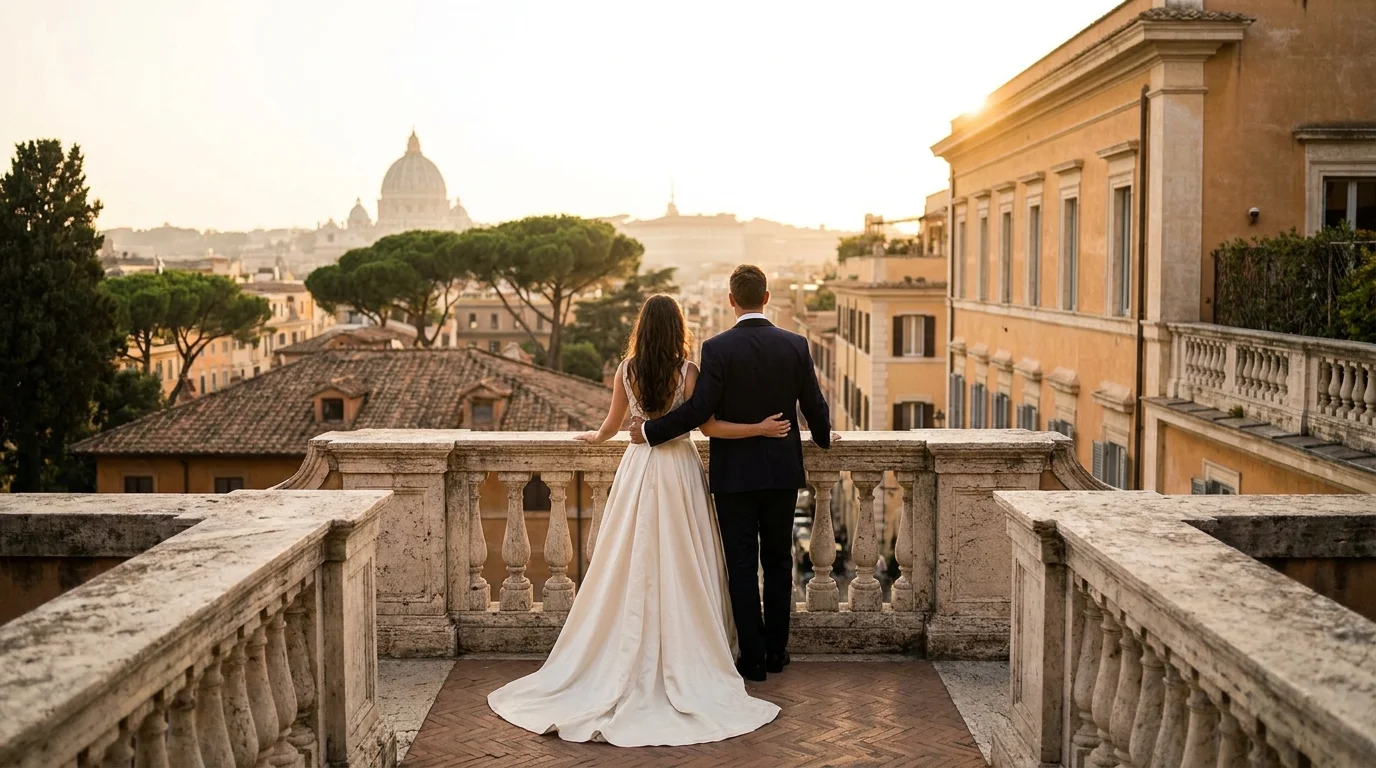
Rome’s historic settings each bring their own practical considerations. A palace, hotel, garden or countryside estate may have different access conditions, conservation requirements and operating hours. Those details deserve attention wherever you choose to celebrate, rather than assumptions based on the address alone.
The responsibilities become clearer when they are considered separately. Roma Capitale confirms the arrangements for a municipal civil ceremony, including available locations, booking requirements and applicable charges. The venue confirms its spaces, setup times, equipment restrictions and house rules, alongside any requirements imposed by the relevant authorities. The planning team brings the agreed tasks into a shared schedule, identifies who must provide each document or permission, and follows up with the appropriate contacts. Translations, interpretation and specialist advice should be arranged where required for your circumstances.
Arrival plans deserve the same care as the room itself. Restricted traffic zones and tourist-coach rules can affect the route, stopping place and type of vehicle used. The transport provider should confirm the permissions relevant to the journey, including the return. From there, the timetable can allow for staggered arrivals, walking distances, luggage and guests with reduced mobility.
Venue selection and practical planning belong together from the first conversation. A terrace, courtyard or historic hall should be considered alongside its access, weather alternative and permitted hours. Our guide to Rome wedding venues and what makes each setting distinct explores the architectural possibilities; the next step is understanding how your chosen setting will work for the celebration and the people sharing it.
Marriage Documents: Confirming the Requirements for Your Circumstances
Start with the requirements for your nationality, residence, marital history and chosen ceremony. The relevant registrar and consular authority should confirm the documents and appointments before you make travel plans around a presumed sequence.
The documents needed are not identical for every international couple. A Nulla Osta, a certificate of no impediment or another accepted form of evidence may be relevant, depending on your circumstances and the applicable arrangements. An Atto Notorio is part of the process for some nationalities, including routes described in official guidance for American and Australian citizens. Legalisation, apostilles, translations and personal appointments must be checked for the documents concerned; they are not interchangeable steps. Confirm validity periods with the receiving office before ordering certificates. With those requirements established, the planning schedule can work backwards from the intended date, leaving room for appointments and any questions raised by the authorities.
If either partner cannot understand Italian sufficiently for the official proceedings, confirm interpreter arrangements with the registrar. The office determines what is required, including identification and any formalities. Do not assume that every interpreter must hold a particular professional registration, or that any bilingual guest will automatically be accepted.
Our guide to what being legally married in Italy means for foreigners introduces the questions international couples need to consider, while civil ceremony rules and real costs in Italy looks more closely at the municipal route. These are useful starting points for a discussion with the responsible offices, whose current requirements take precedence for your case. The planning team can help organise the information, appointments and specialist contacts within the agreed brief. Share your nationality, residence, preferred ceremony and intended dates through our contact page so the conversation can begin with the details that matter, rather than a generic checklist.
Civil, Religious, or Symbolic: How the Format Changes the Venue Shortlist
The ceremony format shapes both the feeling of the day and the available settings. A municipal civil ceremony depends on an authorised location and the registrar’s arrangements. A religious celebration requires discussion with the relevant church or faith authority, including its preparation and permissions. A symbolic ceremony offers greater flexibility in the words, setting and timing, within the venue’s conditions, but does not itself create a legal marriage. Some couples complete the legal formalities separately and devote the Roman celebration to their personal vows.
Discuss the ceremony early so the venue and timetable support it. Our overview of civil, religious, and symbolic ceremonies in Italy explains the main distinctions, while choosing the right officiant considers the voice, language and tone of the celebration. For an Orthodox ceremony, the relevant church confirms its own preparation and permissions; our page on Greek Orthodox weddings in Italy offers further context. Any combination of legal and celebratory events needs enough time for both.
Full Planning, Partial Support, or Wedding-Day Management: Where the Line Really Falls

Planning labels can mean different things from one proposal to another. The useful distinction is the work included, when it begins and who is responsible for each part of the celebration.
Full planning generally brings together venue selection, budget development, suppliers, design and coordination, with any document support or guest programme expressly defined. Partial support builds on arrangements already made: the planner reviews the existing commitments and agrees which remaining tasks to take on. Wedding-day management requires preparation before the event, including a review of contracts, supplier contacts and the timetable. It should not mean meeting the suppliers for the first time as guests arrive. Availability, staffing, hours and surrounding events all need to be confirmed in the proposal, whether you choose a collection or discuss an individual planning brief.
When a planner joins after contracts have been signed, some conditions may already be fixed. Setup times, access, payment dates and cancellation terms should therefore be reviewed before agreeing the remaining scope. Couples comparing approaches across the country can explore our guide to the best wedding planners in Italy with these practical questions in mind.
Our Rome Wedding Collections: Settings, Programmes and Included Services
The collections below offer distinct settings and programmes. Each lists planning, floral styling, photography, video with editing and DJ or music services. Confirm the selected option and detailed scope in your proposal; Sorrento and Maremma are alternatives outside Rome.
| Collection | Programme | Listed inclusions | Details to confirm |
|---|---|---|---|
| The Rome Castle Wedding — Castello Tor Crescenza | 30, 50 or 70 guests | Exclusive castle use, welcome cocktail, wedding meal, cake, open bar, valet and cloakroom services; flowers, photography, video, DJ, planning and concierge | Discuss guest accommodation, transfers and any additions to the listed programme; confirm ceremony arrangements separately |
| The Imperial Palace Wedding — Palazzo Brancaccio | Up to 100 or 150 guests | Exclusive palace use, reception, aperitivo, wedding lunch, cake and open bar; floral styling, photography, video, DJ, planning and concierge | Confirm accommodation, transport, access arrangements and any additional services against your chosen programme |
| The Pincio Wedding — Casina Valadier | Up to 50 or 80 guests | Exclusive villa use for one day, gardens and halls, aperitivo, wedding lunch, cake, wines and open bar; flowers, photo, video, DJ and coordination | Discuss accommodation, transfers and any extended programme within the venue conditions and applicable limits |
| The Dolce Vita Wedding — Hotel de la Ville | Two nights in 25 rooms | Breakfasts, pre-wedding dinner, symbolic ceremony with celebrant, reception, aperitivo, wedding lunch, cake and open bar; flowers, imagery, DJ and planning | Confirm the rooms and event spaces reserved for your party, guest capacity and any additional accommodation or services |
| The Villa Aurelia Wedding | A celebration for 100 guests | Exclusive day use, preparation rooms, gardens and halls, aperitivo, wedding lunch, cake, wines and open bar; flowers, photo, video, DJ and coordination | Confirm overnight accommodation, transport and any additions; preparation rooms do not imply an overnight stay |
| The Romantic Sorrento Wedding — Villa Antiche Mura | Sorrento: 30, 60 or 90 guests | Villa and gardens from 4pm to midnight, symbolic ceremony, aperitivo, dinner, cake and party; flowers, photography, video, DJ, planning and concierge | An alternative outside Rome; discuss accommodation, travel and transfers for the selected guest count |
| The Romantic Maremma Wedding — La Pescaia Resort | Maremma: 50 or 80 guests | Exclusive resort use for three nights, symbolic ceremony and reception, dinner, cake, open bar and party; flowers, photography, video, DJ and coordination | The 80-guest option includes a stay for 50; confirm accommodation details, additional nights and transfers |
Published prices include VAT where applicable. Your selected programme and any additions are confirmed in the proposal.
For couples benchmarking Italy as a whole before narrowing to the capital, our transparent analysis of why Italian wedding costs vary so widely is the right companion piece to this table.
Administrative and Ceremony Arrangements to Include in Your Budget
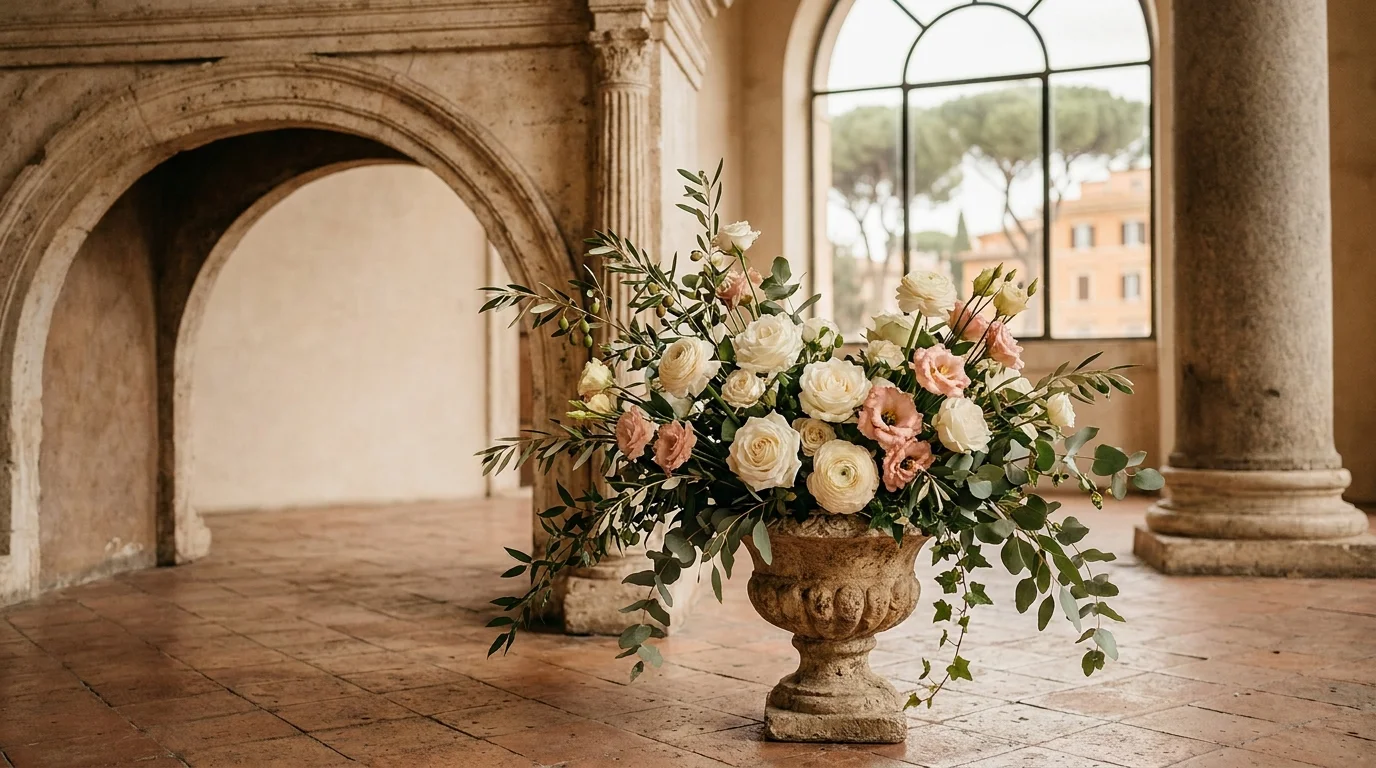
Administrative costs depend on the ceremony and your personal circumstances. Some services may already appear in the proposal; others are paid to an authority or specialist. The table identifies what to check, without applying a single tariff or exclusion to every collection.
| Item | Basis of the charge | What to confirm |
|---|---|---|
| Municipal civil ceremony | The current tariff for your chosen booking | Ask the marriage office about the location, date, residence conditions and payment process; check whether any allowance appears in your proposal |
| Certificates and consular documents | The issuing authority and the documents required | Requirements vary by nationality and circumstances; confirm appointments, fees, accepted documents and validity before arranging the sequence |
| Translation and document authentication | The required document, language and procedure | Ask the receiving office which translation and authentication formalities apply, then obtain a quotation covering the required work |
| Interpretation for official proceedings | The appointments and role required by the registrar | Confirm language needs, the interpreter accepted by the office, identification formalities and the service included in the quotation |
| Public-space or heritage permissions | The location and proposed activity | Check whether permission is needed, who applies, the conditions imposed and any charge before commissioning the relevant setup |
| Coach access and stopping arrangements | The route, vehicle and applicable access rules | The transport provider should confirm the appropriate permissions, stopping places and whether those costs are included in the transfer price |
| Religious preparation and church arrangements | The relevant parish or faith authority | Confirm the documentation, permissions, preparation and any offering or service charge directly; distinguish these from planning support |
Confirm each applicable charge, payment recipient and inclusion before adding it to your wedding budget.
Supplier Budgets in Rome: Imagery, Florals, Music, Transport
A considered supplier budget reflects the work as well as the setting. Historic spaces may require particular installation methods, delivery times or transport arrangements; creative preferences can also change the team and equipment needed. The proposal should make those assumptions clear before you confirm. The collections above already include several core services. Use the following guide to clarify their scope and compare any additions without counting the same service twice.
| Supplier | Scope of the proposal | Details to confirm | Potential additions |
|---|---|---|---|
| Photography | Listed in the linked collections | Named photographer, coverage hours, locations, editing, delivery and gallery access; compare complete galleries before confirming your preferences | Further coverage, a second photographer, albums or prints when outside the agreed service; no automatic supplement should be assumed |
| Videography | Listed with editing and post-production | Team size, coverage, sound recording, film formats and delivery; agree how the team works alongside the photographer | Further events, additional edits or other deliverables; any aerial filming remains subject to lawful operation and conditions |
| Floral and tablescape design | Floral styling is listed in the collections | The ceremony and reception arrangements, bouquet, boutonnière, palette, seasonal choices and installation requirements described in the proposal | Larger installations, specialist furniture or additional decoration beyond the agreed design; open flames require venue approval where applicable |
| Music and sound | DJ or music services are listed | Performance times, equipment, sound limits and the exact programme; live musicians should be expressly identified if included | A string ensemble, live band or additional sound equipment where not included; longer sets must remain within permitted hours |
| Guest transport | A route and schedule tailored to the group | Vehicle capacity, collection points, accessibility, waiting time, return services and relevant permissions; confirm the total for the journeys required | Additional journeys, vehicles or extended waiting outside the agreed schedule, with responsibility for any access charges stated clearly |
| Hair and makeup | A personal brief for the people receiving services | The number of appointments, trial arrangements, location, preparation timetable, products and any touch-ups included in the proposal | Further appointments, another stylist, extended attendance or travel outside the agreed service; confirm each addition before booking |
Confirm the final scope, applicable taxes and total in writing; additions require your agreement before booking.
Our guide to editorial wedding photography in Italy explores light, portrait timing and the balance between direction and observation. Complete galleries and a conversation with the proposed team help you understand what the included service will deliver. Share your date, setting and visual preferences through our enquiry form so photography can be considered alongside the rhythm of the whole celebration.
Choosing the Season and Finding the Right Rhythm for Your Day
Late September and early October can be beautiful in Rome, with changing light across the terraces and rooftops. Conditions vary, however, and there is no guaranteed fortnight of comfortable temperatures or fixed portrait hour. The date, weather, orientation and surrounding buildings all influence how a particular space feels as the afternoon becomes evening.
For a summer celebration, consider shade, drinking water, seating and comfortable arrival times alongside the ceremony itself. In any season, discuss a suitable weather alternative, including capacity, access and the cost of changing the layout. Sunset and the venue’s actual light can guide portraits without dictating the entire experience. Dinner, speeches and guest comfort deserve room in the schedule too. A thoughtful timetable leaves space for the day to unfold. It also gives the team an agreed process for responding when conditions change.
A Roman Menu with a Personal Sense of Occasion
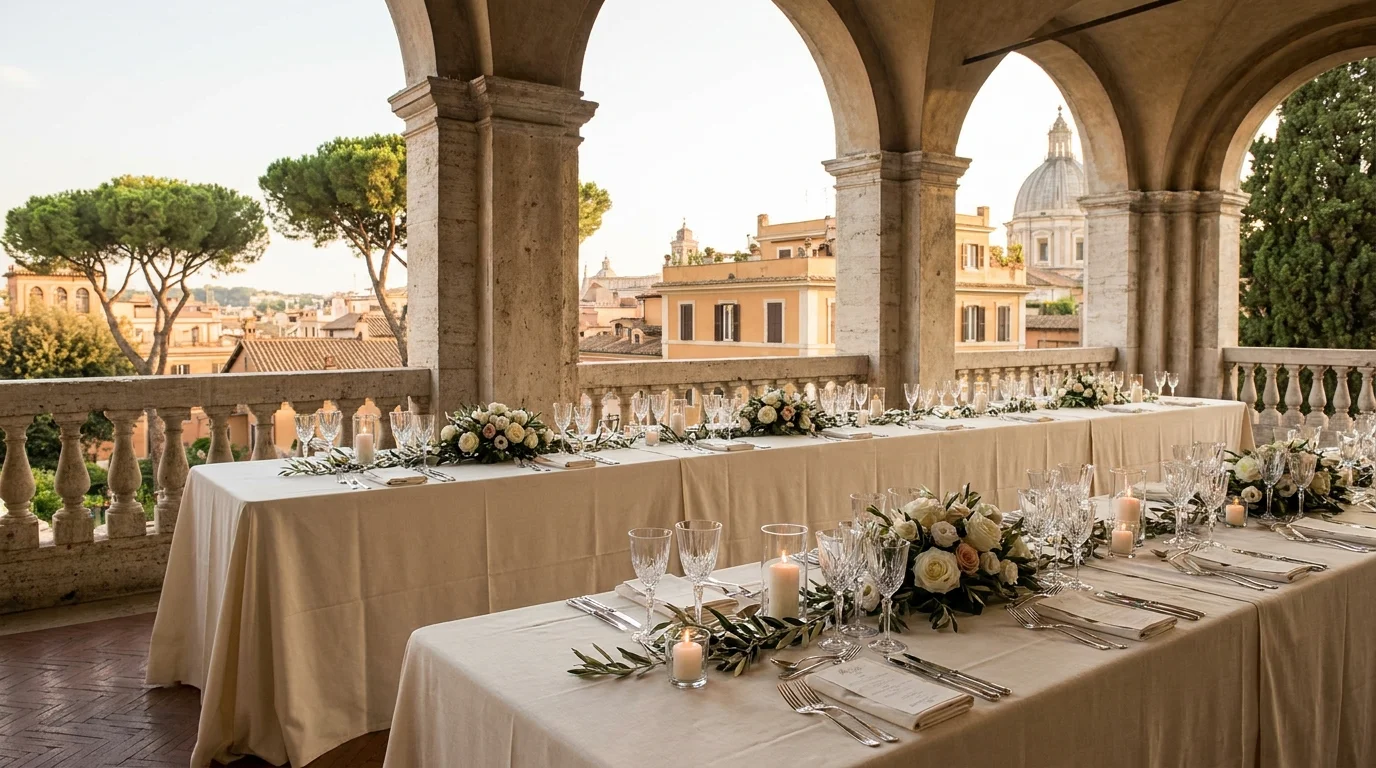
Roman cooking brings a strong sense of place to the table: pecorino, seasonal vegetables, carefully made pasta and recipes with a history of their own. The menu can honour that character while feeling at home in a palace, garden or contemporary hotel setting.
Begin with the flavours you love, then consider the season, setting and pace of the meal. A dinner in a frescoed hall and an evening reception in a garden can each feel refined, with a different rhythm of service. Tastings, dietary requirements and the timing of speeches belong in the planning conversation, together with the caterer’s approach to presentation and hospitality. Our editorial on why Italian wedding food feels different explores the experience around the meal, while regional Italian wedding menu ideas offers inspiration before you narrow the choices. The aim is a menu that feels generous and personal, with enough time for guests to enjoy the food and one another.
Guest Logistics Across Three Days: Arrivals, Transfers, and the Multilingual Bridge
A Roman wedding can become a few days together, with arrivals, a welcome gathering and time to explore the city around the main celebration. Each event needs its own practical plan. Consider flight arrivals, luggage storage, hotel check-in, accessible transport and how much organised activity guests will welcome. A relaxed programme often leaves some time unfilled, allowing people to rest or make their own discoveries.
Guest support should have a clear scope in the proposal. This may include accommodation coordination, arrival information, transfer arrangements and a named contact during agreed hours. If you would like private visits, dinners or day trips, these can be explored alongside the wedding programme, subject to availability and the relevant arrangements. Our curated experiences offer inspiration, while bespoke luxury weddings in Italy explains the wider approach to shaping a celebration around the people attending.
A smaller gathering may make it possible to stay together and keep transfers simple, but the right arrangement depends on the property and individual needs. Our guide to what a micro wedding means in Italy considers that more intimate approach. A larger celebration needs a detailed transport and accommodation plan, with clear contacts and contingencies. Couples imagining a day with very few guests can explore eloping in Rome, then discuss which ceremony, setting and level of support best suit their plans.
The Care Behind a Considered Wedding in Rome
The value of a wedding planner in Rome, Italy, lies in bringing creative care and practical judgement together. A beautiful room needs a workable arrival plan; an intimate ceremony needs the right preparation; an evening reception needs a timetable that supports good hospitality. Keeping these details connected makes decisions easier for the couple and gives suppliers a shared understanding of the day. The result should feel personal and welcoming, with the planning quietly supporting the moments everyone has come to share.
If Rome is beginning to feel like your place, share your preferred dates, guest count and the kind of celebration you imagine. The next conversation can explore suitable settings, ceremony options, available programmes and a budget built around the scope. Reach us through our contact page, and meet the people behind the planning on our team page. Our overview of luxury weddings in Italy introduces the wider collection of possibilities, while villa weddings in Italy by region offers another perspective if you are still comparing the capital with a countryside stay.
Communication contact: Maximilian Figel — Kiss Me Italy Communication Manager
Maximilian Figel is Kiss Me Italy’s Communication Manager, helping international couples connect with the team and find the information they need as their plans develop. His role supports clear communication, while the wedding planning and creative team shape each celebration and coordinate the relevant providers within the agreed scope of service.
Questions Couples Ask Us Before They Book
Can we sign a venue contract before our Nulla Osta is issued?
A venue may accept a booking before the marriage documents are issued, but this does not confirm legal eligibility or a municipal ceremony slot. Check the intended route and contract conditions before committing, including what happens if documents or appointments are delayed. Certificate issue dates should follow the receiving office’s requirements.
Do you take a commission from suppliers, or is your fee the only fee?
Ask for the proposal to explain the planning fee and any supplier commission, referral arrangement or markup relevant to your booking. Any trade discount and how it is applied should also be clear. Confirm who invoices each service and receives payment, so you can assess the scope and total with a shared understanding before committing.
Our documents show different spellings of the same surname. Is that a problem?
A discrepancy should be raised with the receiving authority before documents are submitted. The appropriate correction depends on the records and issuing country; a translation cannot simply change a name to make documents match. The planning team can help coordinate enquiries, while the responsible offices confirm any supporting evidence or amendment required.
We want a priest from our home parish to officiate. Can that happen in Rome?
It may be possible, subject to the host church’s approval and the permissions required for the visiting priest. Discuss the arrangements with both parishes early, including preparation and documentation. The relevant church authorities decide what is acceptable; a symbolic celebration should not be assumed to replace a religious rite or its requirements.
Can we bring our own photographer from the United States?
This can be discussed within your proposal. Confirm the photographer’s applicable working requirements, insurance, travel and venue access, together with how an external appointment affects the collection’s included photography and price. Drone or public-space arrangements need separate assessment where relevant. A shared brief helps the visiting photographer work comfortably with the local team.
What is the deposit schedule, and which currency do you invoice in?
Confirm invoice currency, payment dates and methods in the contract. Published collection prices are in euro. If you pay from another currency, check conversion and transfer charges with your provider when planning payments. Any venue or supplier terms that differ should be identified before you commit.
If rain forces us indoors, who decides and when?
The decision process should be agreed before the wedding with the venue, planning team and relevant suppliers. It needs a named decision-maker, a suitable deadline and a confirmed alternative whose capacity, layout and costs are understood. There is no universal decision hour; setup requirements and conditions at the property determine what is practical.
Will someone from your team be on site for the whole day?
On-site coordination is listed in the collections, but the team size and working hours should be confirmed in your proposal. Discuss setup, ceremony, reception, guest departures and any later collection of equipment, so responsibilities are clear. Additional locations or events may require further staff or an extension of the agreed service.
Do you manage the welcome dinner and farewell brunch, or only the wedding day?
Welcome dinners and farewell gatherings can be considered within a multi-day brief. Some collections include specific surrounding events; others need a separate arrangement. Confirm each event’s venue, menu, guest count and coordination hours in the proposal, rather than assuming that a planning label includes every gathering.
How late can music play at a Rome wedding?
Confirm the permitted hours and sound conditions with the venue before planning the evening. The answer can depend on the property, location and applicable restrictions, including whether music is indoors or outside. An extra payment does not automatically permit later music. Build the celebration around the confirmed limits and discuss any alternatives in advance.