“Our venue contract mentions a ‘house selection’—but what does that actually mean, and how many bottles do we need?” It’s the question international couples ask us most, usually after the venue is booked and the menu is already taking shape.
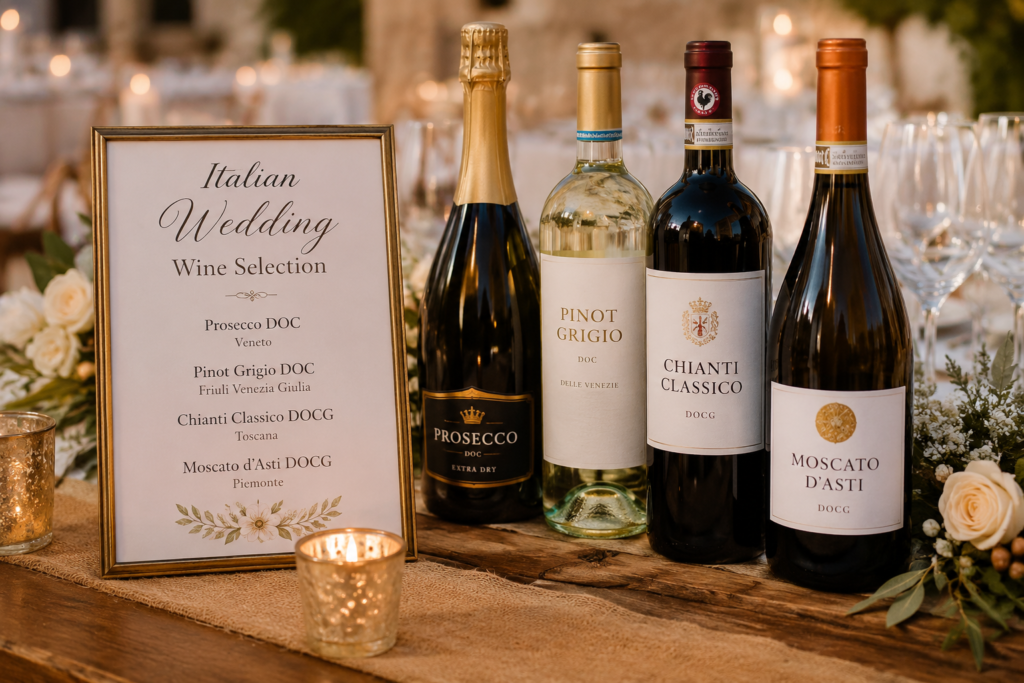
Italian Wedding Wine Selection
An Italian wedding wine selection is a curated sequence of wines—typically five to eight labels—chosen to complement your menu courses, your venue’s service capabilities, and the season of your celebration. At Kiss Me Italy, we coordinate directly with sommeliers, estate producers, and catering teams to build a wine list that flows from aperitivo through the final toast, so you never have to navigate Italian wine logistics alone.
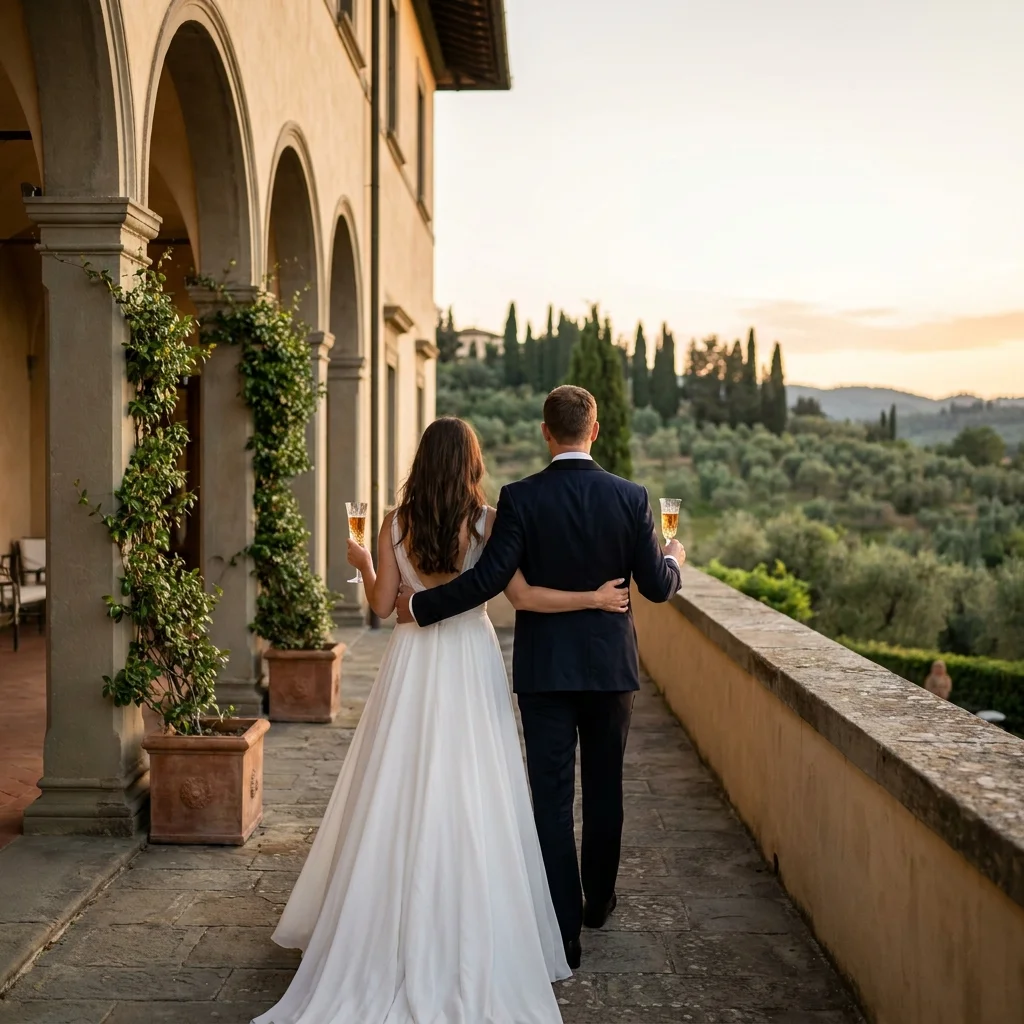
Why Your Italian Wedding Wine Selection Is a Hospitality Decision, Not a Shopping List
The couples we work with rarely arrive asking about specific grape varieties. They ask about atmosphere. They want to know whether their guests—many of whom may never have visited Italy—will feel the place through what they drink. That is the real purpose of an Italian wedding wine selection: it is hospitality choreography.
Consider the arc of an evening. Guests arrive for aperitivo, often standing, often warm from a summer afternoon. A crisp Vermentino from Liguria or a Franciacorta Satèn served at exactly the right temperature resets the mood. Then comes the seated dinner—perhaps a primi of handmade pasta with a delicate ragù, followed by a grilled branzino or a Chianina beef tagliata. Each course demands a different wine personality. The toast, finally, is a punctuation mark: it should feel celebratory without being sweet. What most planners miss is that these transitions require logistical coordination as much as good taste. The sommelier, the catering staff, the bar team, and the couple’s preferences all need to align hours before the first cork is pulled.
We manage this alignment as part of every celebration we design, whether it is a villa wedding in the Tuscan hills or a lakeside reception on Lake Como. The wine list is built alongside the menu, not after it.
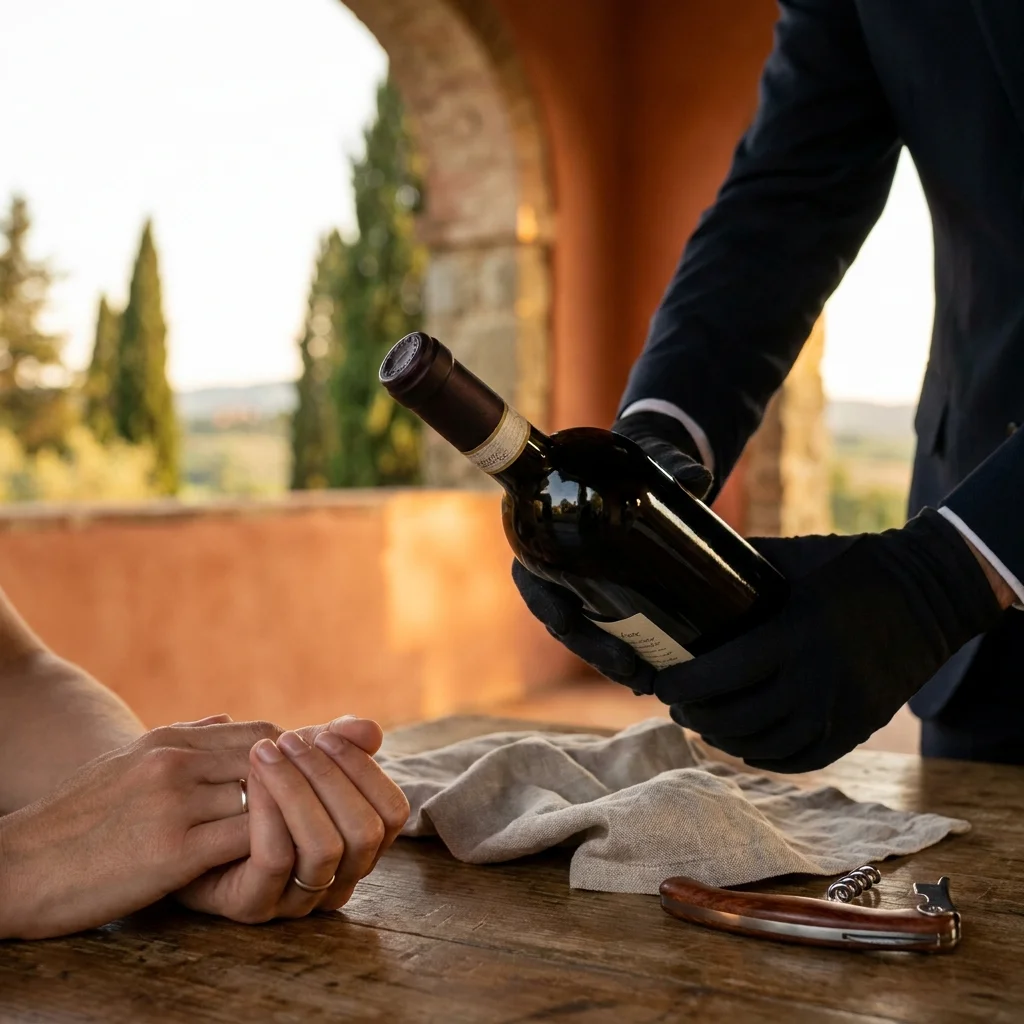
DOC, DOCG, and IGT: The Three Labels That Shape Every Wine Decision
Italian wine classification can feel impenetrable, but for wedding purposes, only three designations matter. Understanding them prevents overspending and ensures you are choosing quality that your guests will actually taste, not just a prestigious label.
DOCG (Denominazione di Origine Controllata e Garantita) is the highest tier. These wines undergo government-regulated quality testing and come from strictly defined zones. Brunello di Montalcino, Barolo, Amarone della Valpolicella, and Franciacorta all carry this designation. For a wedding, DOCG wines are typically reserved for the main course pairing or the toast—the moments where quality should be unmistakable.
DOC (Denominazione di Origine Controllata) covers a broader range of respected regional wines. Verdicchio dei Castelli di Jesi, Soave Classico, and Etna Rosso fall here. In our experience, DOC labels often deliver extraordinary value at the wedding table because they offer genuine regional character without the premium of the most collected DOCG bottles.
IGT (Indicazione Geografica Tipica) is the most flexible classification. Some of Italy’s most celebrated wines—the so-called “Super Tuscans”—are technically IGT because their producers chose grape blends outside DOC regulations. For aperitivo service or a casual welcome dinner the night before, hand-selected IGT wines can be a genuine revelation: approachable, modern, and often produced by the same estates that make headline DOCG bottles.
We never recommend choosing wine by classification alone. The label tells you where a wine comes from and how it was regulated—not whether it belongs at your table. That decision depends on your menu, your season, and the service style your Italian wedding menu demands.
How the Season of Your Wedding Reshapes the Entire Wine List
A July wedding on the Amalfi Coast and an October celebration in Piedmont require fundamentally different wine strategies. Temperature alone changes everything: a structured Barolo that sings in a cool November dining room will taste heavy and tannic on a terrace at thirty-four degrees in August.
For summer weddings (June through early September), we lean toward lighter reds served slightly chilled—Cerasuolo d’Abruzzo, a young Valpolicella, or a Frappato from Sicily. Whites and rosés dominate the aperitivo, and sparkling wines need to be served at 6–8°C to hold their structure in the heat. Ice logistics matter: we coordinate insulated service stations and backup refrigeration, especially at outdoor venues where the nearest kitchen may be fifty metres from the reception area.
Autumn and winter celebrations open the door to fuller wines. A Brunello or an aged Barbaresco can anchor a dinner menu built around truffle, game, or slow-braised meats. The toast might shift from Prosecco Superiore to a vintage Franciacorta Rosé, whose complexity rewards a more intimate, candlelit setting. Couples planning an autumn or winter wedding in Italy often find that their wine budget stretches further, too, because many producers offer more favorable pricing outside the peak harvest season.
In our experience, the season is the single most consequential variable in an Italian wedding wine selection—more than budget, more than guest count. We build every list with the forecast and the venue’s microclimate in mind.
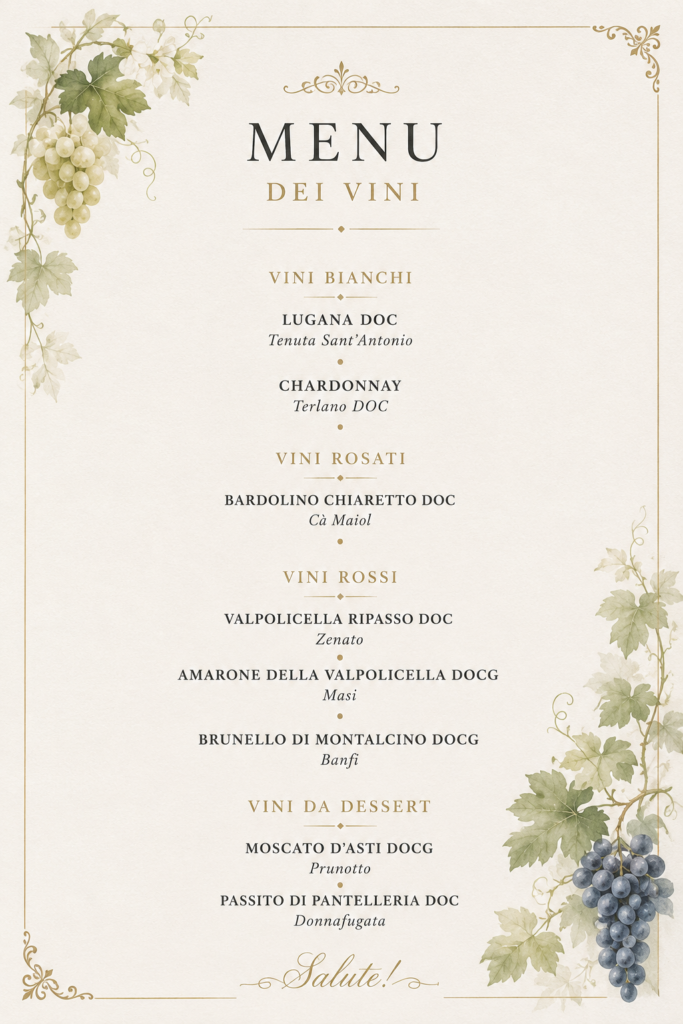
Three Wine Profiles That Map to Italy’s Most Sought-After Wedding Destinations
Rather than presenting hundreds of labels, we find it more useful to think in terms of wine mood—the sensory impression the selection creates across the evening. After thirty years of curating celebrations, three profiles emerge naturally from the geography itself.
Classic: Tuscany and Piedmont
Sangiovese-based reds (Chianti Classico DOCG, Brunello, Vino Nobile di Montepulciano) for the main course. Vernaccia di San Gimignano or a Vermentino Toscano for lighter courses. Franciacorta or a refined Trento DOC for the toast. This profile suits Tuscan venue celebrations and Piedmont’s hillside estates alike—earthy, structured, unmistakably Italian. A Tuscan wedding wine list built around this profile typically features four to five labels.
Coastal: Liguria, Amalfi, and Sicily
Mineral whites dominate—Pigato from the Ligurian Riviera, Fiano di Avellino from Campania, Grillo or Carricante from Sicily’s volcanic slopes. Reds are lighter: Nerello Mascalese from Etna or a Ciliegiolo from the Maremma coast. Prosecco Superiore DOCG from the Conegliano-Valdobbiadene hills works beautifully for the toast in a warm coastal setting. Couples celebrating in Amalfi Coast venues or along the Ligurian coast often gravitate toward this profile instinctively.
Volcanic and Adventurous: Campania, Etna, and the Islands
For couples who want something less expected, volcanic terroir produces wines with remarkable minerality and tension. Greco di Tufo, Falanghina del Sannio, and Etna Bianco for whites. Aglianico del Vulture and Etna Rosso for reds. The toast might feature a Metodo Classico from the slopes of Mount Etna—a genuine conversation starter. This profile rewards couples whose guests are adventurous and curious.
How Much Wine Do You Actually Need for a Wedding in Italy?
This is the question I hear most often, and the answer depends on the structure of your celebration—not just your headcount. A five-hour reception with aperitivo, four courses, and a toast requires more wine than a three-hour dinner. Italian service culture also tends to be more generous than what couples from the UK or US may expect; catering staff will top up glasses throughout the meal.
The general framework we use:
| Service Moment | Wine Type | Quantity per Guest | Notes |
|---|---|---|---|
| Aperitivo (45–75 min) | Sparkling or white | 2–3 glasses (≈ ½ bottle) | Includes Prosecco, Franciacorta, or a still white |
| Seated dinner — white course | White or rosé | 1–2 glasses | Paired with primi or fish |
| Seated dinner — red course | Red | 2–3 glasses | Paired with secondi or meat |
| Toast | Sparkling | 1 glass (≈ ⅙ bottle) | Franciacorta, Trento DOC, or Prosecco Superiore DOCG |
| After-dinner / dancing | Mixed or sparkling | 1–2 glasses (optional) | Often replaced by cocktails or spirits |
Indicative ranges. Contact Kiss Me Italy for a personalized proposal.
As a working rule, we plan approximately one full bottle per guest for the seated dinner, plus a half-bottle per guest for aperitivo and toast combined. For a hundred-guest wedding, that translates to roughly 130–150 bottles across all moments. We always build in a 10% buffer—better to have a few cases unopened than to run short during the final course.
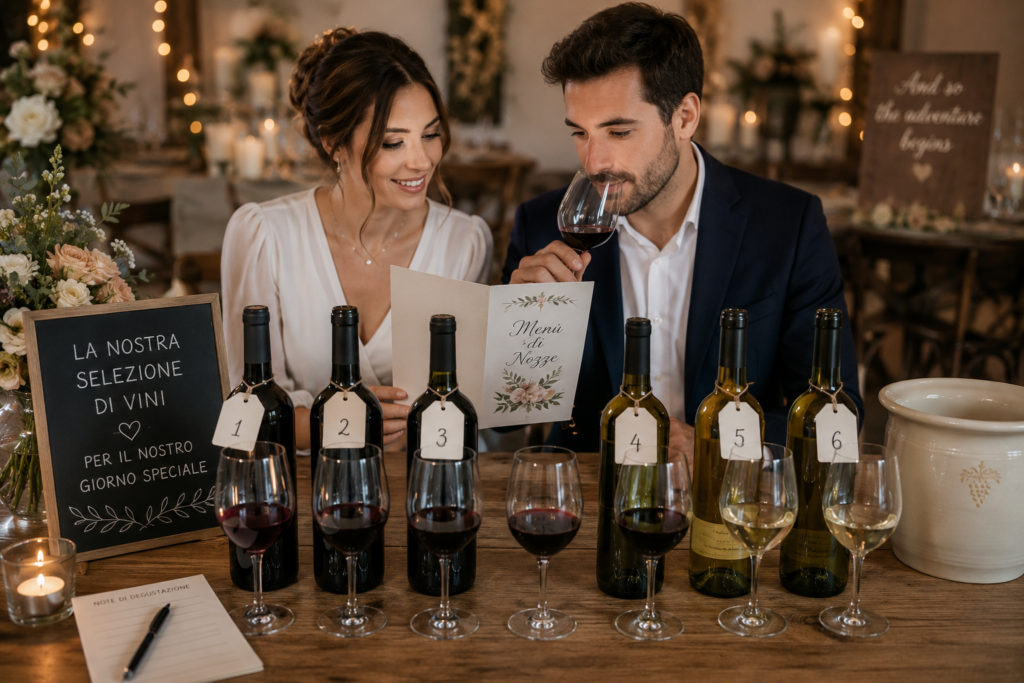
What the Venue Contract Usually Omits About Wine Service
This section is deliberately more technical, because the financial details here are where most misunderstandings arise between international couples and Italian venues.
Corkage fees. Many Italian venues and their in-house caterers permit external wine—but charge a corkage fee of €8–€25 per bottle. Some venues waive corkage if you purchase wine directly from their estate or a partner producer. Others charge a flat fee regardless. The contract language is often vague; we review every clause before the couple signs.
Minimum spend requirements. Certain exclusive-use estates in Tuscany and Lake Como set a minimum beverage spend (€3,000–€12,000 depending on guest count and season), which may or may not include spirits and cocktails. If the minimum is high relative to your guest count, it can be more cost-effective to upgrade wine quality rather than increase quantity.
Glassware. Professional wine service requires appropriate stemware—not the generic glasses many rental companies supply. We coordinate crystal glassware for weddings where the wine list warrants it, typically adding €2–€5 per place setting.
Service staff. A sommelier-led wine service at the table (decanting, pouring, pairing explanations) is separate from standard catering staff. We engage sommeliers for larger celebrations or when the wine list includes aged or rare bottles that benefit from professional handling.
The couples we work with never navigate these details alone. Whether the celebration unfolds in a luxury venue or a private estate, our team confirms every beverage clause before the planning advances. For couples considering a Portofino wedding, where venue and catering options are particularly bespoke, this review is especially critical.
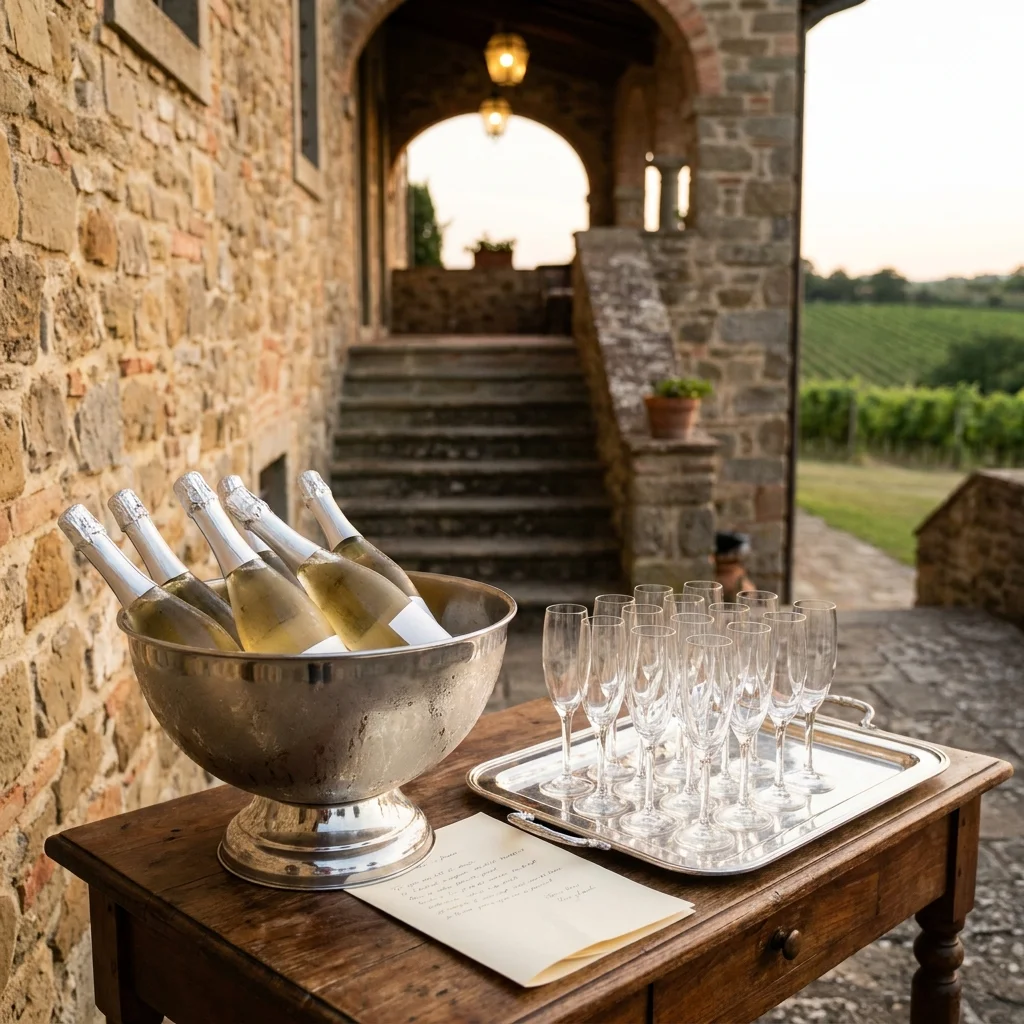
Behind the Scenes: The 30-Minute Window That Makes (or Breaks) the Toast
Here’s what guests never see.
Twenty minutes before the speeches, we check the sparkling again. Temperature. Glass count. Backup cases. We confirm who gives the cue for the pour—planner, maître d’, or bandleader. Then we stage bottles where the staff can move fast without crossing the photographer’s frame.
It’s not romantic. It’s precision. And it’s exactly why the toast feels effortless.
Real Cost Ranges for an Italian Wedding Wine Selection
Pricing varies by region, producer prestige, and whether the venue supplies wine in-house or the couple sources independently. The tables below reflect the ranges we see across our celebrations. All figures exclude IVA (22% VAT) unless stated otherwise.
| Wine Category | Price per Bottle (ex-VAT) | Included | Quoted Separately |
|---|---|---|---|
| Aperitivo sparkling (Prosecco Superiore DOCG) | €10–€18 | Wine, standard delivery to venue | Crystal glassware, sommelier service, corkage (if applicable) |
| Aperitivo sparkling (Franciacorta DOCG) | €18–€40 | Wine, standard delivery to venue | Crystal glassware, sommelier service, corkage |
| White — DOC/IGT (Vermentino, Soave, Fiano) | €10–€22 | Wine, delivery | Corkage, glassware |
| White — DOCG (Vernaccia, Greco di Tufo) | €14–€30 | Wine, delivery | Corkage, glassware |
| Red — DOC (Chianti, Valpolicella, Etna Rosso) | €12–€25 | Wine, delivery | Corkage, glassware, decanting service |
| Red — DOCG (Brunello, Barolo, Amarone) | €30–€90+ | Wine, delivery | Corkage, glassware, sommelier, cellar storage if ordered in advance |
| Toast sparkling (Franciacorta Vintage / Trento DOC Riserva) | €25–€55 | Wine, delivery | Corkage, glassware |
Indicative ranges. Contact Kiss Me Italy for a personalized proposal.
| Full Wine Service Package (100 guests) | Estimated Total (ex-VAT) | Included | Quoted Separately |
|---|---|---|---|
| Essential — DOC-focused, 4–5 labels | €2,200–€4,000 | Wine selection, delivery, tasting consultation (remote or on-site), menu pairing guidance | Corkage, sommelier on the day, crystal glassware, IVA 22% |
| Elevated — DOCG anchors, 5–7 labels | €4,000–€8,500 | All Essential inclusions + on-site tasting with sommelier, label customization consultation | Corkage, crystal glassware upgrade, IVA 22% |
| Prestige — estate-exclusive or vintage bottles, 6–8 labels | €8,500–€18,000+ | All Elevated inclusions + sourcing from private cellars, sommelier-led table service, bespoke label design | Corkage (often waived at this tier), IVA 22% |
Indicative ranges. Contact Kiss Me Italy for a personalized proposal.
| Scope Clarity (Wine Service) | Typically Included | Typically Excluded / Quoted Separately |
|---|---|---|
| Wine sourcing & allocation | Producer selection, vintage checks, quantity planning, substitutions if a label becomes unavailable | Rare/allocated bottles requiring pre-payment or cellar brokerage |
| Logistics to venue | Standard delivery within the region; coordination with venue receiving hours | Long-distance transfers between regions; urgent same-day courier |
| Storage & temperature control | Service brief with target temperatures; coordination with venue refrigeration | Additional refrigeration rental, insulated stations, ice supply for outdoor service |
| Service on the day | Pour sequence plan and timing with catering team | Sommelier-led table service, decanting team, additional bar staff |
| Glassware | Standard catering glassware (where provided by caterer) | Crystal stemware upgrade, specialty stems (Burgundy/Nebbiolo), breakage deposits |
| Venue/caterer fees | — | Corkage per bottle, beverage minimum spends, service charges |
| Taxes | — | IVA (VAT) 22% unless explicitly included in the quote |
| Travel / accommodation / permits | Not applicable to wine supply itself | If a dedicated sommelier team travels or overnight stays are required, these are quoted transparently |
Note: items such as “post-production,” “second shooter,” and “albums” relate to photography services and are not part of wine service scope.
For couples building a broader understanding of Italian wedding investment, our comprehensive cost guide contextualizes wine within the full celebration budget.
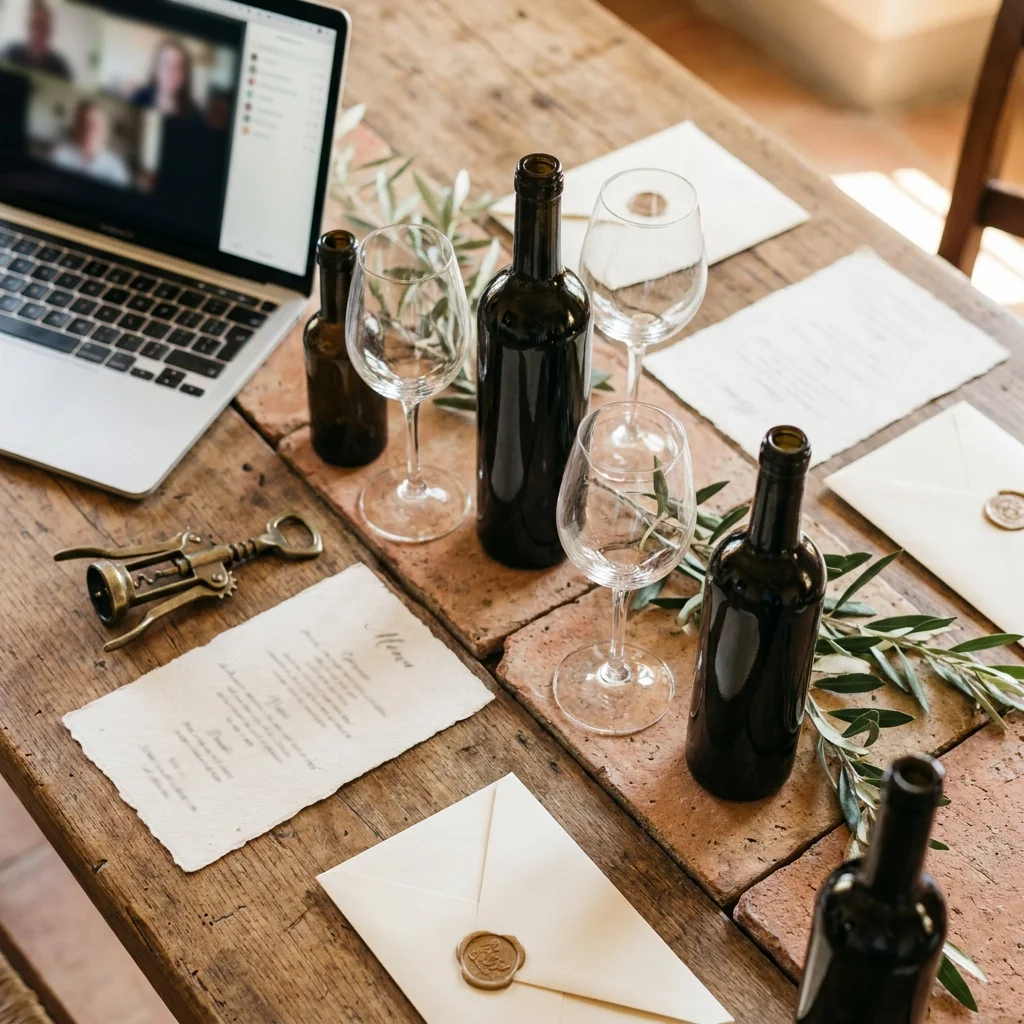
When You Cannot Taste in Advance: How We Manage Remote Wine Selection
Most international couples cannot fly to Italy for a wine tasting six months before their wedding. This is normal. In our experience, roughly seventy percent of the couples we work with finalize their Italian wedding wine selection remotely.
Here is how we handle it. First, we build a shortlist of eight to twelve wines based on the confirmed menu, the season, and the couple’s general preferences—do they lean toward bold reds or lighter, aromatic whites? Do they want exclusively Italian labels, or whether there is a single sentimental bottle from home that should be integrated discreetly alongside an otherwise Italian-led list—handled with the venue and service team so it never disrupts the flow. Then we send detailed tasting notes, producer profiles, and—where the producer permits—arrange small-format sample shipments to the couple’s home country. The final selection is confirmed four to six weeks before the celebration.
For couples who do visit Italy before the wedding, we arrange private tastings at the estate or at the venue itself, often combined with a menu tasting hosted by the caterer. These sessions typically last ninety minutes and are among the most enjoyable parts of the planning process. They also give us the chance to confirm serving temperatures, decanting needs, and the precise pour sequence with the catering team on-site.
Whether the selection happens over a video call from London or at a winery table outside Montalcino, the result is the same: a wine list that feels intentional, personal, and perfectly calibrated to the evening ahead.
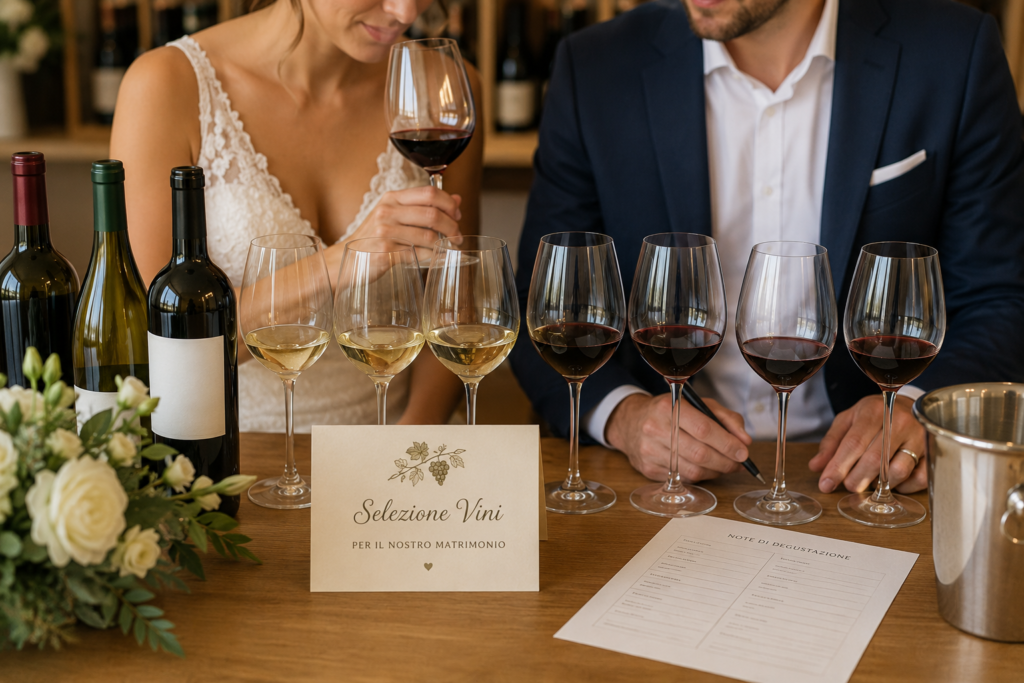
Mixed Menus, International Palates, and Alcohol-Free Alternatives
Italian wedding menus increasingly blend seafood and meat across courses. A crudo appetizer followed by a truffle risotto and then a grilled lamb chop—this kind of menu is common, and it challenges the old rule of “white with fish, red with meat.” We approach mixed menus by choosing versatile bridge wines: a structured rosé from Puglia or Abruzzo, a lighter Nebbiolo, or a skin-contact white from Friuli that can carry across both proteins without jarring the palate.
International palates also require attention. Guests from the US and Australia may prefer fruit-forward, oak-influenced wines, while British and Northern European guests often gravitate toward minerality and acidity. We balance the list to include at least one crowd-pleasing, approachable label alongside more characterful regional selections. The goal is never to educate—it is to ensure every guest enjoys what is in their glass.
Alcohol-free alternatives are no longer an afterthought. We source Italian sparkling grape juices, botanical sodas from artisan producers, and—where the venue permits—coordinate a dedicated mocktail station during aperitivo. For celebrations where a significant portion of guests do not drink alcohol, we adjust the wine quantity downward and reallocate budget toward a more elaborate non-alcoholic program. Couples designing a traditional Italian wedding food experience often appreciate how thoughtfully this integration can work alongside the classic course structure.
Franciacorta, Prosecco Superiore, or Trento DOC: Choosing the Right Italian Wedding Toast Sparkling Wine
The toast is the most photographed pour of the evening. It should be memorable. Here is how the three main Italian sparkling options differ in practice.
Franciacorta DOCG is Italy’s answer to Champagne—Metodo Classico, secondary fermentation in the bottle, minimum eighteen months on the lees (and often much longer for vintage cuvées). It delivers fine, persistent bubbles and a complexity that rewards attention. For an elegant evening reception, particularly in Lombardy or Tuscany, Franciacorta is our most frequent recommendation.
Prosecco Superiore DOCG from the Conegliano-Valdobbiadene hills is lighter, fruitier, and more immediately joyful. It works beautifully for daytime celebrations, outdoor toasts in warm weather, and couples who want a relaxed, convivial atmosphere. It is not “lesser”—it is different. A hand-selected Rive bottling from a single-vineyard producer can be genuinely extraordinary.
Trento DOC is the mountain alternative—Metodo Classico from Trentino-Alto Adige, often made with Chardonnay and Pinot Noir at altitude. It has a freshness and precision that pairs especially well with Dolomites wedding celebrations or any venue where the air carries a crispness that heavier sparkling wines would overpower.
We never default to one option. The toast wine is chosen last, once the menu, the venue, and the season have all been confirmed.
How We Pair Wine to the Menu: Protein First, Region Second
In our experience, the most reliable pairing framework starts with the main protein of each course—not with the wine region. A Sicilian Nero d’Avola might be extraordinary, but if your main course is a delicate sea bass, it will overwhelm the plate. We begin with the chef’s menu, identify the dominant flavour of each course, and then select wines whose weight and acidity complement rather than compete.
For seafood-forward menus—common along the Amalfi Coast, in Liguria, and in Venice—we favour whites with bright acidity: Vermentino, Falanghina, Ribolla Gialla. For meat-centred menus in Tuscany or Piedmont, Sangiovese or Nebbiolo-based reds provide the tannic structure that rich proteins need. The region enters the conversation second: once we know the flavour profile required, we select producers whose terroir aligns with the venue’s geography, creating a sense of place that feels effortless to guests.
Couples who are still developing their Italian wedding menu often find that the wine and food conversations happen in parallel—each informing the other until the entire evening reads as a single, coherent experience.
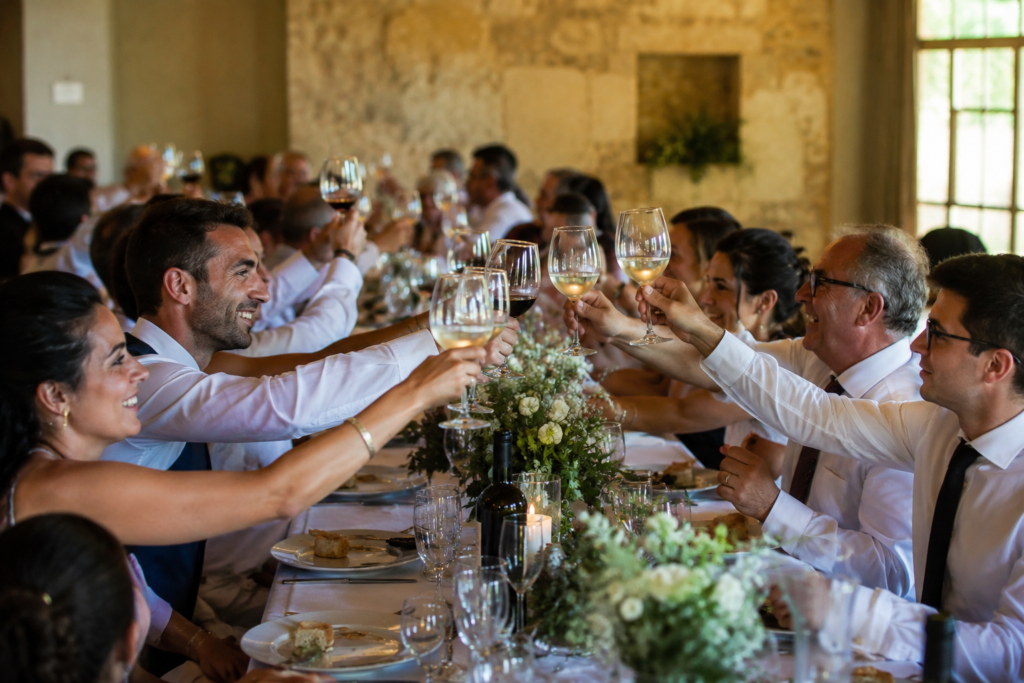
When the Venue Is the Vineyard: Wine Becomes the Setting Itself
Some couples choose to marry among the vines. In these celebrations, the Italian wedding wine selection is not just on the table—it is the landscape, the scent in the air, the story the host tells during the welcome. A vineyard wedding in Italy offers the rare opportunity to serve the estate’s own production, which creates an authenticity that no imported label can replicate.
We work with estates in Chianti Classico, Franciacorta, the Langhe, and Etna where the winemaker personally presents the wines to the couple during the tasting phase. On the wedding day, bottles carry the estate label—and sometimes a custom back-label with the couple’s names and date. These are the details that transform a wine list into a keepsake. Related guide: Italian wedding welcome bags.
For celebrations at venues that are not themselves wine estates, we create the same sense of connection by sourcing from producers within a short radius of the venue. A wedding at a lakeside villa on Lake Garda might feature a Lugana DOC from the southern shore and a Bardolino Chiaretto rosé from the eastern hills—wines that guests can trace on the landscape they see from the terrace.
A Wine List That Feels Like the Evening Was Written Around It
After thirty years of curating Italian wedding wine selections, I have learned that the best wine list is one the guests never consciously notice—because it fits so precisely into the evening that it feels inevitable. The aperitivo sparkles at the right moment. The white arrives chilled to the degree that suits the terrace temperature. The red opens up exactly as the main course lands. The toast lifts the room without interrupting the conversation.
This is what we do at Kiss Me Italy. We manage the research, the tastings, the logistics, the coordination with your caterer and venue, and the service on the day. You enjoy the evening. If you are beginning to think about your celebration in Italy and want a wine experience that feels both effortless and unmistakably Italian, we would love to hear from you.
Frequently Asked Questions About Italian Wedding Wine Selection
Can we bring wine from our home country to serve at our Italian wedding?
Technically yes, but import duties, customs paperwork, and the risk of breakage during transit make it impractical for large quantities. Most couples who want a sentimental bottle—a family wine or a favourite Champagne—bring one or two bottles for a private moment, while the full Italian wedding wine selection is sourced locally. We handle the customs coordination if needed.
What happens to unopened wine bottles after the reception?
Unopened bottles belong to the couple unless the venue contract states otherwise (some in-house catering agreements retain unused stock). We clarify this clause during contract review and can arrange for leftover wine to be shipped to your hotel or packaged as guest gifts the following day.
Is it possible to have personalized wine labels for the wedding?
Yes. Many Italian producers offer custom back-labels, and some allow fully bespoke front-label designs for orders above a certain volume (typically 60–100 bottles). We coordinate the design, approval, and printing timeline, which usually requires confirmation at least eight weeks before the wedding date.
Do Italian venues typically provide wine glasses, or do we need to rent them?
Most catering companies include standard wine glasses in their service package. However, these are often generic tumblers or basic stems. For a curated wine list with DOCG labels, we recommend upgrading to professional crystal stemware through a rental partner, which typically costs €2–€5 per place setting and makes a visible difference in presentation and tasting experience.
How do you handle guests with very different wine preferences—say, half the table prefers sweet wine?
We build flexibility into the list by including at least one off-dry or aromatic option (such as a Moscato d’Asti or a late-harvest Gewürztraminer from Alto Adige) that can be offered alongside the main pairings. For the dessert course, a Passito di Pantelleria or Vin Santo bridges the gap between sweet-wine enthusiasts and those who prefer dry sparkling. The sommelier or service staff manage the pour discretely.
Can we arrange a wine-tasting experience for our guests during the wedding weekend?
Absolutely. We regularly organize private cellar visits and guided tastings at estates near the wedding venue as part of the broader celebration weekend. These are typically scheduled for the day before or the day after the wedding and can accommodate groups of ten to fifty guests. Logistics—transport, timing, dietary accommodations—are managed entirely by our team.
Do we need any permits or special licensing to serve alcohol at a private wedding in Italy?
In most venue-based weddings, alcohol service is covered under the venue or caterer’s existing licensing and insurance. The risk appears when couples add an external bar, a public-facing event element, or service in non-traditional locations on the property. We confirm the venue’s licensing position in writing, align it with the caterer’s insurance, and—when required—coordinate the correct permissions so service remains fully compliant.
How far in advance should we finalize the wine list?
We recommend finalizing the Italian wedding wine selection four to six weeks before the celebration. This allows time for delivery, proper storage at the venue, and any last-minute adjustments if a vintage becomes unavailable. For rare or allocated wines (aged Barolo, limited-production Franciacorta), we secure bottles up to six months in advance to guarantee availability.
Does Kiss Me Italy manage the wine service on the wedding day, or does the caterer handle it?
The physical pouring is handled by the catering team’s service staff, but we coordinate the service brief: which wine is served with which course, at what temperature, whether decanting is required, and the exact timing of the toast pour. When a sommelier is engaged, we manage that booking and ensure they integrate seamlessly with the catering team’s workflow. On the day, our coordination team oversees the entire beverage flow.
Related on the Kiss Me Italy blog: Luxury Summer Wedding in Italy: Destinations, Venues & Planning Essentials.