
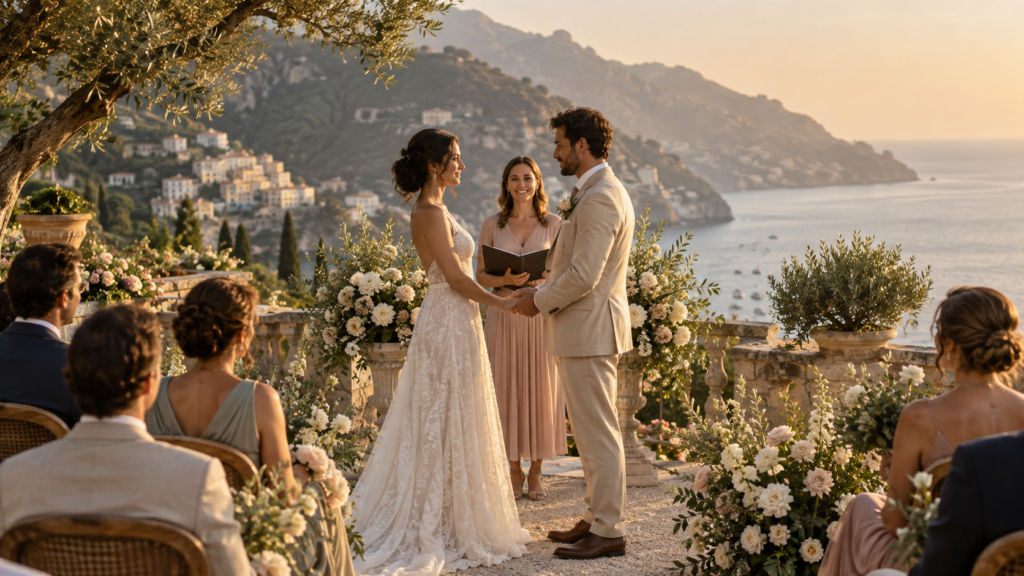
A humanist wedding in Italy is a non-legally-binding symbolic ceremony conducted by an English-speaking celebrant, designed entirely around the couple’s personal story, values, and chosen venue. It carries no civil or religious legal weight under Italian law, which means couples typically complete their legal marriage in their home country before or after the celebration. Kiss Me Italy curates these ceremonies as fully produced luxury experiences — from celebrant selection and ceremony script to venue logistics, vendor coordination, and multilingual guest communication. Read next: pagan wedding in Italy.
Humanist Wedding in Italy
For couples arriving from the United States, the United Kingdom, or Australia, the practical reality of a humanist wedding in Italy often comes as a relief rather than a limitation. There is no residency requirement. There is no consulate appointment for a Nulla Osta. There is no mandatory civil officiant, no municipal fee schedule, no translation of birth certificates into Italian. The ceremony is entirely yours to design. But that creative freedom introduces a different kind of complexity: without a municipal framework dictating the sequence, every element — the celebrant’s approach, the reading selections, the sound levels at your venue, the rain contingency at 4 p.m. on a Saturday in October — must be coordinated by a team that understands both the creative latitude and the logistical constraints of Italian venues.
Humanist vs. Civil vs. Catholic: Which Ceremony Type Matches Your Timeline, Beliefs, and Venue?
This is the first decision international couples face, and it shapes everything that follows. A civil ceremony in Italy produces a marriage certificate recognized internationally but requires documentation from your consulate, an appointment at the local town hall (Comune), and — depending on the municipality — a residency period of up to four working days before the wedding date. A Catholic ceremony requires canonical documentation, a pre-Cana course, and coordination with the local diocese, typically beginning 12–18 months in advance. Our team manages both pathways, and couples considering a legally recognized marriage in Italy can explore the full documentation timeline through that process. Related guide: wedding officiant in Italy.
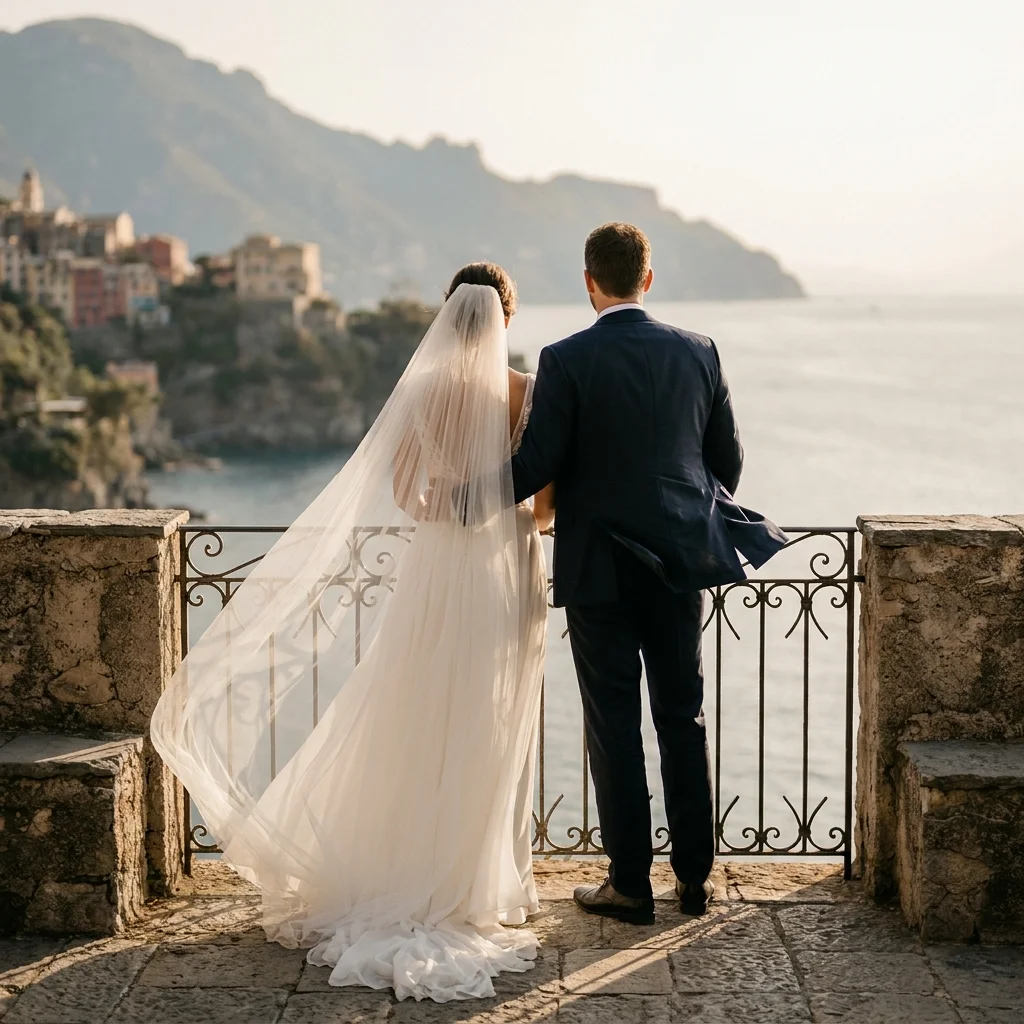
A humanist wedding in Italy eliminates the bureaucratic layer entirely. No consulate visit. No sworn translations. No municipal scheduling constraints. This means venue selection becomes genuinely open: a clifftop terrace on the Amalfi Coast, a private olive grove in Tuscany, a palazzo courtyard in Venice, or a mountain clearing in the Dolomites. The ceremony can happen at any hour, in any language, with any structure the couple chooses. Our U.S. clients typically complete their legal marriage at a courthouse back home — sometimes weeks before the Italian celebration, sometimes after — and treat the humanist ceremony as the emotional centrepiece of their wedding.
The trade-off is clear: a humanist ceremony offers total creative control but no legal status in Italy. For most of our international couples, that is not a trade-off at all. It is the reason they chose this path.
What “Humanist” Actually Means in an Italian Wedding Context — and How It Differs from a Generic Symbolic Ceremony
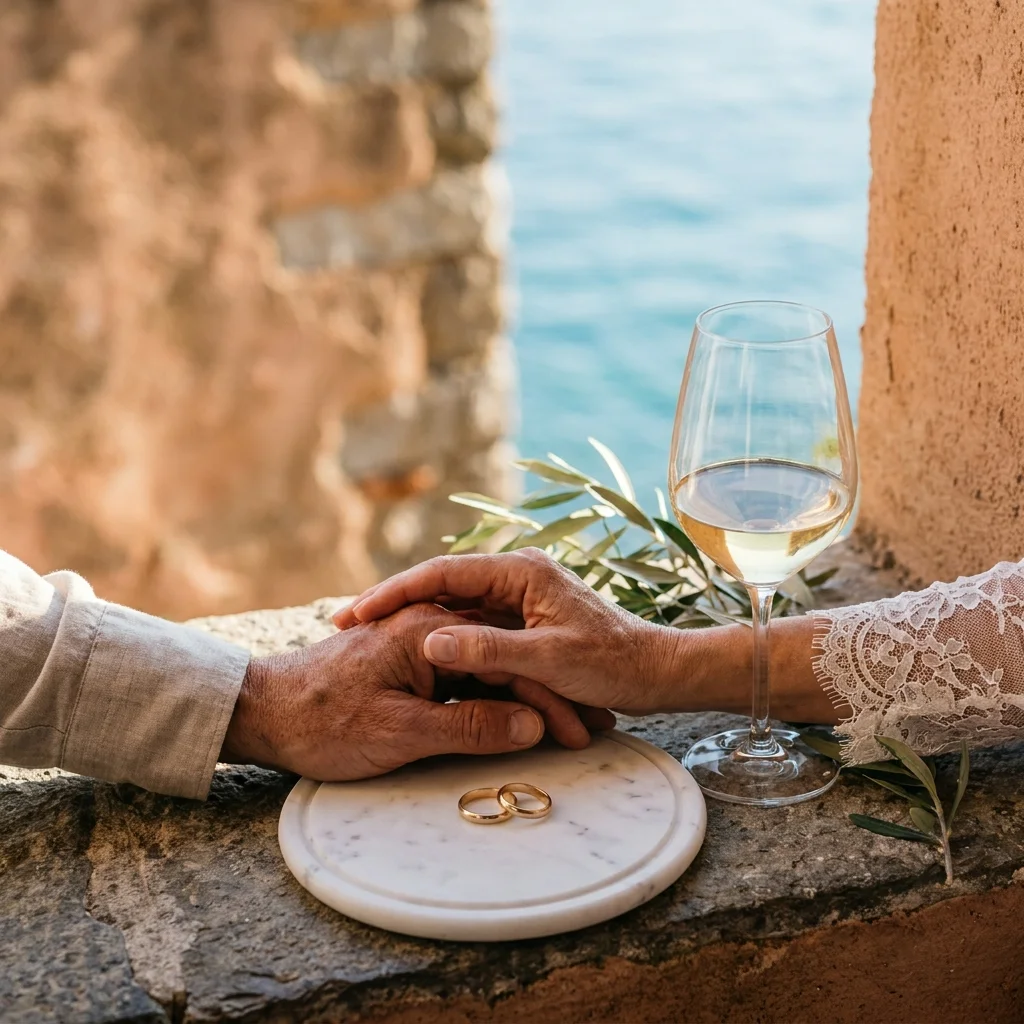
The term gets used loosely. In Italy, any non-legal ceremony can be called “symbolic.” A humanist ceremony is a specific subset: it is secular, centres on the couple’s shared values and personal narrative rather than religious text, and is conducted by a trained celebrant who develops the script through a consultative process. It is not a reading of generic vows from a template. It is not a friend with a microphone. More in our guide: handfasting ceremony in Italy.
The celebrant’s working method matters enormously. A skilled humanist celebrant conducts two to three structured interviews with the couple — often via video call for international clients — to gather the story: how they met, what they value, what they want their guests to feel. From those conversations, the celebrant drafts a bespoke ceremony script, typically 20–30 minutes in length, which the couple reviews and refines. Readings, rituals (handfasting, wine blending, candle lighting, ring warming), and musical cues are woven into the script with precise timing notes that our coordination team uses to synchronize vendors on the day.
At Kiss Me Italy, we bridge the celebrant’s creative process with the venue’s operational requirements. If the ceremony is outdoors at a Tuscan estate, we confirm amplification limits, sunset timing for the specific date, and the backup indoor space. If it’s at a Venetian palazzo, we coordinate water-taxi arrival sequences so the celebrant’s opening words aren’t competing with boat traffic. These are the details that separate a produced humanist wedding in Italy from a well-intentioned one.
Venue Freedom vs. Venue Constraints: What a Non-Legal Ceremony Unlocks (and What Still Requires Permits)

The appeal of a humanist wedding in Italy is often framed as “you can marry anywhere.” That is partially true. You can hold the ceremony in locations that would never be available for a civil or religious wedding: a private beach, a rooftop, a vineyard row, a boat. But “anywhere” still operates within Italian municipal and venue-specific rules.
Outdoor ceremonies at private estates rarely require a municipal permit, but they do require the estate’s own approval for amplified sound, guest capacity, and vehicle access. Ceremonies in public spaces — a piazza, a garden maintained by the Comune, a lakeside promenade — require an occupazione suolo pubblico permit, typically filed 30–60 days in advance. Ceremonies at heritage-listed properties (and many of Italy’s most beautiful venues carry Soprintendenza protections) may restrict where structures like arches or altars can be anchored.
Our team handles every permit application and venue negotiation. For couples considering a villa wedding in Italy, we confirm exclusive-use terms, sound curfews (often 11 p.m. or midnight, depending on the province), and the precise ceremony footprint the property allows. For a Dolomites wedding, we coordinate with local authorities on mountain-access logistics and weather contingency timing — because at 1,800 metres, the window between afternoon sun and evening chill is narrow.
What It Actually Feels Like: A Ceremony Moment on the Ligurian Coast
Late September. A private terrace above the sea, somewhere between Portofino and the Cinque Terre. The stone is warm underfoot. Sixty guests are seated in a loose semicircle, and the celebrant — British, calm, precisely prepared — opens with a line about the couple’s first disagreement: a debate over whether pineapple belongs on pizza, which happened on their second date in Melbourne. The guests laugh. The bride’s father, watching from the front row, exhales.
The ceremony script runs twenty-two minutes. It includes a reading by the groom’s sister, performed in English and then in Italian by a bilingual friend. There is a wine-blending ritual using two local Vermentino wines selected during a tasting the day before. The vows are personal, written by the couple over three months of drafts, refined with the celebrant’s guidance so they land with the right rhythm when spoken aloud. The string trio — positioned behind a low stone wall to keep the sightlines clean — plays Einaudi’s “Nuvole Bianche” as the couple walks back up the aisle together.
No one in the audience knows that thirty minutes earlier, a sudden gust forced the team to relocate the floral arch from the exposed corner to a sheltered alcove. No one knows the celebrant’s microphone was swapped to a backup unit during the pre-ceremony sound check. No one knows the couple’s rings were delivered to the venue at 2 p.m. by a courier from Milan because the jeweller’s timeline shifted by forty-eight hours. They don’t know because the coordination was invisible. That is the point.
Couples drawn to this level of experience can begin a conversation with our team at any stage of planning.
Choosing an English-Speaking Celebrant in Italy: Credentials, Chemistry, and the Script Development Process
Italy does not regulate humanist celebrants the way Scotland or Australia does. There is no Italian equivalent of the Humanist Society of Scotland’s accreditation. This means the quality range is wide. Some celebrants operating in Italy are experienced, trained professionals with hundreds of ceremonies behind them. Others are enthusiastic amateurs.
Our team vets celebrants on three criteria: professional training (we work primarily with celebrants accredited by UK or Australian humanist organizations), language fluency (full professional English, with Italian or other languages as a bonus for multilingual ceremonies), and temperament (the ability to hold a room of sixty to two hundred people with warmth and authority). We maintain a curated roster and match celebrants to couples based on personality fit, not just availability.
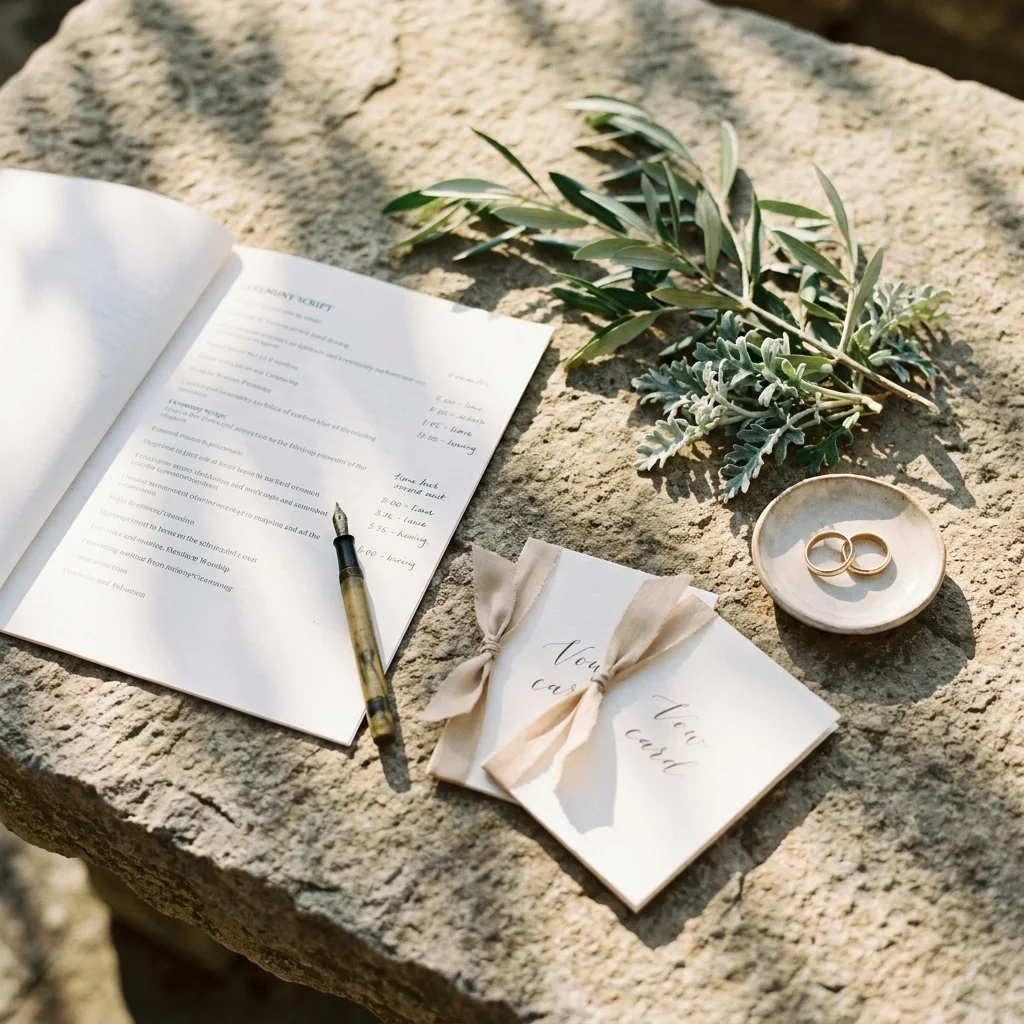
The script development timeline typically runs six to eight weeks. It begins with an intake questionnaire, moves through two video interviews, and produces a first draft that the couple reviews. Revisions follow. The final script is locked two weeks before the ceremony, at which point our coordination team integrates its timing cues — music entries, reading handoffs, ritual props — into the master run-of-show document that every vendor receives.
For couples who want their humanist wedding in Italy to include readings in multiple languages, we coordinate bilingual script formatting and rehearse pronunciation with readers who may be speaking Italian or another language for the first time in a public setting.
What a Humanist Wedding in Italy Costs: Ceremony, Celebrant, and Full-Day Coordination
Pricing for a humanist wedding in Italy depends on three primary variables: the celebrant’s fee, the venue’s ceremony-specific costs, and the coordination required to produce the day. Below are indicative ranges drawn from our recent projects and aligned with pricing on our regional cost pages.
| Component | Typical Range | Includes | Quoted Separately |
|---|---|---|---|
| Humanist celebrant (English-speaking, accredited) | €1,500–€3,500 | Intake interviews, bespoke script writing, rehearsal attendance, ceremony delivery | Travel and accommodation outside the ceremony region; additional languages in the script; post-ceremony signed keepsake script |
| Ceremony venue fee (private estate or palazzo) | €2,000–€15,000 | Exclusive-use ceremony area, basic seating setup, venue coordinator on-site | Floral installations, sound system rental, lighting design, municipal permits for public-space ceremonies |
| Full-day coordination (Kiss Me Italy) | €3,000–€8,000 | Vendor timeline management, ceremony rehearsal direction, multilingual guest communication, day-of logistics, weather contingency execution | Multi-day event coordination, welcome dinner and post-wedding brunch management, VAT (IVA 22%) |
Indicative ranges. Contact Kiss Me Italy for a personalized proposal.
Photography and videography are quoted independently. For context, the ranges below reflect our standard partnerships across Italy’s most requested regions.
| Service | Typical Range | Includes | Quoted Separately |
|---|---|---|---|
| Wedding photographer (full day, single shooter) | €3,500–€8,000 | 8–10 hours coverage, edited gallery (300–600 images), travel within the ceremony region | Second shooter (+€800–€1,500), albums and prints, engagement session, accommodation for multi-day events, VAT (IVA 22%) |
| Wedding videographer (full day, single operator) | €4,000–€9,000 | 8–10 hours coverage, highlight film (3–5 min), ceremony edit; travel within the ceremony region | Full-length ceremony film, drone footage (permit-dependent), second operator, post-production beyond 12 weeks, VAT (IVA 22%) |
Indicative ranges. Contact Kiss Me Italy for a personalized proposal.
Couples planning a destination wedding in Italy will find that the humanist ceremony pathway often reduces total legal and administrative costs by €1,000–€2,500 compared to a civil ceremony, because consulate fees, sworn translations, and Comune scheduling charges are eliminated. That saving can be redirected toward ceremony design — better florals, a live musician, a more experienced celebrant.
Tuscany vs. Amalfi Coast vs. Venice: How Region Shapes Your Humanist Ceremony
The ceremony itself is region-agnostic. The logistics surrounding it are not.
Tuscany offers the widest selection of private estates with outdoor ceremony space and minimal sound restrictions. A Tuscan wedding venue typically allows ceremonies from late morning through early evening, with sunset timing that works beautifully from May through October. Tuscany wedding costs tend to sit in the mid-range for Italy, making it the most accessible luxury option for a humanist wedding in Italy with 60–120 guests.
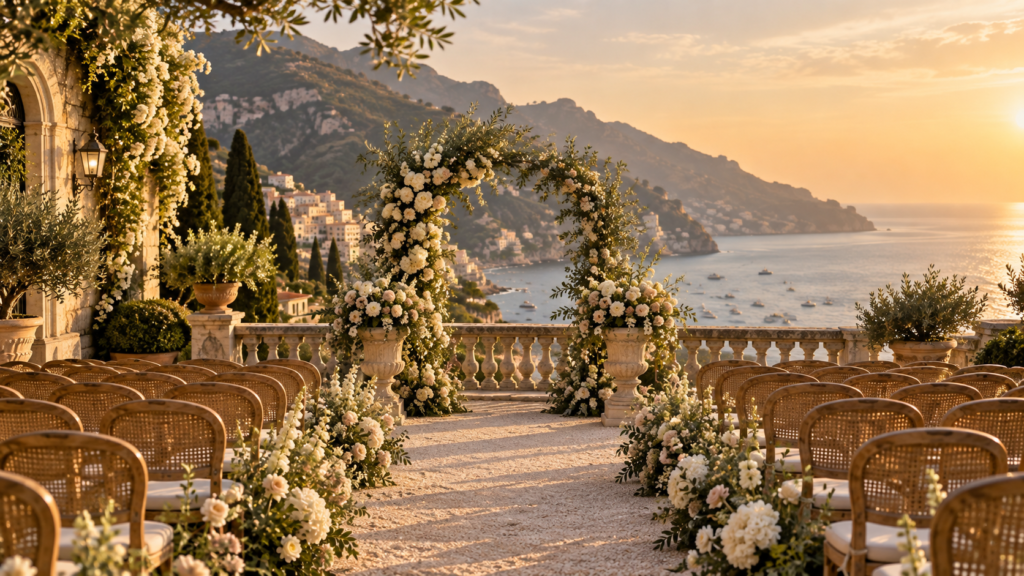
The Amalfi Coast introduces vertical logistics. Ceremony terraces are reached by stairs, narrow paths, or — at some venues — a short boat transfer. Amalfi Coast wedding costs run 20–40% higher than Tuscany for comparable guest counts, driven by access constraints, limited vendor availability, and the premium on exclusive-use terraces during peak season (June–September). But the visual payoff is extraordinary: a humanist ceremony overlooking the Tyrrhenian Sea at golden hour is difficult to replicate anywhere else.
Venice requires water-based logistics for every vendor, every guest, and every piece of equipment. A humanist wedding in Venice means coordinating vaporetto schedules, private water-taxi fleets, and palazzo loading docks. Venice wedding costs reflect this complexity. But for couples who want their ceremony in a Gothic palazzo with canal views, the experience is singular — and the absence of legal constraints means the ceremony can happen in rooms that the Comune would never approve for a civil wedding.
Our team also curates humanist ceremonies in Lake Garda, Lake Como, and along the Ligurian coast, each with its own seasonal rhythms and venue characteristics.
Blended Families, Bilingual Readings, and Last-Minute Weather: The Scenarios Our Team Manages Quietly
A humanist ceremony’s flexibility is its greatest strength — and its greatest coordination challenge. Without a fixed liturgical structure, every variable is a choice. Our team manages the ones that matter most.
Blended families. When one or both partners have children from a previous relationship, the ceremony script can include a family vow or a symbolic gesture (a family sand ceremony, a ring or bracelet for each child). We coordinate these moments with the celebrant to ensure they feel integrated, not appended. Couples exploring a vow renewal in Italy often face similar dynamics, and the humanist format accommodates them naturally.
Bilingual and multilingual ceremonies. For couples with guests who speak different languages, we work with the celebrant to weave translations into the script without doubling its length. The most elegant approach is selective: key emotional moments (the vows, the declaration, a specific reading) are delivered in both languages, while the narrative sections remain in the primary language. We provide printed programs with translations for non-English-speaking guests.
Weather contingency. Every outdoor humanist ceremony we produce has a documented Plan B. This is not a vague “we’ll move inside.” It is a specific alternative location at the same venue, with a confirmed setup time, a vendor notification protocol, and a decision deadline — typically 90 minutes before the ceremony — that our team communicates to every supplier. The couple is informed once. The logistics are handled entirely by us.
Humanist Vow Renewals: Same Framework, Different Emotional Register
A significant portion of our humanist ceremony work is for couples who are already married. They want to celebrate a milestone — a tenth anniversary, a twentieth, a recovery from a difficult year — with a ceremony that reflects who they are now, not who they were at their original wedding.
The format is identical to a humanist wedding ceremony: a celebrant-led, script-developed, fully produced event. The emotional register is different. The celebrant draws on shared history rather than anticipation. The vows look backward and forward simultaneously. Guests who attended the original wedding often participate as readers or witnesses, creating a layered sense of continuity.
We have produced vow renewals on Lake Garda and across Tuscany for couples marking 10, 15, and 25 years. The coordination requirements are the same as a wedding; the emotional payoff, our clients tell us, is often greater.
Why a Humanist Wedding in Italy Requires More Coordination, Not Less
The absence of a legal framework does not mean the absence of complexity. It means the complexity shifts. A civil ceremony at an Italian town hall comes with a built-in structure: the officiant, the room, the sequence, the timing. A Catholic ceremony comes with a liturgy. A humanist ceremony comes with a blank page.
That blank page must be filled with decisions — and those decisions must be coordinated across every vendor. The florist needs to know the ceremony layout to position arrangements. The photographer needs to know the script’s emotional arc to anticipate key moments. The musicians need timing cues synced to the celebrant’s delivery. The venue staff need a setup and breakdown schedule that accounts for the reception transition.
This is what Kiss Me Italy provides: a single coordination layer that connects the celebrant’s creative work, the venue’s operational requirements, and the couple’s vision into a unified production plan. We manage the documentation — not legal documents, but the production documents: the master timeline, the vendor contact sheet, the ceremony run-of-show, the guest logistics brief.
Couples who value this level of international coordination can reach our team directly to discuss their ceremony vision.
A Ceremony That Belongs Entirely to You — Produced by a Team That Manages Everything Else
A humanist wedding in Italy is, at its core, a commitment ceremony built around meaning rather than paperwork. It is deeply personal. It is non-legal. And when produced by a team that understands both the creative latitude and the logistical demands of Italian venues, it is impeccable.
We curate these ceremonies across every region of Italy — from the historic courtyards of Florence to the seaside terraces of the Italian coast. Every element, from celebrant matching to weather contingency, is managed by our coordination team so the couple experiences only the ceremony itself: the words, the music, the faces of the people they love.
Contact Kiss Me Italy to begin designing your humanist ceremony.
Frequently Asked Questions About Humanist Weddings in Italy
Can we have a humanist ceremony and a civil ceremony on the same day in Italy?
Technically yes, but we rarely recommend it. The civil ceremony at the Comune has its own scheduling constraints and typically runs 20–30 minutes with mandatory witnesses. Combining both on the same day creates a compressed timeline that limits ceremony design. Most of our international couples complete the legal marriage in their home country and treat the humanist ceremony as the sole event of the wedding day.
Is a humanist wedding certificate recognized by any country?
No. A humanist ceremony in Italy produces a commemorative certificate — beautifully designed, signed by the celebrant and witnesses — but it has no legal standing in Italy or any other jurisdiction. Scotland and parts of Australia do recognize humanist marriages legally, but that recognition does not extend to ceremonies conducted on Italian soil. The commemorative certificate is a keepsake, not a legal document.
How far in advance should we book a humanist celebrant for a peak-season Italian wedding?
For ceremonies between May and October, we recommend securing a celebrant 10–14 months in advance. The most experienced English-speaking celebrants working in Italy manage 30–50 ceremonies per season, and their peak-month Saturdays fill quickly. Off-season ceremonies (November–March) offer more flexibility, with 6–8 months’ lead time typically sufficient.
Can guests who aren’t professional speakers deliver readings during the ceremony?
Absolutely, and this is one of the most meaningful elements of a humanist ceremony. Our celebrants provide coaching notes and, when needed, a brief rehearsal — either in person the day before or via video call in the weeks prior. We also ensure the sound system is configured for non-professional speakers, with microphone placement that doesn’t require them to hold anything or stand at a lectern if they prefer not to.
What happens if our preferred celebrant falls ill close to the wedding date?
Every celebrant engagement managed through our team includes a contingency protocol. We maintain relationships with backup celebrants in each major region who can step in with the finalized script. Because the script is a written document shared with our coordination team well in advance, the replacement celebrant can deliver the ceremony with the couple’s story intact. This has happened once in our experience, and the couple later said they couldn’t tell the difference.
Are there any Italian venues that refuse to host humanist or symbolic ceremonies?
Some church-owned or diocese-affiliated properties will not host non-religious ceremonies. Certain municipal buildings that are designated exclusively for civil ceremonies may also decline symbolic bookings. Private estates, hotels, villas, and most palazzo venues are open to humanist ceremonies. We confirm ceremony eligibility during the initial venue inquiry, so couples never encounter a refusal after committing to a location.
Can we include religious elements — a prayer, a blessing, a hymn — in a humanist ceremony?
Yes. A humanist ceremony is secular by framework, but it is not anti-religious. If one partner’s family tradition includes a specific prayer or blessing, a skilled celebrant can incorporate it as a cultural or familial gesture within the ceremony’s narrative. We coordinate these inclusions during the script development phase to ensure they feel organic rather than inserted.
Do we need to tip the celebrant, and what is the etiquette in Italy?
Tipping is not customary for celebrants in Italy the way it is in the United States. The celebrant’s fee is a professional service charge that covers all preparation and delivery. If a couple feels the celebrant went above and beyond, a gesture of €100–€200 or a thoughtful gift is appreciated but never expected. We advise our clients on vendor gratuity norms as part of the pre-wedding briefing.
Can a humanist ceremony in Italy be legally witnessed for use in a home-country marriage registration?
No. The ceremony itself cannot serve as evidence for a legal marriage registration in the U.S., UK, or Australia. However, some couples arrange for a notarized declaration of intent or a separate civil signing — conducted privately, often the day before — which can then be apostilled and used for home-country registration. We coordinate with local notaries when this pathway is relevant.