Candlelit Wedding in Italy: Villas, Palazzi, Costs, and Atmosphere
A candle has a working life of roughly four hours before it begins to gutter, and most receptions run longer than that. This single fact — known to every set designer and ignored by most couples — is where the romance of a candlelit wedding either holds together or quietly collapses. The image in your imagination is a frescoed hall lit entirely by flame. The reality involves venue fire codes, refresh schedules, supplier exclusions, and a lighting design that accounts for the moment the sun leaves the windows.
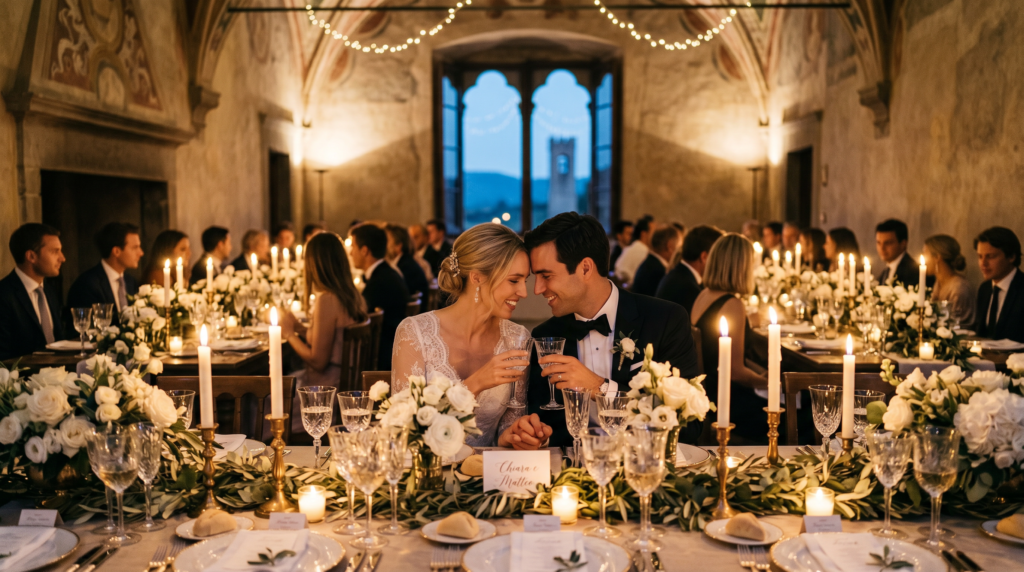
A candlelit wedding in Italy typically costs between €45,000 and €220,000 for a full celebration in a historic villa or palazzo, depending on region, guest count, season, and the scale of the lighting design. The atmosphere most couples picture — a sixteenth-century hall glowing entirely by flame — requires venue fire-safety clearance, professional lighting design, and a refresh team during the reception, all of which Kiss Me Italy coordinates as a single managed production rather than a decorative afterthought.
Why Candlelight Is a Lighting-Design Decision, Not a Centerpiece Choice
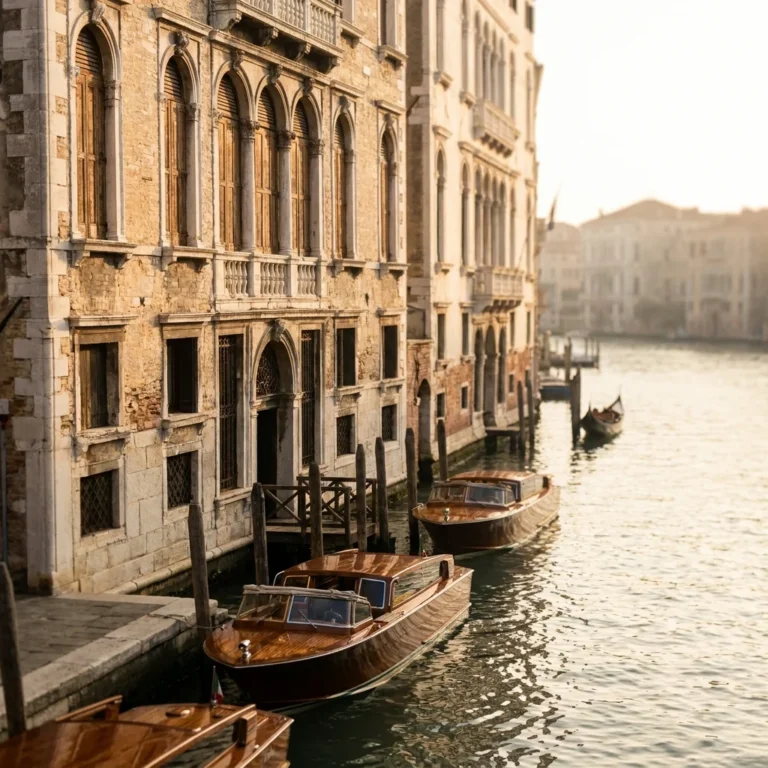
The Palazzo Pisani Moretta, commissioned in the fifteenth century and frescoed across the following two hundred years, is one of the rare Venetian venues where open flame is still permitted under supervised conditions. That permission is the exception. Most historic interiors restrict naked flame near frescoed plaster, tapestries, and gilded wood — and for sound reason.
So the question is never simply “how many candles.” It is a question of architectural grammar. A medieval refectory with high stone vaults absorbs light differently than a Baroque salon lined with mirrors. We read each room before we specify a single taper. Our team manages the balance between live flame, concealed warm uplighting, and battery-driven sources that satisfy the venue’s insurer while preserving the illusion of pure candlelight.
This is the difference between a styled photograph and a four-hour evening that stays luminous. To understand how venue character shapes every other decision, our overview of villa weddings across Italy’s regions is the natural starting point.
Which Italian Venues Were Built for Flame — and Which Only Look the Part
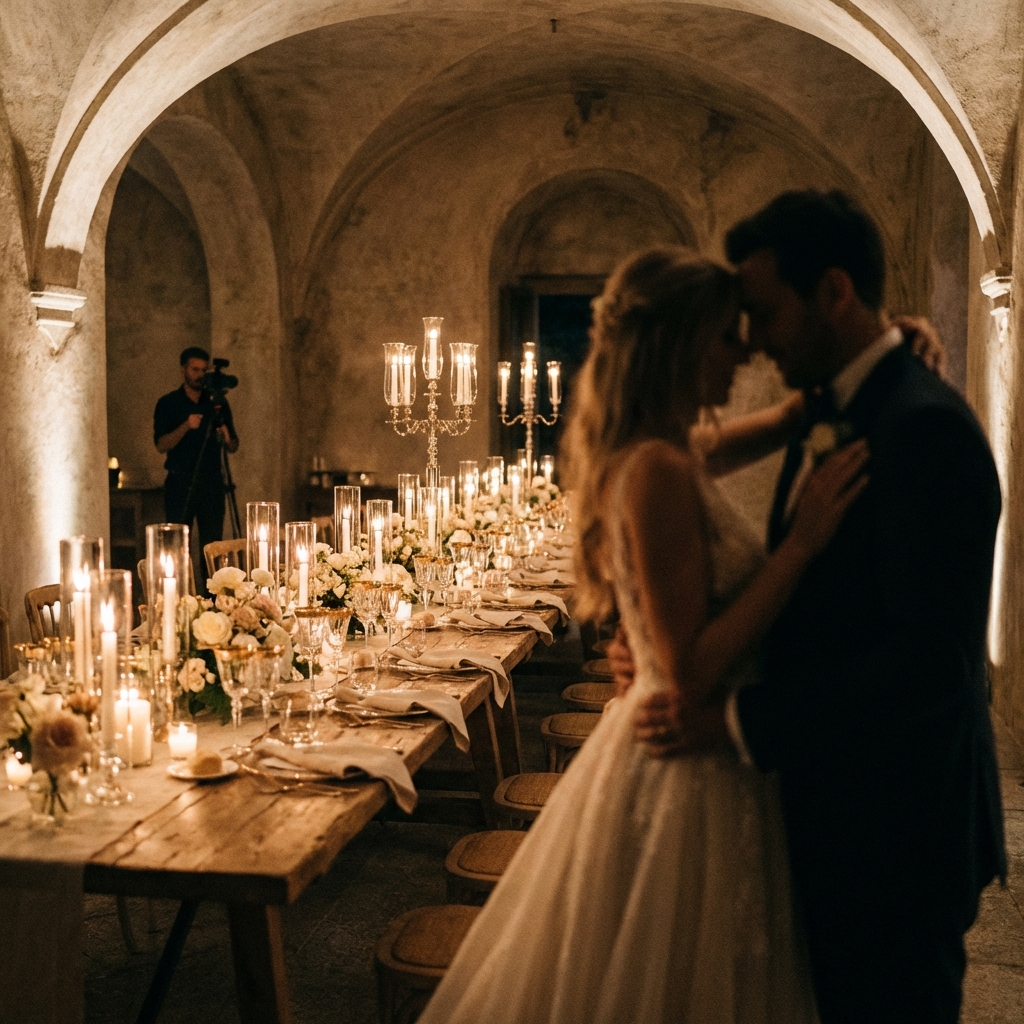
Not every beautiful room behaves well by candlelight. A frescoed sixteenth-century palazzo with tall casement windows holds warm light beautifully after dusk. A glass-walled modern pavilion, by contrast, turns to a black mirror the moment the candles are lit, reflecting the room back at itself.
The settings that reward a candlelight wedding fall into a few distinct categories, each with its own logic:
- Venetian palazzi — frescoed piani nobili where flame, where permitted, meets centuries of gilded surface. Our guide to choosing a Venice wedding venue explains the access and licensing nuances.
- Tuscan villas and cloisters — stone interiors and loggias that glow without competing with the architecture. The Tuscan venue landscape offers more candlelit-friendly halls than any other region.
- Lakefront estates — where water doubles the light. A Lake Como wedding set indoors at dusk carries a particular, mirrored intimacy.
- Coastal terraces — open air requires hurricane glass and weighted lanterns against the evening breeze, a constraint we plan around rather than fight.
Lesser-known venues — a converted olive-press estate in the Tuscan hills, a noble residence above a Ligurian harbour — we describe in detail privately, because their charm depends partly on their discretion. When you share your vision with our team, we match the room to the evening you imagine.
The Hour the Sun Leaves the Windows: Designing the Transition
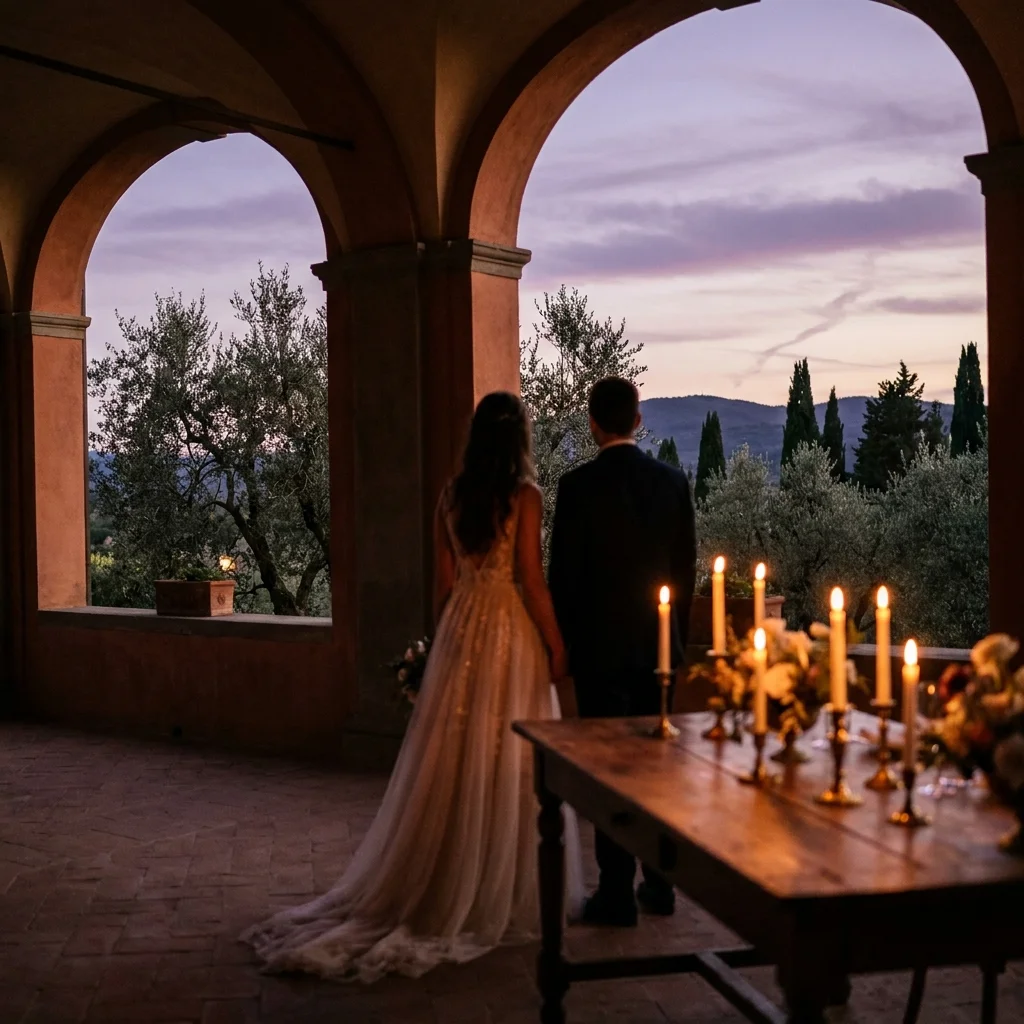
Here is the moment most couples never plan for. The ceremony ends in daylight. The aperitivo glows in golden hour. Then, between the antipasto and the first dance, the room must cross from natural light into candlelight without a flat, fluorescent gap in between.
That transition is the heart of a cinematic evening, and it is engineered. We schedule the candle lighting to begin roughly forty minutes before sunset, layering warm sources as the daylight fades so the shift feels like weather rather than a switch. The scenography — taper heights, the rhythm of light along a long table, the way flame catches glass and silver — is composed the way a stage is lit.
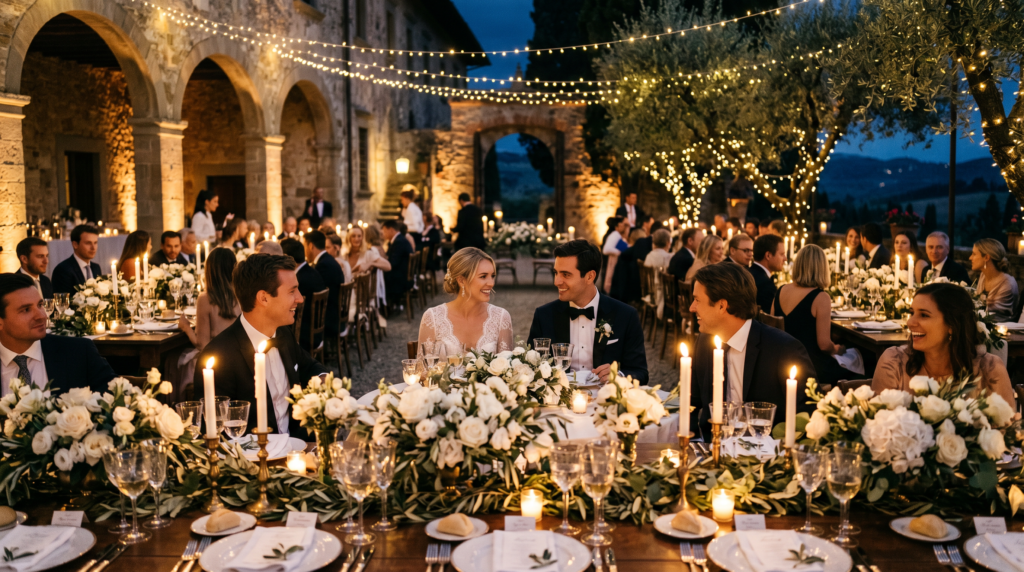
Florals belong to this composition too. Low arrangements that allow candlelight to read across the table, foliage that throws soft shadow rather than blocking the glow. Our approach to wedding tablescapes in Italy treats flowers and flame as one design language, and our palette work ensures the colours hold under warm light, where cool tones can drain away entirely.
Permits, Open-Flame Rules, and What the Venue Contract Won’t Tell You
This section is deliberately plain, because the details here are technical and they matter.
Most historic Italian venues classify open flame under their insurance and fire-safety terms, not their decoration policy. A venue may welcome candlelight on its terraces while prohibiting it within a frescoed hall. Some require a certified fire-watch attendant on site; others permit flame only inside hurricane glass at a minimum height above linens. These conditions rarely appear in the headline contract. They surface in the technical annex — which is precisely what our team reads first.
Where naked flame is restricted, we deploy professional warm-white battery sources, indistinguishable from wax flame in photographs and to the eye at table distance. We coordinate the fire-watch where it is mandated, and we manage the refresh cycle so no candle is left to gutter mid-reception.
On costs, a few items are routinely separate and we name them openly:
- Permits and venue fire-safety fees — quoted per venue, not bundled into a styling figure.
- IVA (Italian VAT, 22%) — applied per Italian law and shown as a distinct line.
- Photographer and videographer travel, accommodation, second shooter, albums, and post-production — quoted separately from coverage.
- Florals and lighting hire — specified by design, since a candlelit reception’s flower and light volume varies widely.
For the wider financial picture, our transparent breakdown of what an Italian wedding actually costs sets candlelight within the full budget.
What a Candlelit Wedding Costs Across Regions and Guest Counts
Ranges below reflect verified Kiss Me Italy planning data for full celebrations. They are indicative; the lighting design itself is the most variable element, since a hall lit by hundreds of tapers with a fire-watch differs sharply from a terrace of weighted lanterns.
| Celebration scale | Indicative total range | Included | Quoted separately |
|---|---|---|---|
| Intimate (up to 30 guests) | €45,000–€75,000 | Venue, planning, lighting design, florals, catering, basic candle program | Permits, IVA, photography, accommodation, transfers |
| Mid-scale (40–80 guests) | €80,000–€140,000 | Venue, full coordination, lighting & scenography, florals, catering, candle refresh team | Permits, IVA, photography/video, fire-watch where required |
| Grand (90–150 guests) | €150,000–€220,000+ | Exclusive-use palazzo or villa, full production, advanced lighting, florals, catering, dedicated technical crew | Permits, IVA, photography/video, albums, guest logistics |
Indicative ranges. Contact Kiss Me Italy for a personalized proposal.
The lighting and candle program alone is worth isolating, since it is the element that defines a candlelit reception:
| Lighting & candle element | Indicative range | Notes |
|---|---|---|
| Candle program (tapers, pillars, holders, refresh) | €3,500–€12,000 | Scales with table length and venue scale; refresh team included at upper range |
| Concealed warm uplighting & ambient design | €4,000–€15,000 | Technical crew and rigging included; power supply quoted per venue |
| Fire-watch attendant (where mandated) | Quoted on request | Required by certain frescoed historic interiors |
| Battery warm-white alternatives | €1,500–€5,000 | For venues restricting naked flame; visually indistinguishable at table distance |
Indicative ranges. Contact Kiss Me Italy for a personalized proposal.
Regional context shifts these figures. A Tuscan celebration and a Venice wedding carry different venue and access costs, while a Portofino wedding reflects the Ligurian coast’s particular logistics. We map your candlelit vision onto the region that suits it best when you begin the conversation with us.
Why Candlelight Demands a Photographer Who Shoots in Near-Darkness
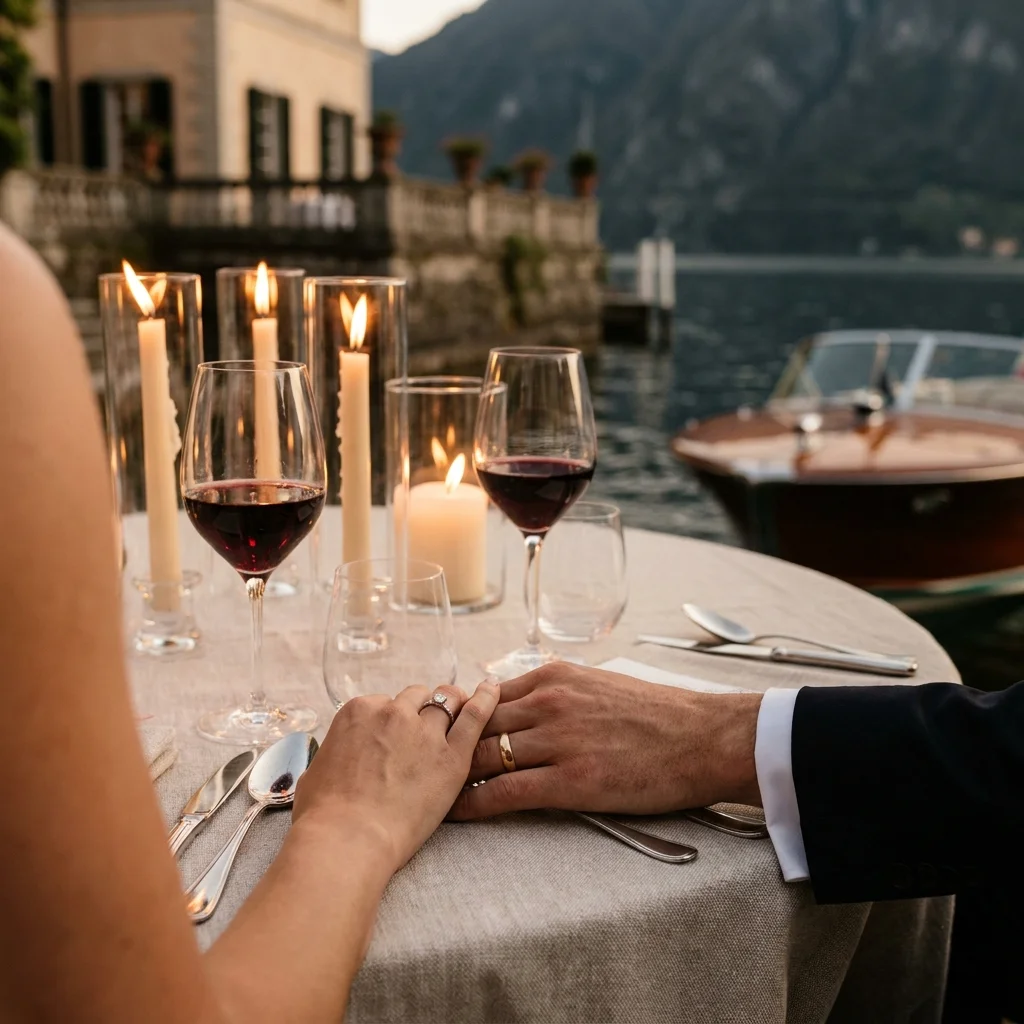
Candlelight is roughly one-thousandth the brightness of midday sun. A photographer accustomed to bright Tuscan loggias is not automatically equipped to render flame without flash washing the room flat. This is a specialist skill.
The images that make a candlelit wedding unforgettable are made by photographers who expose for the flame itself — who hold the warm glow on skin and let the room fall gently into shadow. Our network of editorial wedding photographers in Italy includes those who work natively in low light, and we coordinate their schedule to the candle-lighting moment rather than against it. Coverage is quoted with travel, second shooter, albums, and post-production stated as distinct lines, never folded into a single opaque figure.
How the Menu and the Wine Change When the Room Goes Dark
A short, declarative truth: food eaten by candlelight is slower food. The pace changes. Service softens. Plates are designed to read in warm, low light rather than under bright halls.
We compose the evening so the kitchen’s rhythm matches the light. Our work on regional Italian menu ideas and the tradition behind Italian wedding food shapes courses that flatter a candlelit table, while our wine selection follows the same warmth. A curated aperitivo in the last of the daylight bridges naturally into the lit reception that follows.
From Inquiry to the Final Taper: How We Manage the Whole Evening
A candlelit wedding is, in production terms, one of the more demanding evenings we stage — and one of the most rewarding. From the first inquiry we read the venue, secure exclusive-use access where the calendar allows, clear the fire-safety terms, design the light, and rehearse the transition so the room turns golden exactly when it should. Our team handles the refresh through the night so the last hour glows as warmly as the first.
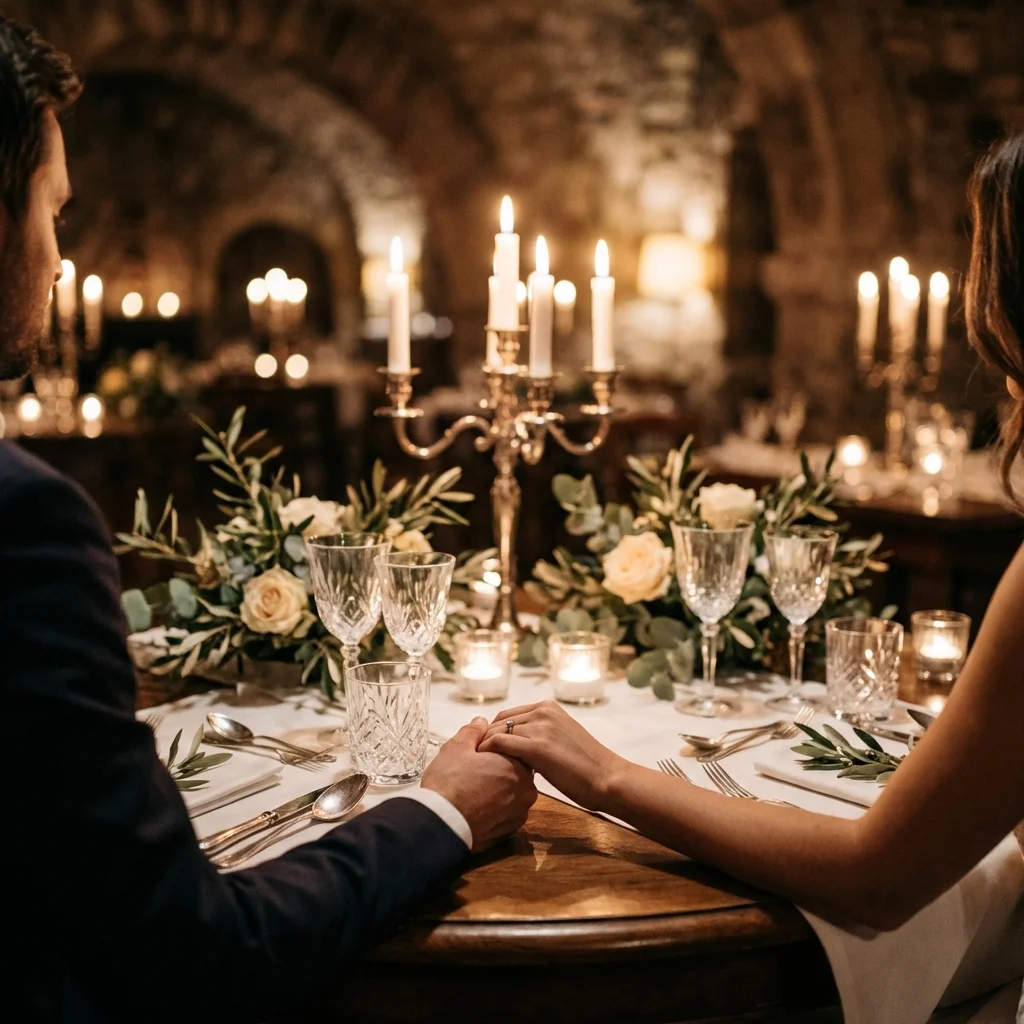
Couples drawn to this atmosphere often share a sensibility we know well — the quiet, unbranded elegance explored in our bespoke luxury wedding approach and across our wider luxury wedding work in Italy. To begin shaping your own candlelit evening, our team is ready to listen to what you have in mind.
Frequently Asked Questions
How many candles does a typical candlelit reception actually use?
A frescoed hall set for 80 guests commonly uses between 300 and 600 individual flames, counting tapers, pillars, and ambient sources. The figure depends on table length and ceiling height, both of which our lighting design accounts for before any order is placed.
Will the venue let us light real candles, or are we limited to battery alternatives?
It varies by venue and is governed by fire-safety and insurance terms, not aesthetics. We read each venue’s technical annex first and, where naked flame is restricted near frescoes or tapestries, deploy warm-white battery sources that are indistinguishable from wax at table distance.
What happens to the candles outdoors if there’s a breeze?
Open-air settings require hurricane glass and weighted lanterns, which we specify as standard for terraces and lakefronts. The candlelight stays steady because the design anticipates the evening wind rather than hoping it stays still.
Can we hold the ceremony in daylight but the reception fully by candlelight?
Yes, and it is the most cinematic structure of all. We schedule the candle lighting to begin around forty minutes before sunset so the room crosses into candlelight gradually, without a flat artificial-light gap in between.
Is a fire-watch attendant always required?
No — only certain historic interiors mandate one under their insurance terms. Where required, we arrange it and quote it as a distinct line rather than absorbing the cost invisibly into styling.
Does candlelight photograph well, or do we need flash everywhere?
It photographs beautifully when shot by a low-light specialist who exposes for the flame. We pair candlelit weddings with photographers who work natively in near-darkness, so the warm glow is preserved rather than washed out by fill flash.
How far in advance should we book a venue that permits open flame?
Venues that allow supervised flame in frescoed halls are limited, so we recommend confirming 12–14 months ahead for peak season. This window also secures the exclusive-use access that a candlelit evening generally requires.
Are the prices in your tables inclusive of Italian VAT?
No — IVA at 22% is shown as a separate line, alongside permits and photography travel. We itemise these openly so the proposal reflects the true total rather than an attractive but incomplete headline figure.
Can a candlelit wedding work for a smaller, intimate guest count?
It works exceptionally well for intimate celebrations, where a single long table by candlelight feels especially close. Our micro wedding planning often pairs naturally with this atmosphere.
You may also enjoy reading Italy Wedding Shuttle Service: Guest Comfort, Precise Timing, and Transparent Pricing.