
Wedding Planner Tuscany Italy
In Chianti, the last weekend of September smells of fermenting must, and it is also the first date to vanish from every estate calendar — usually 16 to 18 months ahead of the wedding. A wedding planner in Tuscany, Italy holds the venue contract negotiation, the Italian supplier team, the design direction, the guest logistics and the on-site production of the day itself, in Italian, on your behalf. Full service here is structured either as a standalone mandate fee or as an all-inclusive collection: ours start from €28,000, with venue, catering, production and coordination included. Kiss Me Italy works almost exclusively with international couples, and the practical reality is that most of our U.S. clients stand inside their venue for the first time three days before the ceremony. Everything before that moment is documentation, timeline and coordination.
Full Planning, Partial Support, Day Coordination: Where Each Mandate Ends
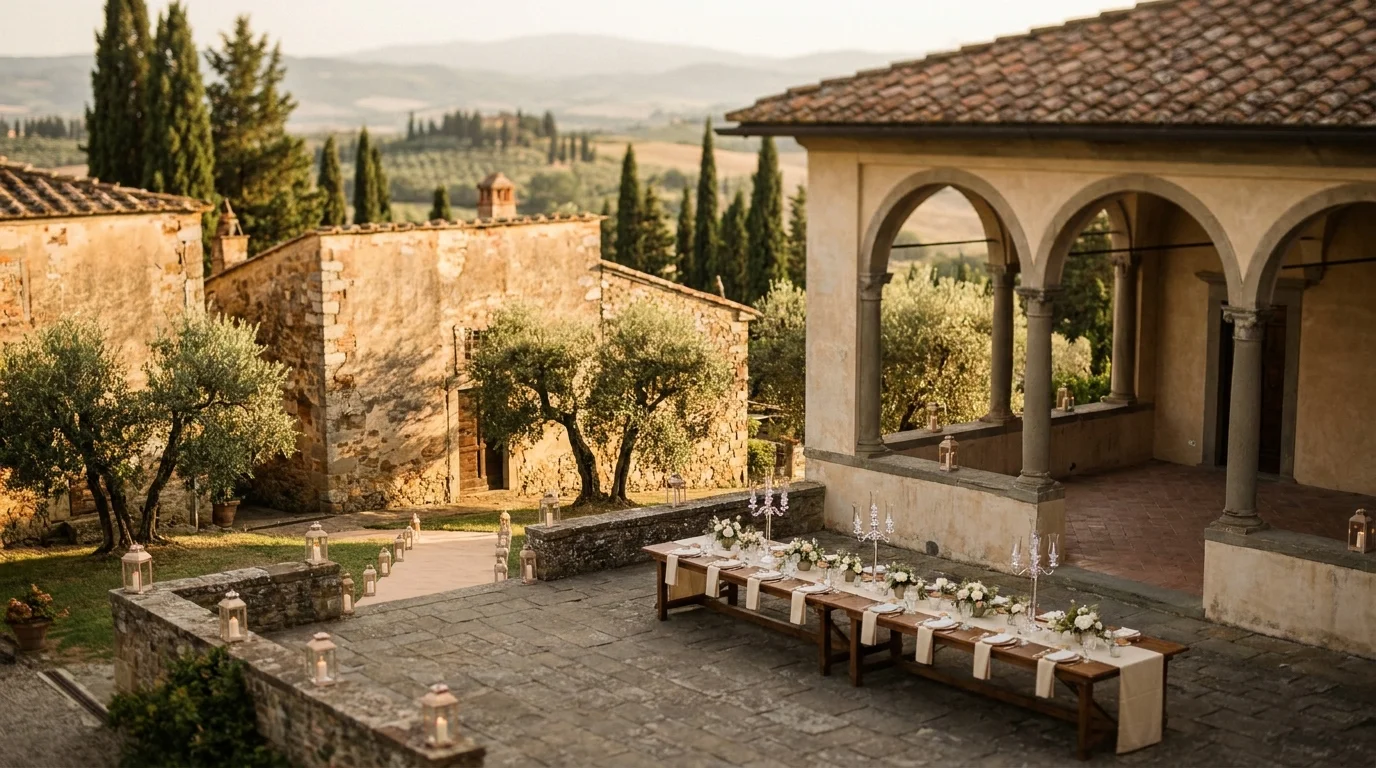
The three service levels are not the same product at different prices. They are different mandates with different liability. Full planning means we open the venue search, negotiate the contract clauses, contract and supervise every supplier, build the design, manage guest accommodation and transfers, and reconcile the final invoices — you have one point of contact and one timeline. Partial support begins when a couple has already signed a venue and asks us to take over supplier curation and production, typically from eight to six months out; we inherit the contract as written, including any clause that was agreed without us. Wedding-day coordination is the narrowest mandate: we absorb an existing plan roughly ten weeks before, walk the site, rebuild the minute-by-minute schedule and run the day. That last option is the one most frequently misunderstood. An estate in the Val d’Orcia reached by a single unpaved access road, with the nearest hotel cluster forty minutes away, needs a shuttle rotation designed weeks in advance — not a timeline read for the first time on the morning. Couples comparing agencies on structure rather than aesthetics often find our notes on how the best wedding planners in Italy actually work useful before any call.
The 16-Month Booking Window That Decides Which Estate You Can Have
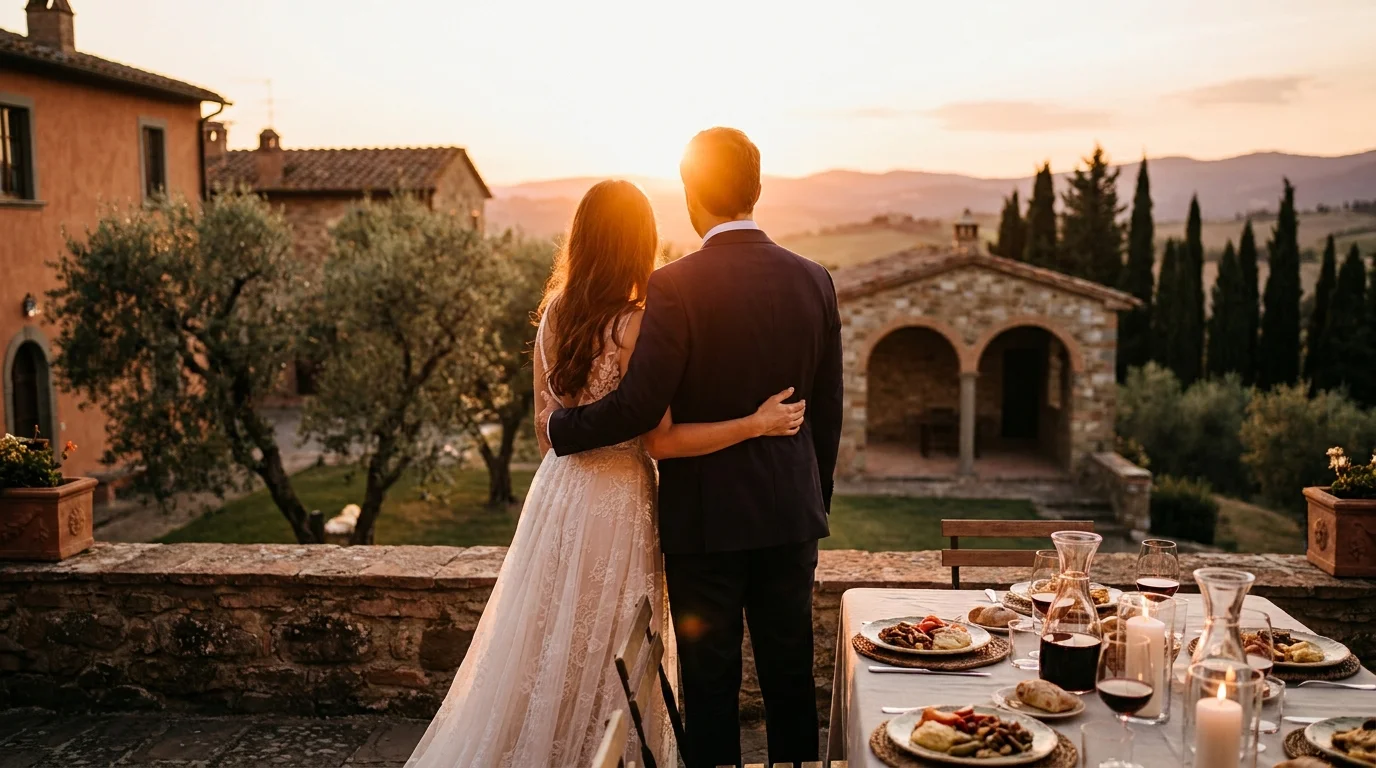
Tuscan availability is not evenly distributed across the season. Mid-May, the first half of June and the two weeks either side of the September harvest are the most requested Saturdays, and exclusive-use hamlets release them roughly eighteen months ahead. July and August are more open, and we plan around them differently: ceremonies from 18:30, aperitivo in shade, dinner served after sunset. When a date matters more than a specific property, we work outward from the date; when the property matters more, we work outward from availability. Our standard sequence is a ten-working-day date hold while our team reviews the contract for cancellation terms, corkage, external-supplier restrictions and music curfews — the four clauses that shape a budget more than any line item. Municipal ceremony rooms and church slots follow their own separate calendars, which is why we file those requests in parallel rather than in sequence. For the wider picture of the region, from the Florentine hills down to the Versilia coast, our guide to luxury weddings in Tuscany and Versilia maps how each area behaves across the season.
Our Tuscany Collections and What Each Price Actually Includes
We publish complete collections rather than opening fees, because international couples budget better against a total. The intimate wedding on a hilltop castle estate in Chianti places you at a private countryside villa with its own pool and a symbolic ceremony at the castle — our entry format for very small guest lists. At the other end, the three-night wedding at a private estate in the Florentine hills holds the whole estate in exclusive use, with sixty guests sleeping on site, a welcome party, the wedding day and the following morning. The figures below show published starting collection prices in euro; the final price depends on the selected guest count, season and package configuration. VAT treatment is confirmed in the written quotation.
| Collection | Format context | Starting price (EUR) | Included | Quoted separately |
|---|---|---|---|---|
| Intimate Wedding — Tuscan Countryside (a hilltop castle in Chianti with a private countryside villa) | Micro wedding, very small party | 28,000 | Private countryside villa stay with its own pool, symbolic ceremony at a hilltop castle in Chianti, planning and on-site coordination | Legal civil ceremony fees, guest travel, extra nights |
| The Boutique Countryside Hotel Wedding — Grotta Giusti Resort | Garden ceremony, hotel service | 35,000 | Garden ceremony, reception, resort service, coordination | Optional overnight stay for guests, spa treatments |
| The Florence Hills Wedding | Panoramic, minutes from Florence centre | 42,000 | Exclusive use of panoramic terrace, garden or loggia, reception, coordination | Guest accommodation in Florence, transfers |
| The Intimate Villa Wedding — an exclusive-use retreat in the Val d’Orcia | 18 guests, exclusive use | 45,000 | Three nights exclusive use, accommodation for 18, ceremony and dinner | Additional guest rooms off site, private transfers |
| The Boutique Agriturismo Wedding — Siena | 30 guests, full weekend | 49,000 | Two nights for 30 guests, wedding weekend programme, coordination | Third-night extension, Siena city transfers |
| Multi-Day Wedding — an exclusive-use retreat in the Val d’Orcia | 40 guests, 18 overnight | 57,000 | Three nights exclusive use, multi-day programme, production | Overnight rooms beyond 18, guest flights |
| The Tuscan Borgo Wedding — a medieval hamlet near Monteriggioni | Medieval hamlet, exclusive use | 68,000 | Entire borgo, reception, aperitivo, wedding dinner, cake, party | Three-night full-board upgrade, extra suppliers |
| The Hilltop Tuscan Castle Wedding — a private castle estate in Chianti | Castle, up to three nights | From €69,000 (50 guests, low season; other guest counts and seasonal rates apply) | Exclusive castle rental, accommodation up to three nights, full production | Legal ceremony filing fees, guest car hire |
| The Grand Tuscan Villa Wedding — Villa Reale di Marlia | Up to 100 guests | 69,000 | 24–48 hours exclusive use, ceremony, reception, coordination | Guest hotels in Lucca, shuttle fleet |
| A Timeless Wedding in Chianti — an exclusive-use borgo in the Chianti hills | 40 guests, two nights | From €79,000 (package configuration affects the price) | Two nights, 38 deluxe rooms plus a signature bridal suite, breakfasts, wedding programme | Wine-estate private tastings, additional nights |
| The Tuscany Castle Wedding — a hilltop castle in Chianti | Multi-day, guests on site | 79,000 | Exclusive use of the medieval hamlet, chapel, gardens, vineyards, guest rooms | Extended stay options, external entertainment |
| Wedding in the Florentine Hills — a private estate in exclusive use | 60 guests, three nights | From €94,000 (low season; €99,000 high season) | Exclusive use, three nights for 60 guests, welcome party, wedding day, full production | Guest flights, pre-wedding excursions |
Indicative ranges. Contact Kiss Me Italy for a personalized proposal. A broader breakdown by guest count and season sits in our reference on what a Tuscany wedding typically costs, and our team is happy to review your numbers before you commit to a date.
Choosing a Venue by Guest Logistics, Not by Photographs

We select venues in the order the day is actually lived: arrival, ceremony, dinner, departure. Twelve to twenty guests travel best in a single property where everyone sleeps on site and no shuttle exists at all. Thirty to forty-five guests usually work in a hamlet or agriturismo with partial on-site accommodation, plus one coach for the group staying nearby. Sixty to one hundred guests require a villa with a service courtyard that can receive catering trucks separately from arriving cars — a detail invisible in photographs and decisive in practice. Couples who want Florence within reach often choose the hills above the city, twenty minutes from the Duomo, where the panoramic terrace format lets guests stay in the historic centre and travel out for the day. Where the estate is agricultural, we plan around working vineyards, and our overview of what a vineyard wedding in Italy involves explains those constraints. For the full spectrum of properties we work with across the region, our guide to wedding venues in Tuscany is the place we send couples in the shortlisting phase.
The Documents the Comune Requires Before We Can File Your Ceremony
This part is administrative. It rewards precision, not enthusiasm.
A civil ceremony in Tuscany requires a Nulla Osta (a no-impediment declaration) issued by your consulate in Italy, plus a sworn Italian translation of your birth certificates and, where applicable, divorce or death documentation. U.S. citizens additionally sign an Atto Notorio or a consular Dichiarazione Giurata. British and Australian citizens follow a comparable but not identical route. Our team handles the appointment scheduling, the sworn translations, the legalisation stamps and the filing with the comune, and we build the sequence backwards from the ceremony date, since consular slots are the narrowest link in the chain. Documents issued more than six months before the ceremony are refused by some comuni. Symbolic ceremonies carry no filing requirement, which is why many international couples marry legally at home and celebrate here — a choice we outline in our comparison of civil, religious and symbolic ceremonies in Italy, alongside the practical detail in our guide to getting legally married in Italy as a foreigner. Where the voice matters as much as the paperwork, we curate the officiant with the same care, as described in our notes on choosing the right celebrant in Italy.
What Sits Outside the Collection Price
Certain items are municipal, consular or supplier-specific, and no collection can absorb them honestly. We quote them transparently as indicative ranges, subject to confirmation against the relevant municipality or supplier, so nothing arrives late in the process. Italian VAT (IVA 22%) applies to professional services and is stated separately below where it is not already embedded.
| Item (indicative) | Range (EUR) | Included in the fee | Not included |
|---|---|---|---|
| Civil ceremony fee, Tuscan comune, non-residents | 500–2,000 | Registrar, municipal ceremony room, marriage certificate issue | Extracts for use abroad, apostille, VAT not applicable (public fee) |
| Sworn translations and legalisation of foreign documents | 250–600 | Certified translator, court sworn statement, stamps | Courier costs, re-issue if documents expire; IVA 22% applies |
| Court-appointed interpreter for the ceremony | 300–650 | Attendance, sworn interpretation of the ceremony | Travel beyond 60 km, rehearsal attendance; IVA 22% applies |
| Photography, full-day coverage, single photographer | 3,800–7,500 | Full ceremony and reception day, travel within Tuscany, online gallery within 8–10 weeks | Second shooter, albums and prints, pre-wedding shoot, accommodation if the estate is over 90 minutes from the studio; IVA 22% applies |
| Film coverage, one operator | 3,500–7,000 | Ceremony and reception, edited highlight film, delivery within 12–16 weeks | Drone permits, second operator, raw footage, same-day edit; IVA 22% applies |
| Guest transfers, 50-seat coach, Florence to countryside estate | 700–1,400 per rotation | Driver, fuel, tolls, one return rotation | Waiting hours beyond contract, late-night second rotation, minibus for reduced-mobility guests; IVA 10% applies |
| Site permits for civic or protected outdoor locations | 400–3,500 | Application, municipal or heritage-body fee, timing authorisation | Security staffing, power generator, cleaning deposit |
Indicative ranges. Contact Kiss Me Italy for a personalized proposal.
Menus, Wine, and the Tasting Nobody Can Attend in Person
Most international couples cannot fly in for a tasting twelve months out. We solve it in two moves. First, we build the menu around what the estate kitchen does best in your specific month — May asks for artichoke and broad beans, late September for porcini, game and the first pressing of new oil. Second, we schedule the tasting for the day after arrival, when adjustments are still possible and the chef is already provisioned. Wine is usually the simplest decision in Chianti and the most negotiated elsewhere: estate-produced labels are often mandatory, and corkage for outside bottles is a contract clause we review before signature. Our team also manages dietary requirements as a written service brief given to the kitchen, not as a verbal note on the day. Couples building their menu direction often start from our regional reference on Italian wedding menu ideas, and the reasons guests remember these meals are set out in our piece on why Italian wedding food feels different.
Floral Design Against the Tuscan Calendar
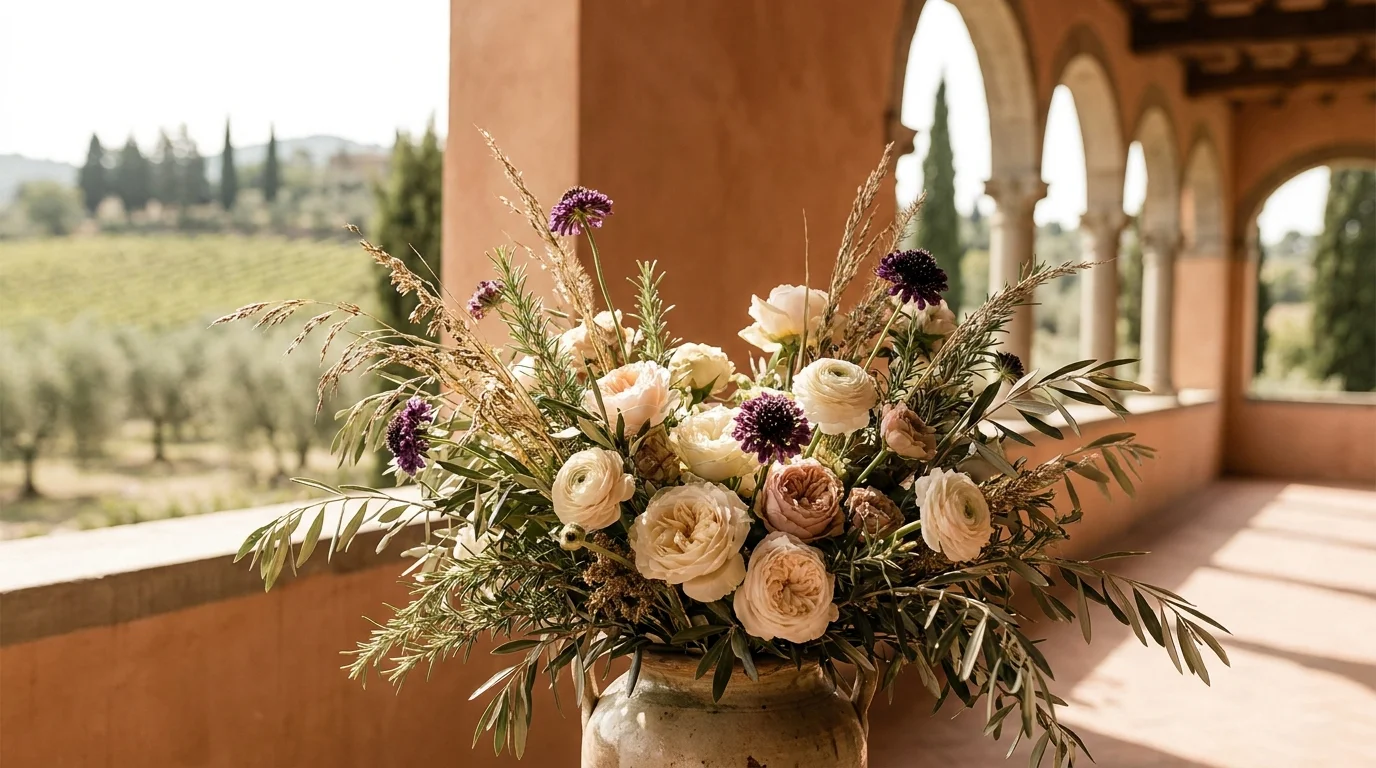
Tuscany gives you a palette by month, and we work with it rather than against it. Peonies until early June. Dahlias from August. Olive branch, rosemary and wild grasses all year, which is why our long serpentine tables photograph so well under candlelight even in late October. We commission from growers in Pistoia, one of the largest ornamental nursery districts in Europe, which shortens the supply chain to a single morning. Imported stems are possible. They cost more and they arrive tired. Our preference, always, is what was cut at dawn.
Production Access, Light Timing, and the Weather Plan We Never Improvise
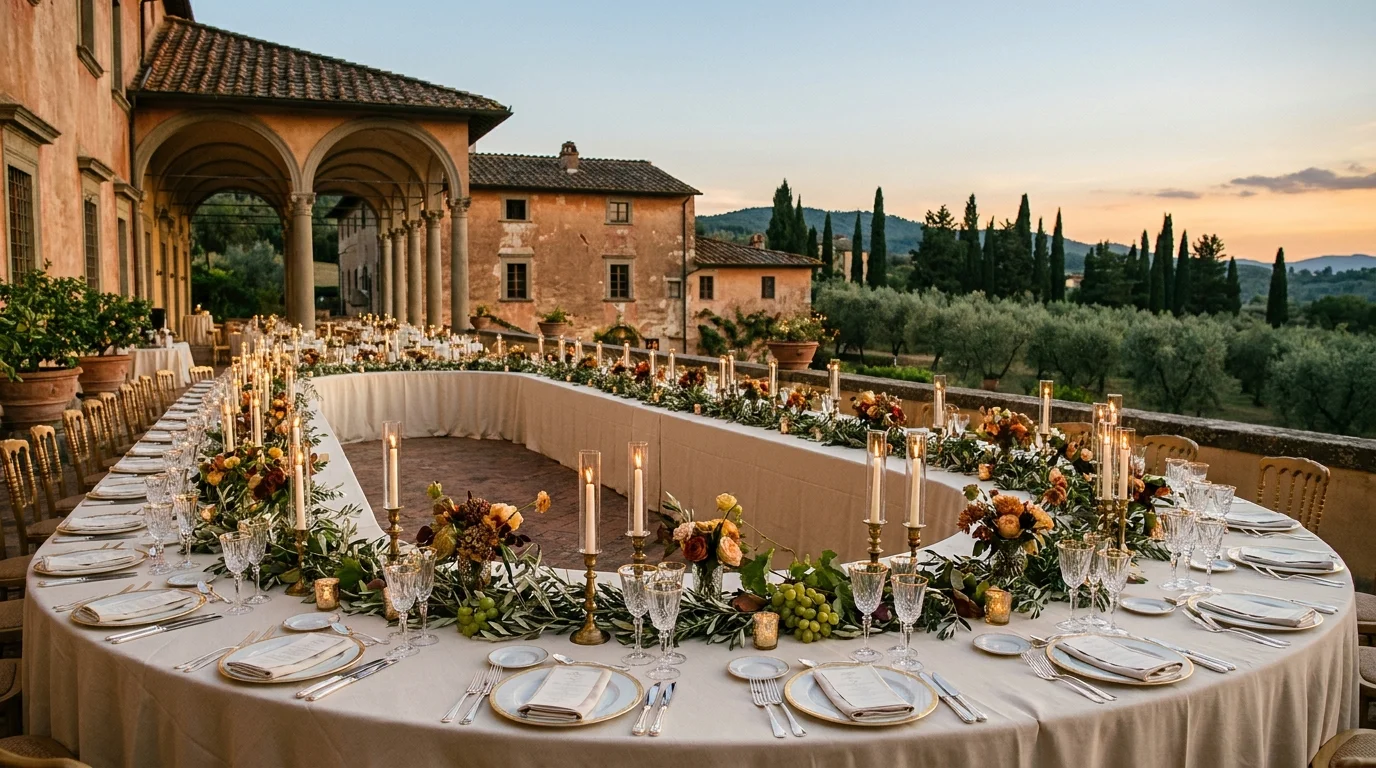
Two operational realities govern the day. The first is light: in mid-June the usable golden window above Florence runs roughly 20:00 to 20:45, while in late September it closes before 19:15 — which moves the entire dinner service, not just the portrait session. We fix the photography schedule before the catering timeline, then negotiate the two together. The second is weather. Spring in Tuscany brings short, heavy afternoon rain; August brings 34°C at 16:00 in the Val d’Orcia. Every floor plan we produce carries a documented alternative — an identified indoor room or a pre-priced structure with a decision deadline agreed with the venue, usually 48 hours out and confirmed by us, not by you. Production access matters equally: lighting rigs, generators and sound systems need loading windows that do not collide with guest arrival, and rural estates frequently limit truck access to before 15:00. For couples pairing local coverage with an editorial approach, our overview of working with a wedding photographer in Italy explains how we brief and schedule the team.
Who Talks to Whom: Coordination Across Five Time Zones
The value of a wedding planner in Tuscany, Italy is rarely visible in the final gallery. It sits in the bridge between an Italian estate manager who answers at 09:00 CET and a couple in California who wakes at 17:00 CET. We hold every supplier conversation in Italian and every client conversation in English, with a single written timeline that both sides read as the source of truth. Our U.S. clients typically receive a consolidated update once a fortnight, and a daily one in the final ten days. Guests receive their own logistics note — transfer times, dress code, distances, pharmacy and clinic details — because a hundred people asking a hundred questions is the part no couple should carry. Florence-based ceremonies bring their own permits and traffic windows, which we detail in our Florence wedding guide. Smaller guest lists follow a different logic altogether, described in our reference on what a micro wedding means in Italy. The people behind this coordination are introduced on our team page.
What Happens After Your First Message
The first exchange is short and factual: date range, approximate guest count, whether the ceremony needs to be legally binding, and the budget you are comfortable with. From there we propose two or three properties that fit the guest logistics rather than a long list that fits nobody, and we put a date hold in place while the contract is reviewed. Nothing is signed before you understand exactly what is included and what is quoted separately. A refined Tuscan wedding is, in the end, a project with a timeline, a document trail and a production plan — and our role as your wedding planner in Tuscany, Italy is to carry all three so that the three days you spend here feel like the only part that ever existed. When you are ready, tell us your date and we will tell you what is still available.
Questions Couples Ask Us Before They Book
Do you take commissions from the venues and suppliers you recommend?
Our fee structure is disclosed in writing before signature, and supplier quotations are passed to you as issued, with no hidden mark-up between the supplier’s price and yours. Where a venue offers a trade rate, we apply it to your budget rather than retaining it. Transparency on this point is what allows us to argue on your behalf during contract negotiations.
Who actually pays the Italian suppliers — us or your team?
With an all-inclusive collection, payments flow through us on a scheduled plan, and you receive one consolidated statement rather than eleven separate invoices in Italian. Under partial mandates, some suppliers invoice you directly, and we manage the deadlines and confirmations. Either way, our team reconciles the final accounts before the wedding week so no payment is outstanding on the day.
What happens if our guest count drops after the venue contract is signed?
Most Tuscan estate contracts set a minimum guaranteed number rather than a fixed one, so a reduction is usually absorbed down to that floor. We negotiate that floor deliberately low at signature, precisely because international guest lists move. If numbers fall below it, we look at reallocating the value into menu, wine or an extra event rather than losing it.
Can we bring a photographer or videographer from our own country?
Yes, and a number of our couples do. We handle the practical side — access times, permit implications, meals, transfers and the shot schedule against Tuscan light — and we brief them exactly as we brief our local team. The only element we ask about early is whether they know how to work with 20:00 summer light in an inland valley.
Do we need to travel to Italy before the wedding?
It is not required. We run video site visits, share measured floor plans and produce sample tablescapes photographed on the actual estate. Couples who do come usually arrive twelve to fourteen months out for two days, and we compress venue viewings, a chef meeting and a florist conversation into that window.
How do payments and currency work for a client paying in dollars or pounds?
Invoicing is in euro, since every Italian supplier contracts in euro. Our U.S., U.K. and Australian clients typically transfer in two to four instalments, and we time the schedule so that the largest payment does not fall in the same month as flights and accommodation. We also flag the exchange-rate exposure at signature, because a nine-per-cent currency movement over eighteen months changes a real budget.
What happens if a confirmed supplier cancels close to the date?
Every category in our supplier network has at least two vetted alternatives already briefed on the region and the season. In practice, substitutions are handled by our team without the couple being asked to make a decision under pressure, and the replacement is contracted at the original agreed price. Notification comes with the solution attached, never before it.
How many of your team are physically on site on the wedding day?
For a wedding of forty guests we are on site with two coordinators from setup to the end of the party; from around eighty guests we work with three, plus a dedicated transfer supervisor when shuttles are involved. Setup begins the morning before for multi-day formats. The number is confirmed in your production plan, not decided in the final week.
Is a marriage registered in Italy automatically valid in our home country?
An Italian civil marriage is recognised in the United States, the United Kingdom and Australia once the certificate is issued and, where required, apostilled. Our team requests the multilingual extracts and the apostille on your behalf after the ceremony and sends them to your home address. Registration procedures at home vary by state or district, and we tell you which documents to expect.
Can you manage a welcome dinner and a farewell brunch as well as the wedding day?
Most of our multi-day collections already include a welcome event, and we frequently add a farewell lunch on the estate or a private wine-estate visit in Chianti. Each additional event is quoted separately with its own inclusions, since staffing and menu structures differ from the wedding day. The advantage of a hamlet in exclusive use is that all three moments happen without anyone driving.