Lake Garda Wedding Boat: Arrival, Route, and the Hours Built Around It
According to historical accounts, in 1439 the Republic of Venice dragged a fleet of galleys overland from the Adige valley and launched it at Torbole, on Garda’s northern tip, to break a Milanese blockade. Whatever the precise details of that episode, the lake still rewards anyone who arrives by water rather than by road — but the constraint that governs a modern lake garda wedding boat is not naval, it is temporal. A vessel can be chartered in a week. The hour it sails, the jetty it is permitted to approach, and the several minutes your dress needs between deck and ceremony chairs: those are the elements that require a planner rather than a booking form.
What a Private Boat Adds to a Lake Garda Wedding — and What It Costs in Time
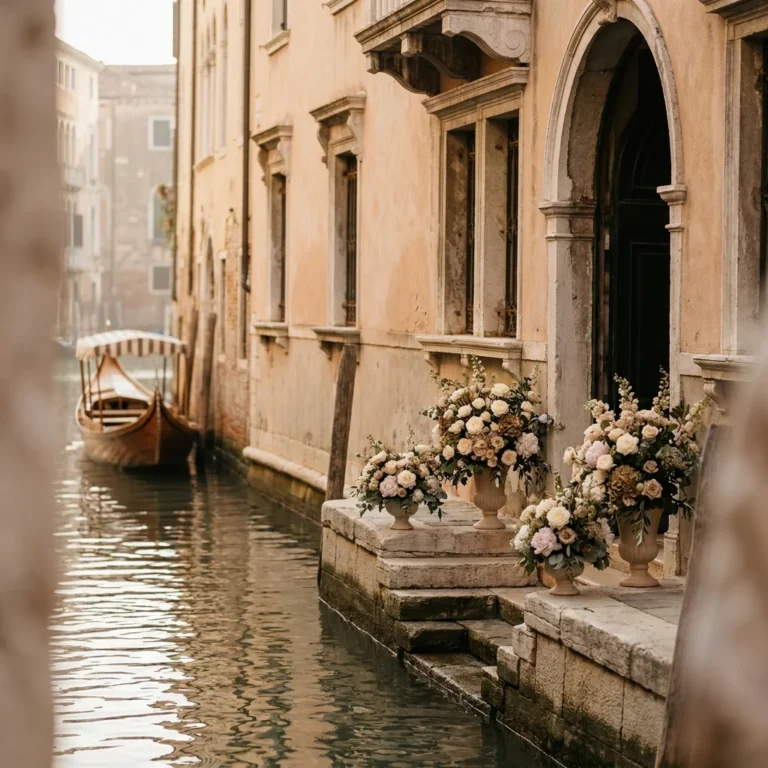
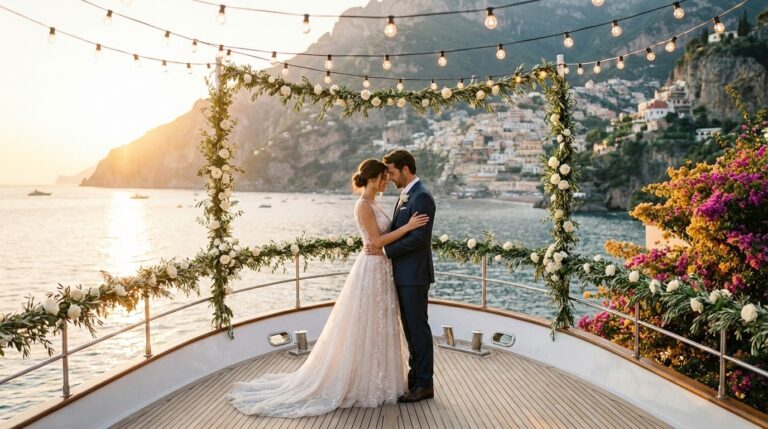
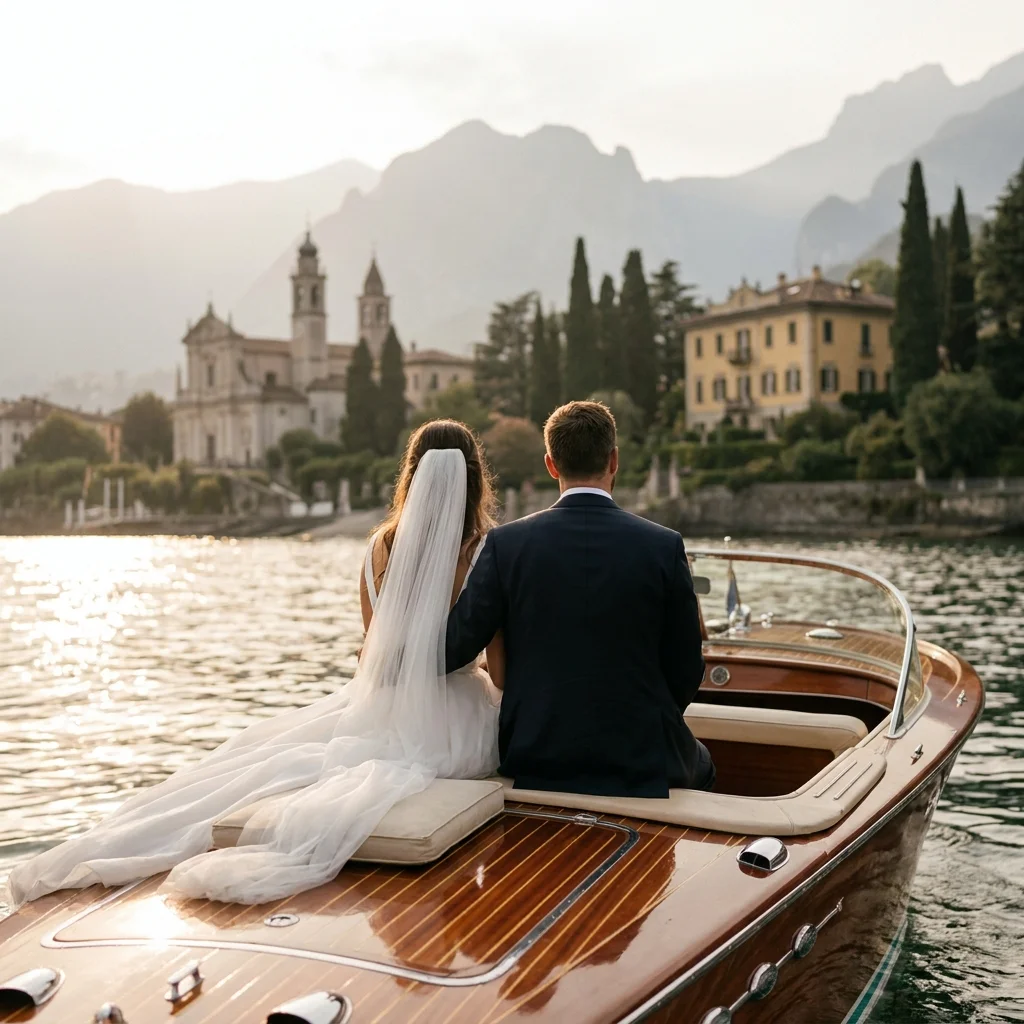
A Lake Garda wedding boat is a privately chartered vessel used for the bride’s arrival, couple portraits, guest transfers between shore venues, or a hosted aperitivo afloat. Charters are typically arranged in blocks of two to four hours, with vessels ranging from classic wooden runabouts for two to licensed passenger boats carrying larger groups. At Kiss Me Italy the boat is never sold as an isolated excursion: we build it into the ceremony schedule, the photographic light, and the reception service so that it costs the day nothing in momentum.
That last point is where most couples underestimate the work. Every minute afloat is a minute borrowed from something ashore. Our team calculates the borrowing precisely for each route, then returns it to you in images and atmosphere.
Sirmione: Why the Peninsula Reads Best From the Water in the Last Hour of Light
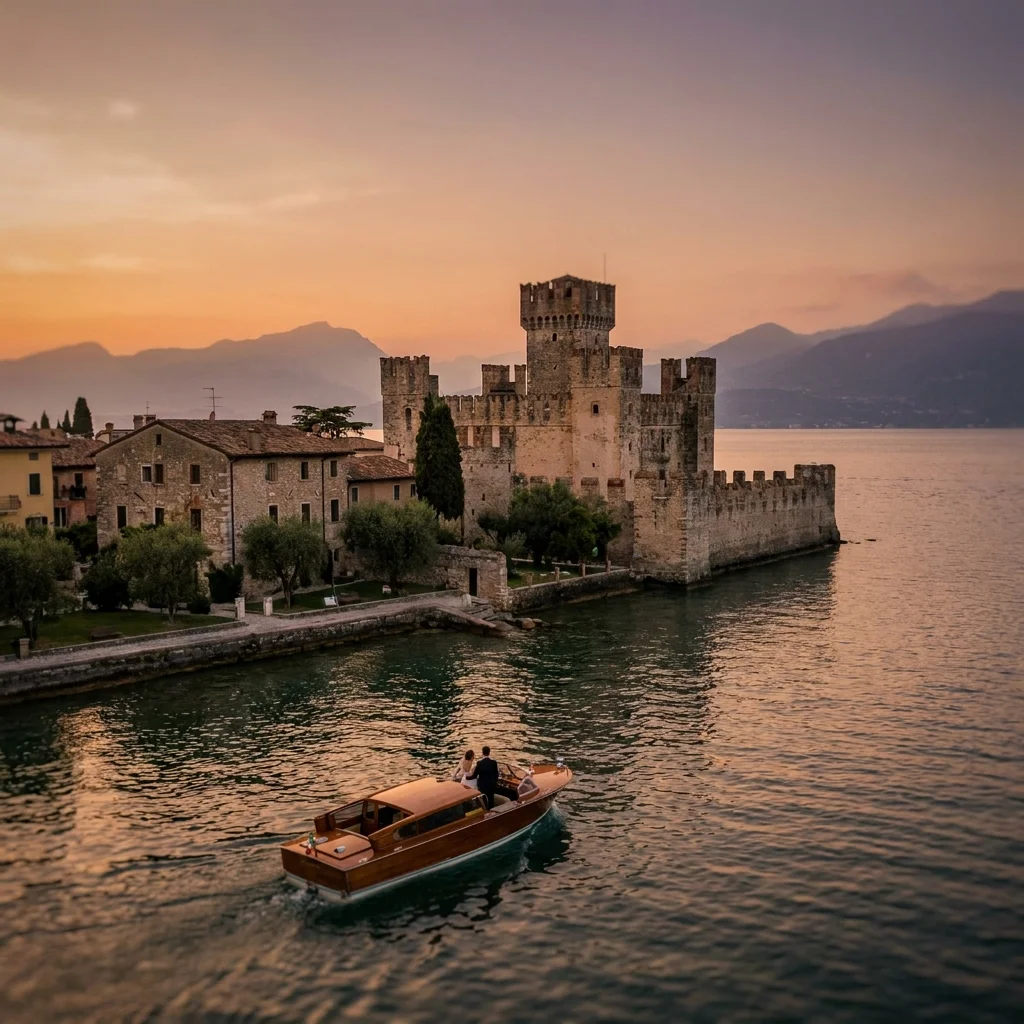
The Rocca Scaligera, believed to have been begun around 1277 under the della Scala family of Verona, was built as a defensive structure facing the water — a design often read as more imposing from the lake than from the land, though visitors should judge this for themselves. Which is precisely why a boat arrival at Sirmione is a scenographic decision, not a transport one. The fortress presents a different profile to those arriving by water, and the Roman ruins at the peninsula’s tip, the so-called Grotte di Catullo, can catch low westward light at certain hours in a way that is difficult to reproduce from every landside vantage point.
Sirmione’s difficulty is traffic. The peninsula is a single narrow spine, and in July the road in is not a road, it is a queue. We routinely move couples and small guest groups by water precisely to bypass this, boarding from a quieter southern shore and landing within walking distance of the venue. Our Garda team confirms landing arrangements in writing with each property for the specific route in question, because a jetty that permits a vessel to set down passengers does not automatically permit it to remain moored through a forty-minute ceremony. For couples still weighing shoreline options, the wider picture is set out in our guide to a wedding in Lake Garda, Italy.
Cavaion Veronese and Punta San Vigilio: The Inland Estate Route That Ends Away From the Water
An eighteenth-century wine estate sits in the hills above Bardolino, surrounded by its own vineyards and olive groves — a private property, not a lakefront palazzo. It is not on the water. We say this plainly because it changes the design of the boat chapter entirely, and honesty here saves a great deal of later rearrangement.
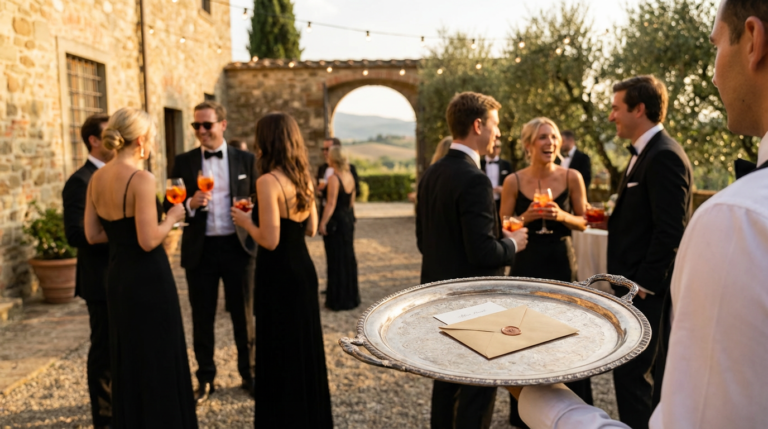
For couples celebrating at this estate, the vessel becomes a distinct movement in the composition rather than the arrival itself. We most often place it the afternoon before the wedding, or on the morning after: a private crossing from the Bardolino shore toward the cypress promontory of Punta San Vigilio, a short drive from the estate — our planning team confirms the exact timing for the specific route and traffic conditions on the day — with the couple photographed against the sixteenth-century villa and its harbour of a dozen boats. The vineyard reception then receives you unhurried, hair intact, without the compromise of a wind-blown veil three minutes before the vows. The full two-day structure is set out in The Eighteenth-Century Estate Wedding — Lake Garda, and the private vessel chapter can be added through our a privately curated Lake Garda boat itinerary.
Couples who prefer to see the whole picture before deciding are welcome to write to our Garda desk with their date and guest count; we reply with a route sketch rather than a brochure.
Malcesine and the Northern Shore: Wind as a Timetable, Not a Threat
Garda has two habitual winds, well known to sailors on the lake. The Peler descends from the north in the early morning. The Ora del Garda rises from the south in the early afternoon and holds until evening. Both are ordinary. Neither is a hazard for a well-chosen vessel. They are, however, a schedule.
The practical consequence for a lake garda wedding boat in Malcesine or Riva is straightforward: on many stretches of this shore, flatter water tends to sit in the windows around dawn and around sunset, and the mid-afternoon is where hairstyles are tested — a pattern our team verifies for the specific date and location rather than assumes. Where a couple is set on a 3pm departure we select a heavier hull with a deeper freeboard and brief the skipper on a leeward route close to the eastern cliffs, confirmed for the day’s actual conditions, where the medieval castle rises directly from the rock. This is coordination, not compromise. It is also the reason we quote the boat only after the ceremony hour is fixed.
The Salò Gulf and Isola del Garda: The Crossing Length Nobody Factors In
The western shore holds Garda’s most theatrical water frontage. Isola del Garda has passed through several noble families, including the Lechi and later the Borghese Cavazza, and carries a neo-Gothic villa believed to date from the early twentieth century, built on the site of an earlier Franciscan house — a silhouette that photographs like a stage flat rising out of the lake. Gardone Riviera’s belle-époque terraces sit a short run to the north.
Here the tension is distance. Garda is among the longest lakes in Italy, and an east-to-west crossing at Torri del Benaco is not the same undertaking as one at Sirmione. A displacement vessel and a fast tender can differ by half an hour on the same route, and half an hour after a ceremony is the difference between a warm aperitivo and a reheated one. We plan crossings by minutes, not by kilometres, verifying timings for the specific vessel and route, and we hold the reception service to the vessel’s actual arrival rather than to an optimistic estimate. Where a shoreline vow renewal is the occasion rather than a first marriage, the shoreline options are set out in our guide to a vow renewal on Lake Garda.
Vessel Selection: Freeboard, Boarding Height, and What a Cathedral Veil Does at Speed
This section is deliberately technical, because the selection criteria are.
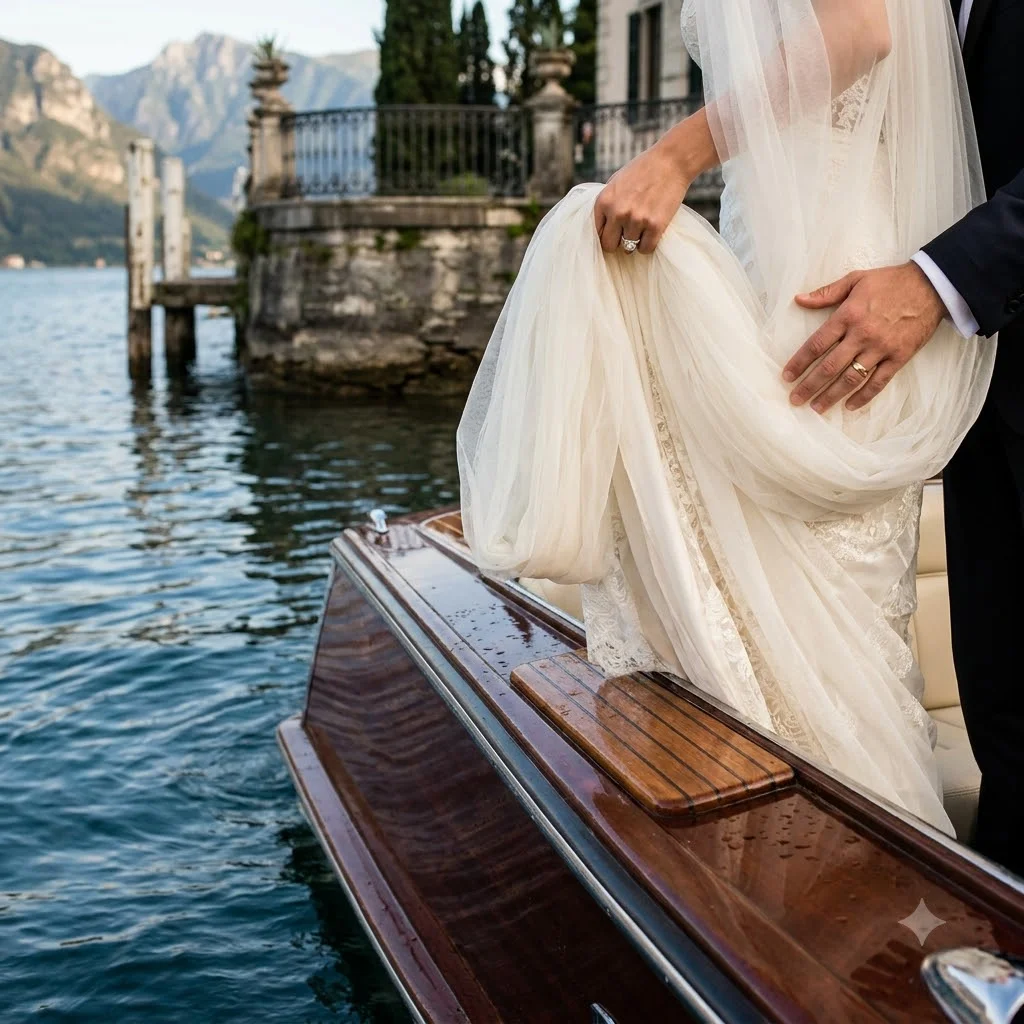
Boarding height is the first filter. A classic wooden runabout — mahogany, low, exquisite in photographs — has a boarding step that is unkind to a fitted gown and to any guest over seventy. A licensed passenger vessel has a flat gangway and a handrail. The dress decides the hull as often as the guest count does. We ask for the silhouette, the train length, and the shoe height before we shortlist vessels.
The second filter is what happens above deck. A cathedral veil at speed behaves like a sail. A chignon is not. Where a couple wants both the veil and the speed, we plan for the veil to be carried, pinned, and released on arrival — a two-person task assigned in writing to a named member of our on-site team, not left to a well-meaning bridesmaid.
The third is licensing and use. A vessel licensed to carry paying passengers, a private charter with skipper, and a bareboat hire are three different legal categories with different insurance profiles. Our team, working with the contracted operator, verifies the applicable category, confirms the skipper’s certification, and checks that catering and music aboard fall within the vessel’s permitted use before any deposit is placed. Couples navigating Italian requirements more broadly will find the framework in our guide on getting married in Italy as a foreigner.
Three Different Boats: Portrait Cruise, Guest Transfer, and Reception Afloat
Couples often use one phrase for three quite separate commissions, and the budget consequences diverge sharply.
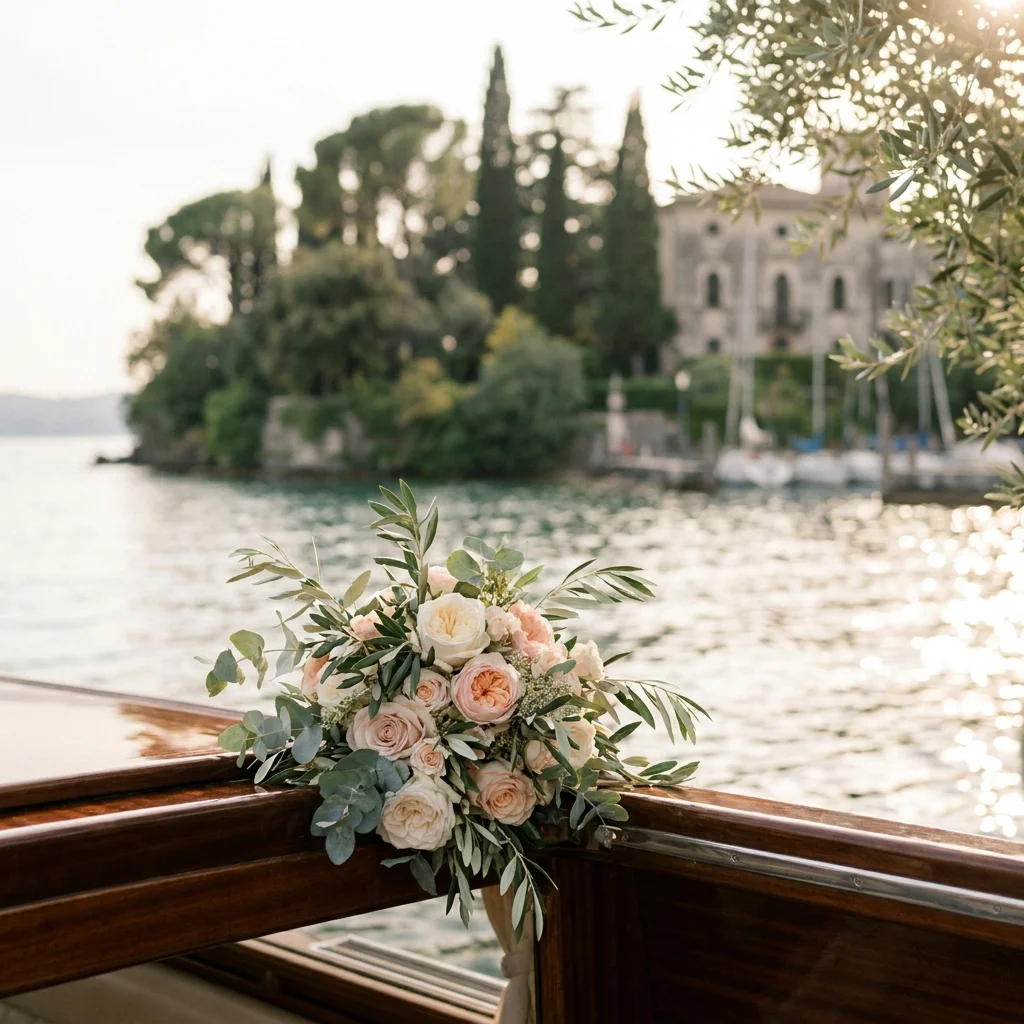
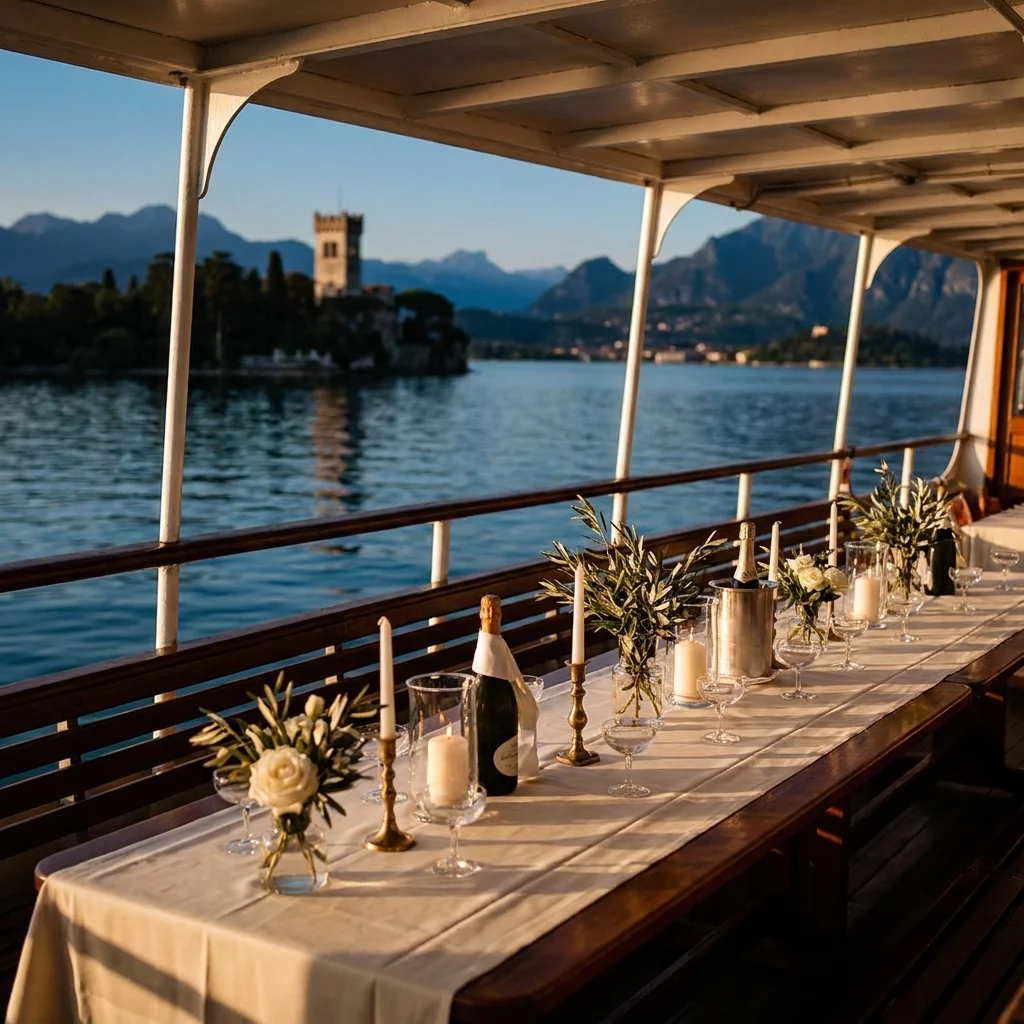
A private portrait cruise carries the couple, the photographer, and occasionally a single assistant. It runs sixty to ninety minutes, usually in the hour before sunset, and it is one of the day’s strongest portrait opportunities. A guest transfer is a logistics operation: a licensed vessel, a fixed boarding time, a manifest, and a shoreside host at each end. A hosted reception afloat is a floating venue, with catering, service staff, waste management, and a music licence to consider.
For an intimate ceremony for two, the first is usually enough — and it pairs naturally with the approach described in our guide to eloping in Italy. For a celebration of sixty, the second and third are separate contracts with separate operators, and our team coordinates them as a single timeline.
The Twenty Minutes After the Ceremony, Described
The engine is cut about four hundred metres out. This is the part nobody plans and everybody remembers.
The lake goes quiet in a way that a garden never does — no service noise, no chairs being moved, no second cousin arriving late. There is water, the sound of it against the hull, and the shoreline receding into that particular Garda haze that softens the Baroque campanili on the eastern bank until they look painted rather than built. The photographer works fast here, because the light on the water is doubled: once from the sky, once from the surface, and it fills the underside of the jaw in a way that is hard to reproduce with a reflector alone. Then someone opens a bottle, and the two of you sit down on the transom, and for the length of one glass nobody needs anything from you at all.
We build that gap deliberately. It is scheduled, protected, and defended against every well-intentioned request to come back early. The imagery that results is discussed in more detail in our guide to commissioning a wedding photographer in Italy.
What Sits Inside the Collection Price — and What Arrives on a Separate Invoice
The Kiss Me Italy collection shown below is published at €109,000 and is not presented as a price for two people. The linked product page and final written proposal govern the current guest configuration, exact inclusions, availability and applicable tax treatment. The boat component is structured separately according to route and vessel class, and every bespoke addition is itemised in writing before signature.
| Collection | Published collection price | Included | Quoted separately |
|---|---|---|---|
| The Eighteenth-Century Estate Wedding — Lake Garda | €109,000 | The estate in exclusive use over two days; 41 rooms for guests for two nights with breakfast; pre-wedding day with dinner; wedding day with ceremony setting, aperitivo, reception and wedding dinner; full planning and on-site direction by our team, according to the published collection specification | Only items outside the published collection specification, including bespoke programme extensions, private vessel charter and skipper, additional guest transfers, legal or municipal fees, additional photography or videography beyond any contracted coverage, albums or other specifically commissioned upgrades |
| a privately curated Lake Garda boat itinerary | Quoted on confirmed itinerary | Private vessel with certified skipper; curated route and timing; on-shore coordination at boarding and landing | Photography and film where not already covered by the selected collection; floral design aboard; catering, wine and glassware; venue hire ashore; guest transfers; permits where a specific jetty requires them; applicable IVA treatment confirmed in the written quotation |
€109,000 is the Kiss Me Italy collection price stated for the linked Lake Garda estate product. It is not a price for two people. The linked product page and final written proposal confirm the current configuration, exact inclusions and any bespoke additions for your date. Contact Kiss Me Italy for a personalized proposal.
The second table sets out how a boat component is actually built, because the charter fee is rarely the whole figure.
| Element | Normally inside a private charter fee | Normally invoiced separately |
|---|---|---|
| Vessel, skipper, fuel for the agreed route | Yes | Route extensions beyond the contracted hours |
| Deckhand or second crew member | Only on larger passenger vessels | Yes, on classic runabouts and tenders |
| Mooring and landing at a third-party jetty | Rarely | Yes, where a private property or municipal berth applies a fee |
| Catering, sparkling wine, glassware, ice | No | Yes, via our catering partner or the shore venue |
| Floral design and deck styling | No | Yes, with installation and removal within the charter window |
| Photographer and videographer aboard | No | Yes, including their travel, accommodation, second shooter, albums and post-production |
| Amplified music aboard | No | Yes, subject to the vessel’s permitted use |
| VAT (IVA 22%) | Stated on each line of the written quotation | Applied per Italian law to the charter category concerned |
Indicative structure, confirmed per contract with the operator. Contact Kiss Me Italy for a personalized proposal.
Third-party administrative costs sit outside our collections entirely and vary by comune. The ranges below are indicative only and are verified with the relevant municipality at the time of booking.
| Item | Indicative range | Notes |
|---|---|---|
| Municipal civil ceremony fee, non-resident couple | €400 – €1,500 | Varies by comune and by ceremony room; higher for historic venues and Saturday slots |
| Sworn translation of documents | €60 – €130 per document | Court stamp duty may apply separately |
| Interpreter for the civil ceremony | €300 – €650 | Required where neither party speaks Italian |
| Symbolic celebrant, bilingual | €600 – €1,600 | No legal effect; often chosen when the marriage is registered at home |
Indicative ranges, exclusive of VAT where applicable. Contact Kiss Me Italy for a personalized proposal. The distinction between civil, religious and symbolic formats is explained in our overview of wedding ceremony types in Italy.
Rain, Chop, and the Second Plan You Will Never Hear Us Discuss
Every boat itinerary we contract carries a mirrored land route. It is drawn at the same time as the primary plan, with the same suppliers, the same timings and the same named contacts — and it is never mentioned to guests unless it is used.
Weather conditions on Garda can vary considerably from one basin to another: the northern basin, hemmed by cliffs, can behave quite differently from the open southern bowl on the same afternoon. Our team monitors the lake bulletins in the forty-eight hours before the date and takes the decision at a fixed hour, agreed with you in advance, so that nobody spends the morning of the wedding refreshing a forecast. Where a crossing is cancelled by the operator on safety grounds, our contracts, confirmed with the contracted operator, specify the treatment of the charter deposit before signature. That conversation happens months early, calmly, in writing. The broader logic of how we hold a multi-supplier day together is described in our guide to choosing a luxury wedding planner in Italy.
Guest Transfers by Water: The Manifest, the Two Hosts, and the Rule About Heels
Moving forty guests by boat is a pleasure for them and an operation for us. It requires a boarding manifest, a host at the departure jetty and a second at the landing point, a stated boarding window rather than a vague hour, and a discreet note in the invitation suite about footwear on a wooden deck.
We build in a buffer of several minutes at each end, sized to the specific transfer, because the last guest to arrive is always the one who drove. Where accommodation is spread across several shoreline towns, we consolidate departures into one or two boarding points rather than five, which is far more elegant and considerably faster; the accommodation logic behind this is set out in our guide to a wedding in Italy with accommodation. Catering afloat, when a hosted crossing runs over an hour, follows the same regional thinking we apply ashore — several starting points appear among our Italian wedding menu ideas.
If a water-borne guest movement is part of what you are imagining, tell us the towns your guests will be staying in and we will map the boarding points before you book a single room.
Commissioning the Vessel: How We Begin
A lake garda wedding boat is not a line item to be added at the end. It is a structural decision that can shape the ceremony hour, the reception service time, and where some of the day’s strongest portraits will be taken. We source the vessel, verify the licence with the contracted operator, contract the skipper, brief the photographer on the route, and hold the shore venue to the arrival minute.
The lake has been carrying processions of one sort or another for centuries. Yours simply needs to be timed. When you are ready, send us your date and the shape of the day you have in mind — our Garda team will come back with a route, a vessel class, and an honest schedule.
Frequently Asked Questions
Can elderly guests or guests with limited mobility join the boat portion of the wedding?
Yes, on vessels with a flat gangway, handrails and covered seating — we shortlist boats by boarding height precisely for this reason. Where a guest uses a wheelchair, we confirm gangway width and jetty access in advance and, if the water route is unsuitable, we arrange a parallel car transfer that arrives at the same moment as the boat.
What happens if the selected wedding boat becomes unavailable before the event?
Our team assesses and confirms contingency vessel options and substitution terms individually for each commission, and the agreed process is written into the charter agreement rather than negotiated in the moment. Should a substitution become necessary, we confirm the replacement with you as soon as it is arranged, with any difference in fee, if any, settled by the operator.
Can children travel on the wedding boat, and can child safety equipment be arranged?
Children are welcome on licensed vessels, and correctly sized buoyancy aids are requested from the operator by age and weight at the time of booking rather than on the day. We also recommend a nominated adult per two children under six, which our on-site host confirms at boarding.
How far in advance should the boat itinerary be confirmed?
We typically finalise the vessel, route and timing once the ceremony hour and venue are fixed, and confirm the written itinerary with the operator well ahead of the date rather than close to it. This gives us time to verify permits, landing arrangements and any seasonal restrictions specific to the chosen route.
Can our pet join a private Lake Garda wedding boat experience?
On private charters this is usually possible with the operator’s written consent, and small dogs travel more easily than large ones on low-freeboard classic hulls. We confirm the policy per vessel and arrange a handler to receive the animal at the landing point so nobody is holding a lead during portraits.
What happens if a guest feels seasick or unwell during the crossing?
Our on-site hosts carry basic remedies and coordinate with the skipper to shorten or adjust the route if needed, and a shore-based alternative is always available for anyone who prefers not to continue by water. This is discussed with the crew as part of the standard pre-departure briefing.
Can luggage or wedding gifts be transported on the same boat as guests?
Light items travel with guests, but suitcases, gift tables and heavy décor are moved separately by road or by a service crossing scheduled outside the guest window. This keeps deck space clear and boarding times short.
Who coordinates communication between the boat crew and the officiant or venue team on the day?
A single member of our on-site team is designated as the point of contact between the vessel, the officiant and the venue, so that arrival timing is relayed in real time rather than assumed. This role is agreed in the planning stage, not improvised on the day.