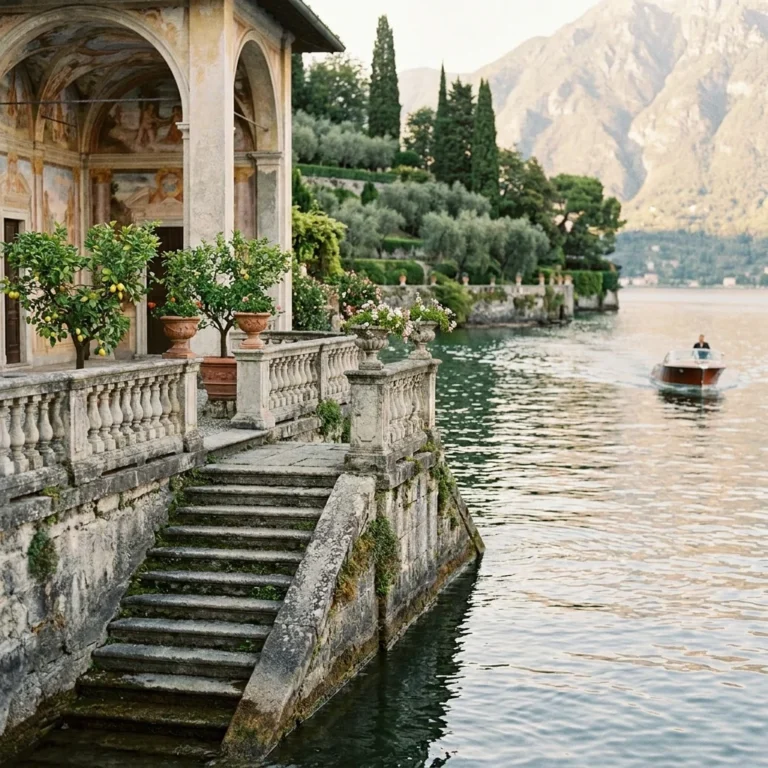
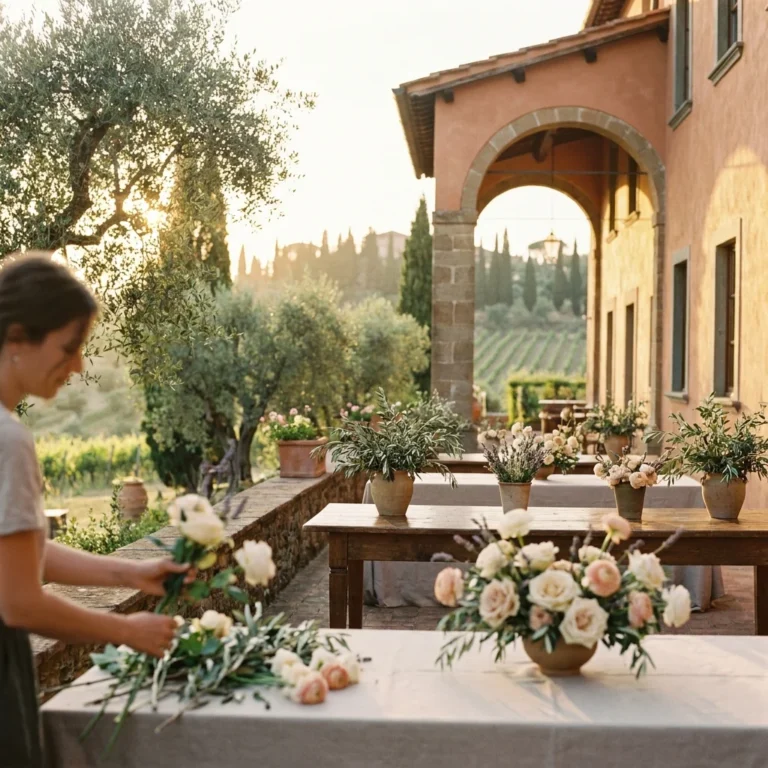
Lake Garda Wedding Flowers
The first written question most couples send us about Lake Garda is not about roses. It is this: will our flowers survive the afternoon? A fair question. Between late June and mid-August, the northern basin heats through the middle of the day and then, almost punctually, the Ora rises from the south around two o’clock and blows until early evening — the same thermal wind that made Torbole a sailing town. It is the single most under-discussed variable in floral design on this lake, and it decides more of the brief than any Pinterest board ever will.
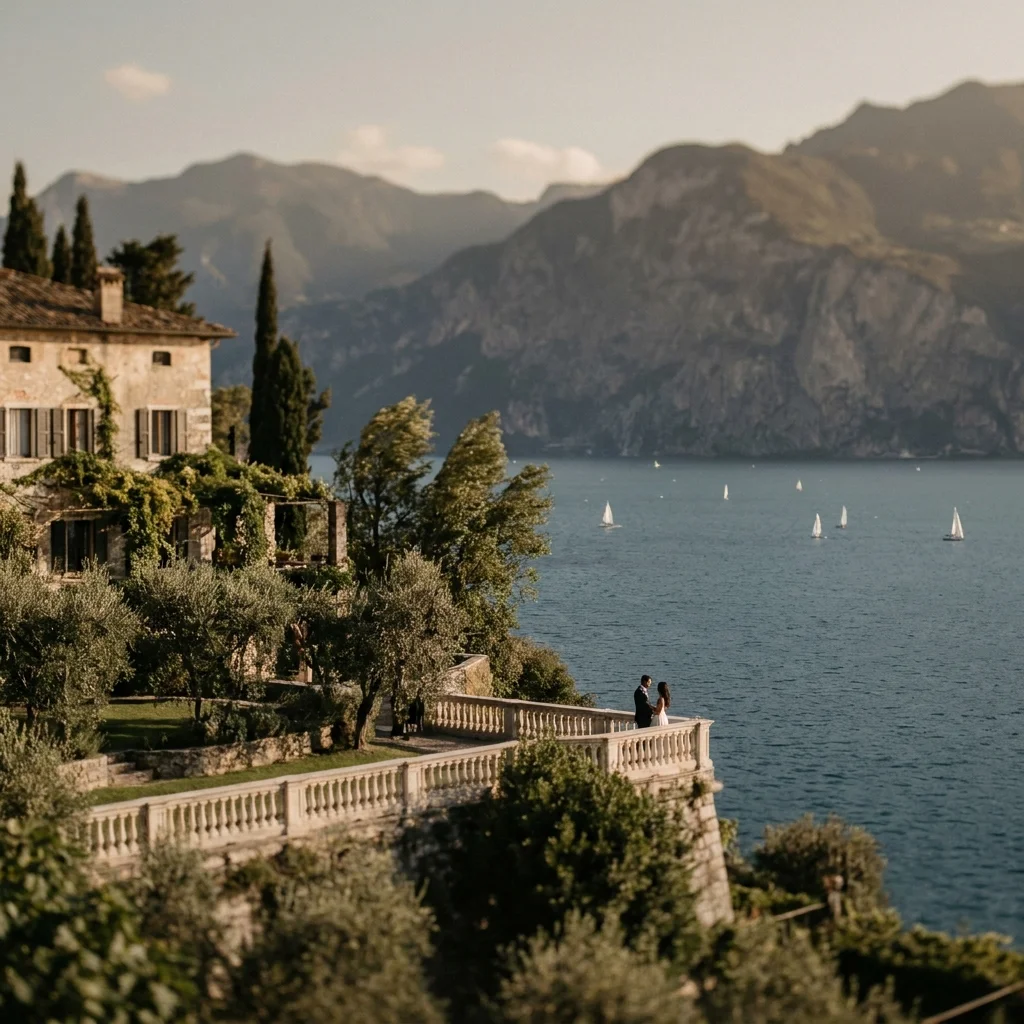
Lake Garda wedding flowers typically range from €4,500 for an intimate ceremony with personal flowers and a modest altar scheme, to €25,000–€45,000 for a full two-day celebration with a ceremony installation, suspended reception design, and lounge styling. The regional palette is Mediterranean rather than alpine: olive foliage, lemon from the historic limonaie of the western shore, oleander, lavender from the Valtenesi and Sirmione peninsula, rosemary, and garden roses grown in the Verona and Brescia provinces. At Kiss Me Italy we curate the design and manage the entire local production — access, installation windows, wind contingency, and strike.
Why the Garda Palette Begins with Olive and Lemon, Not Peonies
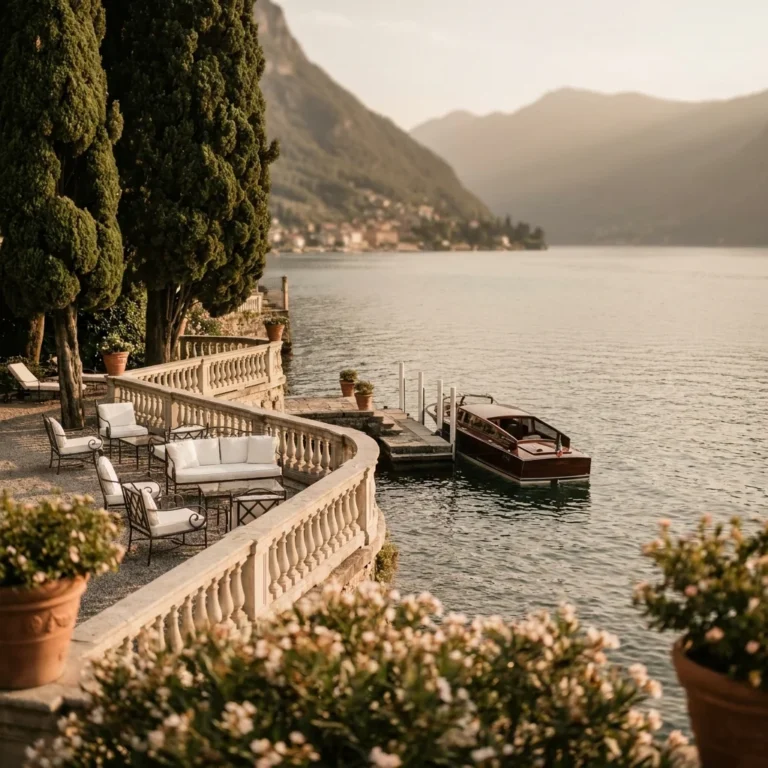
Garda is not Como and it is not Tuscany. The Venetian Republic governed this shoreline from 1405, and what the Serenissima left behind is not only architecture but agriculture: terraced olive groves on the Riviera degli Olivi, and from the seventeenth century onward the great stone limonaie of Limone and Gargnano — pillared lemon houses built to carry winter roofing over citrus that had no business growing this far north. That agricultural inheritance is the honest source of the local floral vocabulary.
So we build from it. Olive branch is the structural backbone of nearly every scheme we design here — silver-reverse leaves that read beautifully against pale limestone and hold their form for eleven or twelve hours without water. Lemon and small citrus enter as accent rather than theme, usually with fruit still attached. Oleander gives the pink-and-white register that grows along every lakeside promenade from Salò to Bardolino. Lavender arrives from the lower lake in late June and July.
Imported peonies and hydrangea are perfectly possible, and we source them when the design calls for them. But a bouquet assembled from what grows within forty kilometres photographs as though it belongs to the place — because it does. Couples who want the wider regional picture before narrowing the brief often begin with our overview of a wedding in Lake Garda, then return to floral direction once the venue is settled.
What Actually Blooms Here Between April and October
Garda’s growing calendar runs earlier than the Alps behind it and later than the Po plain below it, protected by the thermal mass of the water. April and early May bring ranunculus, anemone, the first garden roses, and wisteria on the older villa pergolas. Late May into June is the peak: peony from Lombard growers, sweet pea, jasmine, the full rose season.
July and August shift the register. Heat compresses the vase life of soft-headed blooms, so we lean toward lisianthus, dahlia, celosia, statice, and heavier foliage work. September is, from a floral standpoint, the most generous month on this lake — dahlias at their peak, late roses, the vineyard colour beginning to turn in the Bardolino hills. October gives amaranthus, chrysanthemum in its refined Italian forms, olive with fruit, and the first bronze foliage.
None of this is presented as a rule for you to apply. Our team handles the seasonal cross-check against your date, your ceremony hour, and your venue’s orientation, and we present two or three viable directions rather than an open catalogue.
Scaligero Stone, Eighteenth-Century Villas, and the Fixings Question Nobody Asks Early Enough
Venue architecture on Garda falls into three broad families, and each imposes a different floral grammar.
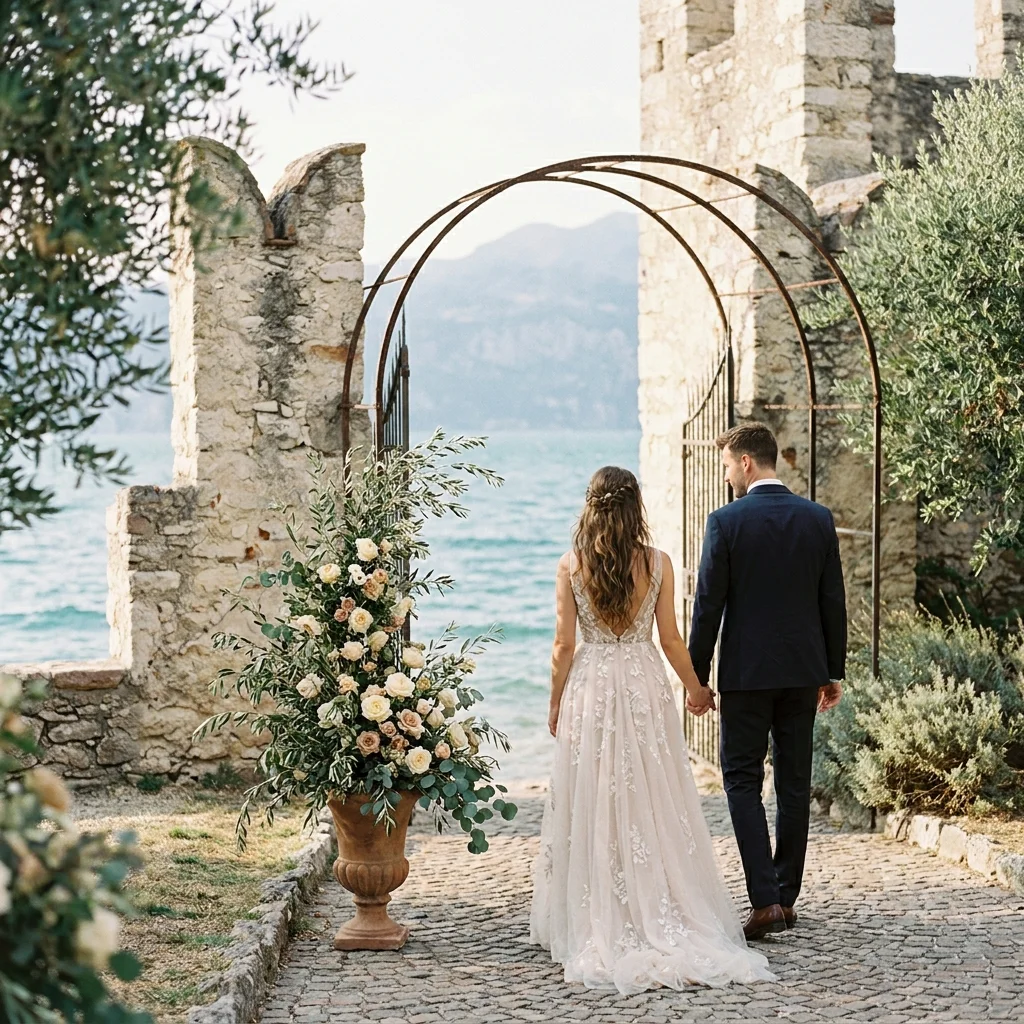
The medieval Scaligero fortifications — the thirteenth and fourteenth-century castles of the Veronese shore — are protected monuments. Nothing is drilled, bolted, or adhered to historic masonry. Design there is freestanding: weighted urns, ground-built arrangements, garland work tied to existing iron rather than stone. We confirm these conditions in writing with the relevant heritage office before a single sketch is approved, generally eight to ten months out.
The Venetian-style country villas of the hinterland are the most forgiving. Villa Cordevigo, an eighteenth-century estate set among the vineyards above Bardolino, offers a formal garden, interior halls, and courtyard geometry that accepts large-scale installation without heritage friction — and, critically, an installation window that begins the previous afternoon because the property is in exclusive use. That single fact changes what is buildable. A three-metre floral arch is a different proposition when the crew has fourteen hours instead of four.
Then there are the private lakefront properties we work with but do not name: a nineteenth-century villa on the Salò shore whose terrace sits four metres above open water on a stone balustrade, and a walled garden near Punta San Vigilio reachable only by a single-lane cypress avenue that will not admit a vehicle over 3.5 tonnes. Both are exquisite. Both require the floral build to be broken into hand-carried components. This is precisely the kind of constraint that a luxury wedding planner in Italy resolves months before it becomes visible to anyone.
The Ora del Garda: Wind, Shade, and the Four O’Clock Problem

This section is deliberately technical, because the physics are not negotiable.
The Ora is a southerly thermal wind that rises most afternoons from spring through early autumn, typically between 13:00 and 15:00, and can sustain 15–25 knots on the open water of the central lake. Freestanding arches above two metres are structurally reviewed, ballasted, and in some cases redesigned as two flanking columns rather than a single span. Suspended installations over an outdoor dinner are only specified where the venue offers genuine wind shelter or a covered structure.
Heat is the second variable. On a July afternoon the stone terraces of the eastern shore radiate long after the air has cooled. Personal flowers are therefore assembled in the morning, held in a refrigerated vehicle, and delivered to the getting-ready suite no more than ninety minutes before the ceremony. Ceremony work goes in last. Reception work goes in during the aperitivo, behind screening, with the crew off site before the first guest is seated.
We schedule ceremonies on the exposed shorelines after 17:00 from mid-June to late August. It is the simplest way to protect both the flowers and the guests.
A Short Note on Lemons
They are not a decorative cliché here. They are a survival story.
The lemon houses of the western shore were built by Franciscan-influenced growers who understood that a wall of stone pillars, roofed in winter and opened in summer, could carry citrus through a Prealpine January. Those pillars still stand above Limone and Gargnano, roofless, like the ruins of a theatre set. When we place citrus in a Garda tablescape, that is the reference. Not Sicily. Not Capri. Garda’s own eccentric, stubborn, four-hundred-year experiment in growing something that should not be here.
Where the Quote Actually Grows: Three Distinct Layers of Floral Work
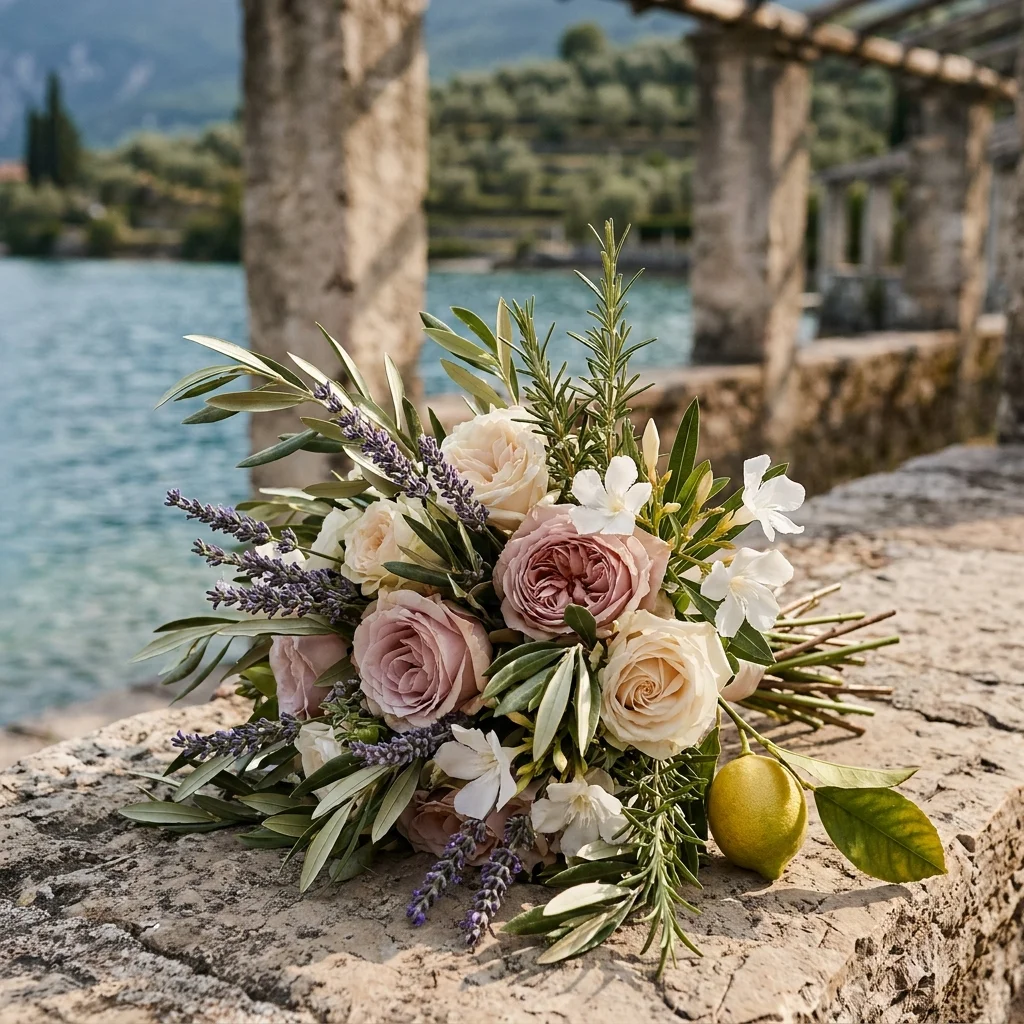
Couples often receive a single floral figure and cannot see inside it. We separate the brief into three layers, and we quote each independently, because they behave differently.
Personal flowers — bouquet, buttonholes, attendants, mothers, flower baskets — are labour-intensive but small in material volume. Cost here is driven by stem quality and handwork, not scale. Ceremony installation is where structure, engineering, and crew hours enter: an arch, an altar scheme, aisle markers, a chapel dressing. Reception styling is the largest and most variable layer, because it multiplies by table count and rises steeply with elevation, candlelight integration, and hired vessels.
Design complexity, not flower count, is what moves a Garda floral budget from €8,000 to €30,000. A single dramatic ceremony gesture with restrained tables often costs less and photographs better than uniformly ambitious styling everywhere. That is a judgement we make together, and it is one of the reasons couples reviewing how much a wedding in Italy costs find floral figures so hard to compare between regions.
Lake Garda Wedding Flower Costs: Current Planning Ranges
The ranges below are indicative planning figures for floral and production work in the Lake Garda area. They are not fixed quotations: every scheme is re-priced against the approved design, venue, access requirements, season and installation schedule before booking.
Our Lake Garda Collection
| Collection | Published collection price | Included | Quoted separately |
|---|---|---|---|
| The Cordevigo Estate Wedding — Lake Garda | €109,000 | Villa Cordevigo in exclusive use across two days; 41 rooms for guests for two nights with breakfast; pre-wedding day with dinner; wedding day with ceremony setting, aperitivo, reception and wedding dinner; full planning and on-site direction by the Kiss Me Italy team, according to the collection specification | Only items outside the published collection specification, including bespoke floral additions beyond the selected scope, additional guest travel or transfers, legal or municipal fees, additional event days, albums or other specifically commissioned upgrades |
€109,000 is the Kiss Me Italy collection price stated for the linked Villa Cordevigo product in this guide. The linked product page and final written proposal govern the current guest configuration, exact inclusions, availability, bespoke floral scope and applicable tax treatment before booking.
Personal Flowers and Ceremony Work
| Element | Indicative range | Included | Quoted separately |
|---|---|---|---|
| Bridal bouquet (garden roses, seasonal focal stems, olive foliage) | €190–€480 | Design consultation, conditioning, hand-tie, ribbon finish, morning delivery within the province | Rare or imported focal varieties; preservation service; VAT 22% |
| Groom’s buttonhole / attendants’ buttonholes | €18–€40 each | Matching stem selection, pin fitting | Not applicable |
| Attendants’ bouquets | €95–€190 each | Scaled-down design in the same palette | VAT 22% |
| Mothers’ posies, corsages, flower-child basket | €45–€130 each | Delivery to a single getting-ready address | Second delivery address on the opposite shore |
| Aisle markers (per pair, pew or chair) | €45–€130 | Fitting and removal | Hired lanterns or stands |
| Altar or chapel scheme | €380–€1,400 | Two arrangements, installation, removal | Church donation or sacristy fee |
| Ceremony arch, columns or pergola dressing | €1,400–€5,200 | Structure hire, floral build, ballasting, wind review, crew, strike | Municipal permit for public or shoreline ceremony sites (indicative €150–€600); VAT 22% |
Indicative ranges. Contact Kiss Me Italy for a personalized proposal.
Reception Styling, Access and Production
| Element | Indicative range | Included | Quoted separately |
|---|---|---|---|
| Low guest-table centrepieces | €130–€330 per table | Vessel hire, flowers, placement, collection | Candles, linen, glassware |
| Elevated or candelabra table design | €290–€680 per table | Structure and vessel hire, floral work, placement | Taper candles and hurricanes; breakage |
| Long or serpentine table floral runner | €180–€340 per linear metre | Continuous foliage-and-bloom build, installation | Table hire and shaping; VAT 22% |
| Aperitivo bar, lounge and entrance styling | €450–€1,800 | Design, materials, installation | Furniture hire |
| Suspended or overhead installation (sheltered spaces only) | €2,800–€9,500 | Rigging assessment, build, crew, dismantle | Venue rigging authorisation; additional insurance |
| Delivery, installation crew and same-night strike | €400–€1,600 | Crew hours within the standard installation window; removal of all hired items | Overnight strike where the venue requires clearance before 08:00 |
| Florist travel and access surcharge | €0–€900 | Travel within Verona and Brescia provinces included | Boat transfer for island venues such as Isola del Garda; ferry-dependent upper-lake access; crew accommodation for two-day builds |
Indicative ranges. Contact Kiss Me Italy for a personalized proposal. VAT (IVA 22%) applies to all Italian floral supply unless stated otherwise in the written quotation.
Every figure above is presented so you can see what sits inside it. When you are ready to translate a mood into a costed scheme, our team will prepare a floral proposal built on your date and venue.
Moving Flowers from Ceremony to Dinner: A Design Decision, Not an Economy
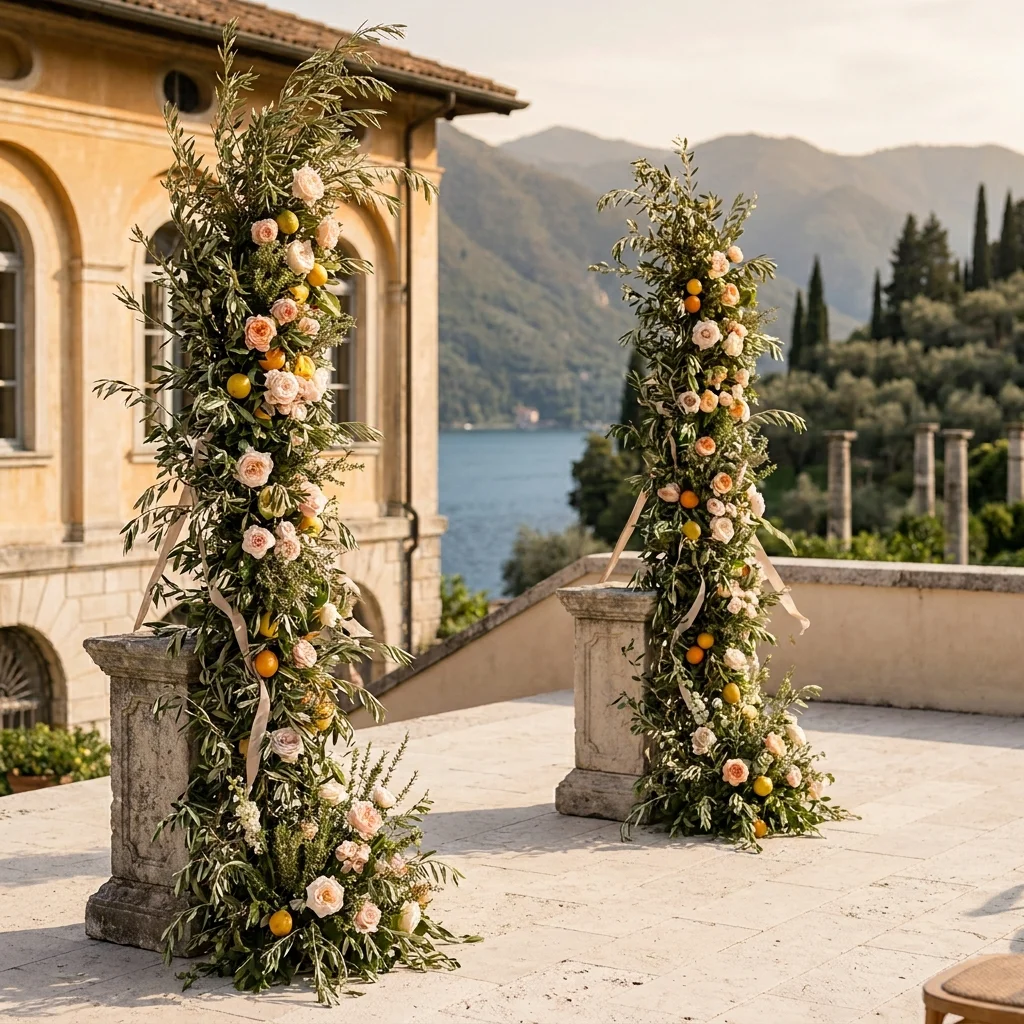
Repurposing is frequently sold as a saving. We treat it as a scenographic choice with a clock attached.
If a ceremony arch is to reappear behind the top table, it must be designed from the outset as two transportable halves, and the crew needs a defined thirty-to-fifty-minute window while guests are held at aperitivo elsewhere on the property. That window has to exist in the timeline before the design is approved, not after. On estates in exclusive use it is straightforward. On a public-access shoreline with a fixed municipal ceremony slot, it frequently is not.
We also manage the reverse decision. Sometimes the most elegant outcome is that the ceremony flowers stay exactly where they are, because guests will pass them again on the way to the cars at midnight, lit differently, and that second encounter is worth more than the material recovered. Our team handles the strike, the collection of hired vessels, and the disposition of the remaining blooms — most often distributed to guests at departure or delivered the following morning to the villa breakfast tables, which is a detail our clients staying at a wedding venue with accommodation tend to remember fondly.
How the Floral Scheme Talks to the Table, the Menu and the Camera
Flowers are one instrument in the scenography, never the whole score. We align the palette with three other things.
The table first: vessel height, candle temperature, linen tone, and sightlines across a long table are agreed with the floral studio in the same meeting, because a centrepiece specified in isolation is the commonest cause of a table that looks crowded in photographs and cramped in life.
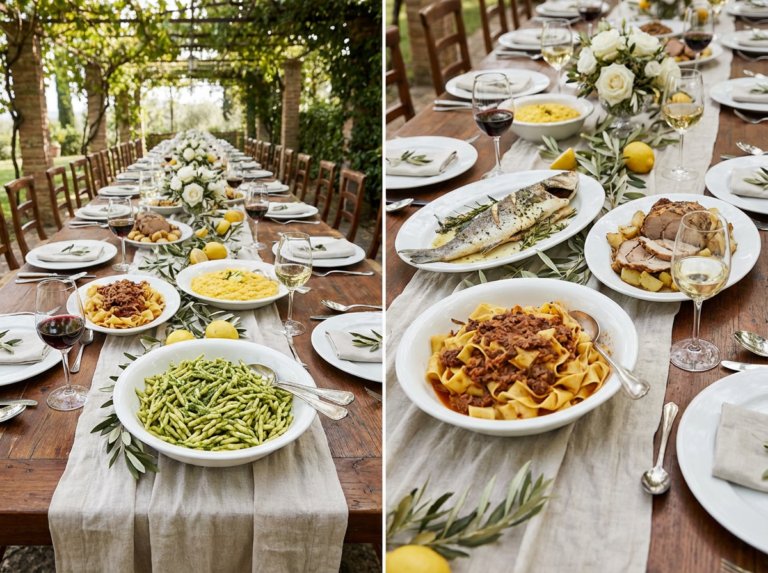
The menu second. Garda cooking is lake-and-hill rather than coastal — whitefish, olive oil from the Riviera degli Olivi, Bardolino and Lugana in the glasses — and a citrus-and-herb floral register sits naturally alongside it. Couples shaping this dialogue often start from our regional Italian wedding menu ideas before finalising the palette.
The camera third. Olive foliage reads silver in the horizontal light after 18:30 on the eastern shore and green at midday; oleander pink turns hot under direct sun and softens completely in shade. We share the approved palette with the wedding photographer weeks in advance so the detail styling, the bouquet portraits, and the reception coverage are planned around the actual materials rather than discovered on the day.
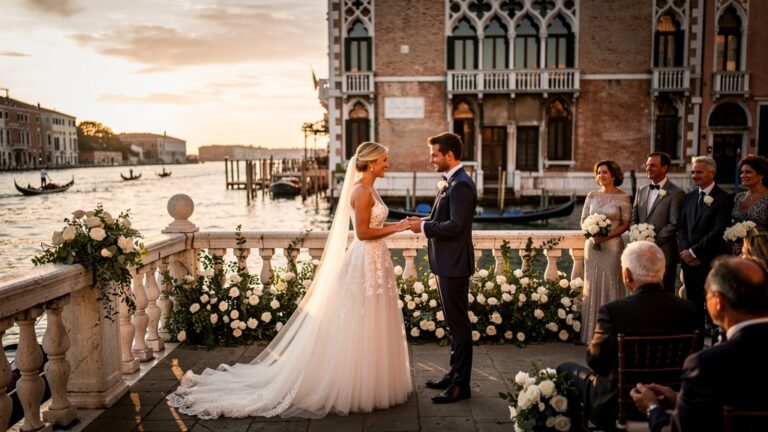
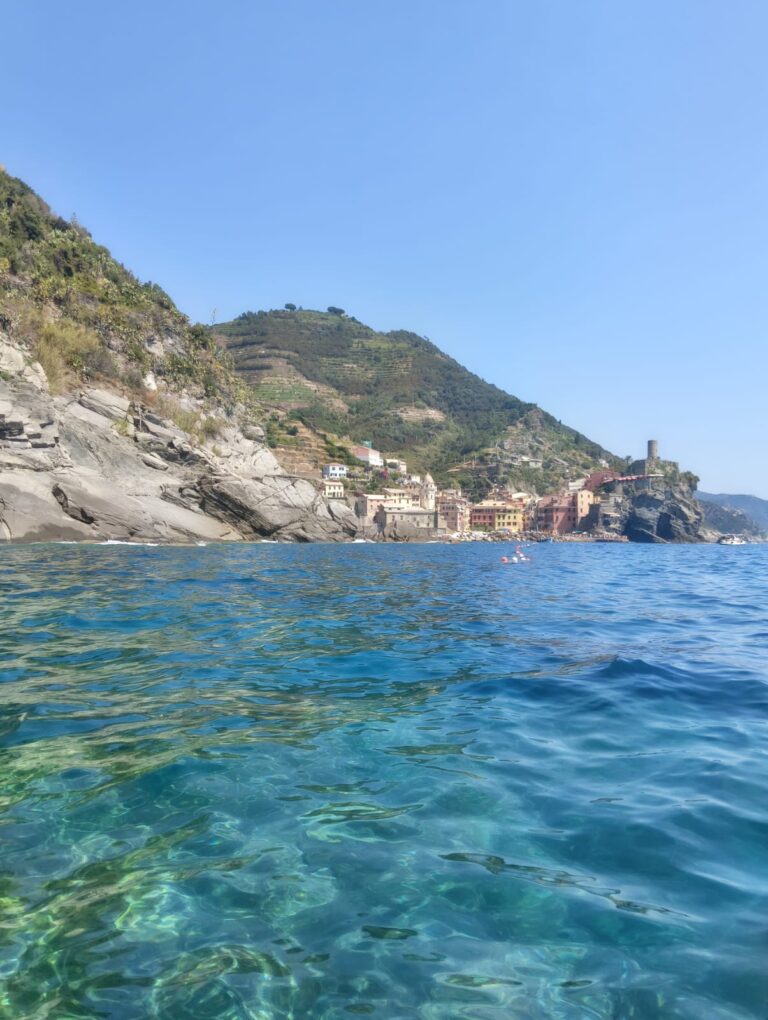
For couples comparing Italian regions, the difference is real: our approach to Italian Riviera wedding flowers leans coastal and salt-tolerant, Tuscany wedding flowers lean agricultural and earthbound, and Venice wedding flowers answer to interiors and water transport. Garda sits between them, and that in-betweenness is exactly its character.
Curated Design, Managed Production
A floral scheme on this lake succeeds when nobody notices the machinery behind it: the refrigerated van at nine in the morning, the wind assessment signed off in August, the heritage office correspondence from the previous winter, the crew that vanished before the aperitivo. We curate the design and we manage the production — florist selection, access negotiation, installation windows, contingency, strike, and the transfer of every hired vessel back to the studio.
Couples planning a longer celebration on this shoreline, or a vow renewal on Lake Garda, are welcome to bring us a single photograph and no further certainty. That is usually enough for us to begin. When the moment feels right, we would be glad to hear what you are imagining, and we will answer with a scheme, a timeline, and a costed proposal.
Questions Couples Ask Before They Commission a Floral Scheme
Can our florist accommodate a cultural flower tradition that requires a specific stem or colour?
Yes, and we treat it as a fixed point in the brief rather than an adjustment. Specific stems, colours, or symbolic quantities — jasmine garlands, red-only palettes, particular numbers of blooms — are declared to the studio at the design stage so sourcing is confirmed with growers before the palette is finalised. Where a variety is not cultivated in northern Italy, we identify the closest botanical equivalent and present both options for approval.
Every approved scheme carries a written substitution protocol agreed with you in advance, naming the accepted alternatives by variety and tone. Our team is notified by the studio at the point of market purchase, usually two to three days before, and the substitution is applied without any decision required from you. In practice this affects a single focal variety, never the overall design.
Do you offer sustainable or locally-grown-only floral options for couples who want a lower environmental footprint?
Yes. We can commission a scheme built entirely from stems grown within the Verona and Brescia provinces, using seasonal availability rather than a fixed wish list, and we avoid single-use floral foam in favour of reusable mechanics and natural binding. This tends to shift the palette toward what is genuinely in bloom that week, which most couples find gives the design more character rather than less.
How are floral plans adjusted if an outdoor ceremony moves indoors because of weather?
The wet-weather floral plan is designed alongside the primary plan and priced within the same quotation, so no new cost appears on the day. Freestanding arrangements are specified to work in both settings, and the installation crew holds a decision deadline — normally the morning of the wedding — set by our team in agreement with the venue. You are informed of the outcome, not asked to make the call.
Can our Lake Garda wedding flowers be preserved or transported home after the celebration?
Bouquet preservation through pressing or resin is available via specialist ateliers in Verona, with the piece dispatched internationally two to four months later; it is quoted separately from the floral supply. Transporting fresh flowers across borders is subject to phytosanitary restrictions and we generally advise against it. Most couples choose preservation of the bridal bouquet only.
Will the florist coordinate directly with a photographer or videographer for detail styling?
Coordination runs through our production schedule rather than between suppliers directly, which prevents overlapping requests during the tightest hours. We reserve a fifteen-minute styling slot after the reception installation is complete and before guests enter, giving the photography team clean access to the finished tables. Loose stems are left on site specifically for flat-lay and detail work.
Can we add floral pieces after the final guest count has been confirmed?
Additions are accepted up to roughly ten days before the wedding, which is the studio’s market-order deadline for imported and specialty stems. Beyond that point we can still add locally available foliage work, candles, and vessels. Reductions after the same deadline are not refundable, as the material has already been purchased.
Can the floral design incorporate specific religious or cultural ceremony requirements, such as a chuppah, mandap, or Orthodox crowning table?
Yes. These structures are engineered and floral-dressed according to the liturgical specifications you provide, and we consult with your officiant or family elders where a particular orientation, material, or symbolic flower is required. Because these installations often have their own structural rules independent of venue architecture, we confirm the design with the relevant religious authority before production begins.
Can a florist work alongside a designer or planner brought from our home country?
Frequently, yes. In that arrangement your designer holds the creative direction and our team manages Italian execution: supplier contracting, heritage and venue authorisations, installation scheduling, crew, and strike. We ask that the division of responsibility be agreed in writing at the outset so that on-site decisions have a single, clear line of authority.