Tuscany Wedding Castle: A Luxury Planning Guide for Discreet International Couples
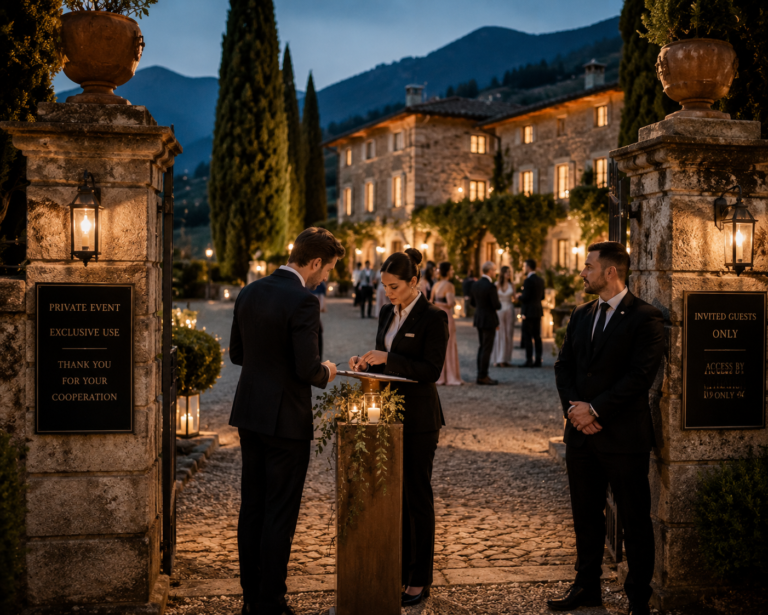
The first question our high-profile couples ask is rarely about flowers or menus. It is about sightlines. Who can see into the courtyard during the ceremony? Can a long lens reach the loggia from the public road below? A historic castle is romantic precisely because it sits above the landscape — and that same elevation is what makes access control the first conversation we have, not the last. Related guide: castle wedding in Italy.
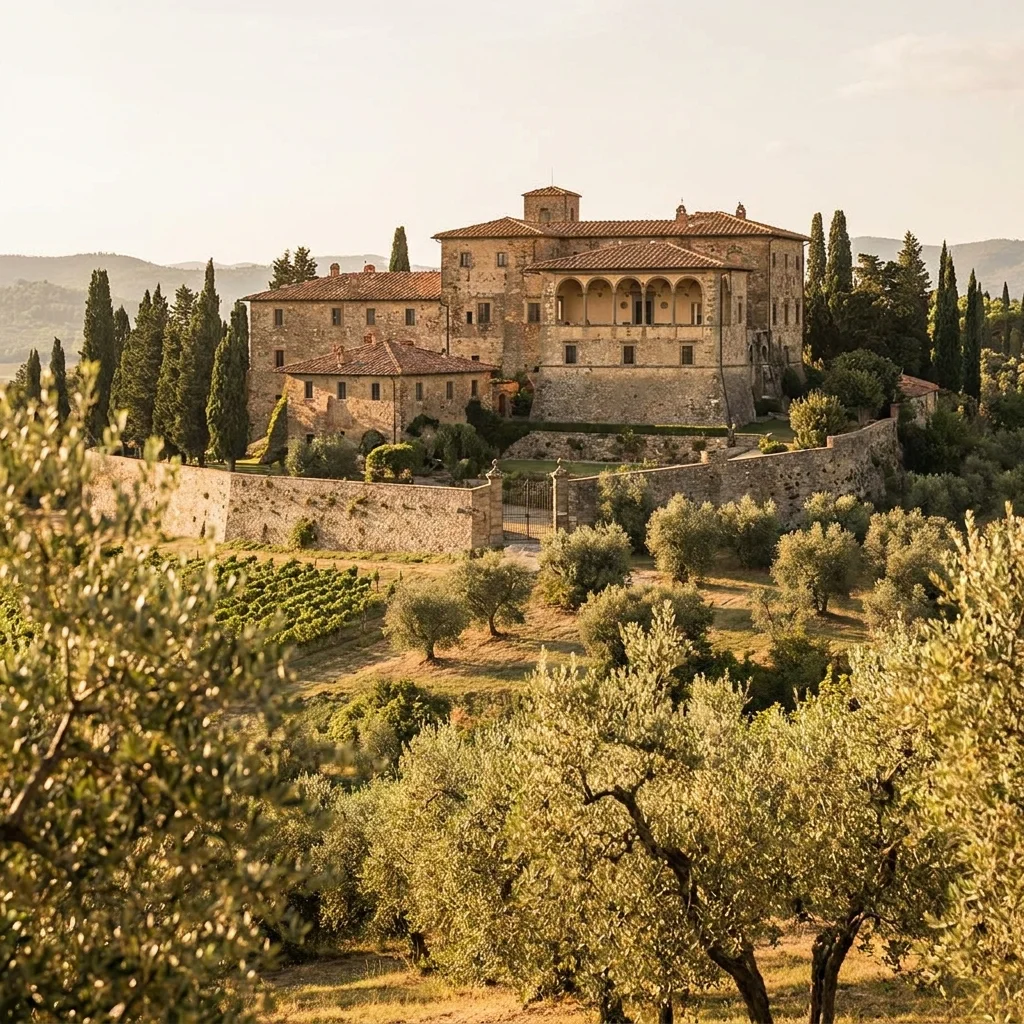
A tuscany wedding castle celebration typically ranges from €80,000 to €350,000 for 60 to 120 guests, depending on the property, the season, and the level of exclusive-use protection required. The most sought-after settings are restored medieval fortresses and Renaissance estates across Chianti, Val d’Orcia, and the hills near Siena, each offering private grounds, on-site accommodation, and the seclusion that high-net-worth couples quietly require. Kiss Me Italy curates these venues end to end — from first shortlist to the moment the last guest departs unobserved.
What “Exclusive-Use” Actually Means Inside a Tuscan Castle
The word appears in every brochure. Its meaning varies enormously. Some properties define exclusive-use as the reception spaces only — leaving an adjacent agriturismo, a working cellar, or a public chapel still operating during your weekend.
We negotiate something stricter. For a Tuscany castle wedding at the level our clients expect, exclusive-use means the entire estate — gates, drive, gardens, towers, and guest suites — under your control from check-in to checkout, with no other booking permitted on the property. That distinction is what separates a genuinely protected celebration from a beautiful venue shared with strangers.
The contracts that achieve this are not standard. They specify staff access points, delivery windows, and the precise hours during which the road below the property is monitored. Our team handles that language directly with estate owners, many of whom we have worked alongside for years. If you would like to understand how exclusive-use is structured for your specific guest count, our team is available for a confidential conversation.
Chianti: Vineyard Castles Where Access Roads Are the Real Privacy Question
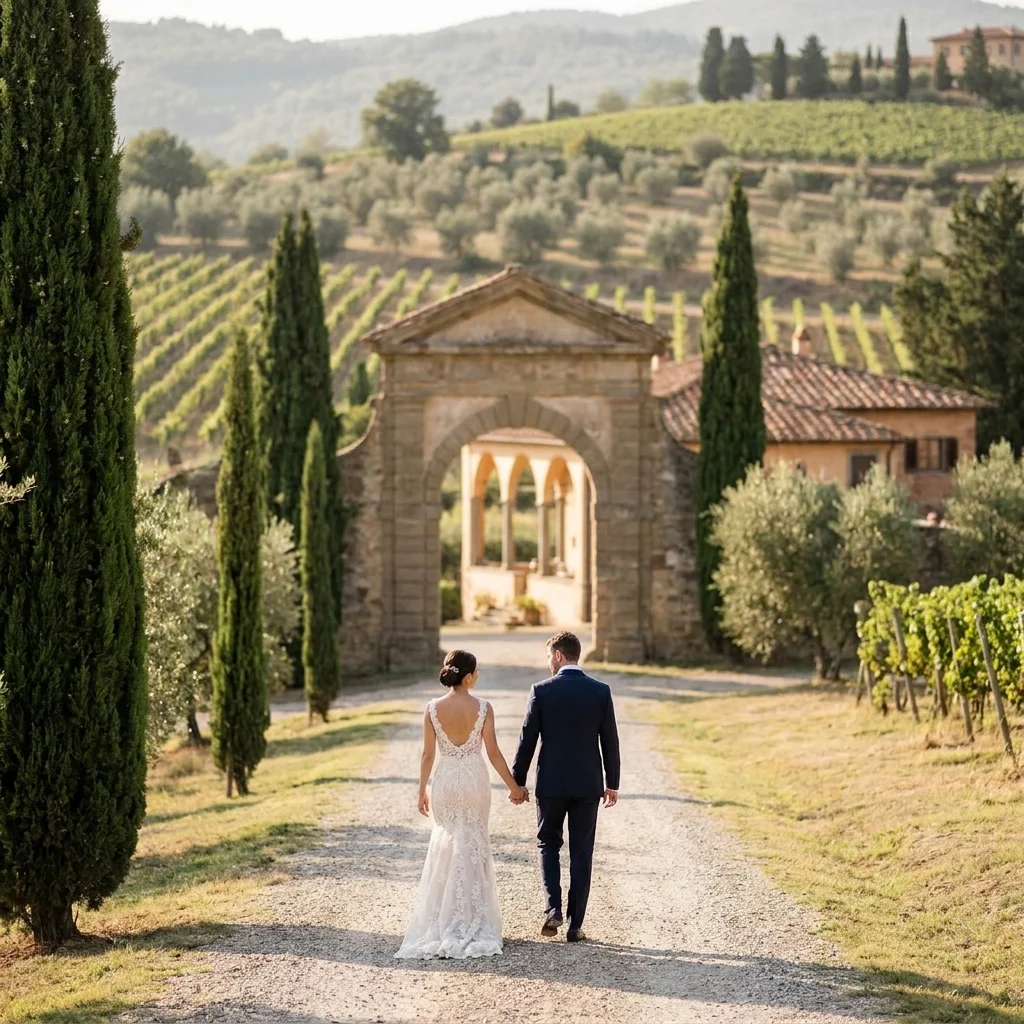
Chianti is the region most couples picture first. Stone towers above ordered rows of Sangiovese. Cypress-lined drives. Cellars that have produced wine for five centuries.
The romance is real. So is the logistical detail few discuss: many Chianti castles sit on shared agricultural lanes, and a wedding that does not control its access road invites passing attention during the most private hours. We address this at the shortlist stage. For each estate, we map the approach, identify where guest vehicles transition to private ground, and arrange discreet checkpoints so that arrivals remain unseen from the surrounding hills.
A Chianti Tuscan castle wedding venue pairs naturally with the surrounding vineyards, and couples who want the cellar woven into the celebration will find our guidance on a vineyard wedding in Italy a useful complement. The wine here is not a backdrop. It is part of the estate’s identity — and we coordinate tastings, cellar dinners, and the guest list protocol that keeps the experience intimate.
Val d’Orcia: Why Isolation Is the Asset, and What It Costs Logistically
If Chianti is intimate, Val d’Orcia is remote. The UNESCO valley south of Siena offers castles set in near-total isolation — no neighbouring property within sightline, no road overlooking the terrace. For couples who require absolute discretion, this is the most naturally protected setting in Tuscany.
That isolation has a price, and it is operational rather than financial. Catering must often be staged from a temporary kitchen. Guest accommodation is finite, so larger parties stay in curated estates nearby with managed transfers. Suppliers travel further, and timing windows tighten accordingly.
We treat these constraints as design parameters, not obstacles. Our team coordinates the entire supplier convoy — florists, kitchen brigade, production, musicians — so that everything arrives, installs, and departs within agreed hours, leaving the valley quiet again by morning. The result is a celebration that feels effortless precisely because the complexity is met with irreplaceable expertise, invisibly applied. To explore which Val d’Orcia estates suit your party size, we welcome you to begin a private discussion with us.
The Hills Around Siena: Renaissance Estates and the Guest List Protocols That Protect Them
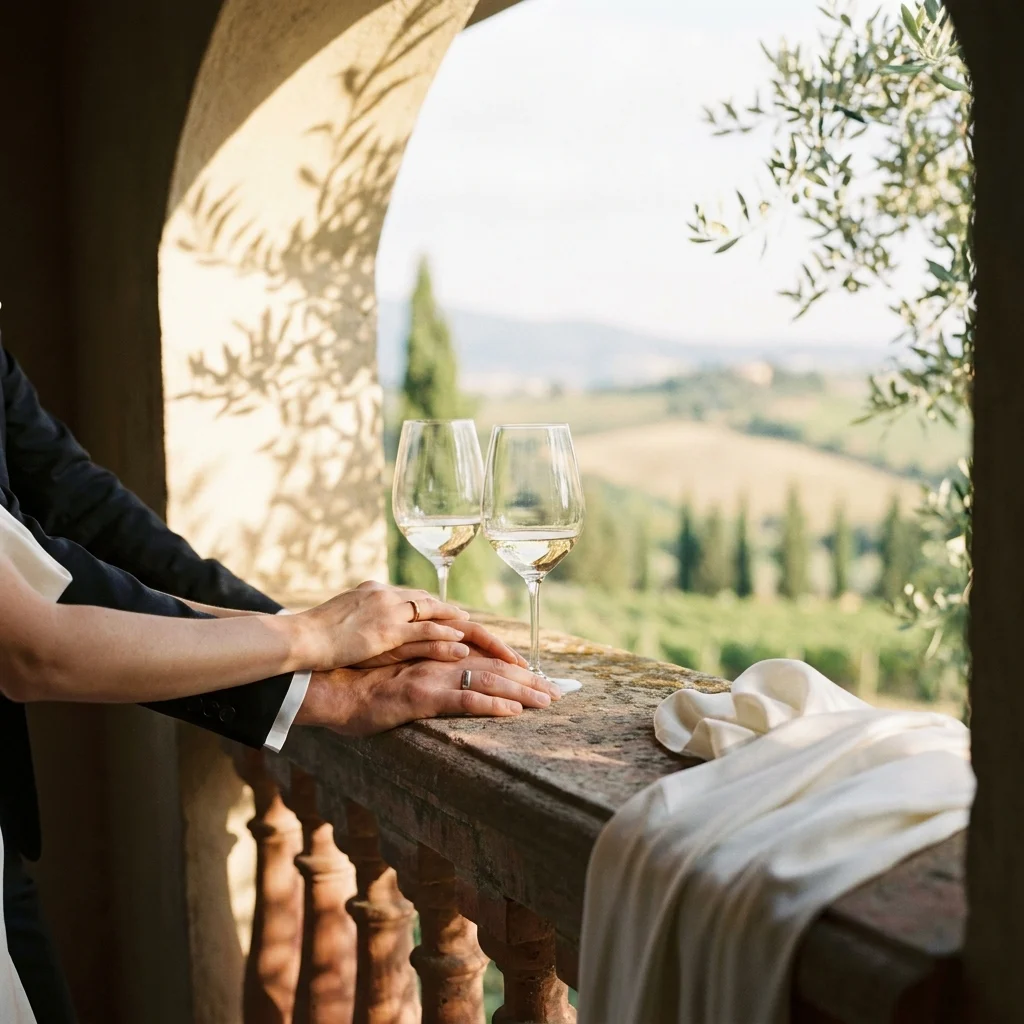
Between Siena and the southern valleys lie a number of restored Renaissance estates — grand fortified villas with frescoed halls, private chapels, and walled gardens. These properties suit couples who want architectural gravitas without the medieval austerity of a pure fortress.
Here, the privacy challenge shifts from geography to people. A frescoed hall photographs beautifully, and that is exactly why confidential events in such settings require a clear protocol on who carries a phone, who shares images, and when. Our discretion framework includes signed guest understandings where appropriate, a no-social-media window around the ceremony, and a single authorised image stream managed by our team.
For high-profile couples, this is not optional refinement. It is the difference between a private memory and an exposed one. We curate the guest experience so that warmth and access control coexist — guests feel welcomed, never policed, while the celebration stays exactly as private as you intend. Couples planning the full estate experience often find our overview of wedding venues in Tuscany the right place to see how each sub-region compares.
Castles Near Florence: Proximity to the Airport Versus Proximity to Attention
Some couples prioritise access. Castles in the hills around Florence offer a compelling balance — frescoed interiors, panoramic terraces, and a transfer time to the airport measured in well under an hour.
The trade-off is honest. Estates closer to the city sit nearer to roads, to neighbouring villas, to the ordinary movement of the valley. We manage this with timing rather than compromise: ceremonies positioned for the hours when the surrounding area is quietest, and arrival sequencing that keeps guest movement contained.
For couples who want to extend their stay into the art city itself — privately, with managed arrivals — our team coordinates that layer too, and the broader picture of a destination wedding in Florence shows how castle and city can be woven into one seamless weekend. A luxury wedding in Tuscany near Florence is the choice for couples who want their international guests to arrive with ease and still leave without a trace.
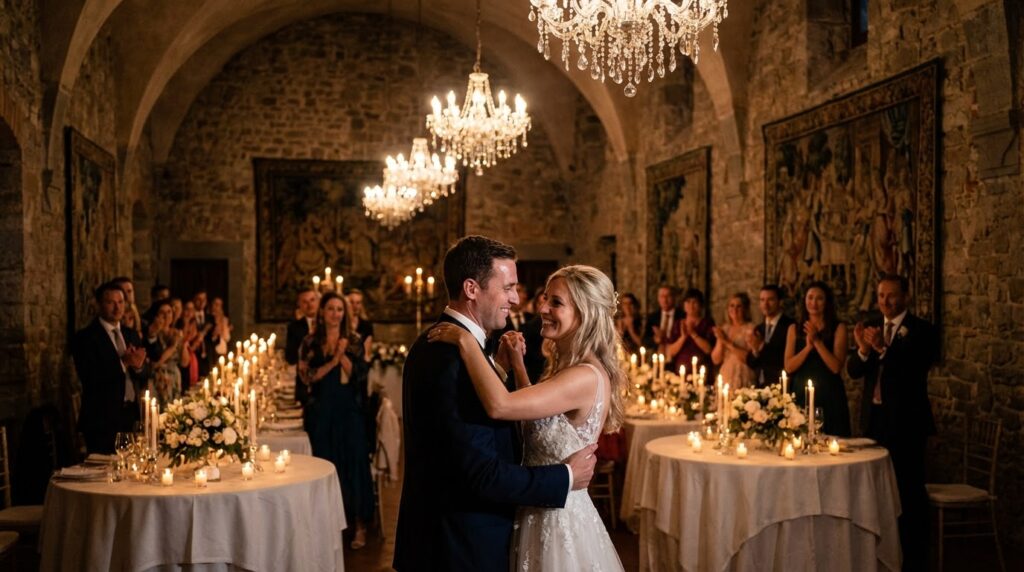
The Operational Reality: Curfews, Catering Exclusivity, and Weather Contingency
The operational reality deserves absolute clarity. A castle is a protected historic structure, and that status governs what is possible inside it.
Most properties impose a music curfew — frequently 11pm for amplified sound outdoors, later for acoustic performance or interior receptions. Many enforce catering exclusivity, meaning your menu is delivered through an approved kitchen rather than a supplier of free choice. Open flame, confetti, and certain installations are restricted to preserve frescoes and stonework. Guest accommodation on-site is finite — a typical estate sleeps 20 to 40, with the remainder placed in curated properties nearby.
None of this limits the celebration. It shapes it. We hold the curfew calendar, the catering agreements, and the wet-weather plan as a single coordinated structure, so that a sudden afternoon storm in Val d’Orcia triggers a pre-rehearsed move indoors rather than improvisation. Our approach to guest shuttle logistics ensures off-site accommodation never becomes a guest’s problem. The constraints exist. We simply absorb them on your behalf.
Civil, Symbolic, or Religious: Which Ceremony a Castle Can Legally Host
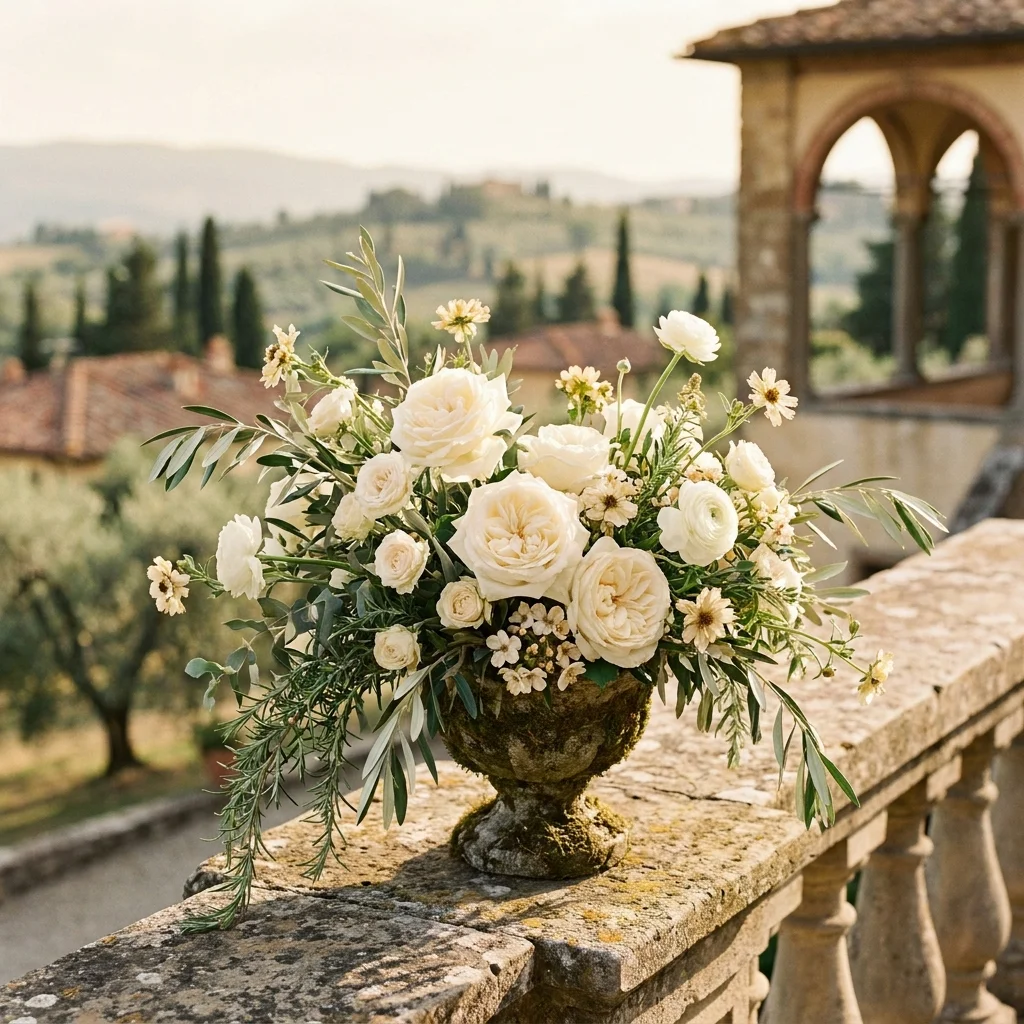
Not every castle is licensed for a legally binding civil ceremony. Some hold the authorisation to host a civil rite on the grounds; others are suited to a symbolic ceremony, with the legal formalities completed discreetly elsewhere. Many estates with a private chapel can arrange a Catholic or other religious service subject to ecclesiastical approval.
For international couples, this distinction matters before the venue is chosen, not after. We clarify it early. Our guidance on the ceremony types available in Italy and on marrying in Italy as a foreigner explains the documentation involved, while our team manages the confidential paperwork — translations, apostilles, registrar appointments — so that none of it intrudes on your weekend. The right officiant for the ceremony is selected to match your language and tone.
Tuscany Wedding Castle Costs: Structured Ranges, Clearly Qualified
Castle pricing is rarely a single figure. It is a venue fee, a per-guest catering structure, a production layer, and a set of clearly separate costs. Below are indicative ranges from current planning records, with inclusions and exclusions stated explicitly.
| Venue Type | Exclusive-Use Fee (2-3 days) | Typical Capacity |
|---|---|---|
| Restored medieval fortress, Chianti | €18,000–€40,000 | 80–130 seated |
| Isolated castle estate, Val d’Orcia | €22,000–€55,000 | 60–100 seated |
| Renaissance estate near Siena | €20,000–€48,000 | 90–150 seated |
| Frescoed castle near Florence | €25,000–€60,000 | 70–120 seated |
Venue fees include exclusive grounds access and on-site suites where available. Catering, production, permits, and VAT (IVA 22%) are quoted separately. Indicative ranges. Contact Kiss Me Italy for a personalized proposal.
| Service Element | Indicative Range | What Is Included / Separate |
|---|---|---|
| Catering (per guest) | €220–€420 | Includes menu, service staff, tableware; wine pairing and late-night service quoted separately |
| Floral & tablescape design | €18,000–€60,000 | Includes design, installation, removal; rare specimen flowers quoted separately |
| Wedding photographer | €5,500–€11,000 | Full multi-day coverage, single shooter, travel within Tuscany included; second shooter, albums, and post-production delivery quoted separately |
| Music & production | €12,000–€45,000 | Includes sound, lighting, stage; opera or string ensembles quoted separately |
Ranges exclude VAT (IVA 22%), travel costs for suppliers outside Tuscany, and overtime beyond agreed hours, all of which are quoted separately. Accommodation for suppliers and any specialist permits required for outdoor production are also quoted independently. Indicative ranges. Contact Kiss Me Italy for a personalized proposal.
| Privacy & Coordination Layer | Indicative Range | Notes |
|---|---|---|
| Full planning & design | 12–18% of total | End-to-end curation from shortlist to departure |
| Access control & discretion management | €6,000–€20,000 | Checkpoints, image protocol, guest list protection; on-site personnel quoted separately |
| Legal & permit handling | €2,500–€6,000 | Documentation, registrar fees, translations; apostille fees quoted separately |
Planning and coordination fees are calculated on total event spend and exclude VAT (IVA 22%). Legal and permit handling ranges exclude apostille fees and any consular charges applicable to your country of residence. Accommodation, travel, and overtime for coordination personnel are quoted separately where required. Indicative ranges. Contact Kiss Me Italy for a personalized proposal. For a broader view of how these figures assemble, our guide to what a Tuscany wedding typically costs offers further context.
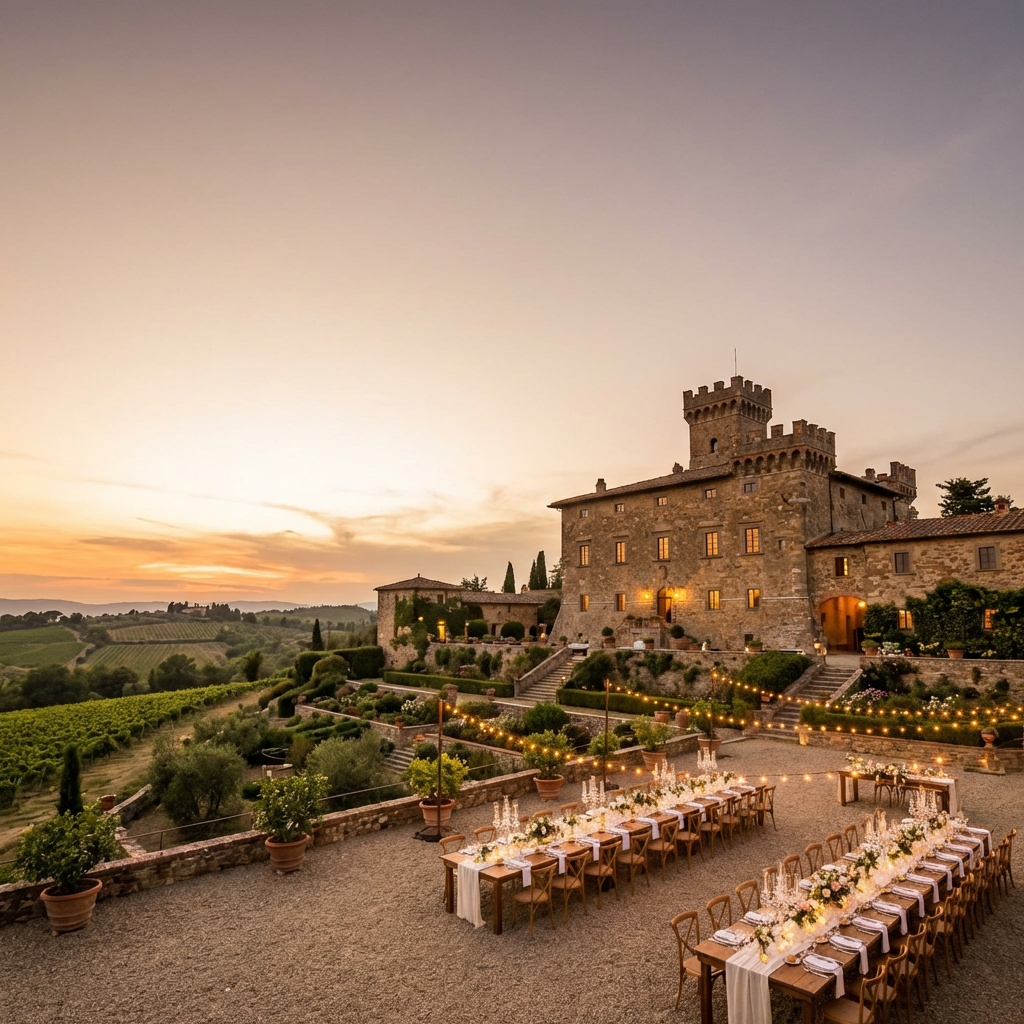
Why a Castle Demands a Planner Who Thinks About Departures, Not Just Arrivals
Most planning attention goes to the ceremony and the first dance. We think equally about the hours nobody photographs. How does a public figure leave the estate at 1am without being seen from the road? Where do supplier vehicles stage so they never cross guest sightlines? Who holds the only authorised image set after the weekend ends?
This is the work other teams overlook, and it is the work our high-profile clients value most. Our credentials and approach are described on our team page, and the philosophy behind a quietly luxurious celebration runs through our work on the old money wedding in Italy. A castle is irreplaceable as a setting. The protection around it is what makes it usable for couples who cannot afford exposure.
For couples comparing planning teams, our perspective on what the best wedding planners in Italy actually deliver may help clarify the standard you should expect. And for those who want the wider regional picture, our guide to a luxury wedding across Tuscany and Versilia sets the castle within its landscape.
An exclusive castle wedding in Italy is one of the most beautiful things we curate. It is also one of the most demanding. We carry that demand so that you experience only the celebration.
If you are considering a castle celebration where privacy is as important as beauty, Kiss Me Italy can prepare a confidential shortlist tailored to your guest count, security profile, and preferred region.
Frequently Asked Questions
What is the minimum number of nights required for exclusive-use at most Tuscan castles?
Most estates require a minimum of two consecutive nights for exclusive-use bookings, and the most sought-after properties in peak season often require three. This minimum protects the estate’s operational rhythm and ensures your privacy framework — checkpoints, image protocol, supplier windows — can be properly installed and removed without overlap with another booking. We negotiate minimum-night terms as part of the initial contract discussion, before any deposit is placed.
How do you handle guest security screening without making guests feel unwelcome?
Discreetly and by design. For high-profile celebrations, we integrate a light verification step into the arrival sequence — typically a named guest list confirmed at the estate gate — so that the checkpoint feels like a warm welcome rather than a security measure. Where a more formal screening is required, we brief the relevant personnel on tone and positioning so that the experience remains gracious. Guests are never made to feel scrutinised; they are made to feel expected.
Are there options for late-night indoor music beyond the outdoor curfew?
Yes, and this is one of the most useful questions to ask early. Many castles that impose an 11pm outdoor amplified sound curfew permit acoustic performance or lower-volume amplified music inside vaulted halls or cellars well beyond midnight. Some estates have a dedicated indoor space — a cantina, a frescoed salon, or a tower room — that is acoustically contained and exempt from the outdoor restriction. We map these options for each property before it enters your shortlist, so the evening programme is never constrained by a curfew you discover after signing.
How do you manage children and multi-generational family logistics at a castle?
Thoughtfully and in advance. Castles with uneven stone floors, open terraces, and historic staircases require a considered layout for younger guests and elderly family members. We identify accessible routes, designate a quiet family space away from the main reception, and coordinate any childcare or supervision arrangements as part of the wider guest experience plan. For multi-generational parties, we also ensure that on-site suite allocation prioritises those who benefit most from proximity, with off-site accommodation reserved for guests who are more mobile.
What happens if the on-site accommodation does not cover all our closest guests?
We treat overflow accommodation as an extension of the estate, not a compromise. When on-site suites are insufficient for the inner circle, we identify a single curated property nearby — a private villa or small boutique hotel — reserved exclusively for your party, with managed transfers running on a discreet schedule. The goal is that guests in overflow accommodation experience the same sense of enclosure and privacy as those sleeping within the castle walls. We never place principal guests in shared or public hotels without your explicit agreement.
When should we choose a castle over a villa or palazzo for our Italian wedding?
A castle is the right choice when elevation, enclosure, and natural seclusion are the priority — when you need geography to do the work that gates and walls alone cannot. Villas offer intimacy and garden beauty but rarely the commanding sightline control of a hilltop fortress. Palazzi offer architectural grandeur in an urban or semi-urban setting, which suits couples who want city access woven into the weekend. If your primary concern is that no lens from a public road can reach your ceremony, and that the estate itself forms a perimeter, a castle is the most naturally defensible setting available in Tuscany.
Can we bring a photographer or videographer from our home country?
Yes, and many couples do for continuity of style. We coordinate their access, accreditation, and movement within the estate’s privacy protocol, and we recommend pairing them with a trusted local team familiar with the venue’s light and restrictions — our photography page explains how we curate this.
How far in advance should we secure a castle for exclusive-use?
For peak months of May, June, and September, we secure exclusive-use estates 14 to 20 months ahead — well beyond the standard booking window. Earlier confirmation protects both your preferred property and the stricter exclusive-use terms our clients require.
Can the celebration extend beyond the wedding day itself?
Frequently. Castles lend themselves to a multi-day weekend — a welcome gathering, the wedding, and a relaxed closing day. We design each part within the same privacy framework, and our curated excursion ideas show how surrounding experiences can be woven in privately.
Is a castle suitable for a smaller, intimate wedding?
Entirely. A fortress designed for 120 can host 30 with extraordinary presence, and intimacy in a grand setting is something we curate often — our guidance on a micro wedding in Italy explores how scale and grandeur coexist.