
An interfaith wedding in Italy is a destination celebration that unites two religious or cultural traditions — most often Jewish and Christian, though many combinations are possible — within a single, legally symbolic ceremony or a carefully sequenced pair of rituals. Kiss Me Italy manages every layer of this process: clergy coordination, venue licensing, guest-experience design, and the scenographic choices that allow both families to feel honored rather than accommodated. Typical luxury budgets range from €60,000 to €220,000 depending on region, guest count, and whether one ceremony or two is planned.
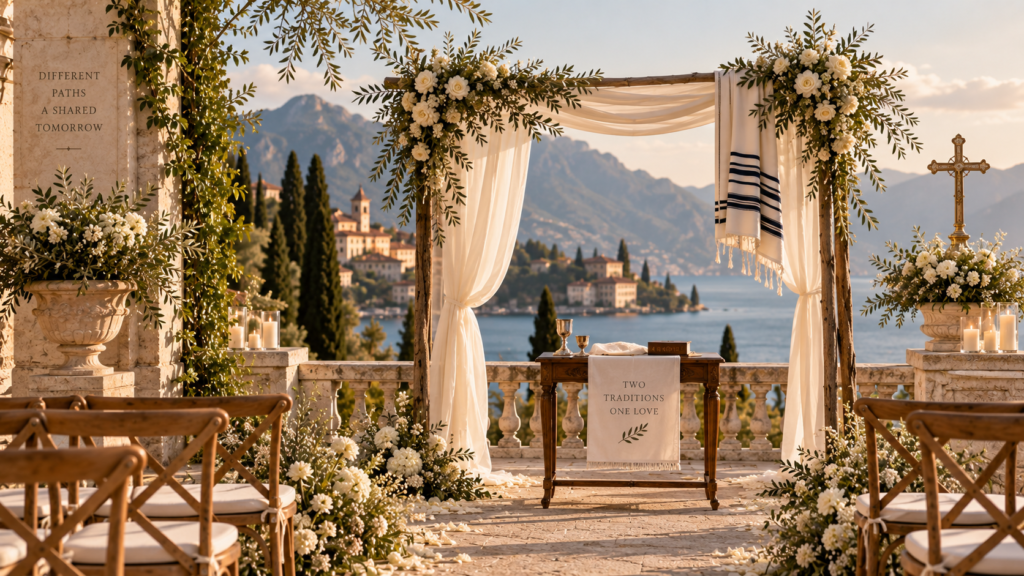
Interfaith Wedding in Italy
Most couples who reach us have already discovered the central tension: the officiant they want lives in Brooklyn or Tel Aviv, the venue they love is a sixteenth-century palazzo with curfew restrictions, and both families expect traditions they consider non-negotiable. That three-way alignment — clergy, architecture, family — is the actual design problem of an interfaith wedding in Italy. It is not solved by choosing a beautiful location and hoping the rest follows. It is solved by understanding which historic spaces can physically and legally host a chuppah beside a unity candle, which rabbis will co-officiate with a non-Jewish celebrant, and how the evening’s flow can move from the Sheva Brachot to a seated Italian dinner without a single guest feeling like an outsider.
One Ceremony or Two: The Decision That Shapes Every Budget Line
Before we discuss venues, let us address the structural question that determines everything else. A single blended ceremony — typically symbolic, lasting 30–45 minutes — weaves elements from both traditions into one arc. A rabbi and a priest or secular celebrant co-officiate. The chuppah stands at the altar position. Readings alternate between Hebrew, English, and sometimes Italian. This format works beautifully in open-air courtyards and frescoed halls where the architecture itself provides the sacred frame.
A two-ceremony format separates the rituals entirely. One might take place in a private garden at 3 p.m., the other in a candlelit salone at 6 p.m. Guests attend both, but each tradition receives its full expression without abbreviation. The cost implications are real: two floral installations, two sound setups, two sets of printed programs, and a longer photography timeline. Yet for families where theological integrity matters more than brevity, this approach can be the only one that feels honest. More in our guide: Chinese wedding in Italy.
We guide couples through this decision during the first consultation, mapping it against venue availability, clergy preferences, and the emotional weight each family assigns to specific rituals. The framework is not about compromise. It is about precision. Reach out to our team to begin that conversation.
Venice: Why Sixteenth-Century Palazzi Suit Interfaith Ceremonies Better Than Churches
Venice holds a unique position in the landscape of the interfaith wedding in Italy. The city’s synagogues — five of them, concentrated in the Ghetto Novo and Ghetto Vecchio — date to the 1500s and remain active. But they are rarely available for private weddings. The real opportunity lies in the palazzi.
A Venetian palazzo originally built for a noble family in the late Renaissance offers something no hotel ballroom can: architectural grammar that reads as sacred without belonging to any single faith. Barrel-vaulted ceilings, terrazzo floors, candlelight reflected off the Grand Canal — these elements create a cinematic frame that honors a chuppah and a unity ceremony with equal gravitas. We have staged interfaith celebrations in a privately owned sixteenth-century palazzo; the room’s proportions naturally direct the eye toward the ceremony space, exactly as a nave would, yet the setting is entirely secular.
Sound matters. Venice’s stone walls amplify a cantor’s voice with extraordinary warmth, but they also carry noise to neighboring apartments after 11 p.m. We manage curfew logistics and sound-level agreements as part of every Venice wedding we produce. For couples weighing the financial architecture of a Venetian celebration, our Venice wedding cost guide details real ranges by season and guest count.
Privacy is another consideration. A palazzo with exclusive-use access means no tourists wandering through the portego during the ketubah signing. We secure these agreements 12–16 months in advance — the standard booking window simply does not apply to interfaith weddings in Italy that require custom room configurations.
Tuscany’s Chianti and Val d’Orcia: Where Open-Air Chuppahs Meet Renaissance Estates
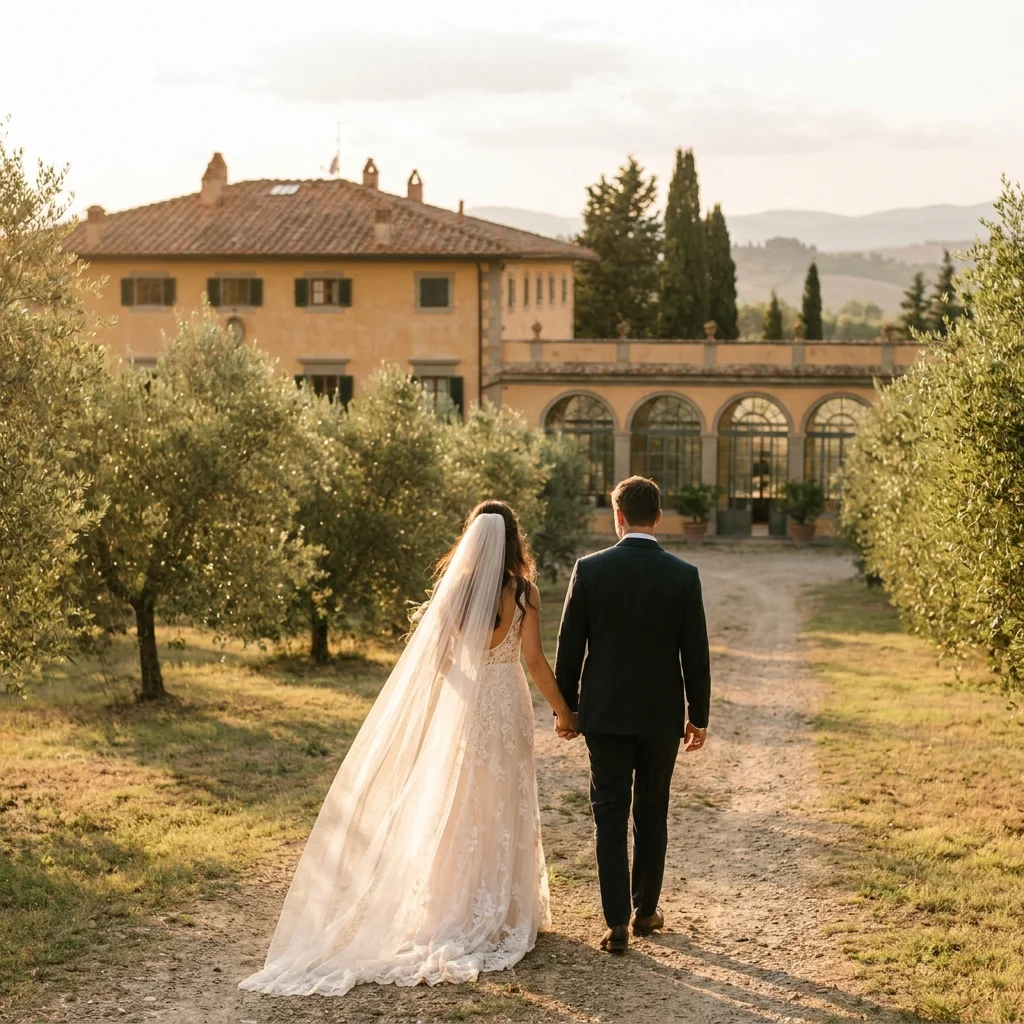
Tuscany remains the most requested region for a multi-faith wedding in Italy, and the reason is partly practical: its villa estates offer the flexible outdoor-indoor flow that blended ceremonies demand. A chuppah erected in a cypress-lined garden at golden hour, followed by a processional into a vaulted limonaia for dinner — this sequence photographs with a cinematic quality that enclosed urban venues cannot replicate.
In Chianti, we work with estates whose original structures date to the fourteenth century, later expanded by Medici-era families. One property — a fortified farmhouse converted into a private estate in the 1600s — features a consecrated chapel on its grounds alongside a secular garden terrace. Couples choosing the two-ceremony format can hold a Christian blessing in the chapel and a Jewish ceremony under the chuppah within the same property, separated by a 200-meter walk through olive groves. The scenography practically designs itself.
Val d’Orcia offers a different register: vast, almost cinematic landscapes where the rolling hills become the backdrop rather than any single building. Here, the ceremony site is often a cleared terrace overlooking wheat fields, and the sense of openness suits families who want the ritual to feel expansive rather than enclosed. Our Tuscany venue guide maps the architectural distinctions between sub-regions, and our Tuscany wedding cost breakdown clarifies what each area commands in high and shoulder season.
Lake Como: Baroque Villas and the Acoustic Advantage for Bilingual Ceremonies
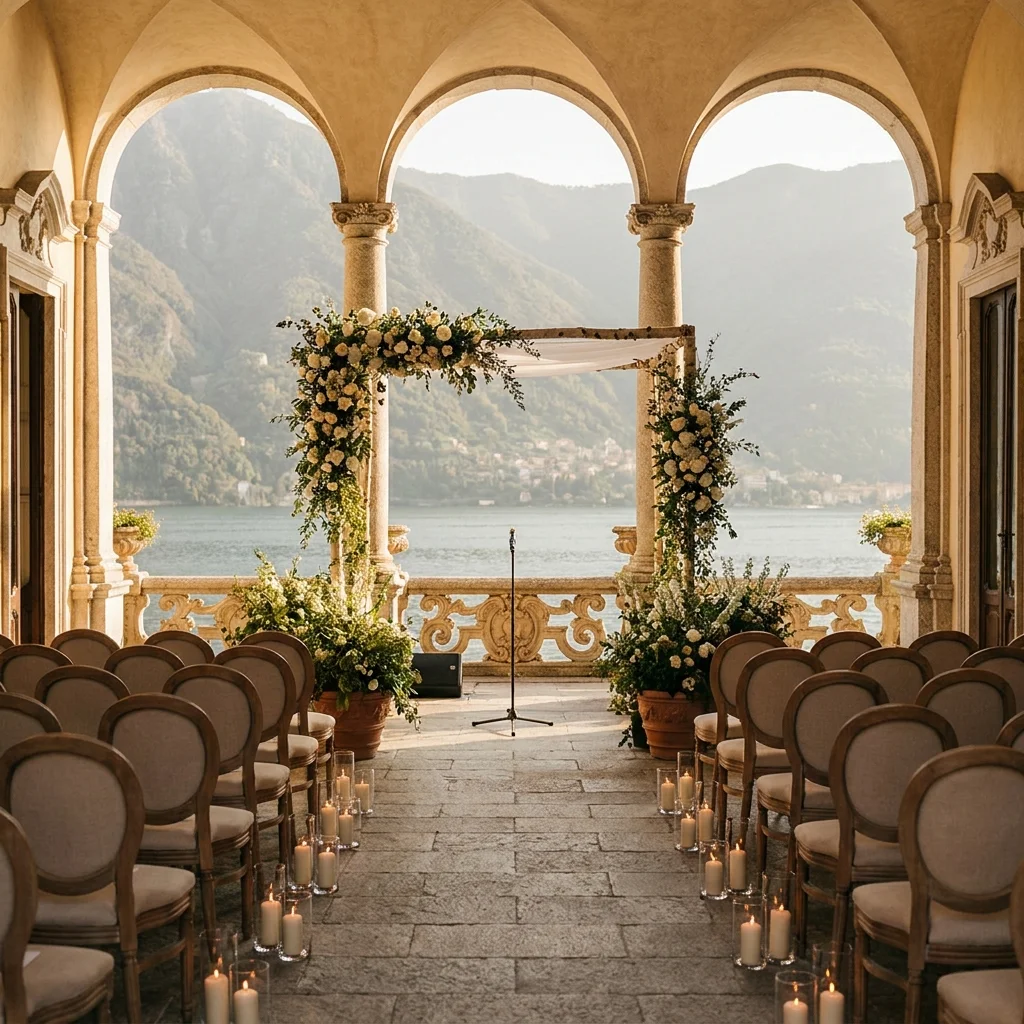
The Baroque villas ringing Lake Como — many commissioned in the seventeenth and eighteenth centuries by Milanese aristocrats — present an unusual acoustic benefit for interfaith celebrations. Their saloni, designed for chamber concerts, project the human voice with clarity across 80–120 seated guests. When a rabbi recites the Sheva Brachot and a celebrant follows with a reading in English or Italian, every syllable lands.
We have produced two-tradition ceremonies in Italy at Villa del Balbianello, where the loggia overlooking the lake accommodates a chuppah with the water as a living backdrop. The FAI (Fondo Ambiente Italiano) manages access, and their scheduling windows are rigid: ceremonies must conclude by a specific hour, and setup begins only after the last public visitor departs. We coordinate these transitions so that couples never feel rushed.
For a broader view of what a celebration on this lake involves, our Lake Como wedding guide covers logistics from ferry scheduling to villa exclusivity windows. Como’s shoulder season — late September through mid-October — offers softer light and fewer tourist boats, which matters when you are staging a ceremony on an open terrace facing west.
The Amalfi Coast and Ravello: Terraced Gardens That Frame a Chuppah Against the Sea
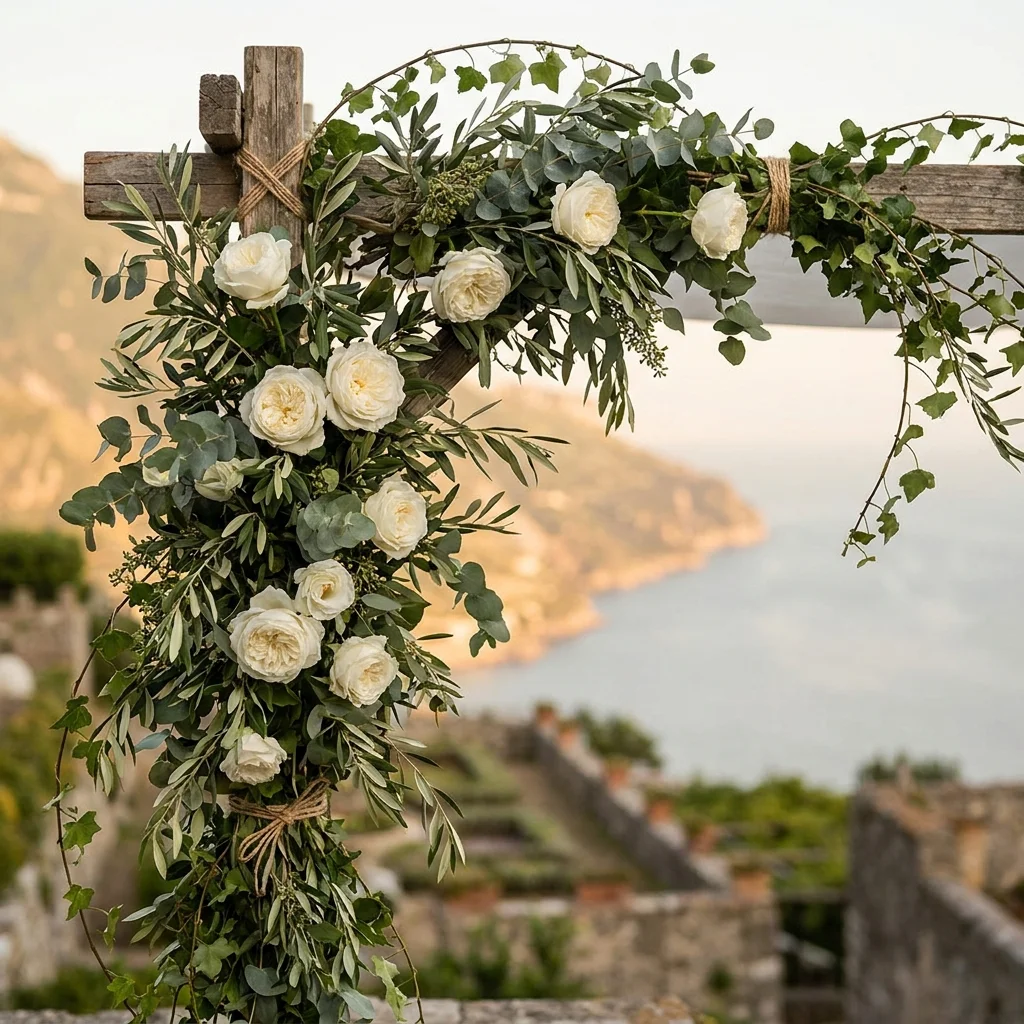
Ravello’s position — 350 meters above the Tyrrhenian — gives it a quality of elevation that feels almost liturgical. The town’s most celebrated terraces, originally part of medieval noble estates, offer unobstructed sea views that serve as a natural apse for any ceremony. A chuppah erected at the edge of one of these terraces, with the coastline dropping away behind it, creates an image of extraordinary visual power.
The constraint here is space. Ravello’s terraces accommodate 60–100 guests comfortably; beyond that, the logistics of seating, sound, and catering become a design challenge we manage carefully. The Amalfi Coast wedding cost page details how guest count directly influences venue pricing in this region.
For interfaith destination weddings specifically, the Amalfi Coast’s municipal regulations require advance notification of any symbolic ceremony held on public or heritage-listed terraces. We file these permits 8–10 months ahead, coordinating with the comune and the venue’s heritage officer simultaneously. Couples who want to explore the broader venue landscape along this coastline will find our Amalfi Coast venue overview useful as a starting point.
When Your Rabbi Lives Abroad: Co-Officiation Logistics We Manage on Your Behalf
Here the tone shifts to the purely operational. A Jewish-Christian wedding weekend in Italy that involves a rabbi traveling from the United States, the UK, or Israel requires coordination that extends well beyond booking a flight.
Travel and accommodation. We arrange lodging for clergy within proximity of the venue, ensuring they arrive rested and with time for a walkthrough the day before. Rabbi travel costs are quoted separately from our planning fee — see the tables below.
Co-officiation rehearsal. When a rabbi and a Christian or secular celebrant share the ceremony, we schedule a 90-minute rehearsal at the venue. This is not optional. The physical choreography of who stands where, who speaks when, and how the couple moves between ritual moments must be blocked like a theatrical scene. I approach this as scenography: every transition should feel intentional, never improvised.
Ritual objects and kosher requirements. A chuppah in Italy may need to be custom-built to suit the venue’s ceiling height or wind exposure. We source or construct chuppahs locally, working from the couple’s design brief. If the celebration includes kosher catering — even partially — our kosher wedding catering guide outlines how we coordinate with certified mashgichim and local kitchens.
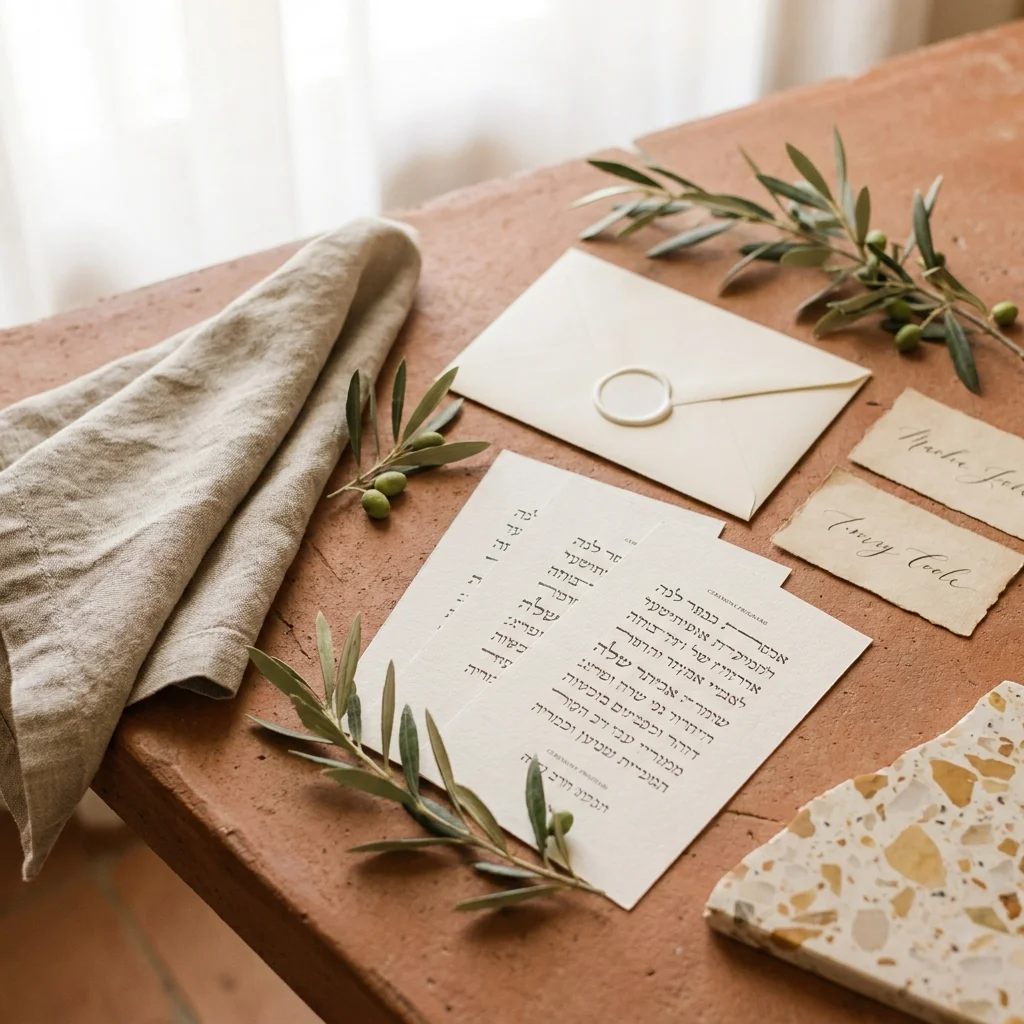
Language. Ceremonies typically move between Hebrew, English, and occasionally a third language. We provide printed programs with transliterations and translations so that every guest can follow, participate, and understand the significance of each moment. This is not a courtesy; it is a hosting strategy.
Designing a Weekend Where Neither Family Feels Like a Guest at Someone Else’s Wedding
The emotional architecture of an interfaith celebration in Italy is as important as the physical one. When a Jewish family and a Catholic family sit together for the first time, the experience must feel curated for mutual comfort, not tilted toward one tradition with polite nods to the other.
We design this at three levels. First, the welcome event — typically a Friday evening dinner if the wedding is Saturday. This gathering sets the tone. We select a venue and menu that feel Italian rather than denominational: a long table in a courtyard, regional wines, courses that happen to align with dietary considerations without labeling them as such.
Second, the ceremony program itself. Beyond translations, we include brief contextual notes — “The breaking of the glass symbolizes…” or “The lighting of the unity candle represents…” — so that participation feels informed rather than passive. Guests who understand what they are witnessing engage differently. They lean in.
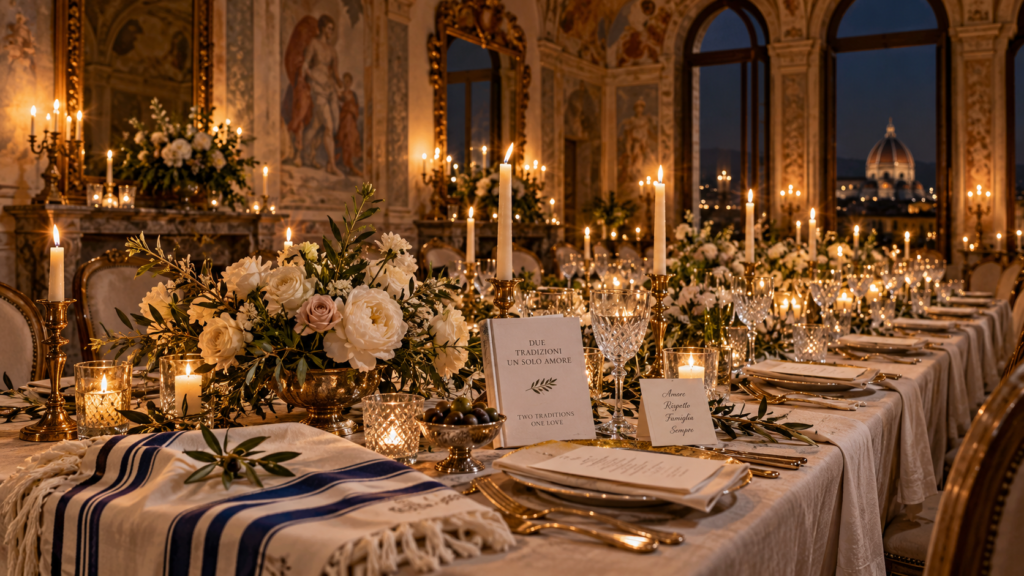
Third, the reception flow. An Italian dinner naturally creates rhythm: antipasto, primo, secondo, dolce. We use this structure to embed moments from both traditions — a blessing over bread here, a toast in a family’s native language there — so that the evening feels woven rather than segmented. For the culinary dimension, our Italian wedding menu guide explores regional courses and how they adapt to dietary frameworks.
If you are beginning to envision how these layers might work for your families, contact Kiss Me Italy to discuss the specifics.
What an Interfaith Wedding in Italy Actually Costs: Region-by-Region Ranges
Pricing for an interfaith celebration reflects the added coordination layers: clergy travel, custom ceremony design, bilingual programs, and — in many cases — kosher or dietary-compliant catering. The tables below draw from ranges published across our regional cost pages.
| Region | 60–80 Guests | 100–150 Guests | Included | Quoted Separately |
|---|---|---|---|---|
| Venice | €80,000–€140,000 | €140,000–€220,000 | Venue exclusive-use, planning & coordination, ceremony design, floral, catering, lighting, printed programs, permits, VAT (IVA 22%) | Photographer/videographer travel & accommodation, second shooter, albums, post-production, clergy travel & lodging, live music |
| Tuscany (Chianti / Val d’Orcia) | €60,000–€110,000 | €110,000–€180,000 | Venue hire (2–3 day exclusive use), planning & coordination, ceremony design, floral, catering, lighting, printed programs, permits, VAT | Photographer/videographer travel & accommodation, second shooter, albums, post-production, clergy travel & lodging, live music, guest shuttle |
| Lake Como | €75,000–€130,000 | €130,000–€200,000 | Venue hire, planning & coordination, ceremony design, floral, catering, lighting, printed programs, permits, VAT | Photographer/videographer travel & accommodation, second shooter, albums, post-production, clergy travel & lodging, boat transfers |
Indicative ranges. Request a private consultation for a personalized proposal.
| Amalfi Coast (Ravello / Positano) | 60–80 Guests | 100–150 Guests | Included | Quoted Separately |
|---|---|---|---|---|
| Full planning | €70,000–€120,000 | €120,000–€190,000 | Venue hire, planning & coordination, ceremony design, floral, catering, lighting, printed programs, heritage permits, VAT (IVA 22%) | Photographer/videographer travel & accommodation, second shooter, albums, post-production, clergy travel & lodging, live music, guest transfers |
Indicative ranges. Ask for a tailored interfaith ceremony plan for a personalized proposal.
| Add-On Service | Typical Range | Notes |
|---|---|---|
| Rabbi / co-officiant travel from US or UK | €2,500–€5,000 | Includes round-trip airfare, 2–3 nights accommodation near venue; honorarium quoted directly by clergy |
| Custom chuppah construction | €1,200–€4,500 | Depends on materials (fresh floral, fabric, wood frame); delivery and setup included; VAT included |
| Kosher catering upgrade (full kitchen supervision) | €3,000–€8,000 above standard catering | Mashgiach fees, imported kosher ingredients, dedicated prep area; VAT included |
| Bilingual ceremony programs (design + print, 100 copies) | €600–€1,200 | Custom design, transliteration, premium paper stock; delivery to venue included |
Indicative ranges. Discuss your clergy and legal timeline with our team for a personalized proposal.
For a broader view of Italian wedding investment across all formats, our comprehensive cost guide provides context that extends beyond interfaith-specific considerations.
Why Interfaith Moments Demand a Different Photographic Approach
A standard wedding photographer captures the kiss, the first dance, the cake. An interfaith destination wedding adds a layer of ritual-specific moments that require anticipation: the signing of the ketubah, the circling, the breaking of the glass, the lighting of a unity candle, the exchange of garlands if Hindu elements are present. Missing any of these is not a missed shot — it is a missed tradition.
We brief every photographer on the ceremony’s full sequence, providing a written timeline that marks each ritual moment, its approximate duration, and the best angle given the venue’s light conditions. For afternoon ceremonies in Tuscan gardens, the golden-hour window between 5:30 and 7:00 p.m. in late June produces the most painterly light for outdoor chuppah portraits. Our photography coordination guide explains how we match editorial style to venue and ceremony type.
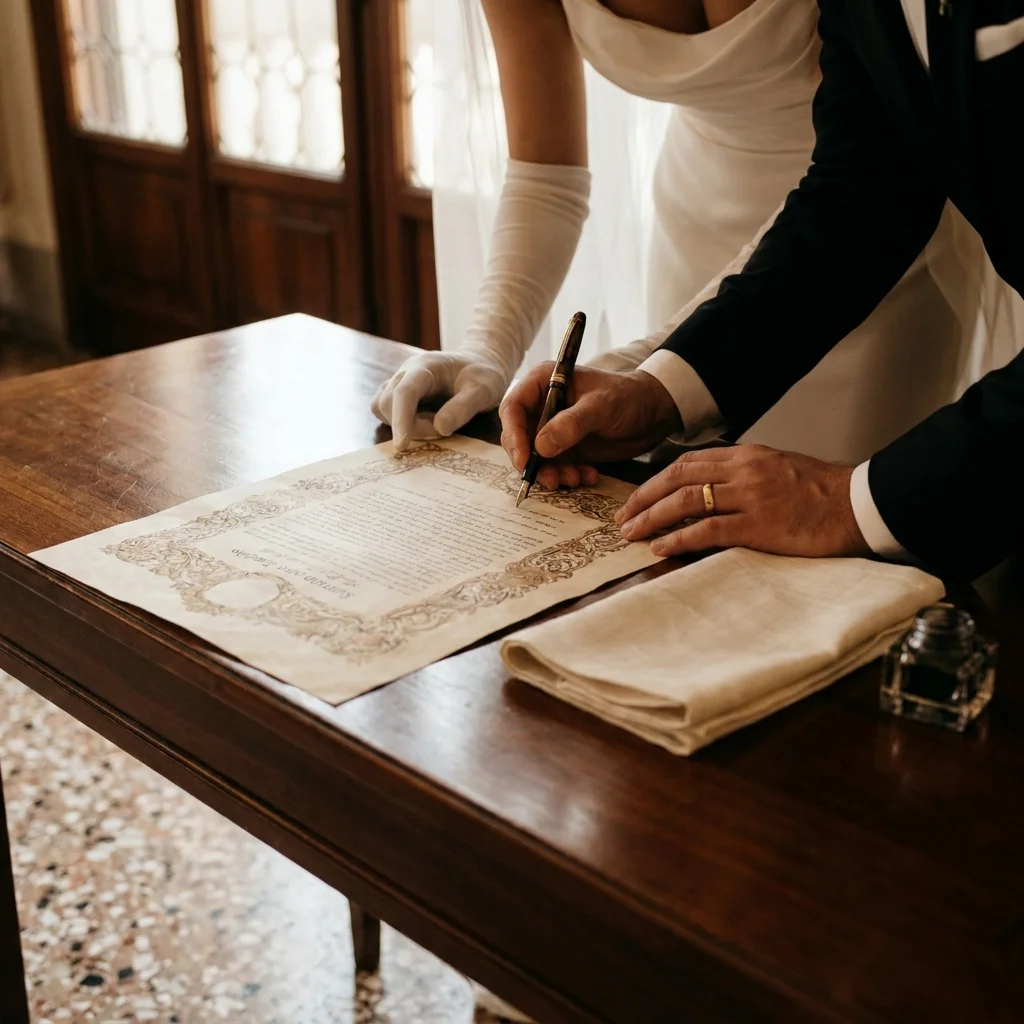
The ketubah signing — intimate, often tearful, usually in a private room before the ceremony — is one of the most emotionally charged moments of a Jewish or interfaith celebration in Italy. We ensure the room is lit, styled, and cleared of clutter before the couple and witnesses enter. It should feel like a scene from a film. Because, in a sense, it is.
The Legal Layer: Why an Interfaith Ceremony in Italy Is Almost Always Symbolic
Italy recognizes Catholic marriages and civil marriages performed by a mayor or delegated official. It also recognizes marriages performed under the Intesa agreements with certain religious communities, including the Unione delle Comunità Ebraiche Italiane. However, a co-officiated interfaith ceremony does not carry legal force under Italian law.
This means most couples planning an interfaith wedding in Italy will hold a brief civil ceremony — often at the local comune or within the venue itself if it holds civil-ceremony authorization — either the day before or the morning of the celebration. The symbolic interfaith ceremony then becomes the emotional and spiritual centerpiece of the day, free from legal constraints on wording or structure.
We manage the civil paperwork, the Nulla Osta process, apostilles, and translation requirements as a standard part of our coordination. Our guide for foreigners marrying in Italy covers the documentary timeline in detail. The key constraint: paperwork should begin no later than four months before the wedding date.
An Interfaith Wedding in Italy Is Not a Compromise — It Is a Composition
The word I return to, again and again, is composition. A great interfaith celebration does not split the difference between two traditions. It composes something new — something that could only exist because these two families, these two histories, chose to meet in a frescoed salone or a Tuscan garden or on a Ravello terrace overlooking the sea. The venue becomes a character in that story. The ceremony becomes a scene. The weekend becomes a narrative that every guest carries home.
This is what we do at Kiss Me Italy. We do not offer templates. We compose. And every composition begins with a conversation. Begin yours here.
Frequently Asked Questions About Interfaith Weddings in Italy
Do we need a ketubah translated into Italian for witnesses or venue staff?
No Italian translation of the ketubah is legally required, as the document carries religious rather than civil authority. However, we recommend preparing a brief Italian-language summary for venue staff and any local witnesses who may be present during the signing. This avoids confusion and ensures the moment proceeds with the dignity it deserves. We can arrange certified translation or a plain-language explanatory note depending on your preference.
Can we sign the ketubah in Italy if our witnesses arrive late due to travel delays?
Yes, with advance planning. We always identify backup witnesses — typically trusted members of the planning team or a family friend already on-site — who can step in if travel disruptions affect the primary witnesses. We also build a buffer into the pre-ceremony schedule so that a delayed flight does not cascade into a compressed or skipped signing. The ketubah signing room is held and styled until the moment is ready to proceed, regardless of minor timing shifts.
How do you seat families when one side expects gender-separated seating and the other does not?
This is one of the more nuanced logistical challenges in a mixed-observance celebration. We design a seating plan that creates a natural gender-separated zone on one side of the ceremony space — typically using the aisle as a soft dividing line — while the other side follows a conventional mixed arrangement. Signage is kept discreet and contextual rather than instructional. During the reception, table assignments are handled with equal care: we cluster guests by family unit and social familiarity rather than imposing a single seating logic across the room.
Can we include interfaith-sensitive music — for example, avoiding certain liturgical melodies — and still have live Italian musicians?
Absolutely. We brief every live ensemble on the ceremony’s musical sensitivities before contracting them. Italian chamber musicians and string quartets are accustomed to bespoke repertoire requests, and we provide a curated playlist that balances the couple’s preferences with any melodies either family considers exclusively denominational. If a cantor is present for specific Hebrew passages, we coordinate the handoff between cantor and ensemble so the transition is seamless rather than jarring.
What are the most common interfaith ceremony timing mistakes in Italy — heat, light, ferry schedules — and how do you prevent them?
Three timing errors recur most often. First, scheduling an outdoor ceremony between noon and 4 p.m. in July or August: direct Mediterranean sun at that hour is genuinely uncomfortable for guests in formal attire, and the flat overhead light is unflattering for photography. We push ceremonies to 5 p.m. or later. Second, underestimating ferry and water-taxi transfer times on Lake Como and in Venice: a 20-minute journey on paper can become 45 minutes during peak season. We build transfer buffers into every run-of-show. Third, misjudging the havdalah window on Saturday evenings: if the ceremony must begin after sundown for observance reasons, the exact time shifts by several minutes each week and varies by latitude. We calculate this precisely for the specific date and location.
How do you handle security and privacy for high-profile families during a ketubah signing or blessing?
For families requiring elevated privacy, we implement a tiered access protocol for the pre-ceremony period. The ketubah signing room is accessible only to the couple, designated witnesses, the officiant, and our on-site coordinator. Venue staff are briefed not to enter without explicit clearance. Where necessary, we coordinate with private security personnel provided by the family, integrating them into the venue’s existing access points without disrupting the atmosphere. We also negotiate social-media blackout clauses with all vendors — photographers, caterers, florists — as a standard contract term for high-profile engagements.
Can we host a mikveh visit or other pre-wedding religious moment discreetly in Italy?
Yes. Several Italian cities with established Jewish communities — Rome, Milan, Florence, Venice — have functioning mikva’ot associated with their synagogues. Access for visiting couples is arranged through the local community office, typically requiring a letter of introduction from the couple’s home rabbi. We facilitate this introduction and handle the scheduling so that the visit fits naturally into the wedding-week itinerary without requiring the couple to navigate unfamiliar bureaucratic channels in a foreign language.
What are the etiquette expectations around gifts, donations, or tzedakah at a destination interfaith wedding?
Destination weddings create genuine uncertainty for guests around gift-giving: many feel that the cost of travel is itself a significant contribution. We recommend that couples address this directly and warmly in their wedding website, either indicating a preference for charitable donations to a named tzedakah organization or specifying a gift registry with a range of price points. For the ceremony itself, some couples incorporate a communal tzedakah moment — a collection for a shared cause — which can be framed inclusively for guests of all backgrounds. We help draft the language so it feels generous rather than instructional.
How do you manage dietary labeling discreetly for mixed-observance guests?
Overt dietary labeling — tent cards reading “kosher” or “non-kosher” — can inadvertently highlight differences at the table rather than dissolve them. Our preferred approach is to design a menu where the fully kosher dishes are also the most appealing options for all guests, presented with descriptive Italian-language labels that emphasize ingredients and provenance rather than certification status. Guests with specific observance requirements receive a discreet personal briefing from the maître d’ at the start of service. This preserves both dignity and clarity without making dietary practice a visible social marker during the meal.
What is the contingency plan for wind on terraces — chuppah stability, audio, and candles?
Wind is the single most underestimated variable at elevated terrace venues on the Amalfi Coast, Lake Como, and in Venice. Our standard protocol has three components. For the chuppah, we use weighted ballast bases and, where the venue permits, discrete ground anchors; the fabric panels are attached with quick-release clips so they can be removed in seconds if gusts exceed a safe threshold without dismantling the entire structure. For audio, we position directional microphones with wind shields and always have a handheld backup available for the officiant. For candles, enclosed hurricane lanterns replace open-flame holders as the default on any terrace with an unobstructed sea or lake exposure. We monitor the local wind forecast from 72 hours out and conduct a final site assessment the morning of the ceremony.