Cinque Terre Wedding Tablescape
The measurement that shapes your reception here is not the guest count. It is the depth of the terrace. The dry-stone terraces that step down to the sea between Monterosso and Riomaggiore were cut for vines and lemon trees from the eleventh century onward, by monastic and peasant communities who had no reason to imagine a dinner for sixty. Many of the finest terraces available for a wedding today measure between four and seven metres deep. That single figure decides table geometry, service corridors, centrepiece height, and whether your guests will be seated facing the water or along it — and it is the first thing our team measures, long before anyone discusses linen.
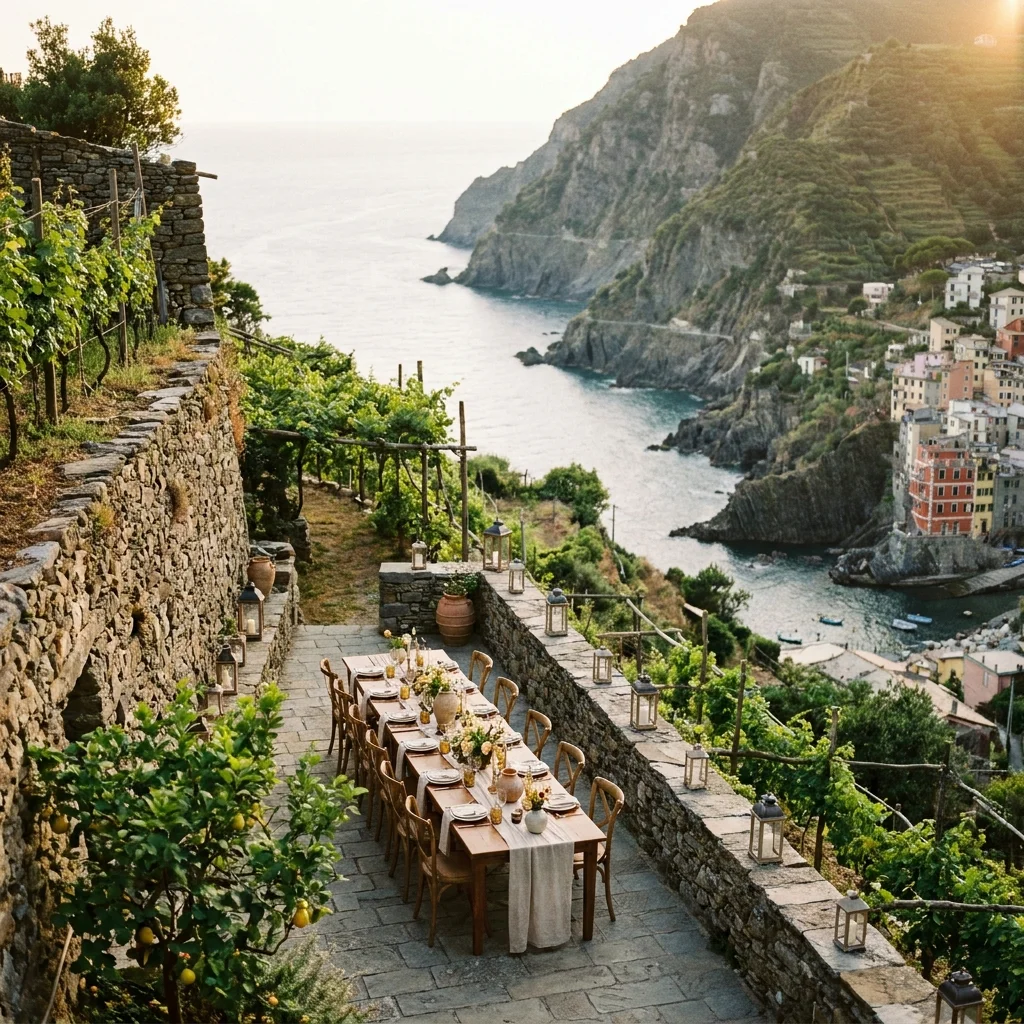
A cinque terre wedding tablescape is a coastal table design built around three physical constraints: terrace width, wind exposure, and access on foot. Refined settings in this stretch of Liguria typically combine handmade ceramics, low seasonal florals, wind-shielded candlelight, and custom-dyed linen, with design and production commonly running €90–€260 per guest before IVA, depending on venue access. Our published Liguria wedding collections at Kiss Me Italy currently range from €59,000 to €199,000 depending on the collection and guest band, and every table is designed, produced, and installed by our team rather than left to a rental catalogue.
What follows is not inspiration in the abstract. It is the architectural and operational grammar of a coastal Italian wedding table on this particular coastline — where a table cannot be widened, a truck cannot arrive, and the wind at 19:40 behaves differently from the wind at 17:00. Couples who want the wider destination picture will find it in our Cinque Terre wedding overview; this page stays on the table itself.
Narrow Sea Terraces vs Inland Garden Venues: Which Table Geometry Actually Survives
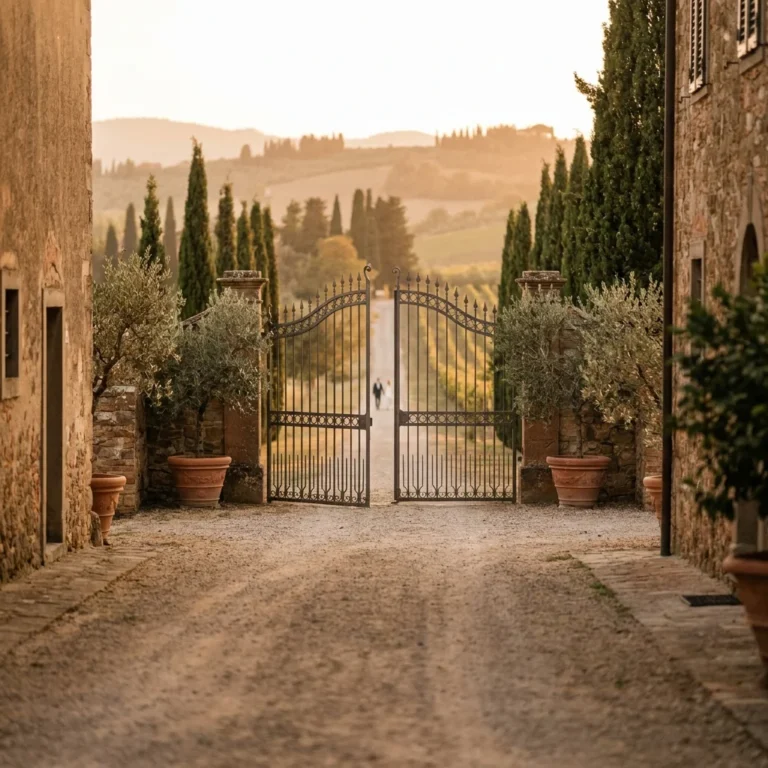
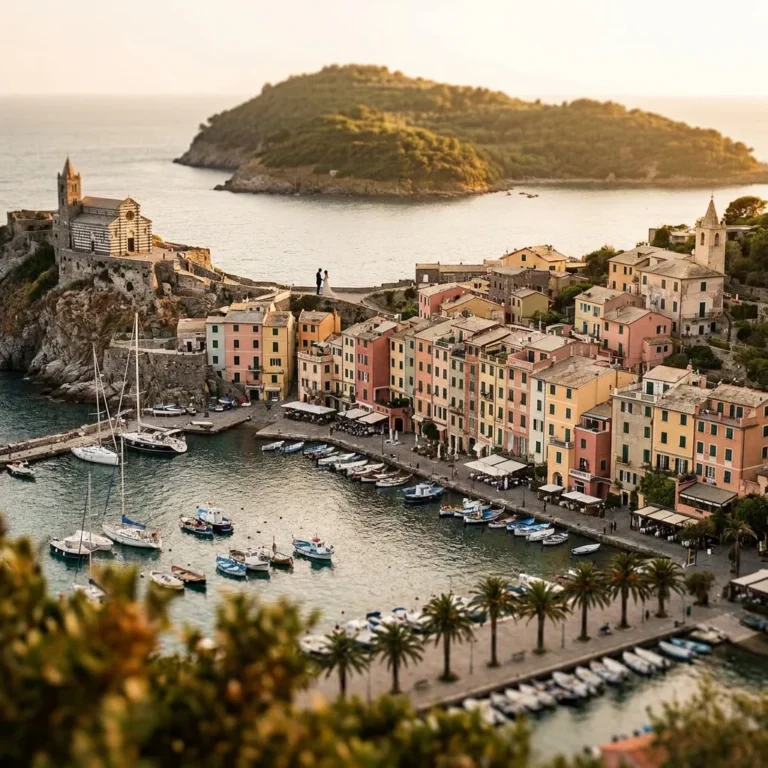
There are two families of venue in and immediately around the Cinque Terre, and they impose two different design logics. The first is the vertical terrace: a stone platform, often originally agricultural, sometimes carved for a nineteenth-century villa, suspended above the water with a parapet on one side and rock on the other. The second is the inland garden or cloistered courtyard, set fifteen or twenty minutes above the villages, with level ground and room to breathe.
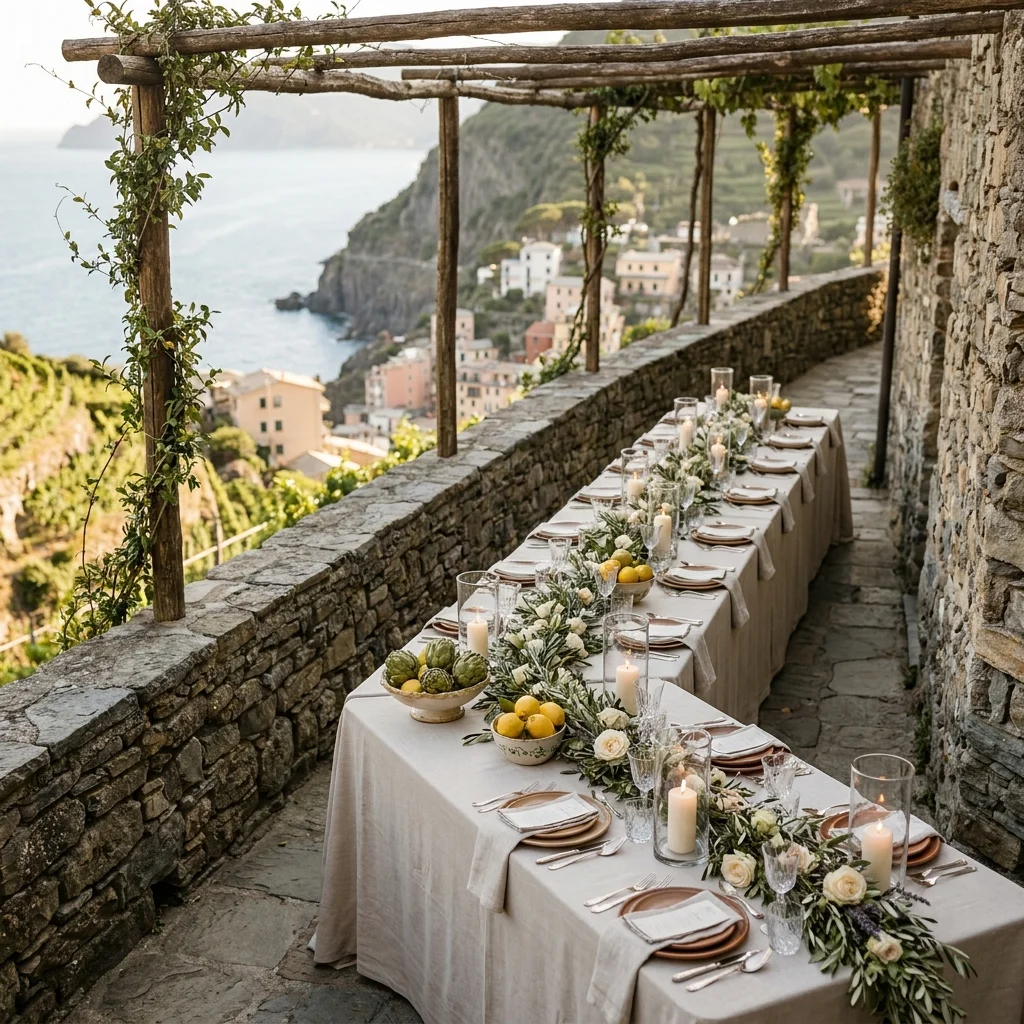
On a narrow terrace, one long table is almost always the correct answer. Not for fashion — for physics. A single rectangular run of 80 to 90 centimetres in width leaves a workable service corridor on one side and allows guests to sit with their backs to the rock and their eyes on the sea. Round tables of 150 centimetres, by contrast, consume terrace depth ruthlessly and force waiters to circulate where there is nothing to circulate in. We have measured terraces where three rounds fit in theory and where dinner service would take an hour longer in practice.
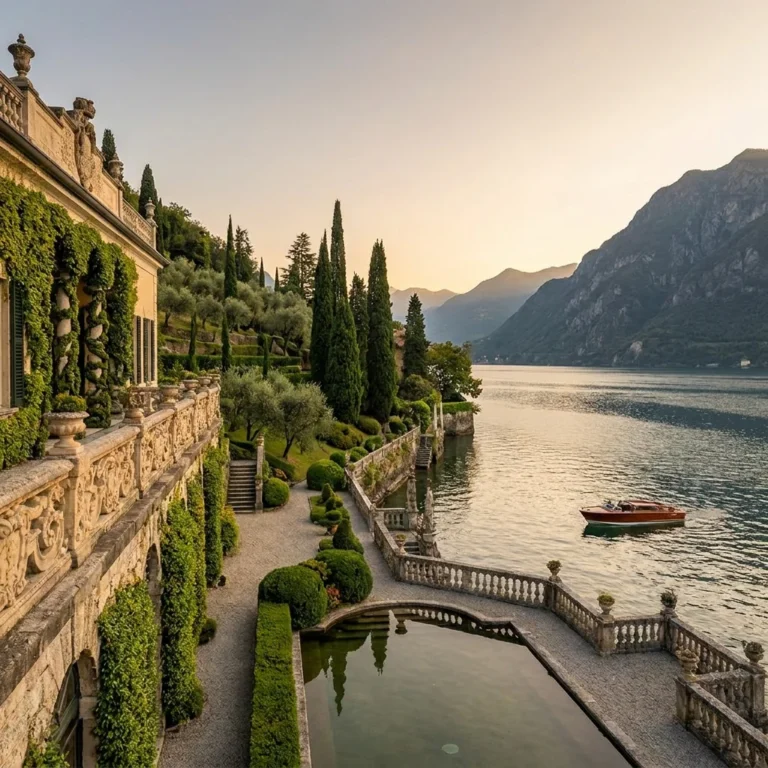
Inland, the vocabulary opens. Curved and sculptural layouts become possible, mixed heights are safe, and a Liguria wedding tablescape can spread across gravel and box hedging with the sea as a distant blue line rather than a presence at the elbow. The trade is intimacy for freedom. Couples drawn to the sculptural end of the spectrum often find that a garden setting on the promontory near Santa Margherita Ligure offers the geometry they imagined, with Cinque Terre reserved for the ceremony and the portraits.
One terrace we work with regularly — unnamed here, as it is privately held and its owners prefer discretion — is reached by ninety-one steps and holds thirty-four seated guests on a single table with two service points. Another, a former vine terrace with a chestnut pergola, seats twenty-two and no more, ever. Knowing the seated ceiling of each terrace before design begins is the difference between a table that photographs beautifully and a table that functions. Our team maintains those numbers, updated after each season, and we validate them on site rather than from a floor plan.
Wind and Salt Air: What Holds on a Cinque Terre Terrace and What Only Holds in Photographs
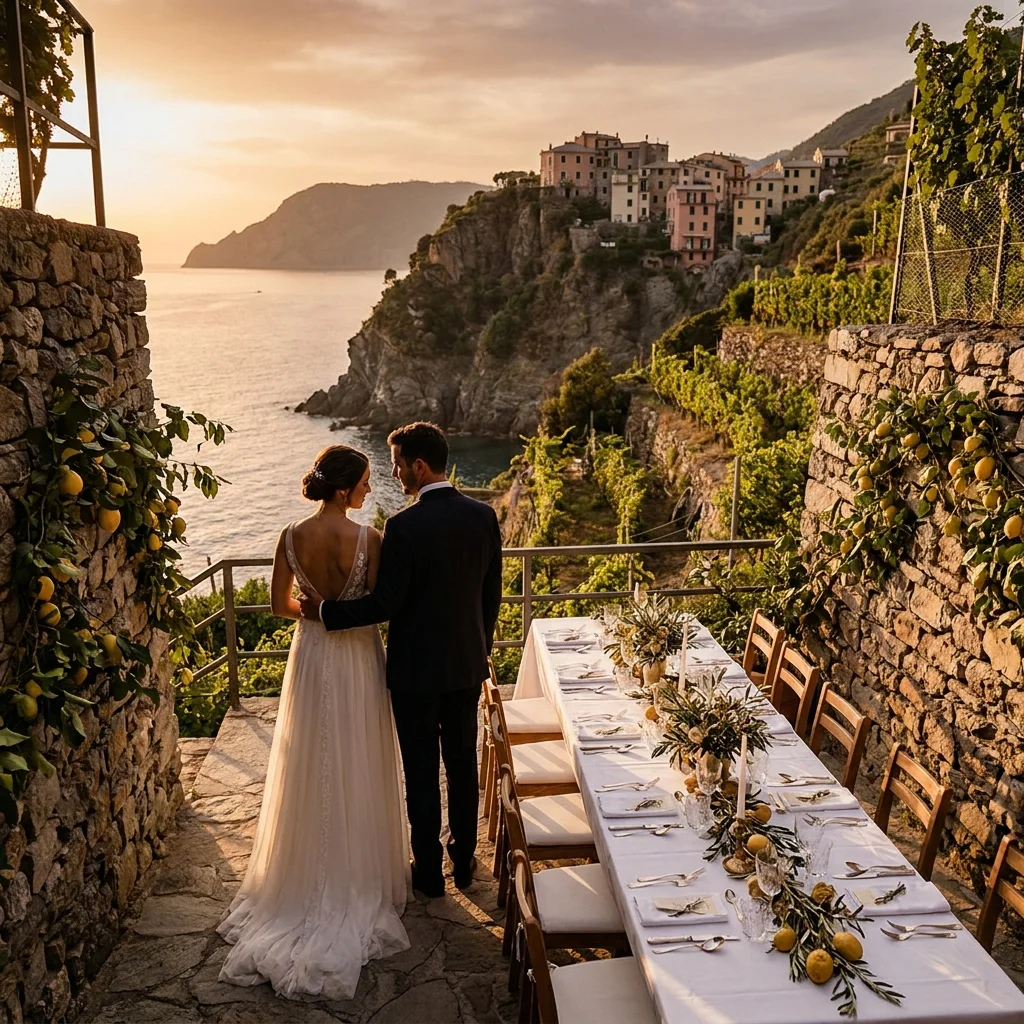
The libeccio arrives from the southwest, usually in the late afternoon, and it does not announce itself. On the exposed terraces above Vernazza and Manarola we have recorded gusts that lift an unweighted menu card cleanly over the parapet. This is the operational fact behind most of our Cinque Terre wedding table decor decisions, and it is the reason our designs look calmer and heavier than a Tuscan or Umbrian equivalent.
Taper candles in open brass holders are exquisite. On a sea terrace after 19:00, they are theatre with a short run. We work instead with glass hurricanes of 25 to 40 centimetres, weighted bases, and low votives sunk into ceramic vessels — a candlelight architecture that reads as generous in photographs while holding through a 20-knot evening. Where a couple is committed to open flame, we specify wind-protected lanterns and a second wax set held in reserve with the crew, replaced between courses if needed.
Salt air affects materials in ways rental catalogues rarely mention. Untreated silver tarnishes visibly within a single humid August evening. Unlined raw silk runners absorb moisture and lose their fall by the second course. Loose petals scatter. Our specification favours matte ceramic, hand-hemmed linen with weighted corners, brushed pewter or gold-plated flatware rather than bare silver, and stone or wood risers that hold their position without pinning. Every element is chosen for how it behaves at 20:30, not how it looks at 17:00 during the styling shoot. Our approach to seasonal, coastal floral work is set out in detail in our guide to Italian Riviera wedding flowers, which our florists apply directly to table design here.
Referencing Liguria Without Rope and Shells: Ceramic, Citrus, and Faded Fresco Colour
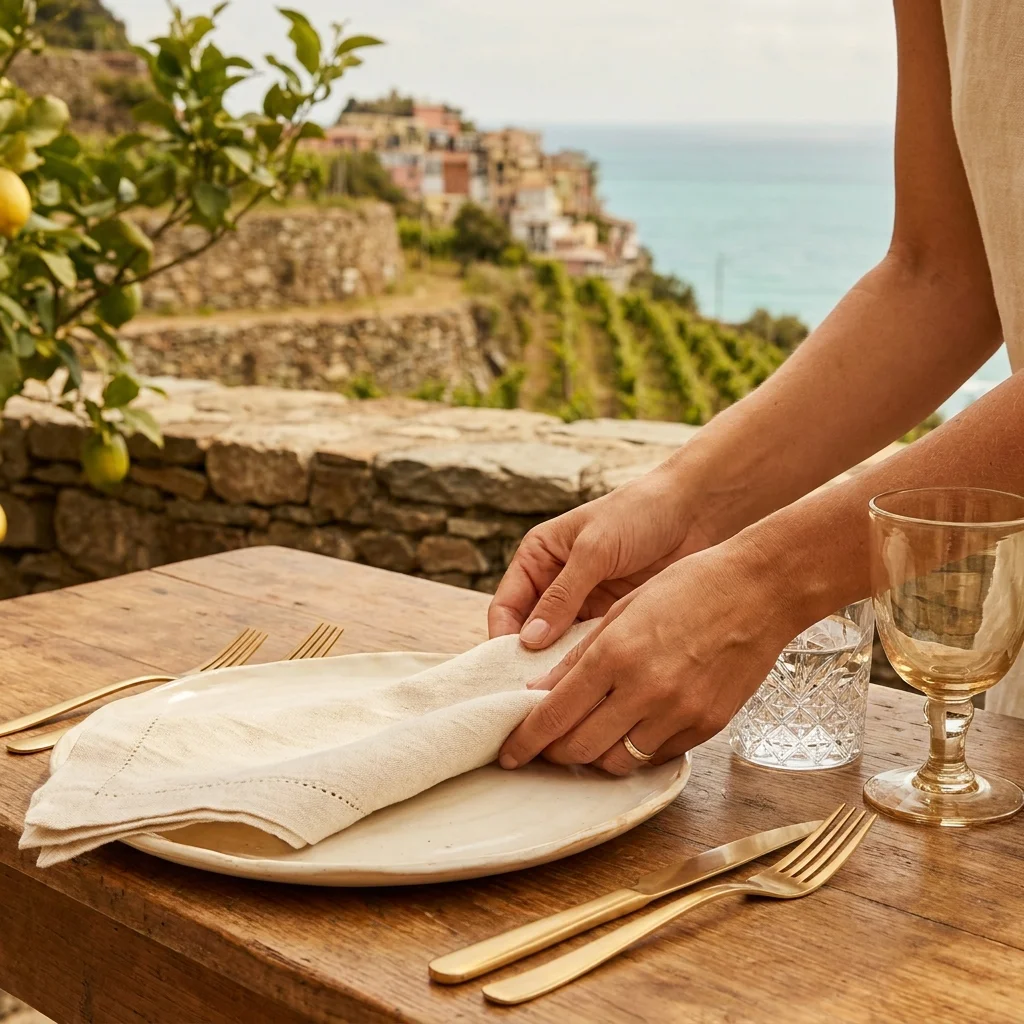
The literal nautical register — rope, netting, driftwood, blue-and-white stripe — is the most common misstep in Ligurian wedding decor, and it is entirely unnecessary. This coast has a far more interesting chromatic archive. The villages themselves were painted in ochre, terracotta, apricot, and dusty rose partly so fishermen could identify their houses from the water, and many façades carry trompe-l’œil painted architecture: false pilasters, false cornices, false window surrounds executed by itinerant painters from the seventeenth century onward.
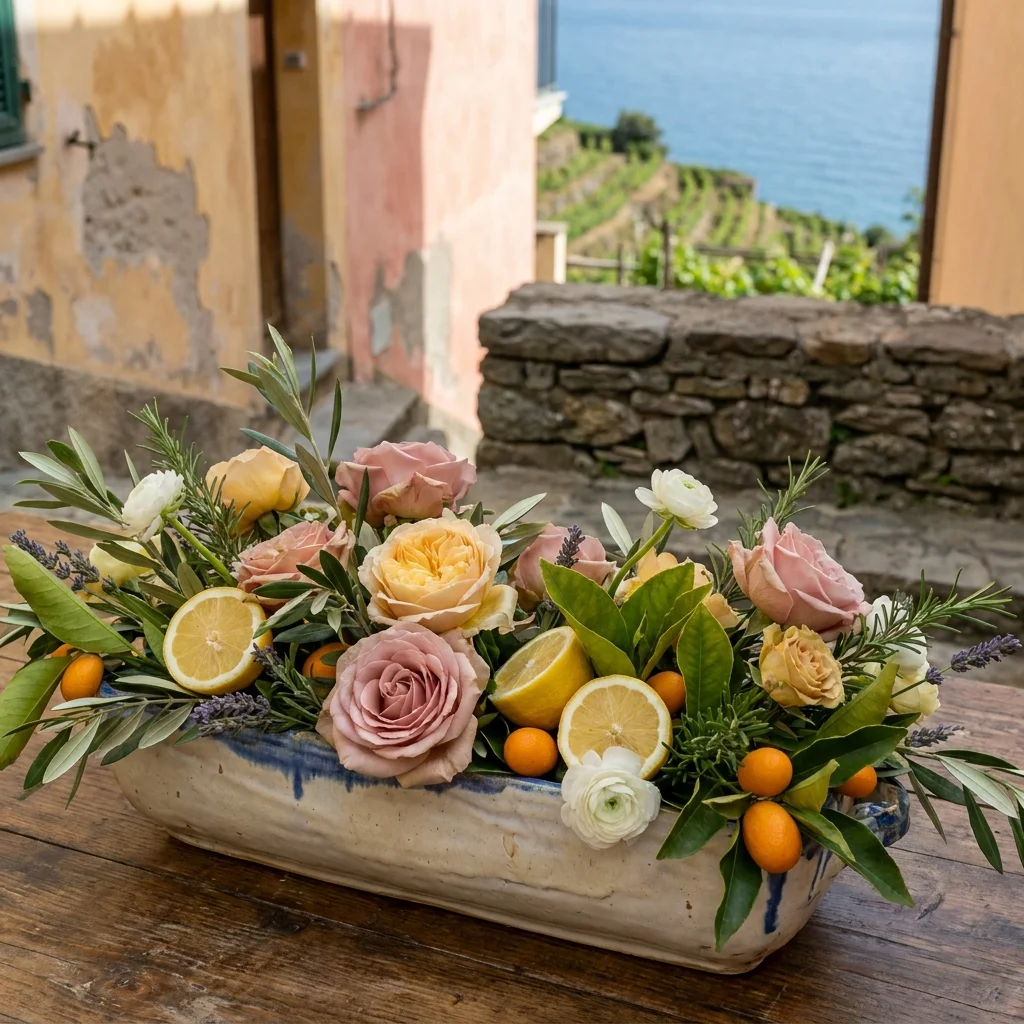
That is the palette we work from. Faded fresco pink. Sun-bleached ochre. The specific green of a lemon leaf rather than eucalyptus grey. Ceramic from the Ligurian and adjacent workshops — hand-thrown, slightly irregular, glazed in cream and Savona blue — gives the table its material anchor. Citrus appears whole and cut, never as a motif. Linen is dyed to a shade that sits between the plaster of Corniglia and the sand of Monterosso, and we sample it under afternoon sun on site because coastal light reads dyes two tones warmer than a Milan showroom does.
Glassware is where restraint matters most. A tall coloured goblet is a strong gesture; four of them per setting on a narrow table becomes noise. We typically specify one hand-blown stem in a smoked or pale amber tone, alongside two clear crystal glasses, so the coloured piece carries the accent. Couples who love a more emphatic glass statement may prefer the language we describe in our Venice tablescape with Murano glass — a different city, a different architectural grammar, and a table that belongs indoors under a frescoed ceiling.
A refined coastal Italian wedding table earns its sense of place through material and colour, not through symbols. The wider stylistic framework across the region — and the distinction between the Riviera di Levante and this five-village stretch — is covered in our Italian Riviera tablescape guide; here the constraints are tighter and the design consequently quieter.
Low Arrangements vs Elevated Ones: How Centrepiece Height Governs Sightlines and Plate Service
On a table 85 centimetres wide, height is not a stylistic preference. It is a service question. Our design rule, applied across every cinque terre wedding tablescape we produce, is that floral and candle elements sit either below 28 centimetres or above 70 — the seated eye line falls between those figures, and anything occupying it blocks conversation across the table and ruins the reverse-angle photograph.
Elevated arrangements above 70 centimetres are magnificent and, on most sea terraces, unwise. They catch wind, they require a stem base that steals table surface, and they interfere with overhead pergola structures where these exist. On the inland garden venues we use them freely, often in alternating rhythm with low runs. On the terraces, we build horizontally: a continuous low ribbon of seasonal material, broken by hurricanes, interrupted by ceramic footed bowls with fruit.
Then there is the plate itself. A charger of 33 centimetres plus a bread plate plus a coastal menu card plus a place-card object consumes 46 centimetres of table depth per cover. Add a shared central runner of 30 centimetres and the arithmetic on a narrow table stops working. We resolve this by moving the menu onto the napkin, by using a ceramic place marker rather than a stand, and — where service style allows — by plating first courses in the kitchen so no platters compete for surface. The interplay between menu structure and table surface is real, and our thinking on regional courses is laid out in our Italian wedding menu ideas, which we use as a starting point when designing service flow.
Sightlines, plate service, and photographic clarity are one problem, not three. Our photographers walk the table with us during the afternoon setup, and we adjust hurricane placement so that the low sun does not flare directly through glass into the lens at the moment of the first toast. The standards we hold our image team to are described in our guide to working with a wedding photographer in Italy.
Load-In, Porterage, and Breakdown: The Production Reality Behind the Table
This section is deliberately technical. The aesthetic decisions above are only deliverable if the production behind them is precise.
Vehicle access in the Cinque Terre is restricted or non-existent in the historic cores of all five villages. Practical consequences, as our team manages them:
- Transfer chain. Rental crates travel by van to a legal drop point, then by hand cart, hand-carry crew, or boat. Where a terrace is reached only from the water, crates are loaded at a nearby harbour and transferred by tender. Our logistics on private sea transfers are covered in the context of the San Fruttuoso wedding, a bay with comparable constraints.
- Porterage window. Hand-carry of glassware, ceramic, and linen for a 40-guest table typically takes a crew of four between two and three and a half hours. We schedule this to begin no later than 11:00 for a 19:30 seated dinner, so that the table is fully dressed before ceremony guests arrive.
- Crate strategy. We specify padded, stackable crates sized for stairways rather than pallets. Breakage on hand-carried routes runs materially higher than on level venues, so we build a 10% overage on glass and ceramic into every order.
- Power. Several terraces have single-phase domestic supply only. Ambient lighting, sound, and catering equipment are load-calculated in advance; where the supply is insufficient we bring a silenced generator positioned out of guest earshot.
- Breakdown. Many village venues carry municipal noise and access limits between 23:30 and 01:00. Where breakdown cannot be completed within the limit, we secure a next-morning collection window with the venue in writing at contract stage, not in the final week.
- Weather protocol. Every terrace design we produce has a validated indoor or covered alternative with a defined decision hour — usually 14:00 on the wedding day, based on the local marine forecast — and a table plan that preserves the design intent rather than improvising it.
Six suppliers touch the table: planner, florist, caterer, rental house, venue, and photographer. In our production, the planner owns the schedule and the rental house reports to us, not to the venue. That is why our timings hold.
What the Design Budget Covers — and What Is Quoted Separately
Our Liguria collections are complete celebrations with published guest bands and inclusions that vary by collection, with the venue and reception programme defined on each linked product page. The table is designed and installed within the collection scope. Below are the real collections at their published prices and guest basis.
| Collection | Published price / guest basis | Venue and setting |
|---|---|---|
| The Riviera Castle Wedding | €59,000 for 30 guests; €69,000 for 50; €85,000 for 70 | Castello Canevaro, Zoagli — exclusive use, symbolic ceremony, welcome cocktail, wedding lunch or dinner; published collection also includes floral styling, professional photography and videography, DJ, planning and Kiss Me Italy Concierge, with overnight stay and breakfast in the castle for 16 guests |
| The Aristocratic Villa Durazzo Wedding | €59,000 for 30 guests; €69,000 for 50; €85,000 for 70 | Villa Durazzo, Santa Margherita Ligure — exclusive use, symbolic ceremony, welcome cocktail and wedding reception; published collection includes floral styling, professional photography and videography, DJ, planning and Kiss Me Italy Concierge |
| The Iconic Portofino Castle Wedding | €59,000–€85,000; published from €59,000 for 30 guests | Castello Brown — ceremony on the panoramic terrace and reception in an exclusive restaurant; published collection includes floral styling, professional photography and videography, DJ, planning and Kiss Me Italy Concierge |
| The Splendido Legend Wedding | €94,000 for 60 guests | Belmond Hotel Splendido — Secret Garden ceremony, Champagne corner and private dinner; published collection includes florals, professional photography and videography, DJ, planning and Kiss Me Italy Concierge |
| The Riviera Abbey Wedding — La Cervara | €149,000–€199,000; published variants for 30, 50 and 100 guests | Abbazia della Cervara — three-day exclusive-use programme, with rooms and suites for up to 34 guests for three nights; published collection includes wedding programme, florals, professional photography and videography, DJ, planning and Kiss Me Italy Concierge |
The linked product page governs the published guest band and included programme for each collection. Across the Liguria range, venue and wedding programme, floral styling, professional photography and videography, DJ, dedicated planning and Kiss Me Italy Concierge are included according to the selected collection; accommodation is included only where the individual product states it. Quoted separately are items outside the published scope, such as additional guests beyond the selected guest band, guest travel or accommodation not already included, legal or municipal formalities, additional event days, transfers, albums or other bespoke upgrades. Any applicable IVA treatment is confirmed in the written proposal before booking. The final written proposal confirms the exact guest configuration, inclusions and total before you commit.
For couples building a table outside a collection — at a private terrace, a villa with accommodation, or a restaurant with sea frontage — the components price as follows. These are indicative ranges from current supplier documentation and are confirmed venue by venue.
| Component | Indicative range | Included / quoted separately |
|---|---|---|
| Custom-dyed linen (cloth, napkins, runner) | €180–€420 per 10-guest table | Dyeing, hemming, laundering and delivery within La Spezia province included; hand embroidery and monogramming quoted separately |
| Handmade ceramic charger and plate service | €22–€55 per guest | Rental, transport, wash-up included; breakage overage and IVA 22% separate |
| Glassware (three stems, one hand-blown) | €9–€26 per guest | Rental and polishing included; replacement of damaged pieces charged at cost |
| Flatware (brushed pewter or plated gold) | €7–€18 per guest | Rental and polishing included; salt-air-resistant finish specified as standard |
| Candlelight architecture (hurricanes, votives, wax) | €45–€180 per table | Glass, weighted bases, wax and reserve wax set included; wind lanterns for fully exposed terraces quoted separately |
| Table floral design (low seasonal ribbon) | €180–€650 per table | Design, conditioning, installation and removal included; imported stems and elevated structures quoted separately |
| Stationery and calligraphy (menu, place marker) | €14–€52 per guest | Design, print and hand calligraphy included; letterpress, foiling and overseas shipping separate |
| Design direction, installation and breakdown crew | €1,800–€6,800 | Site validation, technical drawings, dressing crew and breakdown included; porterage surcharge and next-morning collection separate where access requires it |
Indicative ranges. Contact Kiss Me Italy for a personalized proposal.
Access costs are specific to this coastline and are worth isolating, because they are the line item couples never anticipate.
| Access item | Indicative range | Notes |
|---|---|---|
| Hand-carry porterage crew | €38–€58 per person, per hour | Minimum four hours; applies to stair-access terraces only |
| Boat transfer of rental crates | €450–€1,500 | Return trip, harbour handling included; weather-driven rescheduling at no charge |
| Municipal public-space or terrace occupation permit | €150–€950 | Varies by comune and duration; filed by our team, fees at cost |
| Silenced generator and cabling | €300–€950 | Delivery, fuel and technician included where supply is single-phase |
| Next-morning breakdown and collection | €400–€1,200 | Applies where venue access closes before breakdown completion |
Indicative ranges. Contact Kiss Me Italy for a personalized proposal.
Couples comparing regions often ask how these figures sit against other Italian destinations. Our transparent breakdown of Portofino wedding cost is the closest comparison on this coast, while the structural differences of a palazzo reception are set out in our Venice wedding cost guide. If you would like a venue-specific validation of the numbers above, our team will prepare one on request — write to us with your date and approximate guest count and we will confirm what is feasible on which terrace.
Late May vs Mid-September: How Two Months Change the Same Table
The same design behaves differently eight weeks apart, and the difference is measurable at table level. In late May, the sea is still cool, evening humidity is moderate, and linen holds its press through dinner. Peonies and the first garden roses are at their best. Sunset falls around 20:45, which means candlelight becomes visually dominant only after the main course — so the table must carry itself in daylight.
Mid-September inverts this. Sunset arrives close to 19:35, candlelight carries the entire seated dinner, and the palette can go deeper: fig, dahlia, bronze fennel, late citrus. Humidity is higher and salt haze is heavier, so we specify a second linen set and increase the glass polish allocation. September tables photograph warmer and need roughly 30% more wax than May tables for the same visual effect.
August is the month we discuss most carefully with couples. Heat retained in stone terraces through the evening affects both flowers and guests, and we shift seated service later, condition all material in refrigerated transport, and favour ceramic over metal surfaces that hold warmth. Our seasonal guidance for the destination as a whole sits alongside our broader Liguria wedding planning material, and we adapt it per terrace rather than per month.
The Twenty Minutes When Guests Find Their Seats
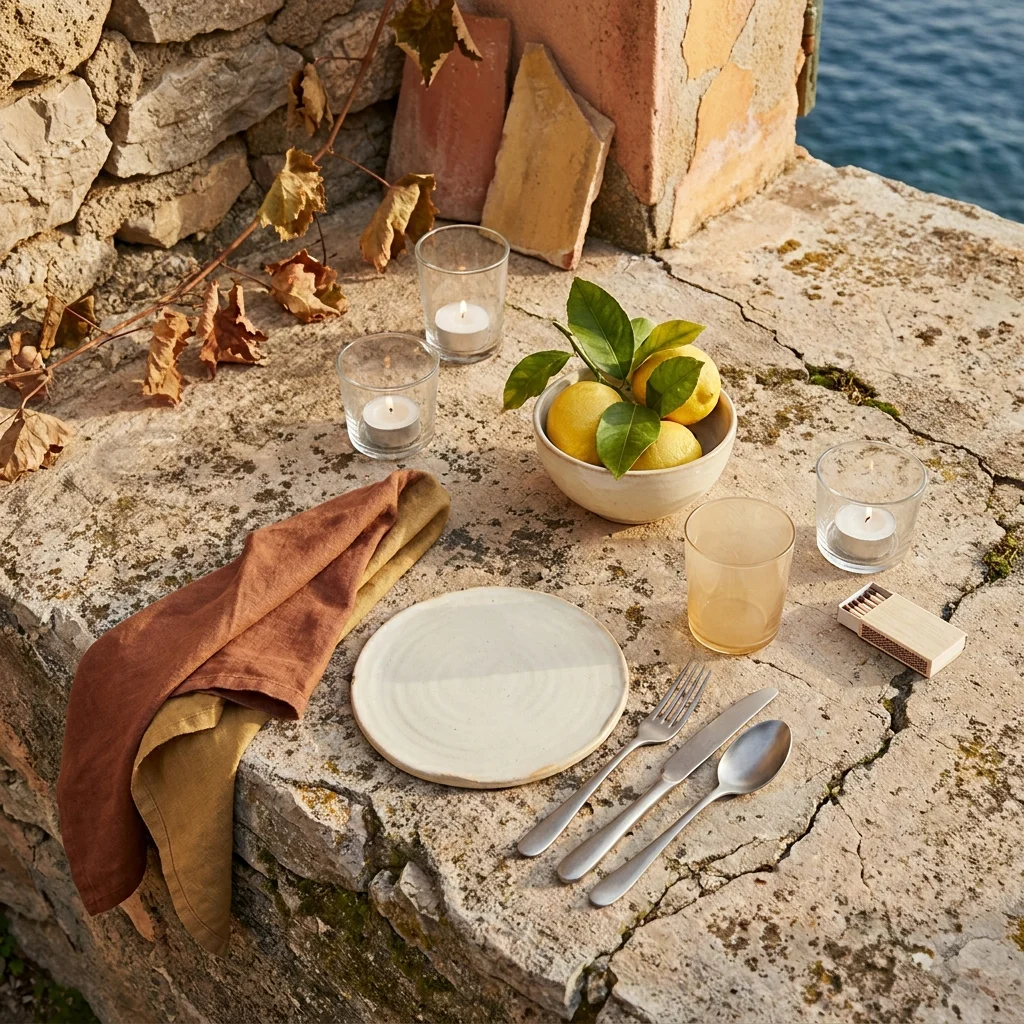
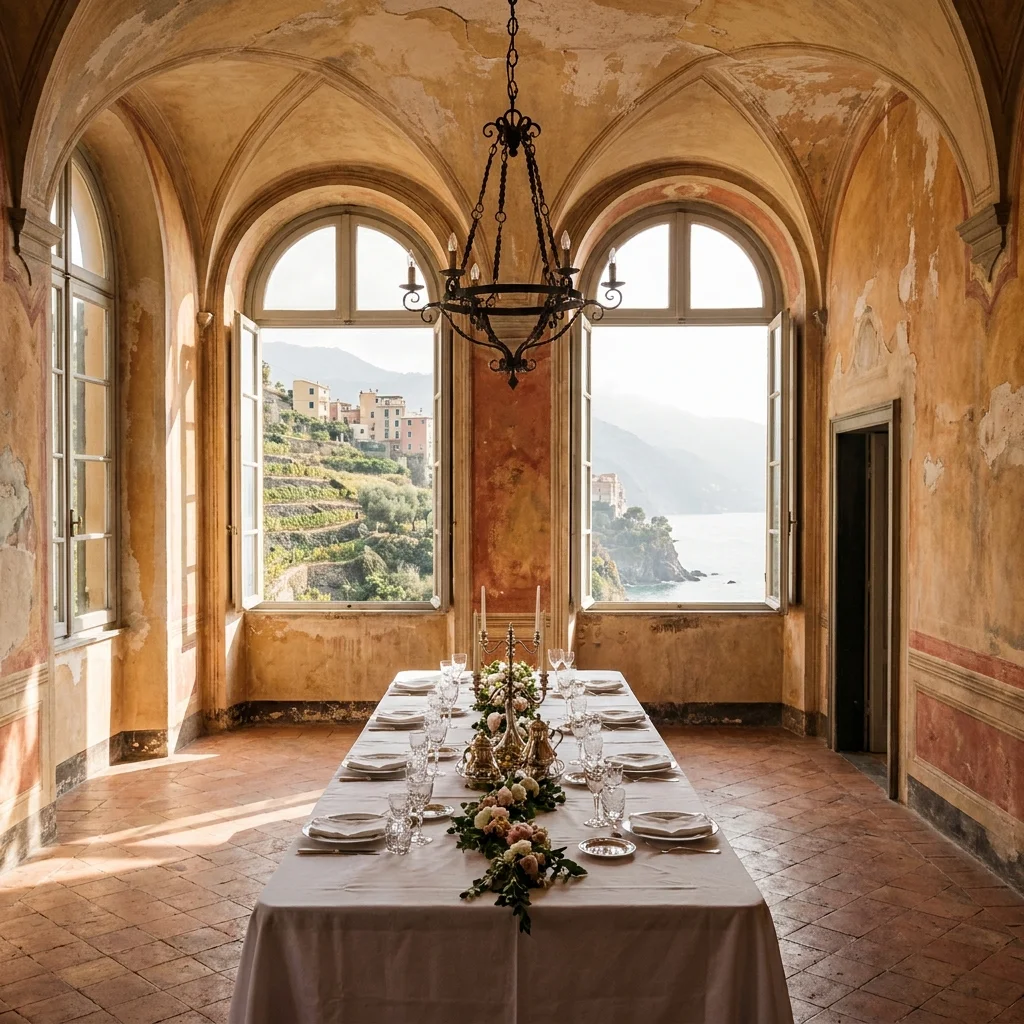
They come up from the cocktail with glasses still in hand. The light has dropped behind the headland, and the terrace has changed while they were not looking: the long table now runs the full length of the parapet, dressed in linen the colour of old plaster, and forty small flames sit low along its spine.
Someone reads their name from a hand-painted ceramic disc and keeps it. A grandmother touches the linen. The groom’s brother leans over the parapet, then turns back to the table, and cannot decide which view he prefers.
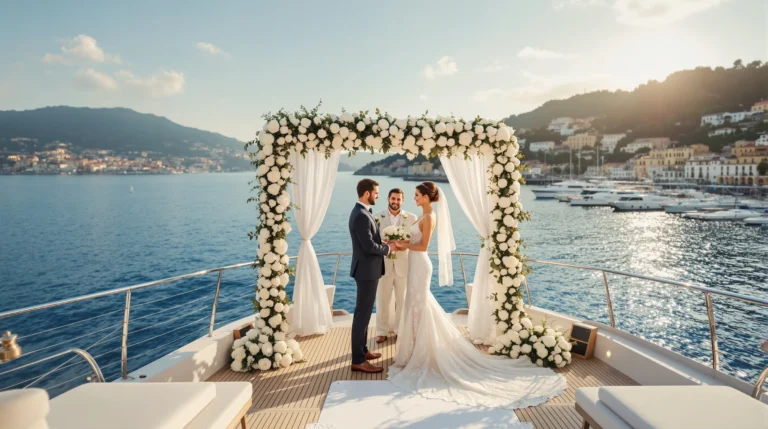
This is the moment the whole production exists for. Not the photograph — the recognition. A well-made cinque terre wedding tablescape makes guests feel that this dinner could not have happened anywhere else on earth, and it does so before a single plate arrives. The food then confirms it, which is why the character of Italian wedding food and the character of the table are designed in the same conversation.
Our Coordination vs the Standard Supplier Chain: Who Actually Owns the Table
In the conventional model, a couple books a venue, the venue recommends a caterer, the caterer sub-contracts a rental house, and a florist arrives independently on the day. Nobody owns the table. Decisions get made at 16:00 by whoever is holding the ladder.
We work differently. Our team issues a technical drawing of the table at scale — cover width, runner width, hurricane positions, service points — which the caterer, the florist, and the rental house all work from. Deliveries are sequenced: linen and base layer by 11:00, glass and ceramic by 13:00, floral installation from 15:00, candle set at 17:30, final pass with the photographer at 18:15. The bride sees the finished table before her guests do, in daylight, with time to change nothing or everything.
Venue-side, our relationships are built over seasons rather than enquiries. Castello Brown, whose fortifications above the Portofino harbour were rebuilt in the sixteenth century and restored as a private residence by a British consul in 1867, holds different terrace rules from Villa Durazzo, commissioned in the seventeenth century by the Durazzo family, whose Italian gardens allow a wholly different footprint. Abbazia della Cervara, founded in 1361 and once host to a Pope and a captive French king, imposes conservation constraints on fixings that no rental house would know unprompted. We know them because we have dressed those rooms.
Couples who want to understand how we build a celebration around a specific table, rather than the reverse, will find our reasoning in our approach to personalized weddings in Italy and in the framework behind our bespoke luxury weddings in Italy. What separates a curated luxury wedding tablescape in Italy from a decorated one is authorship, and authorship requires a single hand. Tell us which village you have in your mind and our team will tell you honestly which terraces there can hold the table you are imagining.
Beyond the Main Table: Welcome Dinners, Second Villages, and Guest Accommodation
Most Cinque Terre celebrations run across three days, and the main table is rarely the only one. A welcome dinner in a second village, a farewell lunch on a vine terrace, a boat aperitivo between the two — each requires its own smaller design and its own access plan. We treat them as a family of tables with one palette and three intensities, so the wedding evening remains the visual peak.
Guest logistics feed directly into this. Where a wedding party is housed together, breakfast and welcome settings can be produced by the same crew with no additional transfer, which is one reason many couples consider a wedding in Italy with accommodation in the Levante. Where guests are spread across villages, our schedule builds in ferry and train timings rather than assuming cars.
Neighbouring destinations extend the same architectural language without repeating it. A rehearsal dinner in the fishing harbour described in our Camogli wedding guide, a formal evening under the palazzi of a Genoa wedding, or the three-day rhythm outlined in our Portofino wedding weekend — each offers a different room, a different century, and a different table. Our team designs the sequence so no two dinners feel like the same evening in a different jacket.
Choosing Where the Table Stands
Everything about a cinque terre wedding tablescape follows from one decision: which terrace, which century, which orientation to the water. Palette, height, wax quantity, porterage hours — all of it is downstream. Couples who begin with the table and let us find the terrace that suits it end up somewhere they had not considered and would not now change.
We measure before we design. We validate before we quote. And we install in daylight, hours before the first guest climbs the steps, because a coastal table on this shoreline forgives nothing improvised. If you are weighing a Cinque Terre wedding reception against other Italian options, our comparison of what a wedding in Italy costs by region will give you honest orientation, and the way we select and direct venues is set out in our guide to choosing a luxury wedding planner in Italy.
When you are ready, send us your date and your guest number. Our team will come back with the terraces that work, the table that fits them, and a figure that does not move.
Frequently Asked Questions
Can an elderly guest or a guest with limited mobility reach a Cinque Terre terrace safely?
It depends on the property, and we tell couples plainly rather than optimistically. Some terraces involve genuine step counts — occasionally ninety or more — with no alternative route, while others are reached by a short, gently graded path from a drop-off point. We walk the access route with each couple during site validation, note resting points and handrail sections, and where a guest cannot manage the climb we arrange a chair-carry or a seated position at a lower-access table rather than excluding them from the plan.
Do any Cinque Terre venues restrict candles or open flame beyond the wind itself?
Yes — several properties, particularly those with wood-beamed ceilings, thatch elements, or proximity to dry vegetation, impose their own flame rules independent of weather, sometimes requiring enclosed glass only or a fixed distance from any structure. We confirm each venue’s fire policy in writing at contract stage and design the candlelight architecture to that policy from the outset, so it is never a last-minute substitution.
How far in advance does a custom tablescape need to be commissioned?
For a fully bespoke ceramic run, dyed linen, and commissioned floral plan, we ask for a minimum of four months, and closer to six where a workshop is producing pieces specifically for the wedding. Peak-season dates compress workshop capacity further, so couples marrying in July or August should expect to confirm materials earlier than the general minimum.
Is it possible to insure heirloom china, silver, or glassware used on the table?
Yes, and we recommend it for anything irreplaceable. We can introduce couples to short-term event insurance covering transit and handling on the wedding day, and we provide the itemised inventory and photographic condition report that most insurers require before issuing a policy. This sits alongside, but is separate from, the handling protocol our crew follows on site.
Who makes the final call if a storm forecast threatens the terrace on the wedding day itself?
The decision sits with our production lead, made jointly with the couple where time allows, at the agreed decision hour written into the contract — typically 14:00 on the day. We do not leave that call to the venue or the caterer, because only our team holds the full picture of the covered alternative, the crew schedule, and the guest experience on both sides of the decision.
Yes. We coordinate bilingual or trilingual wording directly with your stationer or our own calligrapher, confirm translations before printing, and organise the seating chart so language variants are matched to each guest without any visible inconsistency across the table. This is planned alongside the dietary coding system, since both draw from the same guest data.
Can heirloom tableware be transported from our home country and incorporated safely?
Yes, and we do it regularly with family porcelain, silver, and glassware. We ask for photographs and dimensions in advance, integrate the pieces into the table drawing, and assign a named member of our crew to their handling, packing, and return at the end of the evening.
How are damaged or missing rental pieces charged after the reception?
Rental houses charge breakage at replacement cost, itemised, after the return count. We build a 10% overage into glass and ceramic orders on hand-carried venues, which absorbs normal loss, and any charge beyond that is passed through at cost with the supplier’s documentation attached.
We reserve signature pieces at the design-approval stage precisely to avoid this, and we hold a documented second option for every specified material. If a workshop cannot deliver, we present the alternative with physical samples rather than substituting silently.
Yes. We use discreet coded marks on the reverse of place cards or a subtle variation in napkin fold, cross-referenced to the caterer’s seating chart, so service is accurate without any visible labelling on the table.
Can our overseas stationer coordinate directly with the local planner and rental team?
Absolutely — we work with couples’ own stationers frequently. Our team supplies the table drawing, ceramic and linen colour references, and final guest counts, and we handle Italian customs documentation and delivery timing so printed material arrives intact and on schedule.