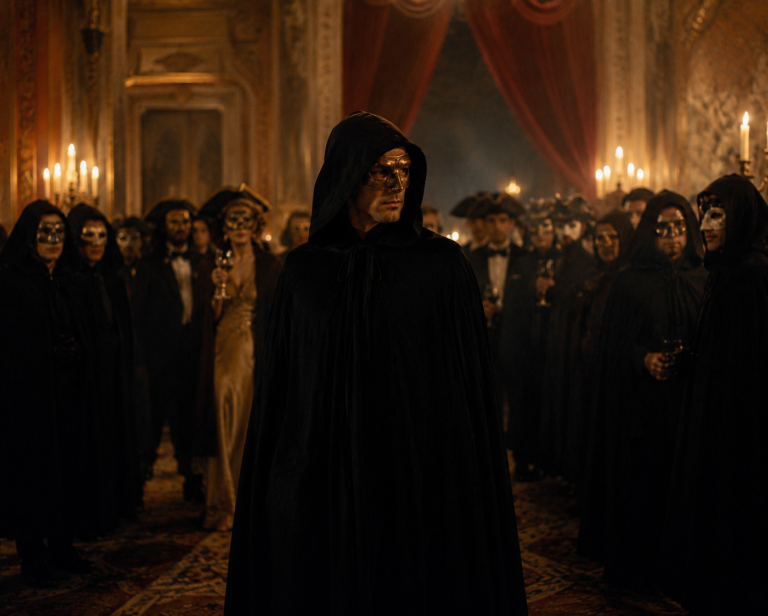
The most common question we field from international guests, often six weeks before a celebration in the hills above Florence, is deceptively practical: will linen read as too casual inside a frescoed sixteenth-century hall? It rarely does. But the answer depends on the building, the hour, and the season — and that nuance is precisely what an invitation rarely communicates clearly.
What to Wear to an Italian Wedding
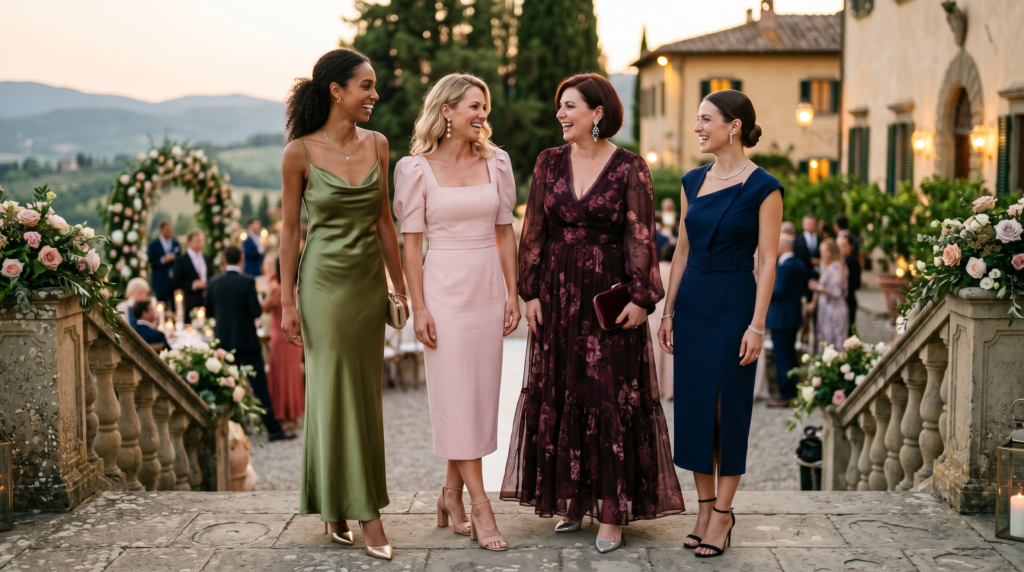
What to wear to an Italian wedding depends on the venue type and the season: lightweight tailoring, midi or floor-length dresses, and refined fabrics suit most celebrations. For men, a tailored suit or linen blazer; for women, an elegant dress in fabrics that move. Guests avoid white and overly bridal looks, while black is perfectly acceptable when styled with elegance. The setting — a lake villa, a Tuscan estate, a coastal terrace, a city palazzo, or a countryside courtyard — refines everything that follows.
At Kiss Me Italy, we treat guest attire not as a private styling decision left to chance but as part of the choreography we curate for the couple. When we coordinate a wedding inside a Baroque palazzo or on a vineyard terrace, we shape the language of the invitation, the dress-code phrasing, and the practical guidance that reaches every guest. The result is a room where everyone looks as though they belong to the same story.
Why a Venetian Palazzo and a Tuscan Vineyard Call for Entirely Different Wardrobes
Consider two buildings. The first, a Venetian palazzo commissioned in the late sixteenth century, holds its frescoes in rooms still licensed for ceremonies — gilded stucco, Murano glass, marble underfoot. The second, a vineyard estate in the Chianti hills, opens onto gravel courtyards and long cypress avenues where the reception unfolds under open sky.
These are not the same evening. A palazzo asks for a heightened register: floor-length silhouettes, structured tailoring, fabrics that catch candlelight. A vineyard rewards lightness, movement, and a palette drawn from the landscape itself. To dress for one as though it were the other is the single most frequent source of guest uncertainty — and the easiest for us to resolve through clear communication.
The architectural grammar of a space sets the tone before a single guest arrives. We read that grammar for our couples. When a celebration unfolds in one of the historic wedding venues in Venice, the city’s own theatricality lifts the dress code naturally; guests sense it the moment they step from the water taxi onto the fondamenta. A vineyard wedding in Italy, by contrast, invites a relaxed sophistication that still photographs beautifully against rows of vines at golden hour.
This is why generic dress-code labels fail international guests. “Formal” means one thing in a marble salone and another on a terraced hillside. Our role is to translate the venue into wardrobe guidance that feels effortless rather than prescriptive.
Italian Wedding Guest Attire by Setting: Lake Villa, Coastal Terrace, City Palazzo, and Countryside
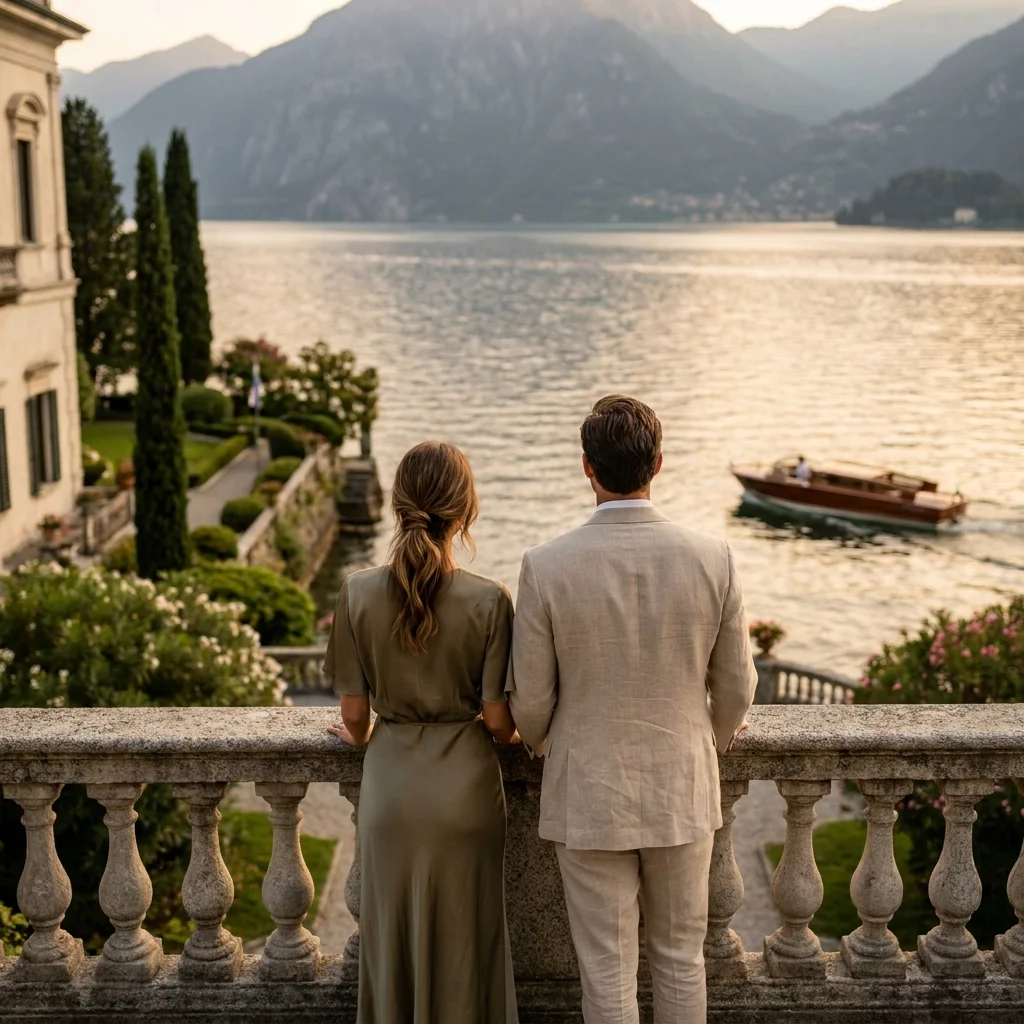
The clearest way to understand what to wear to an Italian wedding is to begin with where the celebration takes place. Each Italian setting carries its own visual logic, and that logic should guide the wardrobe more than any abstract dress-code word.
Lake Villa Weddings: Lombardy Elegance with Restraint
The villa weddings of the northern lakes carry a particular quietness. These are gardens descending in terraces toward the water, neoclassical façades, and that distinct Lombardy refinement that prizes understatement over display. Here, guests do well with tailored elegance in muted tones — sage, dove grey, soft blue, warm ivory short of bridal white.
For the lake celebrations we coordinate around Lake Como wedding estates and Lake Garda venues, we guide guests toward fabrics with subtle sheen rather than sparkle, and silhouettes that move gracefully across lawns and stone steps. The lakes are cool in the evening even in July; we advise a wrap or light jacket without ever framing it as a worry.
Coastal Terrace Weddings: The Amalfi and Ligurian Question of Heat and Wind
The coastal terraces present two practical constraints guests rarely anticipate: the midday heat between late June and mid-August, and the sea breeze that lifts hems and unsettles fine hair. Our solution is timing and fabric. We schedule ceremonies after the heat softens, and we steer guests toward materials that flow rather than cling.
For celebrations along the Amalfi Coast and across the Ligurian coast, women look exceptional in lightweight floor-length or midi dresses that catch the wind beautifully on camera. Men suit unlined linen or summer-weight wool blazers in stone, sand, or pale blue. A seaside wedding in Italy is no place for heavy black wool at two in the afternoon — though black returns elegantly after sunset. Read next: summer wedding in Italy.
City Palazzo Weddings: The Highest Register
A frescoed palazzo in Rome, Florence, or Venice raises the bar without apology. These rooms were built to impress, and they ask guests to meet them. Floor-length gowns, formal cocktail dresses, dark tailored suits, and considered accessories belong here.
When we plan inside the noble residences of Rome or the Renaissance palaces of Florence, the scenography itself becomes a character — and guests dressed with intention complete the frame. We communicate this register clearly so that no one arrives feeling under-dressed against gilded ceilings.
Countryside and Vineyard Weddings: Refined Lightness
The Tuscan and Umbrian countryside celebrations favour a softer, sun-warmed palette: terracotta, olive, dusty rose, cream. Long dresses in natural fibres, linen suits, loafers or elegant flats for gravel and grass. The countryside rewards comfort that still reads as polished — and our guidance protects guests from the discomfort of stilettos sinking into a courtyard at the aperitivo hour.
Whichever setting your celebration takes, our team translates it into clear, gracious wardrobe direction. Speak with us and we will shape that guidance around your venue from the very first conversation.
What Do Men Wear to an Italian Wedding: Suits, Linen, and the Detail Most Guests Overlook
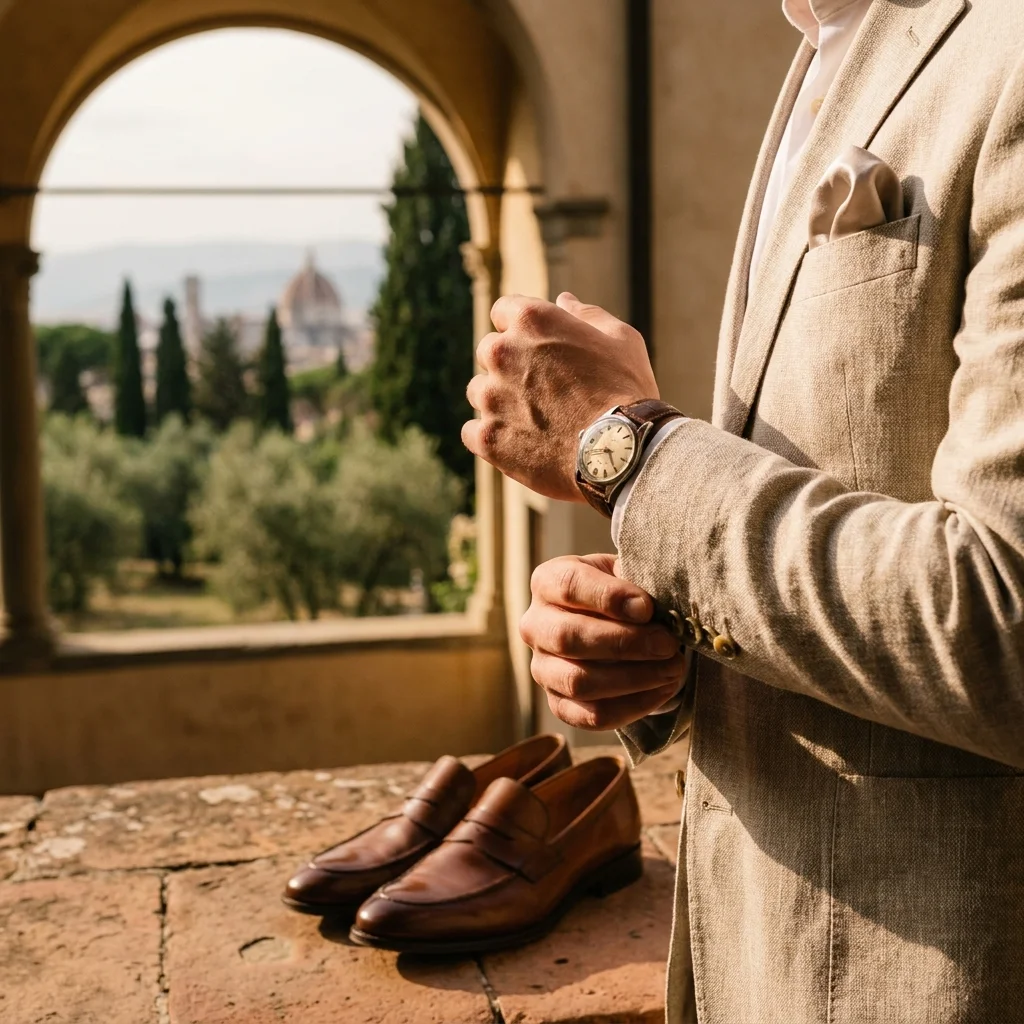
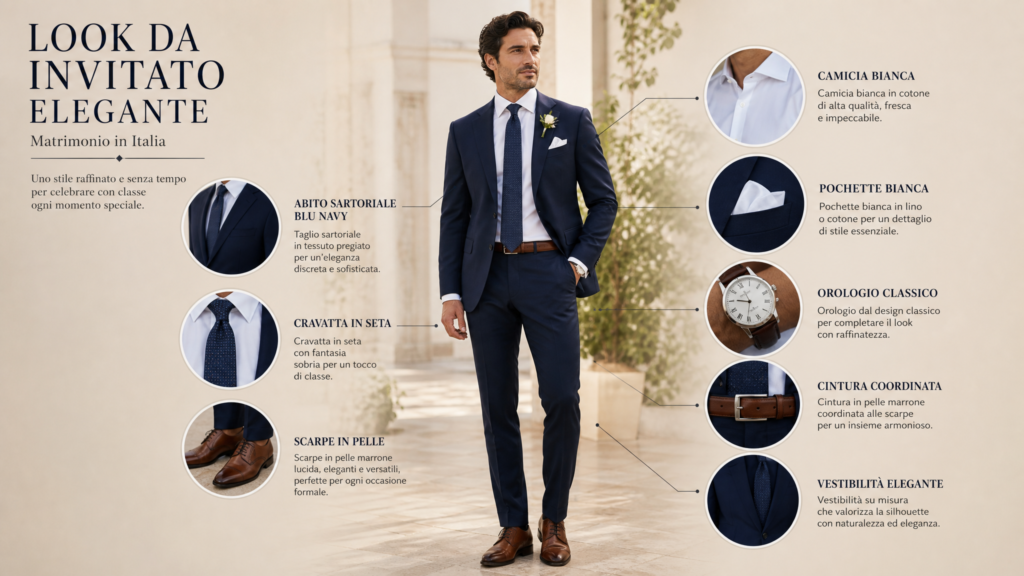
Men’s attire at an Italian wedding deserves the same consideration as women’s, and Italian men set a high standard. The country that gave the world its finest tailoring expects a certain care. The good news: the rules are clear, and we make them clearer.
For a men Italian wedding outfit, the foundation is a well-fitted suit. In spring and autumn, mid-weight wool in navy, charcoal, or deep grey carries any setting. In high summer, unstructured linen or cotton-blend blazers in lighter tones bring breathability without sacrificing elegance. Fit matters more than formality — an Italian eye forgives a relaxed fabric far sooner than a poorly cut shoulder.
The detail most international guests overlook is the shoe. Italians read footwear instantly. Leather loafers, polished oxfords, or elegant suede do the work that sneakers and casual lace-ups undo. For coastal and countryside weddings, a refined loafer worn without socks is entirely correct and quietly stylish.
Ties remain a question of register. A city palazzo welcomes a tie or even black tie when the couple requests it; a vineyard terrace at golden hour invites an open collar with a pocket square. When couples ask us what their fathers, brothers, and groomsmen should wear, we provide a clear scale — and we coordinate the gentlemen’s palette so that the wedding party photographs as a considered whole rather than a collection of individual choices.
For grooms specifically, the luxury weddings we design often call for bespoke or made-to-measure tailoring, which we help coordinate through trusted ateliers when a couple wishes. This is wardrobe as scenography — the groom dressed in harmony with the venue’s architectural language, not against it.
Can You Wear Black to an Italian Wedding? Colour and Fabric Through an Etiquette Lens
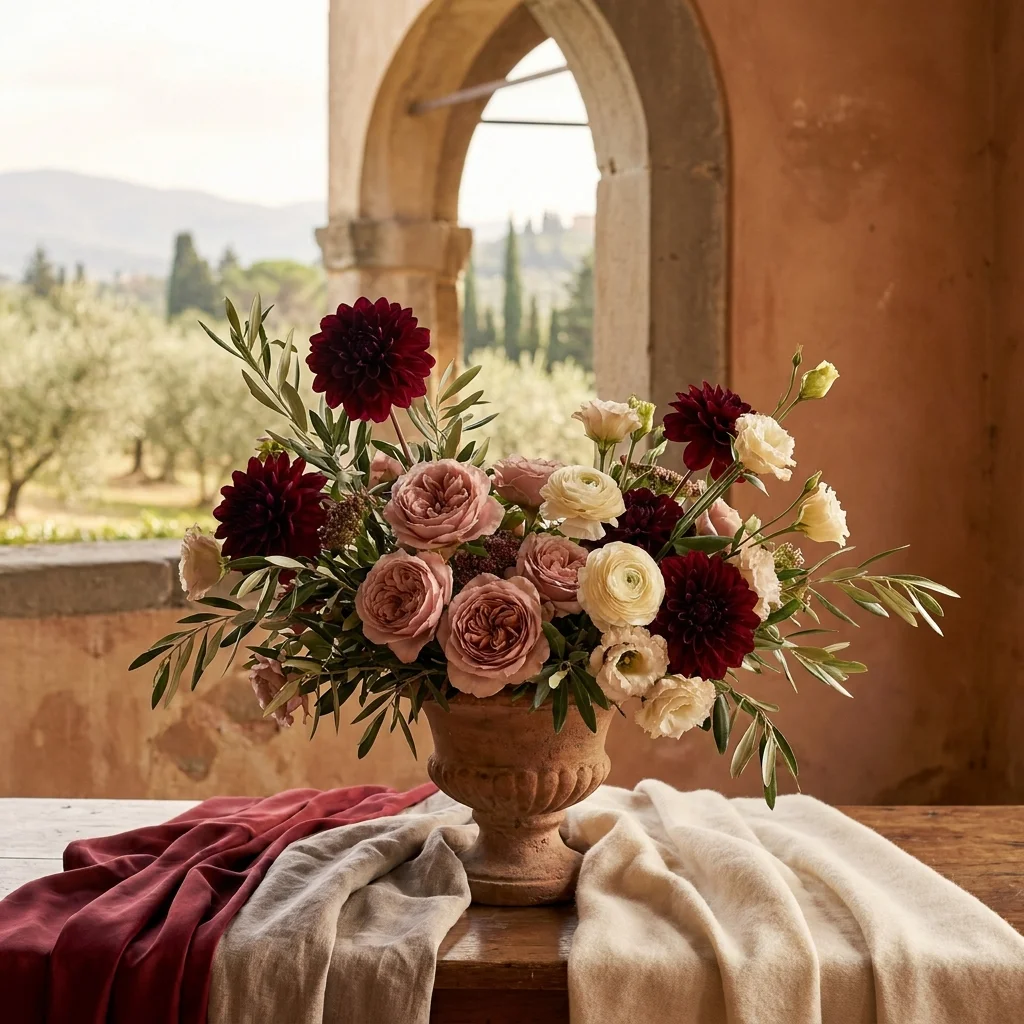
Let us answer the most-searched colour question directly. Yes, you can wear black to an Italian wedding. Black is elegant, classic, and entirely welcome at Italian celebrations, particularly evening receptions and city palazzo weddings. The old superstition against it has long faded among the families we work with.
The colour to avoid is white, and anything that reads as bridal — ivory, cream, pale champagne in a long silhouette. This is the one firm convention, and it exists out of respect for the bride rather than rigid rule. We communicate it gently in the guidance we send to guests, so no one need feel the awkwardness of arriving in the wrong tone.
Red deserves a word. It is bold, beautiful, and perfectly acceptable — though guests sometimes prefer to avoid drawing the eye too strongly from the couple. We never frame this as a prohibition. We simply offer perspective, and most guests find their own balance once they understand the room.
Fabric matters as much as colour for the camera. Heavy synthetics photograph flatly and trap heat; natural fibres — silk, fine cotton, linen, light wool — move, breathe, and catch Italian light with depth. This is where attire guidance and photography intersect, and why our coordination with the wedding photographer in Italy extends to palette harmony across the guest room.
For couples building a coherent visual world, our work on the Italian wedding colour palette shapes not only the florals and linens but the tones we suggest to guests, so the entire celebration holds together in every frame.
How Silhouette and Fabric Read on Camera in Italian Light
This section is, frankly, the one most guests never think about — and the one that most changes how a wedding looks afterward.
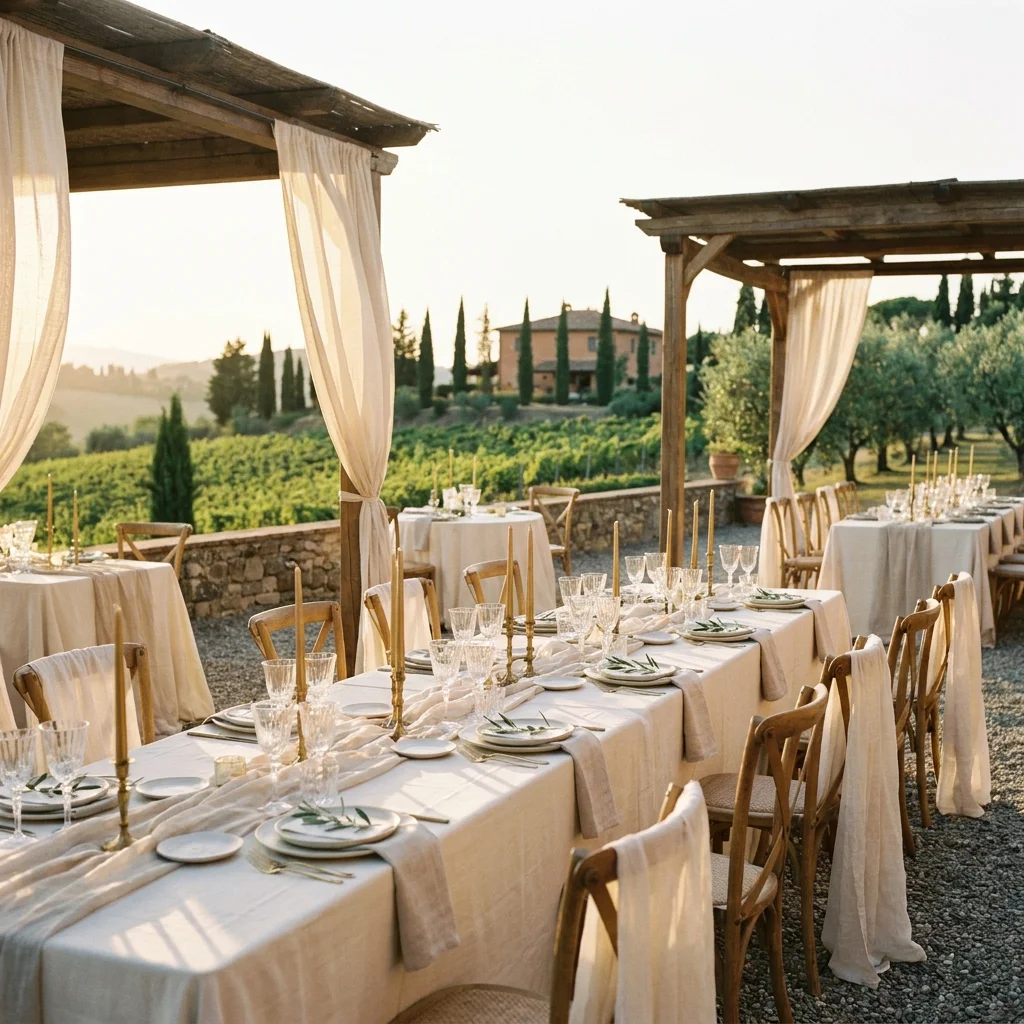
Italian light is directional and warm, particularly in the hour before sunset that photographers call the golden hour. Fabrics that move — silk crepe, chiffon, fine linen — come alive in it. Stiff, structured, heavily beaded pieces can read as static or harsh. We mention this not to dictate, but because guests who understand it tend to choose pieces that flatter both themselves and the collective image of the day.
Silhouette plays against architecture. Long, fluid lines complement the verticality of a palazzo’s columns and the horizontal calm of a lake horizon. Sharp tailoring sits beautifully against Renaissance stone. We share this awareness with couples who want their guests to feel part of the scenography rather than incidental to it.
Palette harmony is the final layer. When a guest room drifts into clashing neons, the wide reception shots suffer. We never impose a uniform — that would be joyless — but the gentle palette guidance we provide keeps the overall image coherent, editorial, and timeless.
How We Protect Guests From Dress-Code Confusion Through Invitation Wording
Here is where attire becomes a planning service rather than a guest’s private guessing game. International guests read “cocktail” or “formal” differently depending on their own country’s conventions — what an American calls black-tie optional, a Briton or an Australian may interpret entirely differently.
We resolve this before it ever becomes confusion. We craft invitation wording that names the dress code and the setting together, so a guest reading “garden formal at a hillside estate” understands both register and terrain. For weddings with guests from many countries, we prepare a short, elegant guidance note — never a list of rules — that translates the dress code into concrete, reassuring direction.
This coordination matters most when families span continents. The aesthetics of an Italian bride celebration carry their own visual expectation, and the cultural traditions woven into a Chinese wedding in Italy bring further considerations we manage with care and discretion. Our role is to make every guest feel correctly informed and entirely at ease.
We also manage the practical realities that follow guests across borders: garments that arrive creased from long flights, the need for last-minute alterations, a steaming service before the ceremony. These are quiet conveniences we arrange so that nothing distracts from the celebration itself.
If you would like your guests to arrive informed, comfortable, and beautifully aligned with your venue, our team will manage that guidance end to end.
Why a June Coastal Wedding and an October Tuscan Wedding Demand Opposite Wardrobes
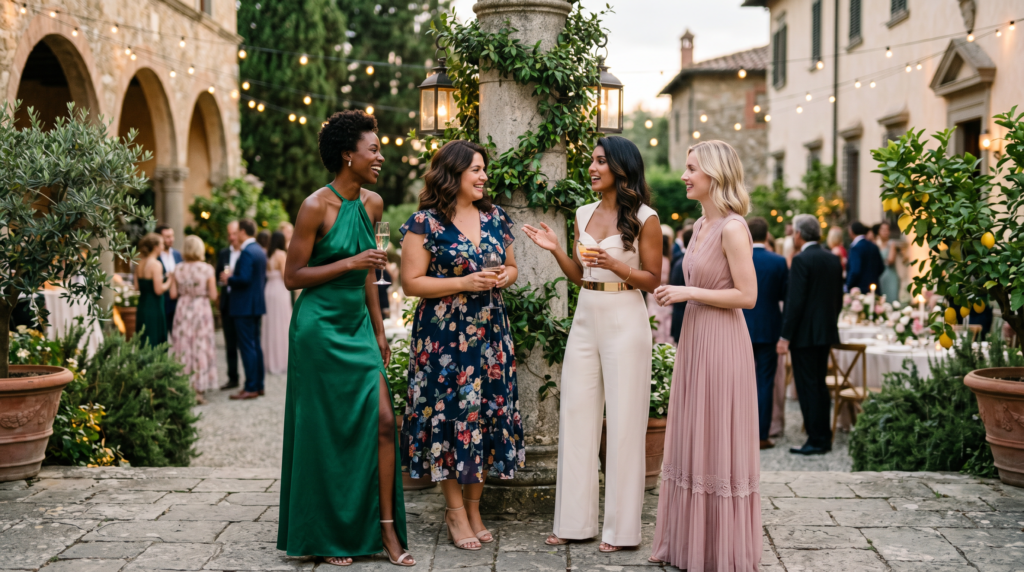
Season reshapes everything. A celebration in June on a southern terrace and one in October among Tuscan vines could not ask for more different wardrobes — and guests planning for both in the same summer often misjudge.
For a summer wedding in Italy outfit, breathability is non-negotiable. June through August brings warmth that lingers into the evening on the coast and in the cities. Light fabrics, open weaves, and pale tones keep guests comfortable through the aperitivo and into the night.
Autumn turns the dial the other way. From late September the Tuscan and lake evenings cool sharply, and guests reach gratefully for a jacket, a wrap, deeper tones, and richer textures — velvet, heavier silk, mid-weight wool. The palette warms with the landscape. Our guidance shifts month by month, drawn from the same understanding that shapes our work on all-inclusive destination wedding planning across the seasons.
The table below sets out how the wardrobe register moves across the Italian wedding calendar.
| Season | Setting Tendency | Guest Wardrobe Register | Practical Note |
|---|---|---|---|
| Late April–May | Gardens, vineyards, cities | Light tailoring, midi dresses, soft pastels | Evenings still cool; a light layer advised |
| June–August | Coast, lakes, terraces | Linen, silk, breathable florals, pale tones | Ceremonies timed after peak heat on the coast |
| September | Vineyards, lakes, countryside | Refined cocktail and formal, warmer palette | Most temperate month; broadest wardrobe range |
| October–early Nov | Tuscan estates, palazzi | Velvet, heavier silk, deeper tones, wool tailoring | Cool evenings; layering becomes elegant, not optional |
Indicative guidance. Contact Kiss Me Italy for a personalized proposal.
What Guest Wardrobe Support and Styling Coordination Actually Cost
This section is deliberately direct. Couples often ask what it costs to extend our care to guest attire, steaming, alterations, and styling coordination — and we believe in transparency before contracts.
The figures below reflect indicative ranges for the guest-facing wardrobe services we coordinate in Italy. They are distinct from the couple’s own attire and from the broader planning fee. Every figure is exclusive of Italian VAT (IVA 22%) unless stated, and travel for ateliers or stylists to remote venues is quoted separately.
| Service | Indicative Range | Included | Quoted Separately |
|---|---|---|---|
| Guest dress-code coordination & guidance note | €450–€1,200 | Invitation wording, multilingual guidance note, palette direction | Print and stationery production; VAT |
| On-site steaming & pressing (wedding party + close family) | €350–€900 | Steaming service the morning of the wedding, on-site technician | Travel to remote venues; guest-wide steaming; VAT |
| Last-minute alterations coordination | €200–€700 | Trusted tailor liaison, scheduling, fittings coordination | The tailor’s own fee per garment; rush surcharges; VAT |
| Personal styling coordination (per session) | €600–€1,800 | Stylist consultation, palette and silhouette guidance, atelier introductions | Garment purchase; stylist travel and accommodation; VAT |
Indicative ranges. Contact Kiss Me Italy for a personalized proposal.
For grooms and groomsmen seeking made-to-measure tailoring, the table below reflects typical atelier coordination in our regions. We manage the relationship; the atelier sets the garment price.
| Tailoring Tier | Indicative Range (per suit) | Included | Quoted Separately |
|---|---|---|---|
| Quality ready-to-wear with alterations | €600–€1,400 | Garment, in-house alterations, fitting | Accessories, shoes, our coordination fee, VAT |
| Made-to-measure (regional atelier) | €1,500–€3,500 | Fabric selection, two to three fittings, finished garment | Premium fabrics, express timelines, travel, VAT |
| Full bespoke (master tailor) | €3,500–€7,000+ | Hand-cut pattern, multiple fittings, finest fabrics | Rare cloths, additional garments, our liaison fee, VAT |
Indicative ranges. Contact Kiss Me Italy for a personalized proposal.
Why Attire Guidance Belongs to the Planner, Not the Guest List
A wedding in Italy is a composed image — of architecture, light, flowers, faces, and fabric. When attire is left entirely to each guest’s interpretation, that composition fractures. When it is gently guided, it sings.
This is the philosophy behind everything we do at the planning we offer across Italy: the venue should become a character in the story, and the people within it should feel they belong to the same frame. We bring decades of architectural literacy — sixteenth-century palazzi, medieval courtyards, Baroque salons — to the simple, human question of how guests should dress.
For couples drawn to a particular destination, our regional guides go deeper still, from the Tuscan estates and Versilia coast to the romance of a Venice wedding and the cliffside drama of a wedding in Portofino. Each carries its own dress-code language, and each we translate with the same care.
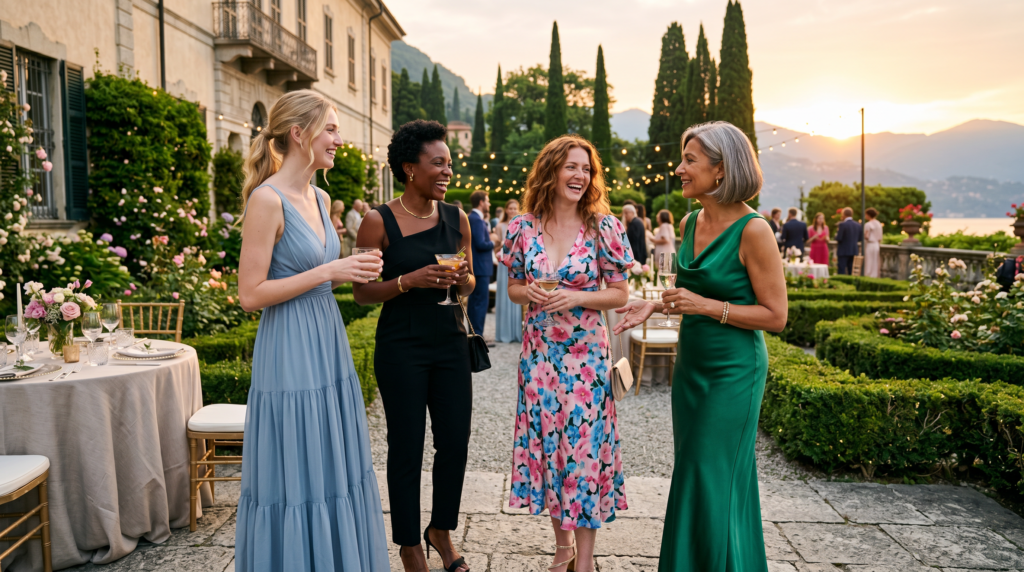
Understanding what to wear to an Italian wedding is, in the end, about understanding the room — and we know these rooms intimately. Begin the conversation with us, and let us shape a celebration in which every detail, down to the fall of a guest’s hem in the evening light, has been considered.
Frequently Asked Questions
What should children wear to an Italian wedding?
Children look charming in soft, breathable formalwear that suits the season — light dresses or linen shorts with a collared shirt for warmer months, and gentle layers for autumn celebrations. We advise comfortable, non-slip shoes for gravel courtyards and stone steps. Our guidance note to guests includes a short line on children so families arrive prepared without fuss.
Is it acceptable for guests to change outfits between the ceremony and the evening reception?
Yes, and at multi-part Italian celebrations it is increasingly common, particularly when an afternoon ceremony moves into a late-evening reception. We coordinate the timeline and any on-site changing arrangements so guests who wish to shift from a lighter daytime look to richer evening attire can do so seamlessly. We simply ensure the logistics support it.
Can guests wear a hat or fascinator to an Italian wedding?
Hats and fascinators are welcome, especially at garden and city celebrations, though they are less customary in Italy than at British weddings. If you love a statement piece, the setting will carry it beautifully. We advise guests on wind exposure for coastal terraces, where a secured headpiece fares far better than a loose brim.
What happens if a guest’s luggage is delayed and their outfit doesn’t arrive?
This is precisely the kind of situation our on-the-ground team resolves quietly. We maintain relationships with regional ateliers and boutiques and can arrange an emergency garment, alterations, or styling support on short notice. The guest enjoys the wedding; we handle the rest.
Should guests match the wedding’s colour palette?
Guests need not match the palette, and we never ask them to — that would feel uniform and joyless. We simply share the general tone so the room harmonizes in photographs without anyone feeling constrained. The aim is coherence, not conformity.
Are open-toe shoes or sandals appropriate for guests?
Elegant open-toe shoes and refined sandals are entirely appropriate, particularly for summer coast and countryside weddings. For uneven terrain — gravel, lawn, cobblestone — we steer guests toward block heels, wedges, or stylish flats that remain graceful underfoot. Stiletto heels and historic courtyards rarely cooperate.
How formal should the parents of the couple dress compared to other guests?
The parents typically sit a step above the general guest register, in formal cocktail or full evening attire aligned with the venue’s grandeur. We coordinate their palette in harmony with the wedding party so the family photographs as a unified, elegant group. This is part of the scenographic care we bring to every celebration.
Do we need to inform guests about local customs around attire before they travel?
For weddings that include a religious ceremony, modest shoulder and knee coverage may be expected inside certain churches, and we include this discreetly in the guest guidance. For civil and symbolic ceremonies the conventions are more relaxed. Our note handles all of this gracefully so no guest is caught unaware.
Planning something special in Italy? Read also our guide: Italy Wedding Shuttle Service: Guest Comfort, Precise Timing, and Transparent Pricing.