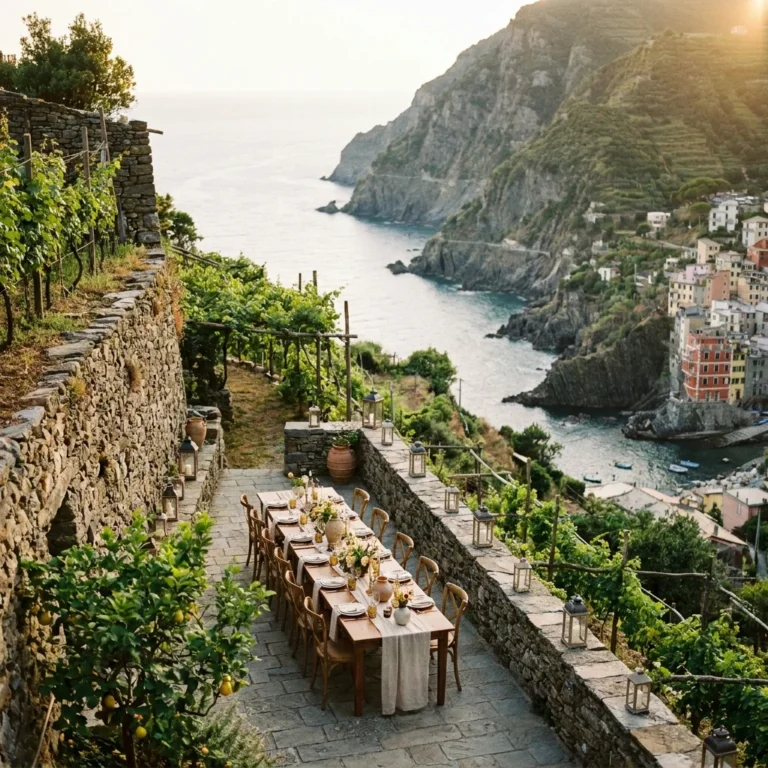
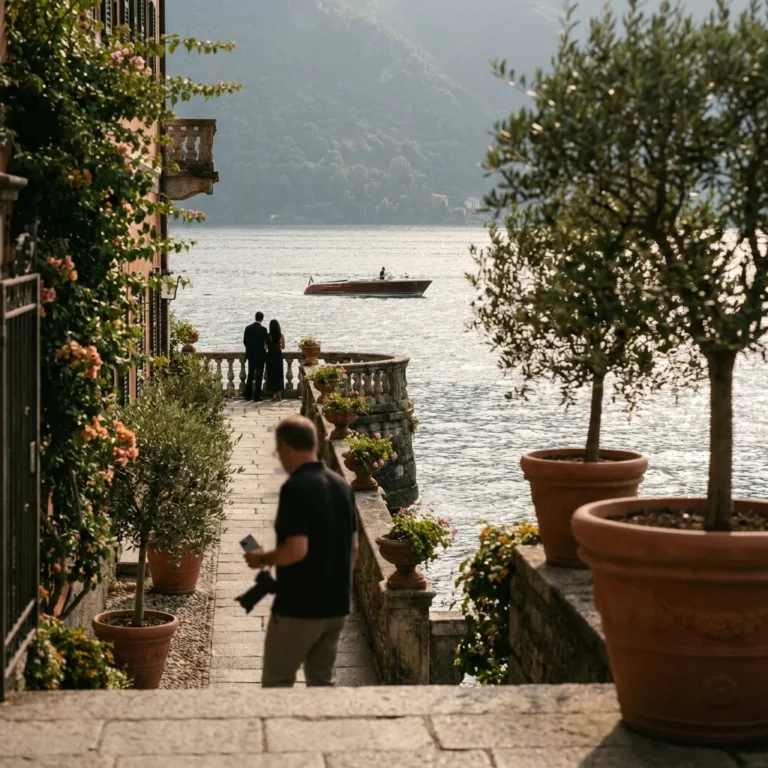
A professional string quartet for a wedding in Italy typically costs between €2,000 and €3,500 for a single ceremony set, with full-day engagements spanning ceremony, cocktail hour, and dinner reaching €3,500–€5,000 or more depending on region, travel requirements, and repertoire complexity. Kiss Me Italy curates and manages every aspect of live string music — from sourcing conservatory-trained musicians to coordinating amplification with historic venue acoustics — so the sound arrives as effortlessly as the light through a sixteenth-century loggia. See also: opera singer for your ceremony.
String Quartet for a Wedding in Italy
Most couples searching for a string quartet wedding Italy experience discover, within minutes, that the marketplace model — browsing directories, requesting quotes from strangers, comparing demo reels without context — collapses the moment you factor in venue-specific logistics. A frescoed salone in a Venetian palazzo resonates differently from a limestone terrace above the Amalfi Coast. The musicians who excel in one setting may be entirely wrong for the other. And the coordination required — permits, power supply, instrument transport by water taxi or hillside shuttle, noise curfews enforced by Italian comuni — is not something a booking platform can manage. It is something a production team manages. That distinction defines our approach.
Why a Fifteenth-Century Salone and a Lakeside Terrace Demand Different Quartets
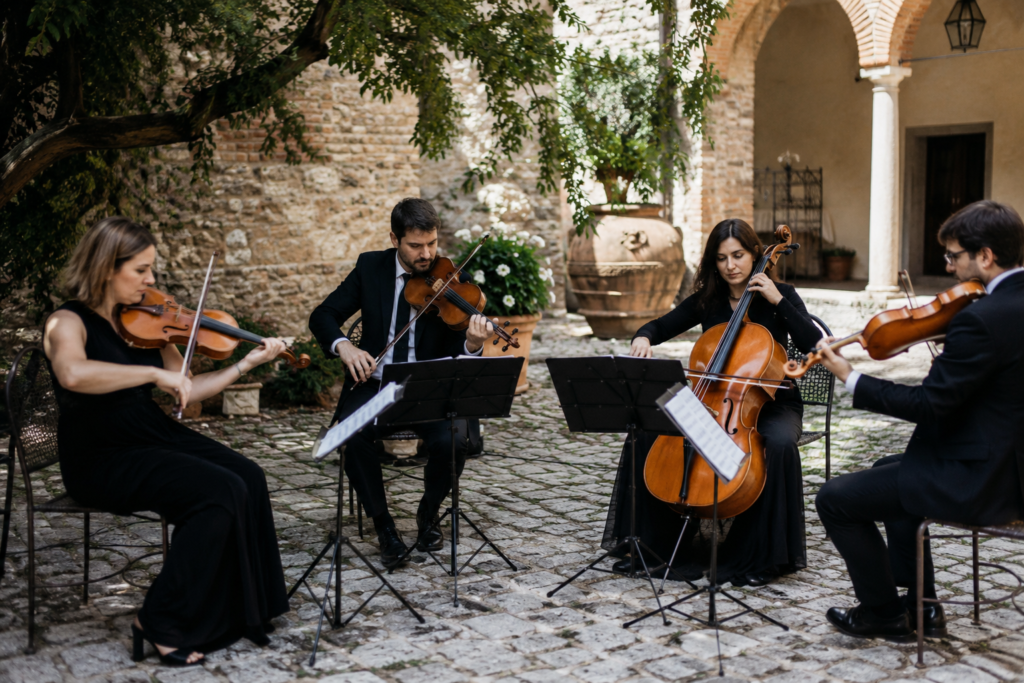
The architectural grammar of a venue determines not just how music sounds but which musicians should play it. A stone-vaulted hall originally built for a Florentine banking family in the 1480s produces natural reverberation that amplifies every bowing imperfection — and rewards every moment of restraint. In such rooms, an unamplified acoustic quartet is not merely preferable; it is the only option that respects the space. We select players whose technique thrives in reverberant environments, where sustained notes bloom and staccato passages remain articulate.
Contrast this with a garden terrace overlooking Lake Como, where sound dissipates into open air within seconds. Here, a discreet PA system becomes essential. We specify directional speakers positioned to project toward the seated ceremony area without competing with the natural soundscape — birdsong, water, wind through cypress. The quartet itself may be identical in training, but the production around them changes entirely. Our team handles speaker placement, cable routing concealed beneath floral arrangements, and sound-check scheduling timed to conclude before the first guest arrives.
For couples considering wedding venues in Venice, the logistics intensify further. Instruments travel by water. Power supply in a medieval building may require a generator positioned in a courtyard, silenced with acoustic baffling. These are not afterthoughts; they are decisions made months before the ceremony, integrated into the full production timeline.
Electric String Quartet vs. Acoustic Ensemble: What the Venue and the Moment Actually Require
The electric string quartet has gained visibility — partly through the Bridgerton aesthetic, partly through social media’s appetite for visual spectacle. An electric ensemble uses solid-body instruments with individual pickups, routed through a mixing desk and amplified through a PA. The sound is louder, more present, and more controllable in outdoor settings. It can also be processed with effects — reverb, delay, distortion — to create a contemporary, cinematic atmosphere.
But louder is not always better. In a Baroque chapel commissioned in the late seventeenth century, an electric quartet would overwhelm the space and clash with the visual register of gilded altarpieces and marble floors. The choice between electric and acoustic is not a preference; it is a design decision governed by venue, ceremony tone, and the emotional arc of the day.
We advise electric ensembles primarily for outdoor receptions, late-evening sets where the quartet transitions into a more contemporary repertoire, or modern venues — a converted industrial space in Milan, a rooftop terrace in Rome. For the ceremony itself, particularly in Italy’s most iconic historic venues, acoustic instruments remain the standard of elegance. Our team manages both options, and many couples choose a hybrid approach: acoustic for the ceremony, electric for the cocktail hour or after-dinner entertainment.
What a String Quartet Wedding Italy Engagement Actually Costs — and What Falls Outside the Performance Fee
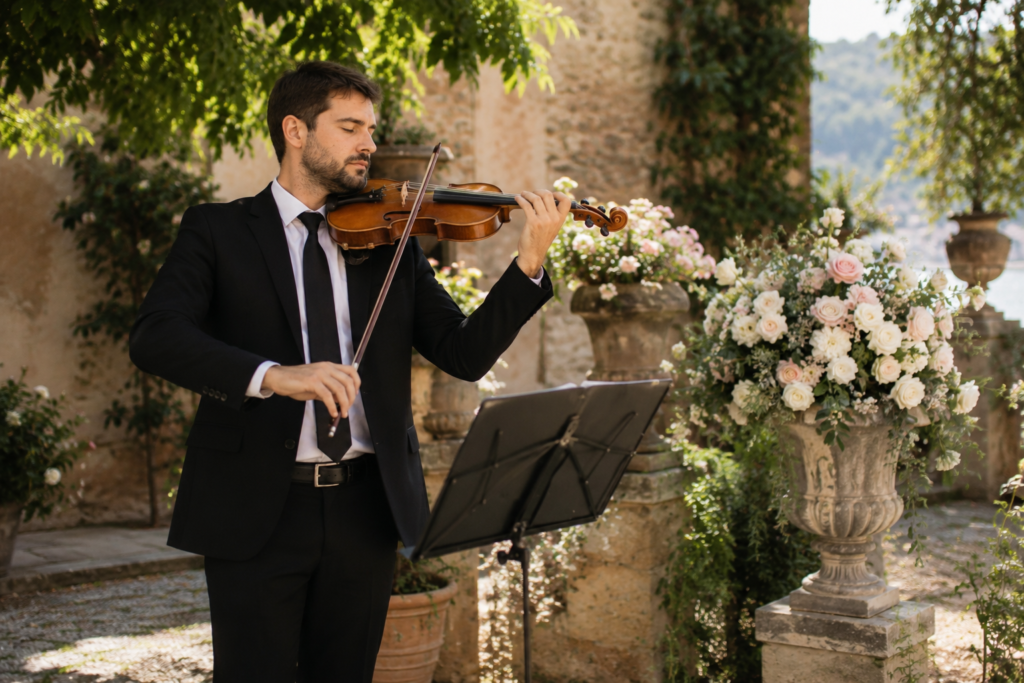
Pricing transparency matters. The performance fee is only one component. Travel, accommodation, equipment, and Italian VAT (IVA at 22%) shape the final investment significantly, especially when the venue sits in a remote Tuscan hilltown or requires boat access along the Ligurian coast. Below, we break down the real cost architecture.
| Engagement Type | Performance Fee Range | Typical Duration | What’s Included |
|---|---|---|---|
| Ceremony only | €2,000 – €3,500 | 30–45 minutes | Pre-ceremony ambient music, processional, recessional; repertoire consultation; one rehearsal |
| Ceremony + cocktail hour | €2,800 – €4,500 | 1.5–2.5 hours | All ceremony music plus 45–60 min cocktail set; one repertoire planning session |
| Full day (ceremony, cocktail, dinner) | €4,500 – €6,000+ | 4–5 hours across sets | Complete musical narrative across all moments; two planning sessions; set-list curation aligned with event timeline |
Indicative ranges based on 2025–2026 engagements. Travel, accommodation, equipment hire, permits, and IVA (22%) quoted separately. Contact Kiss Me Italy for a personalized proposal.
| Additional Cost Component | Range / Status | Notes |
|---|---|---|
| Musician travel (within region) | Quoted separately | Included when quartet is locally sourced; surcharge for inter-regional travel (e.g., Rome-based quartet performing in Venice) |
| Musician accommodation | Quoted separately | Required for multi-day engagements or remote venues; we arrange and coordinate |
| PA system + sound engineer | Quoted separately | Essential for outdoor settings; discreet directional speakers, wireless monitoring |
| Venue-specific permits (noise, access) | Quoted separately | Some comuni require amplified-music permits even for string instruments with PA; we manage the application |
| IVA (Italian VAT) | 22% | Applied to all services; invoiced transparently |
Indicative structure. Every proposal from Kiss Me Italy itemizes each component so there are no ambiguities. Reach out to begin the conversation.
Repertoire as Scenography: Why the Set List Is a Design Element, Not a Playlist
A playlist is a sequence. A curated repertoire is a narrative. The distinction matters enormously in a setting where every visual element — the frescoed ceiling, the candlelit courtyard, the table linens — has been chosen with intention. The music must operate at the same level of deliberation.
We approach repertoire in three acts, mirroring the cinematic structure of the day:
Act I — The Ceremony. Guests arrive to ambient music that establishes emotional register. We typically recommend Renaissance or early Baroque pieces — Pachelbel’s Canon remains popular for good reason, but a Corelli trio sonata or a Vivaldi largo can achieve the same gravitas with less familiarity. The processional is the emotional climax: a piece chosen by the couple, arranged specifically for their quartet’s instrumentation. The recessional lifts — Handel, Mendelssohn, or a contemporary arrangement that signals celebration.
Act II — The Cocktail Hour. The tone shifts. Here, lighter classical works, jazz standards arranged for strings, or even cinematic scores — Morricone, Einaudi, Rota — create an atmosphere of sophisticated ease. For couples drawn to the Bridgerton string quartet Italy aesthetic, this is where modern pop arrangements feel most natural: a Billie Eilish ballad reimagined for viola and cello, a Coldplay anthem stripped to its harmonic bones.
Act III — Dinner. Background texture, not performance. The quartet plays at reduced volume, supporting conversation rather than commanding attention. We select pieces with long melodic lines and minimal dynamic contrast — perfect for a beautifully paced Italian wedding menu where each course deserves its own moment.
Our team manages the full repertoire consultation. Couples receive a curated shortlist based on their preferences, venue acoustics, and the emotional arc we design together. No couple is handed a generic song list and asked to choose.
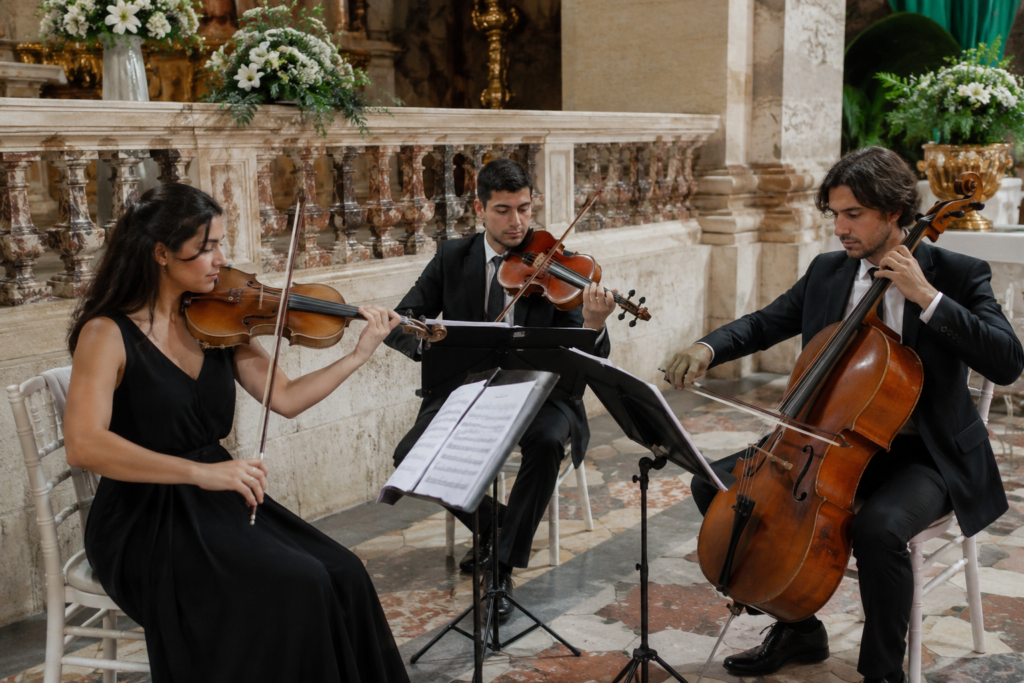
Lake Como vs. Venice vs. Tuscany: How Region Shapes String Quartet Logistics and Cost
Italy is not one market. It is a mosaic of municipal regulations, geographic constraints, and cultural expectations that vary dramatically across regions. The string quartet wedding Italy experience in a Palladian villa near Vicenza bears almost no logistical resemblance to one on a clifftop terrace in Ravello.
Venice. Water access means instruments travel by motoscafo or vaporetto. A cello case in a water taxi requires advance booking and careful handling. Noise regulations in the historic center are strict — amplified music after 22:00 is prohibited in most sestieri. We coordinate with the Comune di Venezia and the venue’s own compliance requirements. Couples exploring Venice wedding costs should factor in the premium that water logistics add to every vendor engagement.
Lake Como. The lake’s geography concentrates sound beautifully — a quartet playing on a villa terrace carries across the water with remarkable clarity. But this also means neighboring properties hear everything, and local noise ordinances are enforced with increasing rigor. Our team secures the necessary permits and schedules sound checks during approved windows. A Lake Como wedding benefits enormously from a planner who understands these micro-regulations.
Tuscany. The rolling landscape and stone construction of Tuscan wedding venues create natural acoustic environments that favor unamplified quartets. Travel logistics are simpler — musicians drive — but distances between Florence-based ensembles and remote agriturismi can exceed ninety minutes. We account for this in scheduling, ensuring the quartet arrives with time to settle, tune, and rehearse in the actual ceremony space. For couples balancing Tuscany wedding costs, locally sourced musicians reduce travel surcharges significantly.
Amalfi Coast. Narrow roads, limited parking, and venues accessible only by staircase or boat define the production challenge. A quartet performing at a terraced venue in Ravello may need to carry instruments up two hundred steps. We arrange porters, confirm access routes in advance, and select musicians accustomed to these conditions. The Amalfi Coast’s extraordinary venues reward this effort with settings of incomparable beauty.
String Quartet vs. Trio: When Three Players Serve the Moment Better Than Four
A string quartet — two violins, viola, cello — is the classical standard. But it is not always the right choice. A string trio (violin, viola, cello) offers a leaner, more intimate sound that suits smaller ceremonies, micro weddings in Italy, and venues where physical space is limited.
The practical difference: a trio requires less stage area (approximately 2×2 metres versus 3×3 for a quartet), produces a softer dynamic range, and costs roughly 20–30% less than a full quartet. The musical difference: trio repertoire omits the second violin, which in many classical works carries counter-melodies and harmonic richness. For ceremony music, this is rarely noticeable to non-musicians. For a full dinner set spanning three hours, the quartet’s richer texture becomes more valuable.
We guide each couple toward the right configuration based on guest count, venue dimensions, and the role music will play across the day. There is no default.
Outdoor Ceremony Sound: The Production Layer Most Couples Never Consider
This section is deliberately technical, because the details matter.
An outdoor string quartet wedding Italy ceremony without amplification works only when guests number fewer than forty and the seating radius stays within eight metres of the ensemble. Beyond that threshold, wind, ambient noise, and acoustic dispersion render the instruments inaudible to guests in rear rows. This is physics, not opinion.
The solution is a discreet PA system — not the towering speaker stacks of a rock concert, but compact, directional column speakers on slender stands, positioned at the edges of the ceremony space and angled to project sound toward guests without visual intrusion. Each instrument is fitted with a clip-on microphone or a small condenser mic on a low stand. A sound engineer — present but invisible, operating from behind a hedge or a column — mixes the balance in real time.
We manage every element of this production layer: equipment sourcing, delivery, setup timing (always completed before guest arrival), cable concealment, and breakdown after the final set. For villa weddings across Italy, where outdoor ceremonies transition to indoor receptions, we also coordinate the repositioning of equipment between locations during the cocktail hour — a window that typically lasts sixty to ninety minutes.
Weather contingency is built into every plan. If rain forces a ceremony indoors, the PA system may become unnecessary, but the musicians need a prepared indoor position with adequate space, lighting, and sightlines. We confirm both scenarios with the venue in advance. No decision is left to the morning of the wedding.
How to Evaluate a String Quartet When You Cannot Attend the Audition
International couples hiring a string quartet for a wedding in Italy face an inherent challenge: they cannot sit in a Milanese rehearsal studio and listen. Demo recordings and video samples become the primary evaluation tools — but they require informed interpretation.
Audio quality of the demo is not the same as live quality. A studio-recorded demo with professional mixing will sound polished regardless of the ensemble’s actual live ability. We request unedited live recordings — ideally from previous wedding ceremonies — that reveal how the quartet handles room acoustics, transitions between pieces, and the subtle dynamic shifts that distinguish professionals from competent amateurs.
We also evaluate ensemble cohesion. A quartet assembled from freelancers who rarely play together will lack the nonverbal communication — the shared breath before an entrance, the instinctive rubato in a familiar passage — that defines a seasoned group. Our network prioritizes established ensembles who perform together regularly, often drawn from the orchestras and conservatories of Milan, Florence, Venice, and Rome.
Verified reviews matter, but context matters more. A five-star rating on a marketplace tells you the client was satisfied; it does not tell you whether the venue was a cathedral or a garden, whether the repertoire was classical or contemporary, or whether the ensemble managed a rain contingency with grace. We provide couples with context-matched references — previous clients whose venue type, guest count, and musical preferences align with theirs.
One Point of Contact: Why Music Should Never Be Planned in Isolation from the Rest of the Day
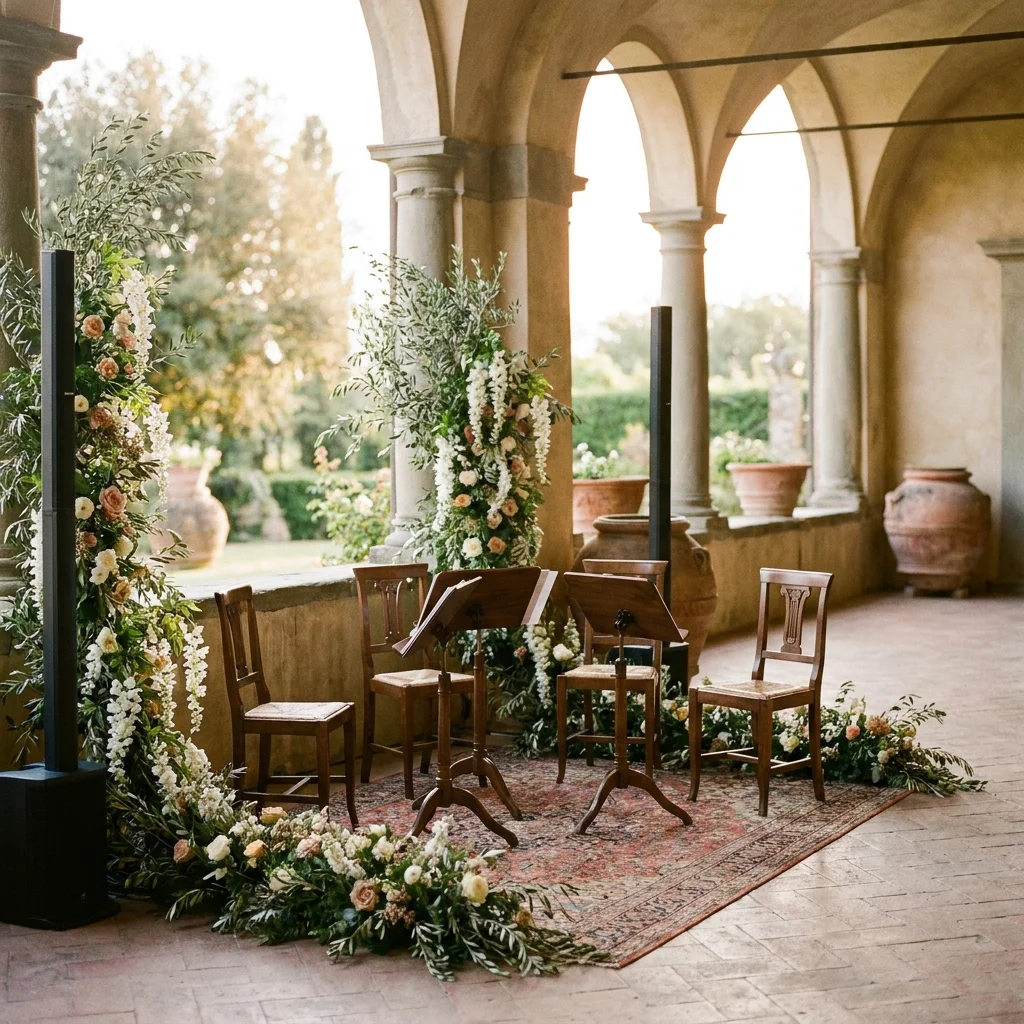
The marketplace model treats music as an isolated procurement task. You find a quartet, you book them, you provide a timeline. What this model ignores is the web of dependencies that connect music to every other element of the wedding.
The quartet’s arrival time depends on the venue’s load-in schedule, which is shared with the florist, the lighting designer, and the caterer. The ceremony set length must align with the officiant’s pacing — a consideration our team coordinates directly with the legal and ceremonial requirements for foreign couples marrying in Italy. The cocktail-hour repertoire must complement, not compete with, the energy of the broader entertainment program. The dinner set volume must be calibrated to the room’s conversation level, which varies with guest count and table layout.
We manage all of this through a single point of contact. The couple communicates their musical vision to us. We translate that vision into a detailed brief for the quartet, negotiate contracts, coordinate logistics with every other vendor, and oversee the day-of execution. The musicians arrive knowing exactly where to set up, when to begin, what to play, and when to pause for toasts. The couple never mediates between vendors.
This is the difference between hiring a string quartet and having one curated for you. Contact Kiss Me Italy to experience it.
Set Length, Breaks, and the Pacing That Keeps Music Feeling Effortless
String musicians cannot play continuously for five hours. Fingers fatigue. Instruments go out of tune in heat or humidity. The standard professional expectation is a fifteen- to twenty-minute break for every forty-five minutes of performance. Our timelines account for this, positioning breaks during natural transitions — the move from ceremony to cocktails, the shift from cocktails to dinner seating, the interval between courses when guests circulate.
| Wedding Moment | Recommended Set Length | Break Window | Notes |
|---|---|---|---|
| Pre-ceremony ambient | 15–20 min | None | Guests arriving; sets emotional tone |
| Ceremony | 20–35 min | None | Processional, readings accompaniment, recessional |
| Cocktail hour | 45–60 min | 15 min before dinner | Lighter repertoire; volume moderate |
| Dinner (first courses) | 45 min | 15 min during main course service | Background level; complements conversation |
| Dinner (dessert / toasts) | 30 min | End of engagement | Optional; some couples prefer DJ or band transition |
Indicative pacing. We customize every timeline to the specific venue, season (summer heat affects instrument tuning frequency), and ceremony structure. Contact Kiss Me Italy for a personalized proposal.
Italian Noise Ordinances and Music Permits: The Regulatory Layer That Directories Never Mention
Every Italian comune sets its own noise regulations. In Venice, amplified music in the historic center must cease by 22:00 in most zones. In Florence, outdoor amplification near residential buildings requires a SCIA (Segnalazione Certificata di Inizio Attività) filed at least thirty days before the event. On the Amalfi Coast, Ravello’s municipal code limits outdoor music to specific decibel thresholds measured at the property boundary.
These are not obscure technicalities. They are enforceable regulations that, if violated, can result in fines or — in extreme cases — the immediate cessation of music mid-reception. Our team manages the full permit process: identifying which regulations apply to the specific venue, filing applications within required timelines, and coordinating with the sound engineer to ensure decibel compliance throughout the event.
For couples planning a wedding in Portofino or along the Ligurian coast, the narrow streets and densely packed buildings amplify sound in unexpected ways. We conduct advance site visits with the sound engineer to map acoustic propagation and position speakers accordingly. This level of preparation is invisible to the couple on the day. That is precisely the point.
When the Venue Becomes a Character and the Music Becomes Its Voice
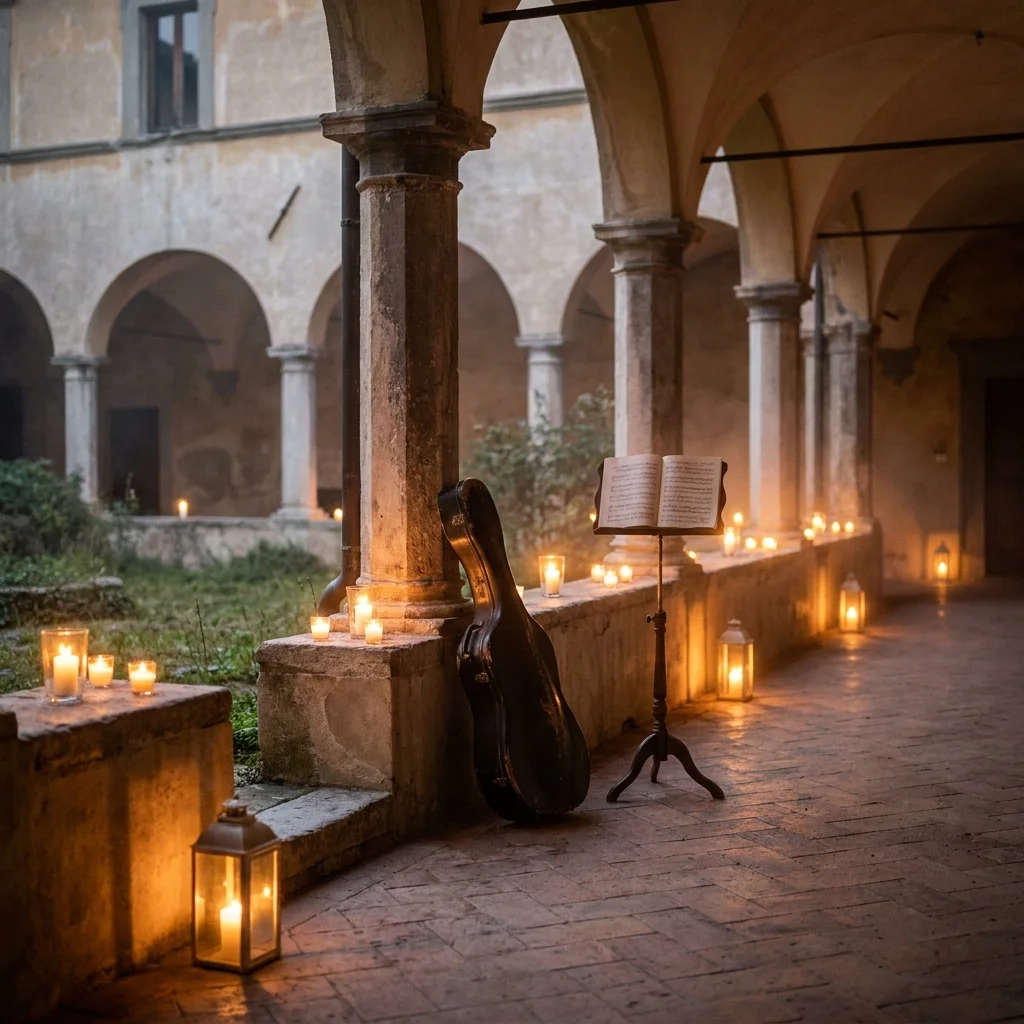
A string quartet wedding Italy experience, at its finest, is not about background music. It is about scenography — the deliberate orchestration of sound within a space that has its own centuries-old character. The frescoed walls of a Renaissance villa, the open-air loggia of a Baroque palazzo, the candlelit cloister of a medieval monastery: each demands a different musical voice, a different dynamic, a different repertoire.
This is what we do. We listen to the venue first, then to the couple, then to the musicians — and we weave all three into a single, coherent narrative. The result is music that feels inevitable, as though the stones themselves had been waiting for exactly these notes.
If that is the experience you envision, we welcome your inquiry. Every conversation begins with the venue, the season, and the story you want to tell.
Frequently Asked Questions
Can the string quartet learn a specific song that isn’t in their standard repertoire?
Yes. Most professional ensembles accept custom arrangement requests, though they typically require four to six weeks’ lead time and may charge an arrangement fee of €300–€600 per piece. We coordinate this process, ensuring the arrangement is completed, rehearsed, and performance-ready well before the wedding date.
What happens if one of the four musicians falls ill on the wedding day?
Our contracts with quartets include a substitution clause requiring the ensemble to provide a replacement of equivalent training and experience. We also maintain a network of vetted musicians in each region who can step in at short notice, ensuring the performance proceeds without compromise.
Is it possible to have the quartet play during the boat transfer in Venice or Lake Como?
Boat-based performances are possible but require specific vessel types with adequate deck space and stability. On Lake Como, some private boats accommodate a trio comfortably; a full quartet needs a larger vessel. In Venice, the traditional topa or a larger motoscafo can work. We arrange vessel selection, instrument safety measures, and sound considerations as part of the production plan.
Do string quartets in Italy typically provide their own music stands and chairs?
Professional ensembles bring their own music stands. Chairs are almost always provided by the venue, but we confirm specifications in advance — armless chairs of appropriate height are essential for cellists and violists. If the venue’s chairs are unsuitable, we source alternatives.
How far in advance should we book a string quartet for a peak-season Italian wedding?
For weddings between May and October, we recommend confirming the quartet at least eight to ten months in advance. The most sought-after ensembles — particularly those based in Florence, Milan, and Rome — book twelve months ahead for Saturday dates in June, July, and September.
Can we combine a string quartet with an opera singer for the ceremony?
Absolutely, and it is one of the most cinematic combinations available. The quartet provides harmonic foundation while the vocalist delivers the melodic line. We manage the musical director who coordinates rehearsals between the singer and the ensemble, ensuring balance and artistic cohesion across the ceremony repertoire.
Are there venues in Italy where live music is not permitted at all?
A small number of churches and protected heritage sites prohibit non-liturgical live music during ceremonies. Certain museum-classified venues restrict amplified sound entirely. We verify music permissions during the venue selection phase, long before contracts are signed, so couples are never surprised by restrictions.
What is the difference in cost between a locally sourced quartet and one traveling from another Italian city?
A locally sourced quartet eliminates travel surcharges and accommodation costs, which can add €1,500–€3,500 to the total depending on distance and overnight requirements. We prioritize regional sourcing whenever the talent pool supports the couple’s repertoire and quality expectations, and we are transparent about the cost implications when inter-regional travel is recommended.
Can the quartet play during an outdoor ceremony if it starts to rain?
Acoustic instruments are highly sensitive to moisture. If rain begins, musicians must move to a covered area immediately to protect their instruments, some of which are valued at tens of thousands of euros. Our contingency plans always include a pre-designated covered performance position — a portico, a loggia, an interior room with open doors — so the transition is seamless and the music continues without interruption.
Keep exploring: Luxury Summer Wedding in Italy: Destinations, Venues & Planning Essentials.