
A traditional Italian wedding food experience unfolds across five to seven distinct courses — aperitivo, antipasti, primi piatti, secondi piatti, dolci, and confettata — typically spanning three to four hours of seated and standing service. The menu reflects regional ingredients, seasonal availability, and a deliberate pacing that transforms dinner into the emotional centrepiece of the celebration. At a luxury level, this sequence is not merely served; it is choreographed around your venue’s kitchen capacity, your photographer’s timeline, and your guests’ comfort.
Traditional Italian Wedding Food
Most international couples arrive with a clear vision of Italian food — and a far less clear picture of how that food actually reaches the table on a wedding day. The gap between a beautiful menu on paper and a flawless dining experience for 80 or 150 guests involves catering contracts, kitchen logistics, service staff ratios, and timing decisions that no Pinterest board will prepare you for. This is precisely the territory where Kiss Me Italy operates: bridging what you imagine with what your venue, your caterer, and the Italian calendar can actually deliver.
What Your Venue’s Catering Contract Won’t Tell You About the Traditional Italian Wedding Menu
Here is a fact that surprises nearly every couple we work with. Most Italian wedding venues operate with exclusive catering partnerships, meaning you cannot bring in an external chef or catering company without explicit — and often expensive — permission. In Tuscany, roughly 70% of estate venues require you to use their in-house caterer or select from a pre-approved list of two or three providers. On the Amalfi Coast, that figure is even higher.
This matters enormously when you have a specific vision for your traditional Italian wedding menu. The aperitivo you tasted at a restaurant in Ravello may not be replicable at your hilltop venue, because that venue’s caterer sources differently, prices differently, and staffs differently. Our team reviews every catering contract before you sign, identifying where the menu can flex and where the venue’s kitchen infrastructure sets hard limits — oven capacity, cold storage, plating stations, even the distance between kitchen and dining terrace.
We also clarify what is included in the per-head catering quote versus what is quoted separately. Service staff, glassware rental, linen, and late-night overtime charges are frequently excluded from the headline price, and these line items can add €15–€40 per guest to the final invoice. Couples who have explored Amalfi Coast wedding costs will recognise this pattern — the base quote is only the beginning of the conversation.
The Aperitivo Hour: Why Timing It Wrong Disrupts Everything That Follows
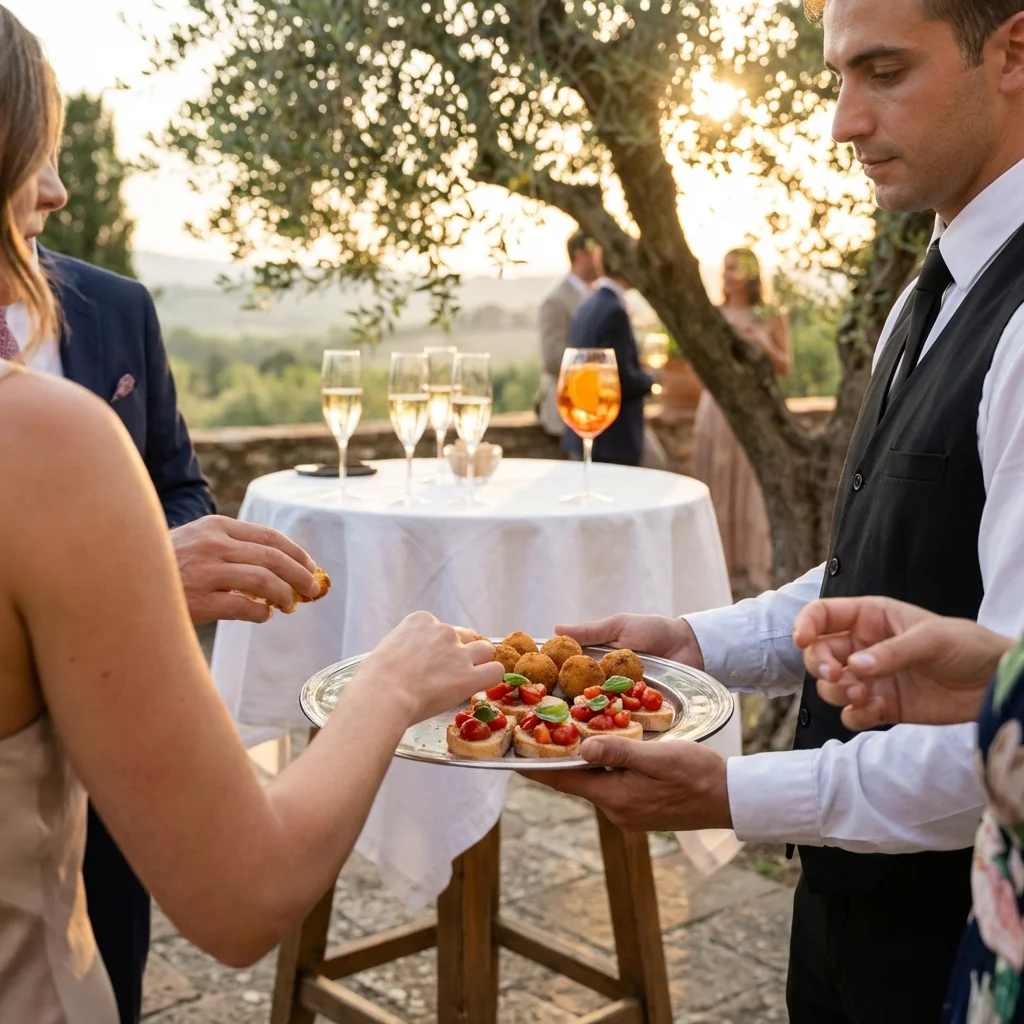
The aperitivo is not a cocktail hour in the Anglo-American sense. It is lighter, more structured, and shorter — typically 45 to 60 minutes. Guests stand, circulate, and graze on small bites: bruschette, crostini, fritti, cured meats, and regional cheeses, accompanied by Prosecco, Aperol Spritz, or a local white wine. The purpose is transitional. It bridges the ceremony and the seated dinner, giving your photographer time to capture couple portraits while guests settle into the celebration.
Timing the aperitivo incorrectly is one of the most common coordination challenges we manage. If it runs too long, guests fill up before the antipasti even arrive. If it’s too short, the kitchen isn’t ready for the first course. For summer weddings in southern Italy — particularly between late June and mid-August — we schedule the aperitivo to begin no earlier than 6:30 PM, when temperatures on exposed terraces drop to a comfortable range and the light becomes ideal for the editorial-style photography that defines a luxury Italian celebration.
The beverage selection during aperitivo also sets the tone for the wine pairings that follow. We work with each venue’s sommelier or our own wine consultants to ensure the aperitivo wines complement rather than compete with the bottles chosen for the seated courses — a detail that matters more than most couples initially realise.
Antipasti and Primi Piatti: Two Courses That Define Your Region and Your Season
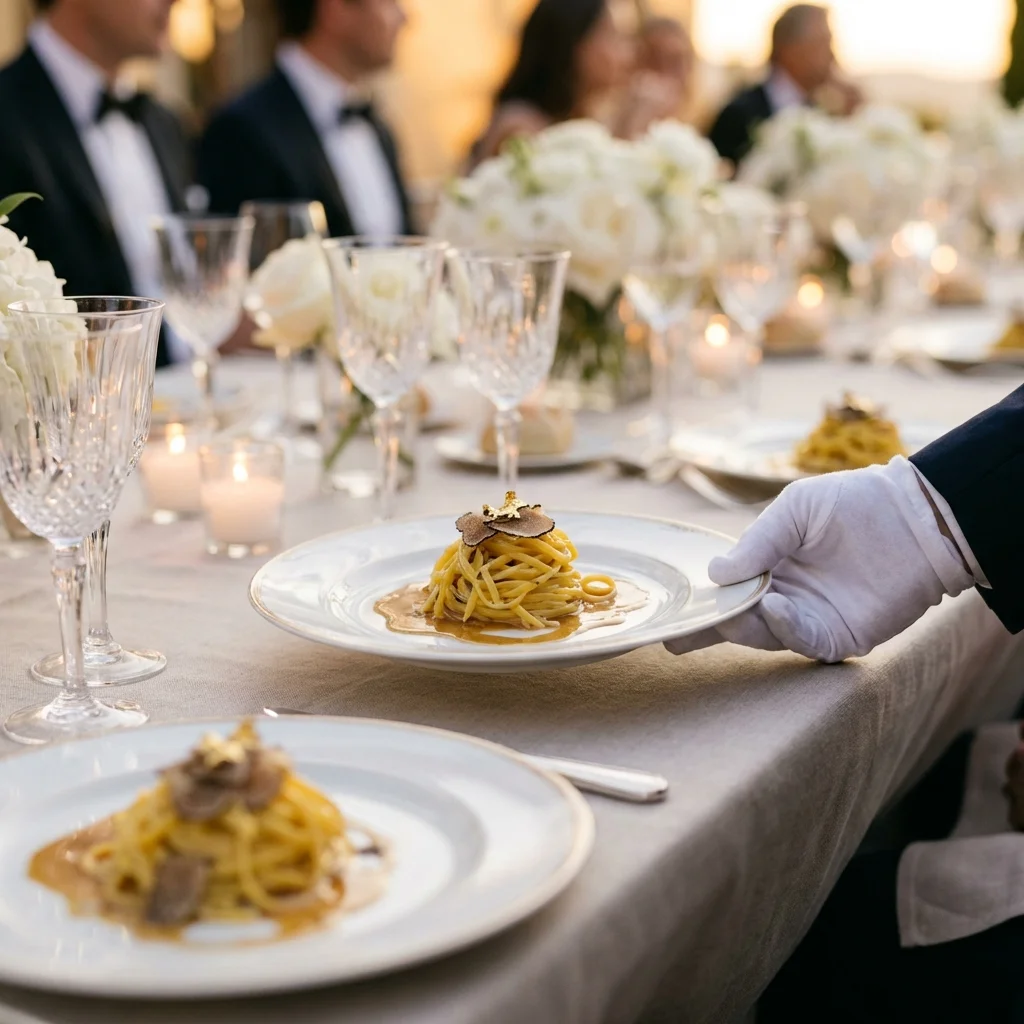
This is where a traditional Italian wedding menu becomes unmistakably local. The antipasti course — served seated — introduces the regional identity of your celebration. In Tuscany, expect crostini di fegatini, burrata with heirloom tomatoes, and shaved pecorino with truffle honey. Along the Amalfi Coast, the antipasti lean toward the sea: crudo di pesce, marinated anchovies, and buffalo mozzarella from Campania’s own dairies. In Piedmont, vitello tonnato and insalata russa appear with quiet authority.
The primi piatti — the pasta course — is the emotional heart of traditional Italian wedding food. It is the course guests remember. Fresh pasta, made that morning or the night before, served in portions generous enough to satisfy but restrained enough to leave room for what follows. Regional classics dominate: pappardelle al ragù di cinghiale in Tuscany, paccheri with Neapolitan ragù on the coast, risotto al Barolo in Piedmont, or handmade orecchiette with broccoli rabe in Puglia.
We often curate a dual primi service — two pasta options presented simultaneously — which allows guests a choice while keeping the kitchen’s timing intact. This is a detail that requires precise coordination with the catering team, particularly for weddings exceeding 100 guests, and it’s one of the reasons couples planning a destination wedding in Italy benefit from having a team that speaks the caterer’s language, literally and operationally.
Couples interested in how regional recipes shape the broader menu will find our guide to Italian wedding menu ideas a useful companion to this overview.
Secondi Piatti and Contorni: The Course Most International Guests Underestimate
By the time the secondi arrives, many international guests are already pleasantly full. This is expected. The second course in a traditional Italian wedding menu is deliberately lighter than the primi — a single protein with one or two seasonal contorni (side dishes), designed to be savoured rather than consumed in volume.
Typical secondi include tagliata di manzo (sliced grilled beef) in Tuscany, branzino al forno (baked sea bass) on the coast, or agnello scottadito (grilled lamb cutlets) in central and southern regions. The contorni — roasted potatoes, grilled vegetables, seasonal salads — are served family-style or pre-plated depending on the venue’s service format.
One practical consideration we always address: the secondi course is where dietary accommodations become most visible. Vegetarian, vegan, and allergen-free alternatives must be plated with the same visual care as the standard dish, and this requires advance coordination with the chef — typically finalised no later than three weeks before the wedding. Our team manages this dialogue directly, ensuring that every guest’s plate arrives with equal elegance, which is a standard we maintain across all celebrations, from intimate weddings to large-scale receptions.
Wine Pairing Across Five Courses: What the Sommelier Discussion Actually Involves
Wine is not an afterthought in a traditional Italian wedding menu. It is architecture. Each course demands a different weight, acidity, and temperature, and the progression from aperitivo through dessert follows a logic that Italian sommeliers take seriously.
A typical pairing structure looks like this. Aperitivo: Prosecco or a crisp local white (Vermentino in Liguria, Falanghina in Campania). Antipasti: a medium-bodied white or rosé. Primi: a lighter red or a full-bodied white, depending on the sauce — a Chianti Classico with ragù, a Verdicchio with seafood pasta. Secondi: the evening’s most structured red — Brunello di Montalcino, Barolo, or Aglianico del Vulture, matched to the protein. Dolci: a Moscato d’Asti or Passito di Pantelleria.
The sommelier discussion typically happens two to three months before the wedding, once the menu is confirmed. We coordinate this conversation between the couple, the caterer, and the venue’s wine cellar — or, where the venue’s selection is limited, we source independently from regional producers. For couples planning celebrations in wine-producing regions, we can arrange pre-wedding tastings at local estates, which double as a memorable experience for early-arriving guests. Our guide to luxury summer weddings in Italy explores how seasonal heat affects wine service temperatures and storage logistics.
What a Traditional Italian Wedding Food Experience Actually Costs: Real Ranges by Tier
Pricing for Italian wedding reception food varies dramatically by region, guest count, venue category, and the level of customisation involved. The tables below reflect ranges we encounter regularly across our portfolio of curated celebrations. Every figure excludes venue hire, which is contracted separately.
| Catering Tier | Per-Guest Range | Included | Quoted Separately |
|---|---|---|---|
| Classic Traditional (estate venues, Tuscany/Umbria) | €150–€220 per guest | Aperitivo, 4 seated courses, house wines, water, espresso, wedding cake service | Premium wine upgrades, late-night food stations, overtime staffing (after midnight), VAT (IVA 22%) |
| Premium Traditional (luxury villas, Lake Como/Amalfi Coast) | €250–€400 per guest | Aperitivo with Champagne, 5 seated courses, sommelier-selected wine pairing, confettata, espresso bar | Bespoke tasting menus, external floral table design, linen upgrades, overtime staffing, VAT (IVA 22%) |
| Ultra-Luxury / Michelin-Level | €450–€700+ per guest | Full bespoke menu by named chef, dedicated sommelier service, 6–7 courses, artisan confettata, midnight buffet | Chef travel and accommodation, custom tableware sourcing, exclusive ingredient procurement, VAT (IVA 22%) |
Indicative ranges. Contact Kiss Me Italy for a personalised proposal.
| Common Add-On | Typical Range | Notes |
|---|---|---|
| Late-night food station (pizza, arancini, porchetta) | €25–€55 per guest | Priced per guest; staffing and equipment included in most quotes |
| Dedicated sommelier service | €800–€2,000 | Full evening; includes pre-wedding tasting session; travel quoted separately if outside venue’s region |
| Confettata display (artisan confetti, custom packaging) | €500–€1,800 | Depends on guest count and packaging design; VAT (IVA 22%) quoted separately |
| Children’s menu (under 12) | €40–€80 per child | Simplified 3-course menu; typically 50–60% of adult per-head rate |
Indicative ranges. Contact Kiss Me Italy for a personalised proposal.
These figures align with what we see across venues in our 2026 venue shortlist, though every property prices differently based on exclusivity periods and seasonal demand.
Italian Wedding Cake and Confettata: The Sweet Finale Is More Logistically Complex Than It Appears
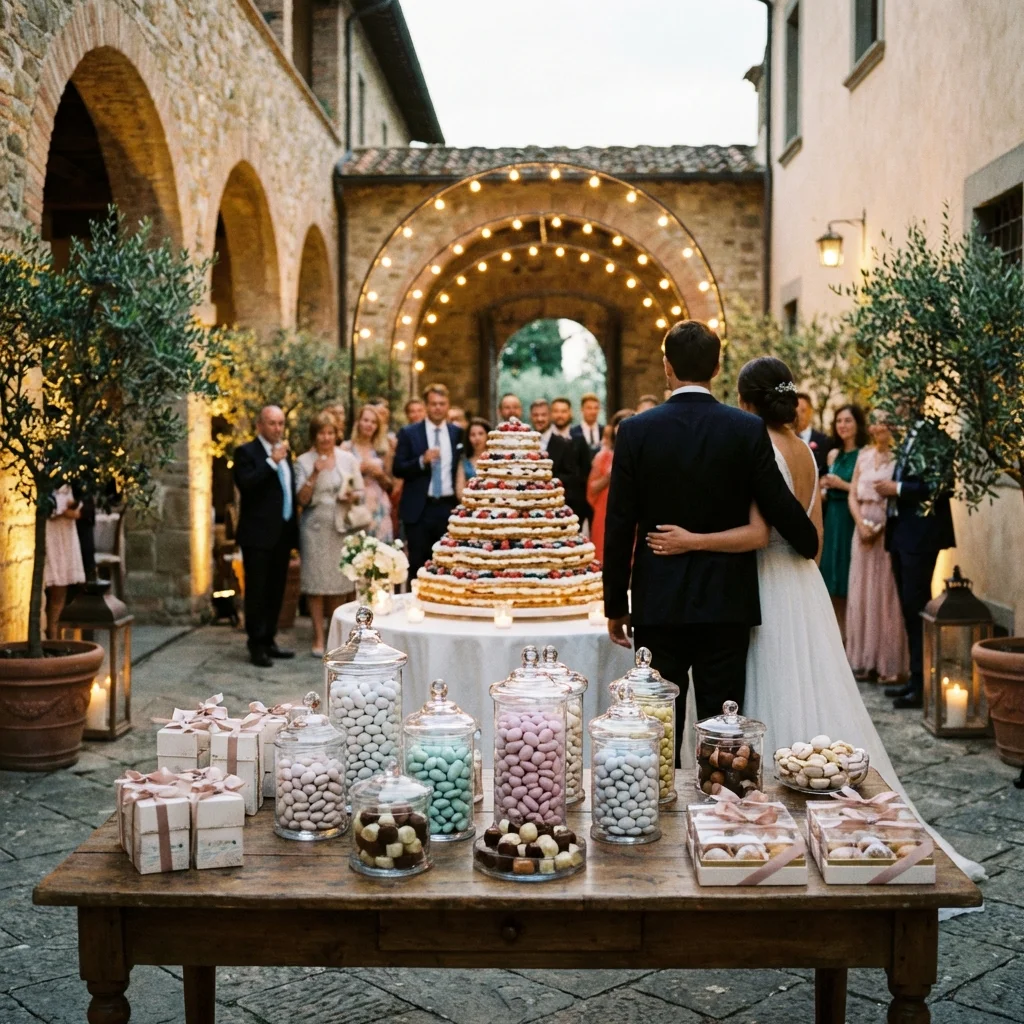
The Italian wedding cake — whether a towering millefoglie, a classic tiered sponge with crema chantilly, or a modern fondant design — arrives at a specific moment in the evening’s choreography. It follows the dolci course (which is itself a separate plated dessert, not the cake) and typically coincides with the couple’s first cut, a moment your videographer and photographer will have pre-scouted for lighting and backdrop.
The cake is almost always produced by a pasticceria external to the venue’s catering team. This means separate delivery logistics, temperature control during transport (critical for buttercream and fresh fruit designs between May and September), and coordination with the venue’s staff for plating and service. Our team manages this relay directly, confirming delivery windows, storage conditions, and presentation timing with both the pasticceria and the catering director.
The confettata — a display of sugar-coated almonds (confetti) in various flavours, often accompanied by small sweets and personalised packaging — serves as both a farewell gift and a visual installation. It is traditionally placed near the exit or on a dedicated table, and its design should harmonise with your overall reception décor. Artisan confetti from Sulmona, in Abruzzo, remain the gold standard, and we source directly from producers who offer custom colour-matching and flavour development. Our detailed exploration of Italian wedding cake traditions covers style options in greater depth.
Why Your Food Styling Matters for Photography — and How We Coordinate Both
Traditional Italian wedding food is inherently photogenic, but only when the timing, plating, and lighting align. This is not a detail most couples think about until they see their gallery. A beautifully composed antipasto platter photographed under harsh overhead lighting at 1:00 PM looks entirely different from the same dish captured at golden hour on a stone terrace.
We brief the photographer and the catering team together, typically during the final site visit four to six weeks before the wedding. The photographer identifies which courses and table moments they want to capture; the catering team confirms when those dishes will be plated and where. This coordination ensures that the food photography in your wedding gallery reflects the same editorial standard as the couple portraits — a seamless visual narrative rather than a collection of snapshots.
For couples who have already explored our approach to choosing a wedding photographer in Italy, this level of integration will feel familiar. The same principle applies to floral design: every visual element on the table — flowers, candles, linens, glassware — is considered as part of a single composed frame.
Service Staff Ratios, Kitchen Access Windows, and the Logistics Behind a Seamless Dinner
This section is deliberately technical. It reflects the operational reality that makes or breaks a traditional Italian wedding food experience — and it is the layer of planning that most couples never see.
Service staff ratio: For a luxury seated dinner, we require a minimum of one server per 10 guests. For ultra-luxury celebrations or complex multi-course menus, we push for one per 8. This ratio is non-negotiable in our planning process, and it is one of the first items we confirm with the caterer.
Kitchen access window: Most venue kitchens become available to the catering team between 10:00 AM and 2:00 PM on the wedding day. If your venue hosts back-to-back events (common at popular Tuscan estates in peak season), the window may be tighter. We confirm this in writing during the contract phase, typically 8–10 months before the wedding.
Plating vs. family-style service: Plated service requires more staff, more time between courses (typically 20–25 minutes), and more kitchen space. Family-style service — large platters placed on each table — is faster, more convivial, and often more authentically Italian, but it requires sturdier tableware and a different linen plan. We advise based on your guest count, venue layout, and personal preference.
Overtime charges: Most catering contracts in Italy define a service window of 5–6 hours. Beyond that, overtime is charged at €300–€800 per hour depending on staff count. We build this into the timeline from the outset, so there are no surprises at 1:00 AM when the dancing is still going strong.
These operational details are part of what distinguishes a curated celebration from a self-managed one. Couples who have reviewed our breakdown of Venice wedding costs will recognise the same transparency applied to a different context.
How a Tuscan Wedding Menu Differs from an Amalfi Coast Menu — and Why It Should
A traditional Italian wedding menu is not a single national template. It is a regional expression. The ingredients, preparations, and even the pacing shift meaningfully between Tuscany, the Amalfi Coast, Puglia, Piedmont, and the Italian Lakes — and the most memorable celebrations lean into this specificity rather than defaulting to a generic “Italian” menu.
In Tuscany, the cuisine is earthy and direct. Ribollita, pici cacio e pepe, bistecca alla fiorentina, and cantucci with Vin Santo define the flavour profile. The wines — Chianti Classico, Brunello, Vernaccia di San Gimignano — are structured and confident. A Tuscan wedding menu served at a stone farmhouse in the Val d’Orcia feels rooted in place.
On the Amalfi Coast, the menu pivots to the sea. Scialatielli ai frutti di mare, totani ripieni, and limoncello-soaked babà reflect a cuisine shaped by salt air and citrus groves. The wines are lighter — Greco di Tufo, Fiano di Avellino — and the pacing often includes a longer aperitivo to take advantage of the coastal views.
In Piedmont, the menu is the most formally structured of any Italian region. Tajarin al tartufo, agnolotti del plin, and brasato al Barolo demand wines of equal weight, and the meal can extend to seven courses without feeling excessive. Couples drawn to Piedmont weddings often discover that the food alone justifies the region.
We guide every couple toward a menu that honours the region where they are celebrating — not because it is a rule, but because it produces a more coherent, more memorable, and more delicious experience for everyone at the table.
A Menu That Feels Effortless Because Every Detail Has Been Managed
Traditional Italian wedding food is not a checklist of courses. It is a narrative — one that begins with the first sip of Prosecco during the aperitivo and ends with a handful of confetti tucked into a guest’s pocket at midnight. When it is curated with care, it becomes the experience your guests talk about for years.
At Kiss Me Italy, we manage every layer of this experience: the catering contract, the sommelier consultation, the kitchen logistics, the dietary accommodations, the cake delivery, the confettata design, and the photographer’s food brief. You taste, you choose, you enjoy. We handle the rest.
If you are beginning to plan your Italian wedding reception food and want a team that understands both the tradition and the logistics, we would welcome the conversation. Reach out to Kiss Me Italy and let us begin shaping your menu.
Frequently Asked Questions About Traditional Italian Wedding Food
Do we need a separate food-and-beverage budget for the welcome dinner and farewell brunch?
Yes. In Italy, multi-day celebrations are typically contracted as separate events, each with its own minimum spend, staffing plan, and service window. A welcome dinner may be priced per head with a simpler wine selection, while a farewell brunch often requires additional rentals (coffee station, glassware, buffet equipment) and earlier staffing call times. We build a complete weekend F&B plan so the wedding-day menu remains the hero — without surprises elsewhere.
What is the difference between a plated dessert course and a dessert buffet in Italy?
A plated dessert (dolci) is served at the table as a formal course, timed like the primi and secondi. A dessert buffet is a separate installation — often paired with the confettata — that guests visit at their own pace. The buffet requires additional display styling, temperature control for creams and fruit, and dedicated staff to refresh and plate. We recommend the format based on your timeline, guest flow, and the venue’s service capacity.
Can we serve a signature cocktail during aperitivo without turning it into an open-bar culture?
Yes — when it is curated, not improvised. We typically recommend one signature cocktail that reflects the region (for example, a citrus-forward spritz on the coast or a herb-led cocktail in the countryside), served alongside wine and a non-alcoholic option. The key is controlling speed of service, glassware, and batching so the aperitivo remains elegant and the seated courses stay on schedule.
How do you plan for heat-sensitive ingredients and food safety at summer weddings?
We plan menus and service layouts around temperature, not just taste. That can mean limiting raw seafood displays, adjusting cheese selections, specifying shaded plating stations, and confirming refrigeration capacity and generator backup where needed. We also align service timing with the venue’s cold-chain capabilities so the experience feels effortless — and remains uncompromisingly safe.
What should we ask at the menu tasting that most couples miss?
Beyond flavour, we focus on execution at scale: how the dish holds for 15–20 minutes, whether plating is consistent across 10+ tables, and how the kitchen sequences two primi without delays. We also confirm portion sizing, sauce stability, and the exact wine-pour plan. We attend tastings to translate what you love into what will perform flawlessly on the wedding day.
Can we include a cheese course, and where does it fit in the flow?
Yes. A cheese course can be served either after the secondi (as a brief seated interlude) or as a styled station opened after dessert, depending on your timeline and dancing start time. The decision affects staffing, table resets, and wine selection (often a structured red or a sweet wine pairing). We recommend the placement that preserves momentum while elevating the guest experience.
How do you handle children’s dining so parents can enjoy the full menu?
We coordinate a children’s service plan with the caterer: earlier plating, simplified dishes, and — when appropriate — a dedicated kids’ table with a supervising sitter team arranged separately. The goal is discreet efficiency. Parents stay present for the celebration, and children are served quickly and comfortably.
What is the most elegant way to communicate dietary needs to guests and vendors?
We recommend collecting dietary requirements through your RSVP process with clear categories (allergies vs. preferences) and a final confirmation message two weeks before the wedding. On the vendor side, we provide the chef with a written matrix by guest name and table number, plus a plating protocol so alternatives arrive with the same presentation standard. It is quiet, precise, and seamless.
Can we incorporate a family recipe without compromising kitchen timing?
Often, yes — but it must be engineered for service. We work with the chef to adapt the recipe to the venue’s equipment and the guest count, and we choose the right moment in the flow (for example, a passed bite during aperitivo rather than a complex plated course). This is where luxury planning shows: the sentiment remains, and the execution stays flawless.
How do we keep the dinner moving without making it feel rushed?
We build a service rhythm that respects Italian pacing while protecting guest energy: defined course gaps, discreet table-clearing windows, and a clear handoff from dinner to cake to dancing. The kitchen, band/DJ, and photo team all work from the same timeline. Guests experience ease. Behind the scenes, it is tightly managed.