A wedding pizza station in Italy typically costs between €1,800 and €6,500 for 50–120 guests, depending on format (stationary wood-fired oven, mobile pizza truck, or chef-attended station), region, and the level of service styling involved. Welcome-night pizza parties and day-after poolside sessions are the most common placements within a luxury wedding weekend, and the coordination required—power supply, venue fire regulations, dough-prep timing, guest flow—is considerably more involved than most couples expect before they begin planning.
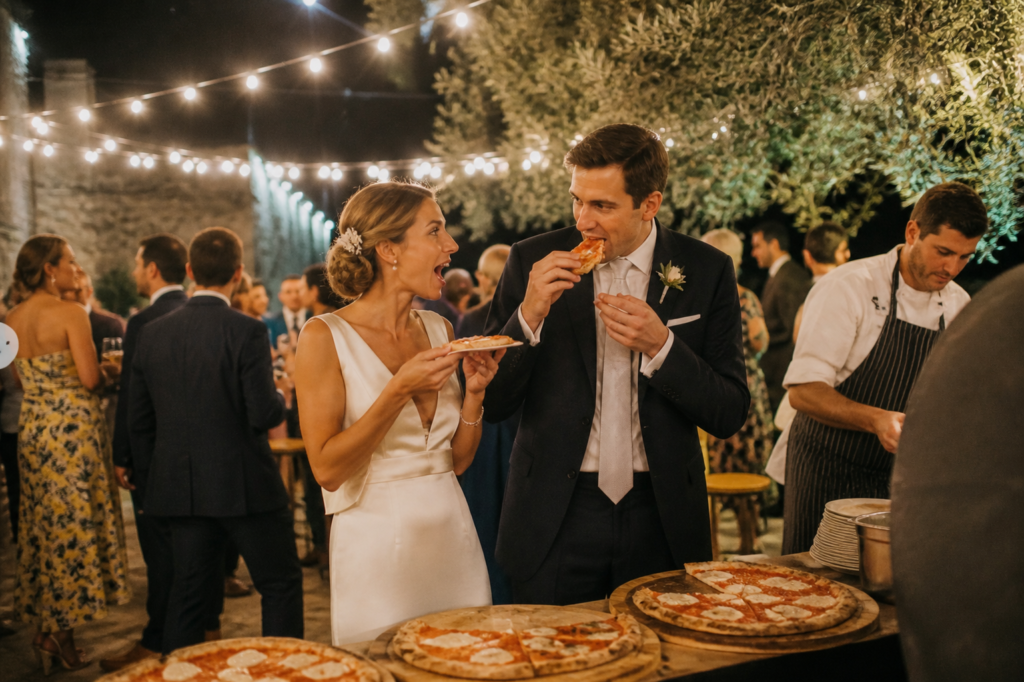
Italy Wedding Pizza Party
The question our high-profile clients raise before any other is not about mozzarella or margherita. It is about control. Who sees the setup? Who photographs the guests in an informal moment? Can the pizza station area be shielded from a road, a neighbouring property, a terrace with sightlines? At Kiss Me Italy, we treat every food station—especially the relaxed ones—as a privacy event in its own right, because the moments when guests feel most at ease are precisely the moments that are most vulnerable to unwanted observation.
Stationary Wood-Fired Oven vs. Mobile Pizza Truck vs. Chef-Attended Station: Which Format Protects the Guest Experience
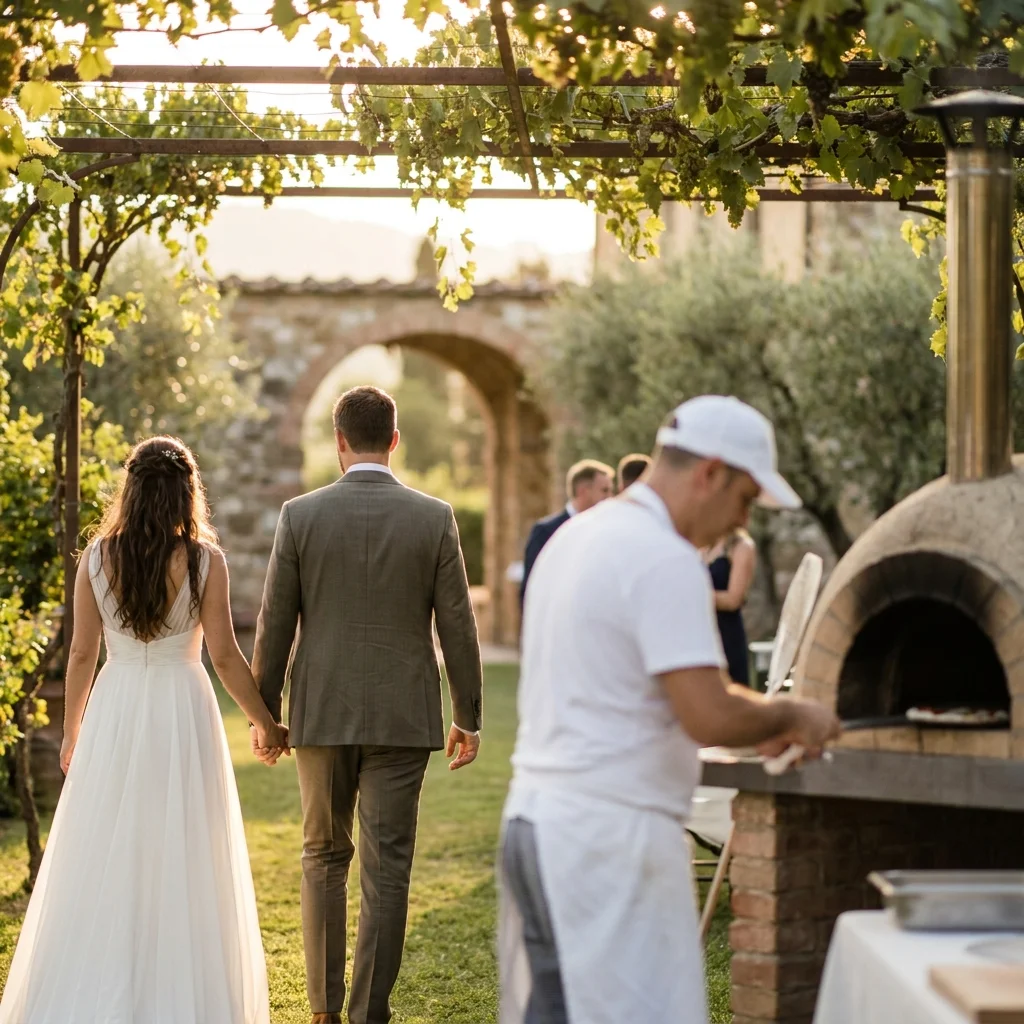
Each pizza station format carries a different operational footprint, and that footprint determines how much control you retain over the space. A stationary wood-fired oven—the kind already built into many Tuscan and Umbrian estate kitchens—offers the highest level of discretion. There is no vehicle arrival, no external branding, no logistical window during which staff are visible from outside the property. The oven is simply there, part of the architecture. Our team verifies its condition, arranges the pizzaiolo and ingredients, and manages the timing so that the first pizza emerges within minutes of guests arriving.
A mobile pizza truck is a different proposition entirely. It requires vehicle access, turning radius, a flat surface, and—critically—a power connection or generator. Generators produce noise. Noise carries. For estates surrounded by open countryside, this is manageable; for lakeside venues or Amalfi Coast properties where sound travels across water and rock, generator placement becomes a genuine privacy and comfort concern. We scout the vehicle route, confirm that no branded signage is visible from any guest area, and position the truck so that its operational side faces away from the celebration.
A chef-attended station—a portable setup with a compact oven brought in by the catering team—sits between these two extremes. It is quieter than a truck, more flexible than a permanent oven, and can be placed within a courtyard, a garden, or under a pergola with minimal visual disruption. For couples holding a welcome dinner pizza party in Italy, this is often the format we recommend, because it allows the pizzaiolo to interact with guests while our team maintains full access control around the perimeter.
What a Wedding Pizza Station in Italy Actually Costs: Three Formats Compared
Online forums cite numbers ranging from €45 per person to €3,600 flat for 80 guests. These are client-reported figures, and they vary enormously because they rarely specify what is included. The table below reflects the ranges we encounter when coordinating pizza stations across Tuscany, Umbria, the Italian Lakes, and Rome.
| Format | Guest Range | Indicative Cost | Included | Quoted Separately |
|---|---|---|---|---|
| Stationary wood-fired oven (venue’s own) | 40–80 | €1,800–€4,900+ | Pizzaiolo (4–5 hrs), dough prep, 4–6 pizza varieties, basic garnish station, cleanup | Premium ingredients (burrata, truffle), additional hours, staffing beyond 1 pizzaiolo, VAT (IVA 22%) |
| Mobile pizza truck | 60–120 | €2,800–€8,500+ | Truck delivery and positioning, 1–2 pizzaioli, fuel/gas, 5–8 pizza varieties, paper/plate service | Generator rental if needed, branded signage removal, travel beyond 50 km from base, luxury plating/styling, VAT (IVA 22%) |
| Chef-attended portable station | 40–100 | €3,500–€7,500+ | Portable oven transport, 1 pizzaiolo, dough prep on-site, 4–8 varieties, service coordination with caterer | Dedicated service staff, floral/styling around station, gelato cart add-on, travel/accommodation for chef if sourced from another region, VAT (IVA 22%) |
Indicative ranges based on 2024–2026 coordination. Contact Kiss Me Italy for a personalized proposal reflecting your venue, guest count, and weekend structure.

Welcome Night vs. Day-After Pool Party: Where a Pizza Station Fits Without Competing With Your Reception
Timing is a design decision, not just a logistical one. A pizza party on the welcome night sets a tone of warmth and informality before the ceremony. Guests arrive from airports and train stations; they are tired, hungry, and often meeting each other for the first time. A protected courtyard with a wood-fired oven, good wine, and no formal seating plan is one of the most effective ways to build the social ease that carries through the rest of the weekend. We coordinate arrival windows with our broader menu planning so that the pizza station opens only when a critical mass of guests has arrived—typically between 19:30 and 20:00 in summer, slightly earlier in October.
A day-after pizza session operates differently. The energy is quieter. Guests are recovering. The setting might be a pool terrace, a garden, or a shaded loggia. Here, a pizza truck wedding Italy format works well because the truck itself becomes a visual anchor—something for guests to gather around without the formality of a seated meal. We pair it with a gelato cart if the couple wishes, creating a self-contained food moment that requires no host duties from the newlyweds.
What we quietly discourage is placing a pizza station during the main reception itself. Not because it lacks elegance—it can be beautifully styled—but because it introduces a second service rhythm that competes with the seated dinner. The traditional Italian wedding meal already has its own architecture: antipasti, primi, secondi, dolci. A pizza station inserted into that sequence disrupts the kitchen’s timing and divides guest attention. Our recommendation: keep the pizza for the bookend events, where it can be the star.
The Venue Restrictions That Shape Your Pizza Station Before You Choose a Menu

Before a single ingredient is ordered, we verify four operational realities with the venue. These are the constraints that most couples—and, frankly, many planners—discover too late.
Fire regulations. Open flame inside or adjacent to a historic building is regulated by local fire codes. Some Tuscan estates built before 1700 have restrictions on any open flame within 10 meters of the main structure. A portable wood-fired oven may require a fire-safety declaration (SCIA) filed with the local Vigili del Fuoco. We manage this filing, but it requires 15–30 days’ lead time.
Electrical capacity. A mobile pizza truck with an electric oven draws 15–20 kW. Many rural Italian venues have a total supply of 30–50 kW, shared across lighting, sound, catering kitchen, and climate control. Plugging in a pizza truck without confirming capacity can trip the main breaker during the reception. We request the venue’s electrical plan during the initial site visit and, if necessary, arrange a dedicated generator positioned where its hum will not reach the guest area.
Vehicle access and surface. A pizza truck weighing 3.5 tonnes needs a paved or compacted-gravel surface and a turning radius of at least 8 meters. Gravel driveways at hillside Italian villa properties are often narrower than they appear in photographs. We measure.
Smoke and ventilation. Wood-fired ovens produce smoke, particularly during the initial firing phase. If the oven faces a terrace where guests are seated, the first 20 minutes of operation will be unpleasant. We schedule the firing to begin 45–60 minutes before guest arrival, so the oven reaches optimal temperature and the heavy smoke phase is complete before anyone is present.
Designed Informality vs. Genuinely Casual: Why the Styling of a Pizza Station Matters More Than the Pizza

This is the section where the tone shifts, because it needs to be direct. A pizza station that looks like a catering afterthought—folding table, paper plates, a stack of napkins—will undermine every other design decision you have made for the weekend. It does not matter how excellent the pizza is. The visual impression registers before the first bite.
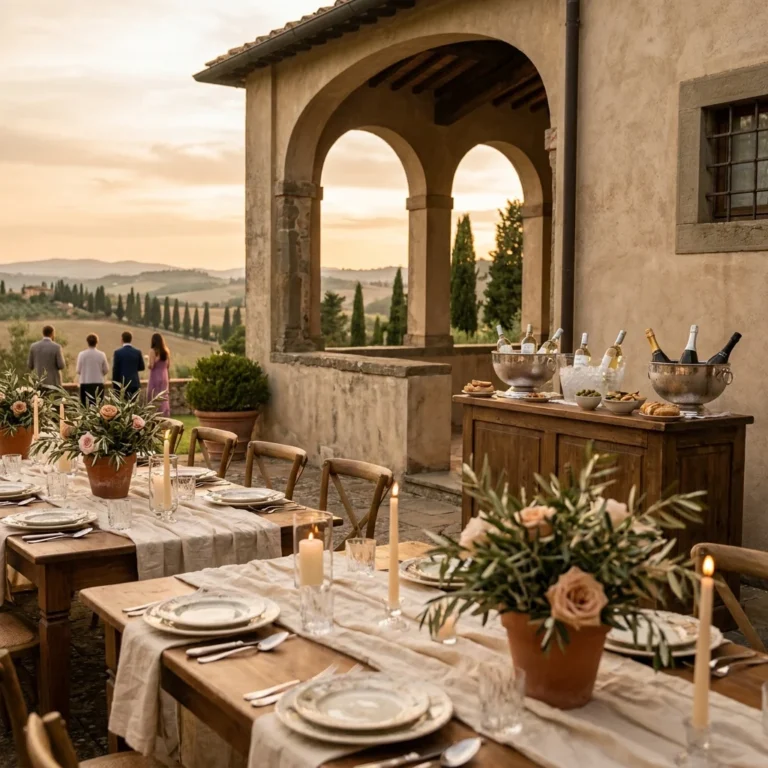
We approach every Italian wedding food station as a designed moment. The station itself is styled: linen runners, ceramic plates sourced from the region, olive-wood boards, hand-lettered menu cards. The pizzaiolo wears a clean, pressed uniform—not a branded polo from the catering company. Lighting is considered: if the pizza station operates after sunset, we install warm downlights or lanterns that match the broader lighting design. The area is defined—by planters, by a low hedge, by a change in flooring material—so that it reads as an intentional space, not a service corridor.
This is not decoration for its own sake. It is access control through design. When a space looks curated, guests instinctively treat it with a certain formality. They linger, they photograph the food rather than each other, and they remain within the defined area. This makes our security team’s work considerably easier, because guest movement becomes predictable. For high-profile couples who have chosen a luxury venue in Italy, maintaining this visual coherence across every touchpoint—including the most informal ones—is not optional.
Tuscany and Umbria vs. the Italian Lakes vs. Rome: How Region Affects Your Pizza Station Options
Geography shapes everything. In Tuscany, many estates already have functioning wood-fired ovens—some centuries old, some recently restored. This is a genuine advantage: no truck, no transport, no generator. The pizzaiolo arrives with ingredients and begins. Umbria offers similar infrastructure at a lower venue cost, though the pool of experienced wedding-specific pizzaioli is smaller, which means booking 4–6 months ahead is essential.
At the Italian Lakes—Como, Garda, Maggiore—the picture changes. Lakeside venues are often vertical: terraces stacked on hillsides, accessed by narrow staircases. A pizza truck may simply not fit. A portable station carried in by hand is more realistic, but it limits oven size and therefore output. For a Lake Como wedding with 100 guests, we typically recommend two smaller portable ovens rather than one large one, operated by two pizzaioli working in parallel, to maintain flow without bottlenecks.
Rome offers the widest vendor pool and the most flexible logistics. Pizza trucks can navigate urban and suburban roads easily, and the tradition of Roman-style pizza (thinner, crispier, cut with scissors) adds a regional character that guests from abroad find memorable. The challenge in Rome is not logistics but noise ordinances: many venues within the GRA (the city’s ring road) enforce strict sound curfews after 23:00, which means a late-night pizza station must operate without a generator.
Adding a Gelato Cart: When It Elevates the Moment and When It Complicates It

A gelato cart wedding Italy pairing is one of the most requested additions to a pizza station, and when executed correctly, it creates a second focal point that extends the event’s duration naturally. Guests finish their pizza, drift toward the gelato cart, and the evening gains another 30–45 minutes of relaxed energy without any formal programming.
The operational reality: a gelato cart requires either a freezer unit (drawing 2–3 kW) or dry ice, which must be replenished every 90 minutes. If the cart is positioned outdoors in July or August, ambient temperatures above 30°C accelerate melt rates and reduce the window during which the gelato presents well. We schedule gelato service to begin no earlier than 21:00 in summer, when temperatures drop, and position the cart in shade or under a canopy.
| Add-On | Indicative Cost (40–80 guests) | Included | Quoted Separately |
|---|---|---|---|
| Artisan gelato cart (6–8 flavours) | €800–€2,200 | Cart rental, gelato production, 1 server, 2-hour service window | Premium flavours (saffron, pistachio di Bronte), extended service hours, cart styling/floral, travel beyond 30 km, VAT (IVA 22%) |
| Limoncello or amaro station | €400–€1,000 | Selection of 3–4 digestivi, glassware, 1 bartender, 1.5-hour service | Rare or vintage spirits, custom glassware, additional bartenders, VAT (IVA 22%) |
| Late-night pizza reprise (post-dancing) | €1,200–€2,800 | Reheating/refiring of oven, 2-hour service, 3–4 pizza varieties, cleanup | Additional pizzaiolo, premium toppings, extended hours past midnight, VAT (IVA 22%) |
Indicative ranges. Contact Kiss Me Italy for a tailored quote based on your venue, season, and guest count.
The Guest List Protocols That Prevent Unwanted Attention at Informal Events
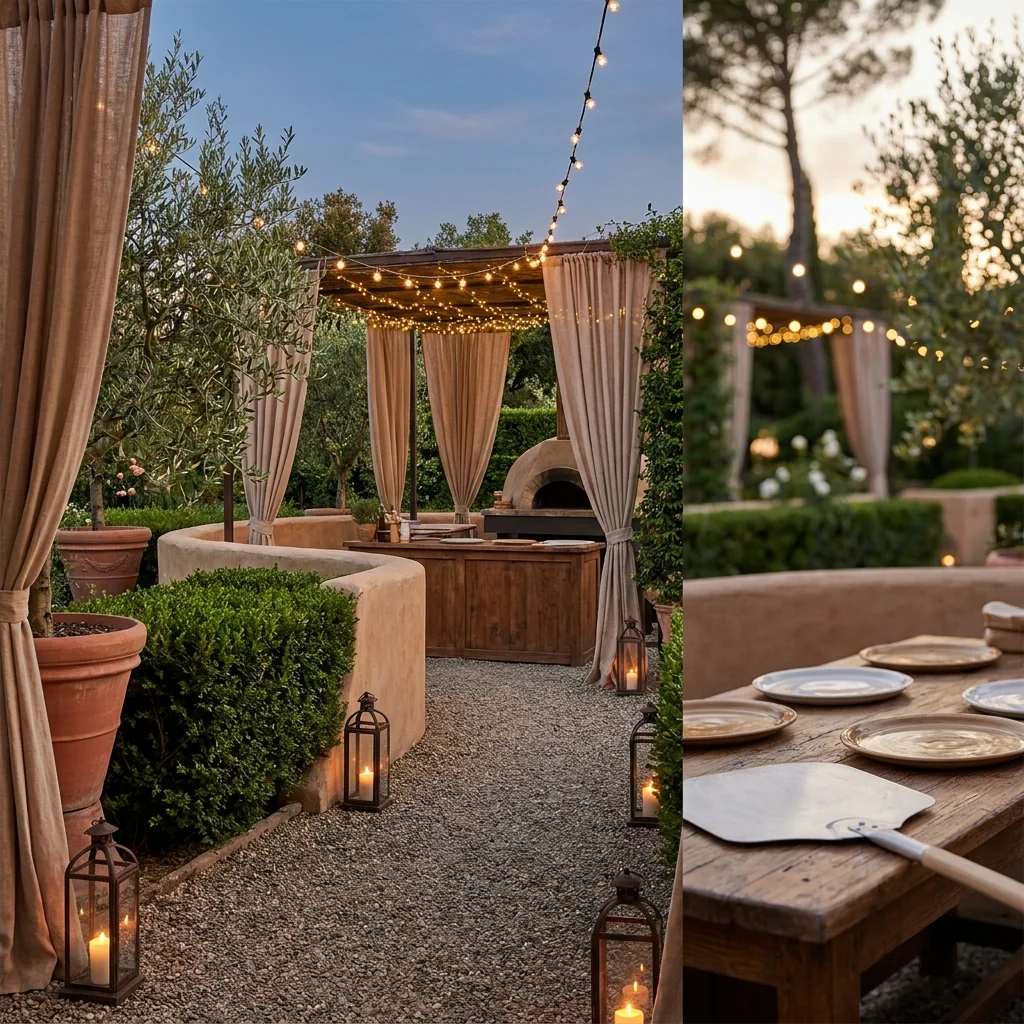
Formal seated dinners have a natural access-control mechanism: assigned seats, a defined room, staff positioned at entries. A pizza station—by design—is open, fluid, and relaxed. This is precisely why it requires more deliberate guest management, not less.
For high-profile couples, we implement what we call a soft perimeter. The pizza station area is bounded by design elements—hedges, planters, fabric screens—that appear decorative but function as sightline barriers. Staff positioned at natural entry points (a garden gate, a terrace staircase) are briefed to recognize every guest by face or by a discreet identification element—a wristband in the wedding’s colour palette, for example—that is distributed at check-in earlier in the day.
Photography protocol is equally important. We coordinate with the couple’s photographer to ensure that informal shots at the pizza station do not include identifiable backgrounds (street names, neighbouring properties, recognizable landmarks that could reveal the venue’s location). For clients who require it, we arrange a brief social-media delay: the couple’s guests are quietly asked to hold any posts until a specific time, giving the couple control over what appears online and when. This is a confidential conversation we have with each guest individually, never announced to the group.
These measures are invisible to most guests. That is the point. The evening feels effortless and warm. The protection is there, but it never announces itself. If you are planning a bespoke celebration where discretion is non-negotiable, this layer of coordination is what separates a managed experience from a catered event.
The Coordination Timeline Most Couples Don’t See: 6 Months to 48 Hours Before Service
Six months out, we confirm the pizza station format based on the venue’s infrastructure report. If a mobile truck is required, we reserve the vendor and lock the date—high-season weekends in Tuscany and the Lakes sell out by February for the following summer.
Three months out, we conduct a site visit with the pizzaiolo or truck operator. We measure access routes, confirm electrical capacity, and identify the optimal position for the station relative to guest flow, wind direction (smoke management), and lighting design. At this stage, we also finalize the menu—typically 4–8 pizza varieties plus any add-ons—and arrange a tasting if the couple is in Italy.
One month out, we confirm the fire-safety filing (if applicable), finalize the service timeline with the broader catering team, and brief our on-site coordinator on the guest list protocol for the pizza event specifically.
Forty-eight hours before service, the pizzaiolo receives the final guest count and any last-minute dietary requirements. Our team confirms generator delivery (if needed), lighting installation, and the arrival schedule for all vendors involved in the station. On the day itself, we fire the oven 60 minutes before guest arrival, conduct a final quality check on the first pizzas, and open the station only when everything—temperature, presentation, perimeter, lighting—is confirmed.
This timeline is why we encourage couples exploring a wedding in Italy to begin conversations about food stations early. The pizza itself is simple. The coordination around it is not.
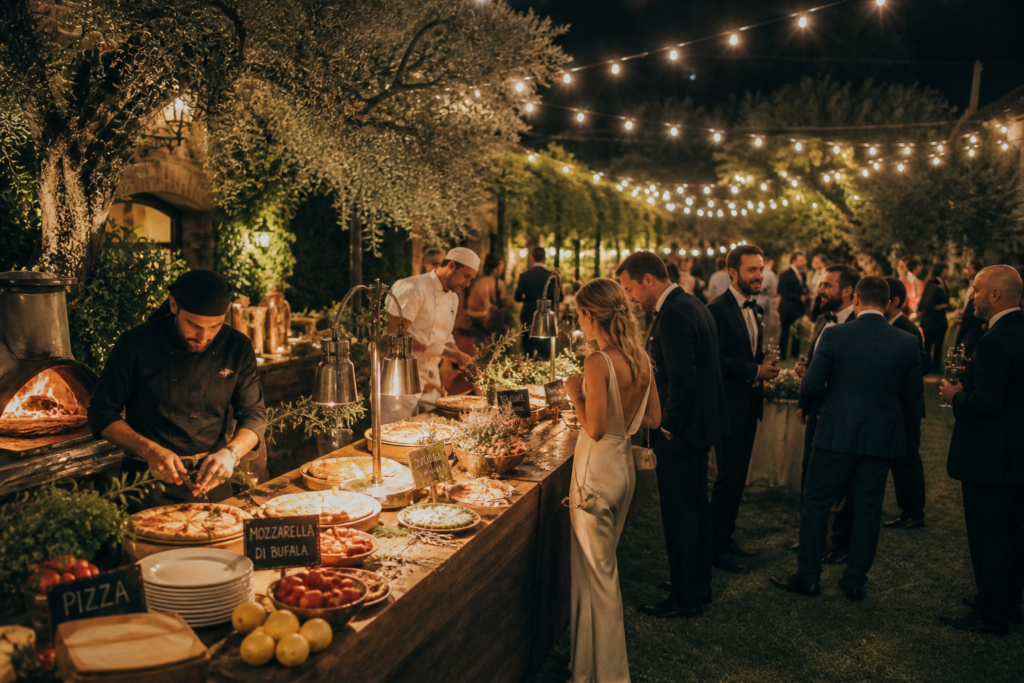
How We Work With Venues and Independent Caterers to Protect the Pizza Station Experience
Many Italian wedding venues have exclusive catering agreements. This means you cannot simply hire an external pizzaiolo and bring them onto the property. The venue’s contracted caterer must either provide the pizza service themselves or formally approve an external operator—a process that involves insurance verification, kitchen-access agreements, and sometimes a fee.
We navigate this on behalf of every couple. In some cases, the venue caterer’s pizza offering is excellent, and we simply refine the presentation and timing. In others, we negotiate a corkage-style arrangement that allows a specialist pizzaiolo to operate alongside the house caterer, with clear delineation of responsibilities. This negotiation is delicate—it involves the venue’s reputation, the caterer’s territorial instincts, and the couple’s expectations—and it is one of the areas where having a dedicated planning team makes the difference between a seamless evening and a logistical conflict that surfaces on the night.
For wedding planners and venues interested in collaborating with Kiss Me Italy on pizza station coordination for their own clients, we welcome direct conversation. Our approach is always to complement existing vendor relationships, not to replace them. Reach out to our team to discuss how we can support your upcoming events.
The Full Cost Architecture of a Pizza Party Wedding Weekend: What Forums Don’t Tell You
Client-reported figures on wedding forums—€75 per person, €3,600 for 80 guests, $4,000 for 40—are anecdotal and almost never include the full picture. They omit venue surcharges for external vendors, generator costs, styling, staffing, fire permits, and the 22% IVA that applies to all services in Italy.
Here is what a complete wedding pizza station Italy budget looks like when every line item is visible:
| Line Item | Typical Range | Notes |
|---|---|---|
| Pizza station (any format, 60–100 guests) | €2,200–€6,500 | See format table above for detail |
| Gelato cart add-on | €800–€2,200 | Optional; see add-on table |
| Generator rental + fuel | €300–€800 | Required only if venue lacks capacity; includes delivery and collection |
| Fire-safety filing (SCIA) | €150–€400 | Required for open flame near historic structures; N/A if using venue’s own oven |
| Venue external-vendor surcharge | €900–€1,500 | Varies by venue; some waive if caterer approves |
| Station styling (florals, ceramics, lighting) | €900–€3,000 | Coordinated with overall design; quoted by floral/décor team |
| Service staff (2–3 additional) | €900–€1,900 | For guest flow, plate clearing, beverage service at station |
| Travel/accommodation for pizzaiolo | €300–€900 | N/A if local; applies when sourcing from another region |
| VAT (IVA 22%) | Applied to all above | Always quoted separately in Italian vendor invoices |
| Photographer/videographer | N/A for station-specific | Typically covered under main wedding photography contract; confirm with your photographer |
All figures indicative and pre-VAT unless noted. Contact Kiss Me Italy for a consolidated quote that reflects your specific venue, region, and weekend structure.
The total cost of a well-executed pizza party within a luxury wedding weekend in Italy typically falls between €4,500 and €12,000 when all supporting elements are included. That range is wide because it encompasses everything from a simple welcome-night session using the venue’s own oven to a fully styled, truck-based pizza and gelato experience with dedicated staffing and security protocols.
Why the Most Relaxed Moment of Your Wedding Weekend Requires the Most Careful Coordination
A pizza station is, by nature, informal. That informality is its gift—it dissolves hierarchy, encourages conversation, and gives your guests a memory that feels distinctly, irreplaceably Italian. But informality without structure is chaos. And for high-profile couples, chaos is not an option.
At Kiss Me Italy, we treat the pizza station with the same precision we apply to the ceremony itself: venue verification, vendor negotiation, fire compliance, electrical planning, styling, guest flow, and—always—privacy. The result is an evening that feels effortless to everyone present, because every operational detail has been resolved long before the first oven is fired.
If you are considering a pizza party as part of your luxury Italian wedding, we would welcome the conversation. Reach out to our team to begin shaping the weekend your guests will remember.
Frequently Asked Questions About Wedding Pizza Stations in Italy
Can we request a specific regional pizza style (Neapolitan, Roman, Pugliese) regardless of where our venue is located?
Yes. We source pizzaioli by specialty, not only by proximity. A Neapolitan-trained pizzaiolo can travel to a Tuscan or Lake Como venue; the additional cost for travel and accommodation typically ranges from €300 to €600, quoted separately from the station fee. We arrange tastings in advance when possible so the couple can confirm the style meets their expectations.
Is it possible to have a pizza station at a venue that prohibits open flames?
It is. Electric pizza ovens—particularly high-end models that reach 450°C—produce results very close to wood-fired and eliminate all flame-related restrictions. The trade-off is a higher electrical draw (15–20 kW), which we verify against the venue’s capacity during the initial site visit. If needed, a silent generator can supplement the supply.
How many pizza varieties should we plan for a station serving 80–100 guests?
We typically recommend 5–6 varieties for this guest count: two classic (margherita, marinara), two seasonal (e.g., courgette flower in summer, porcini in autumn), one with premium ingredients (burrata, truffle), and one designed for dietary restrictions (gluten-free or vegan dough). This range provides enough choice without overwhelming the pizzaiolo’s production rhythm.
What happens if rain forces an outdoor pizza station to move indoors on the day?
Every pizza station we coordinate includes a documented rain contingency, finalized during the site visit. For portable ovens, we identify an indoor or covered alternative position with adequate ventilation. For pizza trucks, we confirm a covered parking area or arrange a rapid transition to the venue’s internal kitchen with pre-made dough ready for a conventional oven. The contingency is tested before the event day.
Can the pizza station operate past midnight without violating local noise ordinances?
The pizza station itself is quiet; the risk is the generator powering it. In municipalities with strict noise curfews—common in Rome, Florence, and lakeside towns—we either connect the oven to the venue’s mains supply or use a sound-insulated generator positioned at least 30 meters from the nearest residential boundary. We confirm the specific ordinance for your venue’s comune during the planning phase.
Do we need to inform the venue’s contracted caterer if we want an external pizza vendor?
Always. Most Italian wedding venues operate under exclusive or preferred catering agreements that require written approval before any external food vendor enters the property. We handle this negotiation directly with the venue and caterer, including insurance documentation and any surcharge that applies. Beginning this conversation at least four months before the event is essential.
Is it realistic to combine a pizza station with a full seated dinner on the same evening?
It is possible but rarely advisable for the main wedding evening. The two service formats compete for guest attention and kitchen resources. If you want both, we recommend placing the pizza station as a late-night reprise—after dancing begins, typically around 23:00—so it functions as a second act rather than a parallel one. This approach is popular and operationally clean.
How far in advance should we book a pizza station for a peak-season wedding in Italy?
For weddings between June and September in Tuscany, the Lakes, or the Amalfi Coast, we recommend confirming the pizza station vendor at least 5–6 months in advance. The best mobile pizza truck operators and specialist pizzaioli are booked on a first-confirmed basis, and peak-season Saturday evenings sell out earliest. Off-season weddings (October–April) offer more flexibility, with 2–3 months’ lead time usually sufficient.
Can Kiss Me Italy coordinate a pizza station for a wedding planned by another planner?
Yes. We regularly collaborate with independent wedding planners and venue coordinators who need specialist support for food-station logistics, vendor sourcing, or privacy management. Our role in these cases is clearly defined and complements the lead planner’s vision. Contact us to discuss how we can support your client’s event.
Keep exploring: Lake Como Elopement Photography: Curated Talent, Calm Direction, Beautiful Light.