
Wedding Officiant in Italy: How We Curate the Right Voice, Language & Ceremony Style for Your Celebration
A wedding officiant in Italy is the person who leads your ceremony — whether legally binding, symbolic, or both — and shapes the emotional arc that your guests will remember long after the last toast. Kiss Me Italy matches each couple with a curated officiant whose language fluency, ceremonial style, and vocal presence align with the wedding’s design, venue acoustics, and guest composition. Fees for a professional wedding celebrant in Italy typically range from €1,500 to €3,500, depending on ceremony type, language requirements, and travel — with legal civil ceremonies involving additional municipal costs quoted separately.
The question couples ask us most often is not “where do we find an officiant?” — it is “how do we know this person will feel right for our ceremony?” A script read aloud in a courtyard with limestone walls and sixty guests seated on linen-covered chairs demands a very different vocal register, pacing, and microphone strategy than a barefoot vow exchange on a Sardinian beach with twelve people standing in a semicircle. This is why we never assign an officiant from a roster. We listen to you first — your story, your languages, the atmosphere you want to inhabit — and then we present one or two celebrants whose sensibility, cadence, and warmth feel like a natural extension of the day we are designing together.
What Happens in the First Forty-Eight Hours After You Inquire About a Ceremony
When a couple reaches out to us, the initial conversation is rarely about flowers or table linens. It begins with the ceremony. Who will speak? In which language? Will it be legally recognised? These are the questions that carry the most emotional weight, and they arrive first.
Within forty-eight hours of your inquiry, our team sends a detailed questionnaire that covers ceremony vision, guest nationalities, language preferences, and any religious or cultural elements you wish to include. We ask whether you envision a bilingual wedding ceremony in Italy or a single-language celebration, because this choice affects everything from script structure to the officiant’s delivery rhythm. A ceremony conducted in English and Italian, for instance, requires a celebrant who can shift between languages without losing emotional continuity — not simply someone who translates line by line.
We also clarify the legal framework immediately. Italy recognises three ceremony categories: civil, religious, and symbolic. A civil ceremony in Italy is performed by a municipal official at the town hall or, in some comuni, at an approved external venue. A symbolic wedding ceremony in Italy carries no legal weight but offers complete creative freedom — and is the choice most of our international couples make, completing legal paperwork in their home country or at the Italian consulate beforehand. Understanding this distinction early shapes every decision that follows, from venue selection to the timeline of your planning. If you are exploring the legal requirements in depth, our guide on getting married in Italy as a foreigner walks through every document and deadline.
Why the Right Wedding Celebrant in Italy Is Not the One with the Best Reviews — It’s the One Who Matches Your Atmosphere
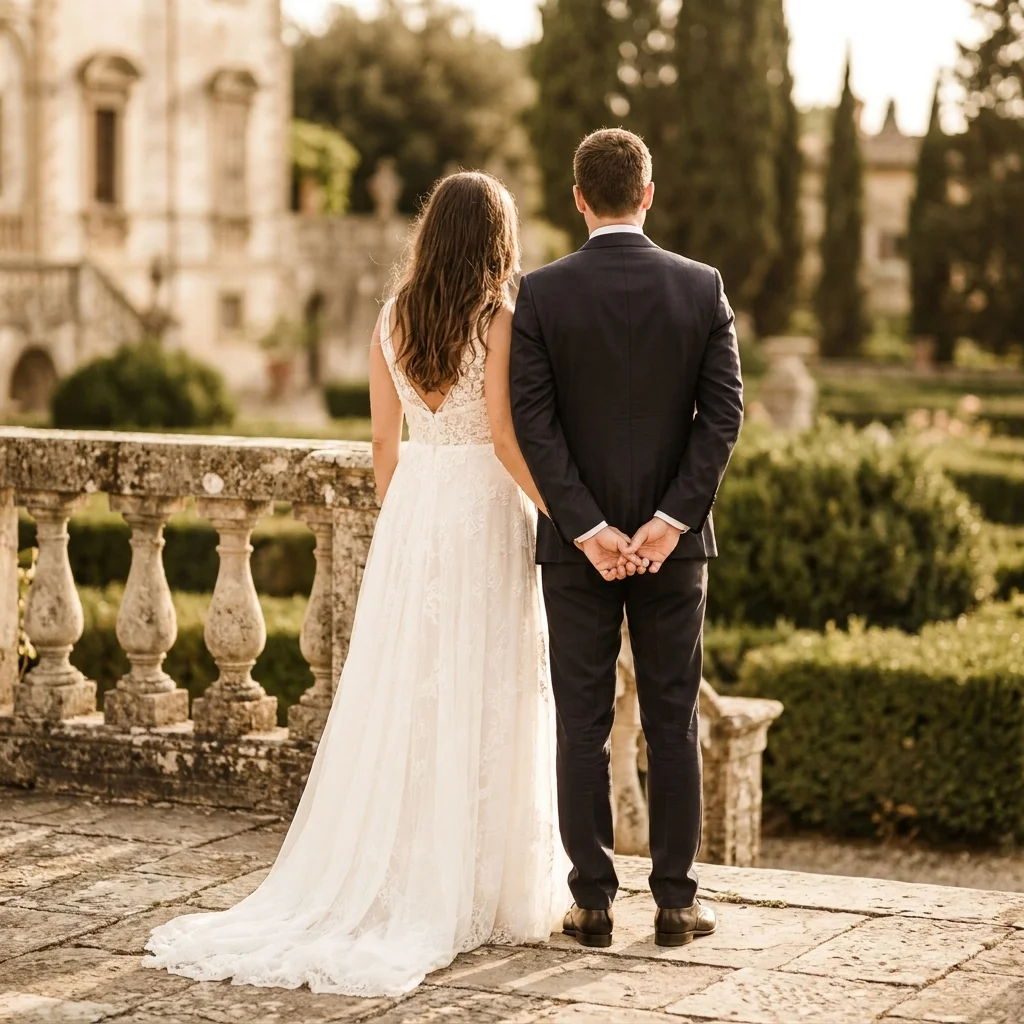
There is a particular shade of confidence that a well-matched officiant brings to a ceremony. You feel it in the way guests lean forward slightly, in the quality of the silence between sentences, in the laughter that arrives exactly when it should. That atmospheric precision is what we design for.
Our curation process begins with your venue’s physical character. A Renaissance chapel with a vaulted ceiling and stone floors produces a natural reverb that rewards a slower, more measured delivery. A terraced garden overlooking the sea, where wind is a constant companion, calls for a celebrant with a warm, projecting voice and an instinct for pausing when a gust passes. We have worked with officiants across every major Italian destination — from the salons of Venice to the olive groves of Tuscany and Versilia — and the match is never generic.
We present you with a shortlist of one or two celebrants, not twenty. Each comes with a recorded sample, a proposed ceremony outline, and a note from our team explaining why this voice suits your day. The couple approves before we proceed. This is a destination wedding officiant Italy service built on editorial judgment, not volume.
If your celebration is taking place on Lake Garda or along the Amalfi Coast, the officiant selection also accounts for regional acoustic conditions — lakeside venues carry sound differently than clifftop terraces, and we plan microphone placement accordingly.
The Permit and Legal Timeline That Shapes Everything — Especially for Civil Ceremonies Before June
This section is intentionally more technical. It needs to be.
Civil ceremonies in Italy require that both partners submit a Nulla Osta (certificate of no impediment) from their home country, translated and apostilled. This document must reach the Italian comune at least two months before the wedding date — but in practice, we advise four months for couples marrying between April and July, when municipal offices across Tuscany, Lake Como, and the Amalfi Coast are processing the highest volume of foreign marriage requests.
The banns (pubblicazioni) must be posted for at least eleven days. In some comuni, the civil registrar will officiate only at the town hall; in others, they will travel to an approved venue for an additional fee ranging from €300 to €1,000. We manage this entire administrative arc — from apostille verification to the final appointment with the registrar — so that you never interact with a municipal office directly.
For symbolic ceremonies, no permits are required from the state. However, many venues impose their own ceremony guidelines: maximum amplification levels, restrictions on open flame, start-time windows tied to sunset or neighbour agreements. A fifteenth-century estate south of Siena, for example, requires all outdoor amplified sound to end by 10:30 p.m. — a detail that affects not only the ceremony but the entire evening’s pacing. We build these constraints into the ceremony design from the start.
Couples considering a destination wedding in Italy often underestimate how much the legal and logistical framework shapes the creative possibilities. Our role is to absorb that complexity so the ceremony feels effortless.
What a Wedding Officiant in Italy Actually Costs — And What Falls Outside the Fee
Transparency matters. Below are the ranges we work within, drawn from our recent seasons. Every figure excludes IVA (22% VAT) unless stated otherwise.
| Ceremony Type | Indicative Fee Range | Included | Quoted Separately |
|---|---|---|---|
| Symbolic ceremony — single language | €900– €1,800 | Officiant fee; one pre-ceremony video call; personalised script drafting (up to two revisions); ceremony rehearsal (day before or morning of); travel within the region of the venue | Inter-regional travel and accommodation; sound system rental; printed ceremony booklets; VAT (22%) |
| Symbolic ceremony — bilingual (e.g. English/Italian, English/French) | €1,200 – €2,500 | All items above plus bilingual script adaptation; coordinated pacing for dual-language delivery | Third-language integration; simultaneous interpretation for guests; VAT (22%) |
| Civil ceremony — municipal officiant | €500– €1,000 (municipal fee) | Municipal registrar; legal certification; ceremony at town hall or approved venue (varies by comune) | Document preparation and apostille coordination (managed by Kiss Me Italy, quoted as part of planning fee); venue transfer fee if officiant travels off-site; VAT where applicable |
| Master of ceremonies — reception and transitions | €1,500 – €3,500 | MC presence from ceremony through final dance; coordination with DJ/band on cue sheets; guest introductions; bilingual announcements | After-party hosting beyond midnight; travel and accommodation outside venue region; VAT (22%) |
Indicative ranges. Contact Kiss Me Italy for a personalised proposal.
Note on travel & accommodation: When any officiant, MC, technician, or municipal registrar is required to travel outside their usual area, we quote transport, accommodation, and per-diem transparently in advance. Nothing is left to assumption.
| Add-On Service | Indicative Range | Notes |
|---|---|---|
| Professional sound system for outdoor ceremony (wireless lapel mic, speakers, mixing) | €600– €1,100 | Includes technician on-site; setup and soundcheck one hour before ceremony |
| Printed ceremony booklets (bilingual, 50–80 guests) | €500– €900 | Design, printing, assembly; delivery to venue day-of |
| Vow renewal ceremony — symbolic | €1,500– €3,000 | Script, officiant, rehearsal; legal paperwork not applicable |
Indicative ranges. Contact Kiss Me Italy for a personalised proposal.
Couples renewing their vows in Italy often choose a more intimate ceremony format — our vow renewal guide explores how we design these celebrations with the same attention to atmosphere and seasonal botanicals as a full wedding.
The Week Before Your Ceremony: Script Approval, Rehearsal Choreography & the Mic Strategy No One Mentions
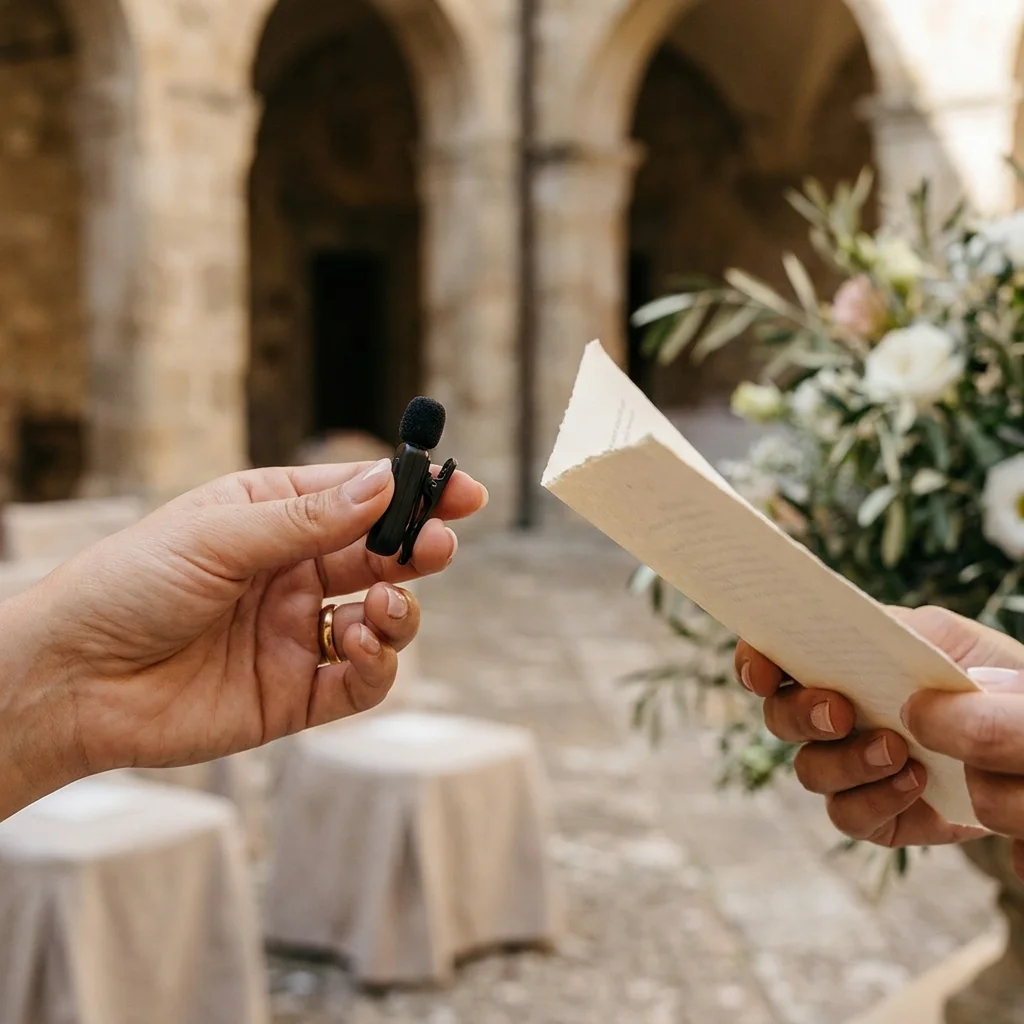
Seven days before the wedding, the ceremony script is finalised. By this point, it has passed through at least two rounds of revision — shaped by your personal stories, your preferred readings, and the specific emotional beats you want to land. We treat the script as a living document, not a template. The officiant’s voice, the venue’s acoustics, and the guest seating plan all inform the final draft.
The rehearsal typically takes place the day before the ceremony or the morning of, depending on venue access. It is not a formality. We walk the officiant through exact positions relative to the floral installation, test microphone levels at the precise hour the ceremony will begin (sound behaves differently at 4 p.m. than at 6 p.m., especially outdoors), and confirm sightlines for the photographer and videographer.
The microphone strategy deserves its own note. For ceremonies with fewer than forty guests in an enclosed courtyard, we often recommend no amplification at all — the natural resonance of stone carries the voice beautifully, and the absence of technology creates a tactile intimacy. For larger gatherings or open-air settings, a discreet wireless lapel mic paired with two low-profile speakers positioned behind the seating creates even coverage without the visual intrusion of a standing microphone. Our photography team coordinates with the sound technician to ensure cables and speakers remain invisible in editorial frames.
This level of choreography is what separates a ceremony that feels “nice” from one that feels designed. It is also why we encourage couples to reach out early — the best officiants in Italy book nine to twelve months ahead for peak-season dates between May and October.
Why Guest Comprehension Is the Most Overlooked Element of a Bilingual Wedding Ceremony in Italy

Imagine sixty guests seated in a lemon grove. Half speak English. A quarter speak Italian. The rest speak French or German. The officiant begins in English, and within three minutes, a third of your guests have drifted — not because the words are wrong, but because the pacing assumes everyone understands.
A bilingual wedding ceremony in Italy is not a translation exercise. It is a rhythm problem. We design ceremonies where language shifts feel like musical movements — a passage in English, then the same emotional beat echoed (not repeated verbatim) in Italian, with pauses that allow the meaning to land for everyone. The officiant knows which sentences to deliver in both languages and which to leave in one, trusting the emotion to carry across.
Printed ceremony booklets help. We design them as small, tactile objects — heavy cotton paper, a particular shade of ivory or sage that matches the day’s botanical palette — with the full text in both languages so that guests can follow along without feeling lost. These are not programmes; they are part of the sensory scenography of the ceremony.
For weddings with three or more languages, we sometimes position a discreet interpreter near a specific guest group rather than burdening the officiant with triple-language delivery. The atmosphere of the ceremony stays intimate. No one feels like they are attending a conference.
The menu planning phase later in the evening benefits from the same multilingual sensitivity — printed menus, staff briefings, allergen cards — and we coordinate both with the same editorial eye.
Master of Ceremonies vs Wedding Officiant: Why the Distinction Matters After the Vows
The officiant’s role ends — or should end — after the ceremony. What follows is a different discipline entirely. The master of ceremonies at a wedding in Italy manages transitions: the move from ceremony to aperitivo, the entrance to the dining room, toasts, cake cutting, first dance cues. This person is part host, part stage manager, part translator.
We often recommend that the MC be a different person from the officiant. The emotional register of a ceremony — reverent, intimate, slow — is fundamentally different from the energy required to guide 120 guests through a five-hour Italian dinner with live music and spontaneous toasts. A great officiant is not always a great MC. We cast both roles with the same care.
For couples hosting celebrations that extend into the late evening — particularly at Italian villas where the after-party moves to a different wing or terrace — the MC’s presence ensures that no transition feels awkward, no guest is left wondering what happens next. The pricing table above reflects this as a distinct service because it is one.
How Seasonal Mediterranean Botanicals Shape the Ceremony Space Your Officiant Stands In
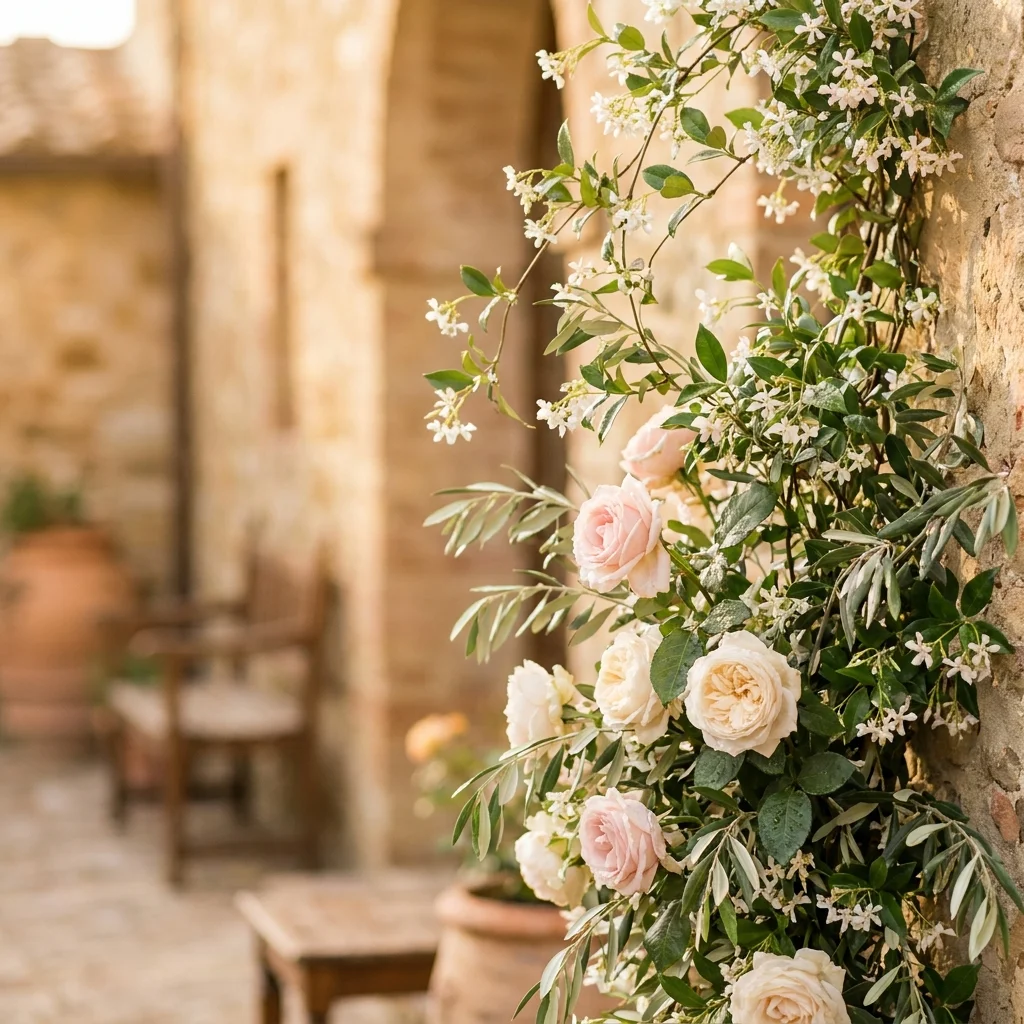
In our ceremony design, we never separate the officiant from the space they inhabit. The arch, the altar table, the aisle — these are not decorations. They are the frame through which your guests perceive the vows, and that frame must feel alive.
In late May, I work with foraged jasmine and early garden roses — their scent is warm, almost honeyed, and it drifts naturally in the still air of a Tuscan courtyard just before sunset. By September, the palette shifts: dried grasses with a particular shade of amber, late-season dahlias in burnt sienna, olive branches heavy with unripe fruit. The texture changes too — from the soft, yielding petals of spring to the architectural, almost sculptural quality of autumn arrangements.
The officiant stands within this composition. The light catches the foliage behind them. The botanical installation frames their silhouette for the photographer. This is our design approach: every element in the ceremony space is designed as a single, coherent sensory experience — the voice, the scent, the colour, the texture of the air itself.
Couples drawn to this level of seasonal integration often find that our Tuscan venue guide helps them understand how landscape and light shift across the calendar, which in turn shapes the ceremony’s entire visual identity.
After the Last Word: What Happens to Your Ceremony Script, Legal Documents & Officiant Coordination Post-Event
The ceremony ends. The applause fades. What remains?
For civil ceremonies, the signed marriage certificate is filed with the comune and typically available as an official copy within two to four weeks. We coordinate the apostille process for couples who need the document recognised in their home country — a step that involves the local Prefettura and, for some nationalities, consular legalisation.
For symbolic ceremonies, we deliver a beautifully formatted copy of the final script — printed on the same paper stock used for the ceremony booklets, signed by the officiant and, if you wish, by your witnesses. Many couples frame it. Some read it aloud on anniversaries.
The officiant’s work is complete, but our coordination continues. The planning team manages vendor settlement, venue walk-throughs, and any post-event logistics so that you leave Italy with nothing to organise and everything to remember.
For couples considering a vow renewal on Lake Garda or a celebration on Lake Como, the post-ceremony process is simpler — no legal filings — but the keepsake script and coordination remain part of our service.
Why the Region You Choose in Italy Changes Which Officiant We Recommend
Italy is not one country when it comes to weddings. It is twenty regions, each with distinct acoustics, light, and ceremonial traditions. A wedding officiant in Italy who thrives in the intimate stone chapels of Umbria may feel entirely wrong for a glittering palazzo ceremony in Venice.
In Liguria — particularly along the coast near Portofino — ceremonies are often held on terraces where the sea is both backdrop and soundtrack. We choose officiants who can work with ambient sound rather than against it, whose delivery has a natural warmth that doesn’t compete with waves.
In the Dolomites, the challenge is different. Mountain weddings at altitude involve thinner air, unpredictable wind, and a visual grandeur that can dwarf a ceremony if the human element isn’t calibrated. Here, we favour officiants with a grounded, resonant presence — someone whose voice anchors the vastness rather than getting lost in it.
In Florence, the architectural density of the city means that even outdoor ceremonies feel enclosed, theatrical. The officiant can afford a more intimate, conversational tone — and the venue options in Florence reward that approach beautifully.
The Ceremony Is the Wedding — Everything Else Is Celebration
I say this to every couple: the reception is magnificent, the flowers are breathtaking, the food is extraordinary. But the ceremony is the moment you became married. It deserves the same design intelligence, the same seasonal sensitivity, the same obsessive attention to atmosphere that we bring to every other element.
When you work with Kiss Me Italy, you are not hiring a wedding officiant in Italy from a directory. You are entrusting us with the most important twenty minutes of your day — and we design those minutes the way we design everything: with botanical precision, sensory depth, and the quiet confidence that comes from having done this beautifully, many times, across every corner of this extraordinary country.
Begin a conversation with our team whenever you are ready. We are here.
Frequently Asked Questions About Hiring a Wedding Officiant in Italy
Can we write our own vows and have the officiant incorporate them, or must we use the officiant’s script?
Absolutely — personal vows are woven into the ceremony script during the drafting phase. Your officiant will help you refine length and pacing so that the vows feel natural within the ceremony’s overall rhythm, typically recommending each set of vows stay between ninety seconds and three minutes for emotional impact.
Kiss Me Italy maintains a curated backup network for every region. If an officiant cannot attend, we activate a replacement who has already been briefed on your ceremony script, language requirements, and venue logistics — ensuring continuity without compromising the atmosphere you designed together.
Is it possible to have a legally binding ceremony at our chosen venue rather than at the town hall?
Some Italian comuni permit the civil registrar to officiate at approved external venues for an additional municipal fee (typically €300–€1,000). However, not all venues hold this approval, and the process varies significantly by region. We verify venue eligibility during the initial planning phase and advise on alternatives if needed.
Can we have a symbolic ceremony on-site and complete the legal marriage on a different day in Italy?
Yes — many international couples separate the emotional ceremony from the legal act. You can host a symbolic ceremony at your venue (with complete creative freedom), and complete the civil marriage either at the town hall on a different day or in your home country before/after Italy. Kiss Me Italy advises on the cleanest sequence for your nationality and timeline, and we design the wedding-day ceremony so it never feels like a ‘second-best’ option — it feels like the main event.
Can we include a religious reading or blessing in a symbolic ceremony without it becoming a religious wedding?
Yes. A symbolic ceremony is entirely flexible in content. Many couples include a scripture passage, a prayer, or a blessing from a family member alongside secular elements. The ceremony remains non-denominational and carries no legal or canonical obligations — it is simply a reflection of what matters to you.
Do you coordinate the officiant with the musicians and photographer, or do we need to manage that ourselves?
All vendor coordination is managed by our team. We create a detailed ceremony run sheet — including music cues, processional timing, photographer positions, and microphone handoffs — and distribute it to every vendor involved. The couple and their families simply arrive and experience the moment.
Are there noise or time restrictions for outdoor ceremonies in Italy that could affect our officiant’s delivery?
Many Italian venues and municipalities impose amplified sound limits, particularly after 10:00 or 10:30 p.m. Some historic properties restrict ceremony start times to specific windows. We identify these constraints during venue selection and design the ceremony timeline around them, so the officiant’s delivery is never compromised by last-minute adjustments.
What is the difference between a wedding officiant and a master of ceremonies, and do we need both?
The officiant leads the ceremony itself — vows, readings, ring exchange, pronouncement. The master of ceremonies manages the reception: guest flow, toasts, music transitions, announcements. For weddings with more than sixty guests or multilingual audiences, we strongly recommend both roles, each filled by a specialist whose energy suits the moment they are leading.
Can a family member or friend officiate our symbolic ceremony in Italy instead of a professional?
For symbolic ceremonies, a loved one can technically lead the moment — but for a luxury destination wedding, we strongly recommend a professional celebrant. The ceremony is the emotional anchor of the day, and delivery, pacing, and multilingual clarity are not areas to improvise. Kiss Me Italy curates an experienced officiant whose presence matches your venue, guest mix, and ceremony style, and we manage the full run-of-show so the result feels effortless and elevated.
Is VAT included in the officiant fees, and are there any additional taxes we should expect?
All officiant fee ranges quoted by Kiss Me Italy exclude IVA (Italian VAT at 22%), which is added to the final invoice. Municipal fees for civil ceremonies may or may not include VAT depending on the comune. We provide a fully transparent cost breakdown — including all applicable taxes — before any commitment is made.
When you are ready to plan it for real, explore our proposal packages in Italy.